
D03 (Atlantic)
R323 (Pacific)
ATLANTIC 19445
Builder: Seattle-Tacoma Shipbuilding Co. Tacoma, Washington.
Displacement: 15,390 tons
Length (Overall): 494ft 9in
Beam: 69ft 6in
Draught: 16 ft
Flight deck: 450ft x 80ft wood covered mild steel plate
Propulsion: 2 Foster Wheeler boilers; 1 x Allis-Chalmers geared turbine driving 1 shaft
Speed: 18 knots
A/C Capacity: 20
Hangar: 260ft x 62ft x 18ft
A/C lifts: 2, Aft 34ft long x 42ft wide; forward 42ft long x 34ft wide
Arrestor wires: 9 with 3 barriers
Catapult: 1 H4C hydraulic
Armament: 2 single 5in USN Mk 12, 8 twin 40mm Bofors, 14 twin 20rnm Oerlikon, 7 single 20mm Oerlikon
Crew Complement: 646
Cdr. R. O. Yeomans RNR Sep - Oct43
A/Capt. J. S. Metcalf RN Oct 43- Apr 44
A/Capt. A. A. Murray RN Apr 44 - Jan 45
A/Capt. J. A. W. Tothill RN Jan 45- Nov 46
768 (DLT)
Nov 44 - Jan 45
Barracuda & Mixed A/C types
1846 (Ferry)
Oct- 44 - Nov 44
Corsair IV
1848 (Ferry)
Oct- 44 - Nov 44
Corsair IV
None
None

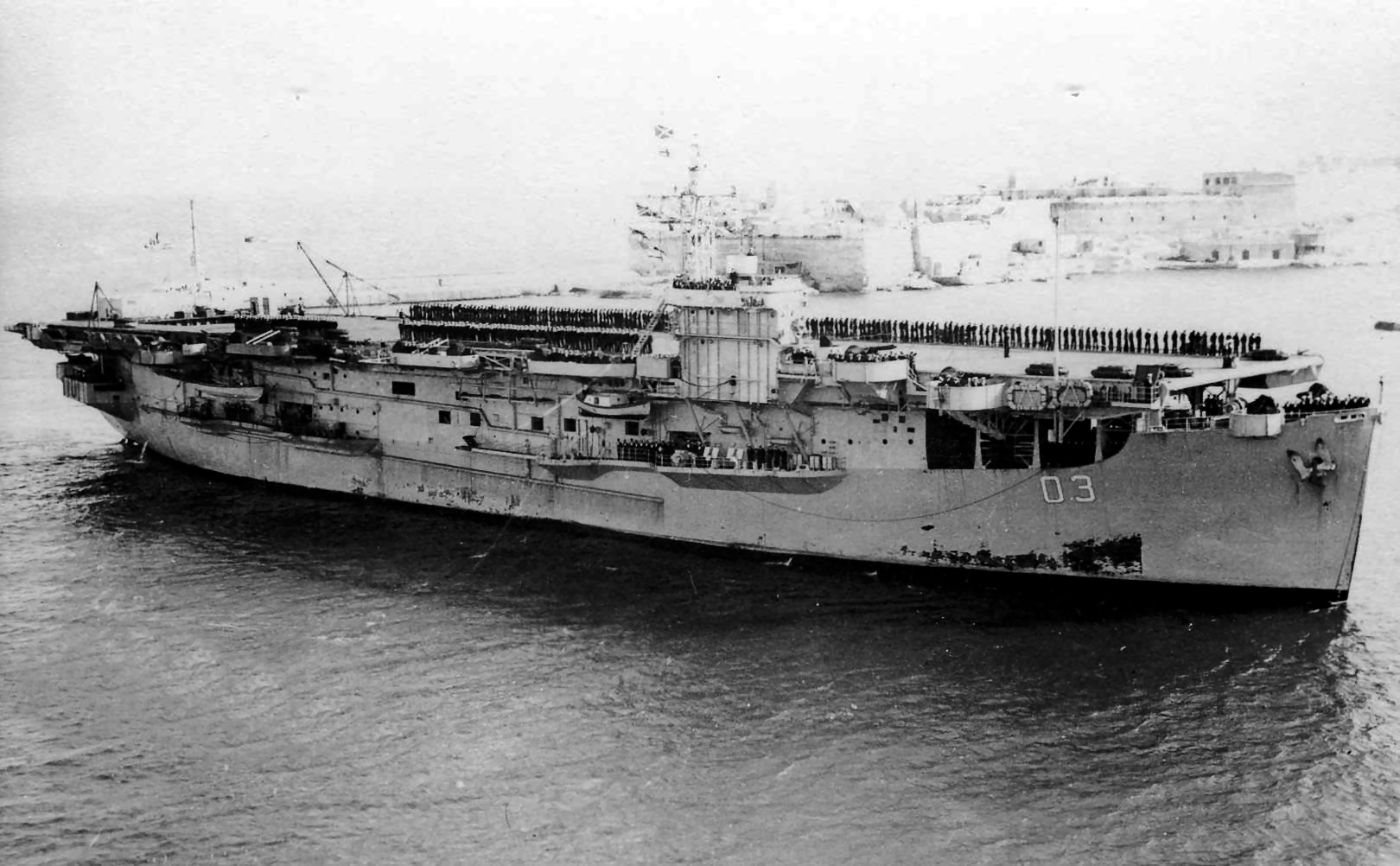
HMS RANEE entering Valletta harbour December 1945 outward bound on her first trooping voyage.
HMS RANEE was an 'Ameer' class escort carrier, her keel was laid down on January 5th 1943, at Seattle-Tacoma Shipbuilding Co. Tacoma, Washington, a C3-S-A1 type freighter Maritime Commission hull number 257, Seattle-Tacoma hull number 41. The hull was purchased by the US navy to become the auxiliary aircraft carrier USS NIANTIC AVG-46, a 'Prince William' class escort carrier.
Whilst still under construction it had been decided that AVG-46 was to be transferred to the Admiralty on loan on her completion as an aircraft carrier. AVG-46 was launched on June 2nd 1943 by her sponsor Mrs. Ray V. Blanco. On July 15th 1943 her US Navy designation was changed to CVE-46.
CVE-46 was delivered to the US Navy on November 8th 1943 and was transferred to the United Kingdom under the lend-lease scheme the same day, and commissioned into RN service as HMS RANEE (D03), Captain J. S. Metcalf RN in command. Her build had taken a total of 307 days, 148 on the ways and 159 days afloat fitting out.
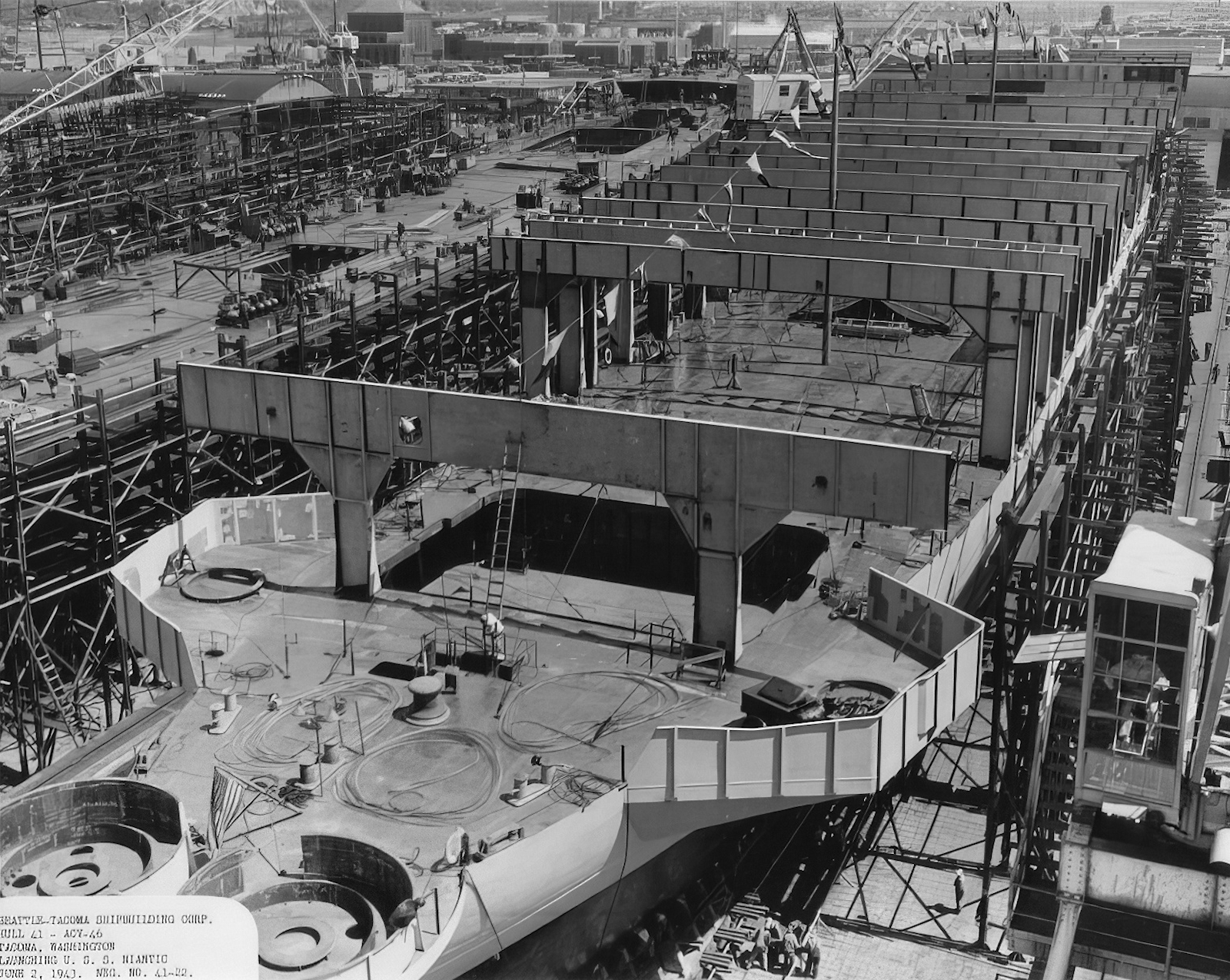
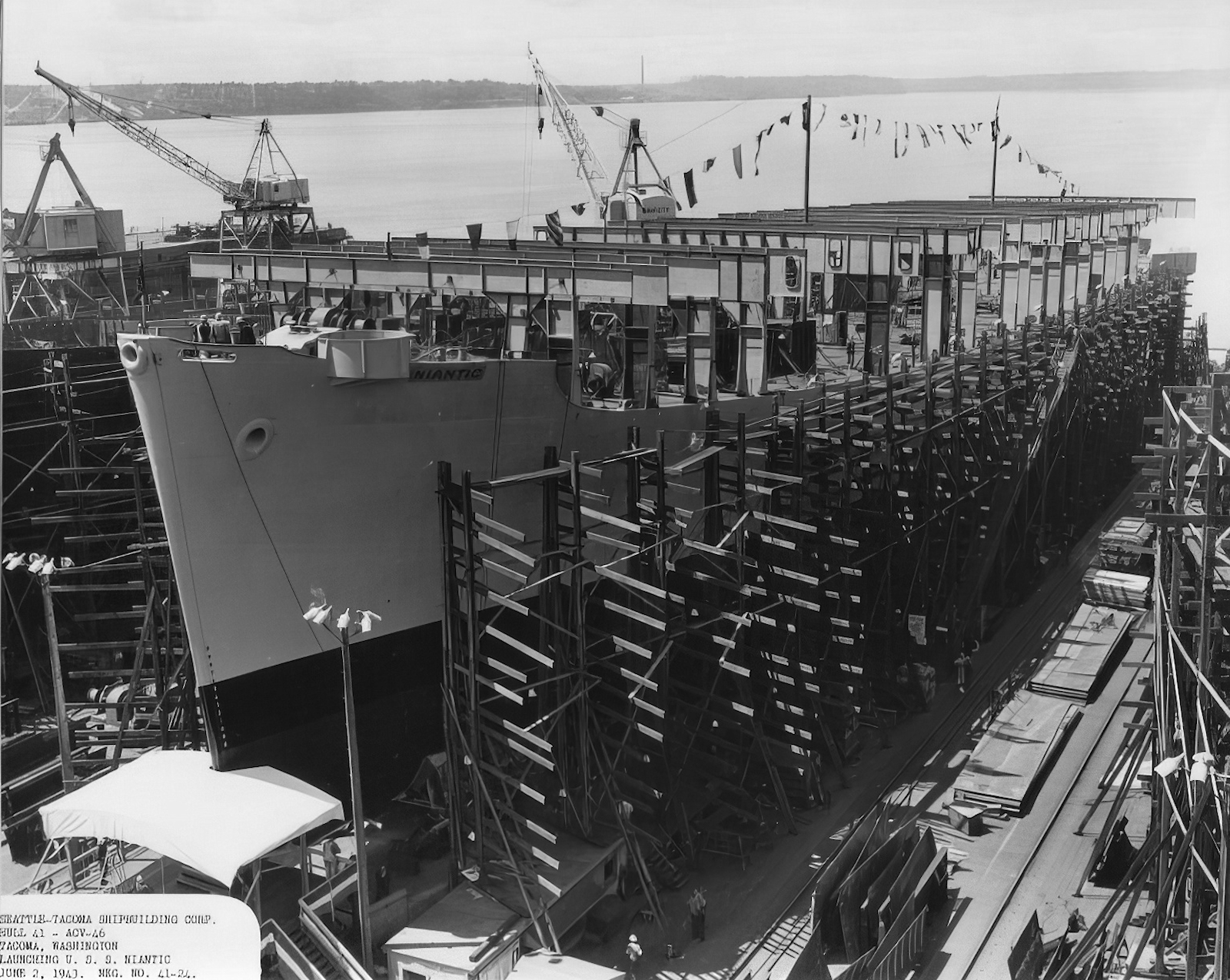
On completion of defect rectification following her builder's sea trials RANEE sailed for Vancouver Island, British Colombia, arriving there on November 19th. She was one of 19 escort carriers sent there to be modified to meet Admiralty requirements by the Burrard Dry Dock Co. Ltd., North Vancouver, British Columbia. However it had been decided by the Admiralty that in order to address a shortage in aircraft deliveries to India, the CVEs RANEE and PATROLLER were not to enter Burrard's yard for the full modification work. Instead, the two carriers were to receive the minimum alterations required to bring them to operational status for ferrying purposes. A reduced crew joined RANEE at Vancouver, her air department was to comprise of only an Air Engineering officer and 10 ratings - all that was required for the ferry role. The remainder of her air department, flight deck crews etc would be drafted in when she was to begin flight operations.
RANEE was to spend the next two months at Vancouver completing a work-up, storing the ship, and familiarising the crew in preparation for ferry duties. On January 26th 1944 while operating in the Georgia Strait, between Vancouver Island and the Pacific coast of British Columbia, RANEE was called upon to offer assistance to her sister CVE
HMS NABOB. She was taking advantage of the aircraft of 850 squadron based at RCAF Sea Island, and had arranged a day of flight operations to put the ship through its paces. While steaming at speed into wind to receive aircraft
NABOB had run aground on an uncharted sand bar and stuck fast. RANEE stood by in case a tow could be rigged in an attempt to pull her off. Two attempts were made to pull
NABOB free, the first at high water in the forenoon with RANEE secured astern, HMCS ARMENTIERES on the starboard and HMCS HARO on the port side; the operation was a failure. A second attempt was made at 18:10 when the tide was again high.
NABOB's crew had worked hard to lighten the ship by pumping out three hundred tons of oil and seven hundred tons of salt water from the petrol tanks. The three ships strained on their towing hawsers while
NABOB's engines ran at full astern and heaved in on her bow anchor; again the attempt failed. RANEE sipped the towing line and returned to Vancouver as two salvage tugs were on route to the scene; it was to take another three days to re-float
NABOB.
On completion of her work-up, HMS RANEE was temporarily allocated to the Eastern Fleet as an aircraft transport for operations in the Pacific and sailed for San Francisco on February 4th 1944. Her mission appears to have been two-fold. Firstly to deliver a consignment of sixty aircraft to
RNS Cochin in Southern India, and secondly to collect and return to Fremantle a dozen American War Brides who had married Australians, together with other service passengers taking passage to Australia and India. RANEE Arrived in Wellington, New Zealand on February 25th and made an overnight stop before sailing for Fremantle in Western Australia, arriving there on Match 8th. After disembarking her passengers RANEE proceeded to Cochin, arriving there on March 18th and began unloading her cargo of aircraft. RANEE sailed for the return leg of her voyage to Vancouver on March 31st calling at Port Phillip. Melbourne, Australia, to refuel and put ashore a member of the crew had been taken ill and required hospital treatment..
HMS RANEE arrived back in Vancouver May 8th 1944 and was berthed at Ballantyne Pier, Vancouver, to await her turn to enter the Burrad's yard. She was moved to No. 8 berth, Lapointe Pier, on May 14th for work to begin. While in Vancouver, Captain Metcalf left the ship, Captain A.A. Murray RN arrived to assume command.
As work progressed the ship was moved to No. 7 berth on March 19th, to berth No 3 on May 23rd and berth No 4 on June 9th. On June 22nd RANEE sailed to Esquimalt and entered dry-dock the following day for the fitting of sea cocks and remedial work; the work took 4 days to complete, the ship undocking on the 27th. On her return from Esquimalt, RANEE returned to berth No 4 to continue her modifications. The ship was to make one last move to berth No 5 on June 30th to complete her modifications and to store ship. The alteration and modification phase of the work was completed by July 12th, having taken a total of 59 days. Part of this work included the addition of 278 tons of pig iron as additional ballast. [1]
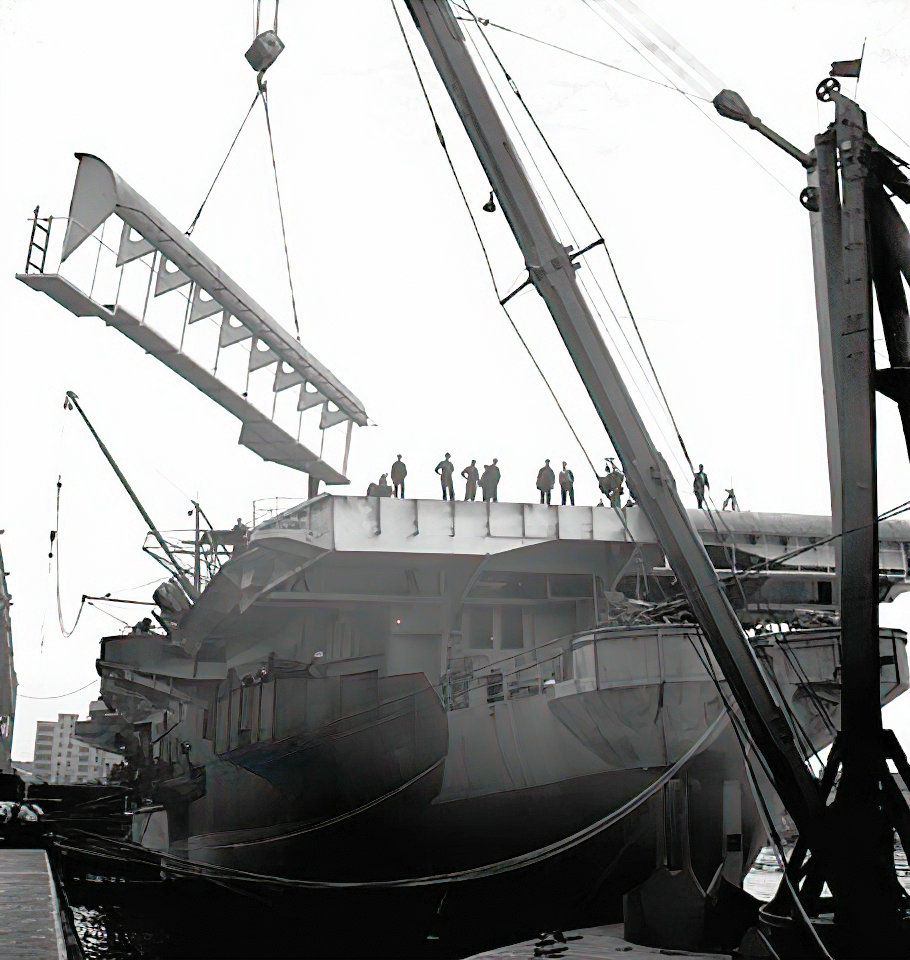

On July 13th RANEE left Vancouver for Esquimalt and re-entered dry-dock on the 14th to complete the fitting of ASDIC equipment; on undocking on the 15th. Prior to her sailing from Esquimalt, RANEE received her first aircraft - a non-airworthy RCAF Blackburn Shark given to the RN on free issue for training flight deck handing parties on the voyage to Norfolk, Virginia. The Shark was ferried out to the ship by lighter from No. 3 Repair Depot RCAF where her floats had been substituted for wheels. Four other CVEs at Vancouver,
PATROLLER,
PUNCHER,
REAPER and
THANE also received written-off Sharks for this purpose. These vintage aircraft caused some interest when the five ships put into US ports; the aircraft were finally pushed overboard when their usefulness had come to an end and deck cargo was due to be loaded.
RANEE sailed for Norfolk, Virginia, via San Francisco and the Panama Canal to begin her second ferry voyage. On her arrival at the US Navy Operating Base, Norfolk, RANEE began embarking a ferry load of sixty Grumman Hellcats for delivery to RNARY Wingfield at Cape Town, South Africa. She sailed from Norfolk on September 5th, and arrived in Cape Town on the 23rd. After unloading her cargo RANEE returned to Norfolk in October to collect a third ferry load, this time bound for the UK.
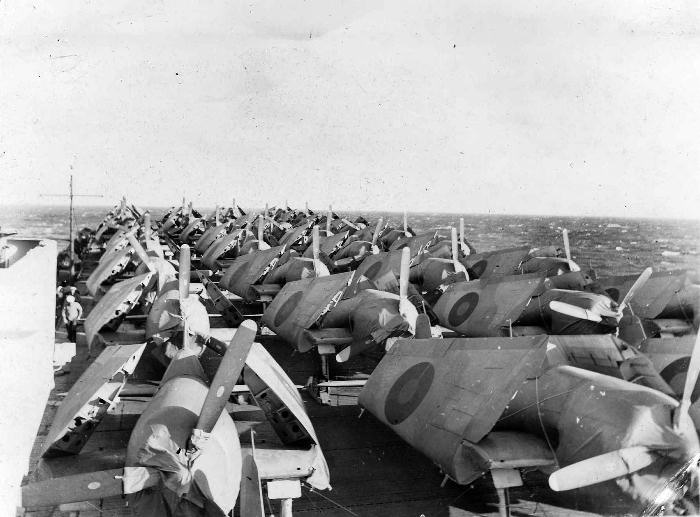

This load included the aircraft and squadron personnel of number 1846 (18 Corsair) & 1848 (18 Corsair) Naval Air Squadrons for passage to the UK, their aircraft were ranged on the flight deck while the hanger deck was filled with spare lend-lease airframes. On October 18th 1944 RANEE was allocated to Western Approaches Command as a ferry carrier and sailed for New York. On the 22nd, she sailed with Convoy CU 44, which arrived at Liverpool on November 2nd. RANEE left the convoy off Ireland and proceeded to Belfast, where she unloaded the airframes and personnel of 1846 and 1848 squadrons to RANMY Belfast before continuing on to Greenock.
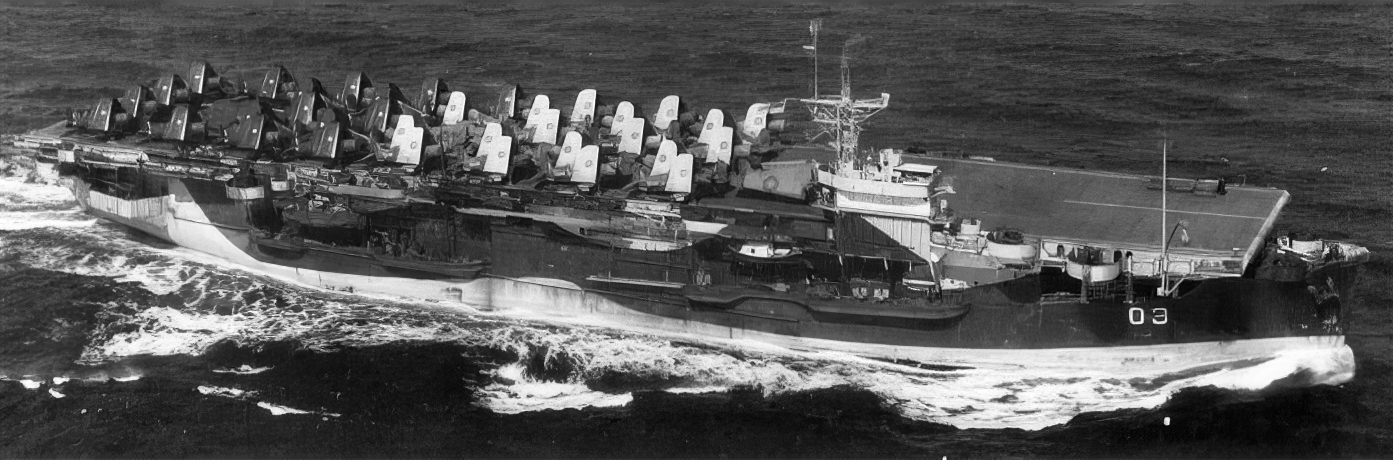
HMS RANEE with the Corsairs of 1846 & 1848 squadrons on deck on passage to the UK.
While at Greenock the crew were granted five days leave to each watch before the ship set sail for the Firth of Forth. There she was to relieve HMS SPEAKER from November 23rd as the duty Deck Landing Training Carrier, operating from Rosyth and Methil for the next six weeks. Before beginning this duty RANEE was put through her first flying trials when an Avenger, a Hellcat and a Wildcat from 778 Service Trials Unit at RNAS Arbroath were safely landed on and flown off on the 23rd and 24th of November. During her period as a training carrier RANEE operated a variety of aircraft types, mainly from 768 Deck Landing Training squadron based at RNAS Arbroath, and others from squadrons working up in Scotland. Out of approximately 2,000 landings and take offs there were 17 crashes; the most serious incident occurred on December 15th when Sub Lt F. Sumner RNVR of 766 squadron was killed. He was making his first night carrier landing in Swordfish NF315 when he bounced on landing and flew over the barriers; the aircraft touched down on the forward end of the Flight deck and ran over the bows into the sea and sank.S
HMS RANEE entered Rosyth Dockyard for a short maintenance period commencing on December 27th. But on New Year's Day 1945, she put to sea for a further week of carrier training but suffered a mechanical breakdown while still in the Firth of Forth which caused the ship to go completely out of control just as she had achieved a speed of some 6 or 7 knots. Not under power and not responding to helm control she was in danger of colliding with other merchant shipping moored in the area; she avoided the first ship in her path only to end up on course straight for
HMS DEER SOUND. In an attempt to stop the ship, the port anchor was let go, she was no longer under power and so had lost most of her forward momentum; in the end RANEE made light contact with the side of
DEER SOUND which left a small dent in her bows but no other damage. After making repairs RANEE resumed her duty as the Deck Landing Training Carrier on January 4th.
On completion of her tour as the deck landing training carrier, RANEE proceeded to Greenock for boiler cleaning, in preparation for loan to the U.S. Carrier Transport Squadron, part of the U.S. Pacific Fleet. On arrival in Greenock, five days leave was granted to each watch and command of the ship passed to Captain J. A. W. Tothill DSC, RN, who relieved Captain Murray on January 20th.
HMS RANEE sailed on Sunday January 21st to join the New York bound Convoy UC 53B; the crossing was heavy going as Atlantic gales lashed the ships for most of the voyage. RANEE suffered damage to her flight deck and in her hangar when the ship's Jeeps tore loose from their lashings and careered around, smashing into things. On January 30th, about 300 miles short of New York, RANEE rendezvoused with the American destroyer USS CECIL J. DOYLE. She was to act as her guard ship for passage through the Panama Canal to Cristobal and north to San Diego. On leaving the convoy, RANEE came beam on to the storm and rolled violently for nearly 24 hours before reaching the calmer waters of the Caribbean. It was rumoured that at its height, the roll was 28 degrees from the vertical. RANEE reached Cristobal 17 days out from Greenock, and after clearing the Panama Canal, the ship proceeded to San Diego, California
The first order of business was voyage repairs; once these were completed, RANEE began to embark the aircraft for delivery to the forward Pacific areas. RANEE left San Diego on February 21st 1945, escorted on the first leg to Pearl Harbour by the USS HUGH W. HADLEY, arriving at Pearl Harbour on February 27th. RANEE continued on to Guam in company with the USS EDWARD C. DALY. The personnel of USN Air Group 80 embarked in HMS RANEE at Guam on March 19th for transportation back to Pearl Harbour, arriving there on the 24th. RANEE was to make a second round trip from Pearl Harbour, Eniwetok, and Guam, ferrying U.S. naval aircraft and personnel before receiving orders in mid-April to return to the UK.
On arrival back in San Diego, RANEE returned to RN control and spent a week having a boiler clean before she sailed on May 2nd for the US Naval operating base at Norfolk to embark a ferry load. She next sailed for New York, arriving there on the 23rd to embark passengers - officers, women and children and a few schoolboys returning home. RANEE sailed as part of convoy CU 72, one of the last New York to UK convoys of the war, departing New York on May 25th and arriving at Glasgow on June 4th 1945.
On arrival at her mooring at Tail of the Bank on the Clyde, work began to convert RANEE to a Replenishment Carrier for duty with the British Pacific Fleet. This primarily entailed the 'tropicalisation' of the ship's ventilation system and the addition of extraction fans in key areas. Dockyard workers were ferried out to the ship each day to work on her until the announcement of the Japanese surrender and the end of the war. RANEE's conversion work was halted when the Admiralty reallocated her as one of six RN CVEs (along with ATHELING, RAJAH, QUEEN, PATROLLER and FENCER) selected for conversion for Naval Trooping; these ships were to be employed bringing military personnel from the Far East back to the UK and some Commonwealth countries.
On September 12th, RANEE sailed for Barrow-in-Furness to receive her trooping conversion; the work being carried out by a Tyneside shipyard. As part of her conversion, she was to have increased accommodation and facilities to house 1000 personnel in addition to her own crew. Three-tier bunks and associated kit lockers for 564 men were installed in the hangar to supplement the existing accommodation available for 786 men, 700 in mess decks and 86 in hammocks. Additional washing and toilet facilities were built in the after-lift well and in now-unoccupied aviation workshop spaces. Extra galley equipment was added to augment the American cafeteria-style messing and dining areas, and sittings of 240 men were set up in the hangar. Time was of the essence in this work, as were costs. Minimal remedial work was authorised for the six ships, the conversion work taking priority. RANEE's conversion was shorter than those of the other five CVEs. Her 'tropicalisation' had been completed before she arrived on the Tyne, and she was ready to proceed to Portsmouth Dockyard on November 8th 1945 to complete a final storing before sailing on her first trooping voyage.
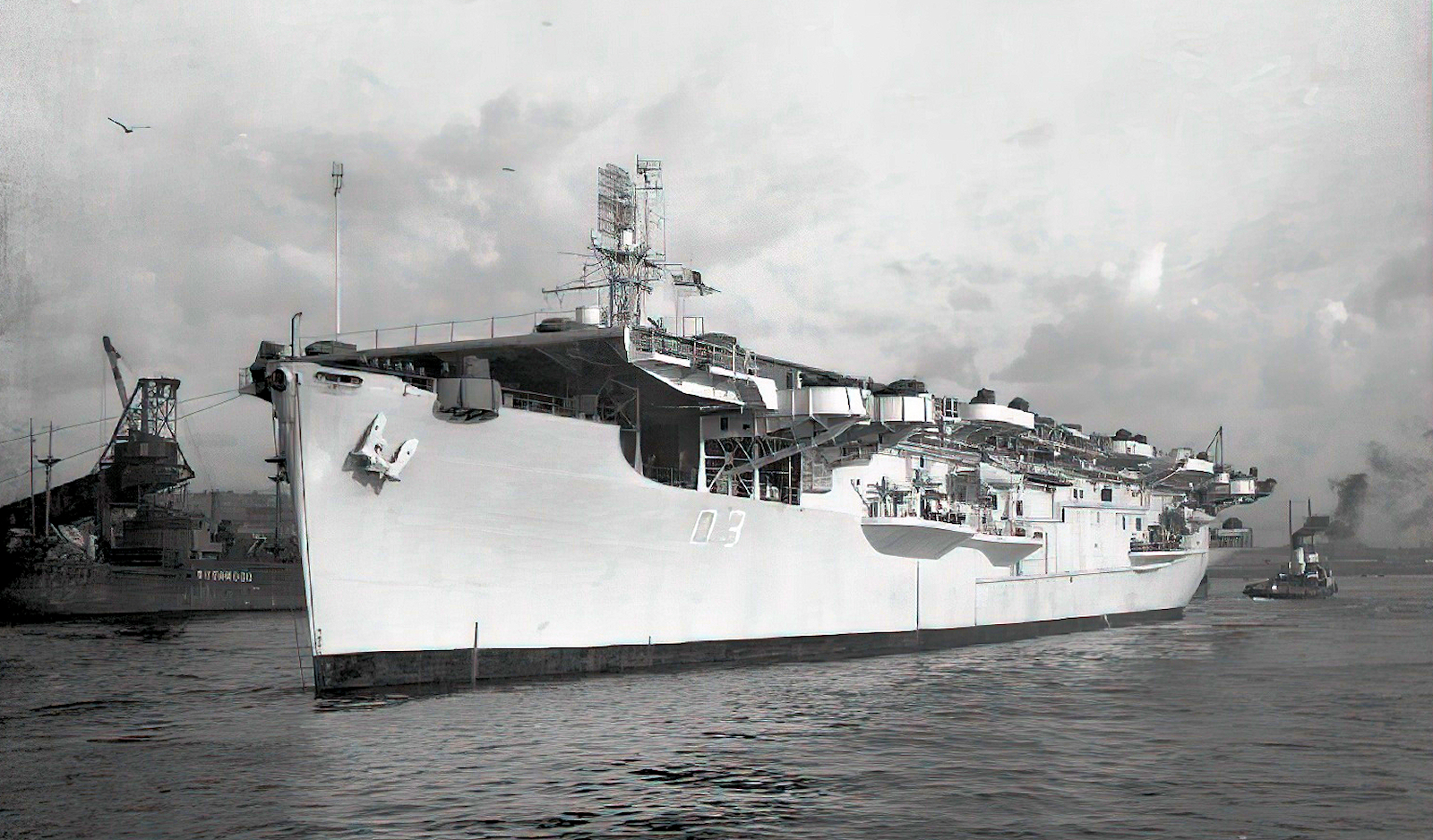
RANEE emerges after her conversion into a troop ship in November 1945. © IWM (FL 18146
First Trooping voyage: RANEE was to sail for Ceylon at the beginning of December, carrying a draft of naval personnel for the East Indies Fleet, leaving Portsmouth at 16:00 on the 9th, bound for Sydney via Malta, Port Suez, and Colombo. She called at Malta on the 12th, sailing at 17:00 on the 13th for Port Said, to transit the Suez Canal. She departed from Port Suez at 15:30 on December 19th. RANEE arrived at Colombo on December 27th and disembarked passengers. After loading stores and passengers for onward passage, RANEE sailed for Sydney on the 29th. The ship arrived in Sydney around January 16th to exchange passengers; she embarked 850 servicemen and 130 tons of food for delivery to the UK. On completion of loading, she departed Sydney at 00:30 on January 20th bound for Fremantle, arriving there on January 26th, securing alongside at Victoria Quay to load cargo before sailing at 18:00 on the 27th for Colombo. The voyage home proceeded as planned until she reached Port Said; bad weather delayed her departure by two days, and her itinerary was changed as a result. She sailed on February 18th to take passage direct to the UK, not calling at Gibraltar as planned. She arrived at Davenport Dockyard in Plymouth on February 25th. Once her passengers had disembarked, RANEE proceeded to Portsmouth Dockyard, arriving on the 27th to undergo voyage repairs; this work took a month to complete and included entry into dry dock.


Second Trooping voyage: On completion of repairs, RANEE sailed on a second round-trip trooping voyage to the Far East, leaving Portsmouth on March 27th 1946; her ultimate destination was Singapore. She called at Gibraltar before putting into Malta on April 3rd, sailing for Port Said the next day. She entered the Suez Canal on April 7th, departing from Port Suez at 05:00 on the 8th for Colombo b via Aden. After a short stop in Colombo, she sailed again at 18:15 on the 20th for Singapore via Penang. Sailed from Singapore on May 2nd, arriving at Colombo on the 6th and sailing on the 8th. She called at Aden on the 15/16th before entering the Suez Canal on the 19th. From Port Said she sailed for Malta on the 20th, calling there on the 23rd. She next proceeded directly to Plymouth, calling there on the 29th before returning to Portsmouth on May 30th.
Third Trooping voyage: RANEE sailed on a third and final round-trip trooping voyage to the Far East, leaving Portsmouth on June 19th 1946; her ultimate destination was Hong Kong. She called at Mata on June 28th, sailed at 20:30 the same day, and arrived at Port Said at 09:00 on July 2nd. She entered the Canal at 04:30 on the 3rd for passage to Aden, departed Port Suez at 23:00, and sailed from Aden at 13:30 on July 7th. Arrived at Colombo on the 13th, sailed for Singapore at 17:00 on the 15th. She arrived in Hong Kong around July 22nd. After two weeks in Hong Kong, she sailed on her return voyage on August 4th and arrived in Singapore on August 8th. Sailed on August 11th, arrived at Colombo on August 15th. Among the passengers were Rear-Admiral J.M. Mansfield DSO, DSC, RN, former Flag Officer, Ceylon & Deputy to the Commander-in-Chief, East Indies, and his wife, who embarked for passage to the U.K. She departed Colombo on August 18th, calling at Aden on the 24th before transiting the Suez Canal on the 28th. Sailed from Port Said at 18:00 on the 29th, arriving at Malta on September 1st. Sailed at 19:30 on September 3rd, calling at Gibraltar on the 5th and Plymouth on the 8th before arriving at Portsmouth on September 9th.
Once all her passengers and cargo had been disembarked, RANEE began the process of de-storing and removing Admiralty equipment in preparation for her return to the US Navy. She sailed from the UK on or around October 22nd for Norfolk, Virginia, carrying passengers, including servicemen's families, stores, and equipment for delivery to the Royal Naval Dockyard in Bermuda, arriving at Norfolk on or around November 8th 1946. [2
CVE-46 was returned to US Navy custody on November 21st 1946 at Norfolk, Virginia; she was stricken for disposal on January 22nd 1947 and was sold on June 9th 1947 to the Waterman Steamship Corp., Mobile, Alabama for merchant service. She was sold on to the Rotterdam Lloyd line in 1948 and renamed SS FRIESLAND. Before being sold again to Panama in 1967 and renamed SS PACIFIC BREEZE. She was scrapped in Taiwan, beginning in May 1974.
Last modified: 01 July 2026<
© 1999-2026 The Royal Navy Research Archive All Rights Reserved Powered by W3,CSS
Press F5 to refresh the page after posting your comment or to hide the form
Shape: Standard, circular.
Blazon (Heraldic description) On a field of blue, a lotus, proper, within two wings displayed and conjoined in base, white overall; two dolphins, Hauriant respecting, gold.
RANEE: The wife of an Indian Rajah.
For explanations of heraldic terms see the
Royal
Navy Ship's Badges page.
Note: The last five CVEs to pass through the Burrard dockyard, PATROLLER, PUNCHER, REAPER, RANEE and THANE had a longer modification timetable than the other 14 vessels modified in Vancouver. This was due to the Admiralty decision that the single Oerlikon mounts on the Gallery Deck and foc'sle deck, were to be changed for fourteen twin mountings. An extra ten days was allocated for this work to be completed.
CloseNote: No accurate dates for this final voyage have been uncovered; however, dates are based on FENCER, which was also handed back into US custody on November 21st with a call in to the Royal Naval Dockyard in Bermuda on passage.
Close
Comments (0)