
No.1770 Squadron formed at RNAS Yeovilton on September 10th, 1943, as the first Squadron to be equipped with the Navy's newest two-seat reconnaissance fighter. Under the command of Lt. Cdr. (A) I. P. Godfrey, RNVR, there were 32 Officers and 110 Ratings, but no aircraft; it would be three weeks before the first of 12 aircraft began to arrive..
After familiarisation with the aircraft and two and a half months of flying training, the Squadron prepared to go north to RNAS Grimsetter, in the Orkney Islands. The maintenance personnel, stores, and equipment travelled by train and ferry, with the aircraft arriving there on December 14th. During their time at RNAS Yeovilton, there was only one recorded flying incident. On October 9th, Firefly Z1886 ('K') lost power on takeoff and made a wheels-up forced landing in a field 1/4 mile south of Illchester. The aircraft caught fire, and the crew, Sub-Lt S. A. W. Waters RMVR & Sub-Lt A. J. Hollywood, were both seriously injured.
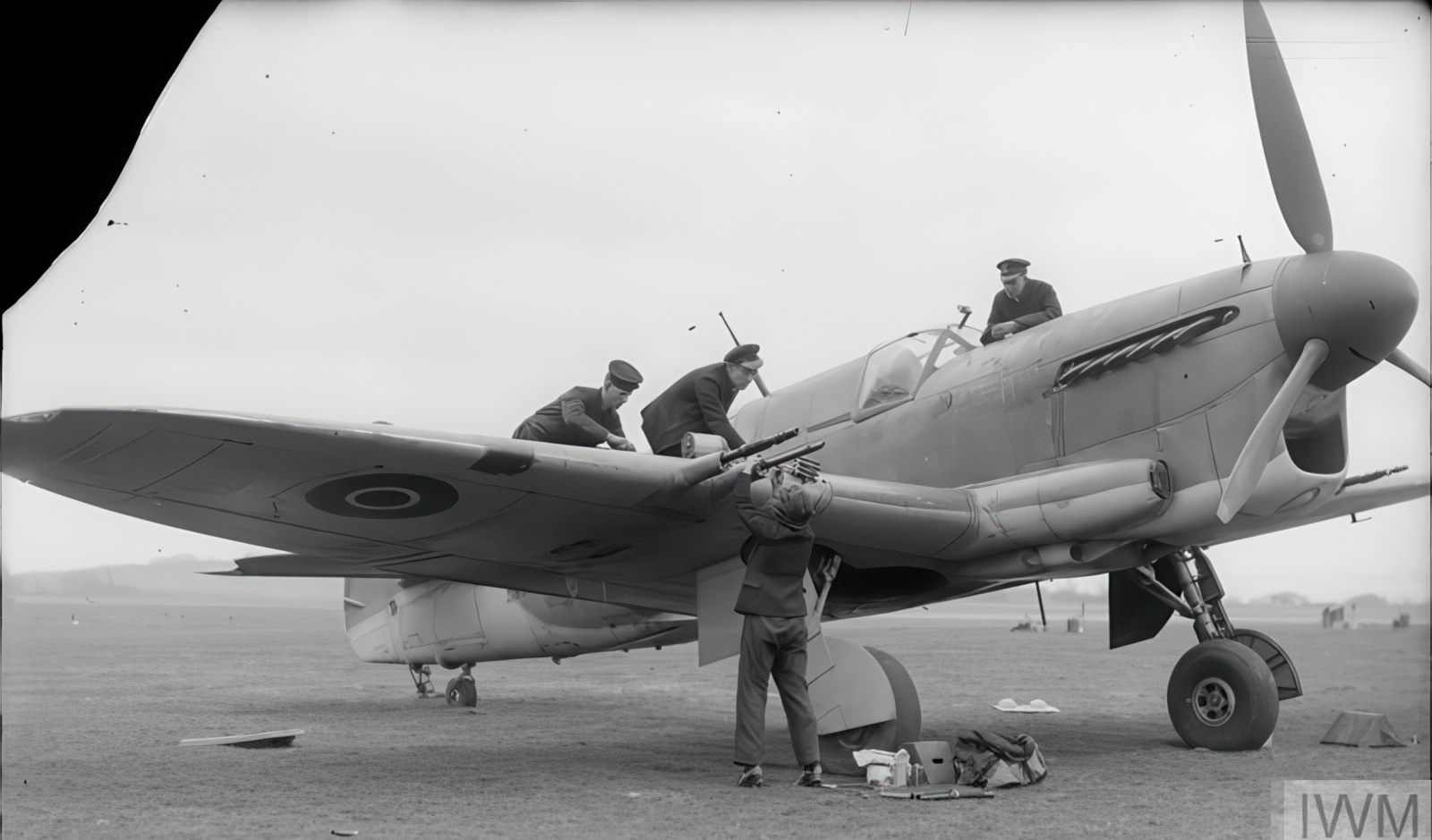
Armourers loading the 20mm cannon of a Firefly Mk.I. ©IWM (A 24695)
While at
RNAS Grimsetter,, Lt. Cdr Godfrey stepped down as the Commanding Officer due to ill health; he was succeeded by a flying Marine, Major V. B. G. Cheesman, DSO, MBE, DSC, RM, on February 5th 1944. The squadron relocated again on February 15th, this time to
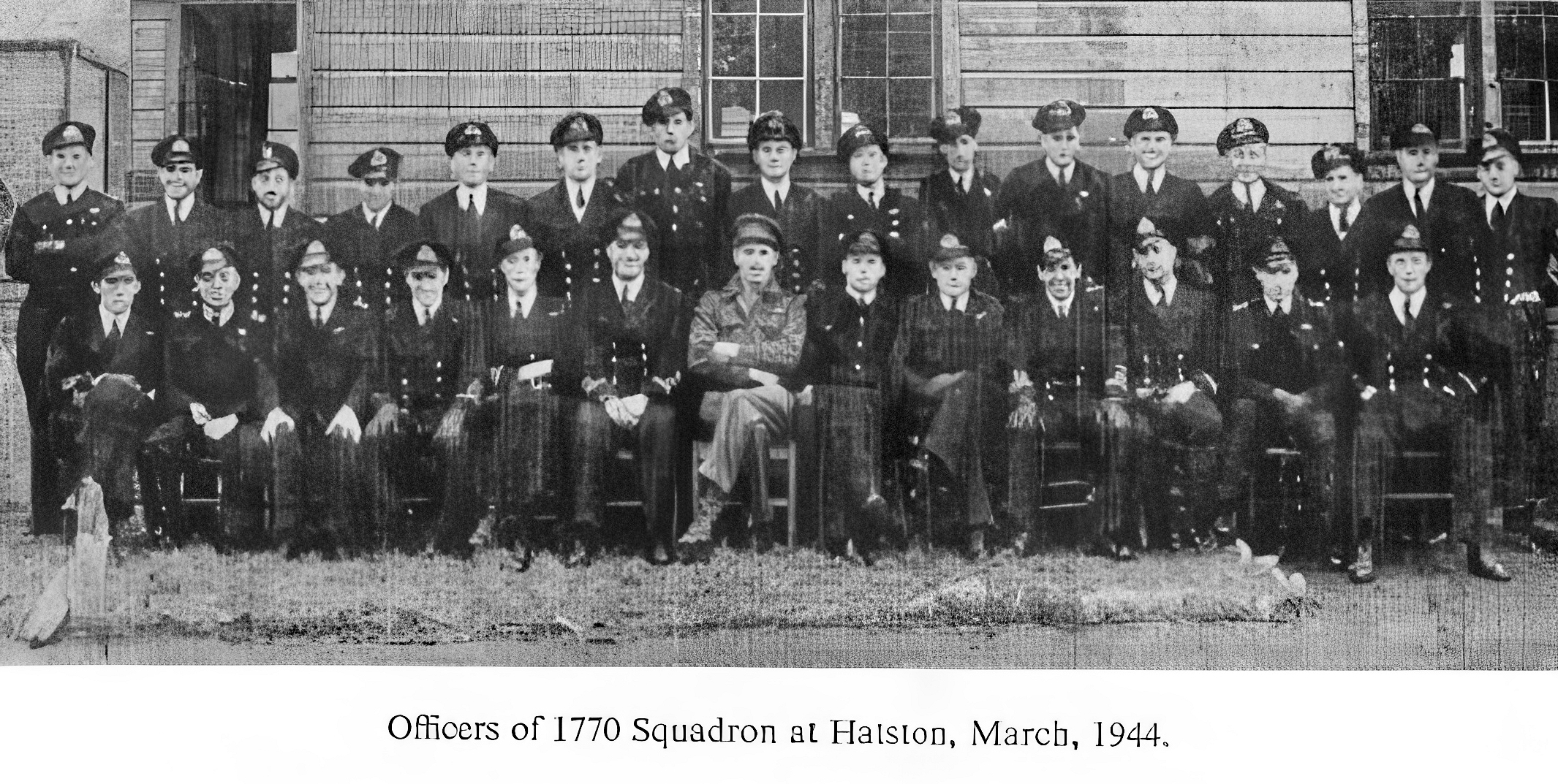
RNAS Hatston, also in Orkney. They were to spend the next two months preparing for their assignment to a Fleet Carrier in May. The squadron’s good flying safety record continued, with only one incident recorded during training at Hatston. On May 2nd, Z1881 ('W'), piloted by Lt. D. Levitt RNVR, suffered a generator failure and landed wheels-up at Hatston.
The squadron was scheduled to join the new Fleet Carrier INDEFATIGABLE during her working-up period in mid-May. The ship arrived at Scapa Flow on May 14th to embark the squadron's maintenance personnel, stores, and equipment, before the aircraft flew out to join her on the 18th. Once secured from flying stations, the ship sailed to return to the Clyde to continue working up. It appears she made the passage unescorted; flying exercises were conducted, and speed trials on the Arran measured mile were carried out on the 18th. The squadron's aircraft continued to conduct flying training exercises with the ship until May 28th, when they were disembarked to RNAS Ayr.
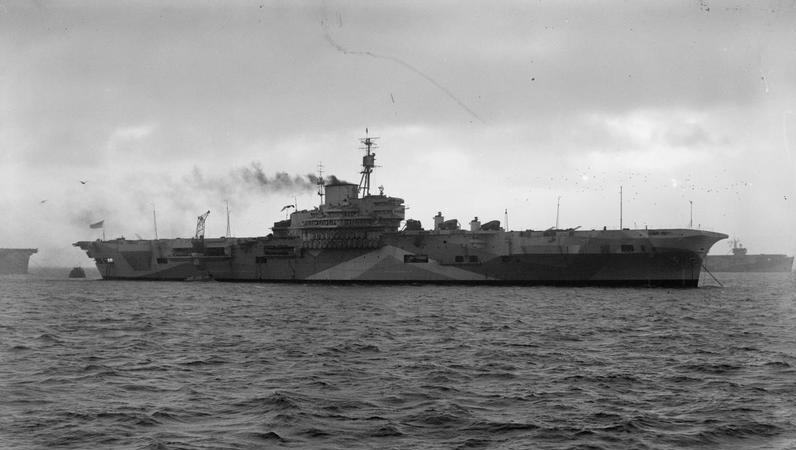
The Fleet Carrier HMS INDEFATIGABLE. Image © IWM (FL 22353)
The squadron rejoined the ship on June 10th as she took passage from the Clyde to Belfast Lough; also embarking that day were two torpedo bomber squadrons, Nos. 820 and 826, each equipped with 12 Barracuda II aircraft. The next three weeks were spent conducting flying exercises, with the carrier operating between Belfast and the Clyde. On July 3rd, she sailed for Scapa to join the Home Fleet. 1770 disembarked to
RNAS Grimsetter,
on the 5th. The following day, one further squadron was embarked; the 12 Seafires of No.
887 Squadron flew from RNAS Eglinton, Northern Ireland, to join the ship off Scapa. 1770 re-embarked on the 9th as she prepared for her first operational sortie, Operation ‘MASCOT’.
Over the next three days, the fleet carriers INDEFATIGABLE , FORMIDABLE, and FURIOUS conducted flying and gunnery exercises off Scapa. The carrier force departed Scapa on July 14th, heading toward the Norwegian coast and the launch position.
Operation MASCOT
This was planned as a repeat of the earlier Operation ‘TUNGSTEN’, an attack against the German battleship TIRPITZ at her anchorage in Kaa Fjord, Norway, carried out in early April 1944. However, bad weather prevented repeat attacks.
INDEFATIGABLE was part of a force comprising of the Battleship DUKE OF YORK, Fleet Carriers FURIOUS (880-3 Seafire LIIc, 842 Flight-(3 Swordfish II) & 1840 -20 Hellcat II), FORMIDABLE (1841-18 Corsairs, 827-12 Barracudas & 830-12 Barracudas) and INDEFATIGABLE (887-1INDEFATIGABLE 2 Seafire FIII, 1770 -12 Firefly, 820-12 Barracuda II, & 826-12 Barracuda II), Cruisers DEVONSHIRE, KENT, JAMAICA, BELLONA, Destroyers BULLDOG, MILNE, MARNE, MATCHLESS, MUSKETEER, SIOUX, SCOURGE, VERULAM, NUBIAN, VOLAGE, VIRAGO, VIGILANT, ALGONQUIN, Frigates BURGES, INMAN, and HOSTE. The operation called for a strike by 44 Barracuda bombers and 48 Corsairs, Hellcats and Fireflies with 15 Seafire escorts.
The strike was delivered on July 17th, but failed to repeat the success of 'TUNGSTEN'. The enemy had warning of the approach of the Barracudas and had time to enshroud the anchorage in smoke, forcing the dive-bombers to release blindly. Tirpitz was undamaged, but an armed trawler was sunk and the destroyer Z33 suffered superficial damage from strafing Corsairs. One Barracuda and one Corsair were lost to flak. The Corsair, JT404 of 1841 Sqn FORMIDABLE, crashed at Sorvaag, Harmay, south of Bodo, while escorting a Barracuda; the pilot, Sub-Lt H. S. Mattholie RNVR, was taken prisoner. Barracuda LS653 ('4W) of 826 Sqn INDEFATIGABLE was hit in the engine by anti-aircraft fire but managed to limp back to the fleet to ditch ahead of the carrier. The crew, comprising Sub-Lt E. S. Falwasser RNZNVR, Sub-Lt K. H. Holliman RNVR, and Leading Airman A. H. Weller, was picked up by SCOURGE. Once all aircraft had landed, the decision was made to cancel a second strike due to thick fog. The force returned to Scapa on July 19th.
On arrival back at Scapa, No. 1770 squadron disembarked briefly to RNAS Hatston on July 25th before flying south to RNAS Donibristle the same day en route to RNAS Burscough.
The squadron aircraft arrived at
RNAS Burscough on July 27th. This visit was to receive new aircraft equipped with underwing rocket projectile rails, replacing their existing machines. On July 30th, the squadron departed from
RNAS Burscough to return to the Orkneys, calling at
RNAS Ayr on the west coast of Scotland before crossing to the east and refuelling at
RNAS Donibristleand RAF Kinloss.
They arrived back atRNAS Hatston on August 2nd. Work now began to prepare for re-joining INDEFATIGABLE on the 7th for her next operation, OFFSPRING.
Operation OFFSPRING
The first objective was to establish two aerially laid minefields between Lepsøy and Haramsa, designed to force the enemy shipping out of the Leads. In addition, the Force was to attack the airfield at Gossen and shipping off the coast of German-occupied Norway.
INDEFATIGABLE was allocated to Force 4, which comprised the Fleet Carrier INDEFATIGABLE (Flag RA CS1) 887 Seafire, 894 Seafire, 820 Barracuda, 1770 Firefly, 1840 Hellcat Sqns) CVEs NABOB (852 Avenger) and TRUMPETER (846 Avenger), Cruisers KENT and DEVONSHIRE, HM Destroyers MYNGS (D26), VOLAGE, VIGILANT, VERULAM, VIRAGO, and SCOURGE, Canadian Destroyers ALGONQUIN and SIOUX.
The Force departed Scapa on August 8th for the largest aircraft mine-laying operation ever undertaken by elements of the Home Fleet. Forty-seven mines were successfully laid by the Avenger crews of 846 and 852 Squadrons, with 29 in Harhamsfiord and 17 in Lepsorev. ‘OFFSPRING’ also saw fighter aircraft attacking ground targets, a WT station on Vigra Island and Gossen airfield was strafed, resulting in 6 Me 110s destroyed and one damaged on the ground with two hangars and some storehouses left burning. Additional targets were hit, including 3 radar and 2 wireless stations, a dredger and gun positions, 3 armed ships of which 2 were left burning and an oil tank which was left smoking. Allied losses included 1 Avenger from 846 Sqn, which was shot down in flames at 18:35. The crew Sub-Lt I. A. Gaunt RNVR, Sub-Lt A. Salisbury RMVR & PO Airman J. H. Ashton were all killed. They were all mentioned in despatches posthumously. Two Seafires from 894 Sqn in the fighter escort were damaged by flak, and another from 887 Sqn was damaged in a barrier crash. Firefly DT945 ('4L'), ditched on return 6 miles West of Storholm Lighthouse, the crew Sub-Lt J. A. Davies RNVR and Sub-Lt D. R. Bennett were both killed. Force 4 set course for Scapa on the 11th.
The squadrons remained on board, and preparations were made to sail for the next operation, another attack on the TIRPITZ, codenamed Operation GOODWOOD. During ongoing flying exercises, Firefly DT948 ('5L') experienced a barrier crash on the 17th. The arrester hook bounced and snapped back into the fuselage, causing the aircraft to hit the No. 2 barrier.
Operation GOODWOOD
This was an attempt to put the German Battleship her out of action for the remainder of the war and to cover the passage of Artic convoys JW59 and RA59A against attack by TIRPITZ if she could not be disabled (she had put to sea on July 31st and August 1st to train with her protective destroyers).
This dual-purpose plan involved three separate Forces: Force One: Battleship DUKE OF YORK (C-in-C HF), Fleet Carrier INDEFATIGABLE (Flag RA CS 1; 887 & 894 Sqns – 24 Seafire, 1840 Sqn – 12 Hellcat, 1770 Sqn – 12 Firefly, 820 Sqn – 12 Barracuda), FORMIDABLE (1841 & 1842 Sqns – 30 Corsairs, 826 & 828 Sqns – 24 barracuda) and FURIOUS (801 & 880 Sqns – 24 Seafire, 827 & 830 Sqn – 18 Barracuda), Cruisers BERWICK and DEVONSHIRE, Destroyers MYNGS (D26), CAMBRIAN, VERULAM, VIGILANT VIRAGO, VOLAGE, SCORPION, SCOURGE, SERAPIS, STORD, WHIRLWIND, WRANGLER and Canadian Destroyers ALGONQUIN and SIOUX. Force Two: Escort Carriers NABOB (852 - 11 Avenger & 4 Wildcat, 856 Sqn - 3 Avenger Det) and TRUMPETER (846 - 8 Avenger & 4 Wildcat, 856 Sqn - 3 Avenger Det), Cruiser KENT, BICKERTON (SO EG 5), AYLMER, BLIGH, KEMPTHORNE, KEATS. Force Nine: Tanker force R.F.A.s BLACK RANGER and BLUE RANGER, Destroyer NUBIAN, Corvettes DIANELLA, POPPY, and STARWORT.
Home Fleet forces left Scapa on the 18th to protect the outward Convoy JW 59, bound for Murmansk, which had departed from Loch Ewe, Scotland, on August 15th. After an uneventful journey north, the attack forces arrived off the coast of Norway on August 20th.
For this strike on the German Battleship, Admiral McGrigor had devised a new plan to damage the TIRPITZ. The Avengers were to form the main strike, each armed with 2 Mk. V – 1,000lb aerial-launched mines, which were to be placed near TIRPITZ herself and the entrance to Kaafjord. The mines dropped near the battleship were to be fitted with time-delay fuses in the hope of causing some damage, which may have prompted her Captain to leave her anchorage and be caught by the mines sown at the entrance. The aircraft from the Fillet Carriers were to launch another strike to both distract the German flak gunners and to attack the TIRPITZ. Although highly skilled in aerial minelaying, the Avenger crews faced a particularly challenging mission; careful route planning would result in each aircraft having only 15 seconds over the target to accurately place two mines. Previous raids on TIRPITZ had found the ship screened by smoke.
Bad weather meant that the first strike was delayed by 24 hours and was undertaken on the 22nd. At 11:00 am, a force comprising 32 Barracudas, 24 Corsairs, 11 Fireflies, 9 Hellcats and 8 Seafires was launched from the three fleet carriers.
Bad weather delayed the operation's start by 24 hours. On the morning of the 22nd, the Avengers from 852, 856, and 846 squadrons began launching at approximately 09:00, and the strike force formed up, ready for departure. They were held in a holding pattern for some time while the Fleet Carriers launched a few aircraft. Then, NABOB and TRUMPETER turned into the wind again, and the Avengers began to land. This phase of the operation was cancelled due to low cloud conditions.
At 11:00, a force comprising 32 Barracudas, 24 Corsairs, 11 Fireflies, 9 Hellcats and 8 Seafires was launched from the three fleet carriers. Thick cloud at 1,500ft also caused the Barracudas and their Corsair escorts to turn back short of the coast; they returned to the carriers without attacking. The 11 Fireflies pressed on to strafe German anti-aircraft guns on and around TIRPITZ at 12:49. Two minutes later, 9 Hellcats each released a 500lb semi-armour-piercing (SAP) bomb on TIRPITZ but did not achieve any hits. Also, 8 Seafires hit Luftwaffe bases at Banak and Kolvik in a coordinated attack.
At 15:30, the ships of Force Two were detached to the west. NABOB was instructed to fuel three destroyer escorts, commencing at 18:00, at a position 120 miles WNW of North Cape, in the Barents Sea. TRUMPETER was tasked with providing Combat Air Patrols (CAP) and Anti-Submarine (AS) patrols. At 17:15, NABOB was hit by a single acoustic torpedo fired by U-354, which struck her on the starboard side, causing a 32-square-foot hole abaft the engine room below the waterline. She began to take on water at an alarming rate; within minutes, NABOB was listing to Starboard and was 15 feet down by the stern. All electrical power had been lost, and NABOB was dead in the water. A second torpedo was launched, which struck the frigate BICKERTON at 17:23. She was hit in the stern, and her damage was extensive. 38 crewmen were dead, and she had lost her propeller shafts in the explosion. The DUKE OF YORK, INDEFATIGABLE , FORMIDABLE, FURIOUS, BERWICK, DEVONSHIRE and KENT immediately took evasive action and dispersed at full speed, taking most of the screening destroyers with them.
TRUMPETER closed on NABOB and maintained air cover while rescue efforts took place. Meanwhile, NABOB's damage control teams work to stop the folding and restore the engines. As early as 17:34, orders had been issued by the C-in-C in the DUKE OF YORK to sink BICKERTON and NABOB if they could not get underway; BICKERTON was beyond salvage and was scuttled at 21:00 by torpedoes from VIGILANT once KEMPTHORNE had taken survivors off.
NABOB’s engines were restarted at 21:00, and she was under power, slow ahead at 10 revolutions by 21:39. She could reach 60 Revolutions by 23:30, with three knots being the maximum speed she could safely maintain. She was ordered to make for Scapa escorted by TRUMPETER, CASSANDRA, KEMPENFELT, ZEST, and ZAMBESI; they arrived at Scapa at 08:00 on the 27th.
During the strike, two aircraft were lost. Seafire LR863 (an 894 Sqn machine) piloted by Sub-Lt I. Sargeant RMVR of 887 Sqn, skimmed the water near Banak, recovered, but then force landed on a beach with his aircraft in flames; He was taken prisoner. Hellcat JV150 of 1840 Sqn crashed into the mountainside flying through the smoke screen to attack an AA position around TLRPITZ at 12:50. The pilot, Lt W. J. Turner RNVR, was killed. Two enemy aircraft wer destroyed by Seafires from 894 Sqn; at 17:15 Sub-Lt H. T. Palmer, SANF (V) in LR816 ('1P') and Sub-Lt R. H. Reynolds, RNVR in LR859 ('1G') shot down two German Blohm & Voss BV 138 reconnaissance aircraft in flames off North Cape, approximate position 71°N 23°E.
GOODWOOD II On the 24th, another combined strike was flown off. Thirty-three Barracudas, each carrying a single 1,600lb armour-piercing bomb, and ten Fireflies, briefed to suppress AA positions using their 20mm cannons, with Corsair and Hellcat fighter-bombers, were to sweep in from multiple directions, causing confusion for the gun directors.
The alarm was not raised until 15:47, and upon reaching the target, it was discovered that the smoke screen, which had previously hampered attempts, had not yet become fully effective. Two hits were scored on the TIRPITZ, one of which was a 500lb bomb that hit the roof of her ‘B’ turret. However, the resulting explosion only dented the thick armour plating; it did cause secondary damage to the machinery of this and other nearby weapon systems. A single 16,000lb bomb found a target; it successfully penetrated several armoured decks but failed to detonate. The strike cost the lives of five pilots: two were Hellcat pilots from 1840 Sqn INDEFATIGABLE , the commanding Officer, Lt. Cdr A. R. Richardson RNZVNR, in JV203 took a direct hit by flak, making an attack on TLRPITZ, his aircraft broke apart in mid-air. Sub-Lt W. J. Lowe RNVR in JV185 was observed spinning at 2,500ft, and emitting smoke before crashing into Sakhovarre Mountain. The other three were pilots from No. 6 Wing, FORMIDABLE; Sub-Lt E. W. Thornberry RMVR, in Corsair JT470 1842 Sqn ('C') died when he ditched in Aiten Fjord, and the belly tank exploded, Sub-Lt L J. H. French RMVR, in JT606 1842 Squ ('T') failed to return from the strike, and Sub-Lt C. E. Woodward RNZNVR in JT309 1841 Sqn was hit by ground defenses while strafing gun position and crashed in flames near the entrance to Kaafjord.
A large number of Corsairs from No. 6 Wing sustained damage during the strike, and some were unable to land on their home carrier upon returning to the fleet. Four aircraft from 1841 Sqm landed on INDEFATIGABLE , after two crashes on deck (both involving 1842 Sqn aircraft) temporarily put FORMIDABLE out of action. FORMIDABLE accepted three others once the wreckage was cleared. Upon completing the recovery of the aircraft, Force 1 withdrew to the Faroes to refuel on the 26th and 27th, while FURIOUS was detached to return to Scapa Flow due to low fuel and limited supplies available in the Faroes. Bad weather again delayed Force 1, which was back in position to launch a third and final strike on the 29th.
GOODWOOD III This time, the strike comprised 60 aircraft. The Germans had learnt the lesson from the second strike and had the target area completely obscured by heavy smoke when the Barracudas arrived; they dropped their bombs blindly in the hopes of scoring hits, but none found their mark. After dropping their bombs, the Barracudas and Corsairs strafed the destroyer escorts in Lair Both, many of which took damage from flak. Upon completing the recovery of her aircraft, INDEFATIGABLE was detached to return to Scapa, and FORMIDABLE followed on the 30th due to a lack of fuel. The remainder of Force 1 switched to cover convoy RA59A.
The third strike resulted in the deaths of three aircrew and the loss of two aircraft in combat, two others written off in deck crashes. Ten aircraft were damaged in combat, with two experiencing barrier crashes on landing. No. 1770 Sqn suffered its first combat loss when Firefly DT949 was hit during a low-level attack on flak positions near Boskop. The crew, Sub-Lt R. D. Viney RNVR and Sub-Lt N. J. Smith RNVR, were both killed. Another Firefly DT975 crashed on deck while returning from the strike. The arrester hook bounced off the deck and locked in the up position, causing the aircraft to continue into the No. 2 barrier. The crew were OK. No. 6 Wing lost another pilot when Sub-Lt J. G. Walker RNVR, flying in Corsair JT492 1842 Squ ('H'), crashed in Kaafjord due to flak damage. Five more Corsairs took varying degrees of damage but managed to return to base. Having dropped their bombs into the smoke, the Barracudas also strafed the destroyer escorts in Lair Botn; six aircraft of 826 Sqn suffered damage from flak. Three had barrier crashes, and one suffered undercarriage failure. Two of the most seriously damaged machines were jettisoned overboard.
Over the three days of Strikes, a grand total of 91 Barracuda, 39 Hellcat, and Corsair fighter-bomber sorties, as well as 15 Seafire fighter sweeps, and 97 escort and support sorties, including Fireflies, were flown from the Fleet carriers.
INDEFATIGABLE arrived back at Scapa on September 1st and began preparations for one final operation with the Home Fleet, Operation DIVAN. A detachment of 5 aircraft was put ashore to operate at RNAS Grimsetter, on September 6th; they re-joined the ship on the 17th. A squadron aircraft ditched ahead of the ship on the 17th, DT946 suffered engine failure after takeoff and ditched in Scapa Flow. The crew was safely recovered. The next day, the Firefly DT940 was damaged while landing on the ship. The aircraft caught an arrester wire but slewed to starboard, and the wing struck the 4.5” gun director.
Operation DIVAN
For this operation, three separate objectives were to be met: first, to create a diversion during the passage of convoy JW 60 through the Bear Island Channel; second, to lay aerial mines in the Leads at Finnenarennen and Gibostad; and third, to harass German forces and destroy military installations in the Tromso Area. INDEFATIGABLE was to be the only carrier detailed for this operation, as part of a force comprising of Carrier INDEFATIGABLE (Flag Rear Admiral CS 10; 887 & 894 Sqns – 24 Seafire, 1770 Sqn – 12 Firefly, 820 Sqn – 12 Barracuda),, SWIFTSURE, CASANDRA, CAPRICE, CAMBRIAN, ZEPHYR, ORIRI, OFFA, ORWELL, ONSLOW, OPPORTUNE, and OBEDIENT. The force sailed from Scapa on September 19th, but on reaching the operational area, bad weather resulted in the operation being cancelled.
The force returned to Scapa on the 24th, and Rear Admiral CS 10 transferred his Flag to KENT. Both 887 and 894 squadrons were flown ashore to RAF Skeabrae upon arrival in the Orkneys. The ship was to proceed to the Clyde the following day for dry docking to be carried out. Upon reaching the Clyde on the 26th, her remaining squadrons were disembarked. No. 820 Sqn flew ashore to RNAS Machrihanish, and 1770 squadron to RNAS Ayr.
On completion of operation DIVAN, HMS INDEFATIGABLE was allocated for service with the new British Pacific Fleet (BPF), which was being assembled in Ceylon for operations against the Japanese. On September 28th, 1944, she proceeded from Greenock to the John Brown Shipyard at Clydebank, Glasgow, to be taken in hand for a short refit to prepare her for service with the British Pacific Fleet. The refit was completed by early November, and she departed the Clyde bound for Portsmouth on the 9th. She was subsequently docked in D Lock at the naval dockyard on the 11th. On the 15th, she became the Flagship of Rear-Admiral P. L. Vian, KCB, KBE, DSO and 2 Bars, RN. The following day, King George VI inspected the ship; the ground crews for her Squadrons 820, 887, 894, and 1770 embarked later that day. She was undocked on the 18th and put to sea the following day to prepare to embark her squadrons on November 21st.
On November 16th, the aircraft of 1770 Squadron moved from RNAS Ayr to NAS Dale, Pembrokeshire, Wales, and flew out of there. The Seafire squadrons, now increased to 24 aircraft each, were ordered to fly cross-country from RNAS Lee-on-Solent to RAF Mona on Anglesey and embarked from there on the 21st. No. 820 Squadron, now re-equipped with Avengers, embarked on the same date, flying out from RAF Upottery, Devon.
Once all the aircraft had embarked, the ship set sail for Gibraltar, accompanied by the destroyers GRENVILLE, UNDINE, and URANIA, on the first leg of the journey to Ceylon to join the new British Pacific Fleet. After making stops at Algiers, Port Said, and Aden, INDEFATIGABLE and her escorts arrived in Colombo on December 10th and joined HM Aircraft Carriers ILLUSTRIOUS, INDOMITABLE, and VICTORIOUS in the 1st Aircraft Carrier Squadron of the British Pacific Fleet.
Before entering the harbour, her squadrons were disembarked at air stations in Ceylon: 1770 to RNAS Puttalam, 820, 887, and 894 to RNAS Katukurunda.
After a fortnight of training ashore, INDEFATIGABLE ’s squadrons were embarked on Christmas Eve 1944, and the ship began exercising with the BPF in preparation for offensive operations in the New Year. For INDEFATIGABLE , this was to be a strike against Japanese installations on Sumatra, operation LENTIL.
The fledgling BPF had already carried out one operation in December, Operation ROBSON, from December 20th to 22nd, by INDOMITABLE and ILLUSTRIOUS. This was the first of four operations that formed the larger plan, Operation OUTFLANK. This was a series of four raids by the Fleet Air Arm on the oil refineries and storage facilities on the island of Sumatra: these raids were given the codenames ROBSON, LENTIL, MERIDIAN One, and MERIDIAN Two.
Operation LENTIL
This was a second attempt to strike the oil refineries at Pangkalang Brandan, Sumatra. This operation was conducted by Task Force 65 comprised the newly arrived INDEFATIGABLE (820 Avenger, 887 & 894 Seafire, 888 PR Hellcat, and 1770 Firefly Squadrons – 71 aircraft), INDOMITABLE (Rear Admiral Aircraft Carriers, BPF, Rear Admiral Sir Philip Vian, KBE, DSO) 857 Avenger, 1839 and 1844 Corsair Squadrons – 50 aircraft) and VICTORIOUS (849 Avenger, 1834 & 1886 Corsair Squadrons – 55 aircraft), Cruisers ARGONAUT, BLACK PRINCE, CEYLON, and SUFFOLK, Destroyers GRENVILLE, KEMPENFELT, UNDAUNTED, UNDINE, URSA, WAGER, and WHELP.
.jpg)
.jpg )
.jpg)
The Force departed Trincomalee on December 31st for Northern Sumatra and arrived at its launch position near Simalur Island on the morning of January 4th. The carrier aircraft were then flown off to attack the oil refineries at Pangkalan Brandan. A fighter strike force (RAMROD) of 16 aircraft - 8 Hellcats from INDOMITABLE and 8 Corsairs from VICTORIOUS- was launched shortly after dawn at 06:10 with orders to suppress the airfields at Bindjai, Medan, Tandjonpoera and Troemon, which were along the approach path to the target. Seafires from INDEFATIGABLE s’24 Wing flew Combat Air patrols over the Force.
The main strike force began launching at 07:40 and comprised 32 Avengers; INDOMITABLE supplied 16 and VICTORIOUS 16, each carrying four 500-lb bombs; INDEFATIGABLE launched 12 Fireflies armed with eight 60-lb rockets each. Among the escorts, top cover was provided by 8 Hellcats from INDOMITABLE, middle cover by 16 Corsairs from VICTORIOUS, and close cover by a further eight Hellcats from INDOMITABLE. Twelve miles out from the target the Fireflies of 1770 Squadron broke away to launch a rocket and cannon attack at 08:25 to suppress air defences in and around the town of Pangkalan Soe Soe, at 08:31 the Avengers of 857 Squadron hit the main Pangkalan Brandan refinery, 849 Squadron hit the Edeleanu Plant at 08:33. The strike succeeded in causing considerable damage: the attack aircraft badly damaged the refinery, and the fighters shot down about 12 Japanese aircraft as well as destroying another 20 on the ground. Two aircraft were lost through ditching, but the crews were rescued. Avenger JZ554 of 849 Squadron VICTORIOUS suffered engine failure while crossing the coast west of Sumatra. After jettisoning their bombs, it ditched 6 miles offshore. Lt. D. M. Judd RNVR, Lt. G. T. Graham RMVR, and PO Airman T. S. Murphy were picked up by a destroyer. Firefly DT936 ('4S'), seriously short of fuel, declared an emergency landing but ditched astern of INDEFATIGABLE . The crew, consisting of Sub-Lt A. W. Tucker RNVR and Sub-Lt E. Miller RNVR, was safely picked up by a destroyer. Photographic reconnaissance of port installations at Belawan Deli, Brandon, and Soe Soe was also conducted by aircraft from 888 Squadron.
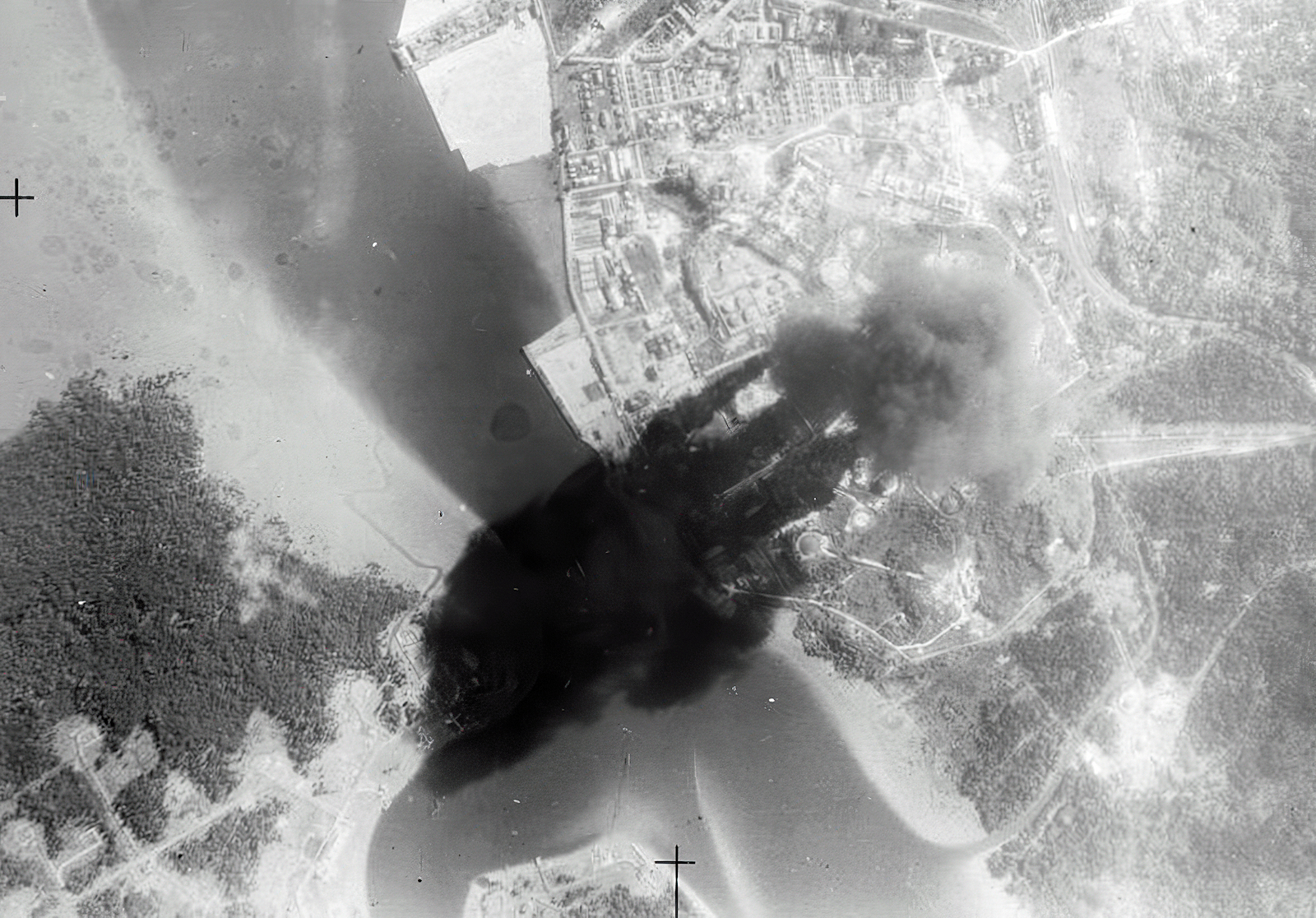
January 4th, 1945: Photo recon image showing a huge plume of smoke, dense enough to cast long shadows, rising from the damaged refinery at Pangkalan Brandan.
In the afternoon of January 6th, INDEFATIGABLE , Cruiser SUFFOLK, Destroyers KEMPENFELT, WAKEFUL and URIANA parted company with the remainder of the Force. These ships were to proceed to Colombo. No. 1770 Sqn lost another aircraft on this date; DT943 ('4A’) was in the landing circuit but low on fuel, and it eventually ditched near the carrier. The crew, Major Cheesman RM and Lt. D. G. J. Wilkey RNVR, were picked up by WAKEFUL. Since the Pangkalang Brandan strike and the subsequent Sumatra operations were launched off the west coast to target long-range objectives, accurate fuel calculations became essential, particularly if aircraft were delayed in the landing pattern upon their return. Upon examining the Firefly's fuel consumption since its arrival in the Indian Ocean, it became evident that the engines had not been adequately retuned for optimal performance in the tropics; furthermore, consumption rates were widely inconsistent across all squadron aircraft.
In the afternoon of January 6th, INDEFATIGABLE , Cruiser SUFFOLK, and Destroyers KEMPENFELT, WAKEFUL, and URANIA parted company with the main Force to proceed to Colombo, arriving there on the 7th, Nos 829 and 888 Squadrons left the ship before she entered harbour, 820 to RNAS Katukurunda and 888 to ENAS Colombo Racecourse. INDEFATIGABLE sailed from Colombo around 10:20 on January 9th for Trincomalee escorted by KEMPENFELT and WAKEFUL, re-embarking 820 Squadron Avengers on passage. She arrived around 18:00 the 10.th The fleet now began preparing for its final departure and a series of strikes, known as Operation MERIDIAN, to be conducted en route to Australia. The ships of the BPF, now designated Force 63, put to sea on the 12th to conduct full-scale rehearsals at sea off Ceylon on January 13th. This involved a combined strike and escort exercise on Colombo in the morning, followed by fighter sweeps over the airfields at Trincomalee and Sigiriya in the afternoon.
Operation MERIDIAN I
The fledgling British Pacific Fleet, Task Force 63, set sail from Trincomalee on January 16th, 1945, expecting to spend the next 20 days at sea. TF63 comprised of the Battleship KING GEORGE V (Flag of Vice Admiral Sir Henry Bernard Rawlings, 2iC British Pacific Fleet), Fleet Carriers INDOMITABLE (Flag of the 1st Aircraft Carrier Squadron (ACS1), Rear Admiral Sir Philip Vian, KBE, DSO) 857, 1839 and 1844 Naval Air Squadrons – 50 aircraft)), INDEFATIGABLE (820, 887, 894, and 1770 Naval Air Squadrons – 73 aircraft), VICTORIOUS (1834, 1836, and 849 Naval Air Squadrons – 55 aircraft) and ILLUSTRIOUS (1830, 1833 and 854 squadrons + 2 Walrus – 55 aircraft), cruisers ARGONAUT, BLACK PRINCE, CEYLON and EURYALUS, Destroyers GRENVILLE, KEMPENFELT, UNDAUNTED, UNDINE, URSA, WAGER WAKEFUL, WESSEX, WHIRLWIND, and WHELP. A Replenishment Group, Task Force 69, comprising the Tankers ECHODALE, WAVE KING, and EMPIRE SALVAGE escorted by the Destroyer URCHIN departed earlier, on January 13th; the cruiser CEYLON detached from TF63 to join the Replenishment Group on the 20th when the two forces first rendezvoused, another Tanker, ARNDALE sailed from Fremantle on the 15th to join TF69.
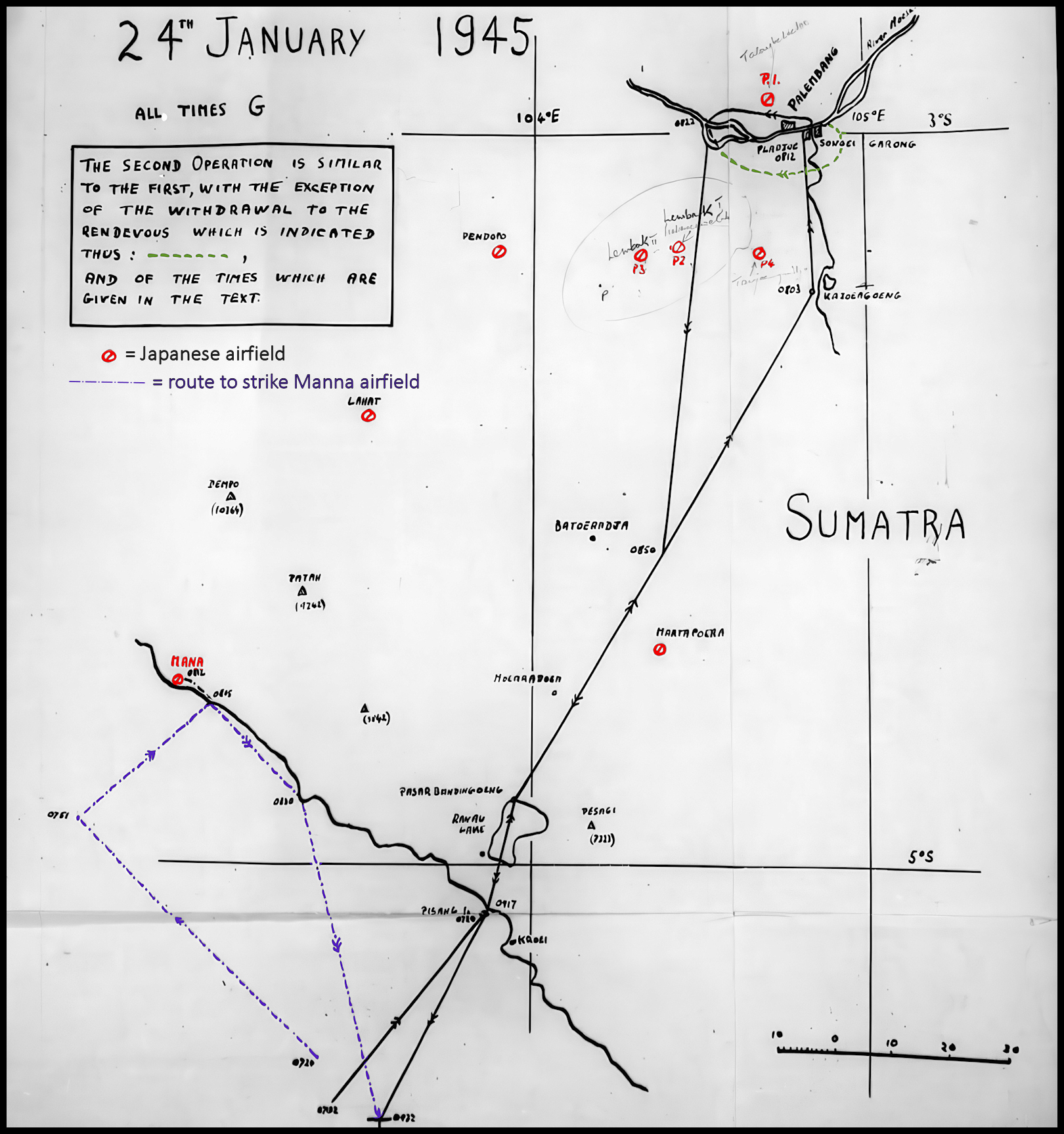
After refuelling from the tankers of Force 69 in poor weather on the 20th, Force 63 approached the flying-off position during the night of the 21st-22nd of January. The weather conditions remained poor and entirely unsuitable for flying operations. The Force withdrew but returned the following night, encountering the same result. On the third night, conditions were acceptable when reaching the flying-off position, approximately 200 miles from the target, the Pladjoe refinery. Flying commenced at 06:15 with the launch of Seafires and Corsairs for Fleet CAP. During the next 45 minutes, the strike force of 48 Avengers, 12 from each of the four carriers and each armed with four 500-lb bombs, along with 16 Corsairs as top cover, and an additional 8 Corsairs and 16 Hellcats as middle cover, were assembled. Two Avengers were damaged on INDEFATIGABLE before take-off, and an additional 4 Avengers and 2 Corsairs dropped out of the formation for emergency landings. At 07:04, nine minutes late, the strike force of 87 aircraft – 47 Avengers, 24 Corsairs, and 16 Hellcats- headed for the objective.
The carriers were slow to prepare the second range and were hampered by aircraft from the first Strike returning for emergency landings. Operations from the second range were not completed until about 07:20; Strike Zebra was launched from INDOMITABLE at 07:09, with 5 Avengers (857 Sqn) and 4 Hellcats (1844 Sqn) as escort, tasked with neutralising the Mana airfield on the coast. Force X-Ray consisted of 24 Corsairs (12 from 1830 Sqn ILLUSTRIOUS and 12 from 1834 Sqn VICTORIOUS), divided into three flights of eight, call signs ‘Whippet I, II, and III’, for the Ramrod assigned to suppress Lembak, Palembang, and Talengbetoetoe airfields in succession. Also included were the 12 Fireflies from 1770 Squadron for the main Strike Bow cover. The 1770 Squadron C.O.’s aircraft became unserviceable at launch, and the remaining 11 Fireflies formed up at 07:15; two others had to return to base with defects soon after. As a result of these delays, the remaining 9 Fireflies did not join up with the striking force until it was approaching the deployment point and pressed on to complete their task of strafing the refinery defences with their 20mm cannons, armed with armour-piercing and incendiary ammunition. The Ramrod had departed 15 minutes late and did not make up any time en route to the first target. A reconnaissance group of 2 PR Hellcats from 1839 Squadron were launched at 08:00 to reconnoitre the island and the target area.
Enemy fighters did not challenge the Avengers and Fireflies until they were within 15 miles of the target. About 20 fighters began to attack, and the fighter escort drove them off. At the same time, the strike force had to navigate heavy A.A. fire and barrage balloons. The Avenger squadrons were divided into two wings. No.1 Wing had 857 and 849 Squadrons, while No. 2 had 854 and 820 Squadrons; arriving over the target, they discovered barrage balloons had been added to the Pladjoe refinery defences. They deployed for their attack at 08:11, and Wing One began their run at 08:14, followed by Wing Two. The strike was over by 08:22, and the Avengers made for their rally point. Several good hits were recorded on the refinery plant, and a wireless station north of the town was set alight. Meanwhile, the escorting fighters had been engaged in heavy dogfights over the target as enemy fighters had responded quickly once the alarm had been raised and claimed 13 single and twin-engined fighters were destroyed, with six more probables.
Major R.C. Hay RM, leader of 47 Wing VICTORIOUS, served as the Air Coordinator for the strike. He directed the strike aircraft to their target, where the crews displayed exceptional bravery and skill. Five Nakajima Ki44 ‘Tojo’ fighters were intercepted and shot down by Corsairs over Sumatra between 08:25 and 09:35. Sub-Lt. Sheppard (1836 Sqn) in JT410 ‘T8H’, Sub-Lt. D. Holland RNZNVR (1836 Sqn) in JT444 'T7P', and Sub-Lt. J.H. Richarda RNZNVR (1834 Sqn) in JT636 'T7J' engaged at 08:40, with the pilot bailing out. Sub-Lt. French (1836 Sqn) in JT486 'T7B', along with Sub-Lt. D.T. Chute RNVR (1836 Sqn) in J7396 'T8K', participated in the action. Major Hay, flying Corsair JT427 coded 'T.RH', also took part in the fight; he shot down either a KA4 or Ki43, which broke apart in flames, along with another that crashed in flames at 08:25 over the Tandjoengradja area. One Corsair from 1836 Squadron and its pilot were lost; Sub-Lt. Blair, in JT368, failed to return from the strike and was last seen in combat with a Japanese fighter over Palembang. Corsairs from ILLUSTRIOUS 15 Wing claimed one Ki44 ‘Tojo’ destroyed during an engagement by Lt H. James, RNVR (1833 Sqn) shared with Lt A. H. Churchill, RNZNVR (1833 Sqn) which was last seen diving steeply on fire at 08:30 and an A6M ‘Zero’ possibly destroyed at low level over Talengbetoetoe airfield at 08:35.
Hellcats from 5 Wing INDOMITABLE shot down six enemy fighters (two Ki-45 ‘Nick’, two Ki-44 ‘Tojo’, and one Ki-43 ‘Oscar’) and damaged three more during the raid. From 1844 Sqn, Sub-Lt L. E. J. Hawkins RNVR, in FN383 ('R6F'), struck a ‘Tojo’ in the port wing at 08:00, south of the Pladjoe oil refinery, causing it to dive steeply. At 08:15, Sub-Lt E. T. Wilson, in JW731 ('R6L'), shot down a ‘Nick’ (shared with the flight leader, Lt A. B. Macrae RNZNvR, in FN431 ('R5H')), followed by a ‘Tojo’, which he left smoking and out of control as it dove over Palembang. From 1839 Sqn, Sqn Lt. Cdr S. F. F. Shotton, in JX758 ('R5A'), attacked a ‘Tojo’ at 08:00, possibly hitting it, before shooting down a ‘Nick’ with its port engine ablaze over Palembang at 08:30. Sub-Lt R. F. Mackie RNZNVR, in JV141 ('R5G'), shot down a ‘Tojo’ at 08:00 before his own aircraft was hit by anti-aircraft fire; he made a safe return to the ship. Lt W. F. H. Schwenk RNVR (aircraft not identified) also damaged one ‘Oscar’ and probably destroyed a second before his own aircraft sustained damage over Palembang at 08:00.
The first returning aircraft landed at 09:40, and recovery was completed by 10:25. The fighter escort reported encountering fairly stiff enemy opposition and claimed the destruction of 13 single- and twin-engined fighters, with 6 considered probable. The Ramrod Sweep achieved its objective, destroying 34 aircraft on the ground and damaging numerous others. The main Strike resulted in probable hits on one powerhouse, three crude distilleries, two other distillation units, a cracking plant, and a reforming unit. A Wireless Station 3 miles northwest of the town was also left in flames. The small striking force sent to the airfield at Mana reported little activity there. One aircraft was destroyed on the ground, and bombs were dropped on the runway.
TF63 lost 13 aircraft in combat and operational sorties. 10 aircrew were killed, and three were taken prisoner: 6 Corsairs, 1 Hellcat, and 2 Avengers failed to return. In addition, one Corsair pilot and one Seafire pilot had to bale out over the fleet.
TF63 began to withdraw at 10:30 and retired to the southwest at 22 knots towards the refuelling area. The 2 PR Hellcats landed at 11:30, having photographed 11 airfields, 6 of which were new and the target.
Five Corsairs from ILLUSTRIOUS’ 15 Wing were lost; 2 pilots from Force X-Ray were killed in action; Sub-Lt A. H. Brown, RNVR (1830 Sqn) was hit by flack during a strafing attack on Palembang III landing strip, his aircraft was seen to somersault in flames along the line of parked enemy aircraft. Lt A. W. Sutton, RCNVR (1830 Sqn), (flying an 1833 Sqn aircraft), failed to return from an attack on Talengbetoetoe airfield; he was believed to have been hit and crashed after making his third strafing run.
Two 1833 Sqn aircraft from the Strike escort were shot down, and their pilots were taken prisoner; Sub-Lt R. I. A. Shaw RNVR was last seen being chased by 2 Ki44 ‘Tojo’ on his tail, and Lt E. J. Baxter, RNZNVR was hit by flack and was forced to bale out over Simpang Lt. Cdr N. S. Hanson, commanding officer of 1833 Squadron, ditched on his final approach to land after returning from a strike mission. His undercarriage struck the water, and the aircraft flipped over onto its back in the wake of the ship, beginning to sink. After escaping underwater, he was swiftly rescued by the destroyer WESSEX and re-joined the carrier the following day, but he was unfit to fly in the subsequent operation.
One Avenger, JZ379 from 820 Sqn INDEFATIGABLE , failed to return. It sustained damage from anti-aircraft fire over the target and is presumed to have ditched after running out of fuel. The crew, CPO H. O. C. Mitchell, Sub-Lt A. Hemington, and Ldg Airman A. C. L. Harris, were not located and were listed as missing and presumed killed.
One Hellcat from 5 Wing INDOMITABLE, Sub-Lt J. M. Haberfield RNZNVR of 1839 Sqn, failed to return from the strike; he baled out of his Hellcat, JX757, which was damaged by enemy fire. He was initially listed as missing, presumed killed, but had, in fact, been taken prisoner. One Avenger, JZ558 of 857 Sqn INDOMITABLE, was shot down by a Japanese fighter and crashed in the jungle; Sub-Lt R. E. A. Hibburd, Sub-Lt J. Mason & PO Airman D. H. Duncan were killed.
Task Force 63 refuelled from the Tanker group on the 26th and 27th. This was a slow process made worse by hose breakages and running fuel supplies; it had become clear that the fuel situation would allow no more than one further strike at Palembang.
.jpg)
.jpg)
Operation MERIDIAN II
At 06:00 on January 29th, TF63 was again in the flying-off position, but inclement weather delayed the first launch until 06:40. The target on this occasion was the Soengei Gerong refinery, located on the opposite side of the Musi River from the previously assaulted Pladjoe installation. As before, the strike force comprised 48 Avengers, 12 from each carrier, a bow cover of 10 Fireflies, close cover of 12 Corsairs, top cover of 12 Corsairs, and mid cover of 16 Hellcats.
Following an examination conducted after the first strike, the orders for the second strike were adjusted; the bombers were to proceed to the rendezvous via a different withdrawal route, passing south of the target to avoid the intense fire encountered around Palembang Town. Separate RAMROD fighter sweeps were to be launched for the two primary airfields: ‘X-Ray’ (12 Corsairs from 1830 Squadron ILLUSTRIOUS) for Lembak, and ‘Yoke’ (12 Corsairs from 1834 Squadron VICTORIOUS) for Talangbetoetoe Airfield. The sweeps were timed so that the two independent squadrons would arrive simultaneously over the airfields to minimise the enemy’s response time to their arrival, subsequently establishing patrols over the airfields once the sweeps were completed. Additionally, 2 Fireflies were launched from INDEFATIGABLE for armed reconnaissance over Mana airfield. The Seafire was the primary CAP aircraft due to its short range, which ruled it out of the strikes. This type, however, was not ideal for deck landing, and many were put out of action through deck landing accidents, so the Fleet CAP was supplemented by the addition of 4 Hellcats and 8 Corsairs.
Problems arose almost immediately: three Avengers and one Firefly failed to launch, and one Avenger, JZ432 from 857 Sqn INDOMITABLE, was caught in the slipstream of the aircraft launched before it, lost control, and ditched shortly after takeoff. The crew—Sub-Lt K. C. Anderson RNVR, Sub-Lt G. P. Morgan RNVR, and Ldg Airman K. H. Turner—were all killed. An additional three Avengers experienced problems and had to make emergency landings. Form-up was completed by 07:34, four minutes late; the strike force was now reduced to 41 Avengers. The second launch, consisting of the RAMROD, bow cover Fireflies, and 2 PR Hellcats from 1839 Squadron, followed shortly after. Two Corsairs turned back due to engine troubles; one from each RAMROD force. One of these, JT539 from 1830 Sqn ILLUSTRIOUS, suffered a hydraulic failure, and the pilot was ordered to bail out.
RAMRODS X-Ray and Yoke arrived over Lembak and Talengbetoetoe airfields at 08:30, but strangely both airfields were virtually deserted. The Japanese had been alerted when the force crossed the coast and were already in the air waiting. The strike force was engaged by Japanese fighters at 08:14, 50 miles out from Palembang, and the escort engaged. The Avengers arrived over the target to find the refinery, once again defended by barrage balloons, which would wreak havoc for the subsequent strike aircraft once smoke from burning oil obscured the area. The Fireflies of the Bow Cover were tasked with engaging the balloons at 4,000 feet in the hope of clearing a path; however, only three balloons were destroyed. The Avengers began their dive-bombing runs at 08:45; two Avengers from 854 Squadron struck balloon cables and went down. JZ112 had its starboard wing sheared off while glide-bombing through the balloon barrage and crashed, resulting in the loss of the crew: Squadron Commanding Officer Lt. Cdr. W. J. Mainprice, DFC, RN, and his observer, Sub-Lt. S. T. Cousins, and air gunner CPO H. G. C. Stollay, FX 79439. Avenger JZ265 faced a similar fate, losing half its starboard wing before crashing, which claimed the lives of Sub-Lt L. R. S. Armstrong RNVR, Sub-Lt L. P. W. P. Houldia, and Naval Airman A. Barber FX 06751. Two more Avengers from 849 Sqn Victorious were shot down, their crews taken prisoner; Z478 ('P1M') went down smoking and made a forced landing in the jungle, with Sub-Lt J. R. Burns, Sub-Lt D. V. Roebuck, and PO Airman I. Barker were captured. JZ386 ('P1B') crashed into the Musi River ablaze, though Lt K. M. Burrenston RNVR, Lt W. E. J. Lintern RNVR, and PO Airman W. J. S. McRae all survived but were taken prisoner.
Other Avengers in the Strike were damaged by accurate flak but managed to find their targets. They were mauled by fighters on the way to the rendezvous point, and the Fireflies engaged the enemy and shot down three of them. The squadron's senior pilot, Lt. D. Levitt RNVR, and his observer, Lt. J. F. Webb RNZNVR, in DT935 ('4M'), shot down an ‘Oscar’ but failed to return from the operation; their kill was shared by. Sub-Lt J. Scott RNVR and Sub-Lt I. H. F. Martin RNVR. One ‘Hamp’ was claimed by Sub-Lt G. E. Pugh RNVR, and a shared ‘Oscar’ with Sub-Lt W. J. Reading RNVR. The strike force departed for the coast at 09:01.
Landing began at 10:15 and would take more than an hour for all returning aircraft to arrive; several badly damaged Avengers were forced to ditch. Two such Avengers managed to reach their carriers, but were ordered to ‘ditch or bale out’ to minimise the risk of fouling a flight deck. Both were from 849 Sqn VICTORIOUS; their crews were picked up by WHELP, JZ336 ('PIG'), which was badly damaged by flak and ditched near the carrier. Sub-Lt I. R.C Paterson RNVR was slightly wounded, but Sub-Lt M. Gunn died of his wounds. JZ345 ('PIC') suffered severe damage to the elevator, wings, oil tank, and hydraulics. Sub-Lt L. R. W. Halliday RNVR, Sub-Lt L. A. Webster RNVR, and PO Airman N. E. Richardson were rescued safely. Two unidentified Avengers from 857 Sqn were unable to land and ditched near INDOMITABLE, both crews were safely picked up by a WESSEX. All returning aircraft were back aboard by 11:00, and the fleet withdrew.
The Fleet CAP fighters had been in action as early as 09:00, pursuing radar contacts and engaging a small group of attackers at 09:40. One Ki-46 'Dinah' was shot down in flames at 09:51 by Sub-Lt J. H. Kernahan, RNVR (887 Sqn) before the rest of the attackers retreated. The Task Force did not come under attack until 11:50, when a group of seven Mitsubishi Ki-21 ‘Sally' kamikaze bombers approached. The CAP Seafires and Corsairs engaged, and three Hellcats scrambled from INDOMITABLE when the attackers were within range of her 4.5-inch guns. The bombers, now at 50 feet, appeared to have singled out ILLUSTRIOUS and INDEFATIGABLE ; all were destroyed, although two came within yards of the two carriers. The Hellcats claimed two kills, both Ki-21 ‘Sally' by Sub-Lt K.A. McLennan RNZNVR of 1844 at 12:00; however, one was shared with an 894 Sqn Seafire flown by Sub-Lt E. Elson RNVR. Seafires claimed another four kills: three by 894 squadron, Lt. Cdr J. Crossman claiming a ki 48 ‘Lily’, and Sub-Lt K.E. Ward RMVR 2 Ki-21 ‘Sally', 1 shared with shipborne gunners. The other was Another ‘Sally' by Sub-Lt J. W. Hayes RMR of 887 Sqn. His aircraft, NN210, was hit in the engine by return fire after making his attack, and he baled out; he was later picked up by UNDINE. The last attacker was destroyed by ship-borne gunfire. During this action, ILLUSTRIOUS was hit by ‘friendly fire’ from the cruiser EURYALUS, as two 5.25-inch A.A. shells struck the ship, killing 12 and injuring 22 others.
MERIDIAN operations were completed at 15:30 as TF63 steamed for the replenishment area. A total of 378 sorties were flown during MERIDIAN One and Two. During this period, 41 aircraft were lost: 16 through enemy action, 11 ditched, and 14 due to deck crashes and landing accidents. The types of aircraft lost were as follows: 16 Avengers (6 to enemy action), 4 Hellcats (1), 15 Corsairs (8), 1 Firefly (1), and 5 Seafires (0). Thirty aircrew were lost; 23 killed and 7 taken as POW. Enemy losses in the air: 30 confirmed and seven probables, 38 were destroyed on the ground.
Force 63 refuelled on January 30th and ‘crossed the line’ on the 31st, arriving at Fremantle, Western Australia on February 4th before reaching their final destination, Sydney, New South Wales on the 9th. The Seafires of 887 and 894, together with the Fireflies of 1770 squadron, were disembarked to RNAS Schofields (Mobile Naval Air Base No.3) and 820 Avengers to RNAS Nowra (Mobile Naval Air Base No.1) the following day. Once ashore, the squadrons regrouped, receiving replacement airframes and aircrews in preparation for re-embarking on the 27th, ready for operations in the Pacific.
On their arrival at Sydney, the combat vessels of the British Pacific Fleet were designated Task Force 113, the support vessels of the Fleet Train as Task Force 112, in readiness for operations with the US 5th Fleet.
On February 27th, INDOMITABLE (Flag, 1st Aircraft Carrier Squadron), together with ILLUSTRIOUS, INDEFATIGABLE , VICTORIOUS, QUICKMATCH, QUEENBOROUGH, and QUALITY, sailed from Sydney for exercises and to fly on aircraft before making their rendezvous with other ships of the BPF, now redesignated Task Force 113, on the 28th. TF113 was under the command of Vice Admiral Sir H. Bernard Rawlings, KCB, OBE, and comprised of the 1st Battle Squadron, Battleships KING GEORGE V (Flagship V.A.B.P.F.), and HOWE, 4th Cruiser Squadron, SWIFTSURE, (Flagship CS 4 Rear Admiral E.J.P. Brind, CB, CBE), GAMBIA, ARGONAUT, BLACK PRINCE, and EURYALUS, (Flag of Rear Admiral (D) Rear Admiral J. H. Edelsten, CB, CBE), the 25th Destroyer Flotilla, GRENVILLE (Captain D 25) ULSTER, UNDINE, URSA, URANIA, the 27th Destroyer Flotilla, KEMPENFELT (Captain D 27), WAKEFUL, WHIRLWIND, WHELP, WESSEX, and the maintenance carrier UNICORN; ILLUSTRIOUS had to remain behind as she had developed defects as a result of a friendly-fire incident and had to be docked to remove her centre propeller before re-joining the Fleet.
The ships of TF113 conducted flying training and exercises while underway and arrived at Manus, the Admiralty Islands, on March 7th. After storing and fuelling at Manus, the carriers INDOMITABLE, VICTORIOUS, and INDEFATIGABLE , along with a screen of six destroyers, proceeded to sea on March 13th for independent flying exercises. Two Fireflies were damaged during the day, both incurring barrier crashes after making fast approaches to the deck: DT934 ('4K') piloted by Sub-Lt V. J. Redding RNVR, and DT934 ('4K') piloted by Sub-Lt L. Crawshay-Jones RNVR. Both were unharmed. After completion, the carriers returned to the harbour. Task Force 113 sailed for Ulithi Atoll on the 18th and arrived there on the 19th.
After refuelling and taking on ammunition and stores, the British Pacific Fleet was redesignated Task Force 57 on March 23rd when it came under the operational control of Admiral Raymond Spruance, USN, C-in-C US Fifth Fleet. TF57 sailed from Ulithi atoll at 06:30 on March 23rd for the operational area off Sakishima Gunto, part of the Ryukyu Islands, located at the southernmost end of the Japanese Archipelago.
Due to the long distances between the operational area and the nearest forward base, all replenishment had to be conducted at sea by the Fleet Train Logistic Support Group (LSG). For the next four weeks, F57 maintained a strike cycle of two days on station, followed by two to three days of replenishment. Shortly after the Fleet departed from Ulithi Atoll, 1770 squadron had one of its aircraft written off. Sub-Lt Crawshay-Jones and his Observer, Sub-Lt J. R. Prince RNVR, in Firefly DT942 ('4G') landed too fast and floated into the crash barrier. [3] Firefly DT980 ('4r’) was damaged after being stopped by the barrier the next day, after the hook bounced off the deck and it missed all the wires.
Replenishment period 1, March 25: TF57 met with the Logistic Support Group LSG at 06:00 on March 25th, at replenishment area ANT, (18° 3o’N 129° 08’E), for a short replenishment at sea, which included the issuing of 4 replacement aircraft from the replenishment CVE STRIKER and topping off fuel tanks. The replenishment carriers embarked on mixed loads for transport to the replenishment area, with numbers varying from 14 to 25 aircraft depending on availability. A typical load for ICEBERG One included 9 Seafires, 7 Avengers, 6 Corsairs, 1 Hellcat, and 1 Firefly, but the composition was adjusted when attrition of certain types exceeded estimates or available spare airframes were in short supply. Fuelling was completed by 15:30.
After completing this topping off, TF57 joined US Task Force 58 on the 26th for joint attacks on the islands of the Sakishima-Gunto group to support preparations for US landings on Okinawa. This marked the first of 12 strike sorties against Japanese airfields in the Islands during Operation ICEBERG One. With the departure of the fleet, the ships of the logistic support group moved to the refuelling area MIDGE on the 28th. Three areas were used for fueling, each a rectangular section covering 5,000 square miles of ocean east of Luzon, with code names derived from insects. Each area was located 50 miles south and 100 miles west of the following coordinates: 'COOTIE' 21° 52’N 129° 24’E; 'MIDGE' 19° 55’N 129° 40’E; and ‘MOSQUITO' 20° 17’N 125° 22’E. The nominated area could change from one replenishment period to the next. LSG Task Units made round trips of approximately 400 miles from their anchorage in San Pedro Bay to restock. The supply chain supporting the BPF with stores and aircraft originated from Sydney to the intermediate base at Manus (2,300 miles from Sydney), and from Manus to Leyte (2,280 miles)
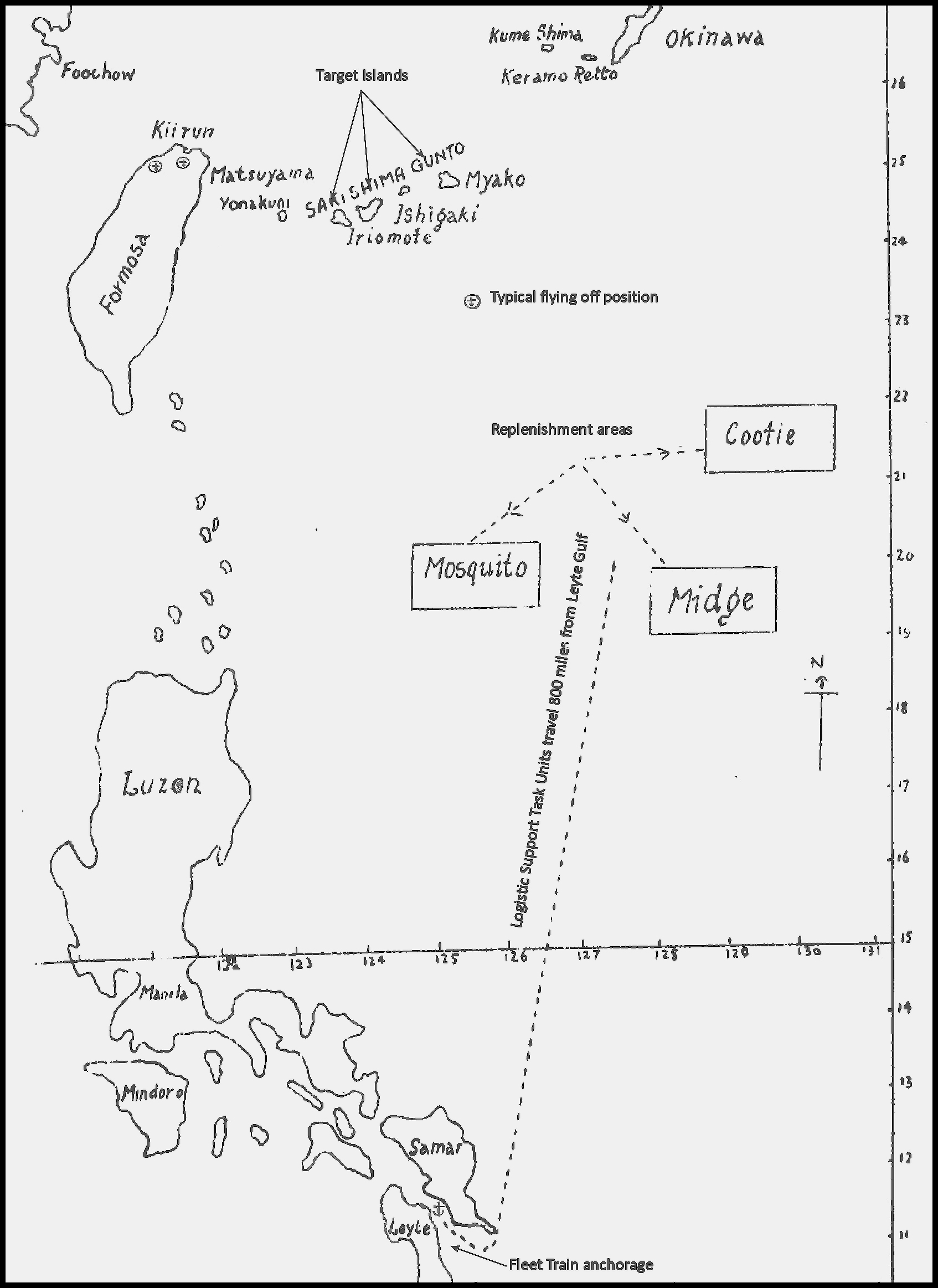
Map illustrating the distance from the forward base at Leyte Gulf to the replenishment at sea (RAS) areas east of Luzon. Established for the BPF during Operation ICEBERG.
Iceberg strike series 1, March 26 - 27: For the first phase of operation ICEBERG, the carriers embarked 218 aircraft: INDEFATIGABLE 40 Seafire, 20 Avenger, and 9 Firefly; INDOMITABLE 29 Hellcat and 15 Avenger; ILLUSTRIOUS 36 Corsair and 16 Avenger; and VICTORIOUS 37 Corsair, 14 Avenger, and 2 Walrus. The carriers were tasked with denying the Japanese use of airfields on two islands in the Sakishima-Gunto group during a series of 12 strike days conducted in rotating cycles of 2 days of strikes and 2 to 3 days of replenishment. When TF 57 stood down to replenish, elements of TF 58 took over the strike task and later TF 52.
ICEBERG operations began at 06:05 on March 26th when the first CAP and one ASP (Anti-Submarine Patrol) aircraft took off. INDEFATIGABLE launched her Seafires for CAP over the force in advance of the first strike launch at sunrise; however, the Seafire still lacked the endurance and range necessary for Ramrod sweeps, so it remained limited to CAP duty. At 06:35, a 48-aircraft strong Hellcat and Corsair RAMROD was launched from a position 100 miles at 180° from Miyako Jima to attack the airfields at Ishigaki and Miyako, where there were three airfields on each island. These sweeps were followed by two escorted bomber strikes and one fighter-bomber strike targeting the airfields and associated buildings.
Once all aircraft had been recovered, the Fleet withdrew to the southeast. TThe Fleet had lost 11 aircraft 3 Avengers and their crews, 1 Corsair and its pilot, 1 Hellcat and 1 Firefly as operational losses. Another four aircraft were in accidents: 1 Avenger, 1 Hellcat, and 2 Seafires.
INDEFATIGABLE ’s squadrons all suffered losses; 1770 lost one Firefly, DT988 ('277/S'), crewed by Sub-Lt D. H. Hobditch RNVR and Sub-Lt A. E. Cundell RNVR, which failed to return from a rocket projectile (RP) strike against shipping in Miyako Bay. The aircraft was hit by flak and ditched, but the crew were rescued. One Avenger from 820 Sqn, JZ628, went over the port side on landing; the crew, Sub-Lt D. H. Thomas RNVR, Sub-Lt J. R. Walker RNVR, and PO Airman W. J. D. Jones, were safely rescued. 887 and 894 Squadrons each had one Seafire written off and one badly damaged. LR813 (887 Sqn), piloted by Sub-Lt A. G. Knight, RNVR, caught a wire but landed heavily, causing the starboard undercarriage to collapse and damaging the wing. NN316 (887 Sqn), piloted by Sub-Lt I. G. Hepworth, RNVR, missed all the wires and floated into No.2 barrier. The damage was so severe that the aircraft was jettisoned overboard. NN447, flown by Sub-Lt R.C. Kay RNVR (894 Sqn), made a fast landing and bounced into the barrier. NN262 (894 Sqn), piloted by Sub-Lt I. H. S. Morgan, RNVR, bounced on landing and ended on its nose, causing its undercarriage to collapse; it too was jettisoned.
Enemy losses were 35 aircraft destroyed on the ground; Many of these turned out to be dummies, and as few as 12 were believed to be real.
At 02:45 in the early morning of March 27th, a bogey was detected by radar to the east. A Hellcat was then launched from INDOMITABLE to intercept it, but the moon was obscured by a cloud just as the pilot was about to open fire, allowing the enemy to escape into the darkness. The fleet was again positioned 100 miles south of Myako Jima at sunrise, and the CAP and ASP were launched at 06:05, followed by a 24-aircraft strong Hellcat and Corsair RAMROD fighter sweep sent into Ishigaki Jima, where they reported little activity. Two bomber strikes, each consisting of 24 Avengers and 4 rocket-equipped Fireflies, were directed against radio stations, barracks, and airfields not targeted the previous day. Coasters off the islands were also attacked. The final mission was a small fighter-bomber strike. A typhoon was reported to be heading towards the Sakishima-Gunto group, prompting the decision to cancel the air and bombardment programme planned against Ishigaki Jima for the 28th, leading to the fleet's withdrawal to the replenishment area east of Luzon after the second day's strikes had been executed.
The Fleet had lost 10 aircraft. INDEFATIGABLE ’s
24 Wing had 2 Seafires and their pilots lost on operational sorties and 3 others damaged in crashes; Sub-Lt S. C. Yarde, RNVR (894 Sqn) in NN400 and Sub-Lt A. G. Cooper, RNVR (894 Sqn) in NN146 were killed when their aircraft collided in mid-air, both aircraft dove into the sea. There were three aircraft put out of action through barrier crashes, NN232 flown by Sub-Lt L. A. Bradbury
RNVR, NN208 flown by CPO M. A. C. Levett and NN290 flown by Sub-Lt A. St Belcher RNVR (894 Sqn).
Replenishment period 2, March 28 - 30: The LSG were waiting at the prearranged rendezvous, in area MIDGE One, a rectangular area which covered 5000 square miles of ocean, at 07:30 on the 28th TF57 met the Tanker Group and began refuelling. STRIKER issued 13 replacement aircraft to the fleet and recovered three flyable, but unserviceable, aircraft; she also transferred replacement Avenger aircrew to 854 Squadron in ILLUSTRIOUS. Her stock of spare aircraft was exhausted, and STRIKER departed for Leyte in the afternoon of the 29th, escorted by CRANE and WHIRLWIND. Replenishment was complete by mid-afternoon on March 30th.
Iceberg strike series 2, March 31 – April 2nd: TF57 was in its flying-off position for another strike day by dawn on March 31st, ready to resume strike operations. TF 57 needed to resume its strikes on the enemy airfields because April 1st was L-Day for the American amphibious assault on the western coast of Okinawa. Pre-dawn CAP and anti-submarine sweeps, followed by Fighter Ramrod launch at sunrise, were now standing procedure, and the force repeated the attacks of the previous strike days. Fighter patrols – Target Combat Air Patrols (TCAP) - were now to be maintained over Ishigaki and Miyako, and there appeared to be little activity in either island. Two bomber strikes were sent against Ishigaki airfield, installations and barracks.
The Fleet had lost 6 aircraft.
Three Seafires from INDEFATIGABLE's 24 Wing were damaged in accidents on deck.
Not long after the start of the second day’s strike program on April 1st, radar detected bogeys at 06:50, approaching from the west at a height of 8,000 feet, closing at 210 knots. The fighter sweep was already en route to Ishigaki and was recalled to intercept; additional fighters were launched, and Corsairs, Hellcats, and Seafires engaged the enemy. Four enemy aircraft were destroyed; Seafires shot down two A6M ‘Zero’ fighters. Sub-Lt Reynolds of 894 Sqn in Seafire PR256 ('146/S') despatched both, but the bulk reached the fleet.
The enemy planes commenced their attacks on the fleet at 07:10. One aircraft machine-gunned INDOMITABLE, killing one rating and wounding two officers and four ratings. It conducted a similar attack on KING GEORGE V but did not cause any casualties. The fleet’s gunners reported that it was difficult to distinguish enemy planes from our own since they were closely following the enemy. At 07:27, the first Kamikaze attack occurred; one enemy plane dove into the base of INDEFATIGABLE's island. Four officers and ten ratings were killed, and sixteen others were wounded. The flight deck was temporarily out of action, but later that day, aircraft were again operated from the ship, although at a reduced scale.
By midday, the fleet was able to resume flight operations; at 12:15, a bombing strike was sent in against Ishigaki to bomb airfields and runways. No activity was noted. At 14:30, combat patrols over the islands reported that more aircraft had been sighted at Hirara and Ishigaki airfields. The fighter patrols attacked these and were followed by a fighter sweep. It was estimated that about 14 enemy aircraft were destroyed on the ground during this attack, and others were damaged.
A second Kamikaze attack involving four aircraft managed to evade INDOMITABLE’s CAP Hellcats and reached the Fleet at 17:30. One aircraft made a dive on VICTORIOUS; the ship’s A.A. fire damaged the attacker, and the plane touched its wing on the flight deck edge, spinning harmlessly into the sea where its bomb exploded clear of the ship. [It is unclear what happened to the other three attackers.] At dusk, the fleet disengaged and steamed southeast. TF57 had lost 4 aircraft. During the second day of strikes, INDEFATIGABLE’s Seafires claimed two A6M ‘Zero’ aircraft destroyed, both shot down over the Fleet by Sub-Lt R. H. Reynolds RNVR 894
Sqn, in PR256 ('146/S'), between 0730 and 0800. However, the Seafires again bore the brunt of the aircraft attrition; three were damaged upon landing, two from
887 Sqn and one from
894 Sqn. Two other aircraft from
894 were write-offs. One pilot from
894 Sqn, Sub-Lt N. T. Quigley, RNVR, died from his injuries after attempting an emergency landing in NF516, which floated through two barriers before stopping. A second pilot from
894 Sqn, Sub-Lt W. G. Gibson, RNVR, was killed on April 1st during the Kamikaze attack on INDEFATIGABLE.
At 05:10 on April 2nd, INDOMITABLE’s four Hellcats, held in night readiness, were launched by moonlight to conduct a pre-dawn sweep for prowling enemy aircraft. Two were allocated to Ishigaki, while the other pair was destined for Miyako but returned to the ship due to radio failures. The remaining two pressed on, only to find no targets. A Fighter RAMROD of 17 Corsairs and Hellcats departed at 06:30 from a launch position of 23° 12’N 126° 02’E to attack all the airfields; one Zeke was spotted over Ishigaki and was shot down by Hellcats, with two aircraft claimed destroyed on the ground. The RAMROD returned by 10:45, and the Fleet withdrew to proceed to fueling area MIDGE One, maintaining a Fleet CAP of 12 aircraft until dark. During the day’s operations, the Fleet had lost 4 aircraft.
Replenishment period 3, April 3 - 5: There was no sign of the LSG in Area Midge (1) at 19° 12’ N 128° 00’ E; bad weather hindered the rendezvous, which occurred at 12:30. Weather and cross swell were too heavy to attempt refuelling. During this replenishment period, the CVEs
SPEAKER with
1840 squadron Hellcats embarked provided CAP for the Fleet Train while
SLINGER provided replacement aircraft and aircrews. The Fleet remained in the area throughout the day. However, towards the evening, meteorological information suggested more suitable weather to the west, prompting the fleet, along with the tankers, to turn west toward the area MOSQUITO.
The fleet repositioned overnight on the 4th to position 19° 37’ N 124° 42’ E. At 06:30, Task Unit 112.2.3, with two more Oilers, arrived on station, making a total of five tankers from which to fuel. TF 57 began refuelling and transferring stores and aircraft at 07:30 in a heavy N.N.E. swell. The Fleet disengaged from the Tanker Group for the night at 19:30.
Fuelling recommenced at 06:30 on the 5th, the weather conditions for fuelling having considerably improved. The Fleet disengaged from the Tanker Group at 19:30 and set course at 20 knots for the operational area. During this replenishment period,
SLINGER provided replacement aircraft and aircrews. She issued 22 replacement aircraft to the fleet carriers and recovered 2 ‘flyable duds'
Iceberg strike series 3, April 6 - 7: TF 57 resumed Strikes on the morning of April 6th, first launch was at 04:50 when four fighters were flown- off INDOMITABLE, two each to Miyako and Ishigaki airfields to attack any enemy aircraft taking off at dawn, and eight aircraft not previously noticed at Ishigaki were attacked. At 06:35 TCAP to cover both islands were launched. The craters in the runway at Miyako airfield were observed to be filled in. Avengers bombed and hit Hirara runway and town, and bombed Nobara, Sukhama and Myara airstrips causing fires. Fighters attacked radio and radar stations, sank two junks and blew up a bowser.
During an enemy attack at about 17:00 four bogeys were engaged and one dived on ILLUSTRIOUS, which took radical avoiding action. The Kamikaze’s wingtip hit the island, spinning the aircraft into the sea where the bomb exploded. Only slight damage and no casualties were caused. One of 894 squadrons Seafires was shot down by gunfire from ILLUSTRIOUS, during the raid: the pilot Sub-Lt N.V. Heppenstall, RNVR was not recovered.
The Fleet had lost 6 aircraft, including 1 to ‘friendly fire’, 2 to bomb blast, and one ditched on take-off. Enemy aircraft losses were six destroyed and six damaged, plus two junks were sunk. INDEFATIGABLE lost two further Seafires, both from 887 Sqn; NN406 piloted by Lt E. Kverndal, RNVR, missed all the wires and flew into the barrier, sustaining severe damage and was later jettisoned. NN208 piloted by Sub-Lt L. A. Bradbury, RNVR, bounced over all the wires and the barriers and crashed into the Deck Park. His aircraft was written off and presumably jettisoned. .
The planned programme for April 7th was changed after receipt of intelligence indicating a possible mass attack by enemy forces; a planned bombardment was cancelled, and the focus remained on maintaining a constant TCAP over the enemy airfields to deny the Japanese the use of their aircraft. CAP for the fleet and the Islands were launched at 06:10. Again, it was observed that bomb craters on Ishigaki had been filled in, and that Hirara and Nobara airfields appeared serviceable. Three bomber strikes were launched during the day to re-crater these fields. This was successfully carried out without loss. At 19:30, the fleet withdrew for its third replenishment period, having successfully disabled all the target airfields.
The Fleet had lost 7 aircraft, 3 in combat and one operationally. Another four aircraft were lost due to other causes. Enemy losses included three aircraft destroyed on the ground and four damaged. Four fishing vessels and three luggers were also damaged. At 19:30, the fleet withdrew after successfully disabling all the target airfields and proceeded to replenishment area Cootie One for their third replenishment period.
Replenishment period 4, April 8 - 9: At 06:00 on the 8th TF57 met the LSG in replenishment area COOTIE One, U.S. Task Group 52.1 having taken over the strike duty.
SPEAKER’s
1840 squadron Hellcats again provided CAP for the
Fleet Train while
STRIKER
supplied replacement aircraft and aircrews; she issued 13 replacement aircraft, recovered 4 flyable 'duds', and supplied one Avenger crew to 854 squadron. Replenishment was completed by the afternoon of the 9th, and TF 57 left Cootie One to return to Sakishima
The strike programme called for further attacks on the 10th and 11th, returning to Leyte for completion; this changed when Admiral Spruance, commanding the U.S. 5th Fleet, requested that TF57 instead strike airfields in Northern Formosa. The U.S. had been hit hard by kamikaze attacks originating from Shinchiku and Matsuyama airfields in Formosa; American carriers had wooden flight decks, and a kamikaze hit could cause very serious damage. The British carriers all had armoured flight decks, so the risks of severe damage were far less. Admiral Rawlings agreed to the new tasking, and the two strike days for Sakishima were cancelled, and TF57 made for Formosa.
Iceberg strike series 4, April 10 - 12: Formosa and ‘ICEBERG OOLONG’ The revised programme called for strikes on Shinchiku and Matsuyama airfields on Formosa on April 11th and 12th. The Fleet arrived in the flying-off position 30 miles southwest of Yonakumi Shima at 06:00 on the 11th, but weather conditions were unfavourable, and the strike was postponed for 24 hours.
The weather had improved considerably during the night as the Fleet returned to its flying-off position off Formosa. At 05:55, the Fleet was detected by enemy reconnaissance aircraft, and shortly afterwards, enemy air activity was noted to the north. Sixteen Seafires were launched at 06:15 for Fleet CAP, and at 07:04, one flight of four from
887 Squadron encountered four eastbound enemy fighters, three A6M2 ‘Zeke’ and a single Ki-61 ‘Tony’. At 07:19, Sub-Lt J. H. Kernahan, RNVR, shot down one ‘Zeke’ into the sea 5- 10 miles north of Yonakuni Shima and claimed the Ki-61 as possibly destroyed. The other two aircraft managed to escape.
Two strikes, each of 24 Avengers and 20 escorting Hellcat and Corsairs, were flown off at 07:15 from position 23°58' N 122°46' E. After forming up these proceeded in company around the coast towards their targets, cloud prevented either strike going over the mountains One strike bombed Shinchiku airfields with delay fused bombs and attacked dispersals. There was flak but no airborne opposition. Due to cloud conditions over Matsuyama airfield, the other strike attacked their alternative target, Kiirun harbour, where hits were observed on the chemical plant, dock area and shipping. One flight investigated Matsuama and found little activity. A nearby railway station and factory were attacked, and one DC-2 ‘Tess’ was destroyed on the ground. A bridge over the river south of Matsuama was destroyed and shipping at Tansui shot up.
At 09:20, during the escort mission, Sub-Lt E. Miller RNVR, the observer of the leading plane, DT941 ('276/S'), spotted several aircraft about five miles away, and the two fireflies closed in. The leading pilot, W. Thomson RNVR, recognised them as five Ki-51 'Sonia' kamikaze dive-bombers in formation heading for the Fleet. He signalled his number two, Sub-Lt J. P. Stott RNVR, and his observer, Lt. R. Ward RN, in DVI19 ('281/S'), to attack. The whole action was over in a few minutes. Sub-Lt Thompson destroyed one target at close range; it exploded, and as he passed by, his windscreen was covered with blazing oil. Meanwhile, his number two, Sub-Lt Stott, was destroying another. Each bagged two after dogfights low on the water, 10 miles NW of Kumi Island, while the fifth aircraft escaped into a cloud. These aircraft had not been detected by radar; fighters were thereafter maintained over the island. Hellcats and Corsairs successfully beat off enemy air attacks; the Seafire CAP did not engage. As a result of the Firefly engagement, Sub-Lt Stott became the top-scoring Firefly pilot,
with two confirmed and three shared enemy aircraft destroyed.
.jpg)
April 12th 1945, the Firefly crews of the ‘Dunbo’ ASR escort on the flight deck on their return after destroying four enemy aircraft in aerial combat. Left to right – Lt. (O) R. Ward, RN, Sub-Lt (A) (P) P. Stott, RNVR; Sub-Lt (A) (O) E. Miller, RNVR; Sub-Lt (A) (P) W. Thompson, RNVR. Image IWM (A 29286
At the end of the days strike a total of
17 enemy aircraft had been destroyed or damaged;
16 shot down and 1, plus 1 probably destroyed, on the
ground, 2 damaged in aerial combat. TF 57 lost
5 aircraft.
A second round of strikes was planned for the 13th; at 05:50, four fighters were flown off, shortly after a raid was made by 4 enemy D3A ‘Val’ bombers, one bomb narrowly missing INDOMITABLE. A Hellcat was hit by friendly fire during the gunnery barrage to defend the Fleet; the pilot was killed. The first Seafire and Corsair CAP flights launched at 06:15 in position 23° 58.5' N. 122° 46' E. At 06:40, a small group of bogeys was intercepted by CAP Corsairs 25 miles to the northwest of the Fleet; two A6M2 ‘Zeke’ were splashed and the remainder retired to the north.
Two Avenger strikes were flown off at 06:45 to attack Matsuyama and Shinchiku airfields. The weather over Matsuyama was fair. Runways, barracks, and dispersal points were successfully bombed, and a petrol or ammunition dump was blown up. Few aircraft were seen on the airfield. Fighters shot up about 12 aircraft on Giran airfield without apparent result. The other Avenger force bombed Shinchiku airfield through low clouds, hitting runway intersections and installations. No aircraft were lost in either of these strikes, and there was no airborne opposition.
At 13:00 Hellcats intercepted 3 A6M2 ‘Zeke’ about 40 miles north of the Fleet, and Corsairs intercepted a Dinah escorted by Ki-44 ‘Tojo’ fighters. All the enemy aircraft escaped in cloud. The Firefly CAP for the ASR Dumbo attacked the suspected radar station on Yonakuni Shima with rockets and apparently destroyed it. When relieved, they also shot up luggers and small craft in the harbour close to Iriizaki. After these bomber strikes were flown on, the Fleet disengaged to the south eastward to refuel.
After
these bomber strikes were flown on, the Fleet disengaged to the
south eastward to refuel. A total of
8 enemy aircraft had been destroyed, 3 shot down
with 5 destroyed on the ground; TF 57 lost 2 aircraft.
Replenishment period 5, April 14 - 15:
At 06:30 on April 14th the Fleet made contact with LSG in
position Cootie One. The carrier FORMIDABLE, with destroyers KEMPENFELT and WESSEX, was waiting and joined Task Force 57, relieving ILLUSTRIOUS, which sailed for Leyte at 17:55, screened by URANIA and QUALITY. Replenishment continued on the 15th,
SPEAKER
provided CAP but no replacement aircraft were available during this
replenishment period; FORMIDABLE was at full strength however, carrying 848 Squadron’s 18 Avengers along with
1841 and
1842 Squadrons - each with 18 Corsairs.
Iceberg strike series 5, April 16 - 17: The Fleet was back on station off Sakishima at position 23° 28’ N, 125° 18’ E in the early hours of April 16th to resume ICEBERG strikes. At 06:00, Fleet CAP was flown off, and at 06:30, the first strike took off to attack Ishigaki airfields. This attack, and a further one flown off at 12:30, left all the runways unserviceable. At 09:30, the second strike took off to attack Miyako airfields, where previous craters were found to be filled in; this attack, together with another flown off at 15:33, left all Miyako airfields out of action. Rocket-carrying Fireflies straffed a radar station at Miyako, and ground installations, barracks, and grounded aircraft generally were straffed. There was no airborne opposition over the targets, and flak was moderate. In the afternoon, Seafire NN208 (887 Sqn) bounced on landing, cleared the barriers and crashed. The pilot, Sub-Lt L.A. Bradbury, was unhurt, but the plane wrecked an Avenger, damaged Firefly DT941 ('276/S'), and knocked two ratings over the side. QUIBERON picked up one, but the other was not recovered. At 17:35, two Hellcats from 1844 engaged a C6N ‘Myrt’ 80 miles east of Formosa, and shot it down in flames.
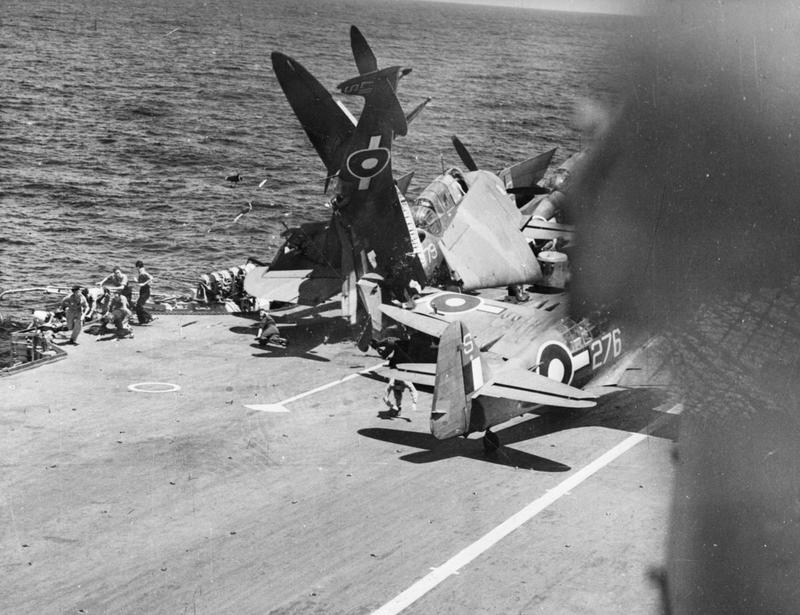
April 16th 1945: The scene after Seafire NN208 of 887 Squadron bounced over all arrestor wires & barriers to land in the deck park damaging an Avenger and Firefly DT941 ('276/S'). The pilot Sub-Lt L.A. Bradbury RNVR was OK but two crewmen were knocked overboard, one of which was not recovered. Image © IWM (A 29715)
The success in subduing the enemy airfields was shown by the fact that only two enemy aircraft were destroyed: one shot down and one destroyed on the ground TF57 lost 5 aircraft - 3 in combat and 2 operationally.
On the morning of April 17th, CAPs was flown off at 06:00, the first strike taking off at 06:30. Efforts had been made to fill in the runway craters at Miyako, but none at Ishigaki, so the strike was sent to Ishigaki. Of the strikes sent to Miyako, the first two left all airfields unserviceable and the third attacked municipal buildings and barracks. TCAPs were maintained over both islands, but reported no activity on any airfields, all of which remained unserviceable at the end of the day. No operational aircraft could be found on the ground. The day's tally was 3 enemy aircraft destroyed in combat and several small ships damaged. TF57 lost 1 aircraft ..
Replenishment period 6, April 18 - 19: During the 18th and 19th the fleet refuelled from the LSG tanker group, SPEAKER again providing CAP fighters. No replacement aircraft were issued during this period.
Iceberg strike series 6, April 20: TF 57 was back on station before dawn on April 20th to carry out their twelfth and final strike day of ICEBERG One. The pattern followed that of previous strike days, and the day ended with all airfields cratered; neither the strike groups nor the Fleet encountered enemy air activity. TF57 lost 1 aircraft .At 19:10, the Fleet set course for Leyte to meet the Fleet Maintenance Group for repairs and a replenishment period.
Damage repair and defect rectification was a priority; the bomb damage to INDEFATIGABLE’s Island was taken in hand by teams from the repair ship ARTIFEX and were completed in a week The Fleet embarked stores, ammunition, replacement aircraft and squadron aircrews were returned to full strength in readiness for the second phase of ICEBERG operations.
Task Force 57 sailed from Leyte at 06:30 on May 1st to return to their operational area off the Sakishima-Gunto group for a second series of 12 strike days. In the forenoon of May 1st, INDEFATIGABLE launched eight Avengers to clear the deck, and four Firefly pilots received deck landing training. One Avenger pilot followed them, but due to changing wind conditions, it was not possible to provide any refresher training to the 18 new Seafire pilots now present aboard.
The forenoon on the 2nd was devoted to Seafire air drills and test flights, during which 13 of the new pilots made one deck landing each. In the afternoon, an extensive air exercise occurred, during which all new Firefly crews participated. Twelve Avengers were launched for the drill, but four returned for emergency landings.
Replenishment period 7, May 3: The Fleet refueled from the
LSG in Area MOSQUITO One during the day on
May 3rd to top off their tanks before departing for the flying off position.
Tragedy struck 1770 squadron that evening, an Avenger parked on the aft end of the flight deck with wings folded accidentally fired off approximately 100 rounds from its forward gun mounts. Some of these rounds penetrated the quarterdeck and ricocheted into 1770 Sqn aircrew cabins. Squadron Observer Sub-Lt (A) J. A. R. Mcintyre RNVR was killed, and two pilots were injured, one of whom was the senior pilot. Some hasty reorganisation was needed to prepare for combat operations the next day.
Iceberg strike series 7, May 4 - 5: The strike program for the first day included a bombardment of shore targets by the Battleships KING GEORGE V and HOWE and Cruisers BLACK PRINCE, EURYALUS, SWIFTSURE, GAMBIA and UGANDA. On arrival at the flying off position, INDEFATIGABLE reported 20 Avengers, 11 Fireflies, and 38 Seafires serviceable. Fleet CAP aircraft began launching at 05:40 when 8 Seafires launched for the first of six CAP serials planned for the day. Ten minutes later, enemy air activity near Sakishima was detected. One small group approached the Fleet, CAP Hellcats intercepted; one ‘Zeke’ was shot down in flames at 07:00 before the others escaped in cloud.
Strike ABLE began launching at 06:10. Twelve Avengers had been ranged on INDEFATIGABLE, but by aircrew briefing time, this had been reduced to nine. Four of these were accelerated. 820 Squadron, led by Lt (A) C. A. G. Aldcroft, RNVR, formed up with eleven Avengers from 849 Squadron and eight Corsairs from 47 Wing aboard VICTORIOUS.
Eight R/P-armed Fireflies were also set to launch as part of this strike, but one became unserviceable before takeoff. They were airborne by 06:17. They were to split into two groups: four to escort the Avengers to Miyako Shima, while the others headed to Ishigaki Shima with orders to attack any shipping in Hirara and Ishigaki harbours. The strike group, led by Lt. Col. R. C. Hay, RM, departed for Miyako Shima at 06:28. The Island was reached at 06:45 and found to be clear of cloud and with good visibility. Communication problems arose on the way to the target; heavy interference was heard on the assigned radio channel, most likely caused by static and not by the transmitter being left on. The transmission could just be heard through the interference.
The targets for 820 Squadron were 5 A.A. troop positions East of the southern end of Hirara Airfield's North/South runway. 849 Squadron was to bomb A.A. emplacements to the west of Hirara Airfield. The attack began at 07:05. Eight aircraft from 820 Squadron aimed at the targets ordered. At least one stick of bombs burst at each end of the target area, and one stick was seen to burst in its counter. Four bombs missed, one of which demolished a farmhouse 500 yards South of the runway. The ninth aircraft failed to identify the targets and aimed at a revetted twin-engined aircraft 600 yards to the North. Its bombs
missed short. Two Avengers used their front and rear guns on a lorry on the airfield. Hits were observed, and the lorry stopped but did not flame. Buildings and boats at Yerabu were also attacked with machine gun fire. One Avenger of 820 Squadron, JZ481, was hit by Flak as it pulled out of its bombing glide. On fire, the hydraulic system was wrecked, and with two crew members injured, the damaged aircraft was escorted out to sea by two others of 820 Squadron. Shortly after the fire in the wing tank burnt itself out, the aircraft was escorted safely back to the fleet, and Sub-Lt (A) A. I. Ryman, RMVR, landed at 07:55 with one undercarriage leg only half down. The aircraft was a write-off and was later jettisoned. The remaining 820 Squadron Avengers landed at 0905.
849 Squadron dropped thirty-seven 500-lb bombs with one direct hit on an A.A. emplacement, and three sticks were near misses. One bomb hung up, and the pilot successfully released it to hit the runway at Sukuma airfield. After rendezvousing with the remaining aircraft of the strike group, they set course for the base at 07:12 and landed by 08:21.
1770 squadron had been briefed to attack targets independently of the Avengers; shipping off Miyako, with Barracks and a radar station as alternative targets, should no shipping be encountered. On reaching the Island, they split into two flights. The first flight of four Fireflies wasted all their rockets on a wreck North of Hirara. This was not a briefed target, suggesting that the crews had paid insufficient attention to their briefing. Without any remaining rockets, they straffed the Defences on Shimoji Shima with cannon, and a fire was started inside a stone or concrete pillbox. The other 3 Fireflies, led by Major V.B. G. Cheesman, RM, found no shipping off Ishigaki. One section attacked the Radio Weather Station with rockets, four pairs bursting amongst the buildings. The Northern building was seen to be hit, and the Southern building was probably hit. The third aircraft attacked Ishigaki Barracks with rockets, which missed close to the south. On their way out, the Fireflies straffed some very small boats in Ishigaki Harbour, two of which caught alight. All 7 Fireflies landed on between 08:22 and 08:25. The remaining Aircraft from Strike ABLE had landed by 08:30.
Strike BAKER for Ishigaki Shima began launching from INDOMITABLE at 08:17 when twelve Avengers from 857 Squadron and the Air Group Leader's Flight of two Hellcats (Cdr N. S. Luard RN) took off. They were joined by a further 11 Avengers from 848 Squadron and 8 Corsairs from 6 Wing. FORMIDABLE as an escort. The Strike departed at 08:45, with four Corsairs bow and four Corsairs stern escort. Air Group Leader's flight of two Hellcats flew above the strike. On approaching Ishigaki, Cdr Luard and his no.2 went ahead and observed that both Ishigaki and Miyara Airfields were serviceable. They instructed the strike leader to attack the targets for which they had been briefed. Lt-Cdr T. G. V. Percy led 848 Squadron's Avengers to attack Ishigaki, and Lt-Cdr W. Stuart, DSC, RNVR led 857 Squadron's Avengers to attack Miyara. All enemy A.A. batteries appeared to be operational and opened fire on the strike aircraft.
848 Squadron dropped 44 x 500-lb bombs on the main runway of Ishigaki Airfield, resulting in an estimated 20 craters in the runway's centre 857 Squadron dropped 44 x 500-lb bombs on Miyara Airfields, scoring 12 hits hits on the southern end of the main runway and six hits off the southern end of that runway. Both Airfields were effectively cratered and unfit to operate aircraft. The Corsairs of the escort dropped 16 x 500-1b bombs on Ishigaki Town and Harbour, hitting Ishigaki Pier. A large junk crossing to Ishigaki was strafed by No. 1 and 2 sections, and left half-submerged. Sub—Lt F. T. Stirling RNVR of 1842 Squadron also straffed and destroyed an unidentified enemy aircraft believed to be a two-seater. One of 857 Squadron's Avengers, the last of the second flight to attack, failed to reach the rendezvous. Aircraft from Strike BAKER had landed by 10:55.
Bombardment: At 10:00, TF57 had split; the bombardment force detached to take up position for the upcoming shoot. Conditions for bombardment appeared good, and it was hoped that artillery fire would effectively take out A.A. batteries around the airfields. The bombardment commenced at midday, EURYALUS and BLACK PRINCE carried out a simultaneous "air burst" shoot on the A.A. defence area of Nobara airfield. KING GEORGE V and HOWE bombarded Hirara airfield and the A.A. defence area to the north of the airfield, on completion of the "air burst" shoot, SWIFTSURE and GAMBIA bombarded Nobara airfield, and UGANDA Sukama air strip. Hellcats from 1844 acted as spotters for the bombardment by KING GEORGE V. The spotting sortie was not a success due to poor radio communication between the aircraft and the Battleship. Two Corsairs from 1842 were tasked with Bombardment spotting and aerial photography for the SWIFTSURE and GAMBIA shoot. The shoot was unsuccessful because the plan was changed from alternate salvos to simultaneous salvos, which made calling the fall of shot for Individual ships difficult.
Kamikaze attack: Meanwhile, at about 11:00, the Carrier group came under air attack. Three small groups of bogeys were detected to the westward, and were soon followed up by a fourth, in all 16 to 20 enemy aircraft, some acting as decoys. Fighters engaged one group working around to the south. Still, one Kamikaze group penetrated the carriers and was first detected at 11:31 when a ‘Zeke’ was seen diving from a great height onto FORMIDABLE. The Kamikaze crashed into the flight deck near the island, causing severe damage; casualties were eight killed and 47 wounded; 11 Corsairs and 10 Avengers were damaged beyond repair, both flight deck barriers were damaged, and the forward one was irreparable. The flight deck suffered a 2-foot square hole with an indentation measuring 10 feet square and 2 feet deep at the centre. Splinters from the armoured deck passed through the hangar deck, causing damage to various compartments. Four minutes later, another ‘Zeke’ was engaged by FORMIDABLE‘s 4.5-inch guns and temporarily disappeared in cloud. It soon reappeared, diving steeply at the ship. Extreme evasive manoeuvres were made as the plane approached. Close-range weapons heavily engaged it and set it on fire; it flattened out at the last moment, appeared to make a deck landing on the flight deck, only to continue over the side, taking the radar arrays of the port amidships gun director with it. The bomb appeared to explode shortly after the plane submerged. .
Ait 11:42, INDOMITABLE was narrowly missed by another Zeke, which dived steeply on her. The carrier's close-range weapons and her escort QUALITY caused the aircraft to burst into flames, and it crashed into the sea about 10 yards off the starboard bow of the ship. No damage or casualties were sustained in either of the last two attacks. Her damage control and repair teams had her patched up enough to land on 13 of her Corsairs by 17:00.
The Fleet CAP aircraft were kept busy; early probes proved to be decoy moves. However, at 11:25, Corsairs engaged the third group of detected bogies, which turned out to be ‘Zekes’. Unfortunately, the Corsairs were only able to shoot down one before losing sight of the remaining three. At 11:15, enemy suicide attacks developed, and at 11:20, Sub-Lt. Reynolds in ('141/S') and his No.2, Sub-Lt. R. C. Kay, RNVR, on CAP duty, saw the fleet turn out of wind and open fire to port. They immediately went to investigate at 1,500 feet. They spotted an A6M2 ‘Zeke 32’ 2 miles away astern of the Fleet and 1,000 feet above them, and they climbed to the attack. The Zeke 32 jettisoned its bomb and turned in as the Seafires made their first runs. Sub-Lt. Reynolds scored several hits on his first attack, and the enemy took violent evasive action, diving to sea level and being pursued by Sub-Lt. Kay. The two Seafires then attacked together, both scoring more hits, and at 11:25, the ‘Zeke 32’ burst into flames and crashed into the sea.
At 12:50, a division of 3 Seafires led by Sub-Lt Miseldine was vectored onto a bogey, which they intercepted seven miles due East of the fleet at 1252. The enemy was recognised as a D3A ‘Val’ and was 1,000 feet below FX. 96216 CPO pilot W. Daniel, the flight Number 2 was in a good attacking position and dived on the enemy from dead astern, obtaining many hits. The ‘Val’ smoked slightly, went into a steep spiral to Port and jettisoned two bombs. As Sub-Lt Miseldine went in for the kill, two crew baled out of the ‘Val’ which he followed down until it crushed into the sea and burst into flames.
At 17:20, another raid was detected approaching the fleet from the West, and a flight of 3 pilots from 887 Sqn, led by Lt A. S. Macleod, RNZNVR, were vectored to intercept. They encountered four A6M5 ‘Zeke 52’ aircraft at 17:25, which were 2.000 feet below them. Simultaneous attacks from astern were made by Lt Macleod in Seafire PR254, Sub-Lt D. T. Challick RNIN in ('131/S') and CPO Pilot I. B. Bird in NN363, destroying one each in a brief engagement in which no resistance or attempt to evade was made. CPO Bird spotted the fourth ‘Zeke’ flying much lower to the sea and gave chase, it climbed and escaped into the cloud. By the end of the day, 24 Wing’s tally was five destroyed.
When the Fleet withdrew only two of the planned strikes had been carried out, the flying programme was abandoned after the Kamikaze attacks. TF57’s tally was 16 enemy aircraft destroyed; 14 by by fighters, 2 shot down by gunfire, several small vessels around the islands-were damaged. TF57 losses totalled 15 aircraft,
only 1 in combat, 14 were lost due to Kamikaze attack.
May 5th: When the Fleet returned to the Islands on May 5th. FORMIDABLE was still not fully operational after taking damage during the Kamikaze attack of the previous day and would not be providing any Avengers for the day’s strikes. She would, however, keep eight Corsairs on deck at readiness to bolster the Fleet CAP, should another attack develop. INDEFATIGABLE reported 19 Avengers, 12 Fireflies, and 33 Seafires serviceable and the first CAP aircraft were launched at 05:45 in position 23° 10’ N, 125° 29’ E, when 8 Seafires launched for the first of six CAP serials planned for the day. The now-usual round of runway cratering strikes was carried out.
Strike ABLE began taking off at 08:26 with INDOMITABLE launching 11 Avengers from 857 Squadron and 8 Hellcats from 5 Wing as escort, plus Cdr Luard’s Air Group Leader Flight of two Hellcats. Launched at 08:45, 15 minutes late. At 08:43, seven Fireflies took off from INDEFATIGABLE to form up with Strike ABLE, an eighth having gone unserviceable in the range. The Strike departed at 09:03, and the Avenger Strike Leader, Lt-Cdr (A) W: Stuart RNVR 857 Squadron, set course for Miyako. One Avenger returned to the fleet with engine trouble. On approaching Miyako, Cdr Luard and his no.2 observed that Hirara Airfield was serviceable. However, they could see no fresh aircraft on it or Nobara Airfield, so he directed the strike to attack the targets for which they had been briefed. 1770 Squadron, led by Major CHEESMAN, RM, was to attack A.A. battery positions at Hirara Airfield, whose runway's intersection was to be bombed by Avengers from 857 Squadron.
The Fireflies reached the Island at 09:40, and Major Cheesman led the attack at 09:45, but due to a radio failure, the second flight was late in its attack. As a result, they were in danger from falling bombs from the Avengers, which had commenced their first run. Six of the seven Fireflies succeeded. However, only 3 of the four target battery positions were attacked. For this mission, a new attack technique was being employed, one which had the Fireflies dive from 8,000 feet at an angle of 40 - 45° and release their rockets at about 3,000 feet. Rocket strikes were observed on all three Batteries. Their 20mm Cannon were also fired during the dives. The seventh Firefly attacked the Barracks 2 - 3 miles N.N.E. of Hirara. The fall of its rockets was not observed, but cannon strikes were seen on the buildings. The Avengers approached the target from the southwest and attacked at 09:50. Hits were observed on the runway intersection, and a few bombs hit the runways off the intersection but only managed to disable the NE-SW runway. The previous day’s bombardment appeared to have been successful, as the strike groups reported that no flak was encountered over Miyako. After the strike was completed, 1770 squadron returned independently to base and began landing at 10:25. The Avengers landed at 11:09.
Strike BAKER for Ishigaki Shima began launching at 10:18 when 12 Avengers from 820 squadron INDEFATIGABLE took off; their takeoff time had been advanced to clear the flight dock for the imminent return of the Fireflies from Strike ABLE. At 11:05, six Avengers from 849 squadron VICTORIOUS and two Corsairs - the Air Group Leader, Lt. Col. R. C. Hay, RM, and his no. 2, took off. Eight Hellcats were launched from INDOMITABLE at 11:04 for the Islands TCAP and provided fighter escort to the target area. After forming up, the Strike departed at 1:19; by this time, the Avengers of 820 Squadron had been orbiting for nearly an hour. Minutes after departure, one Avenger from 849 Squadron developed electrical problems and returned to base.
Both squadrons had targets on Ishigaki airfield; 820 Squadron, led by Lt-Cdr (A) F. L. Jones, DSC, RNVR, was briefed to bomb 3 A.A. positions near the main runway and 849 Squadron was briefed to bomb the east–west runway and dispersal areas. However, shortly after launch, target briefs were changed over the radio; 820 Squadron was to provide a flight of four aircraft to bomb the east–west runway, while the other eight attacked as initially briefed. The 5 Avengers of 849 Squadron were tasked with attacking only the dispersal areas. This change initially caused some confusion, as the Strike Leader, Lt. (A) R. Halliday, RMVR of 849 Squadron, did not receive the radio message ordering this change. The Strike reached the Island at 12:20, and the cloud was found to be 6/10 at 3,000 feet, hindering the attack, which commenced at 12:25 The flight assigned to bomb the runway only managed limited success: only two of the four aircraft dropped their bombs, and hits were seen from one stick. Nine aircraft attacked the three A.A. Battery positions, but two of these suffered partial hang-ups. Bomb explosions were seen at two of the Battery positions and probably at the third, but the effect of the bombs was unobserved. One Avenger could not identify the briefed targets due to the clouds but instead attacked the dispersal area, where its bombs were seen to burst. Seven squadron aircraft straffed Flak positions and other airfield installations with front and rear guns before setting course for the rendezvous point.
849 Squadron made a steep glide bombing attack from East to west on the aircraft dispersal south of the main runway. There was no A.A. fire observed. The bombing was accurate, except for that on the East-West runway. As a result, Lt. Col. R. C. Hay ordered the Hellcat Escort to bomb it, scoring three hits and one near miss. The Strike regrouped at 12:33 and set course for the Fleet. However, on leaving the target, two 820 Squadron Avengers sighted what they took to be heliograph flashes from the water approximately 2 miles S.S.W. of Ishigaki Town. Both aircraft investigated the position but found nothing. All strike aircraft had landed by 14:00.
Strike CHARLIE began launching at 13:45 when 8 Avengers from 857 Squadron took off from Indomitable to strike targets on Miyako Shima; they formed up with 7 Corsairs from 47 Wing VICTORIOUS. These were on passage to begin a tour of TCAP over the islands, and they provided fighter escorts until after the strike. Three aircraft from 1834 Squadron, bound for Miyako CAP, acted as Close Cover, while four from 1836 Squadron for Ishigaki CAP, acted as Middle Cover. The Strike departed at 14:07. The Avengers were briefed to bomb the runways at Nobara and Hirara airfields. The cover made a standard attack impossible, so the strike aircraft made a complete circle over 7/10 cloud and took a good look through the gaps. The first aircraft attacked at 1455; subsequent attacks were made by pairs of aircraft at intervals as ordered by the Strike leader, Lt. Cdr (A) W. Stuart RNVR. Due to the cloud cover, the bombing results were unobserved, but the bombs were seen to explode, all on the runways: 8 bombs on the N/S runway and six on the E/W runway, at least leaving them unserviceable. The strike was re-formed at 15:14, and the course was set for the base. The returning aircraft began landing at 15:51.
The Fleet withdrew at 19:05 and proceeded to replenishment area Cootie. The day was quieter than the previous day. Only 1 enemy aircraft was destroyed in combat, with 3, and 2 probably, destroyed on the ground. TF57 lost 3 aircraft.
Replenishment period 8, May 6 - 7: At 06:30 on May 6th TF57 met up with the LSG. US Task Group 52.1 covered Sakishima. During the day STRIKER transferred 15 replacement aircraft to the Fleet, and INDEFATIGABLE received 1 Avenger and 4 Seafires. A Seafire pilot who had baled out on May 4th rejoined the ship, being transferred from QUALITY, and one of the Firefly pilots wounded on May 3rd was evacuated for passage to a Hospital Ship at Leyte. STRIKER embarked 34 casualties from FORMIDABLE, injured by a Kamikaze attack on May 4th; the other replenishment carriers were tasked with casualty evacuation in the replenishment areas and STRIKER, as Flagship 30th Aircraft Carrier Squadron, had the largest medical staff aboard. She sallied for Leyte at 19:15 in company with KEMPENFELT, detached from TF57 with defects. At 18:45, the Fleet detached from the Tanker Group for the night. At 06:15 on May 7th, fuelling recommenced. Fuelling and exchange of stores, mail and correspondence was completed by 14:00, when the Fleet disengaged from the tankers and took departure for the operations area. During the replenishment period further repairs were made to FORMIDABLE’s bomb damage and she was fully operational when the Fleet left area Cootie.
Iceberg strike series 8, May 8 -9: At 05:15 on May 8th, TF57 relieved US Task Group 52.1 and prepared for a third day of strikes. INDEFATIGABLE reported 20 Avengers, 12 Fireflies, and 32 Seafires serviceable. A planned bombardment was cancelled when the weather deteriorated, but four bomber strikes were still planned; the fighters sent to operate TCAPs over Miyako and Ishigaki reported poor visibility, and all operations for the day were cancelled. INDEFATIGABLE launched a CAP of 8 Seafires at 09:10, but this was reduced to a CAP of 4 aircraft from 12:45, which was maintained until 19:05. The last flight to land on did so in abysmal weather and failing light, but there were no landing accidents during the day. News of Victory in Europe reached the Fleet.
May 9th: The weather had improved and four bomber strikes were planned for the day, two to each island. INDEFATIGABLE reported 20 Avengers, 12 Fireflies, and 32 Seafires serviceable. The first CAP aircraft were flown off at 05:45, INDEFATIGABLE launching 6 Seafire and maintained a CAP of this strength until 19:05.
Strike ABLE began taking off at 08:26 with INDOMITABLE launching 11 Avengers from 857 Squadron led by the Strike Leader, Lt-Cdr (A) W: Stuart RNVR and 8 Hellcats from 5 Wing, including the Air Group Leader’s flight, as escort. These were joined by 8 Avengers from 848 Squadron FORMIDABLE, led by Lt. Cdr T. G. V. Percy, RN tasked to attack the airfield at Ishigaki. One Hellcat had to return to base due to engine trouble before forming up. After forming up, the Strike departed at 08:55, 4 Hellcats as Bow cover and three as stern cover. Approaching the Island, the Air Group Leader, Cdr N. S. Luard RN, pressed on ahead to assess the target areas. He found the main runway at Ishigaki airfield still well cratered, but the secondary east-west runway was serviceable; he instructed 848 Squadron to attack this target. At 09:45, the 8 Avengers dropped thirty-two 500-lb bombs on this runway.
857 Squadron Avengers were ordered to attack the two targets briefed. Before takeoff, dispersed targets adjacent to the airfield. Target no.80, a clump of trees north of Ishigaki Airfield, containing a probable stores dump—20 bombs fell in the target area, and black smoke was observed. Target No.83, another store area, and dispersal for operational aircraft south of the NE end of Ishigaki main runway—20 bombs were dropped, eight landed on target, with the remaining 12 bursting in the general target area. The Strike began landing at 10:57; all had landed by 11:50.
Strike BAKER for Miyako Shima began launching at 10:46. VICTORIOUS launched 12 Avengers from 849 Squadron led by Lt. Cdr D. R. Foster RNVR, the Strike leader, and 8 Corsairs from 47 Wing as escort, led by Lt. Col. R. C. Hay, RM Air Group Leader. They were joined by 16 Avengers from 820 Squadron, INDEFATIGABLE, led by Lt. Cdr (A) F. L. Jones, DSC, RNVR. Immediately after take-off, Lt. Cdr Jones had to return to the ship when his aircraft’s undercarriage refused to retract. Lt. (A) C. A. G. Aldcroft, RMVR, took over as squadron leader. The Strike departed at 11:08. Approaching the islands, Lt. Col. Hay went ahead to Hirara airfield to assess the targets and carry out pre-bombing photography. The island was reached at 11:10, and the weather over Miyako was ideal, with no clouds and maximum visibility. He then confirmed 820 Squadron's targets and instructed Lt. Aldcroft that he was not to bomb until the order was given; this had been mentioned in the pre-flight briefing, where all crews were told not to attack any target until specifically ordered to do so by the Air Group Leader.
After completing his reconnoitre, the Air Group Leader ordered "301 BAKER" to attack, which Lt. Aldcroft took as an order for all Avengers to bomb. However, this was not the Air Group Leader's intention. The order was intended for 849—No. 1 Squadron in the Strike only. No. 1 Squadron orbited the target while the Strike Loader, Lt. Cdr D. R. Foster RNVR, detached three aircraft to attack target no. 40, several camouflaged mounds at Hirara; only one pilot recognised the target, and his bomb load just missed. The other two completely missed dropping their bombs on empty ground. The other aircraft of No. 1 Squadron then bombed the runway intersection, dropping twenty-six 500lb bombs. Seven hits were observed on runways, but only two were really effective.
820 Squadron had been briefed to attack the administration buildings and camouflaged military installations on a ridge northeast of Hirara airfield. While 849 Squadron was bombing the runway intersection, the Air Group Leader was observing this attack from about 1500 feet to the north of the airfield when at 11:45, the heavy flak battery, previously the target for bombing and then heavy bombardment by the HOWE, began firing. Moments later, bombs began to fall near him; 820—No. 2 Squadron in the Strike had begun their attack targets 42 to 45 over which he was passing at the time, without explicit orders. Attempts to order the squadron to break off failed. Thirteen Avengers from 820 Squadron attacked. Twenty bombs were aimed at the administration buildings, with at least two near misses. Twenty-four bombs were aimed at the various camouflaged buildings and installations on the ridge Northeast of the Airfield. There were no visible hits on any installations. No.2 Squadron had been briefed that they would be held as reserves to be diverted onto runways if necessary; hence, the staggered attack. With only two of the three runways obstructed, they should have been directed to finish the job, but only one Avenger dropped its bombs on the runway intersection with unobserved results. The fifteenth aircraft had a hang-up in its original attack and returned, dropping its bombs on Sukama runway, which was hit. One aircraft from No. 1 Squadron also had a hang-up, and a single 500 lb bomb was dropped on the Sukama runway. The Strike departed from the rendezvous point at 12:05 to return to base. 820 Squadron landed at 13:50.
Strike CHARLIE for Ishigaki Shima began launching just before the Avengers from Strike BAKER landed on. Eight RP armed Fireflies, led by Lieutenant (A) G. E. Pugh, RNVR, took off at 13:40 to form up with Strike CHARLIE. At 13:44, 8 Avengers from 857 Squadron, led by the Strike Leader, Lt-Cdr (A) W: Stuart RNVR and 8 Hellcats from 5 Wing from INDOMITABLE were launched to strike Miyara airfield on Ishigaki Shima. Cdr N. S. Luard RN was the Air Group Leader. The Strike departed for Ishigaki Shima at 14:00. The Hellcats were to escort the Strike before taking over the Island TCAP. One Hellcat had to return to base with engine trouble. The strike group arrived at the island at 14:37; although there was no cloud cover over the island, visibility was good. The primary targets allocated to 1770 Squadron were any aircraft seen in the coastal dispersals or Miyara airfield; secondary targets were two covered revetments and a suspected M.T. Pak. 857 Squadron was tasked with bombing the intersection of the primary and auxiliary runways at the same airfield.
The. Fireflies found the dispersals deserted as they ran up the coast, and so their rockets were used against the alternative targets. Twenty-two were fired at the suspected camouflage M. T. Park with unobserved results. Eight were sent against the Northern covered revetment and 34 against the Southern. Some rockets were seen to burst on or very close to both revetments, which appeared to contain nothing more than square pieces of cloth or netting with hanging flaps. Similarly, nothing except one piece of camouflage material was sighted in the suspected M.T. park, although the bushes may have hidden targets. All eight Fireflies came out low from their rocket strikes over and down the coastal dispersals with cannons ready. After the R/P attack, two Fireflies attacked a single-engine aircraft in a revetment at the south end of the main runway and expended a large number of 20 mm rounds on it. It was well hit but did not burn; it transpired that this aircraft had been in this position for the last month and was utterly wrecked. During this pointless attack, a number of gun flashes were seen from an emplacement just beyond the end of the main runway, and they were lucky to escape without taking damage.
The Avenger bombing was less accurate than usual, with only four hits on the middle of the runway intersection, three hits on the West side of the runway to the North of the intersection, two hits on the West side of the runway to the south of the intersection, and 14 hits slightly to the West of the main runway. Together with previous unfilled craters, this rendered both runways unserviceable. Three of the Hellcats carried 500-lb bombs and were ordered to attack dispersal points; only one scored a direct hit on target No.70, and one failed to explode. The strike group encountered no Flak and departed from the rendezvous point at 14:53 and began to land from 15:41.
There was no cloud over the island, and the strike group reached 14:40 with good visibility. The. Fireflies found the dispersals deserted as they ran up the coast, and so their rockets were used against the alternative targets. Twenty-two were fired at the suspected camouflage M. T. Park with unobserved results. Eight were sent against the Northern covered revetment and 34 against the Southern. Some rockets were seen to burst on or very close to both revetments, which appeared to contain nothing more than square pieces of cloth or netting with hanging flaps. Similarly, nothing except one piece of camouflage material was sighted in the suspected M.T. park, although the bushes may have hidden targets. All eight Fireflies came out low from their rocket strikes over and down the coastal dispersals with cannons ready. Only one single-engine aircraft was seen that was not positively identified as a dummy or a wreck. This aircraft was hit with 20 mm rounds from two Fireflies. The Avenger bombing was less accurate than usual. Only about four bombs actually hit the target, but these, together with previous unfilled craters, were sufficient to render both runways unserviceable. The strike group encountered no Flak and began to land on from 15:41.
Strike DOG to attack Nobara airfield on Miyako Shima began to take off at 15:46; twelve Avengers from 820 Squadron INDEFATIGABLE, led by Lt. Cdr F.L. Jones, DSC, RNVR, as Strike Leader. They were joined by 6 Avengers from 849 Squadron, led by Lt (A) R.E. Swain RNVR and 8 Corsairs from 47 Wing as escort, led by Lt (A) D. A. Dick RNVR from VICTORIOUS. Once formed up, the Strike departed at 16:09 and reached Miyako at 16:26. They found excellent visibility over the target, with no clouds. One of INDEFATIGABLE’s Avengers had been forced to abort on reaching the coast, the engine cut out for 2 minutes before restarting to run erratically, after jettisoning their bombs, the crew nursed it back to the Fleet and the engine finally cut out as it crossed the rounddown to land at 17:40.
Both squadrons were tasked with attacking the runways at Nobara airfield. 820 (No. 1) Squadron attacked first, splitting into two flights at 16:43: five aircraft attacked the North/South runway from the North, and the other six took the East/West runway from the East. Results on the North/South runway were disappointing, most bombs falling on the servicing strip to the West, though 3 or 4 burst on the Northern end of the runway. Of the other 24 bombs from the Squadron, many were seen to burst on the East/West runway and were well distributed along its length. Those that did not hit the runway fell on the servicing strip. 849 (No. 2) Squadron bombed the North/South runway at 16:50, and 16 bombs were claimed as hits, with another four believed to have destroyed a parked aircraft. Both runways were left unserviceable. Two of the 11 Avencers of 820 Squadron, which carried out the attack, returned and were given an emergency landing at 17:40. The remainder of Strike DOG aircraft began to land at 18:20.
That afternoon, the Kamikaze suicide planes struck the Fleet hard and caused significant damage; at 16:45, bogeys were detected very low 22 miles to the west, coming in fast. Four Seafires from 894 squadron intercepted at 15 miles, but allowed themselves to be decoyed away by one A6M ‘Zero’ which they shot down at 17:15. Meanwhile, four other enemy planes evaded another patrol of Seafires, and after climbing to about 3,000 feet penetrated the Fleet's defences. From 16:50 onwards, the Fleet was radically manoeuvred by emergency turns at 22 knots. VICTORIOUS came under attack first, and the enemy was hit by close-range weapons but crashed onto the flight deck near the forward lift. The resulting fire was quickly brought under control, but the bomb explosion holed the flight deck, put the accelerator out of action, rendered one 4.5-inch gun unserviceable, and damaged one lift hoisting motor.
At 16:56, a second Kamikaze made a shallow power glide from astern on VICTORIOUS. Despite being hit by heavy gunfire, and on fire, it hit the flight deck aft a glancing blow, and burning furiously, passed over the side. Damage to the ship was confined to one arrester unit out of action, a 40 mm gun director destroyed, and four Corsairs on deck damaged beyond repair. Casualties from both these attacks were three killed, four seriously injured, and 15 wounded.
A third Kamikaze made a pass at VICTORIOUS at 16:57, but then shifted its target to the Battleship HOWE, further ahead. The attacker was hit at a more reasonable range and failed to find a target, passing over the Quarterdeck to crash in flames 100 yards beyond HOWE. At 17:05, a fourth Kamikaze approached FORMIDABLE and then INDOMITABLE, being engaged by both ships without apparent result. It then turned and dived into the after-deck park of FORMIDABLE. There was a large explosion, followed by a fire and a great deal of smoke. Her speed was reduced to 15 knots to aid control of the fire, which was extinguished at 17:20. Six Corsairs and one Avenger were destroyed by fire on deck. The explosion blew out a flight deck rivet, allowing burning petrol to fall into the hangar, which had to be sprayed. As a result, a further three Avengers and eight Corsairs were damaged. Eighteen aircraft were put out of action, four Avengers and 14 Corsairs, of which three Avengers and seven Corsairs were flyable duds. Casualties were fortunately light—one killed and a few injured.
FORMIDABLE reported being fit to land on aircraft at 17:55, and that during the engagement, she had definitely shot down one enemy by gunfire; however, she had only four bombers and 11 fighters serviceable. VICTORIOUS could operate aircraft at a reduced rate due to the damage to her forward lift. Vice-Admiral Rawlings decided to withdraw to fuel, sort out and make good the damage, and return to strike on the 12th/13th May; at 19:50 course was set for area Cootie. During the day, eight enemy aircraft were destroyed, two on the ground, three by suicide, two by gunfire and one by fighters; TF57 lost 11 aircraft, and a further eight were probably damaged beyond repair.
Replenishment period 9, May 10 - 11: At 06:10, May 10th TF57 met the LSG. Six Corsair flyable duds belonging to 1841 squadron were flown off to SPEAKER from FORMIDABLE and 7 replacements were issued. One replacement Seafire was issued to INDEFATIGABLE. Twenty casualties were embarked from FORMIDABLE and VICTORIOUS for passage to the Hospital Ship OXFORDSHIRE at Leyte. At 19:15, the Fleet disengaged from the Tanker Group for the night. Fuelling and storing continued on the 11th; in the afternoon, INDEFATIGABLE transferred 6 Avengers from 820 Sqn and their crews to FORMIDABLE to bolster her aircraft complement for the remaining strike days. On completion, the Fleet disengaged at 16:40 and departed for the operational area.
During this break from operations, a review of the suicide bomber tactics was undertaken; the enemy appeared to have abandoned his previous practice of a high approach in favour of a low one, thereby greatly shortening the warning time for the fleet and making interception by fighters much more difficult. To combat this, it was decided to implement several changes to the fleet’s formation; two radar pickets, each consisting of a 6-inch Cruiser and a destroyer, were to be stationed 12 miles to the north-west and south-west of the Fleet so as to increase the range of detection. Two fighters would be allocated to each picket, and at first contact with the enemy, other fighters would be sent to the threatened sector. Increase A.A. protection for the carriers whenever they are in the operation area by bringing the 5.25 in. cruisers from the screen and stationing them with the main body of the fleet. Also, to station a counter-Kamikaze destroyer astern of each carrier to afford more gun protection in what appeared to be the enemy's favourite position for attacking carriers.
Iceberg strike series 9, May 12 - 13: On arrival at the flying off position at 23° 40’ N, 126°51’ E at 05:20, the radar pickets and four counter-Kamikaze destroyers took station one close astern of each carrier. INDEFATIGABLE reported 15 Avengers, 12 Fireflies, and 37 Seafires serviceable. Flying commenced at 05:40 with the launch of Fleet and island CAPS; 8 Seafire launched for the first of six CAP serials planned for the day, one went unserviceable and landed on INDOMITALE before returning to INDEFATIGABLE at 08:15. Five bomber strike were planned for the day, two to attack airfields on Ishigaki Shima and three to Miyako Shima, however, the second strike for Ishigaki Shima, Strike CHARLIE, was cancelled owing to weather conditions.
Strike ABLE began taking off at 05:40. INDOMITABLE launched 11 Avengers from 857 Squadron led by the Strike Leader, Lt. Cdr (A) W: Stuart RNVR, and 4 Hellcats from 5 Wing as escort led by Cdr N. S. Luard RN, the Air Group Leader and another 4 Hellcats for TCAP. These were joined by 8 Avengers from 848 Squadron FORMIDABLE led by Lt. Cdr T. G. V. Percy, RN. Once formed up, the Strike departed at 06:05. Weather conditions were very bad for the first eighty miles, and the strike had to fly through a front which had a cloud base of 300 feet and heavy rainstorms. This was later cleared, and the Strike was able to climb to 8,000 feet upon reaching the island. The weather over the target was somewhat hazy, but clear of cloud below 10,000 feet. 857 Squadron's Avengers attacked the East-West runway of Ishigaki Airfield, scoring a large percentage of hits on the target. 848 Squadron's Avengers attacked the intersection of the runways on Miyara, a small target on which they only scored a few hits, but sufficient to render the runways unserviceable. Considering previous unrepaired craters, the Air Group Leader was able to report that all runways on Ishigaki Shima were unserviceable. No fresh aircraft were visible, and there was no sign of activity.
On withdrawing to the rendezvous point, over Kuro Shima, a new battery opened fire on the Avengers. The Japanese had figured out that this was a regularly used R/V position and was now considered compromised. The Strike departed for base at 07:22. At 08:22, while returning to the Fleet Avenger call sign “Limbo 384” (serial number unknown) ditched successfully in a rough sea, due to a lack of oil 80 miles west of the fleet. Their position was passed to Indomitable, and the Air-Sea Rescue submarine on H/F and V.H/F. The Air Group Leader detailed two Hellcats to carry out the Air Sea Rescue procedure and stay with the dinghy. The returning Strike aircraft landed at 08:44.
Strike BAKER for Miyako Shima launched at 08:05; 12 Avengers from 820 Squadron INDEFATIGABLE led by Lt. Cdr (A) F. L. Jones, DSC, RNVR, and 10 Avengers from 849 Squadron led by the Strike Leader, Lt. Cdr D. R. Foster RNVR, and 7 Corsairs from 47 Wing as escort and TCAP led by the Air Group Leader Lt. Col. R. C. Hay, RM from VICTORIOUS. The Strike departed at 08:20. At 08:40, Lt. Cdr Foster turned back with engine trouble, and Lt (A) R.E. Swain RNVR assumed the role of Strike Leader. Landfall was made on the southern coast of Miyako at 09:02. There was no cloud cover, and maximum visibility was present. 820 Squadron was to bomb the runways at Nobara airfield, while 849 Squadron was to bomb the runways at Hirara airfield. Bombing attacks were carried out simultaneously at 09:06.
Arriving over Nobara airfield, 820 Squadron split into two flights. Lt. Cdr. Jones led the first flight down to attack the East/West runway from the East at 006, and Lt (A) C.A.G. Aldcroft, RNVR, followed two minutes later with his flight to bomb the North/South runway. Ten hits were counted on the East/West runway, and most of the remaining 14 bombs appeared to burst on the adjacent servicing strips. On the north-south runway, five hits were observed, with several on the servicing strips. Eight of the 24 bombs were seen to miss both runways and strips, and four of these burst among some buildings West of the centre of the runway. At Hirara airfield, 849 Squadron was observed to score fourteen good hits on the runway intersection. However, only 6 of these bombs exploded. On withdrawal, both airfields had been made unserviceable. The Strike reformed at the three rendezvous points and set course for the base at 09:19.
While reforming at the rendezvous, Sub-Lt (A) B. J. Smith, RMVR of 849 Squadron, signalled the Strike Leader “returning to bare alone oil leak". Details of the course for the return flight were passed and received. He landed safely. One Avenger from 820 also had an emergency declared at the rendezvous. Sub-Lt (A) (A) P. F. H. Towle, RNVR, had a fire in the VHF generator of his Avenger. This was burning before he reached the target, during his attack and for some time afterwards. Being uncertain whether the fire was finally out, he requested an emergency landing upon returning to the fleet. He was accepted by the INDOMITABLE, landing at about 10:00. This aircraft was then returned to the INDEFATIGABLE at 1130. The rest of Strike BAKER landed at 10:10.
Meanwhile, INDEFATIGABLE had two Fireflies fired with long-range tanks launched at 08:50 to relieve the Hellcat providing CAP for the downed 857 Squadron Avenger crew from Strike ABLEs. At this time, both the duty ASR submarine and a ‘Dumbo’ ASR flying boat were approaching the area. Upon arriving at the given coordinates, there was no sign of the Hellcats or the dinghy, so a search was initiated. The two orbiting Hellcats had already left for base and landed on at 10:34. Relief Fireflies were launched at 11:25 but without long-range tanks; the original pair landed back on INDEFATIGABLE at 12:45. The new pair arrived on station and located the submarine. However, one aircraft developed engine trouble, and both were ordered to return to base, landing at 13:05.
Strike CHARLIE, cancelled owing to weather conditions.
Strike DOG took off at 13:55, 8 Avengers from 849 Squadron VICTORIOUS led by Lt. Cdr D. R. Foster RNVR, with orders to attack a heavy A.A. position at Hirara airfield and 4 Fireflies from 1770 Squadron INDEFATIGABLE led by Major V.B. G. Cheesman, RM, to strafe two radio stations on Miyako Shima. The original planning called for eight Fireflies, but in light of the unplanned ASR flights, this was reduced to four. The Strike departed at 14:05. The Strike crossed the island's coastline at 14:50, with cloud cover at 3,000 feet; however, visibility was good below this ceiling. The Fireflies launched their attack in two sections: two aircraft fired rockets at the Hirara radio weather station, but all 16 of their projectiles missed. The second section attacked the northern radio station; eight rockets were very near misses, causing some damage to the communications centre buildings.
The Avengers split into two flights of four and attacked their targets at 14:53. Two sticks (eight bombs) were seen to hit inside the target gun position, and one stick was a very near miss on the administration buildings. However, one stick had three dud bombs, which failed to explode. The Strike reformed at 15:10 and departed for base two minutes later. Lt. Cdr. Foster ordered the formation to spread out and keep a lookout for a second dinghy, not the one for which two pairs of FIREFLIES had searched earlier.
On the return flight, one of the Firefly Observers, Sub-Lt D. Sharrett RNVR, noted two flashes on the water some 5 miles off their port beam. When the pilot turned to close on the heliograph signal flashes, the downed crew fired off a very pistol. This was the second dinghy being searched for; the squadron senior observer, Lt. D. J. Wilkey, DSC, RNVR, reported their position to the fleet and the 4 Fireflies orbited the scene until relieved by a flight of Hellcats, when they returned to base and landed at 16:15. The Avengers landed on VICTORIOUS at 16:20. The Destroyer KEMPENFELT later picked up the airmen in this dinghy. [4]
Just before the launch of Strike EASY, a pair of Fireflies equipped with long-range tanks were prepared for launch to provide CAP cover for the rescue submarine. The first left the deck at 15:43, but the second went unserviceable, and a spare had to be ranged. Strike EASY launched at 15:45, also for targets on Miyako Shima, 11 Avengers from 820 Sqn INDEFATIGABLE – the twelfth went unserviceable on the deck - and 8 Avengers from 848 Sqn and 4 Corsairs from 6 Wing as escort from FORMIDABLE. The second CAP Firefly launched at 15:55; the pair then escorted the USS BLUEFISH until the crew had been rescued, and they landed back at base at 19:15. [5]
Strike EASY commenced launching at 15:45 for targets on Miyako Shima, consisting of 11 Avengers from 820 Squadron INDEFATIGABLE, led by Lt (A) C. A. G. Aldcroft, RNVR – the twelfth became unserviceable on the deck – along with 8 Avengers from 848 Squadron led by Lt. Cdr T. G. V. Percy, RN as Strike Leader, and 4 Corsairs from 6 Wing as escort, led by Lt. Col. R. C. Hay, RM, Air Group Leader from FORMIDABLE. FORMIDABLE’s aircraft were delayed and did not launch until 16:10. There was good visibility and little cloud over the Island, which was reached at 16:45. Five minutes later, 820 Squadron attacked the runway intersection of Hirara Airfield, and 848 Squadron attacked camouflaged buildings and gun positions. 820 Squadron claimed a minimum of 10 hits on the runway intersection before their view was obscured by dust and smoke from the bombs dropped by 848 Squadron, which was drifting over the site. On their withdrawal for the rendezvous point, several 848 Squadron aircraft carried out a low straffing run between the airfield and Cape South West of Hirara Town. The Strike encountered very light, but adequate, Flak while over the airfield; however, small automatic weapons fire was directed at the low-flying Avengers engaged in strafing, but this appeared to burst not far above the aircraft. The Sir Group Leader’s Corsair is being fitted with vertical and oblique cameras and obtained excellent verticals of Hirara Airfield. On arrival back at base, the Strike was ordered to keep clear for a time due to possible bogeys and began landing at 18:10. All Strike aircraft had landed by 18:25.
At 19:30, the dusk CAP was landed on, and the Fleet withdrew to the south for the night. The airfields on both Miyako and Ishigaki islands were again suppressed, runways re-cratered, and A.A. emplacements and dispersal areas were strafed. No enemy aircraft were airborne near the Fleet or islands during the day. TF57 lost 5 aircraft, 2 in combat and 3 operationally; 3 enemy aircraft were probably damaged on the ground and a 200 ton coaster damaged.
May 13th. The fleet arrived at the flying off position at 24° 20’ N, 126° 55’ E at 05:20. The radar pickets and four counter-Kamikaze destroyers were deployed. Flying commenced at 05:40 when Fleet and Islands CAPS were flown off. An outbreak of Gastroenteritis occurred in the wardroom on INDEFATIGABLE the previous afternoon, significantly affecting the ship's capabilities for the upcoming strikes; 55 pilots and observers were out sick, plus many of the ship’s Fighter Direction team. The carrier reported 15 Avengers and twelve pilots, 12 Fireflies and six pilots, and 32 Seafires and 21 pilots fit to fly.
The island CAP reported that Ishigaki runways were again serviceable, and a thin strip of Miyara runway had been repaired. At Miyako, one runway at Hirara and both at Nobara had been made possibly serviceable.
Strike ABLE cancelled.
Strike BAKER to attack airfields on Miyako Shima, began launching at 08:0. This comprised of 9 Avengers from 849 Squadron led by Lt. Cdr D. R. Foster RNVR, Strike Leader and 8 Corsairs from 47 Wing as escort and TCAP from VICTORIOUS, plus 12 Avengers from 820 Squadron INDEFATIGABLE led by Lt (A) C. A. G. Aldcroft, RNVR. The Strike departed at 08:15 and made landfall on the east coast of Miyako at 08:51.
A revised target package had only been passed to the carriers as alternatives, six minutes before the Strike were due off the deck. This news reached a few pilots, other than the Air Group Leader and flight commanders, before the strike took off, and the aerial brief on passage was not received by three of 820 Squadron’s crews.’ This was the cause of confusion later. Approaching the islands, the Air Group Leader, Lt. Col. Hay, RM, and his No. 2 went ahead to assess the targets and carry out pre-bombing photography. Preliminary examination revealed that both runways at Nobara had been repaired overnight, and at Hirara, the NE/SW and E/W runways were serviceable. However, no attempt had been made for some time now to restore the N/S runway. He then issued target orders for the strike; the Avengers of 849 Squadron (No. 1 Squadron) were ordered to attack first, their target was the intersection at Hirara, and 820 Squadron (No. 2 Squadron) was ordered to distribute their bombs between the two runways at Nobara. However, on reaching the airfield at 08:55, these three 820 crews proceeded to attack with 849 Squadron Avengers, bombing the NE/SW runway at Hirara as initially briefed. The standard of the bombing was poor; out of 48 bombs dropped, only four damaging hits were observed. These rendered the NE/SW runway out of action, but not the E/W. Just as they were about to exit the area for the R/V point, the heavy A.A. Battery N.W. of Hirara airfield fired four rounds. The remainder of 820 Squadron attacked Nobara as finally ordered; six Avengers took the E/W runway and three the N/S runway. Again, results were poor; out of 36 bombs, probably no more than one hit on each runway was scored. Weather conditions were 5/10 cloud at 3,000 feet, which hampered the attacks to a certain extent, and 820 Squadron had fielded only 12 pilots fit to fly. After reforming, the Strike departed for base at 09:23; 849 began landing at 10:13, and the Avengers of 820 Squadron had landed by 10:22.
Strike CHARLIE began launching at 10:55 for targets on Ishigaki Shima. INDOMITABLE launched 8 Avengers from 857 Squadron led by the Strike Leader, Lt. Cdr (A) W: Stuart RNVR, and 8 Hellcats from 5 Wing, with four as escorts and 4 for TCAP. These formed up with 8 Avengers from 848 Squadron, FORMIDABLE, led by Lt. Cdr T. G. V. Percy RN. The Strike took departure at 11:10. One aircraft from 857 Squadron returned to base soon after launch with an oil leak. Ishigaki was reached at 12:08, the weather was favourable, with 3/10th cumulus at 2,500 feet and the targets were attacked at 1212. 857 Squadron was to bomb a storage dump at Ishigaki airfield and a camouflaged dispersal at Miyara airfield, scoring several hits on target. 848 Squadron bombed targets in Hiraye Town, including Barracks and storehouses. No enemy aircraft were seen, and little A.A. fire was encountered. The Force reformed and set course for base at 12:24. The Fleet was reached at 13:26, and the Strike had landed by 14:13.
Strike DOG began taking off at 13:40; this Strike, however, had targets on both. Ishigaki Shima and Miyako Shima. VICTORIOUS launched 6 Avengers from 849 Squadron led by Lt. Cdr D. R. Foster RNVR, the Strike Loader, and 4 Corsairs from 1836 Squadron as escort led by their C.O., Lt. Cdr J. B. Edmundson. RN. Their targets were on Ishigaki Shima, while INDEFATIGABLE launched 6 Fireflies from 1770 Squadron at 13:40, led by Lt (A) R. O. Steel, RNVR. As the Avengers with their escort were proceeding to a different island, the Fireflies took departure for Miyako Shima as soon as they were formed up.
The Avengers departed for Ishigaki Shima at 13:55, making landfall at 14:50. The attack was preceded by a fighter RAMROD carried out by the escort, which went ahead and strafed the South side of target 418, starting small fires in the huts. At 14:52, the Avengers attacked targets 84 and 85; they dive-bombed in echelon starboard formation from the northeast, moving around to the northwest. The bombing was considered to be very accurate. Still, the destruction of the buildings at target 84 was not confirmed. After the bombing, the escort Corsairs carried out two strafing runs on various targets. The Avenger Force set course for the fleet at 16:02, landing back on VICTORIOUS at 17:06.
On reaching Miyako Shima, the Fireflies split their force to attack two radio stations, one at Nobara and one at Hirara. Two aircraft were assigned to attack the camouflaged station at Nobara; however, on making their attack, it was found that one of the pair had a jammed flap and was unable to fire rockets. His section-mate did fire, but all rockets missed by 25 yards. The other four Fireflies approached the Northam radio station at Hirara. At 14:30, they began their dive on the target. One salvo of eight rockets scored hits or very near misses on the communications centre, but the effects of the attack could not be observed. Having formed up, they returned to the fleet and landed at 15:50. The Firefly, which had been unable to fire its rockets, was forced to make a flapless landing. This was achieved safely, though four rockets detached themselves upon touchdown.
Strike EASY began taking off at 15:40, with 8 Avengers from 848 Squadron led by Lt. Cdr T. G. V. Percy as Strike Leader, and 4 Corsairs from 6 Wing as escort, from FORMIDABLE joining 11 Avengers from 820 Squadron on INDEFATIGABLE led by Lt (A) C. A. G. Aldcroft, RNVR; this was his fourth Strike in two days due the ongoing illness among INDEFATIGABLE’s aircrews, the same issue resulted in a twelfth aircraft being dropped from the Strike as its pilot had also fallen ill. Targets for both squadrons were on Miyako Shima, 848 Squadron were to attack Camouflaged dispersals near Hirara airfield, and 20 was to bomb the runway intersection at Nobara. Cloud was still 5/10 at 3,500 feet over the Island, and at 17:18, the attack commenced. 820 Squadron split into two flights. Six aircraft scored at least nine hits on the East/West runway, but the 5 Avengers, which attacked the North/South runway, failed to cause much damage. Most of the bombs fell on the servicing strip to the west. This target had consistently proven difficult to hit; the failure to hit this runway effectively was attributed to an Easterly wind of any strength across the airfield. 848 Squadron dropped thirty-two 500 lb bombs on the Camouflaged dispersals with moderate success. After returning to the Fleet, Strike EASY landed at 18:25. One Avenger from 848 Squadron called for an emergency landing and was received by INDOMITABLE at 18:55, and crashed on landing.
The dusk CAP was landed on at 19:20 when the Fleet withdrew to fuel in area Cootie. The airfields on both Miyako and Ishigaki islands were again suppressed, and their runways were re-cratered. No enemy aircraft were airborne near the Fleet or islands during the day. TF57 lost 1 Seafire operationally; No enemy aircraft were destroyed or damaged on the ground; 9 camouflaged barges and four small craft were damaged.
Replenishment period 10, May 14 - 15:
At 06:30 on May 14th TF 57 met the LSG n area Cootie One.
A second group comprising
STRIKER (Replenishment), NIZAM and Tankers WAVE KING and WAVE MONARCH were delayed, but
WAS on station
by 10:00. The hospital, ship
TJITJALENGKA arrived at the
replenishment area later that afternoon prepared to accept any
future casualties when the Fleet withdrew from operations. The
replenishment carrier
STRIKER transferred 14 replacement aircraft, including 3 Seafires for 24 Wing, and recovered 1 flyable dud. At 19:10 the Fleet disengaged from the Tanker Group for the night. During the second day of replenishment
STRIKER issued a further 6 aircraft and received one flyable dud. At 17:05 the Fleet disengaged from the Tanker Group and departed for the operations area.
Iceberg strike series 10, May 16 - 17: The fleet arrived at the flying-off position at 23° 40’ N, 126° 51’ E, at 05:10. The radar pickets and four counter-Kamikaze destroyers were deployed. INDEFATIGABLE reported 15 Avengers, 12 Fireflies, and 39 Seafires serviceable. All squadrons were still operating with fewer pilots fit to fly; 1770 could only manage 8. Flying commenced at 05:40 when Fleet and Island CAPs were launched. The flying programme called for five bomber strikes, three to Miyako Jima and two to Ishigaki Jima.
Strike ABLE commenced launching at 05:47, and comprised 8 Avengers from 849 Squadron VICTORIOUS led by the Strike Leader, Lt (A) R. W. Haliday RNVR, plus 8 Corsairs from 47 Wing, four as escort and 4 for Target CAP, with Lieutenant Colonel R. C. Hay RM as the Air Group leader. These were joined by 8 R/P armed Fireflies from 1770 Squadron INDEFATIGABLE led by Lt. (A) R. O. Steel, RNVR. The Strike departed for Miyako Shima at 05:56. Landfall was made on the S.E. tip of Miyako at 06:35, where conditions were hazy with no cloud. The Air Group leader ordered the Fireflies to wait and attack last, instructing the Avenger Strike Leader to attack the runways at Hirara Airfield in two flights of four aircraft. Green Flight attacked first at 06:40, targeting the intersection of the NE/SW runways, as well as the E/W runway. Five minutes later, the Air Group leader ordered Red Flight to bomb the South end of the intersection. Sixteen hits were obtained on the target area of the runway. There was a certain amount of both light and heavy flak, which damaged two Avengers. The Avengers Set course for the R/V point at 06:54.
The Air Group leader next ordered 1770 Squadron to proceed with their attack. The Fireflies had two targets: the Northern Radio Station at Hirara and a camouflaged radio station at Nobara. Four aircraft were to attack each, and at 06:50, after a preliminary orbit, the first flight of 4 made their steep dives on the Hirara radio station. Two aircraft attacked the Administration buildings, and two attacked the communications centre. All 32 rockets missed, though some of those on the Administration buildings were near misses. At the Nobara radio station, the divisional Leader and his No.2 identified the camouflaged target from which one medium gun was firing, but his No.2 lost sight of it in the dive; the other section never identified the target. The Leader's rockets had all missed, and the remaining pilots fired at the point where his rockets had hit. Thus, all missed the target. In addition, the last two aircraft to attack did not hear the order given for the Strike to depart as they were in their rocket dives. Consequently, they were late to the rendezvous without knowing whether the Strike Loader had departed. The Leader passed orders over the radio for them to return to the fleet, but the Air Group Leader wanted them to make another attack until he learned that they had expended all of their rockets. Lt. Col. Hay then led the Island CAP on several straffing runs, resulting in one small vessel left burning and adrift, and about eight barges near Asaki were hit, and several other military buildings were left on fire. The northernmost of the two Radar buildings was also attacked, scoring hits at the base of the antennas, but no fires. Much light flak was encountered here, two out of four aircraft being hit. These Corsairs returned to the Fleet with the Avengers landing at 08:31. All 8 Fireflies had landed at 0755.
Strike BAKER began launching at 07:45 and consisted of 25 Avengers from three Carriers for targets on Ishigaki Shima; 10 Avengers from 857 Squadron led by, Lt. Cdr (A) W. Stuart RNVR (Strike leader) and 4 Hellcats from 5 Wing led by, Cdr N. S. Luard RN (Air Group Leader) as escort from INDOMITABLE. These were joined by 7 Avengers from 848 Squadron from FORMIDABLE, led by Lt. (A) L. F. Auckland, RNVR and 8 Avengers from 820 Squadron INDEFATIGABLE, led by Lt (A) C. A. G. Aldcroft, RNVR.
Form-up was slow and ragged, and was made more difficult by an Avenger transmitter being left on; however, the Strike departed at 08:02. Ishigaki was reached at 09:02. Approaching the Island, the Air Group Leader, Cdr N. S. Luard RN, pressed on ahead to assess the target areas. Hr observed that though the main runway at Ishigaki was heavily cratered, the East-West runway was intact. He directed 857 Squadron's Avengers to concentrate on the latter. They started their attack at 09:04, and the bombing was accurate, with about 70% of the bombs hitting the target. However, these were distributed along the centre and southern sides of the air strip, leaving a narrow strip on the north side that could be used by a skilled pilot in an emergency.
848 Squadrons' target was No.83, the dispersal point between Ohama village and the main runway. This bombing was also accurate, nearly all the bombs falling in the target area, but no fires were started. However, a large crater completely blocked the main road from Ishigaki on the outskirts of the village. 820 Squadron's target was the excavation site on the Western side of the northeast end of the main runway at Ishigaki. This was a suspected underground dispersal or storage area, a challenging target to hit, being an area some 300 by 30 yards. One Avenger was unable to release its bomb on the first run. The pilot, having seen neither flak bursts in the air nor gun flashes on the ground, climbed back to 6,000 feet and carried out a second run, releasing his bombs by jettison; shortly after the observer Sub- Lt (A) D. M. James, RNVR, had reported "bomb gone" at least two 15 M.M. shells hit the aircraft. He sustained a severe wound in one leg and thigh. The gunner, PO Airman B. Pearce, FAA/FX. 82193 administered first aid, applying a tourniquet and administering morphine, while the pilot headed for the fleet at low level to make an emergency landing at 10:15. Sadly, Sub-Lt James died of his wounds later that afternoon. A damage assessment of this target at the time of the attack was unclear. Photographic reconnaissance photographs later revealed that some hits were scored, but no fires were started in the area. The Air Group Leader’s flight carried 500lb bombs, and they carried out attacks on other targets on Ishigaki, one was a near miss on the Radio Weather Station, two burst in Ishigaki Town, and Sub-L (A) R. T. Bell, RMVR scored a direct hit on the barracks in Ishigaki Town. The Force re-formed between Kure Shima and Ishigaki and departed at 09:15. The returning Strike began landing at 11:05.
Strike CHARLIE began taking off at 10:55: Eight Avengers from 820 Squadron INDEFATIGABLE, led by Lt. Cdr (A) F. L. Jones, DSC, RNVR, joined 8 Avengers from 849 Squadron VICTORIOUS led by Lt. Cdr D. R. Foster RNVR, the Strike Loader, With 6 Corsairs from 47 Wing as escort and TCAP for Miyako Shima. Both squadrons had been briefed to attack the runways at Nobara airfield; 849 Squadron the north/south runway, 820 Squadron the East/West runway and camouflaged shelters alongside it.
Once formed up, the Strike departed at 11:12, and landfall was made at 11:56. There was no cloud, visibility was good, and the wind was light from the North East. When they reached the target area, Lt. Col. Hay assessed the targets and gave the order to proceed as briefed, using the new deliberate bombing procedure; each squadron was to attack in flights of four aircraft while being observed by the Air Group Leader, who acted like the spotter for bombardment shoots, relaying the results and amending targets points as needed. 849 (No. 1) Squadron attacked first; the first flight began its dive at 12:02, followed by the second flight at 12:04. No accurate hits were observed. 820 (No.2) Squadron, which had been orbiting the South-eastern tip of the island, was then ordered in; at 12:15 No. 1 flight scored eight hits on the East/West runway, and 4 of the remaining bombs burst on the servicing strip. The Air Group Leader, having assessed this as probably rendering the strip inoperative, ordered the second flight to attack the Northern and central parts of the North/South runway. They did this at 12:19, scoring eight hits and possibly others. There was a total absence of flak. This very deliberate and controlled method of attack was a complete success, and Nobara airfield was left completely unserviceable. However, this method of attack required the bombers to remain over the target area for 20 minutes and was only possible because the flak positions had been neutralised. The Avengers departed from the rendezvous point at 12:28 and returned without incident, and landed at 13:35.
Strike DOG for targets on Ishigaki Shima began taking off at 13:25; 8 Avengers from 848 Squadron led by Lt. Cdr T. G. V. Percy, RN (Strike leader) and 5 Corsairs from 1842 Squadron as escort from FORMIDABLE, these were joined by 8 Avengers from 857 Squadron [6] led by Lt. Cdr (A) W. Stuart RNVR from INDOMITABLE. Approaching the Island, the Strike Leader ordered 857 Squadron to act independently. On reaching the target, 848 Squadron bombed the North-South runway at Miyara airfield. All bombs fell in the target area. 857 Squadron bombed camouflaged buildings in a wood west of Miyara airfield. Twenty-one good hits were obtained. While the Avengers made for the rendezvous point upon completion of their bombing, the Corsair escort detached to strafe two camouflaged aircraft at a point South of Ishigaki Airfield, near the coast. The approach run on to the target was made from East to West at 100 feet. The two heavily camouflaged targets, which appeared to be single-engined aircraft, were hit repeatedly, but did not burst into flames or explode. Two other pilots in the flight straffed three other camouflaged aircraft in this vicinity. Still, it was not possible to definitely establish whether any of these aircraft were operational or not. They re-joined the Strike group and escorted the Avengers back to the Fleet, landing at 16:10.
Strike EASY began launching at 15:30 for targets on Miyako Shima; 8 Avengers 849 Squadron from VICTORIOUS led by Lt. Cdr D. R. Foster RNVR, (Strike Loader) plus four Corsairs from 1836 Squadron led by Lt (A) D. T. Chute RNVR, as escort on passage to assume Miyako TCAP. These were joined by 7 Avengers from 820 Squadron, led by Lt (A) S. G. Woodroffe, RNZNVR; the eighth went unserviceable in the range, and 8 Fireflies from 1770 Squadron, led by Major V. B. G. Cheesman, RM, from INDEFATIGABLE. Having formed up the Strike, set course for Miyako at 15:47. There was no Air Group Leader for this Strike; instead, Lt Chute detached his Nos. 3 and 4 to act as top cover for the Avengers while he and his No. 2 continued ahead of the strike to the island to reconnoitre the target. On arrival at 16:10, it was found that the E-W runway of Nobara airfield was serviceable, and a request was made to bomb this target. The Strike made landfall on the east coast of Miyako at 16:28. There was no cloud, excellent visibility and negligible wind. The Fireflies are now detached to conduct their orders. One Firefly had engine trouble just short of the Island and had to return to the fleet escorted by his section mate.
Lt. Cdr Foster attempted to conduct the Strike in the manner of Lt. Col Hay on Strike "Charlie", only this time he would have to control the bombing. 849 Squadron began its attack at 16:30, with a flight of four followed by a flight of two, bombing camouflaged dispersals. He was able to report and adjust the bombing of his own squadron. However, poor radio communication with Lt. Woodroffe, leading No. 2 Squadron, made this impossible for their bombing. They were instructed to bomb their targets flight by flight. Lt. Cdr Foster and his No. 2 addressed the new target at Nobara airfield, only 3 miles to the south, and managed to put two sticks of bombs on the northern part of the E-W runway, putting out of action the only runway left on the island that the enemy might use.
Meanwhile, 820 Squadron were attacking camouflaged buildings and installations in two numbered target areas on the ridge, northeast of Hirara Airfield. At 16:12, four Avengers attacked the installations numbered 45 and scored eight hits in the centre of the target area. Three minutes later, the other flight of 3 Avengers put all their bombs into the area of installations number 46. At both targets, the results on actual buildings or installations were not observed. The Avenger Strike was completed by 16:50, and the bomber regrouped at the rendezvous point. They departed at 1655 and landed at 17:37.
While the Avengers were bombing, the remaining six Fireflies split into sections to seek out and attack their special shipping and other targets independently of the rest of the strike. Two Fireflies fired 6 R/P at a Barracks at 24°52’N, 125°19’E, scoring two hits, and four near misses. One aircraft fired 4 R/P at a Barracks in Karamata, but the results were unobserved. In the Shimozaki area, they attacked naval targets. Three aircraft fired eight R/P at the launching ramps, but only two hits were scored. Two aircraft fired 4 R/P into a Small lügger, which burst into flames. Another pilot fired six RP into a group of camouflaged vessels, which were suspected suicide boats; 2 R/P removed the camouflage and the other four destroyed at least two boats. A pair of Fireflies attacked two beached barges, only one of the 5 R/P hit, damaging one barge. The squadron then moved on to the Yerabu Area, where three aircraft fired eight R/P at a Large Lugger; a single hit removed the bow. A single aircraft fired two R/P at a large motorboat, but both missed. Another fired four R/P at two Luggers, but all missed. All rocket attacks were carried out in shallow, 20° dives, during which the targets were strafed with 20 mm cannon strikes that started fires among camouflaged installations East of the barge hide-out at Shimozaki, and damaged a fishing vessel camouflaged with foliage at the northern tip of Miyako. The suicide-boats at 24°51’N, 125°19’E. were well camouflaged. In one case, 9 of these were under a single cover, which very closely resembled a rock in the water. One Firefly triggered a booby trap while strafing at about 200 feet in the area of Shimozaki; a mine had been set close to an often-attacked derelict, which detonated. The blast shook the aircraft, though it was fortunately not directly overhead. Another Firefly was hit by flak. All returned safely and landed between 17:40 and 18:00.
Two of the returning Fireflies had deck crashes; Sub-Lt V. J. Redding RNVR in DT987 ('275/S') caught a wire, but the aircraft rose rather than sank to the deck, and the arrester wire held, causing it to land heavily. Sub-Lt G. E. Trollope RNVR in MB390 ('272/S') missed all the wires and entered the barrier; the aircraft stopped upended on its nose. [7]
The dusk CAP landed at 19:35, and the Fleet withdrew to the south for the night. No enemy aircraft were airborne during the day. All runways were made unserviceable; four new aircraft which appeared operational were strafed but did not burn, three others were damaged; 10 small craft of various classes were damaged, and four of them left-in a sinking condition; a large explosion was caused in Ohama town;' 5 direct hits with S.A.P.(Semi-Armour Piercing) bombs were made on a large cave shelter. TF57 ost 5 aircraft; 3 operationally and 2 in deck crashes.
May 17th. The fleet arrived at the flying off position at a position 85 miles 110° from Miyako at 05:20. The radar pickets and four counter-Kamikaze destroyers were deployed. Flying commenced at 05:40 when Fleet and Islands CAPS were flown off INDEFATIGABLE reported 19 Avengers, 10 Fireflies, and 36 Seafires serviceable. 8 Seafires, 4 F.III and 4 L. III launched for the first of the day’s planned seven Fleet CAP serials, and this strength was to be maintained until dusk.
It had been planned to send in four bomber strikes, two to each island, but the second strike to Ishigaki was cancelled. Very light winds, which prevailed throughout the day, would require the Carriers to steam at full speed to launch aircraft. However, INDOMITABLE had reported a defective stern bush, which restricted her speed to 261/2
knots, just enough for flying operations but with no room for error. At 07:42, a Corsair making an emergency landing on VICTORIOUS removed two arrestor wires, crashed through both barriers, burst into flames and passed over the side. On its way, it seriously damaged 2 Corsairs and 1 Avenger in the deck park. One officer and one rating were mortally injured, two ratings were seriously wounded, and two others were slightly hurt. All 20 of her airborne aircraft had to be landed on the other Carriers while jury-rigged barriers were established; this was done by 11:45, and her aircraft began returning. The first landed safely, the second
aircraft bounced in the gap left by the two missing arrestor wires and demolished the first jury-rigged barrier; the second barrier was removed at 12:45 by another deck crash. It would be 17:15 before she could resume flight operations.
Strike ABLE appears to have been cancelled. The subsequent reorganised flying programme for the day saw the first Strike launching at 07:40.
Strike BAKER began launching at 07:44 and consisted of 27 Avengers from three Carriers for targets on Ishigaki Shima; 8 Avengers from 820 Squadron led by Lt. Cdr (A) F. L. Jones, DSC, RNVR, from INDEFATIGABLE, 8 Avengers from 848 Squadron led by Lt. (A) L. F. Auckland, RNVR, from FORMIDABLE, joined by 11 Avengers from 857 Squadron led by the Strike Leader Lt. Cdr (A) W: Stuart RNVR and 4 Hellcats from 5 Wing as escort led by the Air Group Leader, Cdr N. S. Luard RN, from INDOMITABLE. Once formed up, the Strike departed at 08:03. At 08:10, one Avenger returned to INDOMITABLE with an oil leak.
At 08:30, two bogies were reported at 12 o'clock high. The Strike was then about 6,000 feet, and the Air Group Leader and his Hellcats were at about 8,000 feet. The two bogies dived towards the striking force, then turned away and dived towards Miyako. Cdr Luard jettisoned his bomb and gave chase, eventually identifying them as two Corsairs from VICTORIOUS. Why they were there or the nature of their dangerous action is unclear. Cdr Luard then proceeded ahead of the strike to Ishigaki Shima and inspected all infields. The west side of Miyara was serviceable, and so was the east-west runway at Ishigaki. The NE-SW runway at Ishigaki and the field at Hegina were still mainly cratered. He then ordered the strike to attack the primary targets allotted. Ishigaki was reached at 09:07, with good visibility, no cloud and little wind.
INDOMITABLE‘s 857 Squadron bombed the East-West runway on Ishigaki. These aircraft were carrying a large percentage of 500-lb S.A. P. bombs, which probably accounts for the fact that the A.G.L. only saw about 12 bursts on the target and few off it. Both sides of the runway were well cratered, but there was a serviceable strip in the centre of the runway.
848 Squadron bombed the main N-S runway at Miyara, only the west side of which was in use. They scored very few hits, most of the bombs falling on the already cratered centre and east side, and on the west side from the intersection to the northern end. The west side, from the intersection to the south end, was untouched and could still provide about 1,000 yards of good runway. 820 Squadron was the last to attack, and their target was Ohama Town. Two Avengers had been briefed to take the northern half of the target, and six the Southern half. At 09:10, Lt. Cdr. Jones led the attack. Twelve bomb bursts were observed in the northern half of the track and 15 in the southern half. Four bombs were short, and one was over. There were no fires or large explosions, but one column of smoke was seen rising above the general dust. No flak was encountered. One Avenger went on to attack the Ishigaki radio weather station with its rear gun, and some hits were obtained.
On completion of the bombing, Cdr Luard then sent Nos. 3 & 4 of his flight with the strike as they made for the rendezvous point, and together with his No. 2 detached to inspect the targets. There were no new aircraft to be seen on the Island, and no sign of activity. The section then made two straffing passes on two ships, camouflaged with netting and foliage, in Amitori Wan and left both burning. They made several other attacks on targets around Funauke before engine problems forced them to set course for the Fleet. The Force re-formed and took departure at 09:16. Several aircraft, one single and one group of three, returned independently. All returning aircraft began landing at 11:15.
Strike CHARLIE for Miyako Shima began launching at 11:02 and comprised of 6 Avengers from 820 Squadron INDEFATIGABLE, led by Lt (A) C. A. G. Aldcroft, RNVR (8 were ordered, but two failed to spread wings on deck). Joined by 8 Avengers from 849 Squadron [8] 5 took off from VICTORIOUS, the other three launching from INDOMITABLE, where they had landed the day before. The escort appears to have consisted of 8 Corsairs from 47 Wing; 6 took off from VICTORIOUS and two from FORMIDABLE. Six were on passage to assume Tactical CAP over Ishigaki, and two were Lt. Col. Hay’s Air Group Leader’s flight.
Forging ahead, Lt. Col. Hay conducted a preliminary target examination and found that both Nobara runways were serviceable, with previous craters filled in with pink material. The Runway at Hirara was also serviceable. 820 Squadron was ordered to attack first, again following the deliberate bombing technique of attacking in flights. A flight of four Avengers was detailed for the East/West runway at Nobara; however, upon passing from the Air Group Leader to Lt. Aldoroft and then to the flight leader concerned, this order had changed to the North/South runway. At 11:55, four hits were scored on this target, and four misses were counted; however, the fall of the remaining eight bombs was unobserved. The remaining two aircraft of 820 Squadron were then ordered to attack the original target, the East/West runway, and attacked at 12:05, scoring six hits. Thus, Nobara airfield had been rendered unserviceable by just 6 Avengers from INDEFATIGABLE. 849 Squadron was assigned targets on Hirara airfield. Four aircraft attacked the East/West runway, scoring sufficient hits to render it unusable. The second flight were diverted to bomb Hirara Town. Approximately six houses were demolished, but no military targets were damaged. Two aircraft with technical issues were diverted to the amphibious base just north of the town, where one stick of bombs fell along the track leading to the base. [8] Strike CHARLIE began landing at 13:40. Four of the 849 Squadron Avengers were accepted by INDEFATIGABLE, as VICTORIOUS’ flight deck was still under repair after several arrestor wires and crash barriers had been destroyed in earlier deck crashes.
Strike DOG for Miyako Shima began launching at 13:25 and comprised of 8 Avengers from 848 Squadron FORMIDABLE, led by Lt. Cdr T. G. V. Percy (Strike Leader), 8 Avengers from 857 Squadron INDOMITABLE led by Lt. Cdr (A) W. Stuart and 4 R/P armed Fireflies from 1770 Squadron, led by Lt (A) D. Taylor, RNVR.
Approaching the Island, the Strike Leader ordered 857 Squadron and Green Flight of 848 to act independently. The Fireflies detached on crossing the coast to proceed to their target area. Target details had arrived on the ship too late for the Firefly crews to receive a thorough briefing. This problem also occurred during the second Firefly strike on the 16th. However, the Fireflies succeeded in locating their objective, a large number of barges in Shimo Saki. Four hits were scored with rockets on three separate groups of 2-3 barges each. Two hits were scored on a suspected position of hidden barges, and two other hits started fires on a small island in the area.
848 Squadron aircraft bombed a camouflaged dispersal with good results, and camouflaged buildings and underground stores with moderate results. 857 Squadron aircraft carried two different bombloads: four carried 500-lb G.P., the other four 500-lb S.A.P., and they bombed targets 42, 43, and 45 -camouflaged buildings, gun positions and dispersal areas near Hirara airfield; Twenty-eight bombs fell in the target areas. In all, five different targets were bombed during this Strike, hits and near misses being obtained. These were all camouflaged targets, chiefly hidden in woods. The Fireflies landed at 15:55, and the Avengers began landing at 16:10.
After the return of Strike DOG, questions were raised about the current policy of utilising the Firefly as part of a strike package. The Firefly attacks were hindered to some extent by a lack of time and, secondly, by interference from Avenger Bombing. 1770’s C.O. argued that the Firefly's endurance made it more suited for surveying targets and making deliberate attacks rather than waiting for an Avenger strike to form and slowly climb to bombing height unless specifically tasked as escort.
The dusk CAP landed on at 19:15 and the Fleet withdrew to the southward and set course for replenishment area Cootie to refuel. No enemy aircraft were airborne during the day. All airfields had been left unserviceable except Miyara, which may not have been sufficiently cratered. Ohama and Hirara towns were bombed, and barges and small craft were well strafed. TF57lost 4 aircraft; 1 operationally and 3 in deck crashes. One of these was an unidentified Seafire from 47 Wing, which was jettisoned after a serious barrier crash.
Replenishment period 11, May 18 - 19: At 05:45 on May 18th the Fleet met with the LSG in area COOTIE. At 10:30, a serious fire broke out in FORMIDABLE; the guns of a Corsair in the hangar accidentally fired into the Avenger parked in front, which then exploded, igniting the fire. It immediately became clear that the fire curtains, which were supposed to partition the hangar automatically, were out of action due to earlier Kamikaze attacks. The fire was eventually extinguished by drenching the hangar with seawater; 7 Avengers and 21 Corsairs were damaged, ranging from complete write-offs to flyable duds. By the evening, she reported being able to resume limited flying operations.
The replenishment carrier
CHASER transferred nine aircraft: 3 Seafires and 1 Firefly to INDEFATIGABLE, 2 Hellcats to INDOMITABLE, 2 Avengers to FORMIDABLE and 1 Corsair to VICTORIOUS. One Firefly ‘flyable dud’ was received. The Tanker Group detached at 18:00 and changed course to arrive at area COOTIE (1) to rendezvous with the Ammunition Carrier ROBERT MAERSK to resume replenishment the following day. The Fleet was now seriously short of bombs and throughout the day Cruisers not involved in exercises were employed to deliver what were available for issue by jackstay transfers; this continued until dusk when TF 57 withdrew for the night.
The Tanker group was located at 06:45 on May 19th for the second day of replenishment; the Ammunition Carrier ROBERT MAERSK had arrived on station and immediately began issuing bombs to the Fleet while
CHASER received 3 flyable, but unserviceable, Avengers from FORMIDABLE in the morning and issued 1 Firefly MB398 ('272/S'). Bad weather and poor visibility closed in by the afternoon, preventing FORMIDABLE from despatching any further ‘flyable duds’; she had 28 on board when TF 57 withdrew to return to the operational area. At this time, her air group consisted of 13 Corsairs and 2 Avengers that were fit to fly. TF57 detached from the Tanker Group at 19:30 and set course for the operational area.
Iceberg
strike series 11, May 20 - 21: Approaching the flying off position at 23°39' N 126°40" E, on the morning of May 20th, the radar pickets and counter-Kamikaze destroyers were deployed at 05:00. At 05:15, the Fleet ran into dense fog. At 05:24, the Destroyer QUILLLAM, endeavouring to form astern of INDOMITABLE as her counter-Kamikaze vessel, collided with her. The impact caused severe damage to the Destroyer's bow, only superficial damage to the Carrier; there were no casualties. The Australian Destroyer NORMAN was ordered to take QUILLIAM in tow once clear. The cruiser. BLACK PRINCE was sent to stand by both ships at 06:15 and escort them to area Cootie. NORMAN experienced considerable difficulty in towing QUILLIAM stern first; the wrecked bow hanging in the water acted as a hard over rudder. By 13:00, BLACK PRINCE had taken over the tow, but the same difficulty restricted the towing speed to 3 and later to 51/2 knots. The Commander Logistic Support Group was later ordered by signal to despatch the Rescue Tug WEASEL from area Cootie to take over the tow, and
RULER was to provide air cover.
By 07:45, the weather had improved slightly, and the Fleet and Islands CAPs were flown off. INDEFATIGABLE reported 16 Avengers, 10 Fireflies, and 39 Seafires serviceable. 8 Seafires launched for the first of the day’s planned Fleet CAP serials. Although four bomber strikes were planned, weather conditions throughout the day resulted in two being cancelled and one being abandoned.
Strike ABLE for Miyako Shima began launching from 07:50; INDEFATIGABLE had eight Fireflies from 1770 squadron ranged in front of the deck park, and in this exposed position, with the prevailing wind, only four could be armed with rockets. One R/P armed aircraft went unserviceable before take-off. Also launched from INDEFATIGABLE were 3 Avengers from VICTORIOUS’s 849 Squadron, which had remained aboard and were to join with five others launched from VICTORIOUS. A fourth 849 Squadron Avenger was boosted to return to VICTORIOUS as unserviceable to join the Strike. One Avenger dropped out of the formation and returned to the ship at 07:52, followed by a second, which landed at 08:03. The remaining 6 Avengers joined with the 7 Fireflies and the Strike leader, Lt. Cdr D. R. Foster RNVR, set course for Miyako at 08:11. Weather conditions were still poor; on crossing the coast at 08:57, there was 10/10ths cloud cover with no apparent gaps through which to dive bomb.
1770 Squadron, led by Major V. B. G. Chesman, DSO, MBE, DSC, RM, split from the Avengers, they went down through the cloud about 8 miles East of the island, where a second broken layer was discovered over the land at 500 - 1,000 feet, clinging to all the high ground. The Fireflies now split into two flights upon reaching the island. Major Chesman's flight, consisting of 4 aircraft with 2 R/P armed, was tasked with attacking the camouflaged Radio Station at Nobara, while the second flight, comprising 3 aircraft, one of which was armed with R/Ps, targeted a Radar Station at Hienna Saki. Lt. Cdr Foster took the Avengers through the cloud out to sea, where it was found that the cloud base was 2,500 feet with patches of lower cloud. Abandoned the idea of attacking the airfield and instead decided to attack Hirara Town. They began their descent through the clouds at 09:05, and all six Avengers dropped their bombs in a shallow dive at 09:10. Dropping at 1,000 feet and a slow speed, it could be seen that the town looked very shabby. The 24 bombs mostly fell in the centre of the town, aimed at larger buildings. The attack was over by 09:18 when the Avengers set course for the rendezvous point.
Meanwhile, Major Cheesman had concluded that cloud conditions were unsafe for the planned attack on the Nobara radio station, but by making a careful approach, it would be possible to attack one of the alternative targets, the Northern radio station at Hirara, in a shallow dive. During their attack, meagre but inaccurate medium flak from Hirara airfield met them as 8 R/P hits were scored on the roof of the communications centre, which burst into flames. This target was also attacked with cannon by Major Cheesman's flight, as were the barracks south-east of Hirara town. The second flight found the radar station at Hienna Saki to be derelict. The personnel living quarters were still in ruins, and so was a small hut further to the North, while, of the radar itself, only the base remained. There was no sign of any other radar installation, although 200 yards to the Southeast of the site, a small, camouflaged construction was visible, covered over with turf. Eight R/P and 20mm rounds were fired into this site. On their way to the rendezvous, Major Cheesman's flight also emptied their guns into this site. The Fireflies began landing at 10:00. The Avengers landed at 10:39.
Strike BAKER and Strike CHARLIE were cancelled due to poor weather.
Strike DOG began launching at 15:30, with improved weather conditions, targeting targets on Ishigaki Shima. Eight Avengers from 820 Squadron INDEFATIGABLE, led by Lt (A) S. G. Woodroffe, RNZNVR, joined ten Avengers from INDOMTABLE’s 857 Squadron, led by the Strike Leader, Lt. Cdr (A) W Stuart RNVR and 4 Hellcats from 5 Wing, led by Cdr N. S. Luard RN (Air Group Leader) as escort. At 15:47, the Strike set course for Ishigaki and climbed with difficulty through gaps in the clouds to 10,000 feet. The cloud ahead, in the direction of Ishigaki, however, rose considerably higher. To starboard, however, there was a clear patch, and the coasts of Miyako and Tarama could be seen. At this point, Commander Luard and his no. 2 detached and approached to assess whether it was possible to proceed with the Strike. Upon approaching Ishigaki, the cloud layer prevented any visibility. He descended to about 30 feet and found the coastline, with clouds and heavy rain directly over it; he considered the strike aborted. At approximately 16:40, near Tarama Shima the Strike Leader contacted LIMBO (INDOMTABLE operations) to request permission to bomb Miyako Shina, as the weather conditions there appeared to be more favourable. This was denied, presumably in view of the fact that U.S. Shore-based aircraft were due to attack targets on Miyako at 17:00. On being asked, the Strike Loader replied to LIMBO that he considered it impracticable to bomb Ishigaki through cloud – at this time the Air Group Leader was out of radio communications due to the bad weather so his decision to abort the Strike had not yet reached the fleet.
The Strike then set course to return to Miyako. When about halfway between the two islands, the Strike was ordered by LIMBO to make a detour to avoid bad weather, tracking South to the Latitude of the fleet and thence East. Further minor detours followed to avoid patches of bad weather. The return flight was made at an altitude of less than 500 feet, through heavy rain and low cloud. Eventually, they emerged from the weather front and the Fleet was reached at 18:08. Upon returning to Miyako, Commander Luard‘s flight encountered a low layer of 10/10ths cloud over the island, located at an altitude of approximately 100 to 800 feet. He was able to locate a cave that he had previously observed near Miyaguni village, and dropped a 500-pound bomb. Bomb on it, but could not see where it burst. The flight caught up with the Strike in time to land at 18:47. The Avengers of 820 Squadron landed at 18:15; seven still had their bombs on board, the eighth had jettisoned theirs in the sea. 857 Squadron and the escort landed in two stages: five Avengers and 2 Hellcats at 18:15, and four Avengers and the Air Group Leader’s flight at 18:47. The final 857 Avenger landed on INDEFATIGABLE at 18:55.
INDEFATIGABLE’s Seafire CAPS landed on at 17:40, having maintained eight aircraft aloft throughout the day. The dusk CAP landed on at 19:00, and the Fleet withdrew to the south for the night. No enemy aircraft were airborne during the day. The limited strike and poor weather resulted in no enemy aircraft being destroyed or damaged on the ground, and only one junk and three barges were damaged. TF57
lost 3 aircraft
; 1 in combat and 2 operationally.
May 21st. The first flight was planned to depart at 05:40 from a position 85 miles, 110° from MiyakoThe weather at dawn was similar to the previous day, except that the Fleet was clear of fog patches. Flying off was therefore postponed. Four Hellcats were flown off at 06:00 to investigate the weather within a 30-mile radius. They reported clear weather to the east and west, and improving weather to the north. Based on this information CAPs and the first strike were launched at 06:55. INDEFATIGABLE reported 17 Avengers, 11 Fireflies, and 35 Seafires serviceable. 8 Seafires launched for the first of the day’s planned Fleet CAP serials. Five bomber strikes were planned, three to Miyako and two to Ishigaki.
Strike ABLE for Miyako Shima began launching at 07:00. Eight Avengers from 849 Squadron VICTORIOUS, led by the Strike Leader Lt. (A) R. E. Swain RNVR, formed up with eight R/P armed Fireflies from INDEFATIGABLE, led by Lt G. E. Pugh, RMVR. On the way into Miyako, one Firefly developed magneto trouble, and a second found its YE beacon receiver unserviceable and was detailed to escort it back to base. The Strike made landfall at Miyako at 07:55. The remaining six Fireflies now left the Avengers. They split into two flights to attack their designated targets: four aircraft to attack the radio weather station at Hirara and a section of two to attack the camouflaged radio station at Nobara. 849 Squadron were to bomb Nobara airfield. At 08:03, they split into two flights of four and dropped 16 bombs each on the east-west and north-south runways, with limited success. Four dropped on the east/west runway failed to explode; however, both runways were left unserviceable. They departed for the rendezvous point at 08:10.
On reaching Hirara, the Fireflies found the cloud over was 10/10ths at 5,000 feet, and below this broken cloud extended down to 1,000 feet. Lieutenant Pugh led his flight in a steep diving attack on the radio weather station. Two salvos were near misses on the communications centre with two probably hitting. One salvo was seen to be short and the fall of rockets from the fourth aircraft was unobserved. Hits were also obtained with Cannon fire. Meagre but accurate medium flak was encountered during this attack, and Lieutenant Pugh's aircraft was hit.
At Nobara, cloud conditions were worse; the 10/10 layer was at 3,000 feet, and there was much broken cloud below. The attacking Fireflies used the 20° dive technique for this attack. Clouds obscured the fall of 10 of their rockets, but six were seen to fall among buildings East of the camouflaged radio station and at the base of the ridge. However, the results of cannon fire were unobserved. One of the attacking Fireflies was hit by flak. Having regrouped, the Fireflies set course for base, independent of the Avengers. Five Fireflies landed at 09:10. The hydraulics on Lieutenant Pugh's Firefly, DV120 ('270/S'), had failed completely, and landing last, he brought his damaged aircraft in for a safe belly landing at 09:21. The Avengers of Strike ABLE landed at 09:45.
Strike BAKER for targets on Ishigaki Shima began launching from 08:59 and comprised 8 Avengers from INDOMTABLE’s 857 Squadron and 4 Hellcats from 5 Wing as escort led by the Air Group Leader. Lt. Col. R. C. Hay, RM, joined 7 Avengers from 820 Squadron INDEFATIGABLE, led by Lt (A) C. A. G. Aldcroft, RNVR; an eighth Avenger went unserviceable before take-off. Lt. Col. Hay had to return to the ship as soon as the deck was clear, his Hellcat had radio failure and the Strike led by Lt. Cdr (A) W: Stuart RNVR, C.O. 857 Squadron, took departure at 09:13. Another 820 Squadron machine had to turn back due to defects and landed at 09:20.
The Strike reached the island at 10:30, to find 8/10ths cloud cover at 2,000 feet with a clear patch over Ishigaki airfield, the main target. Both squadrons were tasked with attacking the runways at Ishigaki Airfield. In the absence of the Air Group Loader, Lt. Cdr Stuart ordered 857 Squadron to attack first, taking the East/ West runway. The attack began at 10:34; wind conditions made Bombing difficult, but eight hits were observed at the intersection, and four straddled the western end, with another four just north of the intersection. 820 Squadron commenced their attack at 10:36 with orders to concentrate on the northeastern half of the main, North-East/South-West runway. Five of the six Avengers received this order, and four certain hits were scored on the northeast half of the runway, with twelve other probable hits. Conditions for bombing were challenging due to the strong prevailing wind of approximately 35 knots at boring height; however, results were satisfactory. Only two bursts of flak were seen. The Strike re-formed and departed at 1048. One 820 Squadron Avenger requested an early emergency landing, which was accepted by FORMIDABLE at 11:45. The remainder of the squadron landed at 12:20.
Strike CHARLIE for Miyako Shima began launching from 12:10; Eight Avengers from 820 Squadron, led by Lt. Cdr (A) F. L. Jones, DSC, RNVR, took off from INDEFATIGABLE to form up with eight Avengers from 8849 Squadron, led by Lt. Cdr D. R. Foster RNVR, Strike Leader, and the Air Group Leader’s flight of four Corsairs from 47 Wing, VICTORIOUS, as escort, led by Lt. Colonel R. C. Hay, RM. The Strike took departure at 12:25, one Avenger from 849 Squadron dropped out to make an emergency landing at 12:35. The Strike made Landfall at 13:11. When they reached the target area, Lt. Col. Hay assessed the area. The weather for the strike was very poor, with 8-9/10ths cloud at 1000 feet over the entire island, accompanied by occasional clear patches. While the Air Group Leader searched for a possible target, the Avengers completed one and a half orbits of the island. His Inspection showed only the E-W runway at Nobara was serviceable, and the Hirara Airfield was fully serviceable. He ordered one flight of 849 Squadron to bomb Nobara; three Avengers began their attack at 13:26. Two hits were scored on each runway, leaving the airfield unusable. The remaining 4 Avengers were ordered to bomb Hirara airfield. After about 10 minutes, they obtained a clear run and attacked cratering the N-S and N.E.-S.W. runways but left the E.-W runway serviceable. Only twelve bombs had been dropped, one aircraft had a complete hang-up, but six hits were observed. After resetting its bomb load, the seventh aircraft successfully bombed a warehouse in Hirara town.
Meanwhile, at approximately 13:35, seeing that Hirara Harbour was partially clear of cloud, Lt. Cdr Jones, requested and received permission for 820 Squadron to attack. At 13:40, it was possible to attack from the Northeast along the edge of the cloud. Five aircraft took the Southwestern boatyard as their target, though two had to aim at the town East of the target due to cloud interference. One stick was seen to hit in the boatyard with unobserved results. The fall of the remaining 12 bombs was not seen. Two aircraft attacked the northeastern boatyard, but the results were unobserved. The eighth Avenger, pilot Chief Petty Officer R. H. Menzies, F.A.A./FX.89383, attacked the remaining warehouses near Hirara pier. At the briefing, it had been decided that those warehouses were best attacked from the East-South-East, and this was the direction used by C.P.0. Menzies. The attack entailed diving through the cloud and releasing at altitudes of 1,200 to 1,500 feet. At the moment of release, a violent bump was felt in the aircraft. Just before this shook the observer from his seat, he had seen a flash. The Avenger lost a quarter of its Port tail-plane and 2/3 of the outboard side of the elevator, together with the Gunner’s escape hatch. It fell out of control to 300 feet. On recovering, it was found that two of the bombs had hung up and had to be jettisoned. C.P.O. Menzies now managed to form up with and started to return with the main body of the Strike. However, it was discovered that a small fire had broken out beneath him, so he went on ahead, escorted by another Avenger. The fire went out, but there was a partial hydraulic failure, and only the Starboard wheel would come down. Acting on instructions passed over the R/T by the Squadron's Senior Pilot, the gunner emptied his water bottle into the hydraulic fluid reservoir, and this gave enough pressure for the wheel to be lowered. The aircraft landed safely at 15:20.
The remaining 7 Avengers had started to land on at 14:55, but the fifth, JZ553 piloted by Sub-Lt R. D. Walker RNVR, pulled its hook out on the rounddown and bounced off the island into No.2 barrier, where the engine caught fire. The crew were safely rescued, but the deck was out of commission for 17 minutes while the wreckage was cleared. The aircraft was later jettisoned overboard.
Strike DOG, the second strike for Ishigaki Shima, had begun launching at 14:40, Eight Avengers from 820 Squadron, INDEFATIGABLE led by Lt (A) S.G. Woodroffe, RNZNVR, joined up with seven Avengers from 857 Squadron led by the Strike Leader Lt. (A) R. E. Swain RNVR and 4 Hellcats from 5 Wing from INDOMTABLE as escort led by Commander N. S. Luard RN, the Air Group Leader. The Strike departed at 15:01 on course for Ishigaki. The island was reached at 16:25 and was found to be partially cored, with 8/10 to 9/10 cloud cover from 1000 feet to 3000 feet.
Moving forward, the Air Group Leader found that the only target visible was Miyara Airfield, which was visible through the patchy clouds. The only part of this which was serviceable was a strip down the Western side of the southwest end of the main runway from the intersection. At 16:35, he ordered the first Flight of 820 Squadron to bomb this target. Bombs were released above the clouds, and five explosions were seen, but any resulting cratering was obscured by cloud and dust. At 16:45, the second Flight was ordered down, dropping their bombs just below the cloud. Wind was still about 35 knots at bombing height, but six hits were seen on the Southern end of the runway and four in its centre. Twenty of the bombs fell unobserved. The airfield was now considered to be unserviceable. Meanwhile, 847 Squadron was orbiting over the coast at 1,000 feet before passing over their targets twice and reporting that they could not see them due to 10/10 cloud cover. However, parts of the coast around Miyara were occasionally visible. At 16:55, the Strike Leader was ordered to go to the northwestern tip of the island and to bomb anything they could find. By then, the entire island was covered by a 10/10 cloud, except for the North-eastern promontory. The only thing to prevent in this area was a cluster of huts on the highest hill of the North-eastern range. The Strike re-formed at the North-eastern tip of the island, and departure taken at 17:18, arriving at the Fleet at 18:04. Landing commenced at 18:10.
Commander Luard’s preferred approach as Air Group Leader, detaching flights or sections to bomb a target separately while the remainder waited, was not being well received. 857 Squadron objected, arguing they used a great deal of petrol orbiting at height while carrying a bomb load and were too defenceless. However, these concerns were only partly valid; the approach was intended to be used only when flak was light and air opposition non-existent, and it worked well during the later ICEBERG strikes, where these conditions were met.
Strike EASY, the third for Miyako Shima, began launching at 16:15. It was comprised of 6 Avengers from 849 Squadron VICTORIOUS, led by Sub-Lt (A) N. B. Stalker RNZNVR (Strike Leader) and 7 Fireflies from 1770 Squadron, led by Major Chesman; these provided escort for the Avengers. An eighth Firefly had gone unserviceable in the range. The Strike set course for the island at 16:30. Another Firefly had to turn back just short of Miyako Shima and landed at 17:48. On reaching the Island at 17:10, the cloud was 19/10ths over Miyako with base at 1,000 feet and top at 5,000 feet, and below it, there were showers. The remaining 6 Firefly aircraft were asked to wait until the Avengers had finished their bombing runs.
The Avengers circled over the target area at 9,000 feet and made individual runs on Nobara and Hirara Airfields when gaps in the cloud permitted, beginning at 17:20. Two aircraft bombed the E-W runway at Nobara Airfield, scoring five hits, the remaining four aircraft bombed the NE-SW at Hirara Airfield; three sticks were dropped in the target areas, but the results were obscured by cloud. One aircraft had two bombs that failed to release; these were dropped on Hirara town. Both airfields appeared to be unserviceable after the attack. They departed for the rendezvous at 17:4 The Fireflies now split into two flights, each of 3 aircraft. One flight attacked the Hirara radio weather station, while the other took the camouflaged radio station at Nobara. At each target, the Fireflies made individual runs, some firing ripple, some salvo, but all used the 20° shallow dive. At Hirara, Major Cheesman's flight scored two R/P hits on the communications centre of the radio weather station, with two more probable hits. Cannon strikes started fires in the target. One salvo of rockets was seen to be short, and the fall of the third salvo was unobserved. Meagre and inaccurate flak was experienced from Hirara. The other flight, led by Lt (A) D. Taylor, RNVR, was engaged by a single automatic weapon that fired accurately with tracers at Nobara. Two of the Fireflies were hit. No rocket hits were observed on the camouflaged radio station, which was seen to consist of two "criss-cross" aerials, each mounted on a small camouflaged building in the centre of the known target area. Two salvos of rockets fell within this area. The camouflaged buildings were attacked with cannon fire, and numerous strikes were observed on both of them. After leaving their primary targets, the Fireflies attacked a look-out station on the Southern coast of Miyako. Some of the cannon shells bounced off the building, but others penetrated, and the installation was left smoking, as was one of two luggers attacked with cannon, South of Hirara. The Strike began landing at 18:20. For the second time that day, a Firefly was hit by flak but managed to return to base to make a wheels-up belly landing after hydraulic failure. This was Firefly DVI19 ('281/S') piloted by Sub-Lt C. D. Maclaren RNVR. Both aircraft were written off and were later jettisoned overboard.
The dusk CAP landed on at 19:00 and the Fleet withdrew and set course for replenishment area Cootie. A single enemy aircraft, a ‘Myrt’, was shot down at 14:45 by the Hellcat CAP. The five strikes resulted in all airfields being left unserviceable, but no enemy aircraft were destroyed or damaged on the ground. Several barges and two lugers were damaged. TF57 lost 3 aircraft; all operationally.
Replenishment period 12, May 22 - 23: TF 57 net with the LSG on the morning of May 22nd for the last full replenishment period of the ICEBERG operations, the replenishment carriers CHASER and SPEAKER were to return to Manus on completion. RULER with 885 squadron would remain with the Tanker Group providing CAP and ASP aircraft. During the say CHASER transferred 10 aircraft to the Fleet, SPEAKER issued 1 Avenger to 849 squadron on VICTORIOUS. At 18:00 FORMIDABLE was detached to proceed to Manus and then on to Sydney to expedite the repair of battle damage. She was escorted by KEMPENFELT and WHIRLWIND, both of whom were due for refit. At 19:15 the Fleet disengaged from the Tanker Group for the night.
At 07:45 on the 23rd the Fleet reformed on the Tanker Group, and fuelling and' exchange of stores continued. SPEAKER issued 2 Seafires and 3 Fireflies (DK437, DK439, and DK441) to INDEFATIGABLE. No sooner were they airborne than the leathers in INDEFATIGABLE’s arrester gear accumulator gave out. One Seafire required an emergency landing, and its pilot could not work his radio. SPEAKER accepted both Seafires back, while the Fireflies landed on VICTORIOUS. INDEFATIGABLE was able to receive aircraft by 14:40, and the replacement aircraft took off once more. Two of the Fireflies developed serious coolant leaks during take-off and requested immediate emergency landings. At the time of the request, INDEFATIGABLE was not ready to receive aircraft, and urgent orders had been given to turn into the wind. However, Sub-Lt R. O. Steel RNVR in DK441 was highly doubtful of his aircraft's ability to make another circuit, so he landed against the wind with the ship’s rudder over as she made her turn. He knew his undercarriage was down but forgot to lower his hook, entering the side of the No. 2 barrier, which damaged the port station and wrecked the aircraft, fortunately without any injuries. The second Firefly requiring an emergency landing was accepted with only the No. 1 barrier in use. It landed safely, as did the third Firefly and the two replacement Seafires. The condition of these replacement aircraft and others received during operation ICBERG was unsatisfactory; nearly all required remedial work to be completed before they were combat-ready.
Tragically, three Hellcat pilots were killed on this day, two after taking off from CHASER with replacement aircraft dove into the sea; neither pilot was recovered [9]. The other was a pilot from 885 Sqn on RULER, which took off with the prop in fine pitch and dove into the sea.
At 18:00 CHASER, SPEAKER and NAPIER were detached for Manus, leaving RULER with the Tanker Group. At 18:15 the Fleet, now operating only 3 carriers, detached from the Tanker Group taking departure for the operations area for one final strike period.
Iceberg strike series 12, May 24 - 25: The final two strike days had a modified strike plan. Given the absence of FORMIDABLE, it was planned to send in only four strikes each day, with the first to be flown off 2 hours later than usual to provide late-afternoon strikes. Poor weather again intervened; on reaching the flying off position at 23°40' N 126°52' E. INDEFATIGABLE reported repairs to Numbers 2 and 3 barriers were completed by dawn, and that 17 Avenger, 11 Firefly, and 38 Seafires were serviceable. Flying commenced at 09:00, when two sections of Seafires were launched from INDEFATIGABLE to reconnoitre the weather. They were followed at 90:25 by four Hellcats from INDOMITABLE to assess the weather over the islands. They reported the weather was improving slowly in the vicinity, and at 10:00, it was decided to send in only three strikes. Fleet CAPS began launching at 10:10. Eight Seafires, 4 F.III and 4 L. III launched for the first of the day’s planned Fleet CAP serials at 11:00.
Strike ABLE for Miyako Shima did not launch until 10:45. Eight Avengers from 857 Squadron, INDOMITABLE, led by the Strike Leader, Lt. Cdr (A) W: Stuart RNVR and eight Fireflies from 1770 Squadron, INDEFATIGABLE, led by Lieutenant (A) G. E. Pugh, RNVR, they were to act as escorts before striking their own at targets on Miyako.
The Strike took departure at 11:02. The Strike climbed through thick cloud, before the Force did one orbit over the cloud at 11:35, 10 miles south of Miyako, to allow one Flight to re-join. Miyako was reached at 11:40. The cloud was 9/10ths at 6,000 feet, with good visibility, and the wind was negligible. 857 Squadron attacked two targets between 11:42 and 11:53, splitting into pairs; six aircraft attacked Nobara airfield, scoring eight hits on the NE-SW runway and nine hits on the N-S runway. The remaining two aircraft dropped their two sticks on the E-W runway at Hirara, near the intersection, scoring eight hits, thus rendering both airfields unserviceable.
On reaching the South-eastern tip of the Island, the Fireflies detached and split into two flights. Four proceeded to attack camouflaged buildings and installations in a small wood a mile northeast of Hirara airfield, while three went for the radio station North of Yerabu town. Each flight contained one "clean" straffer. At Hirara, only two of the 24 rockets fired between 11:40 and 12:00 fell outside the target area. One hut was hit by R/P, and two others were seen to be badly damaged by cannon fire. An explosion was seen in the target area. Two barges were also hit. At Yepapu, one salvo missed the two small buildings of the radio station, which were not easily identified. Another salvo of eight Rockets burst between the buildings, which were also hit with Cannon. Strikes were also scored on a nearby gun pit.
The Force reformed at Yerabu Shima, and escorted by the Fireflies, they headed north to carry out an anti-clockwise low-level sweep around the coast of the island. A lighthouse at Ikema Jima, North of Miyako, was attacked with cannon fire, and debris flew off its top. On reaching the South-East tip of Miyako at 12:19, the Force set course for base. The Fleet was reached at 1259, and landing commenced at 13:15.
Strike BAKER for Ishigaki Shima began launching at 12:50. The strike was led by Lt. Cdr D. R. Foster RNVR, commanding officer 849 Squadron VICTORIOUS. Eight Avengers from 849 Squadron VICTORIOUS and 4 Corsairs from 47 Wing as escort, led by the Air Group Leader, Lt. Col. R. C. Hay, RM, were joined by eight Avengers, armed with 1,600 Lb armour-piercing bombs, from 820 Squadron, INDEFATIGABLE, led by Lt (A) C. A. G. Aldcroft, RNVR. Once formed up, the Strike set course for Ishigaki at 13:02. Landfall was made at 1403. Cloud was 10/10 between 5,000 and 5,500 feet, with good visibility below and wind 10 15 knots from the North-East.
The Air Group Leader had gone ahead to view the targets and ordered our AVENGERS to synchronise their attack with that of a VICTORIOUS flight on ISHIGAKI runways. Lt. Col Hay ordered 4 Avengers from 849 (No.1 Squadron) to attack the E-W Runway at Ishigaki and the eight 820 (No. 2 Squadron) to attack the target for which they had been armed with 1600 lb. bombs; an underground storage area off the North-Eastern end of the main runway at Ishigaki airfield. The attack began at 14:04, but only two aircraft attacked the E W Runway, and all eight bombs were on target. By some error, four other Avengers from No.1 Squadron attacked the N-S Runway, also scoring eight hits.
Lieutenant Aldcroft led No. 2 Squadron in to attack as ordered, but was not satisfied with his first approach; the entrances to these structures were caves along the shore, an area some 700 feet by 100 feet. Informing the Air Group Leader, he led 820 Squadron round again. On account of the cloud base, final glides had to be begun lower than usual and amid more than usual A.A. fire was for encountered approaching the target, medium guns were firing from immediately Northeast of HIRAYE, from Northeast of the barracks on the outskirts of ISHIGAKI and from North and South of the main runway. The attack was finally launched at 14:10, with heights of release primarily at 2,500 feet. Three hits were observed on the target, and two at the cave entrances; the remaining three were unobserved. This target had been hit before on May 16th, when five hits were scored, and it had now been hit by eight 1600 1b. A.P. bombs, in total.
After the attack on Ishigaki airfield by six instead of four aircraft, the Air Group Leader had only two Avengers left with which to attack the South end of Miyara Airfield, which was partly serviceable. Unfortunately, only one out of the eight bombs dropped struck the edge of the runway. Having reformed at the R/V point, the Force set course for base at 14:17. The Avengers landed at 1615.
Strike CHARLIE began launching at 15:15 for targets on Miyako Shima Eight Avengers from 820 Squadron INDEFATIGABLE had been ordered, but two went unserviceable in the range; the remaining six, led by Lt. Cdr (A) F. L. Jones, DSC, RNVR, took off and joined up with 6 Avengers from INDOMTABLE’s 857 Squadron led by Lt. Cdr (A) W: Stuart RNVR (Strike Leader) and 4 Hellcats from 5 Wing led by the Air Group Leader, Cdr N. S. Luard RN as escort. The Strike crews had been briefed on two series of primary and secondary targets for Miyako and alternates for Ishigaki. On takeoff, INDOMTABLE displayed a last-minute board from the flight bridge instructing Lt. Cdr Stuart and Commander Luard to go to Miyako. As soon as the Strike were airborne, the following instructions were passed by radio: "Attack second series of targets". The Strike Leader acknowledged, Commander Luard’s Hellcat was already airborne before the last-minute board was displayed, so he asked for the order to be repeated, and when this had been passed to him twice from the ship, he acknowledged it. The Strike departed at 15:36, and the course was set for Miyako.
At 4,500 feet, 40 miles out from Miyako, thick clouds were encountered, and the Strike Leader took the Force on instruments through 4,000 feet to break through the cloud at 8,500 feet. During this climb, the Air Group leader lost contact with the Strike. On clearing the cloud, he could not locate any land, and initially, he could not locate the Avenger force. On crossing the Miyako coast at 16:14, the southern portion of the island, including Nobara and Sukama airfields and Junk Bay, were plainly visible. Hirara airfield, however, was just distinguishable. At this point, the Strike Leader reported that he could see his target. In reply, he was instructed to "send three aircraft to bomb the line of sheds and three aircraft to bomb the town." The orders puzzled both Lt. Cdr. Stuart and Lt. Cdr Jones. The Strike Leader reported that he could not make out the message, even after it had been repeated twice, so he detailed three aircraft from 857 Squadron to bomb the town of Hirara and took the other three down to bomb sheds in the amphibious base North of Hirara Jetty. This was the only visible line of sheds. There were suicide boat bases on each island, though as targets, they had different numbers. 857 Squadron had been briefed for Miyako targets: primary, Hirara runways; secondary, the suicide boat base 5000 yards South of the northern tip of the island. And Ishigaki targets were: primary, the East-West runway at Ishigaki airfield; secondary, a line of sheds in the suicide boat base South of Miyara; and the towns of Miyara and Shiraho. The attack resulted in 12 bombs dropped on Hirara Town, and four bombs in Nishibara Village. The results were unobserved.
Meanwhile, Lt. Cdr Jones led 820 Squadron to the nearest target for which he had been briefed, suitable for the 16001b. A.P. bombs carried. This was the suicide base on the western coast of the northern peninsula of Miyako. The attack was made at 16:10 through a 10/10 cloud layer at 5,500 feet, and most aircraft had to make a radical adjustment to their lines of attack on emerging from the cloud. Two aircraft overshot their targets and had to make a second run. One of these attacked an alternative target at O Saka. His bomb missed in the sea, and one of the bombs aimed at the suicide base missed inland. No other results were observed on the primary target; however, some of the bombs likely fell into the sea.
It transpired that just as Lt. Cdr Stuart had bombed his ordered targets, he heard the Air Group Leader talking to INDOMTABLE’s Aircraft Direction Room, which informed him that he was over Miyako. Apparently, he did not realise this when he ordered Ishigaki secondary targets. The late target selection passed via the radio appears to have been the cause of the confusion; Commander Luard took this to mean the secondary targets on Ishigaki, not Miyako. On realising his error, he dove through the clouds and found that this was so, but it was too late to observe the hits scored by the Avengers. The Force re-formed at Yerabu Shima, and departed at 16:43. The Fleet was reached at 17:32.
There was no enemy air activity in the vicinity, and the last CAP landed at 19:07, and radar pickets were recalled. The Fleet withdrew to the south for the night at 19:40. TF57 suffered no losses.
May 25th, the final day of ICEBERG operations: INDEFATIGABLE reported that 15 Avenger, 11 Firefly, and 35 Seafire were serviceable upon reaching the flying off position at 23°40' N 126°52' E. Weather conditions had improved, and flying commenced at 06:00 when 8 Seafires, 4 F.III and 4 L. III launched for the first of the day's planned radar picket CAP serials.
Strike ABLE for Miyako Shima began launching at 06:00. Eight Avengers from 857 Squadron, INDOMITABLE, led by the Strike Leader, Lt. Cdr (A) W: Stuart RNVR and eight Fireflies from 1770 Squadron, INDEFATIGABLE, led by led by Major V. B. G. Cheesman, RM, they formed the sole escort for the Strike before striking their own at targets on Miyako. The Strike set course for Miyako at 06:16, climbing through cloud shortly after leaving the Fleet. The course was plotted using Radar, and the island was reached at 07:10. Weather conditions were not ideal. The cloud was 10/10 at 6,000 feet, with about 7/10 below at 5,000 feet and finally 1/10 at 500 feet.
The main target for both squadrons was Hirara airfield; shortly before reaching the south-east tip of the island, the Fireflies detached from the Avengers went on ahead, splitting into two flights. Only six sets of rocket rails remained serviceable, so each flight contained a "clean" straffing aircraft. Primary targets were the Administrative Building at Hirara airfield and an area of scattered camouflaged buildings on the ridge north of the airfield. This weather resulted in some delay before the final runs could be made on these targets. Twenty rockets were aimed at Hirara Administrative Buildings, but clouds prevented any observation of results, though cannon hits were seen on a subsequent straffing attack. Except for one salvo, the R/Ps were fired in a ripple, and rocket-equipped aircraft attacked in 20-degree dives, while the two strafing aircraft took care of the known flak in their respective target areas.
Similarly, twenty-four R/P were fired at camouflaged buildings north of the airfield, of which eight were seen to strike amongst the huts with no observed effects. Several runs followed this up with 20mm cannon fire. Four rockets were aimed at a second small group of camouflaged installations north-east of the airfield and burst in their area, causing an explosion. A staffing attack by two aircraft resulted in a small building in this area being left burning. One pilot was only able to launch four rockets at his primary target, and clouds prevented him from making another run; he spent his remaining rockets on attacking a secondary target. On their way out from the attack, the Fireflies scored cannon strikes on barges at O Saki and the Military Headquarters at Kunnaka on Yerbau Shima. A column of smoke came up from the latter target. Flak opposition was weak.
The dense cloud cover also hindered the Avengers, which had to complete an orbit over the target to get into an attacking position. The attack commenced at 07:15, but the targets were challenging to see through very small gaps in the thick cloud cover; aircraft went down singly, and in pairs whenever the opportunity presented itself. The results were difficult to observe through the clouds. At Hirara, 12 hits were scored, rendering both the NE-SW and N-S runways unserviceable. One pilot attacked a partially visible runway, and upon breaking through the cloud, he saw it was actually the North-South runway of Nobara Airfield. As he was in a good position, he dropped his bombs on that runway, scoring three hits. The force regrouped at different rendezvous point above the cloud and South of the target, to avoid length climbs through the cloud to reach the normal location for regrouping before departing to return to base. The Fireflies landed at 08:50.
Strike BAKER began taking off at 08:45 for targets on Ishigaki Shima. Eight Avengers from 820 Squadron, led by Lt. Cdr (A) F. L. Jones, DSC, RNVR, took off to form up with eight Avengers from 8849 Squadron VICTORIOUS led by Lt. Cdr D. R. Foster RNVR, the Strike leader, and 4 Corsairs from 47 Wing as escort, with Lieutenant Colonel R. Hay, RM, as the Air Group leader. The strike departed at 09:00, arriving off the north-eastern tip of the island at 10:05. When they reached the target area, Lt. Col. Hay assessed the targets and discovered that at Ishigaki, the Et-W runway had been repaired overnight, and it appeared that the N-S runway was also usable. The weather had lifted slightly, allowing bombing from a maximum ceiling of 4,000 feet. He ordered the Avengers to split forces between Ishigaki and Miyara airfields. Four aircraft from each squadron joined for wing one; the others formed wing two.
The attack began at 10:20. The 4 Avengers of the leading flight of 820 Squadron attacked the southern portion of the main runway at Miyara, and the second flight of 4 took the main runway at Ishigaki. The 4 Avengers of the leading flight of 8849 Squadron bombed the E-W runway at Miyara and the second flight of 4 the N-S runway at Ishigaki. The strike met with light and inaccurate fire from medium flak. One 820 Squadron pilot attacking Ishigaki found that his bombs had not come off and went round again. The bombing by both squadrons was good. At Miyara, eight hits were scored on the southern portion of the North-South runway, the target ordered, while six more were seen on the northern half, with eight hits on the E-W runway. At Ishigaki, eight bombs exploded on the East-West runway, and of the remaining bombs, two fell on the servicing strip immediately to the south, while 11 – 12 hits were observed on the N-S runway. Before leaving, Lt. Col. Hay straffed several military buildings, as well as the town of Hiraye. The Avengers departed from the rendezvous point at 10:34, setting course for base. As they approached the fleet, they passed Strike Charlie outward bound, finally landing at 12:10.
Strike CHARLIE launched at 11:15 with orders to strike at targets on Ishigaki Shima if possible, if not at Miyako Shima. Eight Avengers from 820 Squadron, led by Lt (A) S.G. Woodroffe, RNZNVR, joined up with seven Avengers from 857 Squadron. Lt. P. S. Morris RNVR, senior pilot of 857 Squadron, was the Strike Leader. Escort was provided by 4 Hellcats from 5 Wing INDOMTABLE, led by Lt. (A) P. D. C. Street RNVR. The Strike force departed at 11:31for Ishigaki Shima; however, weather conditions did not improve. At 12:02, the Strike Leader led the Force in a dive from 5,000 feet to sea level to pass under a front in heavy rain. After proceeding on the original course for some time without improvement, he decided to attack the secondary target, Miyako Jima. He altered course accordingly at 12:15. The strike continued flying at sea level until about 10 miles from Miyako, when the Strike broke into a clear patch, and commenced to climb. Over this island, the cloud base was at 9,000 feet.
No.2 (820) squadron was ordered to attack targets 1, 3, 4 and 5, the suicide bases on the island; 4 aircraft bombed the one immediately north of Hirara town, two aircraft to the northern base on the west coast of the Miyako peninsula, and two to the large base at O Saki. At 12:35, eleven 500-1b. Bombs burst in the area of the suicide boat base on the west coast of the peninsula; no results were observed. Two sticks hit the quays in the base immediately north of Hirara town, another stick probably hit the associated buildings, while a fourth near-missed them. Bombs burst across the river mouth in the barge base at 0 Saki.
No.1 (857) Squadron attacked the runways at Nobara airfield in two flights; the Strike Leader’s flight bombed the East-West runway and No.2 Flight the North-South runway. The attack began at 12:47. Both runways were left unserviceable, but precise damage was difficult to gauge due to cloud coverage. After the bombers' attack, the escort dived down and straffed some buildings South of Nalcasoni and camouflaged barges at 0 Saki. The two squadrons and their escort rendezvoused west of the island, and the strike departed for base at 13:05. All aircraft had landed on by 14:55.
Strike DOG for Miyako Shima began launching at 14:00 when eight Fireflies, led by Lt (A) G. E. Pugh, RNVR, took off to escort 7 Avengers from 849 Squadron VICTORIOUS, led by Lt (A) R. E. Swain RNVR, the Strike Leader. The Strike formed up and took departure at 14:14. The cost of Miyako was reached at 15:04, and the Fireflies now detached and went ahead of the Avengers. 1770 Squadron had been given primary targets near Hirara airfield, with suicide boat bases on the west coast of the island as bad weather targets. Only five sets of rocket rails remained serviceable, and these were carried with the object of attacking their primary targets.
As the cloud covered the whole centre of the island, Lt Pugh ordered both divisions to attack the alternate targets, the suicide-boat bases. The cloud cover on the coast was 7-8/10ths between 800 and 3,000 feet, forcing the Fireflies to employ low, slow, and shallow attacks. The attack began at 15:10; the target consisted of two groups of buildings, which were attacked with 40 rockets and 20mm cannon fire. At least eight R/Ps hit each group of buildings, of which two or more were seen to suffer damage. Only eight rockets were seen to burst outside the area of these buildings, but many cannon strikes were observed. Two Fireflies took damage during this attack, although no flak or machine guns were seen firing from the ground. Two aircraft attacked a pair of luggers and four smaller craft south of Hirara with cannon fire. All were left smoking.
The Avengers made landfall at 15:04 but were unable to identify their allotted targets. The Island was overcast, with a 9/10th to 10/10th cloud at 7,000 feet and a base of 300 feet. They maintained an altitude of 6,500 feet and circled around the island, but could find no decent openings. At 15:26, the strike leader detailed pilots to choose individual targets. Barracks and aircraft in revetments were bombed, but no accurate results could be observed because of the weather. The two squadrons rendezvoused west of the island, and the strike departed for base through bad weather at 15:38. All aircraft had landed on by 16:38.
There was no enemy air activity in the vicinity all day. All aircraft were flown on by 19:10, and the Fleet withdrew. At the end of the last day of strikes, TF57 had achieved 26 hits observed on Nobara runways, which were left unserviceable and 14 hits were made on Hirara runways. The Amphibious Tank Bases, a barracks, and barges at O Saki were attacked. A fire was started at Sukama-town, and the suicide boat base was attacked by rockets. At Ishigaki, eight bomb hits were made on each of the main Ishigaki and Miyara airfield runways. TF 57 had lost 1 aircraft.
Vice-Admiral Rawlings, Commander TF 57, in KING
GEORGE V screened by TROUBRIDGE, TENACIOUS and TERMAGENT detached at 22:00 and set course for Guam. The remainder .of the Fleet, under the command of Rear Admiral Vian, Commander AC 1, set course for area Cootie to top off ships with fuel as necessary for them to reach Manus.
During the period March 26th to May 25th the BPF flew 5,335 sorties 1,800 of them by INDEFATIGABLE’s aircraft. The Seafires of 24 Wing shot down 7 enemy aircraft during
ICEBERG phase 1 and 6 during phase 2. From May 12th, Iceberg strike series 9, Seafires from 24 Wing were tasked with providing CAP over the radar picket cruisers deployed to the northeast and southwest screen the fleet; eight Seafires were launched for this duty. 4 L.III & 4 F.III – the L.IIIs split into 2 sections and remained over the Cruisers while the F.IIIIs patrolled the area between the two cruisers. This CAP was maintained from deployment of the pickets till dusk, 8 Seafires launching every two hours, typically 56 sorties in 7 serials.
Replenishment period 13: On May 26th TF 57 met with the LSG to top off with fuel, only the Tanker Group was present in area Cootie for this period, all the replenishment carriers having been withdrawn to Manus. On completion of fuelling &F 57 set course for Manus.
On May 27th the British Pacific Fleet came under the control of Admiral William Halsey's United States Third Fleet and was redesignated Task Force 37 (TF37) in readiness for their next round of operations against the Japanese mainland planned for July.
INDEFATIGABLE was no longer the only BPF Carrier to operate an air group equipped with Seafires; IMPLACABLE had arrived at Manus on May 29th from Sydney carrying 801 and 880 Seafire Squadrons, the 30th Naval Fighter Wing, along with 828 Avenger squadron and 1771 Firefly squadron. She was to take part in strikes against targets in the Turk Islands during June and would change how the Seafire was utilised by the fleet by the time INDEFATIGABLE and the rest of the Fleet returned to the operational area. TF37 arrived at Manus the next day and departed for Sydney on May 31st.
On reaching Australia 1770 disembarked to RNAS Schofields on June 5th. On June 30th, it became part of the new 7th CAG (Carrier Air Group) for service in INDEFATIGABLE along with 830, 877, and 894 squadrons. However, some of the older pilots and observers who had been on the ship since the squadron first embarked in July the previous year were beginning to show signs of the strain of prolonged operations. Many of the Firefly crews had taken part in operations off Norway in July, August, and September and in all the operations since leaving England. Therefore, the decision was taken to stand down 1770 from front line duties, and their place was filled by the newly arrived No. 1772 squadron, which had been training in Australia since late March. This squadron had been earmarked to form part of the 11th CAG for HMS INDOMITABLE with Nos. 1839 and 1844 Hellcat and No.857 Avenger squadrons. Another factor in reliving 1770 was the arrival of IMPACABLE on station in May carrying 801 and 880 Seafire, 828 Avenger and 1771 Firefly squadrons (8 CAG), this combined with 1772 joining INDEFATIGABLE’s 7 CAG meant that 1770 was to regroup ashore, senior aircrew returning home to the UK and enlacements appointed. As part of this process, Major Cheesman RM was relieved as C.O. by Lt. Cdr (A) D. J. Holmes RN on June 22nd, and by early August, around 20 aircrew had been relieved.
With two Firefly squadrons now operating in the BPF carrier force, 1770 was effectively a spare squadron; it was not, however, allocated to a spare Air Group. This is despite the subsequent planned squadron formation in the 1700 series, 1773, which was due to form in the UK on July 1st, being cancelled.
As part of the rationalisation of training provision in Australia, two squadrons, both operating Fireflies, were relocated from Schofields to RNAS Maryborough, MONAB VI in Queensland, 706 Squadron on August 28th, and 1770 Squadron the next day. This move was a strange one - MONAB 6 was not equipped to handle Fireflies, so a special repair party of 13 men was formed out of Mobile Servicing unit No.3 (Firefly support), comprising one Lieutenant, 1 Chief Petty Officer, 8 Petty Officers, 2 Leading Air Fitters and one steward. This party, along with the squadron admin and maintenance personnel, stores the equipment left for Maryborough by train.
The special repair party was issued with equipment from MONAB 6 on reaching Maryborough. The remainder of MS.3, 3 Officers, 7 CPOS & POs and 8 ratings, had to remain at Schofields to support the only other Firefly squadron arriving in Australia. 1790 Night Fighter Squadron had arrived at RNAS Schofields on August 13th.
It is unclear what, if any, serious flying training was undertaken at Maryborough, as the squadron was now surplus to requirements after the Japanese surrender. Consequently, No. 1770 squadron was disbanded at RNAS Maryborough on September 30th, 1945.
Content revised: 23 July 2025
Additional sources:
1770 Naval Air Squadron – Norway to the North Pacific in “H.M.S. INDEFATIGABLE”
a brief history of the sqyadron written by her officers and published as a small
booklet
Action reports of operations of the British East Indies Fleet against Sumatra, Rangoon & Burma, 1/24/45-5/6/45

Motto: Videre est vincere
(To see is to conquer)
NORWAY 1944
PALEMBANG 1945
OKINAWA 1945
Firefly I Sep 1943 - Sep 1945
Commanding Officers
Lt. Cdr (A) I. P. Godfrey RNVR 10 Sep 1943
Major V. B. G. Cheesman DSO, MBE, DSC, RM 5 Feb 1944
Lt. Cdr (A) D. J. Holmes RN 22 Jun 1945
Squadron disbanded 30 September 1945
None
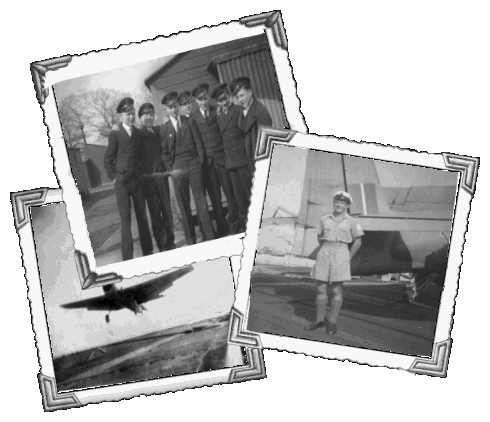
© 1999-2026 The Royal Navy Research Archive All Rights Reserved Powered by W3,CSS
Press F5 to refresh the page after posting your comment or to hide the form
Note: Despite a high number of deck crashes during the operation and one known instance of combat there are no records showing any incidents for 887 during September 1943. The combat report is from the report of proceedings for operation AVALANCHE submitted by the commanding officer of HMS UNICORN.
CloseNote: This squadron is incorrectly listed as being 894 on page 32 of ‘Carrier Operations in World War II: Volume One - The Royal Navy’ by Brown, J.D. (1968). 894 did not arrive in Orkney until July 18th, after operation MASCOT had been completed and the force was withdrawing to Scapa, as recorded on page 327 in 'Squadrons of the Fleet Air Arm' by Sturtevant, R & Balance, T., (1994).
CloseNote: Under the Wing system the component squadrons were under the command of a Wing Leader; because the equipment was the same for each squadron, machines were often flown by pilots from other squadrons in the Wing.
CloseNote: Accounts of which ship fired the shells differ; David Brown, 'Carrier Operations in World War 2 - vol 1 the Royal Navy' attributes them to KING GEORGE V while John Winton, 'The forgotten Fleet' list it as being EURYALUS.
CloseThe Logistic Support Group comprised of two or more Task Units of Task Group 112; one Task Unit provided air cover for the LSG and remained in the replenishment area.
LSG air cover TU 112.2.5, the CVE SPEAKER, (1840 sqn Hellcats for Combat Air Patrol duties over the LSG), escorted by the Sloop PHEASANT and Destroyer KEMPENFELT.
Replenishment group TU 112.2.1, the CVE STRIKER (with 18 replacement aircraft), Tankers SAN AMBROSIO, CEDARDALE and SAN ADOLPHO escorted by the Sloop CRANE, Frigate FINDHORN, and Destroyer WHIRLWIND.
CloseTF 57 losses for the day:
Due to Combat/Operational sortie - 3 Avenger -1 from 854 Sqn* ILLUSTRIOUS, 1 from 820 Sqn INDEFATIGABLE, 1 from 849 Sqn VICTORIOUS - I Corsair from 1836 Sqn* VICTORIOUS - 1 Hellcat from 1839 Sqn INDOMITABLE - 1 Firefly from 1770 Sqn INDEFATIGABLE.
Written off in accidents: 1 Avenger from 849 Sqn VICTORIOUS - 1 Hellcat from 1839 Sqn INDOMITABLE - 2 Seafire – 1 from 887 Sqn and 1 from 894 Sqn INDEFATIGABLE.
Key: * Crew killed
CloseTF 57 losses for the day:
Due to Combat/Operational sortie - 3 Avenger -1 from 854 Sqn* , 1 from 854 Sqn ILLUSTRIOUS, 1 from 857 Sqn INDOMITABLE - I Corsair f from 1834 Sqn* VICTORIOUS - 2 Seafire from 894 Sqn* INDEFATIGABLE.
Written off in accidents: 1 Avenger from 849 Sqn VICTORIOUS - 1 Avenger from 857 Sqn INDOMITABLE, 1 Firefly from 1770 Sqn INDEFATIGABLE, 1 Corsair from 1833 Sqn ILLUSTRIOUS.
Key: * Crew killed
CloseThe Logistic Support Group comprised of two or more Task Units of Task Group 112; one Task Unit provided air cover for the LSG and remained in the replenishment area.
LSG air cover TU 112.2.5, the CVE SPEAKER, (1840 Sn Hellcats for Combat Air Patrol duties over the LSG), escorted by the Sloop PHEASANT and Destroyer KEMPENFELT.
Replenishment group TU 112.2.1, the CVE STRIKER (with 14 replacement aircraft), Tankers SAN AMBROSIO, CEDARDALE and SAN ADOLPHO escorted by the Sloop CRANE, Frigate FINDHORN, and Destroyer WHIRLWIND.
CloseTF 57 losses for the day:
Due to Combat/Operational sortie - 2 Avenger – 1 from 857 Sqn INDOMITABLE, 1 from 849 Sqn*n VICTORIOUS.
Written off in accidents: 1 Hellcat from 1839 Sqn INDOMITABLE, 1 Corsair from 1833 Sqn ILLUSTRIOUS.
Key: * Crew killed
CloseTF 57 losses for the day:
Due to Combat/Operational sortie - 2 Avenger – 1 from 857 Sqn INDOMITABLE, 1 from 849 Sq/n VICTORIOUS, 1 Seafire-from 894 Sqn* INDEFATIGABLE.
Written off in accidents: 1 Seafire-from 894 Sqn INDEFATIGABLE.
Key: * Crew killed
CloseTF 57 losses for the day:
Due to Combat/Operational sortie - 1 Avenger from 849 Sqn VICTORIOUS, I Corsair from 1834 Sqn* VICTORIOUS, 1 Hellcat from 1839 Sqn* INDOMITABLE.
Written off in accidents: 1 Corsair from 1836 Sqn VICTORIOUS.
Key: * Crew killed
CloseThe Logistic Support Group comprised of two or more Task Units of Task Group 112; one Task Unit provided air cover for the LSG and remained in the replenishment area.
LSG air cover TU 112.2.5, the CVE SPEAKER, (1840 Sn Hellcats for Combat Air Patrol duties over the LSG), escorted by the Sloop PHEASANT and Destroyer KEMPENFELT.
Replenishment group TU 112.2. 2, the CVE SLINGER (with 24 replacement aircraft), Tankers AASE MAFRSK, ARNDALE, WAVE KING escorted by the Sloop WOODCOCK, Frigate PARRET, and Destroyer WESSEX. And TU 112.2. 3, Tankers DINGLEDALE and WAVE MONARCH escorted by the Frigate AVON and Sloop WHIIMBREL.
CloseTF 57 losses for the day:
Due to Combat/Operational sortie - 1 Avenger from 857 Sqn* INDOMITABLE, plus 2 from bomb blast. 1 Seafire from 894 Sqn* INDEFATIGABLE to friendly fire.
Written off in accidents: I Corsair from 1836 Sqn VICTORIOUS, 2 Seafires from 887 INDEFATIGABLE.
Key: * Crew killed
CloseTF 57 losses for the day:
Due to Combat/Operational sortie - 3 Corsair - 1 from 1836 Sqn* VICTORIOUS, 2 from 1833 Sqn* ILLUSTRIOUS.
Written off in accidents: 4 – no details.
Key: * Crew killed
CloseThe Logistic Support Group comprised of two or more Task Units of Task Group 112; one Task Unit provided air cover for the LSG and remained in the replenishment area.
LSG air cover TU 112.2.5, the CVE SPEAKER, (1840 Sn Hellcats for Combat Air Patrol duties over the LSG), escorted by the Sloop PHEASANT and Destroyer KEMPENFELT.
Replenishment group TU 112.2.1, the CVE STRIKER (with 14 replacement aircraft), Tankers ARNDALE, DINGLEDALE, SAN AMBROSIO, and SAN ADOLPHO escorted by the Sloop CRANE, Frigate FINDHORN, and Destroyer WHIRLWIND.
CloseEnemy losses for ‘ICEBERG OOLONG’ day one:
Destroyed: 1 Ki-61 ‘Tony’ - 4 Ki43 ‘Oscar’ - 1 A6M ‘Zero’ – 1 Ki-46 ‘Dinah’ – 2 Ki-21 ‘Sally’ - 4 Ki-51 ‘Sonia’
Damaged: 2 Ki-61 ‘Tony’ - 2 Ki-21 ‘Sally’
CloseTF 57 losses for the day:
TF 57 losses for the day:
Due to Combat/Operational sortie - 1 Avenger from 849 Sqn*- VICTORIOUS, 1 Hellcat from 1839 Sqn* in INDOMITABLE, 1 Corsair from 1830 Sqn* ILLUSTRIOUS.
Written off in accidents: 2 Seafire, 1 each from 887 & 894 Sqns INDEFATIGABLE.
Key: * Crew killed
CloseEnemy losses for ‘ICEBERG OOLONG’ day one:
Destroyed in aerial combat: 1 G6M1 ‘Betty’ 2 A6M2 ‘Zeke’
Destroyed on the ground: 5 unidentified aircraft.
Key: * Crew killed
CloseTF 57 losses for the day:
Due to Combat/Operational sortie - 1 Hellcat from 1844 Sqn* in INDOMITABLE.
Written off in accidents: 1 Seafire from 887 Sqn from INDEFATIGABLE.
Key: * Crew killed
CloseThe Logistic Support Group comprised of two or more Task Units of Task Group 112; one Task Unit provided air cover for the LSG and remained in the replenishment area.
LSG air cover TU 112.2.5, the CVE SPEAKER, (1840 Sn Hellcats for Combat Air Patrol duties over the LSG), escorted by the Sloop PHEASANT and Destroyer KEMPENFELT.
Tanker Group TU 112.2. 2, Tankers ARNDALE, AASE MAERSK, CEDARDALE, SAN ADOLPHO, SAN AMBROSIO, and WAVE KING escorted by the Sloop WOODCOCK, Frigate PARRET, and Destroyer WESSEX.
Note: The CVE SLINGER should have been on station as the replenishment carrier but had been withdrawn to return to Australia for mechanical repairs; no other CVE was on station to take her place.
CloseTF 57 losses for the day:
Due to Combat/Operational sortie - 1 Avenger from 849 Sqn*- VICTORIOUS, 1 Hellcat from 1839 Sqn* in INDOMITABLE, 1 Corsair from 1830 Sqn* ILLUSTRIOUS.
Written off in accidents: 1 Seafire from 887 Sqn and 1 Avenger from 820 Sqn INDEFATIGABLE.
Key: * Crew killed
CloseEnemy losses for ‘ICEBERG OOLONG’ day one:
Destroyed in aerial combat: 3 A6M ‘Zero’
Destroyed on the ground: None.
CloseTF 57 losses for the day:
Due to Combat/Operational sortie - 1 Avenger from 848 Sqn* (2 killed one rescued) FORMIDABLE.
Written off in accidents: None.
Key: * Crew killed
CloseThe Logistic Support Group comprised of two or more Task Units of Task Group 112; one Task Unit provided air cover for the LSG and remained in the replenishment area.
LSG air cover TU 112.2.5, the CVE SPEAKER, (1840 Sn Hellcats for Combat Air Patrol duties over the LSG), escorted by the Sloop PHEASANT and Destroyer KEMPENFELT.
Tanker Group TU 112.2. 2, Tankers ARNDALE, AASE MAERSK, DINGLEDALE, SAN AMADO, WAVE MONARCH escorted by the Sloop WOODCOCK.
Note: No replenishment carrier on station
CloseTF 57 losses for the day:
Due to Combat/Operational sortie - 1 Avenger from 848 Sqn FORMIDABLE. *(2)
Written off in accidents: None.
Key: * Crew killed
CloseTF 57 losses for the day:
Due to Combat/Operational sortie - 1 Avenger from 848 Sqn FORMIDABLE *(2 killed one rescued).
Written off in accidents: None.
Key: * Crew killed
CloseThe Logistic Support Group comprised of two or more Task Units of Task Group 112; one Task Unit provided air cover for the LSG and remained in the replenishment area.
LSG air cover TU 112.2.5, the CVE RULER (885 Sqn - 12 Hellcats, 4 Avengers and 8 Corsairs - for Combat Air Patrol an Anti-Submarine duties covering the LSG), escorted by the Sloop CRANE.
Tanker Group TU 112.2. 1, Tankers CEDARDALE SAN ADOLPHO, and SAN AMBROSIO escorted by the Frigate AVON and Sloop WHIIMBREL.
CloseEnemy losses for the day:
Destroyed in aerial combat: 5 A6M ‘Zero’/’Zeke’ - 5 B6N ‘Jill’ - 1 D3A ‘Val’ - 2 D4Y ‘Judy’ - 1 C6N ‘Myrt’
Destroyed by ships guns: 2 A6M ’Zeke’
CloseTF 57 losses for the day:
Due to Combat/Operational sortie - 1 Avenger from 847Sqn* INDOMITABLE.
Written off due to Kamikaze attack: 10 Avengers and 1 Corsair in FORMIDABLE, 1 Seafire from 894 squadron INDEFATIGABLE, 1 Hellcat from 1844 squadron INDOMITABLE and 1 Avenger from 848 squadron FORMIDABLE.
Key: * Crew killed
CloseTF 57 losses for the day:
Due to Combat/Operational sortie - 1 Corsair from 1836 Sqn VICTORIOUS.
Written off in accidents: 2 Seafires from 887 Sqn INDEFATIGABLE.
CloseNote: The letter of proceedings for INDEFATIGABLE covering May 4th – 9th states three landing accidents – a barrier crash, a collapsed oleo, and a rounddown strike - but they do not all tally with those recorded in Sturtivant, R., Burrows, M. & Lee, H., (2004) 'Fleet Air Arm Fixed-wing Aircraft Since 1946'. There is no mention of an aircraft striking the rounddown on this date, however they record LR791 Hit lift, ballooned, hit barrier (S/L EW Cowle), NN211 Bounced into No.2 barrier (S/L PFH Cowie), and NN232 Port oleo collapsed landing (S/L AR McEvoy).
There is no record of a S/L PFH Cowie in the Navy list. S/L EW Cowle, RNVR is correctly recorded and appears in the Navy list entry for 887 Sqn. If this is merely a mix-up and both crashes are attributed to EW Cowle, is it likely that he would have flown a second sortie after a crash on deck?
CloseThe Logistic Support Group comprised of two or more Task Units of Task Group 112; one Task Unit provided air cover for the LSG and remained in the replenishment area.
LSG air cover TU 112.2.5, the CVE RULER (885 Sqn - 12 Hellcats, 4 Avengers and 8 Corsairs - for Combat Air Patrol an Anti-Submarine duties covering the LSG), escorted by the Sloop CRANE.
Replenishment group TU 112.2. 1, the CVE STRIKER (Replenishment), Tankers WAVE KING and WAVE MONARCH escorted by the Sloop PHEASANT, Australian Destroyers NAPIER, - NORMAN, and NEPAL.
CloseNote: Sturtivant, R., Burrows, M. & Lee, H., (2004) 'Fleet Air Arm Fixed-wing Aircraft Since 1946' give may 8th as the date for this interception which is recorded in The letter of proceedings for INDEFATIGABLE covering May 4th – 9th as occurring on the 9th,
CloseTF 57 losses for the day:
Due to Combat/Operational sortie - 1 Corsair from 1836 Sqn† VICTORIUOS.
Written off due to Kamikaze attack: 3 Corsair in VICTORIUOS, 7 Corsairs in FORMIDABLE and 1 Avenger from 848 Sqn FORMIDABLE.
Servery damaged due to Kamikaze attack: 4 Avengers and 14 Corsairs, of which 3 Avengers and 7 Corsairs Were flyable duds.
Key: * Crew killed, † taken prisoner
CloseThe Logistic Support Group comprised of two or more Task Units of Task Group 112; one Task Unit provided air cover for the LSG and remained in the replenishment area.
LSG air cover TU 112.2.5, the CVE RULER (885 Sqn - 12 Hellcats, 4 Avengers and 8 Corsairs - for Combat Air Patrol an Anti-Submarine duties covering the LSG), escorted by the Sloop CRANE.
Replenishment group TU 112.2.2, the CVE SPEAKER (replenishment),, Tankers ARNDALE, AASE MAERSK, DINGLEDALE, and SAN AMADO escorted by the Sloops PHEASANT and WOODCOCK, Australian Destroyer NEPAL, and Australian minesweepers BALLARAT and WHYALLA.
Note: The rescue Tug WEASEL also arrived on station with the Tanker group.
CloseTF 57 losses for the day:
Due to Combat/Operational sortie - 1 Hellcat from 1839 Sqn* INDOMITABLE, 1 Avenger from 849 Sqn VICTORIUOS, plus 1 Avenger, 1 Corsair and 1 Seafire – no details available
Written off in accidents: None.
Key: * Crew killed, † taken prisoner
CloseNote: VICTORIOUS Flying Narrative for 12 may 1945 lists these as Strike ABLE in error. The Air Group Leader’s report correctly identifies this as Strike BAKER.
CloseThe Logistic Support Group comprised of two or more Task Units of Task Group 112; one Task Unit provided air cover for the LSG and remained in the replenishment area.
LSG air cover TU 112.2.5, the CVE RULER (885 Sqn - 12 Hellcats, 4 Avengers and 8 Corsairs - for Combat Air Patrol an Anti-Submarine duties covering the LSG), escorted by the Sloop CRANE. escorted by the Sloop CRANE. The Destroyer GRENVILLE joined on the 15th.
Replenishment group TU 112.2.1, the CVE STRIKER (Replenishment), WAVE KING and WAVE MONARCH escorted by the Australian Destroyer NIZAM. And TU 112.2. 3, Tankers ARNDALE, DINGLEDALE, escorted by the Sloops PHEASANT and WOODCOCK.
CloseTF 57 losses for the day:
Due to Combat/Operational sortie - 1 Avenger from 848 Sqn FORMIDABLE, 2 Corsair from 1836 Sqn VICTORIOUS.
Written off in accidents: 1 Corsiar from 1836 Sqn VICTORIOUS, 1 Seafire from 887 or 894 Sqn, INDEFATIGABLE .
Key: * Crew killed, † taken prisoner
CloseNote: For this Strike 5 launched from VICTORIOUS, followed by 5 others displaced due the flight deck being unable to recover aircraft -2 from FORMIDABLE and a further 3 from INDEFATIGFABLE.
CloseTF 57 losses for the day:
Due to Combat/Operational sortie - 1 Hellcat from 5 Wing INDOMITABLE.
Written off in accidents: 1Corsiar from 1836 Sqn VICTORIUOS, 1 Seafire from 47 Wing INDEFATIGABLE, 1 Avenger from 848 Sqn FORMIDABLE.
Key: * Crew killed, † taken prisoner
CloseThe Logistic Support Group comprised of two or more Task Units of Task Group 112; one Task Unit provided air cover for the LSG and remained in the replenishment area.
LSG air cover TU 112.2.5, the CVE RULER (885 Sqn - 12 Hellcats, 4 Avengers and 8 Corsairs - for Combat Air Patrol an Anti-Submarine duties covering the LSG), escorted by the Sloop CRANE and Destroyer GRENVILLE.
Replenishment group TU 112.2.1, the CVE CHASER (Replenishment), Tankers SAN AMBROSIO, SAN ADOLPHO, and CEDARDALE escorted by the Sloop WHIMBREL, Frigate PARRETT, Destroyer NORMAN and Australian minesweeper BENDIGO.
Joining on the 19th - ROBERT MAERSK (Armament SIS) escorted by Australian minesweeper CAIRNS
CloseTF 57 losses for the day:
Due to Combat/Operational sortie - 1 Corsair from 18936 Sqn* VICTORUIOUS, 1 Corsair from 18416 Sqn FORMIDABLE.
Written off in accidents: 1 Seafire from 894 Sqn INDEFATIGABLE.
Key: * Crew killed, † taken prisoner
CloseTF 57 losses for the day:
Due to Combat/Operational sortie - 2 Firefly from 1770 Sqn, INDEFATIGABLE.
Written off in accidents: 1 Avenger from 820 Sqn INDEFATIGABLE.
Key: * Crew killed, † taken prisoner
CloseThe Logistic Support Group comprised of two or more Task Units of Task Group 112; one Task Unit provided air cover for the LSG and remained in the replenishment area.
LSG air cover TU 112.2.5, the CVE RULER (885 Sqn - 12 Hellcats, 4 Avengers and 8 Corsairs - for Combat Air Patrol an Anti-Submarine duties covering the LSG), escorted by the Sloop CRANE and Destroyer GRENVILLE.
Replenishment group TU 112.2. 3, the CVE SPEAKER (replenishment), Tankers WAVE KING and WAVE MONARCH with TU 112.2.1, the CVE CHASER (replenishment) and Tankers AASE MAERSK, and SAN AMADO, Armament Store ship ROBERT MAERSK with combined escorts Frigate AVON and FINDHORN, Destroyer NAPIER.
The Cruiser BLACK PRINCE, and Destroyer NORMAN were still in the service area escorting the damaged Destroyer QUILLAM while under tow from the Tug WEASEL.
CloseNote: The two officers referred to as killed after taking off form CHASER are mentioned in the narrative of operation Iceberg T’HE CONTRIBUTION OF THE BRITISH PACIFIC FLEET TO THE ASSAULT ON OKINAWA, 1945’ submitted to the Lords Commissioners of the Admiralty on the 7th June 1945, by Admiral Sir Bruce A. Fraser, G.C.B., K.B.E,, Commander-in-Chief, British Pacific Fleet.
Only Sub-Lt R. D. Napier, RNVR of 885 Sqn, a Hellcat pilot on RULER and Sub-Lt A. C. Ralston, RNVR, 1834 Sqn,a Corsair pilot on VICTORIOUS are recordedd as being killed in air crashes on this date.
CloseTF 57 losses for the day:
Due to Combat/Operational sortie - 1 Corsair from 1834 Sq*n VICTORIOUS.
Written off in accidents: Nil.
Key: * Crew killed, † taken prisoner
CloseThe Logistic Support Group comprised of two or more Task Units of Task Group 112; one Task Unit provided air cover for the LSG and remained in the replenishment area.
LSG air cover TU 112.2.5, the CVE RULER (885 Sqn - 12 Hellcats, 4 Avengers and 8 Corsairs - for Combat Air Patrol an Anti-Submarine duties covering the LSG), escorted by the Sloop CRANE.
Replenishment group TU 112.2. 3, Tankers WAVE KING and WAVE MONARCH with TU 112.2.1, Tankers AASE MAERSK, and SAN AMADO, with combined escorts Frigate AVON and FINDHORN.
CloseTanker Group only.
TU 112.2.1, Tankers DINGLEDALE, SAN AMADO, and WAVE EMPEROR escorted by Frigates USK and BARLE.
CloseNote:
Details for carrier operations in Operation ICEBERG are drawn from the Vice Admiral, Second in Command, British Pacific Fleet Report of Operations against the Ryukyu Islands and Formosa, 3/26/45 to 4/20/45 and 5/4-25/45. Strangely, the section of the report covering phase one, March 23rd – April 20th, 1945, is vague and presents as a narrative only. However, phase two, May 4th – 24th, is very detailed and includes accounts from all the fleet carriers about their operations. This very lopsided report makes comprehensive accounts of the first six strike days quite difficult.
CloseNote:
Sub-Lieut. (A), R.N.V.R. (P), L. Crawshay-Jones & act Sub-Lieut. (A), R.N.V.R. (O), J. R. Prince are recorded as both being killed when Firefly DT942 crashed aboard HMS INDEFATIGABLE March 23rd.1945 (Sturtivant, R. & Burrows, M. (1995) ‘Fleet Air Arm Aircraft 1939 to 1945’ Tonbridge Wells, Air Britain (Historians)) but no CWGFC records exist to support this. Sub-Lt J. R. Prince is listed as being involved in another incident the next day, from which he was unhurt.
CloseNote:
This was the crew of Avenger JZ633 ('382/P'), 849 Sqn Victorious, Sub Lt. B. J. Smith RNVR & PO Airman O. Jones (no mention of an Observer) ditched 09:37 on May 12th at position 23°47’ N, 126°08’ E. Spotted by Fireflies from 1770 Sqn, which investigated and reported the position to the fleet; Sub Lt. Smith had flashed an incorrect position for his ditching, placing him 110 mile north of his actual position so discovery by the Fireflies was pure chance. They remained on the scene until relieved by Hellcats. American ‘Dumbo’ ASR plane arrived on scene at 16:35 but was advised not to land because of deteriorating weather, it remained on scene to guide KEMPENFELT in before returning to base.
CloseNote:
This narrative stated that the unidentified Avenger from 857 Sqn INDOMITABLE had ditched at 08:05, and the crew Sub Lt. T. F. Staniforth, RNVR, Sub Lt. W. Illingworth, RNVR, and FX /1136 77, P.O. Airman R. F. Morttmore were rescued by the USS BLUEFISH at 15:03 (log entry records this) – well before the final pair of Fireflies had launched.
CloseNote:
No report from the Strike or Air Group Leader are to be found in Appendix No.3 to "Indomitable’s" No.3770/024 of 19th May 1945. Narratives of Group, Strike & Escort Leaders. Operation "ICEBERG IX & X".
The strikes for May 16th, 1945, are detailed on page 276 of the Vice Admiral, Second in Command, British Pacific Fleet report of operations against the Ryukyu Islands and Formosa, from 26/345 to 20/4/45 and 4-25/5/45. The page only provides reports for Strike BAKER – the same omission occurs on the next numbered page, 277, only details Strike BAKER for May 17th. Strike DOG, comprising 8 Avengers, was flown on both dates.
CloseNote:
It is believed this aircraft suffered a buckled main spar and was probably ditched overboard.
CloseNote:
No Strike Leader’s report is available for this mission. Following previous conventions, the Air Group and Strike leader operate from the same carrier, so whoever led 849 Squadron from VICTORIOUS would be the Strike Leader. This is most likely the commanding officer, Lieutenant Commander D. R. Foster, RNVR.
Close
Comments (0)