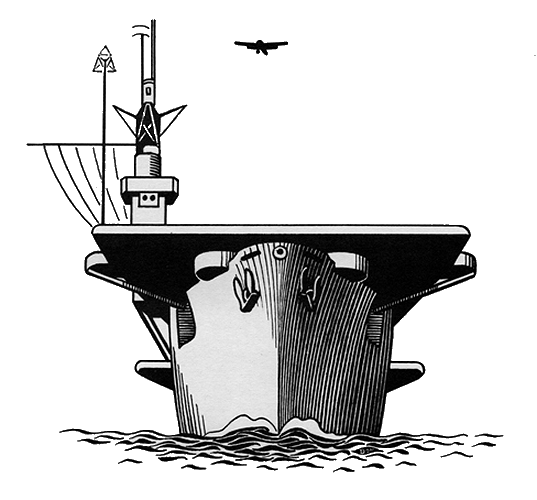
This site attempts to record the histories of the 45 Escort Carriers operated by
the Royal Navy during World War Two and the immediate post war years.
In many cases these histories are far from complete - those vessels
which had less distinguished, but not less vital roles to play, have
unfortunately had the accounts of their deeds forgotten by history.
The aim of this site is to present an historical record for each of
these ships; some accounts are detailed and well illustrated with
rare and precious photographs loaned by those who served on board
these hybrid ships - others are brief accounts at best, with a
single photo.
Thirty-nine of these vessels were loaned to the United Kingdom under
the ‘Lend-Lease’ agreement that existed between the U.S. and Britain
for the supply of war materials. This agreement afforded Britain a
valuable life-line;
"The United States should loan what articles were needed, as a man
would loan his garden hose to help his neighbor put out a fire
without reference to payment, but with the expectation that the hose
itself would be returned."
(Franklin D. Roosevelt 17 Dec 1941.)
These borrowed ships were to be returned at the end of hostilities
or payment was due. Two had been destroyed, one damaged beyond
repair, the remaining ships were returned to the US Navy and the
majority were converted back into merchant vessels and enjoyed long
careers under the Red Ensign.
Of the six British built carriers one was sunk, HMS 'Audacity', the
world's first merchant conversion to an aircraft carrier, having
survived for only six months. 'Audacity' had pioneered the role of
the escort carrier, providing air cover for convoy protection
outside of the range of land based aircraft. The last of the British
carriers was to become a floating exhibition hall for the 1951
Festival of Britain, before finally being sold for breaking in 1952
-the other four vessels were converted back into merchantmen in the
late 1940's
I am extremely grateful to all those who have loaned or donated
precious materials for inclusion within this project - without their
kind generosity and support it would not have been possible.
Tony Drury
|
 |
Tony Drury served with the Fleet Air Arm
between 1976 and 1985 as a Naval Air Mechanic (Airframes &
Engines) before being medically retired.
He served on 707, 781 (VIP Flight), 845,
and 846 Naval Air Squadrons maintaining Westland Wessex H.U.5
helicopters. He also served on the Naval Hovercraft Trials
Unit at RNAS Lee-on-Solent as a Leading Air Engineering Mechanic
(Mechanical) servicing BH Mk.7 and SRN Mk.6 hovercraft.
In 2007 he graduated from the Open University, with a BSc
(Honours) Social Sciences.
|
|