A History of HMS QUEEN
.jpg)
HMS QUEEN underway
© IWM (FL 17806)
HMS QUEEN was a 'Ruler' class escort carrier (US Bogue class) built in the USA at Seattle-Tacoma Shipbuilding Co. Tacoma, Washington. Her keel was laid down on March 12th 1943as a C3-S-A1 type freighter, Maritime Commission hull number 260, Seattle-Tacoma hull number 44. The hull was purchased by the US navy to be completed as the USS ST. ANDREWS ACV-49 (changed to CVE -49, July 15th, 1943). She was launched July 31st by her sponsor Mrs. Robert W. Morse. Whilst still under construction it had been decided that CVE 49 was to be transferred to the Admiralty on loan on her completion as an aircraft carrier.
After completing builders and Admiralty acceptance trials on 1st CVE - 49 was transferred to Royal Navy custody at Tacoma. Washington on December 7th 1943; she was accepted on behalf of the Admiralty by Commander D. B. Dowling who assumed temporary command of the ship. The White Ensign was hoisted and the ship was commissioned HMS queen, pennant number D19, she was the sixth ship to bear the name. she had taken a total of 270 days to complete; 143 days on the ways and 127 days outfitting.
Modification and preparation to enter service:
Manned by a small steaming party under the command of Commander Dowling, QUEEN departed Trachoma for Vancouver, British Colombia, on Decemebr16th, possibly under her own steam or under tow by tugs, arriving at Lapointe Pier later that day where she was moored in stream.
She was one of 19 escort carriers to be modified to meet Admiralty requirements in Vancouver, British Columbia. She would also receive her full crew compliment and work up ready for beginning her active service. A crew draft of for several escort carriers sue to enter service had left the UK on November 13th 1943 on the armed troop ship the QUEEN ELIZABETH which sailed from Greenock as convoy TA.71. She arrived at New York on November 19th and the personnel were taken by train to Asbury Park, New Jersey to the R.N Barracks there, HMS ASBURY. In early January 1944 the crew draft began to travel from New York to Vancouver by train, this being achieved in several groups; on arrival at Vancouver, they were accommodated onboard the CVE
THANE which was acting a naval barracks for crew waiting to join carriers as they became ready for active service.
This work was undertaken by the Burrard Dry Dock Co. Ltd., North Vancouver, British Columbia. QUEEN was the ninth ship to be modified by Burrards: At the time of her arrival at Vancouver sister CVEs
EMPRESS,
SHAH,
NABOB,
PREMIER and
SPEAKER were in the hands of the Burrard's yard and at various stages of modification. During this period the ships company vacated the ship; Officers lived ashore and the crew were accommodated aboard HMS
THANE.
Work commenced to de-store the ship and her alteration work began the following day: this work totalled 150 separate modifications and included lengthening of the flight deck, fitting redesigned flying controls and fighter direction layout, modifications to hangar, accommodation and store rooms, installing extra safety measures including major changes to the aviation fuel stowage and oiling at sea arrangements,, modifying gunnery and other internal communications, adding extra W/T and R/T sets, and improved darken ship arrangements.
QUEEN moved into No 4 berth on December 16th, from there she moved to Berth No.3 on December 29th.She returned to No. 4 berth on January 16th 1944, and Berth No. 5 on January 28th. From there she entered Burrard' s floating dry dock on February 3rd for the fitting of additional sea valves and other remedial work and on undocking on the 5th she moved to No 7 berth. Her alteration work was completed on February 7th; including holidays, QUEEN had spent 49 days in dockyard hands.
Burrard's dockyard in Vancouver. Left: an extension of the flight deck
was one of the modifications carried out on the new escort careers. Right:
HMS Queen alongside. possibly No 7 berth at Burrard's dockyard for
final fitting out.
Although the alteration phase of her work was now complete QUEEN was still undermanned, during January her crew began to arrive, including the commanding officer Captain K. J. D’Arcy RN, the non-commissioned personnel being accommodated in
THANE. QUEEN was not fully crewed until February 10th; her commanding officer and 29 officers (from HMS ASBURY) and ship’s company (12 CPO’s,.44 PO’s and 330 Ratings from
THANE plus 30 Ratings from
SMITER) officially came aboard at 09:00 and by 17:00 the remaining crew draft had come aboard and the ship was fully commissioned. Although recorded as alterations completed on February 7th QUEEN still had unfinished work and trials to complete before leaving the Burrard’s yard; she conducted basin tests of her engines on the 12th while still at No 7 berth.
QUEEN departed Vancouver for the Puget Sound Navy Yard, Bremerton, Washington on the 14th where she arrived at 18:15 toto take on ammunition between the 16th to the 18th. She remained at Bremerton until the 21st when she sailed to return to Canadian waters The ship now commenced steaming, gunnery, radar and other trials and exercises. the Straits of Georgia (between Vancouver Island and the mainland). On February 26th while at sea for low angle 5”-gun practice on a moving target and 20mm and 40mm shoots on a sleeve towed by an aircraft. These were completed by 15:45 and the captain ordered a new course to enter Nanoose Harbour; the ship ran aground at 16:40 in the harbour entrance.
She was stuck fast and a redistribution of weight was ordered in an attempt to raise the bow; the heavy boxes of ammunition that had only been loaded and manhandled into the magazines were no brought up and stacked on the on the starboard quarter, anything else that was heavy but moveable was taken aft. The tug “HARO” arrived at 20:25 and by 20:31 QUEEN was free of the rocks; once clear the area with tug assistance she was able to make her own way into Vancouver harbour where she arrived by 04:00 on the 27th and dropped anchor. Thirty minutes later a lighter came alongside to begin offloading ammunition to lighten ship before an inspection in
dry-dock could be carried out. The first of two oil lighters were alongside by 12:55 and the defueling process began.
QUEEN was docked in the Burrard' s floating dry dock on February 29th for repairs to a gash in her hull; the bulk of her crew were disembarked to live ashore at HMCS NADEN leaving only a skeleton crew aboard. Repairs were to take until 18th March 1944. On the 24th she sailed down to Bremerton to repeat ammunitioning the ship embarking the original stock that had been returned to Bremerton for temporary safe keeping. Loading was completed during the evening of the 25th March and on the following morning the individual boxes were disrt4ributed to their respective gun mounts and magazines. After calling at the Point Wells oiling jetty to take on a full load of furnace fuel oil she sailed to return to Vancouver to resume her work-up.
Maiden voyage: Ferry trip to Glasgow: April 1944
Having completed all her final trials, calibrations and tests, zigzag practice, radar tracking with aircraft in the Esquimalt area HMS QUEEN departed from Vancouver at 14:00on April 3rd for her maiden voyage to the UK, via the Panama Canal.
She arrived at Balboa Harbour at 14:35 on April 15th; bad luck struck again as the ship was preparing to secure alongside pier 18, mooring wires were being thrown ashore when one was missed and fell into the water fouling the ship’s propeller. The ship’s diver was sent down to investigate at 18:30 but the entanglement was severe and work was abandoned at 23:00 only to recommence at 02:00 using underwater cutting apparatus. The wire was successfully cleared by 09:45 the following morning. The ship slipped her mooring at 12:10 on the 16th to enter the Canal, it was soon realised that the propeller fouling had damaged a blade and the ship now had a singing propeller - it was out of balance. The decision was taken to proceed to Norfolk Naval Yard as planned where repairs could be carried out. She exited the Canal at around 21:30 on the 16th and set course for Norfolk. Virginia.
QUEEN arrived at US Navy Yard Norfolk at 09:25 on April 24th and eventually berthed at Pier3, berth 23 at midday. She was guided into dry-dock No 3 with the aid of tugs for repairs to begin on April 25th; repairs were completed on may 1st and after undocking she returned to berth 23.
On May 2nd 12 officer from 855 Naval Air Squadron embarked, followed later in the day, and over the next two days, by squadron stores and equipment. The Squadron had formed at the US Naval Air Station Squantum, Massachusetts on February 1st 1944 with 12 Avenger Mk.II aircraft. Having completed their formation and work up the squadron was to take passage to the UK on board QUEEN.
The ship put to sea on the morning of May 6th to conduct gunnery exercises in Chesapeake Bay commencing at 13:00 followed by direction finding equipment calibration, anchoring at the Lynnhaven Roads naval anchorage on completion. AT midnight she weighed anchor and set course to return to Chesapeake Bay escorted by two U.S. Destroyers, the USS ROY O’ HALE and USS DALE W. PETERSEN to be in position to begin flying operations early on the morning of May 6th. The day was spent giving experience to both the ship’s flight deck departments and the squadron pilots who needed to experience Deck Landing on a carrier at sea. The first Avenger to land on was at 07:32 and other aircraft flew out from US Naval Air Station Norfolk throughout the day to land on and perform several touch and go landing practices before being struck down into the hangar. There was only one flying incident during the day, Avenger JJZ500 ('SR') piloted by Sub-Lt R. K. H. Johnson RNVR drifted to port on landing and the port wheel dropped into the deck edge walkway. On completion of flying the ship and her escorts anchored in Hampton Roads.
May 6th 1944: Left:, an Avenger of 855 squadron on approach for a
for a deck landing. Right: Avenger JJZ500 piloted by Sub-Lt R. K. H. Johnson RNVR drifted to port on landing and the port wheel dropped into the deck edge walkway.
Below: Communications department ratings pose with a Corsair fighter on the
flight deck on completion of loading the ferry load at Norfolk: Image from
the Grosvenor Dove collection.

Early in the morning of May 7th QUEEN arrived at Pier 7, Naval Operating Base, Norfolk, Virginia, and by 08:30 work commenced loading U.S. airframes for transport to the UK supplied under the Lend-Lease agreement.; these were mostly Corsair fighters which were lifted on board by crane and arranged on the
flight deck as cargo; the damaged Avenger JZ500 was put ashore; no replacement airframe was embarked. Loading was finished by late afternoon and HMS QUEEN sailed at 16:30 for passage to New York. On arrival on the 8th, she berthed at 35th Street pier at 16:30 and voyage repairs were begun by workers from the Bethlehem Steel company. Voyage repairs were completed on May 12th and QUEEN slipped from her mooring and put to sea to join Convoy CU.24 which was assembling off New York and preparing to sail for the UK.
The convoy reached the UK on May 23rd, QUEEN detaching for the Clyde when the main convoy proceeded to Liverpool. She anchored at the Tail of the Bank, Greenock at 09:30. The following day she was joined by the Tugs EMPIRE ASH securing a line for’d and EMPIRE BRACKEN securing astern before making her way up the Clyde and securing alongside the KGV Dock in Glasgow. Her ferry load of Corsairs was of loaded by cranes and lighters. Beginning at 14:45 on the 25th 855 squadron was disembarked, the 11 Avengers going to Renfrew airport by road while the personnel, stores and equipment were off loaded onto the dock side.
Ferry trip Greenock to New York and Casablanca, Casablanca to Freetown and return to Greenock: May - July 1944
QUEEN remained alongside at the KGV Dock until the 28th when she moved back down to the river and secured to a mooring at the Tail of the Bank to await joining convoy UC24 to return to Norfolk for a second ferry load, this rime she was to make a ferry voyage to Casablanca for the US Army Air Force.
[1]
Note:
QUEEN is not listed amongst the vessel for this convoy in the Arnold Hague convoy database entry for UC.24.
On arrival at New York on June 9th s: he was berthed at Pier 14 Staten Island at 06:12 By 08:45 a US working party of one officer and 49 enlisted men were on the flight deck and work commenced to load a mix of P-51 Mustang and P-47 Thunderbolt aircraft which were load by crane; the task continued throughout the day Meanwhile the ship’s own working parties were busy loading medical and naval stores, canteen supplies and vegetables; this task was not completed until 23:40. At 15:00 on June 12th twenty-five US Navy Officers and a draft of 119 enlisted men boarded for passage to Casablanca.
At 04:30 on June 13th QUEEN departed from Pier 14, and with the aid of tugs fore and aft and a pilot, she started making her way down the buoyed channel in the Hudson River until she could drop the pilot off at the Tideway Buoy. By 08:12 she had rendezvoused with the Destroyer Escorts USS BURROWS and USS LOY and once clear of three harbour the three vessels increased speed to seventeen knots and set course to rendezvous with convoy UGS 45 for the Atlantic crossing. Convoy UGS 45, consisting of 102 ships, had left its form-up area in Hampton Roads, Virginia, the day before and was already on its way to Casablanca at the slow speed of eight knots; QUEEN joined the convoy by 19:00 north west of Bermuda.
This was an uneventful crossing and around 14:00 on the 26th the Casablanca section of the convoy, the merchantmen SAMCONAN, SAMSHIREIU, SMITH THOMPSON and HMS QUEEN, broke off. The US Destroyer escorts were relieved by a local escort comprising the French minesweeping sloops LA BOUDEUSE and LA GRACIEUSE and the patrol vessels USS PC-482 at 15:00. QUEEN anchored at 21:03 outside the port at Casablanca. At 07:00 the following morning a pilot boarded the ship and QUEEN entered the inner harbour at 08:00, securing alongside at 08:30. An aircraft handling party began disembarking aircraft by 09:30. The US draft of officers and men left the ship at 13:15.
The delivery of aircraft completed, QUEEN slipped her mooring wires and with tug assistance cleared the inner harbour at 07:27 on Sunday July 2nd and dropped anchor in the outer harbour. Divisions were held on the flight deck and a Church of England party went ashore for Divine Service.
QUEEN was now to sail to join another convoy for passage, this time to Freetown, Sierra Leone. Close to midnight the ship raised anchor and made her way through the swept channels to open sea and joined up with convoy OS 81 which had started from Gibraltar and was making its way southwards to Freetown. QUEEN took up station astern of the convoy Commodore’s ship and the convoy proceeded south at the slow speed of 7½ knots.
During the trip southwards the ship carried out Exercise Action Stations and Action Messing. Plotting exercises were carried out with HMS LEITH and HMS KILMARTIN. On July 9th land-based air cover began when a French Sunderland and a Wellington aircraft joined the convoy and at 14:00 the Dakar section of the was departed. Emergency routines for the operation of auxiliary steering positions were exercised frequently and during the morning of July 11th the ship’s portable SQ radar unit was switched on and tested.
By 09:37 on July 12th HMS QUEEN had dropped anchor at Freetown. While the oiler INVERSE and a water boat came alongside to service the ship two lighters also came alongside at 16:30, each one loaded with a Swordfish aircraft which had been issued by
R.N. Air Station Hastings (HMS SPURWING) located 8 miles Southeast of Freetown on the Bunce River. These were hoisted aboard using one of the ship’s derricks; these ‘A’ frame devices were normally stowed in a special tray alongside the flight deck Port and Starboard, capable of lifting an Avenger or Wildcat aircraft hoisting was done purely by manpower. In all 13 aircraft were embarked over the next four days for return to the UK, some having been on the strength of 777 Sqn others had been held by the aircraft storage section; none were operational but two swordfish were ranged aft on the flightdeck to give the impression that QUEEN could retaliate.
The last aircraft was loaded by 12:45 on the 16th and the ship began preparations for passage to the UK. At 14:00 on July 17th the ship passed through the harbour boom and proceeded along the buoyed channel and finally out into the open sea. Having cleared the port area, the ship’s gunners carried out high angle shoots with the Bofors and Oerlikon guns whilst Y 5" gun carried out a low angle shoot. She now formed part of Convoy SR.15 bound for Gibraltar; QUEEN is listed as escort together with HM Frigates ROTHER, TEES, WEAR and WYE and the Destroyer VERITY. At 16:30 the 6-ship convoy exercised on passage with dummy dive bombing and torpedo bombing attacks carried out by aircraft. From Freetown. The convoy left the area at 14 knots. HMS QUEEN entered the inner harbour at Gibraltar at 09:50 on July 24th and secured port side on to berth 52.
Within an hour of her securing alongside a lighter was brought alongside with more aircraft to be hoisted on board for passage, these came from the aircraft storage section at
RN air Section North Front and included more Swordfish and at least one Bouton-Paul Defiant. This was followed by another lighter certifying aircraft spares and stores.
QUEEN was to remain at Gibraltar awaiting Convoy MKF.33 which sailed from Port Said on on July 28th bound for Liverpool. While waiting to join the convey QUEEN put to sea for exercises on August 2nd, escorted by the Flower-class corvettes STONECROP and PIMPERNEL with the AA Cruiser SIRIUS also in the vicinity. The carrier engaged in local exercises. From 09:30 to 10:30 the group was was subject to dummy dive-bombing and torpedo bombing attacks conducted by aircraft from Gibraltar. On completion of the exercises that evening the ships set course to return to harbour. An alarming discovery was made at 20:55, pieces of shrapnel from SIRIUS which must have been blasting away at a very high angle.
Once secured alongside QUEEN made preparations to sail again, departing at 06:38 on August 3rd to take up position as target, exposing her sides to dummy torpedo attacks by RAF Beaufighters. This was followed ab an anti-submarine exercise (Sub unidentified) presumably putting the ship’s ASDIC operators through their paces. On completion of this phase the submarine surfaced and was the target for practice Action Stations by the 5”-gun crews at the stern. On completion she returned to harbour. Later that day the ship’s Air Repair Department returned aboard [2]
Note:
Presumably the Air Repair Department disembarked to RN Air Section North Front when the airframes were embarked on July 24th.
Presumably disembarked to RN Air Section North Front when the airframes were embarked on July 24th. followed by a draft of fifty-three ratings.
QUEEN sailed at 92:12 on August 4th to rendezvous with Convoy MKF.33, joining at 02:36 taking position astern of the British built escort carrier HMS ACTIVITY. The convoy passage was uneventful and QUEEN arrived on the Clyde on August 10th. After making her way up river she was manoeuvred stern first by tugs to a berth in the KGV Dock Glasgow at 19:00.
Stores and passengers were disembarked on the 11th and local leave was granted. The aircraft wee craned off on the 12th and wear taken by road to nearby
R.N. Aircraft Maintenance Yard Abbotsinch near Paisley. Work was completed in the afternoon f the13th and the ship left the dock at 17:00 aided by tugs, to make her way sown river to a mooring at Tail of the Bank.
Under refit and a change of anti-aircraft armament: September- December 1944
The 29th August 1944 brought a welcome respite from paint chipping, and HMS Queen slipped from her buoy and headed downstream towards the Mull of Kintyre. She joined up with the 2nd Escort Group and together they made their way through the Minches, rounded the coast of Scotland from west to east and then headed southwards to Methil following a well buoyed course and arriving at 21:30 on August 30th.
She was taken in hand at a commercial dockyard on the 31st and would not emerge until mid-December. Part of her refit included an a self-deduce armament upgrade; the single Oerlikon mounts on the Gallery Deck and foc'sle deck, were to be changed for fourteen twin mountings.
At 10.00 on December 20th work commenced embarking ammunition, which consisted of 20mm, 40mm and 5" shells, and, for the first time, bombs. As the ship began preparations for leaving the dockyard. QUEEN weighed anchor at 09:16 on the 23rd and moved into the River Tay Estuary to commence trial runs throughout the day and night culminating the following morning of Christmas Eve. She picked up a river pilot at 09:35 and returned to Dundee harbour, she secured at 11:20. QUEEN was to celebrate Christmas at Dundee but put to area on the 27th when she sailed for Rosyth.
On the 28th she entered the Rosyth Dry Dock; she was to remain docked until January 11th. During this time additional personnel began arriving to man the ship for flying operations, including Lieutenant P.E. Miller RNVR the ship’s Deck Landing Control Officer (DLCO). Aviation stores were embarked while in dock. After ammunitioning and taking on fuel she sailed for Scapa Flow on the evening of January 19th 1945.
853 squadron joins the ship for work up on the Clyde: January 28th – March 1st 1945
On arrival at Scapa the ship carried out radar calibration and embarked a ground party of maintenance personnel from
853 squadron along with stores and equipment on the 21st. She sailed for Greenock on the 22nd, arriving there on the 23rd.
On completion of her trials, she prepared to receive her first fixed wing aircraft; elements of
853 squadron, 6 Avengers and 1 Wildcat flew out from
RNAS Ayr and landed on. Once secured from flying stations QUEEN returned to her berth on the Clyde. The squadron operated a total of 8 Avengers and 4 Wildcats however not all of the aircraft had reached
RNAS Ayr by embarkation day; the squadron had departed from
RNAS Hatston, Orkney but the move was delayed by bad weather. Three Avengers flew to Ayr by the east coast route and arrived on the 24th but the others, flying by the west coast, were driven back by heavy snow storms and next day flew by the east coast as far as
RNAS Arbroath. There they were joined by two Wildcats returning from a loan to
CAMPANIA on the 25th; one of these, JV735 ('TW') was damaged on landing. The 2 Avengers and 1 Wildcat from
RNAS Arbroath eventually arrived at
RNAS Ayr later on the 27th, but were grounded by poor weather conditions..
On the 29th QUEEN sailed out to the carrier training area (also known as the Carrier playground, an area bounded by Rothesay, Little Cumbrae Island, and Ailsa Craig). This was to be a flying work up for the ship,
853 Was already operational and had seen action operating from
TRACKER on Russian Convoy duty. The Squadron Avengers were given carte blanche for deck landing practice, this however was promptly terminated at 13:00 when it began to snow. The 2 Avengers and 3 Wildcats now at Ayr were still grounded by bad weather. In the early hours of the 31st Sub-Lieutenant’s Spencer, Davis, Lea and Hunter each carried out 4 night deck landings. Later in the day Lieutenant Sailes and Sub-Lieutenant’s Swift and Parker flew aboard from
RNAS Ayr in Wildcats 'QU', 'QY' and 'QZ'. (The squadron aircraft had been allocated the prefix Q with the move to QUEEN). They were joined by the remaining 2 Avengers and further day deck landings were carried out by Avenger pilots.
On February 1st FOCT (Flag Officer Carrier
Training) and his staff were embarked to witness anti-submarine exercises and simulated torpedo attacks on the ship and bombing of a towed target by the Avengers while the Wildcats carried out interception exercises. On the 2nd flying training sorties continued to be flown, and Sub-Lieutenant’s Curtis, Gall, Duxbury and Buchanan did four Avenger night deck landings each.
Intensive flying training continued whenever the weather permitted until February 16th; A total of seventy-seven Avenger training sorties were flown. Many of the flights were at night and they included boosted take-offs at night. Avenger crews also began rehearsing a new activity, that of aerial mine laying. Twenty-nine Wildcat sorties were also flown on a variety of exercises.
On the final day of exercises, the 15th, a force of six Avengers was launched in the early hours to simulate the night laying of mines between the Isle of Man and Calf of Man. FOCT and his staff were embarked from
SEARCHER that morning, being picked up by two of 853’s Avengers, for a final inspection. At 10:46 while conducting DLT sessions Sub-Lt R. H. Parker, RNVR was about to be accelerated from the deck in Wildcat JV740 ('QY') when the tie-back ring broke immediately the catapult was activated, the aircraft, already at full power, ran off the end of the Deck and over the bow into the sea. The pilot was picked up uninjured within four minutes. FOCT spent the night aboard and was flown off to the light Fleet Carrier VENERABLE early the following morning. With his departure the ship returned to her mooring off Greenock and the squadron went on ten days’ leave.
The squadron returned from leave on February 27th and there were a few aircrew changes; Sub-Lt Babanau RNVR, an Avenger pilot relieved Sub-Lt Fernie, while three new Wildcat pilots joined - Sub-Lt’s RNVR Couzens, Coverdale and Hubbard. Two Wildcat pilots left, Lt Swift departed, he had been grounded on the 9th because of defective vision and Sub-Lt Day who had been appointed to the squadron on January 14th but never flew with it. Squdron strength was now 9 Avengers and 3 Wildcats.
QUEEN put to sea in the afternoon of the 28th to resume flying training and exercising the Carrera Playground. Six Avengers were launched to carry out navigation exercises on March 1st while another 3 were flown ashore to
RNAS Machrihanish for compass swinging in preparation for the ship sailing for her first operational sortie the next day.
Operations with the Home Fleet March – May 1945
QUEEN sailed on March 2nd for Scapa Flow in company with the escort carriers
SEARCHER and
TRUMPETER, escorted by the destroyers ZEALOUS, SERAPHIS and SCOURGE. During the passage six Avenger A/S patrols were flown. One Avenger took a pilot to
RNAS Hatston to return with a new Wildcat. As a replacement for ‘QY’. The carriers arrived at Scapa on the 4th and QUEEN was to remain at anchor for the next 10 days.
On March 14th flying resumed in preparation for Operation CUPOLA, the ship operating within the Flow. Eight Avengers were launched on navigation exercises and were safely recovered. Three new Wildcats were flown on from Hatston, JV628, JV650, and JV680. This raised the squadron complement of aircraft to 9 Avengers and 8 Wildcats. Another Wildcat pilot, Midshipman W. A. Storey RNVR - joined the squadron. All new Wildcat pilots qualified at deck landing. On the 15th seven Avengers were launched for a minelaying exercise (Minex) off the island of Papa Westray and recovered. Ten Wildcat sorties were flown on a variety of training missions. On the 17th nine Avengers and six Wildcats were launched for a Minex. On recovery the aircraft were launched again, the Avengers for another Minex and the Wildcats to intercept them on return. Wildcat JV720 ('QY') flown by Midshipman Storey floated into the barrier. In total 33 Avenger and 22 Wildcat training sorties were flown including formation mine laying exercises, escorts and interceptions.
Operation CUPOLA: March 18 -21st
CUPOLA was a joint, air minelaying operation to lay air laid mines in the southern entrance to the Askenvold anchorage (61°19'5"N, 05°04'E), and a shipping strike off the coast of Norway undertaken by Force 1 which comprised of CVEs
SEARCHER (882 Sqn – 20 Wildcat),
PREMIER (856 Sqn - 8 Avengers & 8 Wildcats) and QUEEN (853
Sqn - 9 Avenger & 8 Wildcat) the Cruiser BELLONA, and Destroyers ONSLOW, ZEST, SERAPIS, HAIDA (RCN) and IROQUOIS (RCN)). They were to arrive in position 'AA' (61°52'N, 01°45'E) at 07:00 but bad weather was encountered on the way and the operation had to be postponed to the afternoon.
Around 13:25 the strike commenced flying off.
PREMIER's 856 Squadron launched all sixteen aircraft for this mission, 8 Avengers carrying mines and 8 Wildcats, these were joined by a further 12 Wildcats of 882 Squadron from
SEARCHER, providing fighter cover. Two Avengers from QUEEN's
853 Squadron flew a/S patrols around the force while two Wildcats were launched to provide top cover over the carriers.
Landfall was made at the correct location at 14:20, with the weather just beginning to lift on the coast and good visibility in the Leads. The Avengers turned north when over Bygdefeld, a conspicuous hill to the south of Askevold. The approach was made to the laying position unopposed, and at 1429A/20 seven mines were laid in the shipping channel, close south of Prestoy Island. One aircraft was unable to release its mine due to material failure and returned with it to the carrier.
The fighters, in close support, also experienced little resistance to their stafing of shore targets, including a coastal gun battery and a patrol vessel. All aircraft returned safely to the carriers in rapidly deteriorating weather conditions.
The bad weather caused some problems for returning aircraft on completion of the operation on the 20th, with the wind gusting to 40 knots on the surface and 60 knots over the carrier decks. Most affected were those operating from QUEEN; both of 853
Squadron's Wildcats were damaged on recovery, one (JV735 'QW') taking the barriers while the undercarriage of the other (JV753 'QX') collapsed, in addition one of her Avengers (JZ409 'QL') had to land on PREMIER bursting both tyres in the process. The force arrived back at Scapa Flow at 14:00 on the 21st.
Operations MUSCULAR and PREFIX: March 24th – 28th
This set of concurrent operations called for day and night strikes against enemy shipping on the Norwegian coast: MUSCULAR was a night strike in the Leads between Stadlandet and Bredsund while PREFIX I called for a day strike in the Leads between Trondheim Fjord and Kristiansund North and PREFIX II a second day strike if targets were located.
Force 2, comprising of the Escort Carriers
SEARCHER ((Flag CS 1) 882 Sqn, 20 Wildcat),
PUNCHER (821 Sqn, 9 Barracuda & 12 Wildcat),
NAIRANA (835 Sqn, 14 Swordfish & 6 Wildcat), QUEEN (853Sqn, 12 Avenger & 4 Wildcat), Cruisers BELLONA and DIDO, Destroyers ONSLOW (D 17), SERAPIS, CARYSFORT, ZEST, ZEALOUS, HAIDA (RCN), and IROQUOIS (RCN) sailed from Scapa on March 24th.
At 09:50 on the 25th March QUEEN launched four Wildcats to intercept a bogey reported at a range of 30 miles; this was identified as a RAF Coastal Command Liberator with a defective IFF. The Avengers were bombed up with four 500lb bombs each.
On reaching the operational area on the morning-of the 26th the weather was marginal, however PREFIX I commenced with a strike by aircraft from QUEEN and
SEARCHER; 9 Avengers, each armed four 500lb bombs, and 4 Wildcats (top cover) where launched by catapult from QUEEN escorted by 19 Wildcats from 882 Sqn to attack shipping in Trondheim Leads and North Kristiansand. As they approached the coastline at 300 feet, conditions were better and two ships, as a tanker escorted by a minesweeper, were staffed by two flights of Wildcats. The force was intercepted by a group of eight or ten Messerschmitt Bf 109Gs which were engaged by two flights of Wildcats which shot down three and damaged two others. The Avengers in the strike package found no suitable targets so they had to jettison their bombs and return to the fleet.
MUSCULAR was to have commenced on the night of the 26th, a night strike by
NAIRANA’ s Swordfish against targets in the Leads between Stadlandet and Bredsund but bad weather forced this part of the operation to be cancelled. The bad weather continued throughout the 27th and the task force remained off the coast waiting for it to clear.
PREFIX II was carried out in slightly better weather on the 28th when 15 Wildcats from 882 Sqn launched to strike targets at Aalsund, 7 of these aircraft were fighter bombers each carrying 2 2501b SAP bombs. The strike was led through rain, sleet and poor visibility by a single Firefly Night Fighter from 764 Sqn specially embarked in
SEARCHER for this operation. The cloud ceiling was too low for glide bombing, however, and
PUNCHERs 821 Sqn Barracuda strike was cancelled. Once all aircraft had landed on the force withdrew to return to Scapa around 10:15 on the 29th. On arrival at Scapa 853
Sqn disembarked their serviceable squadron aircraft, nine Avengers and five Wildcats to
RNAS Hatston and a ground party was put ashore.
Operation NEWMARKET: April 6th – 12th
QUEEN was part powerful force which included four CVEs,
PUNCHER (821 Sqn – Detachment of Barracuda II, 825X Sqn – 8 Wildcat), QUEEN (853 Sqn, 9 Avenger & 8 Wildcat),
SEARCHER ((Flag CS 1) 882 Sqn, 20 Wildcat), and
TRUMPETER (846Sqn, 12 Avenger & 4 Wildcat), Cruisers BELLONA, BIRMINGHAM, and the destroyers ONSLOW, OFFA, SCORPION, SCOURGE, ZAMBESI, ZEALOUS, ZEST and CARYSFORT. The Force sailed form Scapa at 07:00 on April 6th, to conduct air strikes against German submarine tenders off Kilbotn, Norway.
853 squadron kept Avengers at stand-by on the 6th and 7th but no patrols were flown, although one Avenger flew to
SEARCHER for a spare part and returned. Four Wildcats flew as top cover for the force on the 6th. On the 8th nine Avengers were bombed up, but the weather deteriorated and the strike was postponed. On the 9th three Avengers were armed with depth charges and maintained on stand-by. At the end of the day they were rearmed with bombs. The carrier forced turned back to the coast of Norway on the morning of the 10th but the weather continued bad and at the end of the day operation Newmarket was abandoned and course set for Scapa Flow. The squadron-maintained aircraft at stand-by in duty periods on passage to the Flow, but bad weather prevented any flying. The ships returned to Scapa Flow around 23:11 on the 12th and anchored for the night.
At 0925 the next morning the ship boosted off 9 Avengers and 6 Wildcats from 853 Squadron to
RNAS Hatston. The two unserviceable Wildcats were boosted off to
RNAS Hatston on the 14th.
From April the 15th to the 26th the squadron flew intensively from
RNAS Hatston. Over 170 Avenger training sorties were flown, the vast majority of them (71) glide bombing practice. One hundred Wildcat sorties were flown on a mix of section drill, air to air firing and fighter direction exercises. The ground party was re-embarked on the 27th and the squadron, mow operating nine Avengers and eight Wildcats, including four on loan from 853 Squadron led by Sub-Lt Sargent, RNVR with RNVR Sub-Lt’s Atkinson, Berry and Edwards, and took off from
RNAS Hatston to land on the ship in the Flow.
When the first Avenger, JZ400 ('QA') flown by the Senior Pilot, Lt. Sailes, with the CO as Observer, approached to land the ship was not quite into wind and the aircraft was waved off. The next two Avengers landed on and were struck down in the hangar and the next five were parked on deck forward of the barriers after landing. By then Lt. Sailes had gone around and made a new approach, he landed successfully and hooked a wire which was a signal to the flight deck crew to lower the barriers. Unfortunately, the hook then pulled out of the aircraft and with the barriers lowered it careered down the deck to crash into the parked aircraft. Avengers JZ400 (‘QA’), JZ535 (‘QC’), JZ402 (‘QF’), JZ399 (Q’K’), JZ401 (QM), and JZ409 (‘QL’) were all seriously damaged but there were no injuries. It was the first time that JZ400 had been deck landed since returning from a major overhaul.
It took an hour to clear the deck for all the remaining aircraft to be landed on. In the next two days five of the damaged aircraft were off loaded onto lighters for transport to RNAS Hatston and replacement aircraft obtained and serviced ashore. JZ401 (‘QM’) remained onboard for a main plane change to be carried out. The replacement Avengers, JZ596 ([QA’), JZ472 (‘QC’), JZ405 (‘Q’F), JZ456 (‘QK’), and JZ549, which had been left at Hatston for a major inspection, was given a ten-hour extension and was retained as (‘QL’) landed-on on the 29th.
Operation JUDGEMENT: May 1st– 6th
QUEEN sailed from Scapa on May 1st in company with
SEARCHER (882 Sqn, 20 Wildcat), and
TRUMPETER (846 squadron, 12 Avengers 8 Wildcats), Cruisers NORFOLK ((Flag CS 1, Rear Admiral McGrigor), DIADEM, destroyers OPPORTNE, SCOURGE, ZAMBESI, SAVAGE, CARYSFORT, OBEDIENT, ORWELL and RFA BLUE RANGER to conduct Operation JUDGEMENT another attack on U-boat depot ships at Kilbotn harbour in the Lofoten islands. On passage to the Norwegian coast 853 squadron flew seven Avenger patrols and ten Wildcat sorties on section drills. On the 3rd two Avengers and a Wildcat were launched to investigate a contact but nothing was found.
On May 4th eight squadron Avengers armed with four 500lb bombs each, and four Wildcats as escort were boosted off to join the strike force of forty-four aircraft which also included Avengers of 846 from
TRUMPETER and Wildcats of 882 from
SEARCHER. A 9th squadron Avenger went unserviceable due to an airlock in the fuel supply and had to be left behind.
The strike flew at low level until making landfall at Skoger. It then climbed to 4,000 feet, at which altitude the targets in Kilbotn Harbour were clearly visible. 846 Squadron had been assigned the U-boat depot ship BLACK WATCH as its target and 853 a torpedo depot ship believed to be the KARL Von HERRING but later identified as the METEOR. Wildcats from 882 Squadron were to bomb and strafe a flak ship, the ex-Norwegian cruiser HARALD HAARFLAGER, which was tied up at a pier some way from the other ships. The weather was very good with a little cloud to give some cover to the approaching aircraft. They encountered moderate heavy and light flak.
As the close escort fighter strafed the targets the Avengers peeled off in rapid succession to bomb them. The first 853 squadron aircraft to dive was JZ596 ('QA'), flown by Lieutenant Sailes with the CO as Observer. It received a direct hit in the port mainplane, probably by a 40mm shell, and was badly damaged. The Telegraphist Air Gunner, CPO Astbury, was wounded by shrapnel, but the aircraft remained controllable and the attack was pressed home. The targets were rapidly obscured by smoke and spray making it difficult to observe hits. ‘QF’, flown by Sub-Lt M. E Gall, RNVR suffered an electrical failure and its bombs had to be dropped with the emergency release, resulting in an overshoot. The last 853 Avenger, piloted by Sub-Lt H. D. Buchanan, RNVR finding the 853 target completely hidden, saw the BLACK WATCH emerging from the smoke and spray and transferred his aim to this, scoring a direct hit which was followed shortly by a violent explosion.
May 4th 1945, the last Home Fleet offensive operation against the Germans: Left, the Avengers sweep in from an overland approach to Kilbotn Bay. The U-boat depot ship is centre right; a tanker is in the centre, and a flak ship can be seen above the aircraft IWM (A 28658). Right, bombs bursting on a tanker (foreground) which later sank, while swirls of water behind hide the end of the 5,000 tons U-boat depot ship which had just blown up after being hit by other naval bombs. A flak ship which was left in a damaged condition is in the left foreground. IWM (A 28656).
All 853 Squadron aircraft returned to the ship and landed on safely. One 846 Avenger and one Wildcat failed to return and were presumed to have been shot down by anti-aircraft fire. Photographs by the last aircraft to leave the scene showed both primary targets on fire with the BLACK WATCH down by the stern. Reconnaissance later showed both had sunk. It was later learned that U 711 had been moored between the two depot ships and had also been sunk. Four 853 Wildcats were flown-off as top cover and protection for the returning strike. The carrier force then set course for Scapa Flow, with QUEEN taking turns as duty carrier providing stand-by Avengers. ‘JUDGEMENT’ was the last Home Fleet Operation against Germans in the war.
On the 6th of May seven Wildcats were boosted off for section drill and gunnery tracking exercises with the escort. In the course of the latter, Sub-Lt Berry, RNVR (835 Sqn) in Wildcat JV842 carried away the aerials of ZAMBESI. Its hook and fuselage were damaged and it was diverted for an emergency landing at RAF Sumburgh in the Shetlands.
Operation CLEAVER, 6th-9th May
Later in the day on the 6th the carrier force was diverted at 16:00 to a position to the east of the Orkneys while on passage for Scapa Flow. They were to prepare to sail as Force 6, a covering force for Operation CLEAVER. The operation called for vessels of the 40th Minesweeping Flotilla to sweep and clear German minefields in the Skagerrak and Kattegat between Norway and Sweden in the north and Denmark in the south. This was to allow the passage of Force 5, Cruisers BIRMINGHAM and DIDO escorted by the destroyers ZEPHYR, ZEALOUS, ZODIAC, and ZEST tasked with the shipborne return of the Danish government-in-exile to Copenhagen and to the take the surrender of German warships in Danish waters.
The vessels involved in this operation were split into three groups: Force 5 comprised of Cruisers BIRMINGHAM (Flag of R. A. Commanding, C. S. 10), DIDO, Destroyers ZEPHYR (Captain D 2), ZEALOUS, ZODIAC, and ZEST. Force 6 comprised NORFOLK (Flag of R. A. Commanding, C.S. 1), CVEs
SEARCHER (882 Sqn, 20 Wildcat),
TRUMPETER (846Sqn, 12 Avenger & 4 Wildcat), QUEEN
(853 Sqn, 9 Avenger & 8 Wildcat), Destroyers SCOURGE (Captain D 23), SAVAGE, OPPORTUNE, OFFA, CARYSFORT, ZAMBESI, OBEDIENT. And the 40th Minesweeping Flotilla: CATHERINE, ELFRIDA, GRECIAN, GAZELLE, TABOO, STEADFAST, MAENAD, and CYNTHIA.
Cover for the minesweeping operation was provided by the Carriers of Force 6 commencing on May 6th, on the same date Force 5 left Scapa for the Skagerrak. Having passed through the German minefields off the Skagerrak Force 5reached Copenhagen on May9th where the British naval force accepted the surrender of the German heavy cruiser PRINZ EUGEN and light cruiser NÜRNBERG.
Before commencing the operation, the composition of QUEEN’s embarked aircraft was adjusted; to make room for more fighters three Avengers were flown ashore to RNAS Hatston, taking with them a number of pilots and observers who were being relieved from first-line flying; at 18:00 on the 6th Avengers JZ401 (‘QM’) and JZ549 (‘QL’) were flown to
RNAS Hatston by Sub-Lt Gall and Sub-Lt Babanau along with Sub-Lt Briscoe who were all leaving the squadron. Early the next day Sub-Lt Berry was delivered back to the ship by a visiting Avenger, and upon its departure was followed ashore by the damaged Avenger JZ596 ('QA') which was launched for
RNAS Hatston by Sub-Lt Buchanan who was also leaving the Squadron. He first landed on
CAMPANIA, which had joined the force during the night, to take Lieutenant Beeston and Sub-Lt Storey to pick up two new Wildcats from her, but they returned empty-handed. Later that day 5 additional Wildcats from 815 Sqn fighter flight were flown over to QUEEN from
CAMPANIA, three of them flown by additional pilots being loaned to the Squadron; Lt Green, Lt Kemp, and Sub-Lt Woodward. The changes resulted in an aircraft complement of six Avengers and 12 Wildcats.
On May 7th QUEEN set course for the Skaggerak still in company with
SEARCHER (882 Sqn, 20 Wildcat),
TRUMPETER (846 squadron, 12 Avengers 8 Wildcats), Cruisers NORFOLK ((Flag CS 1, Rear Admiral McGrigor), DIADEM, destroyers OPPORTNE, SCOURGE, ZAMBESI, SAVAGE, CARYSFORT, OBEDIENT, OFFA and the Oiler RFA Fortol to conduct Operation CLEAVER. A/S patrols were flown throughout the day.
On the 8th of May Victory in Europe Day was announced, however hostilities were not due to end until midnight so fighter and A/S cover was given to minesweepers clearing a channel to Copenhagen; the carrier force itself stayed outside the minefields of the Skaggerak. 853 maintained two Avengers on patrol throughout the day, flying 12 sorties, and 18 Wildcat sorties were also flown. One Avenger, piloted by Sub-Lt I. P. Davis, RNVR sighted a formation of JU 52’s which were displaying the sign of surrender and another, piloted by Sub-Lt 0. E. Barnes, RNVR fired a short burst at a Dornier flying boat. At the end of the day Force 6 withdrew, and set ting course for Scapa Flow.
QUEEN arrived back at Scapa on the 10th. At 08:35 one Avenger, carrying two Avenger and one fighter pilot as passengers, together with the five extra Wildcats, were flown off to
RNAS Hatston. Here Avengers JZ549 and JZ401 and Wildcat JV666 (a replacement for the one which had to be left at RAF Surmburgh) were collected and flown out to join the ship in the Flow. Lt W. T. Sykes and three air gunners joined the squadron which was now back to a strength of 9 Avengers and 8 Wildcats.
On the 11th Vice Admiral McGrigor and his staff came aboard and congratulated the aircrew who had taken part in Operation JUDGEMENT, which he stated had been a model operation in all respects. On the 13th QUEEN and 853 squadron sent representatives to a thanksgiving service on the Battleship RODNEY and to an assembly on
TRUMPETER which was addressed by the First Lord of the Admiralty.
JW.67 - the last escorted convoy to Kola Inlet, Russia, codenamed Operation TIMELESS5
At Scapa Flow the ship began preparation for escorting convoy JW 67 to Russia. Although the war in Europe had ended it was feared that some U-boats might not have heard of, or would not observe, the cease-fire. QUEEN sailed from Scapa Flow on the 14th of May in company with ORIBI and OFFA.
On the 15th she joined the convoy which consisted of twenty-six merchant ships with eleven escorts. Over the next six days 34 Avenger sorties were flown maintaining A/S patrols up to 100 miles ahead of and around the convoy. The Wildcats also flew 22 sorties. The convoy arrived in the Kola Inlet on the 20th and the escort force spent the next three days there, during which the Red Navy Choir gave a concert in the hangar and some of the crew of the Russian battleship “ARCHANGEL” (formerly HMS ROYAL SOVEREIGN) attended a screening of the film ‘Bathing Beauty.”
On the evening of May 23rd QUEEN, with ONSLOW and OBDURATE in company, sailed from the Kola Inlet to join up with the return convoy RA 67 with twenty-five merchant ships. On passage back to the UK 25 Avenger and 22 Wildcat sorties were flown. Increasingly the emphasis changed from patrolling to exercises in which Avengers made dummy attacks on the ships in the convoy while the Wildcats endeavoured to intercept them. In the course of these passage back to the UK one Wildcat, JV706 ('QT), flown by Sub-Lt K. W. Atkinson, RNVR (835 Sqn) failed to catch a wire on landing and crashed into the ship’s island on the 27th. No one was injured.
Her last wartime duty complied Queen proceeded to the Firth of Clyde; on passage the news came that 853 squadron was to disband on arrival. Captain K. J. D’Arcy DSO RN addressed the officers and men of the squadron and congratulated them on the standard of efficiency maintained throughout their five months’ stay on QUEEN and praised the operational achievements, especially the attack on Kilbotn.
The squadron aircraft flew off QUEEN for the last time on May 30th, at 08:00 six Avengers and seven Wildcats flew over the ship in “Balboa” formation before flying ashore to the Aircraft Holding Unit at
RNAS Stretton for the Wildcats to be put in storage, their crews went directly on leave. The 6 Avengers then flew on to
RNAS Donibristle where they too were to be placed in storage. At 12:55 the remaining 2 Avengers were catapulted off the ship and flew directly to
RNAS Donibristle The remainder of the squadron personnel stayed with the ship until it reached Greenock and travelled on leave from there.
With the departure of her aircraft, QUEEN made her way to
Greenock and dropped anchor at 17:56.
Experimental Work – Wave measuring and Radar Trials: June 1945
HMS QUEEN began a period of trials sailing in company with the destroyer KEPPEL at 09:45 on June 2nd she made her way out to sea and landed on a solitary Swordfish from 836 Sqn at 13:35. This was a short trial lasting a week, the ship returning to Greenock on June 8th.
QUEEN remained at her mooring until she was visited by a Rear Admiral Engineering and his staff on June 21st and she was moved on the 23rd, assisted by two tugs to enter the No. 4 floating dry-dock at Greenock. On June 25th both Watches were at work on the floor on the dry-dock laying out the anchor chain as it was paid out by the capstan. During the following days the crew went in to a repetitive cycle of cleaning and painting ship.
She was undocked on June 29th June and made her way out to the B4 anchor berth
On July 1st the ship moved to X buoy and once again the crew were tasked with cleaning and painting ship. On the 5th of July the crew began disembarking aircraft ammunition – a task that lasted all morning.
Allocated for service with the British Pacific Fleet
From the 6th July to the 6th August 1945 HMS
QUEEN sat on X buoy at Greenock. On July 24th the personnel of 810 Squadron
embarked. On the 10th August 1945 QUEEN, with the aid of tugs, slowly made her way up the Clyde passing Garvel Point to the KGV Dock where she was swung in stern first. The remainder of the day was once again spent taking on more stores.
During the afternoon of the 11th shore-side cranes commenced lifting aircraft onto the flight deck. These included two squadrons; the ten Barracuda IIIs of 810 squadron and twelve Seafire XVs of 802 squadron
for ferrying [3]
Note:
802 was intended to join the new 9th Carrier Air Group in Australia which was to have comprised Nos.802 and 899 Seafire, No.85 I Avenger, and No.1773 Firefly squadrons, a spare group for service in an Implacable-class carrier of the British pacific Fleet.
810 was equipped with the new Barracuda TR.III but only the Mk.II was to operate in the Pacific as part of the Carrier Air Groups embarked in the new Light Fleet Carriers; none of them arrived on station before V-J day but records show 16 aircraft being at TAMY I and 7 at RNFAP in readiness for arrival of light fleet carriers.
812 Sqn VENGEANCE 13th CAG
- 814 Sqn VENERABLE 15th CAG
- 827 Sqn COLOSSUS 14th CAG
- 837 Sqn GLORY 16th CAG
The Barracuda TR.III was operated by the East Indies Fleet, SMITER operated 815 Sqn briefly in August 1945 but it was disbanded and returned home in September. It could therefore be assumed that 810 was destined for Ceylon not Australia.
It is also unclear as to what role QUEEN was to play with the BPF, at he time of her reallocation CVEs were operating as either ferry carriers – Australia to the forward area base, replenishment carriers = ferrying replacement airframes for the forward base to be issued at sea to the carriers of the BPF during replenishment periods, or a Combat Air patrol/Anti-Submarine carrier on station in the replenishment area to protect the logistic support group. 810 Sqn would not be onboard for any of these roles.
, additionally various aircraft types were also embarked as a ferry load for delivery to Australia.
Japan surrenders and all plans change: August 1945
Loading of aircraft and stores was completed on August 14th, QUEEN was due to the next day. At midnight on the 14th the Prime minister Clement Atlee made a broadcast to the nation and announced the cessation of hostilities with Japan.
On August 24th QUEEN made her way back up the Clyde to enter KGV Dock again, this time to off load her ferry load. At 13:45 she commenced swinging into the dock but a manila rope fast ashore (employed to help the swinging process) suddenly snapped, causing the officer in charge of the foc’sle party to order both anchors to be dropped immediately. The ship was alongside safe and sound. by 14:15 and unloading commenced.
802 squadron personnel left the ship at 14:30 for
RNAS Abbotsinch, 810 squadron had officially disbanded on August 22nd and the personnel left the ship at 10:00 on the 26th. Now empty, the ship was ordered to Greenock on the 28th; after embarking a number of officers and WRNS ratings as pardoners for the short journey, she cast off at 14:12 and with the aid of tugs left KGV Dock, finally mooring on E 1 buoy and her passengers disembarked at 18:00.
On September 1st 1945 QUEEN lost her operational status, lighters came along
side and offloaded all off her aviation petrol. On the 14th September the oiler APPLE LEAF alongside to pump out most of her fuel tanks and more stores were taken off the ship. On the 15th, 16th and 17th all hands were employed to de-ammunition the ship.
Conversion for Trooping Duties: September - November 1945
QUEEN had been chosen by the Admiralty as one of six RN CVEs selected for conversion for Naval Trooping, along with
ATHELING,
RAJAH,
RANEE,
PATROLLER and
FENCER these ships were to be employed bringing military personnel from the Far East back to the UK and some commonwealth countries.
At 5:25 on September 18th, QUEEN sailed for Barrow-in-Furness to receive her trooping conversion; the work being carried by the Barrow shipyard. As part of her conversion, she was to have increased accommodation and facilities to house 1000 personnel in addition to her own crew. Three tier bunks and associated kit lockers for 564 men were installed in the hanger to supplement the existing accommodation available for 786 men, 700 in mess decks and 86 in hammocks. Additional washing and toilet facilities were built in the after lift well, and now unoccupied aviation workshop spaces. Extra galley equipment was added to augment the American cafeteria style messing and dining areas for sittings of 240 men were set up in the hanger. Time was of the essence in this work, also costs. Minimal remedial work was authorised for the six ships, the conversion work taking priority.
On completion of the conversion work her accommodation capacity was: Crew – 25 Officers & 215 Men Ship accommodation for trooping. 71 Officers & 485 Men Hangar accommodation 0 Officers & 540 Men Total capacity 1,336 personnel (96 Officers & 1240 Men).
She was ready to proceed to Portsmouth Dockyard on November 18th 1945 to complete a final storing before sailing on her first trooping voyage. She arrived a t Spithead on the 19th. She entered Portsmouth Harbour on the 23rd and secured along side the North Corner Jetty at 08:30. Since QUEEN lost her operational status on September 1st her Chatham based crew had been progressively drafted away and replaced by Portsmouth ratings, the last of her original crew left the ship at Portsmouth.
While alongside she took on fuel oil and additional stores in preparation for sailing to Australia. Later that day her first passengers arrived, 540 New Zealand Officers joined the ship at 17:20 for passage to New Zealand and at 18:00 another Draft arrived.
First Trooping voyage, round trip Portsmouth to Sydney
QUEEN left her berth at 14:30 on November 24th and began her passage to Australia. After a passage troubled by engine failures, she as=arrived at Port Said at 08:00 on December 3rd 1945 to enter the Suez Canal. She embarked a Canal pilot at 08:45 on the 5th and entered the Canal. Her next port of call was Colombo, Ceylon, entering harbour at 08:44 on December 16th. Here she took on fuel oil and at 16:45 one Petty Officer and three ratings boarded for passage to the Cocos Islands. At 18:25 six ratings were discharged to hospital ashore.
AT 11:07 QUEEN slipped her mooring and put to sea bound for the Cocos Islands; shortly after clearing the harbour her engines began to play up again and eventually stopped and the anchor had to be dropped to prevent her drifting. She was able to get under way again by 21:51. At 10:40 on the18th the ship crossed the equator in longitude 84° 52'. The ship arrived at the Cocos Islands and at 08:35 the anchor was dropped in the outer anchorage. The crew then disembarked naval stores and Christmas fare for the Cocos Islands, the Petty Officer and three ratings were also disembarked. The ship sailed at 10:226 for passage to Fremantle. Western Australia. The ship anchored in Gage Roads off Fremantle at 19:00 on Christmas Day, but owing to the shortage of water transport and the state of the weather it was unfortunately not practicable to land libertymen. She was taken in hand by tugs at 09:46 on the 26th and made her way into Fremantle Port, passing the North Mole at 10:00 and securing alongside Victoria Quay, G Shed at 10:40.
At 08:00 on December 28th the New Zealand Officers left the ship, transferring to the Troopship ATHELONE CASTLE and at 09:20HMS QUEEN slipped her mooring and headed out to sea, this time bound for Sydney, New South Wales.
QUEEN arrived at Sydney during the morning of January 3rd1946 and at 10:00 moored in Little Sirius Cove. At 1:25 the ship discharged 47 Chiefs and Petty Officers of the Draft to the Royal Naval Barracks, Sydney and the Australian Draft of 1 Petty Officer and 24 ratings to Rushcutter. The following day six officers arrived aboard for passage. On the 7th 140 ratings joined the ship at midday and at 14:00 five NCO’s and 62 Royal Marines ex HMS REAPER followed. At 11:58 on January 8th she slipped her moorings and at 13:10 she secured port side to at No. 7 berth Woolloomooloo Bay. The following day a Draft consisting of 13 CPO’s, 78 PO’s, 485 ratings, and 20 VAD’s joined for passage. She also embarked 15 Cot and 60 Non-Cot cases including 6 sick Officers for UK. Two medical officers were embarked for passage.

HMS QUEEN moored in Sydney Harbour January 3rd 1946.. Photo: courtesy David Weaver
QUEEN sailed from Sydney at 16:07 on January 19th to return to Fremantle on the first leg of her voyage back to the UK. She arrived at Fremantle on the 16th and secured starboard side to at No 6 berth at 08:26. For the best part of the day the crew were storing ship with Food for Britain. At 14:20 a Commodore, the Naval Officer-In-Charge, Fremantle visited the ship. She sailed from Fremantle at 09:49 on the 17th bound for Colombo. Five days later, on the January 22nd, at 05:00 the main propulsion failed and the ship lost steering way. The reason for this was “an oil fuel overload pressure diaphragm fracturing.” As a safety precaution the whole engine room plant was shut down until the cause of the lack of oil fuel pressure was discovered. Repairs were completed by 08:00 sufficient to allow her to get underway again and was able to make 16 knots by 11:50. She anchored in Colombo Harbour at 15:16 on January 25th.
After taking on fresh water and victualling stores QUEEN sailed from Colombo at 10:30 on January 27th bound for Aden. She arrived at Aden at 16:20 on February 1st sailing for Port Suez at 07.27 the next morning. She arrived at Port Suez at 18:50 and anchored while wanting her turn to enter the Canal. With a Canal pilot on board, she weighed at 05:43 to begin her transit She secured at Port Said at 17:52 the same day. She sailed for Gibraltar at 10:35 on February 7th. After experiencing some heavy seas in the Mediterranean, she anchored at Gibraltar at 21:50 on February 12th. This was a refuelling stop only, the ship remined at anchor for four hours before resuming her passage to Portsmouth.
On reaching the UK QUEEN called first at Plymouth, anchoring in Plymouth Sound at 20:20 on February 15th, at 21:40 the Devonport draft was disembarked onto a ferry. Four Officers and four nursing sisters also left the ship. At 23:45 QUEEN put to sea on passage to Portsmouth. At 11:35 on February 16th she stopped to pick up a pilot and tugs fore and aft to enter Portsmouth Harbour and by 12:40 she was finally secured alongside the North Corner Jetty at Portsmouth Dockyard. At 15:50 the main draft left the ship, with baggage following at 18:15. The Chatham draft left the ship at 08:15 on the 18th.
FSecond Trooping voyage, round trip Portsmouth to Ceylon
No sooner had the last of her passengers left the ship new ones began to arrive: By 10:00 a draft of thirty-three ratings had joined from various naval bases, and at 1100 the Stockheath draft joined the ship.
At 10:30 on February 20th 1946 Captain Byas arrived on board as the replacement for Captain D’Arcy, who had been with the ship for just over two years. At 11:30 the next morning both Captains did rounds and presumably Captain Byas
was taking his first look at an American built lend/lease escort
aircraft carrier. His handover complete Captain D’Arcy left the ship
at 17:35.
QUEEN remained alongside in Portsmouth Harbour observing harbour routine until The March 3rd when the main draft arrived on board the ship at various times throughout the day. She put to sea the next afternoon, slipping her tugs outside Portsmouth Harbour at 13:07 and she made her down the English Channel bound for Ceylon via the Suez Canal.
She anchored at Gibraltar at 17:20 on March 8th. After refuelling she departed at 15:00 for passage to Malta. The ship was secured head and stern at No 9 berth, Dockyard Creek, Grand Harbour, Valetta at 12:20 on March 11th. At 14:44 the draft of one hundred and seventy-four ratings left the ship. Her stay in Malta was short, she slipped her berth with attendant Tugs at 06:30 on March 12th to continue her passage to Port Said. She arrived in the Harbour at 18:20 on March 14th an at 18:40 1,411 bags of mail were disembarked. She entered the Canal at 06:20 the next morning, passage of the canal took eleven hours and the ship anchored in Suez Bay at 17:12. At 21:05 the ship made its way southwards through the Red Sea.

HMS QUEEN arriving at Valletta,
Malta on march 11th 1946.
At 11:00 on March 19th the local pilot was embarked to take the ship into Aden Harbour, where she secured head and stern at No. 4 berth. Naval Stores for Colombo were embarked and oiling commenced at 12:45. She embarked the local pilot at 10:20 the next morning and proceeded for Colombo. She anchored in Colombo Harbour at 15:10 on march 26th. The Draft of about 500 men left the ship that afternoon. The following day (27th) the ship followed a fairly typical harbour routine, and at 15:00 four CPO’s, three PO’s and 100 ratings joined ship for passage to the UK.
On march 29th some reorganisation of messing had to be carried out in order to accommodate approximately 100 WRNS, VAD’s, cot and non-cot cases, it was decided to move the Chief Petty Officer’s Mess to No. 8 berthing space to enable these passengers to be carried. QUEEN was also being tasked with the carriage and disposal of Fleet Air Arm airframes, engines and equipment for disposal at sea. The material being loaded for disposal at sea was ferried out to the ship on aircraft lighters from the Naval Aircraft Embarkation Unit based in Colombo. The majority of the airframes were stripped down to the fuselage, but still on their undercarriage, many still had their engine installed. Engines and equipment were boxed. One consignment caused some consternation, a number of boxed, but inert, Torpedoes were hoisted aboard.
On the 31st a very large draft of 440 ratings joined ship at 14:10 and these were followed at 14:30 by 11 WRNS Officers, 23 male Officers and one Sergeant Royal Marines. At 15:40 five cot cases were brought aboard.
On April 1st the final complement of the draft was topped up with the arrival of 98 WRNS and 14 VAD’s at 08:30, the final passenger to arrive was Major General Newman at 0930. At 10:18 QUEEN departed from Colombo for Aden carrying 711 passengers, 123 of them were female.
Starting at 15;00 the crew began jettisoning the airframes and materials carried on the flight deck these included 5 Barracuda and 2 Corsair airframes two un-boxed radial engines, several radial engines still attached to corsair nose nacelle, several boxed engines and inert torpedoes; this task was completed at 18:00.
HMS QUEEN arrive in Aden at 09:15 on April 7th. The purpose of this short stop was to take on more fuel oil, and so leave was granted to the crew, the draft and WRNS for part of the day. The ship left port at 18:00 and continued on her way northwards through the Red Sea to Suez.
For this transit of the Canal QUEEN made the passage in two halves, she anchored at 10:20 on April 11th at Port Suez and collected a local pilot. At 11:00 the ship entered the canal and proceeded at 8 knots. Arriving at Ismailia on Lake Timssh, the mid-point at 16:50 the ship anchored and dropped off the pilot. She embarked a new pilot at 04:20 and re-entered the Canal At 05:20. In the vicinity of El Tina just south of Port Said the ship gave way to the much larger warships HMS EASTWAY and HMS INDOMITABLE; she finally reached Port Said at 14:02 on April 12th and secured by Head and Stern at 4 R berth. At 15:30 another group of officers and three ratings joined the ship for passage to the UK. The large numbers of men and women in the draft were also using fresh water at a great rate, so another 375 tons was embarked.
HMS QUEEN left Port Said at 05:49 on the 13th and set course for Gibraltar, where she arrived at 07:04 on the 18th. At 14:50 another three Lieutenants and sixty-one RAF personnel joined ship for passage to the UK. Later, in the mid-afternoon, another 20 ratings joined the ship for passage. Fuelling and embarkation complete she departed Gibraltar at 17:04.
By 06:32 on Monday the 22nd April 1946 the ship had anchored in Plymouth Sound, and a variety of ships appeared to take the large number of men and women in the draft to shore. At 08:25 four cot cases, nine Royal Navy Officers, two Royal Marine officers and two WRNS Officers left the ship. At 09:55 the main draft of Royal Marines and Royal Navy personnel left the ship. By 11:08 the ship was making her way out of Plymouth Sound and setting course for Portsmouth.
At 09:36 on April 23rd she stopped to pick up a pilot to take the ship into Portsmouth where she secured to No 5 buoy. Unusually the first to disembark were the Starboard Watch were sent on long leave early, leaving the ship at 10:45. The first draft disembarked at 11:20 when forty-four Officers left the ship followed by Major General Newman at 11:35. The remaining cot cases and two nursing Sisters left the ship at 12:40 for the Royal Naval Hospital Haslar, and the final elements of 423 Royal Navy ratings left at 14:30.
The ship remained at No 5 buoy until the morning of April 30th when she was assisted by tugs and entered No 14 dry-dock at 09:15. During her period in dock the opportunity was taken to remove three of her 40mm Bofors mounts; 2 from the port for’d quarter and one from the starboard for’d quarter. The guns and their mounting were stowed them below in the hangar area. On inspection it was discovered that the mounting for the SK air-search radar antenna - the large bedstead shape object at the top of the mainmast – was damaged and the decision was taken to remove it and stow it in the hanger. This unit had not been used since her final days of operational flying so its removal did not impact on her capabilities as a
Troop Ship. The ship left the dry-dock at 13:35 on the 27th May 1946 and secured alongside the south wall of No. 3 Basin.
At 09:55 on June 2nd Admiral Sir G. Layton - Commander in Chief, Portsmouth - visited the ship, inspected Divisions and walked round between decks. The Admiral left the ship at 1155.
Third Trooping voyage, round trip Portsmouth to Hong Kong
At 05:45 on June 4th 1946a draft of Royal Marine officer embarked, 3 Captains, 1 Lieutenant, seven 2nd Lieutenants, six temporary Lieutenants. A draft of 206 Fleet Air Arm Ratings joined ship for passage at 13:10. They were joined at 14:30 by 23 naval officers, 7 R.N. and 16 R.N.V.R., plus 2 R.F.A. Engineering Officers, 2 Cable & Wireless Officers and 17 Admiralty civilians.
The ship was moved from her berth in No 3 Badin into ‘D’ Lock on the 5th where preparations for departure continued. Sailing was postponed by adverse weather conditions but she was moved out of ‘D’ Lock with the aid of tugs on the 6th and proceeded out of harbour. Having cleared the harbour, the ship made her way to the de-gaussing range where several runs were made to check HF and DF calibrations. The trials of all refitted machinery were very satisfactory. At 16:35 the ship entered the English Channel on passage to Gibraltar.
QUEEN dropped anchor in Gibraltar harbour at 13:08 on June 9th. After refuelling and taking on stores she sailed for Malta at 17:15. She arrived at Malta on the morning of June 12th and with the assistance of tugs the ship was secured head and stern at a berth in Dockyard Creek, Grand Harbour, Valetta. The draft of 206 Fleet Air Arm ratings and three Royal Marines were discharged at 11:00. The tugs returned at 20:30 and at 20:40 the ship slipped and made her way out of port to continue her voyage to Port Said.
At 09:20 on the morning of June 15th a pilot was embarked and he took the ship into Port Said, where she dropped anchor at 10:05 and discharged the pilot. At 12:10 the same day the ship slipped and made her way down the canal, arriving at Ismailia at 17:33 the ship anchored remained overnight. At 05:15 on the 16th the pilot embarked, and at 05:45 the ship proceeded to the Great Bitter Lake where she anchored again at 07:55. She was underway again at 09:07 and the ship continued southwards. The ship finally cleared the canal at 12:15 after dropping off the pilot at Suez Bay she carried on through the Red Sea towards Aden and Colombo. After the usual brief call at Aden QUEEN arrived at Colombo on June 26th and by 07:00 she was secured to buoys fore and aft. At 09:30 a draft of 41 ratings and one Royal Marine were discharged to RNB Colombo.
At 10:30on June 27th a new draft arrived and it consisted of 596 naval ratings, 47 RAF men, 3 Army, 15 Royal Marines and 23 officers from various services – a total of 684 men. The ship was filled to capacity and arrangements had to be put in hand for three meal sittings. Also embarked were stores, provisions and aircraft parts for “ditching.”
The ship sailed from Colombo at 14:55 for Singapore. Later that afternoon the aircraft parts were ditched in 299 fathoms. She arrived at Singapore on July 2nd and anchored at 14:15. At 15:00 298 ratings, 5 Royal Marines, 2 Army ranks, 47 RAF other ranks and 9 Admiralty civilians disembarked. At15:30 four civilian Chinese repatriates were embarked and at 18:45 the ship made her way out of port and set course for Hong Kong.
HMS QUEEN arrived in Hong Kong waters at 06:45 on July 6th 1946 and at 09:35 she secured to buoy A1. After lunch the draft were disembarked and consisted of 197 Royal Marines, 9 RAF other ranks, 2 Chinese ratings, 4 Chinese civilians, and 292 naval ratings. At 6:00 another 10 R.N., 8 R.N.V.R., 8 R.M officers and 13 Admiralty Civilians disembarked.
At 09:30 on July 12th a draft of 440 ratings joined the ship for passage, and these were followed by 140 Royal Marines at 0945. Smaller drafts followed in the morning and consisted of an Army draft of 39 men; one Admiralty civilian and two Merchant Navy ratings; and 16 Chinese ratings. At 11:30 28 male officers and civilians were embarked along with 24 female passengers - 8 QARNNS (Queen Alexandra’s Royal Naval Nursing Service), 1 Staff Sister RAF, 5 British Red Cross, 8 FANY (First Aid Nursing Yeomanry), 1 member of UNRRA (United Nations Relief and Rehabilitation Administration), 1 member of ENSA (Entertainment’s National Service Association).
QUEEN sailed from Hong Kong early on the morning of July 13th to return to Singapore where she arrived early on the morning of the 17th, dropping anchor at 07: 20. Work began disembarking stores at 07:30. The following members of the draft disembarked: - 50 naval ratings, Brigadier Bainbridge, 2 Army WO’s, Staff Sister Miss Jamieson and Mrs. Sutter UNRRA, Mr. Ellis DDVSO. The ship sailed for Colombo at 17:50.
She reached the Ceylon coast on the evening of July 20th and at 20:00 the ship anchored and spent the night outside Colombo. Next morning at 07:20 the ship was secured on buoys within the harbour. As usual stores and mail were unloaded and a draft of 13 ratings and 3 naval officers were disembarked. On July 23rd the embarking of stores continued. At 08:15 the ship’s derricks were rigged and a number of aircraft and components were hoisted aboard for ditching. At 10:30 181 ratings and 4 Royal Marines joined the ship for passage.
HMS Queen left Colombo at 09:46 on the 24th and once clear of the harbour increased speed to 16 knots until just after lunch, when she slowed down to ditch the aircraft and components which were assembled on the flight deck. On reaching Aden on July 30th a pilot was embarked at 06:15 and at 06:32 the ship was secured to buoys fore and aft. At 11:00 a draft of 6 ratings, 4 Army other ranks and 4 Admiralty civilians were embarked for passage. QUEEN left Aden at 18:25 and headed northwards through the Red Sea for Port Said. HMS Queen picked up the Suez Canal pilot at 06:35 on August 3rd and arrived at Port Said at 18:30. While in Port Said Captain Whitley RN joined for passage to the UK.
Just after midnight on the 4th August HMS Queen slipped and made her way out of Port Said and set course for Gibraltar. She arrived at Gibraltar at 0930 on the 9th August and remained in harbour until 15:00 on the 10th when she weighed anchor and set course for Plymouth.

HMS QUEEN on her final voyage
as a Naval Troopship
HMS QUEEN arrived in Plymouth Sound at 11:40 on August 13th. At noon two offenders were promptly put into the Officer of the Guard’s boat and at 12:45 three ratings were discharged to hospital. A draft of 49 Royal Marines and 26 Chinese ratings left the ship at 13:30, and another 160 ratings followed an hour later. At 15:00 one Admiralty civilian and two Merchant Navy personnel disembarked. She departed Plymouth at 09:15 on the 14th and set course for Portsmouth, arriving at Spithead the ship anchored overnight
At 07:12 on August 15th 1946 HMS QUEEN was assisted by two tugs and a pilot to enter Portsmouth Harbour, and at 08:15 the ship was secured alongside the Pitch House Jetty. There was a phased disembarkation of personnel and at 10:00 98 Marines left the ship, followed by a draft of 40 Army other ranks; and at 13:40 499 ratings. 18 naval officers and 2 R/M officer also disembarked, along with 14 nurses and 4 civilians.
Her arrival back at Portsmouth marked the end of her duties as a Trooping Ship and she was earmarked for return to the US Navy as was required under the Lend-Lease arrangements under which she was loaned to the Unit Kingdom.
Ferrying Aircraft to Canada on passage to be returned to US Navy custody
From the 16th of August the majority of the crew were sent on leave whilst those remaining on board continued disembarking naval and victualling and Ministry of Food stores embarked for shipment to UK. Tugs took QUEEN in hand at 08:30 on the 30th August and placed her on No. 5 buoy. From the 31st August to the 17th September the ship was working with a reduced company and a Loan Ship party was provided.
QUEEN left Portsmouth harbour at 10:57 on September 19th 1946 for passage to Glasgow. While crossing the Bristol Channel she suffered weather damage to the forward part of her flight deck and its support frames when she encountered a North Westerly gale force 8-9. The ship finally anchored at Glasgow at 09:45 on the 21st. Later in the day at 17:05 a pilot boarded and with the usual tug assistance she moved upstream and secured at No. 10 berth in the KGV Dock.
She was at Glasgow to embark a consignment of aircraft and equipment for delivery to Canada and the U.S. on her final voyage to the U.S. Naval Yard at Norfolk, Virginia. A total of 7 Firefly (DK485, DK545, MB566, MB579, MB588, MB668 and MB694) and 2 Seafire Mk. XV (PR425 & PR428) aircraft issued from RNAS Abbotsinch were hoisted aboard and secured on the flight deck, other stores and aircraft support equipment was stored in the hangar deck which had been stripped of the trooping bunks and lockers. She also embarked 52 Women and children, 20 Polish repatriates, 130 Newfoundland and USA repatriates for the passage. The ship also carried an extra Medical Officer (Surg. Lt J.M. Wallace RNVR), one nurse (Miss J. Willis, QARNNS) and one VAD (Miss I. D. McIlwraith) as part of her crew for this voyage; an invaluable and necessary addition to the ship’s complement; particularly as there were infants under 12 months and nearly all the mothers were seasick during the first 48 hours out.
Looking once again like an aircraft carrier QUEEN slipped her moorings at 10:47 on the 26th and made her way down stream to anchored at Tail of the Bank, Greenock at 14:30. She disembarked 35 WRNS ratings belonging to RNAS Abbotsinch who had taken passage from Glasgow. She sailed from Greenock at 15:25 and set course for Canada.
The passage over the Atlantic was largely uneventful except for the 30th September when the ship was up to her old tricks in the engine room – a diesel generator tripped, the engines stopped and a steering telemotor was out of action. The ship’s engineers were quick off the mark again and in the space of 25 minutes the ship was underway at 16 knots. Ice was encountered on October 1st; at 02:15 the ship passed one iceberg of dimensions approximately 40 feet high by 100 feet long in position 520 40’ N, 520 40’ W, it was detected by the ship’s Type SG Radar at a range of 13,000 yards.
Having cleared the Grand Banks in heavy fog she entered the Strait of Belle Isle at 08:45 still in thick fog and visibility under 1,000 yards. The visibility improved later and was clear by 1100. She continued into the Gulf of St. Lawrence, towards 20:35 on the 2nd the ship stopped to pick up a pilot at Father Point, and then proceeded on to Quebec.
The following day at 07:05 QUEEN anchored at Quebec. After changing pilots the ship then
weighed anchor and continued on, arriving at Montreal at 16:45. The ship remained at anchor throughout the night. At 06:00 on October 4th the ship weighed anchor and with tug assistance finally secured alongside Laurier Pier at 10:15. The aircraft and stores were off loaded on the 5th; the ship’s derrick was used to offload Fairey Aviation Company’s storesfor the Canadian Car and Foundry Company while a floating crane disembarked the 7 Fireflies. On October 6th the ship was open to visitors from 13:00 to 18:00.

HMS QUEEN arriving at Montreal
on October 4th 1946 to deliver airframe for the Canadian FAA.
QUEEN departed from Montreal on October 12th, the pilot embarked at 08:45, and at 09:00 she slipped and proceeded to Quebec. The ship arrived at Quebec at 19:00 and anchored there for the night. The following morning the pilot embarking at 06:05 and the ship was underway at 06:35. The passage down the St. Lawrence River was without incident, and at 1600 the pilot disembarked at Father Point and the ship set course for Halifax, Nova Scotia.
The ship arrived at Halifax at 08:00 on the 15th and with the aid of a local pilot and tugs made her way to pier No. 22 where she berthed starboard side to at 11:30. After lunch the crew and the local shore parties were busily engaged disembarking the two Supermarine Seafires and stores.
Also present at Halifax was Canada’s first aircraft carrier HMCS WARRIOR, a Colossus-class light aircraft carrier built for the Royal Navy but loaned to the Canadian government in January 1946. She carried two squadrons, 883 Seafire and 826 Firefly. [5] Captain Byas arranged for as many British stores as could be made available to be transferred to WARRIOR. This included a quantity of British radio and radar spares to avoid being “abandoned” in the ship on being handed over to the US Authorities. These radar “spares’ also included the original SK (bedstead) radar aerial.
Disposal: Return to US Custody
At 16:00 on Friday October 18th 1946 HMS QUEEN slipped and proceeded for Norfolk, Virginia. Whilst leaving the pier the bow was caught by the wind resulting in the Starboard sponsons damaging two doors on the upper level of the shed alongside. The damage was estimated by the ship’s Chief Shipwright as being comparatively slight.
QUEEN arrived off the Virginia coast at 06:30 on the October 21st. The pilot embarked at 06:25 and with tug assistance the ship made her way to berth No 31 at Norfolk Navy Yard where she secured alongside at 08:45.
At 14:15 on October 25th a USN Care & Maintenance party embarked to inspect the ship and take possession of CVE-49. HMS QUEEN was now officially paid off. At 17:05 Admiral Asher USN and guests came aboard the ship for a small ceremony to hand the ship over to the USN authorities. The ceremony was semi-official and impromptu and had to be arranged to suit the circumstances. Rear Admiral E.P. Forrestel, USN Commandant Naval Base, being the senior USN Flag Officer present, accepted the invitation to attend the ceremony. He was accompanied by a few senior USN Officers of his staff and from the staff of Rear Admiral Ainsworth, USN Commandant Fifth Naval District. A small cocktail party on board followed.
At 18:00 the ship’s company mustered on the jetty and at 18:15 they embarked into motor transport for passage to the United Kingdom via New York and the SS FRANCONIA.
No further use was too be made of her as an aircraft carrier and she was marked for disposal in December, and struck from the Naval Vessel Register in July 1947 and put up for sale. She was sold to the Waterman Steamship Corp., Mobile, Alabama in July 1947 and moved to Gulf Shipbuilding Corp shipyard, Mobile, Alabama for conversion into a general cargo freighter with accommodation for15 passengers in 5 cabins. The new freighter was purchased on August 24th 1948 by the Dutch Government the vessel was transferred to the ownership of the he Stoomvaart Maatschappij Nederland (SMN), she was renamed ROEBIAH.
On September 5th 1948 she sailed on her maiden voyage for Singapore and Batavia. In December 1963 she was transferred to the NV Nedlloyd Lines and on May 14th 1966 she sailed from Mormugao in India via the Suez Channel to Antwerp where in mid-July 1966 she was sold in dock to the President Lines in Manila and was renamed SS PRESIDENT MARCOS. In 1972 she was renamed by the same company as SS LUCKY ONE. In July 1972 sold for breaking to Chin HO Fa Steel & Iron Works in Taiwan. Arrived at Kaohsiung on July 28th 1972 and on August 8th 1972, the demolition was started.
Content revised:
01 December 2024
Sources used in compiling this account:
Click here for a list of
Primary sources
Additional sources:
Weaver, D. (2004) The History of HMS Queen: A World War II Lend Lease Escort Aircraft Carrier
Hong Kong, Self published
Fold3.com various documents including;
Admiralty War Diaries
Norfolk Navy Yard War Diaries
Mew York Navy Yard War Diaries
Miscellaneous documents
|
Home
page |
go to the top
|


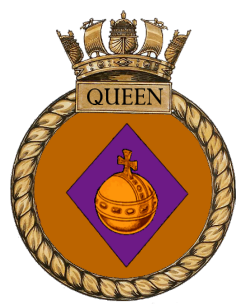


.jpg)
.jpg)
Comments (1)
Lovely to see my Grandfather, PO Telegraphist Eric Kelland fourth from left on the deck in front of the Corsair. Eric remained in the RNVR for many years, serving aboard the carrier HMS Eagle on NATO exercises. He retired from The RNVR as a Lieutenant Commander.