A History of HMS RAJAH
|
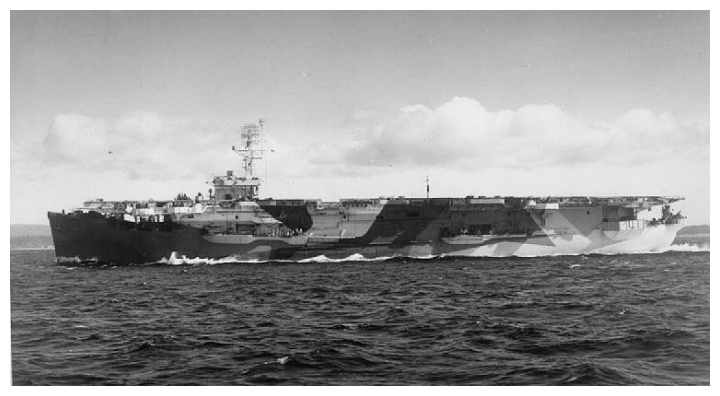 |
HMS RAJAH at sea c.1944. © IWM (FL 7059) |
HMS
RAJAH was an -Ameer- class escort carrier, her keel was laid
down on December 17th1942, at Seattle-Tacoma Shipbuilding Co.
Tacoma, Washington, a C3-S-A1 type freighter, Maritime Commission
hull number 256, Seattle-Tacoma hull number 40; purchased by the US
navy to be the USS McCLURE, AVG-45, a -Prince William- class
escort carrier, but her name was changed to PRINCE on
November 13th 1942. Whilst still under construction it had been
decided that AVG 45 was to be transferred to the Admiralty on loan
on her completion as an aircraft carrier. AVG-45 was launched on May
18th 1943 by her sponsor Mrs. J. L. McGuigan and was assigned to
Willamette Iron & Steel, Portland, Oregon, for the completion of her
construction as an escort carrier. Her US navy designation change d
to CVE-45 on July 13th 1943. She was transferred to the United
Kingdom under Lend Lease on October 17th 1943: She was delivered on
January 17th 1944, and commissioned into RN service as HMS RAJAH
(D10), Commander Philip Baker RN in command.
Modification and preparation to enter service:
After
completing her builder-s sea trials and Admiralty acceptance tests
HMS RAJAH proceeded to Vancouver, Canada to be modified to
meet Admiralty requirements, receive her full crew compliment, and
work up ready for beginning her active service. This work was
undertaken by the Burrard Dry Dock Co. Ltd., North Vancouver,
British Columbia. RAJAH was the twelfth ship to be modified
by Burrards, and she arrived at Vancouver at on February 1st and at
6 p.m. she was secured at No 7 berth, Lapointe Pier; at this time
sister CVEs SPEAKER, QUEEN, RULER and ARBITER were in
the hands of the Burrard' s yard and at various stages of
modification,. Work commenced to de-store the ship before she was
moved to number 3 berth on the 4th for her alteration work to begin:
this work totalled 150 separate modifications and included
lengthening of the flight deck, fitting redesigned flying controls
and fighter direction layout, modifications to hangar, accommodation
and store rooms, installing extra safety measures including major
changes to the aviation fuel stowage and oiling at sea arrangements,
modifying gunnery and other internal communications, adding extra
W/T and R/T sets, and improved darken ship arrangements.
As work
progressed RAJAH moved through the yards various berths; the
yard could be working on six different ships at any time with
separate aspects of the work carried out at different berths, the
ships passing through like a production line, moving from one berth
to another until complete. RAJAH moved to No 4 on February
20th, then to No 5 March 4th where her alterations were completed on
March 17th having taken a total of 45 days.
RAJAH sailed for
Esquimalt, Victoria, North Vancouver on March 19th to enter dry dock
for the fitting of additional sea valves and other remedial work.
She entered the berthing dock on the 20th, and was un-docked on the
22nd. She was to remain at Esquimalt, for a spell of defect
rectification, to embark Confidential Books and more stores and to
prepare for her post modification shakedown. Whilst moored in
Esquimalt the ship was visited by two officers from No. 7 Radio
Detachment RCAF, Patricia Bay, on April 11th; they were shown around
the ship, and in particular the operations room.
Once
the defect rectification period was completed RAJAH made a
short round trip voyage to the US Naval Yard at Bremerton,
Washington to ammunition the ship and then returned to the Straits
of Georgia (between Vancouver Island and the mainland), for
steaming, gunnery, radar and other trials and exercises.
|
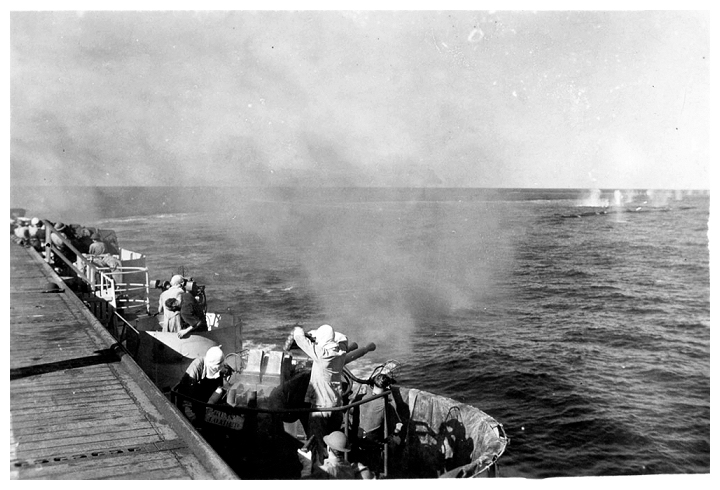 |
HMS RAJAH: Starboard aft 40mm Bofors crew test fire
their weapons during gunnery exercises in the Straits of
Georgia, April 1944. |
UK Bound: Rajah's First Ferry Load
HMS
RAJAH Left Esquimalt on May 2nd 1944 bound for the Panama Canal
and on to Norfolk, Virginia. At the Naval Operating Base, Norfolk
RAJAH was allocated to Western Approaches Command for ferry
duties, and began embarking aircraft on the 29th of June 1944. The
ferry load included the 12 Avengers of 857 squadron and the 18
Corsairs of 1842 squadron for transit to the UK. Also embarked were
the aircrews and personnel of these two squadrons. On completion of
loading RAJAH sailed for New York were she joined the east
bound convoy TCU 30 on July 2nd; this was mainly a troop ship convoy
with a few merchant vessels. RAJAH arrived at Liverpool on
July 12th where she unloaded stores and the aircraft of 1842
squadron; the next day she proceeded to Belfast to disembark 857
squadron and more stores. From Belfast RAJAH sailed for a
short defect rectification period in a Clyde dockyard.
Deck Landing Training Duties: August 1944
After
her repairs RAJAH was transferred toe control of the Flag
Officer Flying Training for a tour as the west coast Deck Landing
Training Carrier. The ship-s flight deck equipment was put through
its paces by an Avenger (JZ106)from 778 service trials unit and a
Wildcat (JV342) from 768 squadron on July 23rd; this involved
several arrested landings and catapult assisted take offs by each
aircraft.
From
July 31st till August 14th RAJAH was to operate as a deck
landing training carrier being visited by a verity of aircraft,
these mainly belonged to 768 Deck landing Training squadron from
RNAS Ayr. This period put the various ships- departments through
tier paces while training carrier pilots in the art of deck landing,
and was not without its mishaps. The pilots under training included
those of No. 618 squadron, Royal Air Force; normally they flew
mosquitoes but carried out their DLTs in the Barracudas of 768
squadron. This was in preparation for operations in the pacific
theatre were it was hoped they would be able to employ their
-bouncing- anti-ship mine developed from the famous dam busting
bouncing bomb designed by Barnes Wallace.
|
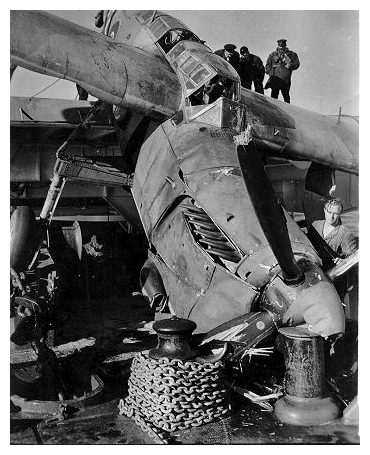 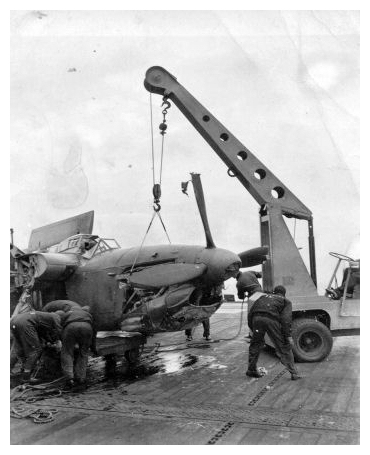 |
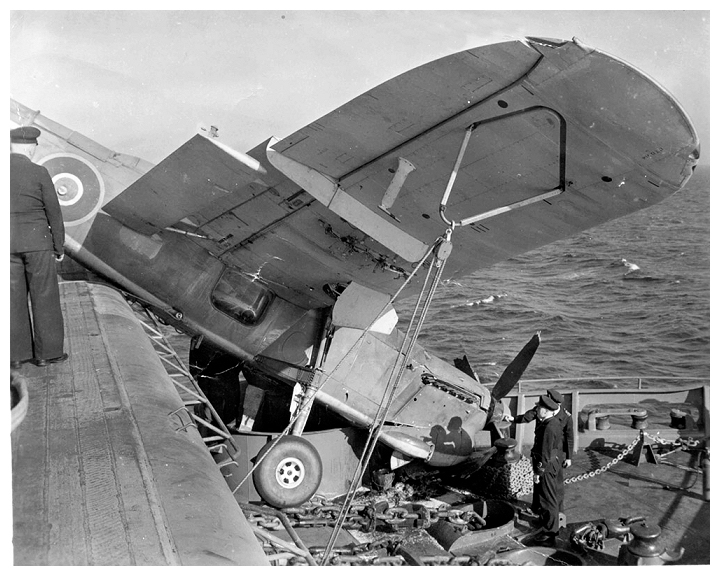
Top: A Barracuda which either missed all the arrestor
wires or lost its hook ran off the end of the flight
deck and went nose first in the foc-sle while on Deck
Landing Training, August 1944. Left & Right Recovering
the wreckage. |
The
training period started badly, one of the first aircraft to approach
the ship, a Barracuda, suffered rudder damage and spiralled into the
sea; the pilot F/Lt Maclean RAF was picked up by a fishery vessel.
There were numerous minor flying accidents during the two weeks of
intensive activity; one was more spectacular, Barracuda LS643 flown
by Pilot Officer JR Myles RCAF suffered an undercarriage failure on
August 13th and the aircraft came to rest in the posrt walkway.
Another, unidentified Barracuda failed to stop on landing and ran
over the front of the flight deck coming to rest nose first in the
foc-sle. Two other squadrons made shorter visits to RAJAH during
this period, 769 DLT squadron from RNAS East Haven operated on board
during August 11th 7 12th, and were followed on the 12th - 14th by
sister DLT squadron 767, also from RNAS East Haven.
Round trip ferry voyage to Ceylon: September 10th - November 11th
1944
Once
her DLT duties were completed RAJAH was re allocated to
Western Approaches Command for further ferry duties, proceeding to
RNAMY Belfast to embark her next load. On September 9th she embarked
the personnel and 12 Avenger aircraft of 849 squadron, the personnel
and 21 Avengers of 857 squadron along with the personnel and 6 Photo
recon Hellcat s of 888 squadron, for delivery to southern India and
Ceylon.
RAJAH sailed on the 10th; she called at Gibraltar, Alexandria
and Aden before reaching Cochin, S. India on October 9th. Here she
disembarked 849 squadron to RNAS Cochin and 957 squadron for the RN
Aircraft Repair Yard at Coimbatore. RAJAH continued on to
Trincomalee, Ceylon, disembarking 888 squadron to the Naval Air
Station at China Bay on the 11th. She spent the next week storing
ship and embarking passengers in preparation for the return voyage
to the UK. The passengers included the personnel of 822 squadron
which was returning to the UK without its Barracudas; the aircraft
type performed less than satisfactorily in the tropical climate and
were withdrawn after only a month of operations.
RAJAH sailed for home on October 19th, calling at Port Said and
Gibraltar on route. She arrived back on the Clyde on November 10th
and after unloading she entered a Clyde dock yard for defect
rectification.
Loan to the US Navy as a Transport Carrier
In December the Admiralty agreed to loan HMS RAJAH to the US
Navy for operations as a transport and aircraft ferry carrier with
the US Pacific fleet She sailed with convoy UC49B which departed
from Liverpool on December 20th 1944, and arrived at New York on
December 31st. After passing through the Panama Canal in early
January 1945 she arrived in San Diego, California to begin
operations on January 15th.
|
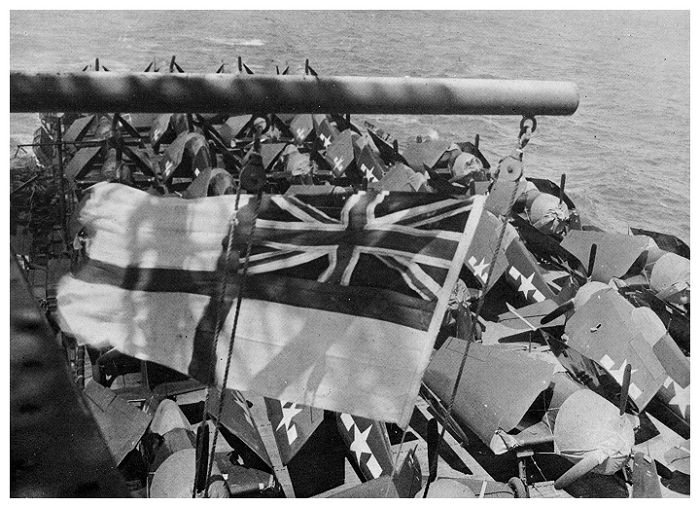 |
1945 - HMS Rajah somewhere in the Pacific, her decks
laden with US F6f-3s destined for Guam. . |
RAJAH carried aircraft and personal from San Diego to Guam in
the Mariana Islands, via Pearl Harbour. On her return passage to San
Diego she carried passengers and evacuated injured US personnel. Her
RN designation changed from D10 to R310 for service in the Pacific
but this may not have been worn. She was to operate in this role for
six months, and was returned to RN duties on July 7th 1945 when she
sailed from San Diego for the Naval Operating Base at Norfolk. She
reached Norfolk on July 23rd and embarked the personnel and 18
Corsair aircraft of 1853 squadron for passage to the UK. RAJAH
sailed (probably not in convoy since the war in Europe was over) on
July 28th bound for the Clyde, arriving there on August 5th.
Troop Ship Conversion : August - November 1945
HMS
RAJAH was one of six RN CVEs (along with ATHELING, RANEE,
QUEEN, PATROLLER and FENCER) selected for conversion for
Naval Trooping, these ships were to be employed bringing military
personnel from the Far East back to the UK and some commonwealth
countries.
Once
her passengers and cargo were disembarked RAJAH went upstream
to Meadowside Quay for her conversion to a troop ship; this work was
undertaken by Messrs Alex Stevens Ltd. During this period almost all
of the ship-s company were drafted off the ship and a scaled down
complement arrived to man her. The work consisted of converting the
hangar deck into accommodation spaces; about 600 bunks were
installed along with additional mess decks and heads. When the work
was completed on November 13th RAJAH left Meadowside Quay and
moved downstream to X4 buoy off Rosneath Patch where she was to
store ship, and carry out post conversion trials.
First trooping voyage: November 1945 - January 1946
After
embarking passengers RAJAH sailed for a round trip trooping
voyage to Gibraltar, Colombo and Bombay departing on November 22nd.
She reached Colombo on December 14th where she embarked/disembarked
passengers before sailing for Bombay on the 17th. She arrived at
Bombay on December 20th and embarked a contingent of Combined
Operations personnel for return to UK; she was to spend two days
here before sailing for Plymouth. Christmas day was spent at sea in
temperatures of over 90 degrees F - massed voices on the flight deck
could be heard singing, -'when the snow lay round about, deep and
crisp and even.-' RAJAH reached Plymouth on January 11th and
disembarked her first passengers before continuing on to Portsmouth
and later Sheerness, arriving there on the 13th; she finally berthed
at Chatham on the 14th. Leave was granted once the ship was secured.
Second trooping voyage: February - March 1946
After
the ship-s company returned from leave the ship was ready for a
second trooping voyage, she sailed again at the beginning of
February 1946, calling at Gibraltar, Malta, Port Said, and Aden,
arriving in Colombo on the 23rd. On the return journey she called at
the same ports, calling at Plymouth, Portsmouth and Sheerness before
she arrived in Chatham Dockyard for repairs on March 23rd.
|
 |
RAJAH entering Valletta harbour on one of her trooping
voyages in 1946. |
Third trooping voyage: August - November 1946
RAJAH returned to duty on August 10th 1946 and was again
Allocated to Rosyth Command for continued use as a troopship; she
was to make a third and final trooping run to Ceylon in September
Calling at Gibraltar, Malta, Port Said, Aden and Colombo. The ship
developed engine trouble in the Arabian Sea and was adrift for
several days while her engineers fixed the problem. The delay caused
a change in the ship-s schedule of stops, it was planned that she
would call at Singapore after leaving Colombo but this was cancelled
and a stop over of 10 days was made in Ceylon. At Colombo RAJAH
embarked part of the ship-s company of HMS GOULD, the BPF
Headquarters which had been housed at Chatham Camp, Colombo to
administer the winding down of the fleet after the closure of HMS
GOLDEN HIND in Sydney. This included a Royal Marine Band which
provided much welcome entertainment on the voyage home. On her
arrival back in Chatham she was stood down from duty and work began
de-storing her in preparation for her return to the Us Navy.
Her
final voyage from the UK was to Norfolk, Virginia via Bermuda; her
passengers included GI Brides and their children, a draft for HMS
Sheffield which disembarked at Bermuda..
Disposal: Return to US Custody
CVE 45
was returned to US Navy custody at Norfolk Navy Yard, Virginia on
December 13th 1946, RAJAH-s crew transferred to the fleet
carrier HMS INDEFATIGABLE for passage home. CVE 45 was
stricken for disposal on February 7th 1947 and was sold to the
Waterman Steamship Corp., on July 7th 1947.She entered merchant
service as the S.S. DRENTE
in 1948. She was renamed LAMBROS in 1966 and, further renamed
ULYSSES in 1969. She was scrapped in Taiwan starting in June
1975.
Content revised:
31 October 2021
Sources used in compiling this account:
Click here for a list of
Primary sources
Additional sources:
Fold3.com various documents including;
Admiralty War Diaries
Norfolk Navy Yard War Diaries
Mew York Navy Yard War Diaries
Miscellaneous documents
|
Home
page |
go to the top
|





Comments (0)