Orfordness 1666,
Texel 1673,
Quebec 1759,
Martinique 1762,
Havana 1762,
Heligoland 1914,
BELGIAN COAST 1914-18,
JUTLAND1916.
In the spring of 1942 work began to establish a Combined Operations Landing Craft base in Shoreham, Sussex. In May 1942, the construction of 11 purpose-built embarkation hards to serve landing craft and ships that would support Commando operations on the European coast was ordered. These 11 were all constructed in the Portsmouth Command area (between Portland and Newhaven) and completed by July of that year. These included two Landing Craft Tank (LCT) embarkation hards at Shoreham; a 4-berth hard ‘H’ at Shoreham outer harbour [possible location Half Tide Quay just outside the locks] and 5 berth hard ‘K’ at Shoreham inner harbour [possible location is the site of the Lady Bee Marina, just inside the canal]. A thir,d 3 berth LCT hard ‘L’’ was built at Sleepers hole, Newhaven.
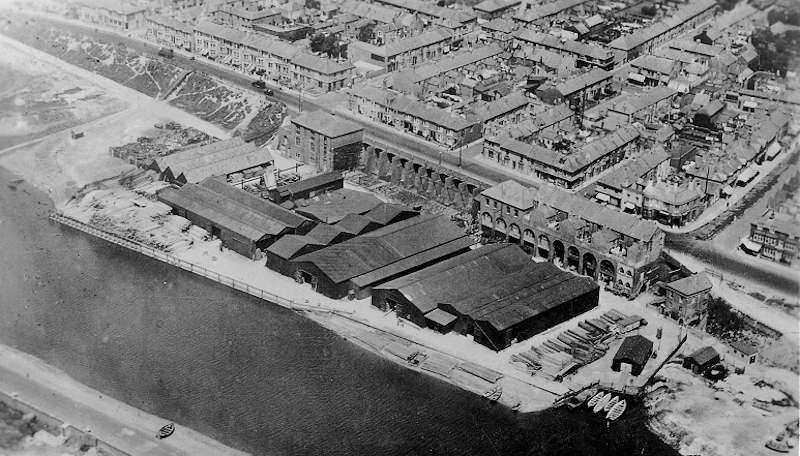
The base would eventually occupy buildings at several sites in the Shoreham, Portslade, Aldrington and Hove area. The main facilities were centred in and around the eastern end of the Southwick Ship Canal (also known as Shoreham or Portslade canal); a 1¾mile long sheltered waterway which runs from Shoreham, past Southwick, and terminates in Portslade. It is accessed via a set of locks at its western end where it joins the River Adur at Shorehan. The River Adur flows from the north, and turns to the east near Shoreham, to reach the English Channel. The guardroom was in an old building at Butt's Baltic Wharf on Aldrington Basin, ratings accommodation and the LCP maintenance base were located at John Brown's Wharf (part of Royal George Wharf).
Many buildings would be requisitioned for accommodation and office space at the bottom of Grand Avenue, Hove; these included the Princes, Haslemere, and the Kingsway Hotels, and Courtenay Gate along with several other properties centred on Grand Avenue. The Kingsway Hotel was used as WRNS quarters. It is believed that various accommodation ships were moored in Shoreham harbour to provide other billets for the establishment's personnel and landing craft crews.
Although not yet commissioned, the newly opened landing craft bases at Shoreham and Newhaven took part in operation 'JUBILEE' the ill-fated allied raid on the port of Dieppe, which began in the early hours of August 19th 1942. For this operation the 4th and 5th Landing Craft Flotillas (Royal Navy) arrived at Shoreham and Newhaven in early August to prepare for the assault. Their arrival was supposed to be secret; however, a miscalculation of the tides resulted in most of the small vessels running aground. All preparations to hide the flotilla's arrival were useless - they were clearly visible from the coast road.
Final planning for the launch of operation 'JUBILEE' was carried out at Lancing College, HMS KING ALFRED (L), where the Canadian Army and Royal Navy commanders, Lieutenant Colonel D Menard and Lieutenant-Commander J. H. Dathan, finalised the embarkation plans. The forces for JUBILEE would be sailed from a variety of south coast ports, including Shoreham, Newhaven, Gosport, Portsmouth, and Southampton. Canadian troops of the Les Fusiliers Mont-Royal, 6th Infantry Brigade, departed from Shoreham, being transported in LCPs [Landing Craft Personnel] crossing directly to the French beaches - an unpleasant trip in a flat-bottomed craft with a top speed of 12 knots. The largest force involved in the operation comprised of 4,963 men of the 2nd Canadian Infantry Division, they were to suffer staggering casualties, only 2,210 returned to England, and many of these were wounded. 907 Canadians lost their lives, 1,946 were taken as prisoners of war.
.jpg)
The base was commissioned as an independent command with the ship's name LIZARD on October 7th 1942, Lieutenant-Commander F.C.M. Evans, RNVR who had been the Officer in Charge, now in command. However, on February 22ms 1843 Captain P. Hordern (ret) RN, former CO of Coastal Forces base HMS BEE (Weymouth) was appointed as commanding officer; Lieutenant-Commander Evans assuming the role of Executive Officer.
The base provided training facilities for men of the Royal Marines and Royal Navy in seamanship and survival skills to prepare them for their hazardous duties as landing craft crews. Crews participated in regular exercises, usually up the coast to LIZARD's sister Landing Craft Base, HMS NEWT in Newhaven, but they were not always given advance warnings of these, particularly night exercises. Often, they were awoken in the middle of the night and loaded onto Southdown buses waiting outside to transport them to their craft moored in the Southwick Ship Canal. The base also provided repair and re-supply facilities for a variety of types of landing craft, in particular LCV (P)s [Landing craft vehicle (Personnel)] & LCP (L)s [Landing craft personnel (Large)].
While LIZARD handled many hundreds of landing craft over its three years as an operational naval base the first units that can be traced as being attached to the base for training are the 902 & 803LCV(P) Flotillas, Royal Marines. Both were formed at Dartmouth in 1942, the 803rd arrived at Shoreham in 1943, having formed as the 434th LCA [Landing Craft Assault] Flotilla but becoming the 803 LCV(P) Flotilla when they reached Shoreham. They received new landing craft, transferred from the Royal Navy, collecting them from their berths in the Portslade Basin. This unit was to remain at Shoreham until the spring of 1944 when it moved to Hayling Island, Hampshire to prepare for D-Day operations. LCVPs had a crew of four, three Marines and one RN stoker; most flotillas of smaller landing craft were composed of 16 vessels..
By January 1944 the base was very busy with as many as 94 craft in residence; the base was now home to elements of Force “J” working up for the Normandy landing on Juno Beach: these included 3 of the 5 flotillas of "A" (L.C.V. (P)) Build Up Squadron, 802, 803 and 804 flotillas (the H.Q. and 800, 801, were at HMS NEWT at Newhaven). Also present were "D" (L.C.M.) Build Up Squadron, comprising of the 600th and 601st Build Up Flotillas and their H.Q. (these were later absorbed into “F” Build Up Squadron). Also present were the 707th (L.C.P. (L)) Assault Flotilla and the 35th Landing Barge (Supply and Repair) Flotilla.
.jpg)
The 600th & 601st Build Up Flotillas operated 16 L.C.M. each; the 802nd, 803rd & 804th Build Up Flotillas operated 16 L.C.V.(P) each; the 707th Assault Flotilla operated 12 L.C.P. (L); the 35th L. B. (Supply and Repair) Flotilla operated 19 specialist Landing barges - 6 L.B. (Engineering)., 10 L.B.(Oil). & 2 L.B.(Water), most detached to bases along the south coast.
In February 1944 one of the largest Landing craft exercises of the war was undertaken, lasting for eight days, taking the craft as far afield as Portsmouth and Poole. This was an exhausting schedule for the crews, and tragically two men died. In early May 1944 the flotillas based at Shoreham and Newhaven participated in exercise FABIUS III, a full rehearsal for the Normandy landings. There were six FABIOUS groups; 4 of them were British, FABIUS I was the rehearsal for Assault Force "O", FABIUS II was the rehearsal for Assault Force "G". FABIUS III was the rehearsal for Assault Force "J" and involved elements of the 3rd Canadian Infantry Division landing at Bracklesham Bay, West Sussex. FABIUS IV was the rehearsal for Assault Force "S”, FABIUS V was a marshalling exercise for British units in the initial build-up forces for Gold, Juno and Sword beaches. FABIUS VI was a marshalling exercise for Force "B". Marshalling began on April 27th and craft began loading on the 29th; FABIUS I, II, III and IV were carried out simultaneously on May 4th.
By late May 1944 the Build Up Flotillas had all relocated to their assigned bases for the upcoming operation Neptune; the 600th & 601st Build Up Flotillas to HMS SEA SERPENT at Birdham, the 802, 803 and 804 Build Up Flotillas to HMS NORTHNEY at Hayling Island and the 707th Assault Flotilla had been moved to the Portsmouth area. The 35th L. B. (Supply and Repair) Flotilla was relocated to HMS DRAGONFLY on Hayling Island and were mainly moored in Langston harbour. In their place came the 22 Landing Craft Tank Mk.4 (LCT) of the 42nd & 48th LCT flotillas, part of "I " Squadron for Neptune Assault Group "S " 2. They would sail for Sword Beach in company with the rest of "I " Squadron, 40th LCT and the 251st and 263rd LCI (L) Flotillas which were at Newhaven. It is unclear what loads the LCTs embarked but they were probably elements of the 27th Armoured Brigade.
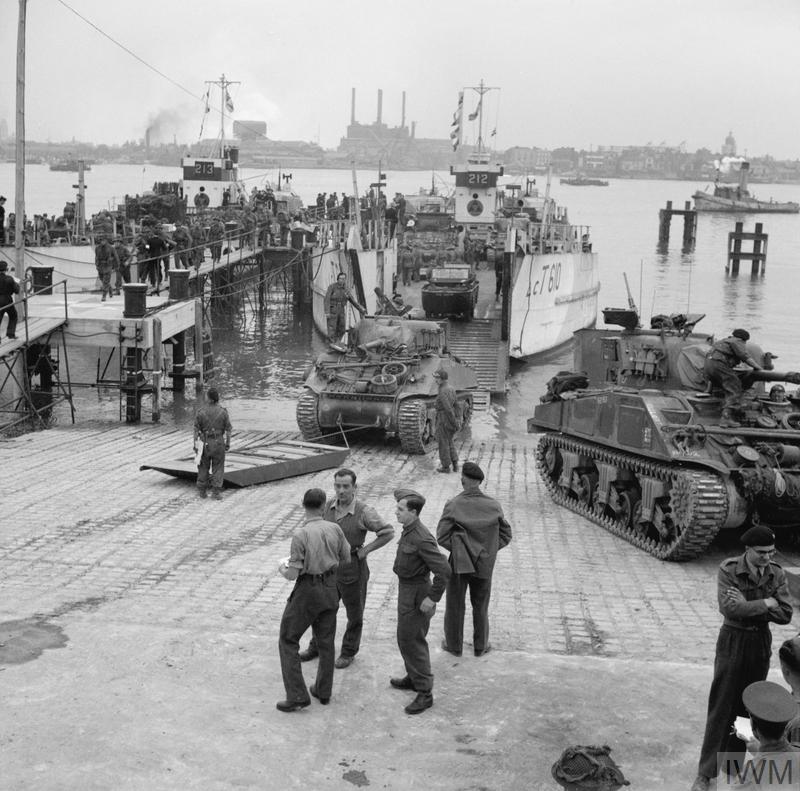
Each LCT would embark 4 vehicles (reversed onto the vehicle deck) and 20 personnel; The Squadron commander, Lieutenant Commander M.O.W. Miller, RN recalls
Another tasking for D-Day was that of a refugee receiving station; 8 LCI(L) [Landing Craft Infantry (Large)] at Portland and 8 at the Ilse of Wight were at readiness to to evacuate French refugees from the British invasion sector and to ferry them back to Shoreham where facilities had been set up to process them. It is not known of any were evacuated.
Within months of the successful Allied invasion at Normandy the base was far quieter; the only operational unit to be allocated to LIZARD was the 442nd Ancillary Flotilla operating 12 LCP(S), and a new role was allocated, that of holding reserves of landing craft. There were28 LCM in pooled reserve and 34 LCV(P) in operational pooled reserve moored in the canal.
In mid-September ‘F’ Beach Commando (Naval Party 1504) arrived from HMS ARMADILLO, Dunoon to conduct training, and another unit, the 401st Training Flotilla (15 L.C.M.) took up residence. They were also joined by a new Base Flotilla equipped with 12 L.C. V.s. The 442nd Ancillary Flotilla disappears from the records by December 1944; by this time the reserve craft holding had changed to 26 LCM, 3 LCP(L), and 20 LCV(P).
The New Year brought new units and taskings for LIZARD; in February 1945 Paxman Overhaul Party Number 1 (Naval Party 4231) arrived from HMS PORCUPINE, Portsmouth. This specialized unit handled the Diesel powerplants installed in many types of landing craft. ‘F’ Beach Commando returned ARMADILLO Match 1st.
With the Allied forces in Europe pushing German forces back towards the Rhine naval parties were planned to occupy captured ports; 2 Naval Parties, N.P. 1742 and N.P. 1734 were formed at LIZARD as early as November 1944. These were formed when Rear Admiral H T Baillie-Grohman, was appointed Flag Officer in Charge, Kiel in preparation for naval-forces occupying the ports in the British zone of North Germany. Both parries left Shoreham at the start of May 1945 for Tilbury on route to Kiel. A third party, N.P. 1776 was formed as a Port Party to operate a Danish port, the party was not required and the personnel sent to Royal Naval Barracks Portsmouth on May 17th. Paxman Overhaul Party Number 1 moved to HMS NORTHNEY II, Hayling island at the end of May to prepare for service in the Far East.
In early June 1945 members of the Ship's company of HMS LIZARD and Captain Hordern, attended the funeral of Captain J. N. Pelly CBE RN, commanding officer of HMS KING ALFRED, who died suddenly on the morning of June 6th 1945. This was a public funeral with full military honours, the coffin being carried to KING ALFRED on a gun carriage followed by contingents from surrounding Naval, Army and Air Force establishments.
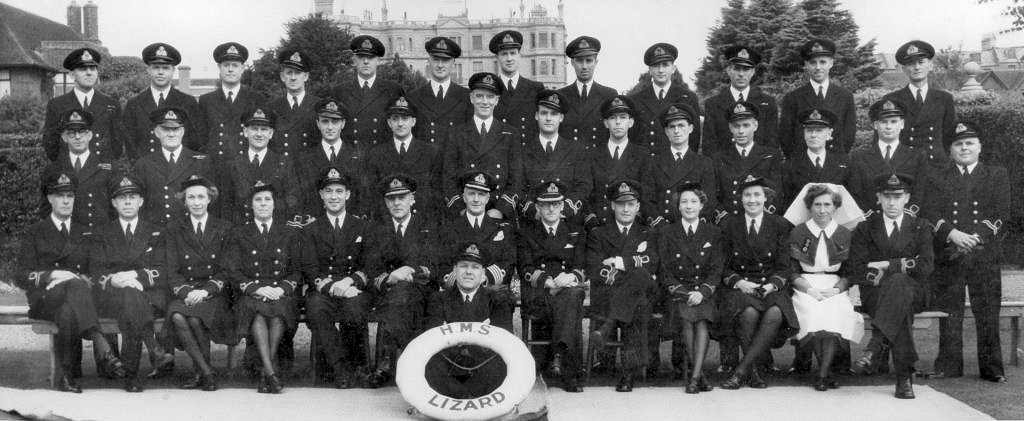
At the start of August 1945Captain W.C.T. Eyres, formerly CO of landing craft base HMS CRICKET (another Royal Marine Landing Craft Crew Training Base at Burseldon), assumed command of HMS LIZARD. The base began to run down towards eventual closure after VJ Day, August 15th 1945; the following day LCG(M)180 [Landing Craft Gun (Medium)] was the first of many craft to arrive at HMS LIZARD to decommission.
The establishment was reduced to care & maintenance status on October 21st 1945; the following day Captain W.C.T. Eyres presented the ship's bell to the Mayor of Hove, Alderman AH Clarke, "as a memento of the happy relations which have existed since 1942 between the officers and men and the Borough of Hove." At the time of its closure on December 31st 1945 more than 50,000 men passed through HMS LIZARD.
Revised August 2020
Sources:
Books
Warlow, B. (2000) Shore Establishments of the Royal Navy (Second Edition) Liskeard, Maritime Books
Middleton, J. (2002, 2003) 'Encyclopaedia of Hove & Portslade' Vol.8, I to L Brighton & Hove Libraries
‘The Green List’ (LANDING SHIPS LANDING CRAFT AND LANDING BARGES) January, June and December 1944 editions. Produced by the Operations Decision, The Admiralty.
The Navy List, Oct 1942 to Oct 1945
On line
Embarkation Hards page on the Maritime Archaeology Trust website
https://maritimearchaeologytrust.org/embarkation-hards
803 Flotilla pages on the Second World War Experience Centre website
https://war-experience.org/803-flotilla-home/
Combined Operations Training in the UK on the Combined Ops Website
http://www.combinedops.com/Training%20EST%20UK.htm
Naval Parties of the Royal Navy, 1942-1991 on the Naval-History.Net website
https://www.naval-history.net/xBW-RNNavalParties.htm
Force ‘S’ Orders and Force ‘J’ Orders for Operation Neptune on the Fold3.com website
The Dieppe Raid: A Tragedy Sixty-Two Years Ago *PAGE NO LONGER AVAILABLE**
BR. 1736(26) Naval Staff History Raid on Dieppe (Naval Operations) *PAGE NO LONGER AVAILABLE**
Lancing College and Operation "JUBILEE", the Dieppe Raid 1942 **PAGE NO LONGER AVAILABLE**
© 1999-2026 The Royal Navy Research Archive All Rights Reserved Powered by W3,CSS
Comments (1)
Was 603 flotilla involved in conflicts during DDay and during the war as my grandad was royal marine and served with landing craft COPRA