A History of HMS ARCHER
|
 |
HMS Archer Shortly after delivery to the RN. Photo:
Author's collection |
HMS ARCHER started out as the 11,900-ton Motor Ship MORMACLAND, a C3 type passenger freighter operated by the US operator Moore-McCormack Lines Her keel was laid down on August 1st 1939 at Sun Shipbuilding & Dry Dock Company, Chester Pennsylvania as Maritime Commission hull number 46, Sun number 184. She was, named for Rear Admiral Emory S. Land, USN (ret.), the third of a series of four cargo vessels of the Mormacpenn class (MORMACPENN, MORMACYORK, MORMACLAND AND MORMACMAIL). These ships had accommodations for 10 or 12 passengers and were powered by four Busch-Sulzer diesels connected to a single propeller shaft through Westinghouse electrical couplings and a Falk single-reduction gear set. They have a normal shaft horsepower of 8,500 and a sustained sea speed, fully loaded, of 16½ knots.
MORMACLAND was launched on December 14th 1939 by her sponsor Miss Anne E. Bailey, daughter of Senator Bailey, chairman of the Senate Commerce Committee. Her build was completed on April 24th 1940 and she was delivered to Moore-McCormack Lines for the American Republics Line service to South America calling at New York, Barbados, Trinidad, Rio de Janeiro, Santos, Montevideo, Buenos Aires. All four Mormacpenn class vessels were pressed into military service within a year.
MORMACLAND and her sister MORMACMAIL were requisitioned by the Maritime Commission for conversion into Auxiliary Aircraft Carriers; MORMACMAIL was requisitioned on March 6th 1941 and became the USS Long Island, MORMACLAND was requisitioned on May 20th 1941 for conversion and transfer to Britain upon completion as BAVG 1
Note:
U.S. Navy classification 'BAVG' designates her as 'British Auxiliary Aircraft Carrier' - her predecessor and sister ship, USS LONG ISLAND was AVG 1.
Conversion to a warship: May 1941 - November 1941
The MORMACLAND was to be converted in the same manner as the MORMACMAIL and the work was to be carried out by the Newport News Shipbuilding & Dry-dock Company, Virginia. The conversion consisted of installing a lightweight wooden flight deck on a truss work superstructure which covered 70% of the ship's length, fitting a small enclosed hangar beneath the aft of the flight deck to be serviced by a single lift. ARCHER had no island superstructure; a small navigation bridge was built under the forward edge of the flight deck while the original bridge was retained under the flight deck with enlarged wings on either side to give adequate visibility. Her original funnel had been removed and replaced by a system which split the exhausts into two deck level vents which emerged amidships on either side of the flight deck. While this solution neatly concealed the funnel and reduced her silhouette it was soon found that when steaming at maximum speed, necessary for flying operations, ARCHER's Busche-Sultzer diesel engine produced volumes of black smoke which could completely obscure the flight deck so much so that pilots could see neither the batsman nor the deck.
Upon the completion of her conversion into a carrier on November 15th 1941 she was transferred to the Admiralty and commissioned into the Royal Navy as HMS ARCHER (D78) at Norfolk, Virginia, on November 17th, Acting Captain J.I. Robertson RN in command. She was the fifth vessel to bear the name ARCHER./p>
|
 |
HMS Archer pictured with a Martlet and two Swordfish on
her flight deck. Photo: Author's collection. |
Sea trials: December 1941
After storing and manning ship ARCHER began her acceptance trials in Hampton Roads on Sunday December 23rd 1941; after ship handling runs and other acceptance trials three US Navy Wildcats flew out to her for deck landing and accelerator trials, safely landing aboard at 11:06 Tragedy was to strike however on the first catapult launch half an hour later; the hydraulic aircraft accelerator misfired causing the fighter to be released prematurely. Without sufficient airspeed the Wildcat dove into the sea off the bow; a quick-thinking crew member, Able Seaman Giddings, dove over the side and made repeated attempts to find the pilot, Lieutenant-Commander J. J. McRoberts, USN but without success. Later the remaining two Martlets were flown off the deck while steaming at full speed into the wind as the accelerator was damaged beyond repair by the ship's engineers. ARCHER put into Philadelphia Navy Yard on Christmas Eve for repairs, she was not ready to continue her trials until the New Year. On January 2nd, 1942 ARCHER safely catapulted three Martlets and completed her sea trials.
Operational duties and disaster strikes: January 1942
On January 9th ARCHER proceeded down the Delaware River bound for Norfolk, Virginia to embark a ferry load of aircraft before setting out on her maiden Atlantic crossing to the UK. ARCHER's bad luck with mechanical systems struck again before she even reached the open sea; first her gyro compass failed near to Goose Island, and after steaming through the night at 14 knots her engine began to cause concern and she had to heave to at 07:20 in order to affect repairs. She arrived at the Norfolk Naval Operating Base at 12:47. On the morning of January 12th she embarked eleven Martlets (the Wildcat was named the Martlet when first in RN service) as cargo.
ARCHER left Norfolk on the morning of the 13th bound for Kingston, Jamaica where she was to embark her own aircraft, four Swordfish belonging to 834 naval air squadron from RNAS Palisadoes. She soon suffered more mechanical failures; first her steering broke down at 10:30, followed by the gyrocompass which failed again at 11:40. After making repairs she resumed course for Jamaica at 22:30 hours while 200 miles east of Charleston, South Carolina disaster struck when a ship loomed out of the darkness to port; ARCHER's engines were put into full reverse but too late to have any serious effect, the ships collided. ARCHER was struck on her port bow by the Peruvian merchantman SS BRAZOS tearing a large gash in her side; No 1 hold began to fill with water and the she began to settle by the bow, when damage control parties had stemmed the water ARCHER had settled with a 5-degree trim down by the bows. The BRAZOS was also down by the bows, and both ships were dead in the water. Attempts to assist the BRAZOS were unsuccessful and at 03:00 the following morning the ten officers and twenty-five men who were aboard transferred to ARCHER using their own boats. ARCHER's captain, who had contacted US coastguard authorities and requested assistance, started the ship moving towards the US coast at first light; the ship could only make minimal progress going astern because her single large screw was half out of the water. The BRAZOS was still afloat, but she later sank. The loss of the S.S. BRAZOS was to raise serious legal questions about which government (if any) should be sued for damages by her owners Agwilines Inc, New York.
The US Coast Guard tug TALLAPOOSA rendezvoused with ARCHER at 02:40 on the 16th, and a tow was established by 07:50. The TALLAPOOSA however was not an ocean-going tug and she struggled to reach a best speed of only 1 knot; after two hours it was decided that ARCHER would cast off the tow and continue under her own power until a more powerful tug could reach her. Later the following day the sea going tug CHEROKEE arrived and took up the tow. On the after-noon of January 21st, eight days after the collision, ARCHER reached Columbus Pier, Charleston.
On January 28th ARCHER went into dry dock for repairs, she was not passed as fit for operations until the beginning of March. She was moved to Pier 317 on March 7th to begin to store and ammunition the ship. Next, she re-embarked her aircraft (accounts differ here - some sources quote twelve Martlets... the original 11 +1?) as cargo for delivery to the Fleet Carrier HMS ILLUSTRIOUS, and finally the four Swordfish aircraft of her own small Squadron, 834 Naval Air Squadron which had flown out from Jamaica to join her.
New orders, convoy escort to Freetown: March 1942
ARCHER's new orders were to provide anti submarine patrols for a
convoy bound for Sierra Leone and to deliver her cargo to
ILLUSTRIOUS at Freetown. She sailed from Charleston on Wednesday
March 18th bound for San Juan, Puerto Rico, in company with the
cruiser DEVONSHIRE and two destroyers of the 1st Support Group, in
readiness to escort a fast convoy to West Africa. Convoy AS.2 sailed
from Charleston for Freetown, Sierra Leone on the 19th and comprised
of four merchant ships AGWILEON, BRAZIL, MONTEREY and MORMACTIDE.
ARCHER's steering gear again gave trouble on the 22nd, but this was
rectified on passage, arriving San Juan next day.
ARCHER in company with DEVONSHIRE and three escort vessels joined up with the convoy on Tuesday March 24th and regular anti-submarine patrols were flown from dawn until dusk, no U-Boats were spotted and the squadron suffered only one serious crash on March 30th when a returning Swordfish caught its tail hook on the lift edge, this ripped free of the aircraft which ended up in the barrier. The aircraft was seriously damaged but no-one was injured. The ship's engines and gyro compass both continued to give trouble during the crossing but ARCHER and her charges arrived safely at Freetown on April 3rd 1942.
At Freetown, Sierra Leone: April - May 1942
HMS ILLUSTRIOUS was already in the harbour when ARCHER arrived. On board this carrier was 882 Naval Air Squadron equipped with Martlet fighters, a detachment of six of these fighters and support personnel were to be transferred to ARCHER to provide a fighter capability, in exchange ARCHER transferred the twelve new machines that she had brought from America. This new fighter capability was eroded almost overnight when Lieutenant-Commander (Flying), Lieutenant-Commander A. C. R. Duvall RN was informed that ILLUSTRIOUS was to retain four of the machines to bolster reserves for the upcoming invasion of Madagascar; under this arrangement two Martlets joined the ship on April 9th.
It was hoped that ARCHER's next orders would be to proceed to the UK for refit and modification but before this could happen her engines let her down again. Her diesel engines were connected to the propeller shaft through a magnetic clutch mechanism, it was this piece of machinery that was most often giving trouble; as the clutch disengaged itself the engines raced out of control and a tremendous shuddering would be felt throughout the ship. Such an occurrence meant stopping both engines and attempting to fix the clutch, this was problematic if there were aircraft aloft, as well as the threat from any nearby enemy submarines.
ARCHER spent the next five weeks in Freetown before she was ready to leave; she had been on the verge of sailing on several occasions but new defects had continued to plague her. Orders had arrived that she was to be ready to sail with a convoy on May 13th but again she was destined to remain in Freetown, the 55 RAF passengers she was to carry being reassigned to an alternate vessel on the 10th.
Near the end of April, she was able to put to sea for much needed flying practice with her two Martlets but bad luck struck again on Sunday April 26th when the second aircraft to land suffered an arrester hook problem and ran into the barrier reducing the fighter strength to one until repairs could be completed.
Ferrying duties and passage to Cape Town: May - June 1942
ARCHER finally left Freetown on May 15th bound for Cape Town on route to Mombasa and then to the Suez Canal to enter the Mediterranean, ferrying fighters to points along the way. Passage to Cape Town was a rough one and only essential flying was possible, several landing on incidents kept the air engineering department busy; on reaching Cape Town on the 24th the sea was so rough ARCHER rolled eighteen degrees before entering the lee of the harbour. The serviceable squadron aircraft were flown ashore to RNAS Wingfield for compass swinging while the ship prepared to load her ferry cargo of six Hurricanes for delivery to Mombasa.
The stopover was only supposed to be 25 hours, long enough to embark the six Hurricanes and then sail for Mombasa, but her engines gave out yet again and it was not until the 28th that ARCHER finally left the quayside. The ship could now only manage 12 knots and this lack of speed meant there was insufficient wind over her deck to operate her aircraft; signals about the continuing decline of her machinery had finally got results and she was recalled only hours after leaving port to await orders for passage to Greenock. Once back alongside in Cape Town she embarked passengers and cargo for the UK, amongst this cargo was three million pounds sterling in gold ingots under armed guard. She sailed from Cape Town on June 8th.
On passage: June 1942
On June 14th ARCHER came across survivors of
the merchantman SS LYLE PARK which had been sunk by the German
raider KMS MICHAEL on the 11th; only two men survived, the Captain
and the Bosun, both were found in separate life rafts. The following
day a Swordfish was despatched to deliver a message to the Cable &
Wireless Office in Georgetown on Ascension Island to be transmitted
to the Admiralty about the survivors. The plan was to drop a message
in a suitable centaur from the aircraft but on arrival over the
island the pilot, Lt. E. Dixon-Child, spotted the runway of the
newly completed USN airstrip Wide Awake and decided to land and hand
over the message. The strip was intended for a stopover field for
planes being ferried across the Atlantic and had not had any
visitors until Swordfish 'A' V4653 came into sight; the defenders
opened fire on the plane but no-one was injured and Lt. Dixon-Child
and his crew made history as the first plane to land there.
While searching for the survivors of the LYLE PARK another signal concerning ARCHER's engines was received, this one again countermanded her orders to sail to the UK, this time she was ordered to New York for much needed engine repairs. ARCHER made for Freetown after recovering Swordfish 'A' from her Wide Awake adventure in order to disembark her passengers and the gold. The passage back to Freetown was marred by tragedy on the 19th when armourers were handling a 250lb bomb which exploded in a walkway on the edge of the flight deck, the blast killed eight men and injured eleven more, one of which died from his wounds two days later. A large hole was ripped through the hanger bulkhead starting a fire which activated the fire suppression system; one aircraft was damaged before the fire was extinguished. Those who died at the time of the explosion were buried at sea, the man who died later form his wounds was buried in Freetown.
Passage to New York and defect rectification: June -November 1942
ARCHER departed from Freetown on June 26th for New York and was once again plagued by faults; her engines broke down completely on July 3rd leaving her drifting in mid-Atlantic while her engineers went to work. The duty Swordfish patrol aircraft was aloft to provide air cover against the very real threat of U-Boats; the Admiralty warnings indicated that her course to the US would put the ship at risk of encountering as many as 23 enemy submarines. Her engines were back on line later that day and ARCHER's captain decided to head for the Naval Base at Bermuda to effect repairs before continuing on the New York.
While at Bermuda an outbreak of Flu put the squadron aircrew out of action and the only man fit to fly was the Commander Flying, he spent the first three days out of Bermuda on constant readiness to launch a Swordfish but was not called upon to take to the air. ARCHER had been given a destroyer as escort and US sea planes patrolled her course, several suspicious contacts were chased down by the destroyer and patterns of depth charges dropped.
HMS ARCHER reached the safety of the harbour at New York on July 15th, anchoring just inside the harbour wall to off load aviation petrol and ammunition in preparation for entering the shipyard; her squadron was flown off to operate ashore from
USNAS Floyd Bennett Field, Brooklyn. Two days later ARCHER proceeded into the harbour and made her way to the shipyard at Hoboken, New Jersey where she was to undergo repairs to her machinery and receive modifications to improve her aircraft ferrying capabilities. Work commenced on July 17th and was to take three and a half months to complete.
Ferry trip to Casablanca and passage to UK for further modification:
November 1942
After a short post-refit work up HMS ARCHER was employed as a ferry carrier; she embarked a cargo of thirty-five US Army Air Corps Curtis P-40F Warhawks and a contingent of US personnel of detachment 'J' or 'Joker squadron' of the 33d Fighter Group for passage to Port Lyautey, Casablanca, Morocco. She joined convoy UGF2 which sailed from Hampton Roads on 2 November 1942 to take the southern trans-Atlantic route. On the 14th she was off the West African coast and began catapulting thirty-two of the Warhawks, which flew ashore to newly captured airfields.
The P-40s was to be stripped of ammunition, navigation equipment, and excess fuel to reduce weight for carrier catapult launch, but having no arrestor hook they had to make landfall to land or ditch. The operation did not go smoothly, the first 15 aircraft made good launches and climbed to altitude without trouble, the next 15 struggled into the air. When it came to launching number 31 the catapult failed to propel the aircraft with full force, it dipped below the flight deck and hit the sea, the pilot, 2Lt O. Hearing was rescued by a US destroyer. On the 16th an attempt was made to launch the remaining four aircraft, the first made it off the deck OK but the third flown by 2Lt R. Kantner failed to gain airspeed and ditched. The last aircraft was successfully launched on November 18th when ARCHER reached Casablanca. After unloading her passengers and cargo at Casablanca ARCHER sailed to Gibraltar to await convoy MKF3, which had sailed from Algiers on the 23rd bound for the Clyde, it reached Gibraltar on the 27th and ARCHER joined as part of the escort force.
|
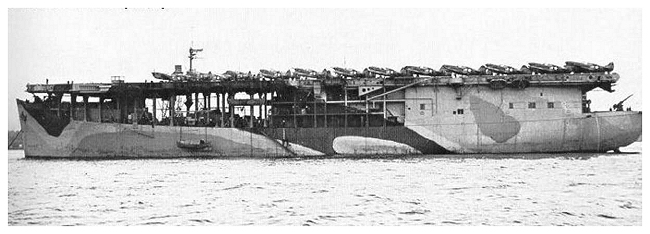 |
HMS Archer carrying a cargo of thirty-five US Army Air
Corps Curtis P-40F Warhawks, November 1942 .
Photo: Author's collection. |
Operations with Western Approaches Command: February - May 1943
On arrival in the UK on December 3rd 834 squadron departed for RNAS Crail. ARCHER now entered Alexandra dock in Liverpool for a further two-month refit and modification period. This work commenced on December 4th and included the lengthening of her flight deck by an additional 28 feet and adjustments to her defensive armament fit. Two of her original three 4in guns had been removed, leaving one mounted right aft under the overhang of the round-down, and two twin Bofors were added in addition to her ten Oerlikon.
Work completed ARCHER was reassigned to Western Approaches Command on February 17th 1943 and began a period of workup operations in Rothesay Bay carrying out trials with her new gun armament and new squadrons. No. 892 squadron began embarking at 08:22 on February 19th with 6 Martlet V fighters, they were joined by the 9 Swordfish IIs of 819 squadron on February 28th; both squadrons had been ashore at
RNAS Machrihanish, Argyll, in Scotland 819 having re-equipping with the new Rocket Projectile armed Swordfish. The first flying incident occurred on the first day when Swordfish HS362 'G' flown by Sub Lt. J. H. Lamb RNVR missed the arrestor wires and floated into the barrier. catapult trials were conducted with the Martlets on the 21st and 22nd, followed by further flying exercises.
On the 23rd ARCHER was joined by sister BAVG,
HMS BITER for a period of joint anti-submarine exercises. There were three flying accidents during the exercises, on March 12th Martlet FN231 failed to reach sufficient flying speed for take-off and ditched alongside, the pilot, Sub Lt. W. G. Bowles RNZNVR was rescued by the attendant Royal Marine launch. The next day a second Martlet, FN232 flown by Sub Lt J. A.F. Wood RNVR, crashed on landing, and Sub Lt. H. J. Nicholls RNVR in Swordfish HS292'G' suffered a parted arrestor wire after making a fast approach.
On March 17th ARCHER moved to Scapa Flow where she was to be inspected by His Majesty King George VI on March 20th, he was accompanied by the Commander-in-Chief Home Fleet, Admiral Sir John Tovey, and Vice Admiral, Aircraft Carriers, A. St. G. Lumley Lyster. ARCHER returned to the Clyde the following day to begin another round of defect rectification in shipyards on the Clyde and in Belfast.
On leaving the Clyde shipyard at the end of the first week of April ARCHER disembarked her squadrons on passage to Belfast; 819 flew ashore to
RNAS Machrihanish on the 8th and 892 to RAF Ballykelly, Northern Ireland on the 9th. By April 23rd ARCHER was back at sea and re-embarked 819 squadron on the 24th, they had flown from Machrihanish to join 892 at RAF Ballykelly, and flew to
RNAS Belfast to re-join the ship. Meanwhile 892 squadron had relocated to
RNAS Machrihanish and ‘A’ flight (3 Martlets) embarked from on the 28th as ARCHER finished her preparations for returning to active duty.
Operations with 4th Escort Group
HMS ARCHER sailed from the Clyde on May 2nd, accompanied by the Destroyers MILNE, ECLIPSE and FURY, to join the 4th Escort Group, (EG4) operating off Hvalfjord, Iceland, for convoy support operations in the North Atlantic. The passage to Iceland was a stormy one with heavy weather causing some minor damage. Her squadrons managed to conduct Anti-submarine patrols in spite of the conditions, and she entered the anchorage at Hvalfjord at 22:13 on the 5th. All aircraft were flown ashore to the RN Air Section at RAF Kaldadarnes. On May 7th ARCHER and EG4 sailed from Hvalfjord with the destroyers FAULKNOR, ONSLAUGHt and IMPULSIVE screening the carrier, in order to overhaul the westbound Convoy ONS.6 which had sailed from Liverpool on April 29th bound for Halifax. ARCHER re-embarked her aircraft once underway and began anti-submarine patrols.
At 15:10 that afternoon ARCHER sighted an American Army Air Corps B-17 Flying Fortress, No 25840 on its transatlantic flight to Britain. Since ships and aircraft could not communicate with each other, having no common system, the B-17 circled the carrier, it appeared to be in trouble of some kind or simply lost and made a low run over the carrier, possibly with a thought of setting down on her small, pitching deck., The pilot eventually came in for a controlled ditching inside ARCHER’s destroyer screen; mistakenly thinking that the carrier was steaming into wind, the pilot came down parallel to ARCHER on the same heading, hit the chop and reared right over on its back. Nine of its crew of ten were rescued by FAULKNOR and ONSLAUGHT.
Only one day out from Iceland a major flying accident put five aircraft (out of her total of 12) out of action; Swordfish 'A' HS290 flown by Sub Lt J. H. Lamb suffered arrester hook failure on landing and tore through the barrier into the aircraft park. Damage was done to Swordfish 'A', 'B', 'F' and 'M' and one Martlet fighter; the damage to 'A' and 'M' was beyond repair and after all salvageable parts had been removed the two airframes were jettisoned overboard on the 9th.
Convoy ONS 6: Archer launched aircraft to investigate a contact on the 8th, in response to a possible U-Boat contact reported by the destroyer FAULKNOR at 13:45, the first of three Swordfish was launched at 14:01 followed by the second at 14:20 and the third at 14:25 but the search failed to find anything. EG4 joined convoy ONS 6 on the 9th and although the wind had increased significantly anti-submarine patrols were flown but Sub Lt R. E. Martin RNVR, was lost when the Swordfish he was piloting crashed over the side into the sea.
Convoy ON 182: ARCHER provided air cover for ONS 6 until May 11th when EG4 was ordered to support the west bound convoy ON 182 between the 12th and 14th May. The convoy had to alter course several times on the 13th to avoid ice, but the rest of the trip west was otherwise uneventful. At 16:15 on May 14th ARCHER left the convoy, with the escorts DEVEREN, ROSE and EGLINTON for passage for Argentia, Newfoundland. They reached Argentia in thick fog on May 16th having dodged several ice bergs in heavy fog. ARCHER and 4th Escort Group refuelled and stored ship before sailing again at 08:30 on the morning of May 19th to rendezvous with eastbound convoy HX 239.
|
 |
HMS Archer with two Swordfish parked on the rounddown .
Photo: Author's collection. |
Convoy HX 239: The weather had deteriorated by the time the elements of EG4 joined HX 239 on Friday May 21st and ARCHER was unable to launch aircraft until the 22nd when dawn to dusk patrols resumed, there was still a heavy swell though which meant the deck was pitching and rolling and making landing hazardous. The convoy was ordered in eleven columns, ARCHER took station inside the convoy as the rear ship of the seventh column, in Position 74, where she remained except when required to manoeuvre outside convoy to steam into wind to operate aircraft.
During the forenoon of May 22nd Swordfish 'F' sighted a surfaced U-Boat shadowing two corvettes from convoy ON 184's escort, this convoy was about thirty miles to the northward on a south-easterly course. This aircraft was only lightly armed with two depth charges, at the time of take-off, 13:15, the wind speed over ARCHER's deck was down to 17 knots, insufficient to launch a full armed Swordfish. When Swordfish 'F' turned to investigate the U-boat turned 180 degrees which indicated the aircrafts approach had been detected. The Swordfish approached the U-Boat from dead ahead but it showed no signs of submerging, but started to zig-zag. A signal from ARCHER informed the crew that a second Swordfish and a Martlet were on their way, so Swordfish 'F' loitered while waiting for the reinforcements. A short time later, about two miles on the new course, the U-boat began to dive and Swordfish 'F' immediately began an attack run from the bow. 'Her two depth charges exploded twenty seconds after the U-boat had disappeared about a hundred yards ahead of the U-Boat. 'The Martlet and second Swordfish arrived a few minutes later and remained on station until ONSLAUGHT arrived at the smoke float dropped by the Swordfish at 15:12. The U-boat managed to give them the slip and no further contact was made. Two Swordfish and one Martlet were kept on patrol until it was dark at 22:30, when all aircraft landed on.
On Sunday May 23rd Swordfish 'F' took off at 08:00 with orders to patrol from the convoy's starboard bow through ahead and port beam to astern. At 08:15 ARCHER received good HF/DF bearings of a U-boat transmission from PELICAN and FAULKNOR, giving a fix on the port quarter of the convoy at a range of about twenty miles. Swordfish 'F' was ordered to return to the convoy and then sent to investigate on PELICAN's last bearing. At 08:55 the Swordfish sighted a U-boat on the surface almost directly ahead making about two knots. and immediately climbed into the cloud base to make its approach. The U-boat dived, but 'F's crew could see the white feather trailing from her periscope. At 09:05 the Swordfish made its attack dropping their stick of four Mk XI depth-charges followed by a smoke float; 'F' remained circling round it until 10:10, but no further traces of the U-boat were seen; it had been badly damaged and was only just able to make its base at Lorient.
At 09:15 Swordfish ‘G’ and Martlet B took off to support Swordfish F's attack. As visibility was low the Martlet was ordered to remain in company with Swordfish ‘G’ rather than proceed ahead to the target. At 0:935 while looking out for signs of Swordfish ‘F’ the crews of both aircraft sighted another U-boat on their port bow heading straight towards them, its pronounced foaming wake indicating a speed of about 12 knots. This boat was unusual, it had a particularly large conning tower, and was probably a 'milch cow' tanker for refuelling operational U-boats at sea. Both aircraft attacked at once but the U-boat saw them and turned hard to starboard and began a crash dive. The Martlet reached the submarine in time to fire 800 rounds of o.5in ammunition at the after end of the conning tower and stern gratings. The slower Swordfish ‘G’ passed over the swirl twenty-five seconds after the U-boat had dived and delivered her four depth charges. The first fell on the edge of the swirl and the remaining three crossed the track to starboard. ‘G’ remained in the vicinity for another three quarters of an hour, but sighted nothing further.
Later
that morning Swordfish 'B', pilot Sub-Lt H. Horrocks RNVR, observer
Sub-Lt W. W. N. Balkwill RNVR, and Telegraphist air gunner Leading
Airman J. W. Wick made a rocket attack on, and sank the German
U-boat U-752; the first U-boat to be sunk by rocket attack alone,
and only the second to be destroyed by aircraft operating from an
escort carrier. At 1018 hours Swordfish 'B' was flying at 1 500 feet
when a surfaced U-boat was sighted at a distance of about ten miles
making about 15 knots. The Swordfish immediately turned to port into
cloud cover and maneuvered into a good position for a surprise
attack. Coming out of the cloud cover they saw the U-boat very
slightly to port of them, holding her original course and speed at a
range of about one mile. Sub-Lt Horrocks dived to press the attack.
The attack consisted of four salvos of rockets armed with 251b
explosive warheads , two rockets per salvo. The first pair were
fired at a range of 8oo yards achieved complete surprise, but hit
the water about 150 yards short; now alerted the U-boat began to
crash dive. The second salvo, fired at 400 yards, went in the water
about 30 feet short of the conning tower. The third salvo, fired at
300 yards, fell about 10 feet short and slightly abaft the conning
tower. By now the U-boat was at a sharp diving angle with her stern
clear of the water when the fourth salvo, fired at zoo yards,
smashed into the submarine on the waterline about twenty feet ahead
of the rudders. Her dive aborted the U-Boat began to circle to port,
gushing out oil. Crew men appeared on deck and manned her guns at
which point Swordfish 'B' withdrew and requested fighter cover.
Martlet 'B' arrived on the scene within a minute of being vectored
and fired her remaining 600 rounds in a long burst into the conning
tower, killing the U-boat's captain. The submarine's gun crew fired
a few rounds at the Martlet, then retreated into the conning tower.
The fighter then directed the destroyer ESCAPADE, which was about
ten miles away, towards the U-boat. At 1050 the crew of the U-boat
came on deck and took to the water as their ship sank beneath them.
ESCAPADE arrived a few minutes later and picked up survivors.
There were no more U-boat sightings after May 23rd but patrols were maintained dawn till dusk. A third Swordfish was lost on May 24th when HS365 'K' suffered an engine failure and ditched, the aircraft sank, but Sub Lt S. Brilliant RNVR & his crew were rescued. ARCHER and her escorts detached from EG4 and convoy HX 239 on the same day and set course for the Clyde. Flying was over for the trip by Tuesday May 25th with the exception of two sorties flown by Martlets in the forenoon for calibration exercises with ARCHER's RDF equipment. The destroyer ONSLAUGHT was detached to Scapa Flow at 10:30, reducing the carrier's escorts to two, so anti-submarine patrols of one Swordfish were flown from 13:00 to 20:30, by which time land was in sight. ARCHER moored on the Clyde and her aircraft were disembarked to
RNAS Machrihanish that evening.
Operations with Western Approaches Command: May - July 1943
Captain H. T. T. Bayliss RN relieved Captain Robertson as commanding officer at the end of May while ARCHER underwent another period of defect ratification on the Clyde. ARCHER next put to sea on June 15th when she re-embarked the aircraft of both 819 and 892 squadrons from RNAS Abbotsinch in preparation for anti-submarine exercises in the Irish Sea. These were designed to give experience of U-boat hunting for upcoming anti-submarine sweeps planned for the Bay of Biscay area; the tactics and procedures employed so far were on a very small scale and often only responding to a contact rather than actively hunting for U-Boats.
Anti-submarine sweeps in the Bay of Biscay: July 1943
From June 26th ARCHER was assigned to Operations 'REGULATION'; vessels participating in this operation were engaged in the interception of inward and outward blockade runners and protection of Allied convoys in the Bay of Biscay area, ARCHER resumed escort support duties, joining convoy KMS 18B, one of many convoys carrying troops and equipment for the upcoming operation 'HUSKEY', the invasion of Sicily. ARCHER left the convoy on July 3rd when she reached Gibraltar.
Beginning July 19th 1943 ARCHER was allocated to the Commander-in-Chief Plymouth for Operations 'MUSKETRY' and 'SEASLUG' to undertake anti-submarine sweeps in the Bay of Biscay. Flying operations commenced with one swordfish being put out of action, HS637 'G' suffered a collapsed undercarriage and damage to her port wing after her pilot Sub Lt. J. H. Lamb made a heavy landing. Anti-submarine patrols continued without incident until the 25th when Lt S. Brilliant flying in Swordfish LS153 struck the rounddown damaging its tail wheel.
This was a short lived patrol, further defects and a lack of U-Boat activity in the area saw ARCHER released from operation 'SEASLUG' on the 26th after only a week on station when she took passage to Plymouth. She entered Devonport Dockyard on the July 28th to begin a short defect rectification period to conduct temporary repairs before sailing to Greenock to begin major engine repairs. While on passage to the Clyde the swordfish of 819 squadron flew ashore to RNAS St. Merryn on August 1st, re-embarking the following day. ARCHER arrived in the Clyde on August 3rd. Her aircraft flew ashore to
RNAS Machrihanish three days later. Captain Bayliss left the ship during this month to take up a new appointment as Commanding Officer of the new British built escort carrier HMS VINDEX. Command temporarily passed to Commander W. J. Nixon RN, ARCHER's executive officer.
Withdrawn from active service: November 1943 - August 1944
ARCHER had been plagued by engine and machinery defects from the beginning, and these came to a head when work commenced on major engine repairs in August. It was found that her defects were extensive and the Admiralty decided to withdraw her from active-duty status effective from November 6th 1943. Three days later Commander. H.E. Bickley RN (retd) arrived to assume command.
ARCHER was towed to a mooring in Gareloch where she was employed as a stores hulk until she was moved again in March 1944. This time she was towed up the coast to a new mooring in Loch Alsh where she was used as an accommodation ship from March 6th; Commander H. Walker RN (retd) relived Commander Bickley as C.O. from March 8th 1944. ARCHER spent the next six months in Loch Alsh until the beginning of August 1944 when she was towed to Belfast for repairs to replace main gearing and prepare her for service as an aircraft ferry.
Operations with the Ministry of War Transport: March - December 1945
This major period of maintenance and conversion work was to take seven and a half months to complete, and was finished on March 15th 1945. During the period in the hands of the dockyard it had become clear that ARCHER would no longer be capable of operating aircraft and plans were made to loan her to the Ministry of War Transport (MoWT) for use as a dedicated aircraft ferry carrier.
|
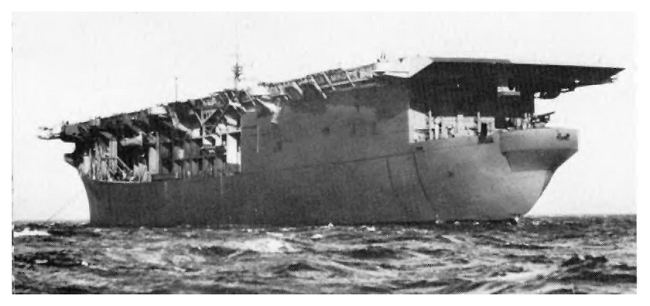 |
|
MV EMPIRE LAGAN
Photo: Author's collection. |
HMS
ARCHER was decommissioned on March 15th and renamed the MV EMPIRE
LAGAN; her outward appearance was unchanged, her defensive armament
was still installed
[2]
Note:
A photo of EMPIRE LAGAN at Auckland clearly shows forward 20mm Oerlikons still
mounted. see link at end of this document
but she was now painted grey overall. During her time with MoWT she
was managed by the Blue Funnel Line and registered in the port of
London.
Little
is known of her career as the MV EMPIRE LAGAN except that she made
an Atlantic crossing with the west bound convoy UC69 which departed
Liverpool on May 24th 1945 and arrived at New York on June 3rd,
EMPIRE LAGAN then sailed to Norfolk, Virginia to embark a ferry
load. It is not known where this ferry load was delivered. The next
time she appears in records is upon her arrival n Auckland, New
Zealand where she arrived on the afternoon of Thursday September 6th
1945, having sailed from Brisbane; on her departure she was bound
for Sydney. While she was alongside at Western Wharf, Auckland1
she was opened to the public and approximately 20.000 people visited
the merchant aircraft transport over four days. The visit was
however marred by thefts; a quantity of chocolate, beef extract,
biscuits, and tinned milk was stolen from the ship's lifeboats. The
food was in sealed tins which could be opened with a key attached to
the side (like oversized sardine tins). It was found that a number
of tins had been opened and the contents taken. Linen and glasses
were also liberated. The purpose of the visit is not clear, she was
possibly operating as part of the British pacific Fleet's Fleet
Train and carrying NZ service personnel returning home.
EMPIRE
LAGAN returned to the UK at the start of December 1945 and was
reverted to Admiralty charge on December 6th.
Disposal: return to US custody January 1945
BAVG 1 (formerly ARCHER) was no longer required for service in the Royal Navy and a steaming crew was drafted aboard to handle the ship on her final Atlantic crossing. Work began to prepare her for her return to the custody of the US Navy as soon as she docked, de-storing her and removing Admiralty equipment.
BAVG
1was returned to the US Navy at Norfolk, Virginia on January 9th
1946; no longer required for use by the US navy she was stricken for
disposal on February 26th 1946 and moored on the James River to
await disposal. She was purchased by Sven Salen of Stockholm, she
was rebuilt as a passenger ship with accommodation for 600 single
class passengers and registered under the ownership of Rederi A/S
Pulp Company as MV ANNA SALEN. She was used as an emigrant ship from
1949 on various routes, including Europe to Canada and Australia she
was further sold on to Cia Nav SA Piraeus, Greece in 1955. Renamed
TASMANIA she operated on the Piraeus-Melbourne service of the
Hellenic Mediterranean Line. In 1958 she was rebuilt to 7,638 gross
tons and in 1961 was sold to China Union Lines, Taipei and renamed
UNION RELIANCE. On November 7 1961, the UNION RELIANCE collided with
the Norwegian tanker BERAN in the Houston Ship Channel and was
beached on fire, to avoid blocking the waterway. She was towed to
Galveston on November 11; she was sold for breaking in Jan 1962,
work starting in March 1962 at New Orleans.
1
Photo of EMPIRE LAGAN at Auckland clearly shows forward 20mm
Oerlikons still mounted.
http://paperspast.natlib.govt.nz/cgi-bin/paperspast?a=d&cl=search&d=EP19450912.2.26.1
Content revised:
31 October 2021
Sources used in compiling this account:
Click here for a list of
Primary sources
Additional sources:
Lauterpacht H., a& Greenwood, C. J., (1951) 'State
Responsibility -Vicarious Responsibility' Responsibility of
United States in respect of Vessel Handed Over to Great
Britain under Lend-Lease Act and Operated by Great Britain'
in 'I nternational Law Reports Volume 12' Cambridge,
Cambridge University Press
Internet Archive Pacific
Marine Review, January 1940 p.77 & March 1940 P. 31-33
Acceded March 26 2017
Fold3.com various documents including;
Admiralty War Diaries
Norfolk Navy Yard War Diaries
Mew York Navy Yard War Diaries
Miscellaneous documents
|
Home
page |
go to the top
|




Comments (0)