A History of HMS ATHELING
|
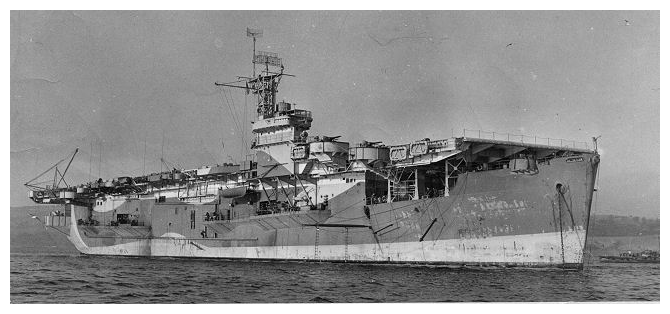 |
HMS ATHELING at anchor. Photo: Author's collection |
Three US maritime
Commission hulls were earmarked for transfer to the Royal Navy as
escort carriers with the ships' name 'ATHELING':
ATHELING (1)
CVE 58– ordered from Kaiser Shipbuilding Co., Inc., Vancouver, Washington, her keel was laid down on December 17, 1942, Kaiser hull no. 304, Maritime Commission no. 1095, a type S4-S2-BB3 hull. She was the
Forth of Fifty Casablanca class auxiliary aircraft carriers ordered and the second one intended for transfer to the Royal Navy under Lend-Lease arrangements as the HMS ATHELING.
However, soon after construction began the US Navy decided that she was required for the US war effort and would be retained, the name ANGUILLA BAY being assigned. CVE-58 was launched on May 12th, 1943 by her sponsor Mrs. J. Hallett. She was delivered to the U. S. Navy August 31, 1943 and
commissioned as the USS CORREGIDOR (CVE-58) Capt. R. L. Bowman in command.
ATHELING (2)
On December 28, 1942, the keel was laid for a type S4-S2-BB3 Maritime Commission hull, hull no. 1096: to become a Casablanca class auxiliary aircraft carrier at the Kaiser Shipyard, Vancouver, Washington, Kaiser hull no. 305. Her sponsor was Mrs. James McDonald; she was launched on 26 May 1943 and was intended for transfer to the Royal Navy under Lend-Lease arrangements as the HMS "ATHELING". Before delivery, however, the US Navy decided that she (and other escort carriers building for Britain at that time) would be required for the US war effort and subsequently the second ATHELING was delivered to the U. S. Navy on 13 September 1943 at Astoria, Oregon and commissioned as the USS MISSION BAY, CVE-59 Captain William L. Rees in command.
ATHELING (3)
As an alternative to the Casablanca class escort carriers the admiralty were offered a second batch of 23 BOGUE class ships building at the Seattle-Tacoma Shipbuilding Co. yard in Tacoma, Washington. These were Maritime Commission C3-S-A1 type 9,800 ton freighter hulls being constructed for completion as auxiliary aircraft carriers.
Laid down 9 June 1942, at Seattle-Tacoma Shipbuilding Co. Tacoma, Washington, as Maritime Commission C3-S-A1 type freighter hull number 244, Seattle-Tacoma hull number 28. She was purchased by the US navy to be the USS GLACIER, ACV-33 (later changed to CVE - 33). She was launched on September 7th 1942 by her sponsor Mrs. Richard P. Luker. Whilst still under construction it had been decided that CVE 33 was to be transferred to the Admiralty on loan on her completion; the hull was towed to the Bremerton Navy Yard, Portland, Oregon, for completion and fitting out as an aircraft carrier. CVE 33 was commissioned as USS GLACIER 12 July 1943, Commander. Ward C. Gilbert USN in command.
CVE 33 was Decommissioned by the USN and transferred to the Royal Navy at Vancouver, Canada on July 31st 1943 and commissioned as HMS ATHELING (D51) on 28 October 1943, Captain Ronald Ian Agnew RCN in command. She was originally to have been named 'SETTER' but this was changed before her handover. While at Vancouver, ATHELING, along with other Lend-Lease carriers, was to be modified to meet Admiralty requirements, receive her full crew compliment, and complete sea trials and work up ready for beginning her active service. This work was undertaken by the Burrard Dry Dock Co. Ltd., North Vancouver, British Columbia.
Modification and preparation to enter service: August - October 1943
CVE-33 was the second of nineteen escort carriers to be modified by Burrards for the Royal Navy. She arrived LaPointe Pier on July 31st and was berthed at No.4 berth and work commenced immediately to de-store the ship and to remove her Low-Pressure turbine for remedial work to be carried out. Work on
AMEER was already in hand, she had begun her modifications on July 22nd.
Modification work totalled 150 separate alterations and modifications which included the lengthening of the flight deck, fitting redesigned flying controls and fighter direction layout, modifications to hangar, accommodation and store rooms, installing extra safety measures including major changes to the aviation fuel stowage and oiling at sea arrangements, modifying gunnery and other internal communications, adding extra W/T and R/T sets, and improved darken ship arrangements. Progress was slow however, this was due to several factors; the majority of the work force had never worked on a ship before and had been specially hired to fulfil the contract to modify the ships on behalf of the Canadian government, initially the work proceeded slowly due to lack of Admiralty information and drawings. Also, when the ship left the Puget Sound Navy Yard she was fully stored, but in order to get into certain compartments the ships had to be partially de-stored. These factors slowed up the work on the first four ships to enter the Burrards yard, taking an average of 97 working days to complete. This was too long for the Admiralty; the carriers were urgently needed and a revised schedule was drawn up for the fifth and successive carriers which allowed each ship only 45 days for carrying out the work.
As work progressed ATHELING moved through some of the yards various berths; the yard could be working on six different ships at any time with separate aspects of the work carried out at different berths, the ships passing through like a production line, moving from one berth to another until complete. The bulk of her crew arrived at Vancouver on August 26th when a draft from the UK arrived, these men had arrived in the US on a troop ship from the UK, then crossed the US into Canada by train from New York. These new crew members were billeted ashore initially until relevant areas of the ship became habitable.
Her LP rotor assembly was removed in early September and was despatched to Messrs. Allis Chalmers, Milwaukee, for partial re-blading on the 17th. On October 3rd ATHELING was moved from No.4 berth and placed in Burrards Floating Dry Dock at North Yard to be fitted with Asdic equipment and additional sea valves. She was undocked on the 7th and moored at No 3 berth. A replacement LP rotor was received. while she was in Dry Dock and work commenced to fit this as soon as she was alongside at No.3 berth. She moved to No.4 berth again on October 17th and her alterations were completed on October 28th, 4 days behind schedule. ATHELING moved to a mooring in the stream off Lapointe Pier on the 29th to begin preparing for her post modification shakedown. Her modifications had taken a total of 89 days to complete.
The next fortnight was spent on trials and working up, including a short round trip voyage to the US Naval Yard at Bremerton, Washington to ammunition the ship and arriving on November 5th and sailing on the 10th for the Straits of Georgia (between Vancouver Island and the mainland), for steaming, gunnery, radar and other trials and exercises. (It is possible that ATHELING was moved to the Canadian Naval Base at Esquimalt, Victoria, North Vancouver, for her trials, and while there she embarked Confidential Books and more stores).
Maiden voyage, Ferry trip Vancouver to Greenock: November 1943 - January 1944
ATHELING and her sister ship
AMEER sailed from Esquimalt, Victoria on November 25th 1943, proceeding down the west coast of the US to San Diego where they were to embark more stores and equipment before transiting the Panama Canal. The two ships reached Bilbao to enter the Canal on December 6th.
|
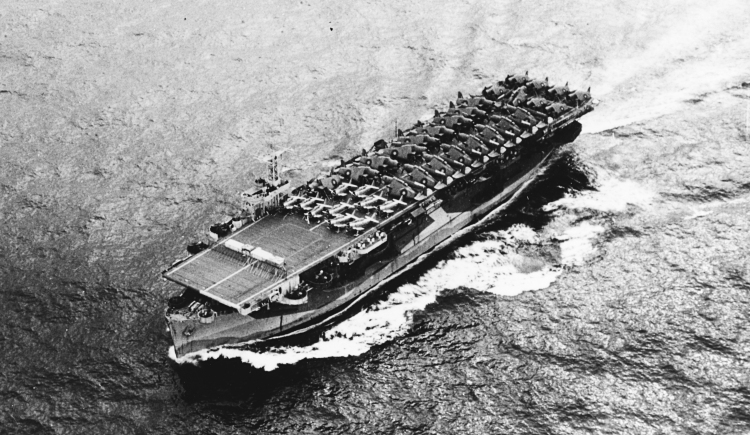 |
HMS ATHELING underway on 22_December 1943 with her ferry load on route to New York from Norfolk. U.S. Navy photo 80-G-450245 from the U.S. Navy Naval History and Heritage Command. |
After clearing the Canal on the 10th, the two carriers proceeded to the US Naval Operating Base at Norfolk Virginia, arriving there on December 18th. Both ships were to embark a cargo of stores and Lend-Lease airframes for delivery to the UK. ATHELING load included the 18 Corsairs of
1836 squadron, the 18 squadron aircraft were loaded first, they were hoisted aboard from the quayside, having been taxied through the streets to the dock from
USNAS Norfolk and were stowed in the hangar. A deck cargo of 18 Avenger, 8 Hellcat and 10 Harvard were then loaded; The squadron equipment, stores and personnel also embarked.
AMEER loaded a mix of 55 airframes and stores.
On Completion of
loading the ships sailed on the 22nd for Brooklyn, New York to
embark passengers, spend Christmas and await an East bound convoy
with which to make the Atlantic crossing. ATHELING and
AMEER sailed from New York on Wednesday December 29th 1943 as
part of the 24-ship fast convoy UT.6 which included 16 troopships
and the US navy escort carrier the USS SANTEE. On approaching
Ireland ATHELING, AMEER and SANTEE detached from the convoy and
proceeded to Belfast, Northern Ireland to unload some of their ferry
loads to
RNAMY Belfast. ATHELING unleaded her full ferry load and
1836 squadron on January 9th 1944;
AMEER offloaded part of her load. On completion of unloading ATHELING and
AMEER sailed for the Clyde. ATHELING next entered a shipyard for further modification for use as a fighter carrier.
Allocated for service with the 21st Aircraft Carrier Squadron (21 ACS), part of the Eastern Fleet: passage out February - April 1944
On completion of this conversion work ATHELING was allocated to the Eastern Fleet and began preparation to sail for Ceylon. She was to embark four squadrons for transit to India and Ceylon, On February 26th the 12 Barracuda IIs of 822 squadron flew out from
RNAS Burscough, and a further 12 Barracuda IIs of 823 squadron came aboard from Renfrew, all were stowed as cargo; the aircrew and maintenance personnel making the passage by troopship. Also, on the same day the 14 Corsair IIs of
1837 squadron embarked from
RNAS Stretton
and a further 10 Corsair IIs of
1838 squadron flew out from
RNAS Burscough accompanied by their aircrews.
|
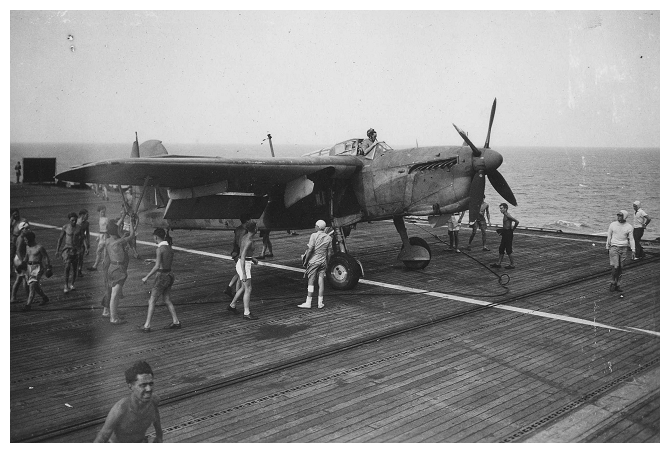 |
A Barracuda being attended to after a deck landing
accident onboard HMS ATHELING - note the broken off
propeller bade - the pilot is surveying the damage from
the cockpit (August 1944, 822 Squadron DLT session) . Photo: From the
collection of the late John Vallely, Sub Lt. (A) RNVR. |
She sailed on March 3rd as part of Convoy KMF.29A bound for Alexandria; the convoy was a large uplift of naval air power for the Eastern Fleet, with nine FAA squadrons being ferried to Ceylon, four each in the two carriers and one, 832 squadron being split between the two aircraft transports. The convoy comprised of four vessels operating in the ferry role, the escort carriers ATHELING and
BEGUM and the aircraft transports ATHENE and ENGADINE, together with the troop ship SS STRATHNAVER. These were escorted by the light cruisers NIGERIA and PHOEBE, sloops CAUVERY, and ERNE, Frigates CRANSTOUN, DEANE, FINDHORN, LOSSIE, REDMILL (returned to base March 5th), SHIEL, SPEY, and TAFF. The convoy reached Alexandria on March 17th.
BEGUM entered the Suez Canal first, on the 18th reaching Port Taufiq on the 19th where she was to spend the next four days to wait the arrival of a delayed ATHELING, before continuing their voyage. Sailing on the 23rd the next port of call was Aden on the 27th where the ships were to refuel. From Aden ATHELING,
BEGUM, ATHENE, ENGADINE and the troop ship ARONDA formed convoy AJ.2 sailing for Ceylon the following day and arriving in Colombo Harbour on Tuesday April 4th 1944.
After storing and refuelling both ATHELING and
BEGUM sailed with convoy JC34A from Colombo for Madras on April 9th; on arrival ATHELING unloaded the Barracudas of 822 & 823 squadrons on April 11th and 12th respectively for onward delivery to RAF Ulunderpet. The Corsairs of
1837 and
1838 squadrons disembarked on April 13th, bound for
RAF Minneriya, Ceylon. ATHELING next sailed from Madras for Colombo with convoy CJ23B on the 16th. Upon her arrival back at Colombo she joined the 21st Aircraft Carrier Squadron (21 ACS), part of the East Indies Fleet.
|
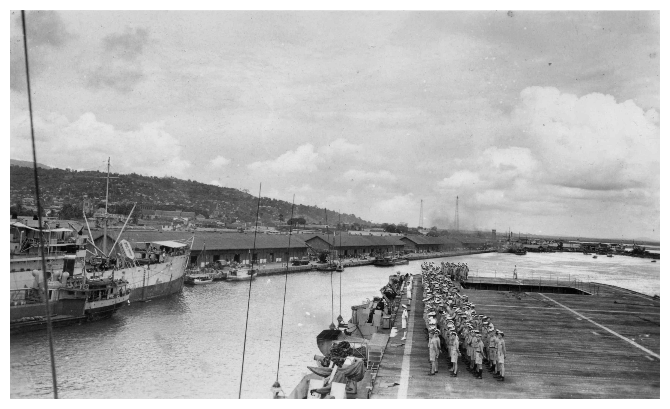 |
HMS ATHELING leaving her berth in Colombo - date
unknown. Photo: From the collection of the late John Vallely, Sub Lt. (A) RNVR. |
Operations with 21 ACS: April - July 1944
ATHELING began working up as a fighter carrier from mid-May then operated on trade protection duties in the Bay of Bengal. She embarked 889 squadron (10 Seafire F.III) from
RNAS Colombo Racecourse and 890 squadron (10 Wildcat V) from
RNAS Puttalam, both on May 13th.
ATHELING operated as a spare deck and CAP carrier for the Fleet carrier HMS ILLUSTRIOUS from June 10th as part of operation "COUNCILLOR". This was a diversionary sweep into the Indian Ocean intended to distract Japanese attention from American operations in the Marianas Islands. After only three days ATHELING was found to be too slow for this task, there being a speed difference of 12 Knots between the two ships and ILLUSTRIOUS completed her role in the operation alone from the 14th. On completion of her operations both squadrons were disembarked to
RNAS Puttalam; 890 on July 11th, and 889 on July 30th - where both squadrons were disbanded.
On August 15th the Barracudas of 822 squadron flew out from
RNAS Katukurunda to join ATHELING for an intensive period of Deck Landing Training; the squadron had absorbed 823 squadron in July and now operated 21 Barracuda IIs. There is only one recorded landing incident for this session, Barracuda LS521 'G' flown by Lt E.W. Moore RNVR caught its tail wheel on the rounddown and entered the barrier damaging its propeller on the 19th. The squadron departed for
Katukurunda on the 21st.
|
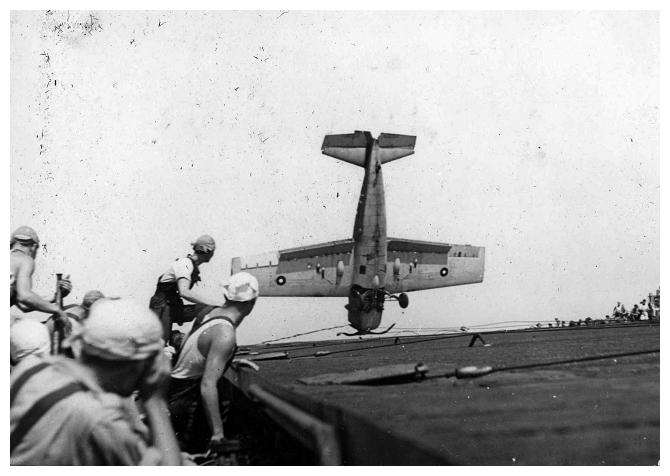 |
Wildcat JV508 of 890 squadron goes into the barrier, May
15 1944 while ATHELING worked up as a fighter carrier
with the East Indies Fleet. Photo: From the collection
of the late John Vallely, Sub Lt. (A) RNVR. |
ATHELING next embarked the 4 Swordfish of 818 squadron on August 23rd for trade protection duties while the ship acted as a ferry carrier between Ceylon and South Africa. On the 25th ATHELING left Trincomalee and re-embarked
1838 squadron from
RNAS Colombo Racecourse, for passage to
RNAS Wingfield at Cape Town. On arrival there on September 12th; both squadrons disembarked to Wingfield,
1838 was to disband after disembarking. ATHELING embarked 32 Avenger aircraft at Cape Town for ferrying to Ceylon, loading on 17th - 18th September. The Swordfish of 818 were re-embarked later on the 18th as cargo since no flying was possible in the ferry role.
ATHELING proceeded from Cape Town to Cochin, Southern India where she disembarked her ferry load and 818 squadron to
RNAS Cochin on October 6th. ATHELING arrived back at Trincomalee on October 10th and was allocated to the role of East Indies Fleet ferry carrier.
|
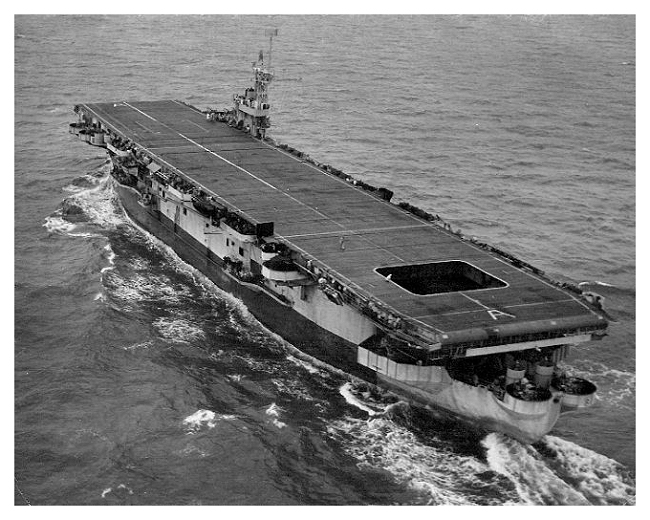 |
HMS ATHELING
wearing her later colour scheme and her and
deck identification letter. Photo: Author's
collection. |
On loan to the US Navy as a ferry carrier: December 1944 - September 1945
Shortly after she was nominated for loan to the US Navy for duty as a ferry carrier. She made one last ferry trip for the RN sailing for Sydney, Australia on December 9th 1944 in company with the CVE
BATTLER, the cruiser HMNZS ACHILLES, Destroyers WAGER and WHELP for Australia, the following day they were joined by HMS SWIFTSURE (flagship of Rear-Admiral E. J. P. Brind, CB, CBE, commanding Fourth Cruiser Squadron) and their escort, the destroyers KEMPENFELT (Captain D, 4th Destroyer Flotilla, WESSEX, and WAKEFUL, to proceed in convoy to Australia. Most of the destroyers returned to Trincomalee on the 11th and on the 16th the cruisers SWIFTSURE and ACHILLES parted company with the carriers and went on ahead to Fremantle. On her arrival in Sydney ATHELING unloaded her ferry load for delivery to Bankstown airport where the advance party of
MONAB II was preparing to commission the site as an RN Air Station on January 29th 1945.
At Sydney the ship underwent repairs and maintenance before being transferred to U.S. control. Her RN designation changed from R304 to A450 for service in the Pacific but this may not have been worn. Her duties with the US Navy involved ferrying aircraft and personal from San Diego California to Guam in the Mariana Islands, and other U.S. bases in the Pacific, via Pearl Harbour. On her return passage to San Diego, she carried passengers and evacuated injured US personnel.
ATHELING reported for duty with U.S. Pacific Fleet on January 2nd 1945, sailing from Sydney her first port of call was the island of Espiritu Santo on the 7th and arriving at Pearl Harbour on the 14th. Five days later she sailed for Manus with passengers, stores and equipment, arriving there on February 2nd, she sailed on the 5th arriving back at Pearl Harbour on February 14th. After exchanging passengers and stores she sailed for San Diego on the 19th, arriving there on the 23rd; this completed her circumnavigation of the globe.
She sailed again on March 10th for her first-round trip from San Diego, arriving at Pearl Harbour on the 16th. She arrived at Guam on the 27th and sailed for Roi Island, Kyajalien Atoll, Marshall Islands on the 29th. She arrived back at Peral Harbour on April 9th and sailed for San Diego the next day, arriving on April 16th.
|
 |
 |
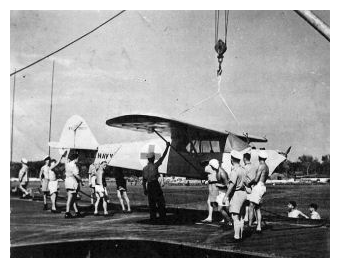
Loading US
Navy aircraft for return to the US Photos: Courtesy
of Charles Kelly |
On April 19th, she embarked the personnel of VF-50 from NAS San Diego for passage to Pearl Harbour, sailing the following day. VF-50 were disembarked to Naval Air Station Ford Island, Hawaii on the 26th. From Pearl Harbour she made a round trip to Guam, arriving back on May 17th. She sails again on the 18th but there are no records for this voyage until she arrived at Ulithi atoll on June 16th, 4,000 miles from Hawaii. Here she embarked the aircraft and personnel of VJ-19 from Falalop island, for transport to Engobi, Eniwetok atoll 1,500 miles east. After an overnight stop at Guam ATHELING preceded to Eniwetok atoll, and after unloading continued on to San Diego, arriving on June 28th.
Between July 6th – 19th she underwent repairs and alterations at San Diego before making on final run to Pearl Harbour, arriving there on the 25th. She sailed on the 27th having been returned to RN control bound for Balboa and the Panama Canal. She departed from Cristóbal on the Atlantic end of the Canal on August 13th bound got Jacksonville. She was at sea in the Gulf of Mexico when the Japanese surrender was announced on the 15th.
HMS ATHELING depart Jacksonville on August 22nd arriving at Norfolk Naval Operating Base, Virginia on August 23rd. She sailed for Plymouth, via Trinidad on August 29th, calling there on September 3rd to collect passengers and stores for passage to the UK, sailing on the 6th. She arrived at Devonport Dockyard, Plymouth, on September 16th and was nominated to undergo conversion for trooping duties.
Conversion for duty as a troop ship September - November 1945
ATHELING was one of 6 CVEs to be converted for Trooping, along with FENCER, PATROLLER, QUEEN, RAJAH, and RANEE. For Trooping these vessels were outfitted to carry approximately 60 officers and 1,000 ratings in addition to a reduced crew of about 250. ATHELING’s conversion was to undertaken by Devonport Naval Dockyard and was estimated to cost £17,426.
The main work consisted of converting the hangar deck into accommodation spaces; 684 bunks and kit lockers were installed along with providing a dining hall in hangar with tables and seating for 240 men. Additional Heads and washing facilities were installed by converting several spaces, including the torpedo workshops, pyrotechnics locker, aircraft and Boat engine workshop and aft lift well spaces. Corticene (a form of Limonium) wase laid in all gangways, the dining hall and the berthing spaces in the in hangar for improved footing. Additional equipment was also installed I the main galley and Wardroom galley to cater for the increased numbers to be fed (three and a half times her wartime complement). Several petrol tanks were converted to provide additional fresh water.
The ship was also to be tropicalised as far as possible in the time available, mainly by providing improved ventilation in the hangar deck and engine room; much of the work had already been competed on previous refits. Additional lifesaving equipment, sufficient for evacuation of all onboard was provided by installing banks of extra Carley Floats on the Flight Deck. For good order and discipline part of compartment A.104E – forward of Frame 47 was Convert ed into a Guard Room with four cells.
|
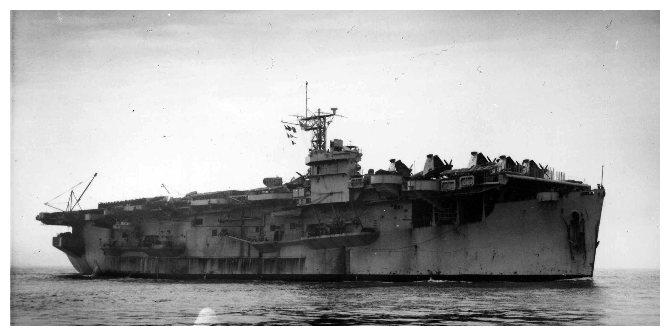 |
HMS ATHELING
at Portsmouth in 1946 completing a trooping
voyage; she is carrying Seafire and Firefly aircraft on
her flight deck.. Photo: Author's collection |
First Trooping voyage: November 1945 – February 1946
The work was completed by mid-November, and ATHELING sailed for Colombo on November 15th 1945, arriving there on December 3rd. After embarking passengers, she sailed for Fremantle calling there on December 14th before arriving in Melbourne on the 18th. Here she embarked 700 New Zealand naval personnel for passage home and sailed for Wellington, New Zealand on the 20th. ATHELING arrived in Wellington on December 23rd, where she celebrated Christmas before sailing again for Sydney on the 27th, arriving on New Year’s Eve 1945. On reaching Fremantle on January 13th 1946 1,300 cases of food from the Food for Britain Appeal were embarked before she sailed for Colombo on the return voyage. ATHELING arrived back at Plymouth on February 10th 1946.
Second Trooping voyage: February – May 1946
ATHELING was to make a second-round trip trooping voyage to Sydney via Colombo at the end of February 1946. She called at Fremantle on March 28th and arrived in Sydney on April 4th. Here she embarked passengers, including the eighty-two officers and men that comprised the Fijian and Tongan contingent for the Victory March in London due to take place on June 8th. ATHELING sailed from Sydney on April 14th, calling at Fremantle on the 20th, continuing on for Colombo and Aden. Arriving back in the UK at the end of May.;
Third Trooping voyage: August – October 1946
ATHELING made at least one more trooping voyage to Colombo where she embarked 900 passengers, including nearly 100 officers and more than 50 civilians in addition to large drafts of naval ratings. She docked at Portsmouth from Colombo on October 18th. She had steamed a distance of nearly three times round the world since she was converted for trooping purposes.
Disposal: return to US custody December 1946
On completion of her last trooping voyage ATHELING was desstored and all RN equipment was removed by the dockyard. A steaming crew remained onboard for her final Atlantic crossing to Norfolk, Virginia.
CVE 33 was returned to US Navy charge at Norfolk Virginia, on December 6th 1946. Her name was stricken from the US Navy List February 7th 1947 and she was out up for disposal. She was sold to National Bulk Carriers, Inc., on November 26th 1947, and at some point was named 'ROMA'. She was scrapped in Italy starting November 2nd 1967.
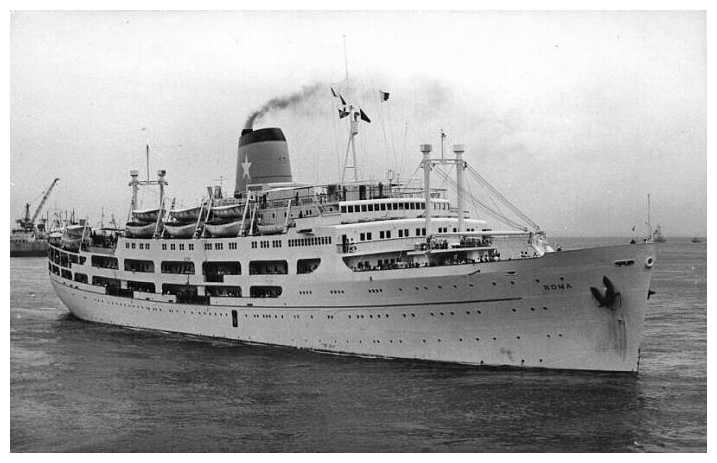 |
The S.S. ROMA |
Content revised:
05 January 2022
Sources used in compiling this account:
Click here for a list of
Primary sources
Additional sources:
Fold3.com various documents including;
Admiralty War Diaries
Norfolk Navy Yard War Diaries
Mew York Navy Yard War Diaries
Miscellaneous documents
|
Home
page |
go to the top
|





Comments (0)