Fleet Minesweeper
No badge issued for this vessel
Battle Honours
PACIFIC 1942
NEW GUINEA 1942
Specifications
Bathurst-class corvette
Builder: Cockatoo Docks and Engineering Co Ltd, Sydney, New South Wales, Australia
Displacement: 733 tons
Length: 186 ft
Beam: 31 ft
Draught: 8 ft 6 in
Propulsion: triple expansion engine, 2 shafts. 2,000 hp
Speed: 15 Knots
Armament: 1 12 Ponder, later1 × QF 4 inch Mk XIX gun, 3 × Oerlikon 20 mm cannons (later 4), 1 × Bofors 40 mm gun (installed later), 2 x.303 Vickers machine guns, 40 Depth charges (4 throwers and 2 chutes)
Crew complement: 85
Commanding Officers
Lt. Basil Paul, RANR(S) 28 Feb 1941
Lt.Cdr. John Nevill Collins, RANR(S) 6 Jul 1943
T/Lt.Cdr. Philip Jack Sullivan, RANR(S) 3 Jan 1945
Lt. Eric Kuhle Connor, RANR 8 May 1945 to April 1946
Related items
None
Reminiscences
None
Gallery
None
H.M.A.S. GOULBURN
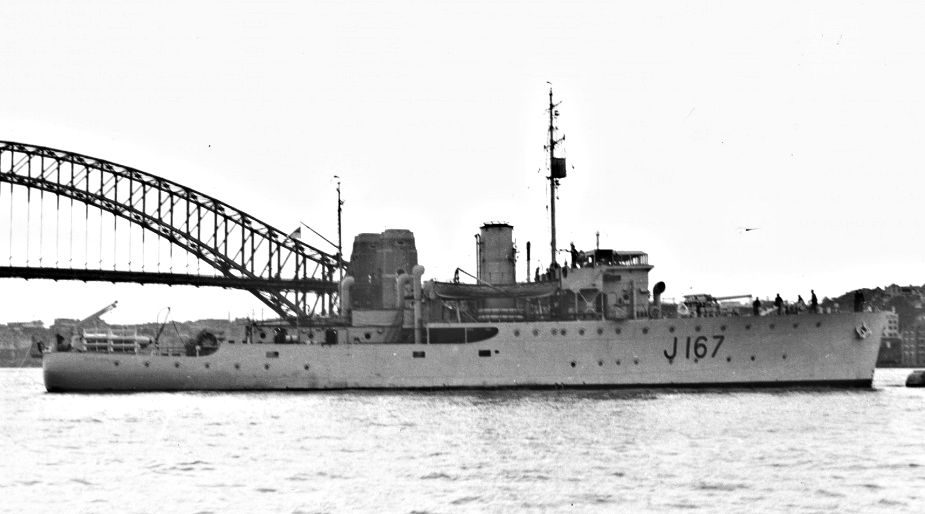
HMAS GOULBURN in Sydney harbour
Early history
A Bathurst-class corvette ordered from Cockatoo Docks and Engineering Co Ltd, Sydney, on April 16th 1940, her keel was laid down on July 10 1940. The ship was launched on November 16th 1940, by Mrs Carola Crace, wife of Rear Admiral J. G. ‘Jack’ Crace, the commander of the Australian Squadron. She was commissioned as H.M.A.S. GOULBURNon February 28th 1941, the first RAN warship to carry the name of the New South Wales city. Her first commanding officer was Lieutenant Paul Basil, RANR(S).
After completing her sea trials and working up, GOULBURN entered service on April 23rd, joining the 20th Minesweeping Flotilla. At the start of May, she sailed from Melbourne with the Sloops WARREGO, SWAN, and auxiliary minesweepers DOOMBA and ORARA, to conduct sweeps along the south-east and east coasts of Australia, part of a group of ships attempting to locate mines sown by the German auxiliary cruiser PINGUIN and auxiliary minelayer PASSAT. The Flotilla arrived in Sydney on May 17th. Here they were joined by other ships of the Flotilla, including GOULBURN’s sister ship BURNIE.
On the morning of the 23rd, the Flotilla, now comprising WARREGO, SWAN, GOULBURN and BURNIE, sailed to continue the search for mines. On the 25th, they were joined by the Trawlers GOONABBEE and SAMUAL BENBOW acting as Dan Layers and ST. GILES for mine destruction, and began sweeping off the New South Wales coast from Broken Bay. During the month-long operation, only six mines were destroyed; one of which had its cable cut by the Sloop SWAN in the forenoon on the 24th and the sweeps were concluded on the 30th, and the Flotilla returned to Sydney on the 31st. GOULBURN and BURNIE were now released from the Flotilla and received new orders for service on the China Station. Both ship companies were granted leave.
On June 16th, GOULBURN and BURNIE sailed from Sydney for Singapore, calling at Brisbane, Townsville, Cooktown, Thursday Island and Darwin, arriving in Singapore on July 12th 1941.
Singapore and operations on the China Station
Operating out of Singapore, GOULBURN was employed on AS/S patrols, minesweeping and convoy escort duties. In November 1941, two other Bathurst Class Corvettes arrived at Singapore, and the four vessels formed the 21st Minesweeping Flotilla, MARYBOROUGH (Flotilla Leader), GOULBURN, BENDIGO , and BURNIE.
After Japan attacked Pearl Harbour in December 1941, GOULBURN and other RAN corvettes were engaged on local convoy escort, anti-submarine patrol, and minesweeping duties from Singapore down to the Sunda Strait. GOULBURN and BURNIE arrived at Batavia on January 30th; GOULBURN was placed in the floating dock on arrival for remedial work, undocking the next day. The two Corvettes remained in the harbour until February 5th, when they proceeded on a three-day anti-submarine patrol of Batavia Roads. On the 8th, the two Corvettes sailed to escort two merchant ships bound for Colombo. Only one merchant vessel sailed; the crew of the SS KUMSANG refused to sail, so the two Corvettes escorted the SS HARPASA until mid-day on the 9th in position 8°26´S, 101°31´E, when they parted company from the HARPASA and returned through the Sunda Strait, arriving at Oosthaven in Sumatra on February 12th. The next day, they commenced an anti-submarine patrol of the port; Singapore fell to the Japanese three days later.
on the 17th, GOULBURN and BURNIE stood by during demolition operations at Oosthaven before parting company, GOULBURN proceeding to Ratai Bay to escort a small convoy of four ships, the S.S. BOTH, S.S. MARILYSE MOLLER, S.S. STAGEN, AND S.S. BBALIK PAPEN. After steaming south into the Indian Ocean at 8 Knots unmolested, the convoy was ordered to disperse at 19:40 on the 18th and to proceed independently. GOULBURN now set course for Tjilitjap, Java where she arrived during the afternoon of February 19th. She remained at Tjilitjap until sailing for Batavia on the 22nd.
Passing through Sunda Strait on the 23rd, GOULBURN reached Batavia without incident the following morning. On the afternoon of the 24th, she sailed with her sister Corvette HMAS TOOWOOMBA to carry out sweeps at the entrance to the Sunda Strait. . TOOWOOMBA and her sister ships, BALLARAT and WOLLONGONG, also a part of the 21st Minesweeping Flotilla, had been operating from Batavia since October 1941 .During the operation, they were aware of enemy aircraft shadowing them. Returning to Batavia on the 25th, GOULBURN anchored in the harbour until sailing two days later to join the 21st Minesweeping Flotilla on the Sunda Strait patrol. She joined the flotilla off Merak on the northwestern tip of Java, and shortly afterwards, attacks by Japanese dive bombers began; however, no damagThe Sunda Strait patrol was discontinued on the 28th, and the flotilla entered the Indian Ocean, en route to Tjilitjap, where they arrived on March 1st. GOULBURN, in company with TOOWOOMBA, left almost immediately with orders for Fremantle, arriving in the afternoon of March 9th; they were briefly shadowed by a Japanese bomber, but saw no sign of enemy shipping. The course was altered for Exmouth Bay, as their original course and speed were almost certainly reported. Fuel reserves were already low, and upon securing at Fremantle, it was found that she had only 7 tons of fuel oil left on board.y shipping. Upon securing, it was found that she had only 7 tons of fuel oil left on board.
Convoy escort, A/S and M/S duties off the Sunshine Coast, May 1942 – November 1943
GOULBURN was now assigned to convoy escort duty, operating on the Queensland coast as part of an escort force based in Brisbane covering local departures and incoming convoys from Townsville in the north, Sydney to the south, and Papua New Guinea to the east. Some convoys bound for Townsville were escorted for the entirety of their voyage, and return convoys were covered on passage back to Brisbane. Between the convoy duties, she conducted the usual A/S and M/S patrols off the coast.
Her first voyage appears to have commenced on May 23rd, sailing in company with the Soop SWAN and Corvette CESSNOCK to take over the escort of convoy ZK.8, comprising four Dutch Merchant ships which had sailed from Sydney on May 18th, bound for Townsville, and remained with them until arriving at Townsville on the 25th. It is unclear which, if any, convoy she escorted back to Brisbane.
Her commanding officer, Lieutenant Paul Basil, RANR(S), was promoted to Lieutenant Commander on October 15th
On November 1st, GOULBURN sailed with the Corvette ECHUCA to escort a convoy to Townsville. At 08:30, GOULBURN proceeded out of harbour ahead of the merchantmen LARCH BANK, FORT PINE, DUNTROON, and JESSE APPLEGATE; once in open water, a speed of 8 Knots was maintained. ECHUCA was detailed to await a late starter, the S.S. KATOOMBA, and they joined the convoy at 19:00.
At 02:00 on November 5th, ECHUCA was detached with orders to anchor off Keswick Island and carry out repairs to the port engine, which necessitated the fitting of a new main bearing. The convoy was dispersed at 05:10 in a position south of Dent Island to proceed independently to Townsville. At 08:30, GOULBURN anchored close to ECHUCA and transferred 200 pounds of fresh meat, as that vessel's main freezer was also defective. By 09:10, repairs were completed, and both ships proceeded in company for Brisbane, arriving at 06:40 on November 7th.
The following six days were spent carrying out self-maintenance before sailing again on the 13th. On this day, she carried out exercises commencing at 11:15, when a spray target was streamed and three Wirraway aircraft from R. A. A.F. Station, Lowood, conducted dive-bombing practices. At 12:05, it was GOULBURN’s turn to conduct a live firing; she opened fire with her main armament at a Pattern of 6 target towed by H. H. A. S. KIANGA. The initial range was 1,900 yards, and six practice projectiles were expended with satisfactory results and concluded at 12:12. That afternoon, she conducted sweeps of the swept channel before switching to A/S patrol to await her next convoy.
This routine continued until May 12th 1943, when she sailed from Brisbane to escort the American submarine USS TUNA for trials and training off Brisbane. The next day, GOULBURN served as the target vessel for the USS TUNA, conducting simulated attacks, and returned to harbour upon completion. She resumed her usual duty on the 21st, sailing to escort convoy BT 61.
She was to repeat this duty on August 16th with the American submarine USS DRUM, acting as the target vessel for training exercises, including a night radar attack on the 17th. Meanwhile, on July 6th, 1943, Lt. Cdr J. N. Collins, RANR(S) arrived on board to take over as commanding officer.
Dry docking for repair and refit in Sydney, December 1943
On November 23rd, 1943, GOULBURN set course for Sydney to be drydocked for inspection of her Asdic dome and a refit. At 00:56 on November 25th 1943, while on passage, GOULBURN experienced severe vibration felt throughout the ship for 10 seconds; at the same time, both engines raced wildly. They were immediately stopped by the duty E.R.A., fearing they had shed a propeller. The Engineering Officer conducted investigations focusing on the starboard engine. Who concurred that this was a possible cause, either a broken prop shaft. The ship resumed course on the Port engine only, making 8 Knots and reached Sydney Heads late that morning. Divers were sent down to investigate the mooring and confirmed that the starboard screw and the shaft, broken at the ‘A’ frame, were missing.
GOULBURN moved to Chapman’s Dock, Belmain, Sydney, on December 2nd and entered dry dock as planned; however, work now included inspection of the port shaft and fitting a new starboard shaft and screw. She was undocked on the 8th and moved to a berth alongside the Naval Dockyard at Garden Island to begin a refit. Planned to be completed in January, the refit was not completed until February due to a strike at Cockatoo Island dockyard, which held up the work on the starboard crankshaft. In addition to new drive shafts and screws, a new four-inch H. A.-L.A. Mark XIX gun was installed. The ship put to sea on February 28th to carry out engine trials and gunnery exercises with the latest equipment. Further engine adjustments were required once the ship was moored back at Garden Island that evening. Sailing again on March 1st, she conducted radar trials and calibrations in the forenoon with HMAS COLAC as the target vessel. After more engine adjustments and trials, she sailed for Brisbane in the evening of March 5th, arriving there in the forenoon of the 7th.
Allocated for escort, A/S and M/S duties off Papua New Guinea, March – November 1944
GOULBURN now received new orders, being allocated to the escort force based out of Milne Bay, Papua New Guinea, and after conducting live anti-aircraft firing outside Brisbane harbour on the 8th, set course for Milne Bay and arrived there in the morning of March 13th, 1944. Sailing in company with sister Corvette BENDIGO , the next morning, she conducted exercises with the US Submarine DACE. Live gunnery shoots were practised on the 15th. She now settled into the familiar routine of local convoy escort and A/S patrols.
In May, her commanding officer reported that the ship could not exceed 11½ knots in calm waters due to the type of screws currently fitted. In response to this, GOULBURN was ordered to proceed to Cairns for docking in July for an inspection. She departed from Milne Bay at 07:35 on July 1st, arriving there at 07:10 on the 3rd. Having secured alongside Kuranda Jetty, Cairns, she commenced boiler cleaning and work to overhaul her main and auxiliary engines. Three days' recreational leave was granted to each watch of the ship's company, commencing A.M. July 4th. This work was completed by the 12th and GOULBURN entered the U.S. floating dock at 15:50 on the 13th. All work, scaling, painting and work on the underwater hull and fittings was carried out by the ship's company. She was undocked in the afternoon on the 15th. On completion of fuelling, she secured alongside Kuranda Jetty at 18:30.
She sailed to return to Milne Bay at 12:24 on July 17th, having embarked eight tons of stores, arriving there on the 18th. After fuelling, she embarked on a further 10 tons of mail and stores for Langemak, sailing on the morning of the 20th. While on passage on the 21st, GOULBURN overtook S.S. WILLIAM GLACKENS at 09:30; she requested escort, as she was proceeding with difficulty owing to a damaged bow. GOULBURN remained in company until arrival at Langemak. She Anchored in Langemak Bay at 18:32.
At the end of August, having delivered a convoy to Saddler Harbour on the 26th, she moored in Lombrum Cove, Manus Island, to have adjustments carried out to radar equipment by U.S. Base Radar Staff. A new I.F.F. set was installed on the 29th. Satisfactory tests were carried out with the Cruiser H.M.A.S. SHROPSHIRE. She sailed at 07:00 on the 31st for Langemak, Papua New Guinea arriving at 08:30. Later that morning, a U.S. water barge, coming alongside, hit GOULBURN's starboard side between frames 20 and 21, tearing a hole in the shell plating just above the waterline, eight inches long and two inches wide at the widest part, and slightly buckling the frame. The ship’s damage control party made temporary repairs, and GOULBURN proceeded to Finschafen, where repairs were carried out by personnel from the U.S. Army Maintenance Repair Dock, Small Ships section, at Finschafen. Further damage was sustained on the afternoon of September 2nd; U.S. Army tug No. 383, while manoeuvring in the harbour, crashed into the maintenance barge secured alongside GOULBURN. The barge sank, and valuable equipment was lost, and minor damage, in the form of denting and gouging, was done to GOULBURN'S shell plating between frames 24 and 26. Work on the original damage was completed on September 3rd. The hole in the shell plating was welded; however, no steel plate was used to stiffen the damaged area. She sailed for Madang at 17:00; however, the repair was not 100% watertight, and ‘weeping’ occurred on passage.
On reaching Madang at 07:00 the next morning, the ship commenced boiler cleaning and a short self-maintenance period. Base Staff from the repair ship and stores carrier HMAS WHANG PU carried out further repairs to the shell plating. She returned to active duty on September 12th.
She commenced her next boiler clean and self-maintenance period on October 14th while anchored in Binnen Harbour, Madang, Papua New Guinea. She piy to sea again at 05:20 on the morning of October 21st and after picking up Patt. VI. target proceeded to exercise area “B” to conduct a live firing exercise with the Destroyer HMAS VELIDETTA, which conducted 4” low angle firing practice at the towed target at 07:57. On completion of the exercise, GOULBURN returned to Madang.
Two days later, she sailed to repeat the duty, this time for a day and night gunnery exercise, sailing at 14:36 to tow a Patt. VI. target for live firings by H.M.A. Ships BARCO0, STRAHAN, WAGGA and VENDETTA. Day firings were commenced at 16:44 and were completed at 17:56. GOULBURN was in position for the night exercise at 19:15, however, the range was fouled by another vessel, and while GOULBURN made the turn to reverse course and clear the range, the towed target was overturned by the change in wind direction and had to be righted before being towed, upright back to Madang.
Return to Sydney and operations with the 21st Minesweeping Flotilla
On arrival at Mios Woendi on November 24th for a boiler clean, she entered Woendi Harbour at 07:46, anchoring in the R.A.N. anchorage at 08:16. On November 27th 1944, she received orders to proceed to Sydney for docking, and an additional boiler cleaning party joined the ship to complete the work by the morning of the 28th. After fuelling and storing the ship, she sailed at 11:58 and proceeded to Madang, arriving on the 30th and secured alongside HMAS PINGWO at 22:45.
She sailed for Langemak at 16:45 on December 1st, arriving at Langemak Bry at 07:40 the next morning. After disembarking personnel and stores, and taking on fuel, she slipped at 11:52 and proceeded to Townsville via the Solomon Sea and the Jomard Passage. She arrived at Townsville on the morning of December 6th, and after fuelling, resumed her voyage at 16:05. She arrived at Sydney on the morning of the 10th.
Four days later, she was moved by tugs at 07:10 to Fitzroy Dock for dry docking, emerging on the morning of the 16th and secured alongside Oil Wharf, Garden Island. At 15:00, she sailed for Melbourne to report to the Senior Officer, 21st Minesweeping Flotilla in BALLARAT for A/s and M/S operations. The Flotilla operated out of Melbourne for the remainder of December, returning to Sydney on New Year’s Eve 1944. Minesweeping and A/S sweeps were carried out slowly along the New South Wales coast, operating out of Sydney. On January 4th 1945, Lt. Cdr P. J. Sullivan, RANR(S) arrived on board to take over as commanding officer while the ship was operating in Jervis Bay. The Flotilla returned to Melbourne on March 6th.
Refit and allocated for service with the British Pacific Fleet (BPF): March – November 1945
GOULBURN arrived at the Naval Dockyard Pier, Williamstown, at 08:00 on March 9th to begin her annual refit. The work was scheduled to take a month and included the fitting of her long-awaited replacement propellers. On April 1st, she began storing and ammunitioning a ship, followed by Steaming, Radar, A/S, and Gun Mounting trials, and compass adjustments. Generally preparing for sea on completion of her refit by Naval Dockyard, Williamstown, on the 5th.
At 08:00, April 6th, she sailed from Nelson Pier, Williamstown, with a 60’ X 50’ steel lighter loaded with 25 tons of coal, amounting in all to 100 tons, in tow bound for Manus. Poor weather conditions delayed any real progress towing the awkward barge until the 12th, when a speed of 7 knots was achieved. She finally arrived at Manus. On May 4th, and anchored in Saddler harbour at 15:00, the barge was handed over to shore authorities. The following day, after fuelling and storing, she made several runs over the degaussing range before proceeding to the anchorage near Rara Island with sister ships KALGOORLIE and TOOWOOMBA.
Commencing on May 7th, she underwent a boiler clean and received a new coat of paint. These tasks were completed on the 14th, when she was placed on readiness to sail with 4 hours' notice. On May 15th, she sailed for Saddler Harbour at 08:00 to take on ammunition for her Boors gun before sailing to rendezvous with Corvettes KALGOORLIE, LISMORE and TOOWOOMBA to conduct anti-aircraft live firing at a towed drogue target. On completion, she returned to her anchorage off Rara Island. She put to sea again on the 19th in company with KALGOORLIE, carried out an Oropesa sweep of the swept channel from the boom at the entrance to Saddler Harbour down to the anchorage at Rara Island, a channel measuring 2½ miles long by 1 mile wide. On completion, they returned to her anchorage off Rara Island. She sailed on the 21st for an anti-submarine patrol seaward of Saddler Harbour, returning to her anchorage off Rara Island after being relieved on the 23rd. She returned to Saddler Harbour on the 28th to take on fresh water and provisions from the VSIS FORT DUNVEGAN.
Escorting Admiralty Floating Dock No. 18 from Darwin to Milne Bay: June – July 1945
On June 6th, orders were received to sail for Darwin in company with TAMWORTH, GOULBURN as Senior Officer, to escort one of two Admiralty Floating Docks (AFD) that were to be operated at Milen Bay and Manus. They departed at 12:00 and arrived at Darwin at 15:00 on June 14th. Both Corvettes took the time in harbour to perform a boiler clean.
AFD 20 arrived in Darwin on May 22nd, AFD 18 on the 24th. AFD 18 had begun her long tow to the Pacific on January 25th 1945, when she left Malta, entered the Suez Canal on February 16th, and reached Cochin, India, on March 24th. AFD 20 had arrived in Cochin on March 10th. She had left Greenock on New Year's Eve 1944. The two Docks departed from Cochin on April 9th.
Both Docks resumed their journey to their operational areas on June 19th; AFD 18, now under the tow of the tug HMAS HEROS and the salvage vessel HMS SALVESTOR, was bound for Milne Bay, Papua New Guinea, escorted by GOULBURN and TAMWORTH. AFD 20, with the harbour tug EMPIRE SAM towed astern, was towed by HM Tug DESTINY, and the rescue tug HMAS SPRIGHTLY, and was bound for Manus in the Admiralty Islands under escort by the destroyer HMS BARLE.
AFD 18 and her escorts and tugs were codenamed "force ST,” and they made slow progress covering the first 800 miles due to poor weather; their rate of advance was only 3 knots, resulting in their late arrival at Thursday Island in the early hours of June 28th. Fores ST arrived off Booby Island at 04:00, and GOULBURN detached and proceeded into Fort Kennedy, securing alongside at 07:00, taking on fuel oil and water. However, it was found that victualling provisions were in short supply in Port Kennedy, which was awaiting resupply. Although generous in sharing these limited stocks, there was insufficient to meet the requirements of the whole of the Force. Lt. Cdr Sullivan decided that the available fresh provisions should be distributed between the Dock and the towing vessels; the two Corvettes would have to make do and hope for better luck later during the passage. The rescue tugs HMS LARIAT and HMAS CAMBRIAN SALVOR joined Force ST on this date. After passing Booby Island, the tug LARIAT relieved SALVESTOR, who proceeded into Thursday Island for replenishment. At 08:00 on June 29th, off Dalrymple Island, SALVESTOR relieved HEROS, which was detached to return to Darwin after calling into Port Kennedy to resupply. GOULBURN left Port Kennedy at 12:00 to overtake force ST off Ince Point and instructed Tamworth to return to Port for fuel oil and water.
With AFD 18 now under tow by SALVESTOR and LARIAT, with CAMBRIAN SALVOR standing by, the convoy headed for Bramble Cay, 150 miles to the northeast, but the weather deteriorated again, with E.S.E. force six wind and very rough seas. At 16:00, LARIAT reported a defective steering gear, and she had to cast off from the tow, thus leaving SALVESTOR to single-handedly handle the dock. CAMBRIAN SALVOR made several unsuccessful attempts to get a tow line to the dock, with daylight failing fast and the risk of collision with the dock, the operation was abandoned until dawn, leaving SALVESTOR to hold the dock without overstraining the single towline, which was all that stood between the dock and probable disaster on Bramble Cay. The decision was taken to heave to and wait for dawn. GOULBURN took LARIAT in tow.
Daylight dawned on the 30th with no improvement in the weather. At 11:00, LARIAT reported that her steering gear had been repaired, and she detached from GOULBURN. However, within 15 minutes, her port engine stopped due to a defective circulating pump, and it would take 24 hours to ship a spare pump; she continued on one engine in the meantime. Conditions still prevented CAMBRIAN SALVOR from getting a line to the dock. There was no alternative but for force ST to remain hove to, making 0.5 knots to windward until Sunday, 1st July, when at 11:00 LARIAT had affected repairs and by excellent seamanship secured a line to the dock and assisted SALVESTOR with the towing. The addition of a second tug increased the force's speed to 1.5 knots. At 12:00, TAMWORTH reported a suspected case of appendicitis. At 18:00, she was dispatched to Port Moresby to land the patient and take on fuel and water.
TAMWORTH rejoined at 01:45 on the morning of July 3rd, but was almost immediately dispatched to search for a downed aircraft. Nothing was found and she rejoined at 10:00 on the 5th. At 09:00 on the 6th, LARIAT’s main engine broke down, and she cast off the tow. SALVESTOR and CAMBRIAN SALVOR took up the tow, making 4.5 knots. At 09:30, TAMWORTH took LARIAT in tow and detached to take her into Milne Bay independently. AFD 18 and force ST entered Milne Bay through the China Strait on July 8th. The dock began voyage repairs undertaken by the SALVESTOR.
BPF Fleet Train escort duty
GOULBURN and TAMWORTH sailed from Milne Bay on July 18th for Manus, arriving at Seadler Harbour on the 21st. After fuelling and storing, moved to anchorage off Rara Island on the 22nd. The next day, they were joined by BENDIGO, and all three sailed for Eniwetok Atoll, arriving there on the 29th.
At Eniwetok, the Australian Corvettes BENDIGO, GAWLER, and TAMWORTH formed Task Unit 112.3.5, with Lt. Cdr P. J. Sullivan, RANR(S), HMAS GOULBURN in command to escort the Minesweeper Maintenance Ship HMS KELANTAN, the Distilling Ship RFA BACCHUS, Rescue Tug WEAZEL, and Tanker AASE MAERSK, on passage to Manus, sailing at 18:00 on August 6th. They arrived at Manus at 10:00 on the 12th.
On the 13th, GOULBURN secured alongside KELANTAN and commenced a boiler clean, which was completed on the 18th. She now carried out M/S exercises with MARYBOROUGH on the 20th and 21st before going alongside the Deperming Ship HMS SPRINGDALE on the 22nd to have electrical coils placed around the ship to reduce her magnetic signature in readiness for operations sweeping off Hong Kong.
On the 13th, GOULBURN secured alongside KELANTAN and commenced a boiler clean; she was still alongside when the news of the Japanese surrender was announced on the 15th. The 21st M/S Flotilla was to be redeployed to Hong Kong as soon as possible to conduct sweeps in Chinese waters. In parallel with the boiler clean, her sweeping gear underwent a thorough overhaul. These tasks were completed on the 18th. She now carried out M/S exercises with MARYBOROUGH on the 20th and 21st before going alongside the Deperming Ship HMS SPRINGDALE on the 22nd to have electrical coils placed around the ship to reduce her magnetic signature in readiness for operations sweeping off Hong Kong.
Post War history
At 08:00 on August 30th, GOULBURN took departure from Manus as C.T.U. 112.4.5. With BENDIGO and WHYALLA in Company forming the escort for convoy consisting of HM Tugs EMPIRE JOSEPHINE (commodore), and EMPIRE SAM, Tankers DARST CREEK, GOLDEN MEADOW, and IERE, with Motor FishungVesselss 1092 and 1156, to Hong Kong, calling at Moratai, Zamboanga and Subic Bay en route. The convoy arrived in Hong Kong harbour on September 21st. The escorts fueled from the Tanker WAVE EMPEROR.
On September 22nd, GOULBURN reported to the Senior Officer, 21st Minesweeping Flotilla for orders. She operated out of Hong \Kong harbour until October 10th, when she sailed for Amoy harbour, on the Southeastern coast of China, anchoring off Monkey Island at 12:44 the following day. On October 18th, the Flotilla commenced a clearing sweep in Amoy harbour entrance. BURNIE, GOULBURN and FREMANTLE conducted a sweep in the extreme eastern part of the area; the remainder operated in the western part. On completion, the ships returned to their original berth. On the 22nd, BALLARAT (Senior Officer), BENDIGO, BURNIE, CAIRNS and GOULBURN commenced searching in the area south of Quemoy Island, anchoring in the vicinity each night, returning to Amoy in the afternoon on the 24th
On October 26th, BALLARAT (Senior Dottier), BENDIGO, BATHURST, CAIRNS, GOULBURN and FREMANTLE commenced clearance of the area south eastward of Chapel Island Lighthouse, returning to Amoy in the afternoon on completing the sweep. At 15:38, GOULBURN was detached to proceed to Hong Kong for boiler cleaning.
She moored alongside the Dept Ship KELANTAN on October 30th and commenced a boiler clean. At this stage, she had steamed 161,046 miles since commissioning. She sailed to return to Amoy on November 4th. A further search off Chapel Island, conducted by MARYBOROUGH (Senior Officer), BATHURST, BURNIE and GOULBURN, was completed on the 7th.
The Flotilla sailed from Amoy to return to Hong Kong at 09:00 on November 11th. Their work completed, the Flotilla, the last Australian naval unit operating with the British Pacific Fleet, was released from service, and preparations began for their return to Australia. The Flotilla departed from Hong Kong at 09:00 on the 15th, bound for Morotai, arriving there in the afternoon of the 22nd. After embarking passengers, they departed the following day for Thursday Island.
Arriving at Thursday Island on the afternoon of November 28th, more passengers and several small vessels joined, the latter being taken in tow; GOULBURN took the Auxiliary Patrol and Search and Rescue Vessel HMAS KAZEMBE in tow and sailed for Townsville, arriving on December 1st. COULBOURN departed Townsville on December 4th for Sydney. The ships of the Flotilla had, by now, become separated, and some had different final destinations; however, on December 8th, BENDIGO, BALLARAT , BATHURST and COULBOURN had rejoined, and the four ships entered Sydney Harbour at 11:38 on December 9th in line ahead. They proceeded up the harbour, around Fort Dennison and secured at Village Point wharf at 12:54.
Paid off and disposal
There is no record of any further voyages; it is assumed she was reduced to the reserve, possibly around April 1946, before she was paid off on September 27th 1946 and put up for disposal.
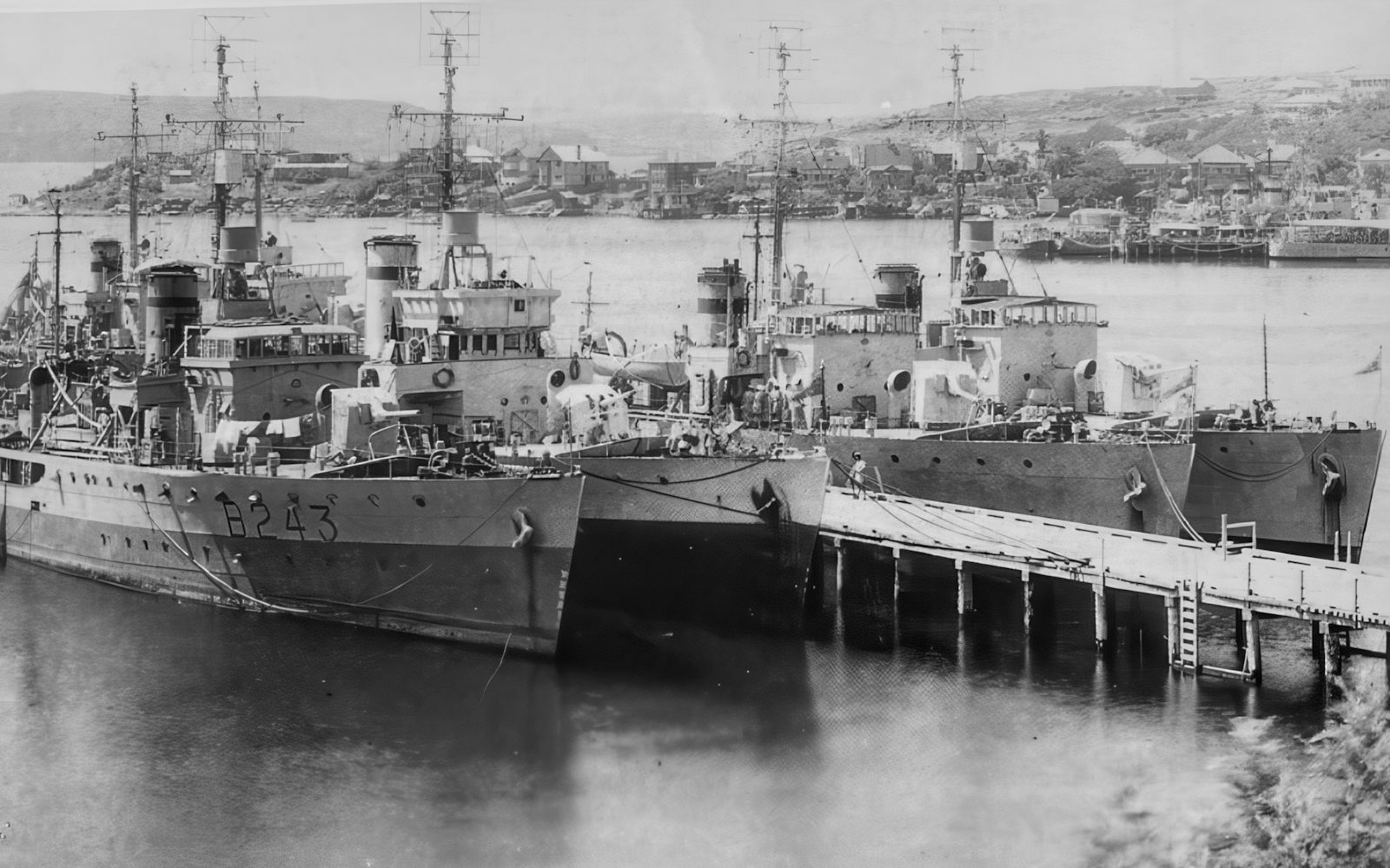
GOULBURN, wearing her BPF pennant no. B243 with BENDIGO, BALLARAT, BATHURST moored at Village Point wharf, Watsons Bay, Sydney.c. December 1945
She was sold on October 13th 1947, to Captain S. P. Bell of Pacific Enterprise Incorporated for £12,500. She was later resold to P. J. Lobo & Co, Hong Kong, for £15,000. in December 1950. GOULBURN and sister ships BALLARAT and BENDIGO were acquired by by A. H. Carrol, acting as agent for Ta Hing Co (Hong Kong) Ltd. GOULBURN and BALLARAT were subsequently refitted for the Chinese coastal trade; however, in January 1951, the Commonwealth Government issued a Statutory Order banning them from proceeding to Chinese waters.
GOULBURN and BALLARAT were sold for the final time to John Manners & Co of Sydney in 1953. The corvettes were broken up for scrap at Iron Cove later that year. Only BENDBENDIGOIGO left Australia; sold as a seagoing vessel, and not held up in an Australian shipyard, she was later acquired by the Navy of the People’s Republic of China and entered service as a warship.
Notes:
Last modified: 31 December 2025
Primary information sources
Additional sources:
AWM78-123/1 Reports of Proceedings, HMA Ships and Establishments HMAS GOULBURN (I) January 1942 - October 1945
AWM78-123/1 Reports of Proceedings, HMA Ships and Establishments HMAS BENDIGO (I) March 1942 - December 1945
AWM78-123/1 Reports of Proceedings, HMA Ships and Establishments HMAS BURNIE (I) February 1942 - January 1946
AWM78-123/1 Reports of Proceedings, HMA Ships and Establishments HMAS BALLARAT (I) December 1942 - January 1946
Comments (0)