
D72 (Atlantic)
R311 /A731 (Pacific)
ATLANTIC 1944
OKINAWA 1945
Builder: Seattle-Tacoma Shipbuilding Co. Tacoma, Washington.
Displacement: 15,390 tons
Length (Overall): 494ft 9in
Beam: 69ft 6in
Draught: 16 ft
Flight deck: 450ft x 80ft wood covered mild steel plate
Propulsion: 2 Foster Wheeler boilers; 1 x Allis-Chalmers geared turbine driving 1 shaft
Speed: 18 knots
A/C Capacity: 20
Hangar: 260ft x 62ft x 18ft
A/C lifts: 2, Aft 34ft long x 42ft wide; forward 42ft long x 34ft wide
Arrestor wires: 9 with 3 barriers
Catapult: 1 H4C hydraulic
Armament: 2 single 5in USN Mk 12, 8 twin 40mm Bofors, 14 twin 20rnm Oerlikon, 7 single 20mm Oerlikon
Crew Complement: 646
Captain H. P. Currey RN Nov 43 - Sep 45
Captain J. M. Armstrong RAN sep - Oct 45
Commander Sir M. Culme-Seymour RN Oct 45 - Jan 46
Captain J. H. Huntley RN Jan 46
None
None

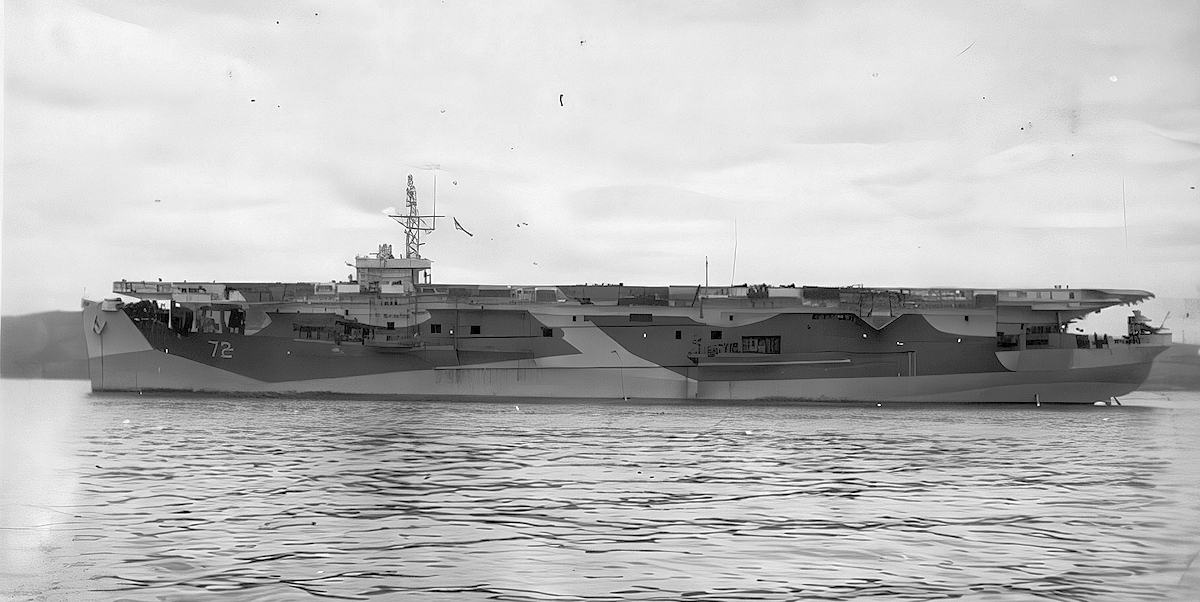
HMS RULER after her modification work and flight deck extension have been completed. C.February 1944
HMS RULER was a 'Ruler' class escort carrier; her keel was laid down on March 25th, 1943, at Seattle-Tacoma Shipbuilding Co., Tacoma, Washington, as a C3-S-A1 type freighter hull, Maritime Commission hull number 261; Seattle-Tacoma hull number 45. The US Navy purchased the hull to become the auxiliary aircraft carrier USS St. Joseph ACV-50 (changed to CVE-50, July 15th, 1943). After 149 days on the Ways, the hull, complete with flight deck support beams and its engines and associated machinery installed, was launched on August 21st 1943, by her sponsor, Mrs W.W. Smyth. Whilst still under construction, it had been decided that CVE 50 was to be transferred to the Admiralty on loan on her completion as an aircraft carrier. The proposed name was later cancelled.
CVE -50 was immediately taken in tow by tugs for her first short voyage to a Sea-Tac fitting-out berth a few cable lengths away where she was to spend the next fifteen weeks alongside completing her build and fitting out. Approximately fifty subcontractors from all parts of the USA were involved in her construction and fitting out. These included Allis Chalmers of Milwaukee, which supplied and fitted the turbines and double reduction gearing; Foster Wheeler, which made and installed the two oil-fired boilers; General Electric, which built the generator sets; Cramp, which made the 4-bladed propeller; and McKieman-Terry, which supplied the steering gear and capstans. Buffalo Forge made the fans, and Worthington the pumps; Otis supplied and fitted aircraft lifts; Dayton lighting and Sperry navigation equipment were installed, as were Automatic Electric telephones and Raytheon radar. Carrier Corporation fitted the refrigeration and air conditioning, and Bofors and Oerlikon provided the 51 guns for her close-range air defence. One of the heavier items installed, having been hoisted by crane at the fitting-out berth, was the 42-ton aircraft catapult. Remarkably, she was ready for sea in the first week of December 1943, less than four months after her launch.
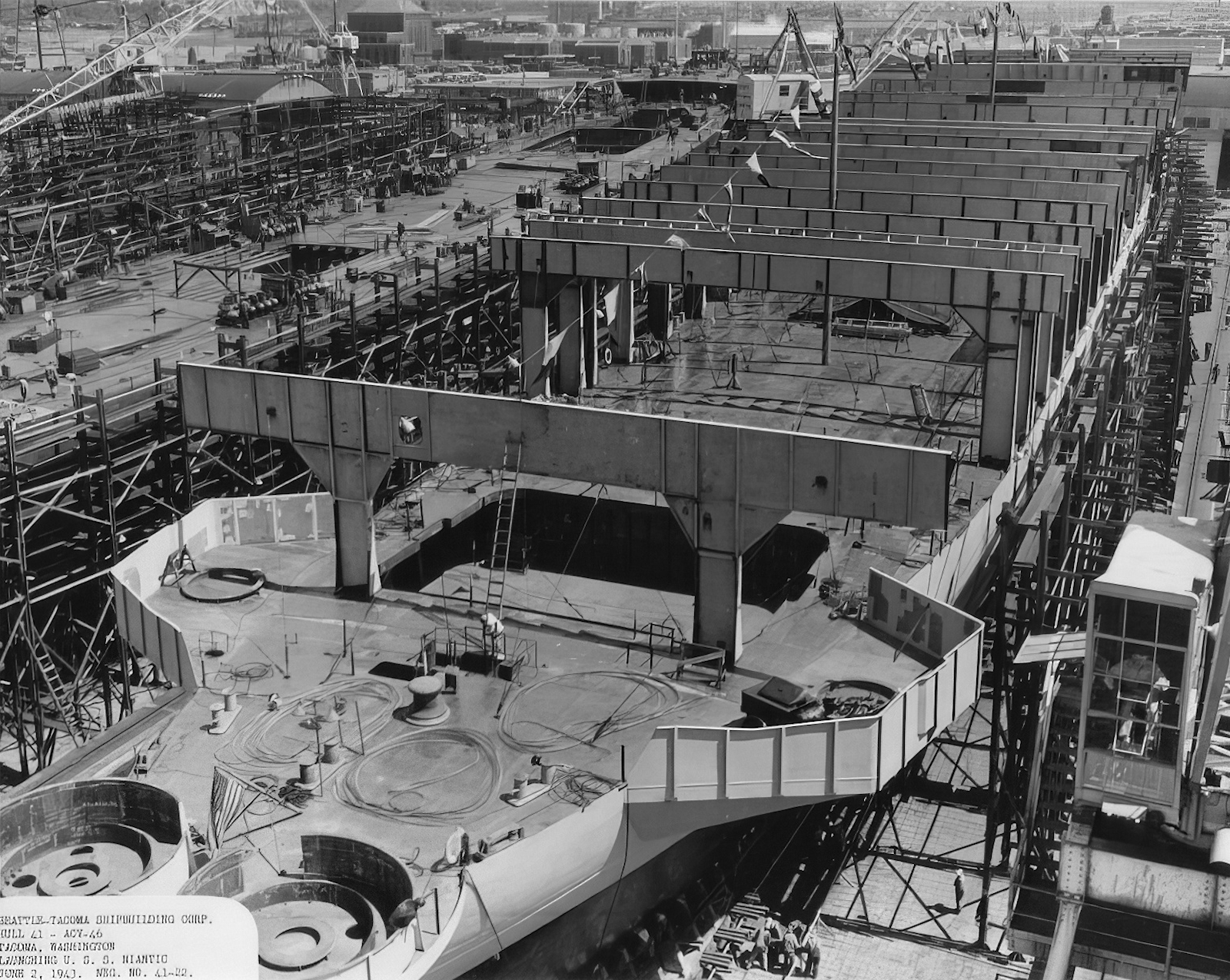
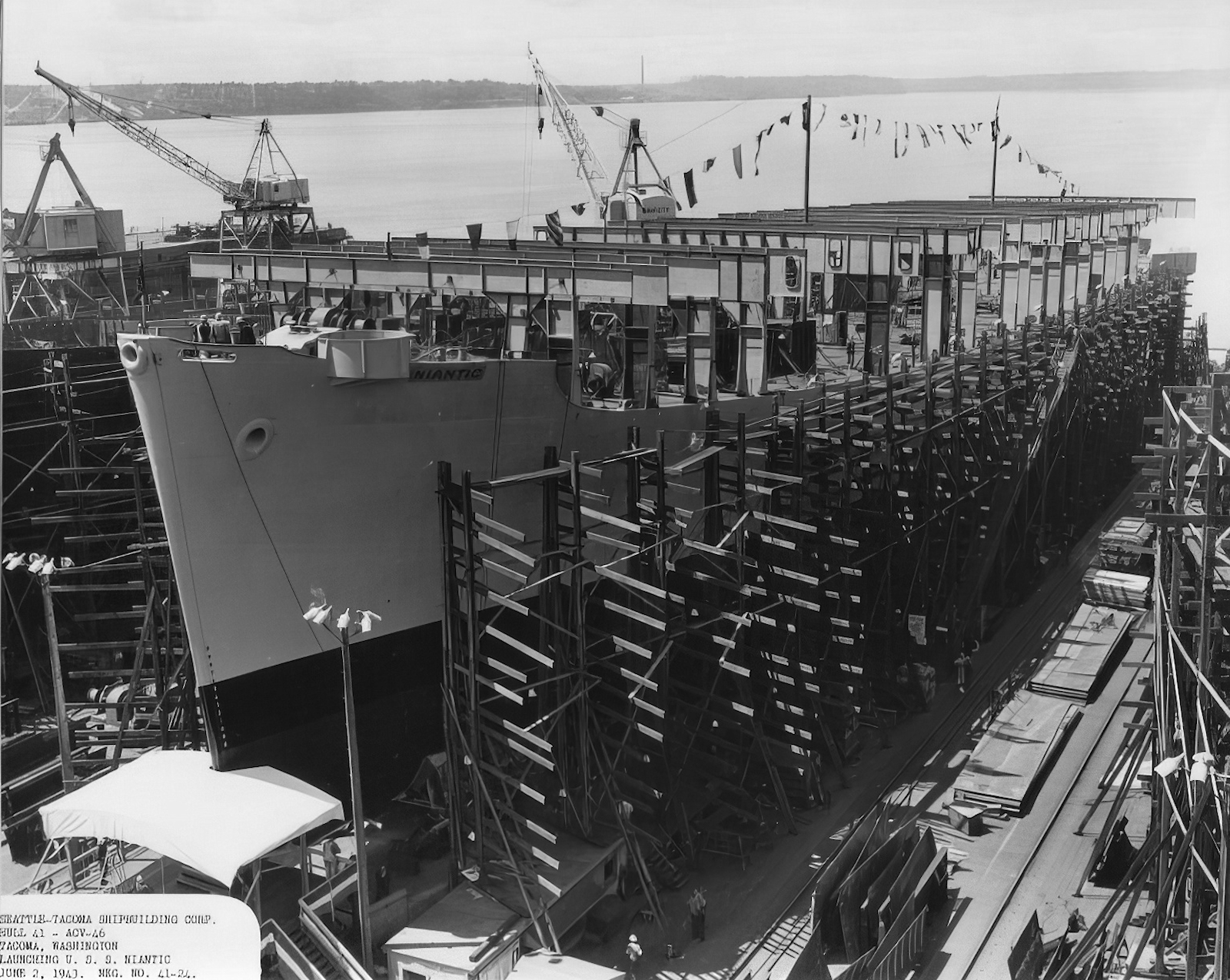
With her engines and most other equipment (except some radar) installed and initially tested alongside, CVE -50 was taken to sea on trials by the contractor SeaTac, accompanied by representatives of the US Bureau of Ships (USBS) in early December 1943. The trials lasted several days, and included speed trials over a measured mile in Puget Sound, in which she achieved over 18 knots. On her four-hour full power trial, she averaged 18.8 knots. The steering gear was rigorously tested off Port Townsend in Juan de Fuca Strait and, after a comprehensive series of other tests, on December 17th the ship was duly accepted by the US Navy off Dash Point in Commencement Bay, Tacoma by Captain McGuigan USN of the USBS.
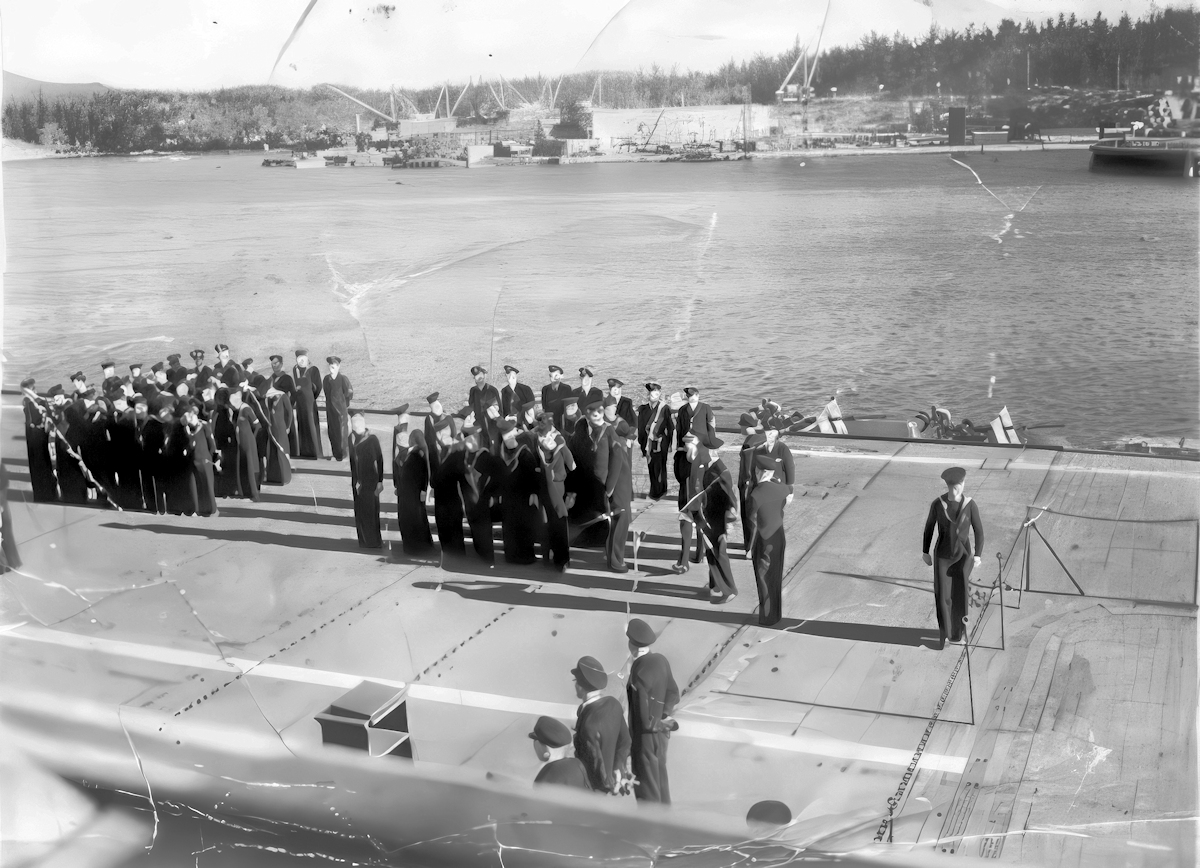
After completing builders and acceptance trials on December 17th, CVE-50 was transferred to Royal Navy custody at Tacoma. Washington on December 22nd 1943; she was accepted on behalf of the Admiralty by Commander R. E. Cowell, RD RNR, the ship’s executive officer, who temporarily assumed command of the ship. The Commissioning Warrant was read out before the crew assembled on the Flight Deck, and the White Ensign was hoisted, commissioning her as HMS RULER, pennant number D72. CVE-50 took 272 days to complete: 149 days on the ways and 123 days outfitting.
At this time the ship had a limited, partly temporary, RN steaming crew, and a few of her key personnel, including the Commander (E), Lt-Cdr(E) H. Connor RNR, the Commander (S), Lt-Cdr(S) M. Blaxland RNR, Sub-Lt(S) T. Lloyd RNR, the First Lieutenant. Lt J. Dougall RNR, the Torpedo (Electrical) Officer Sub-Lt(T) H. M. Sweezie RCNVR, and Supply Assistant Derek Allam.
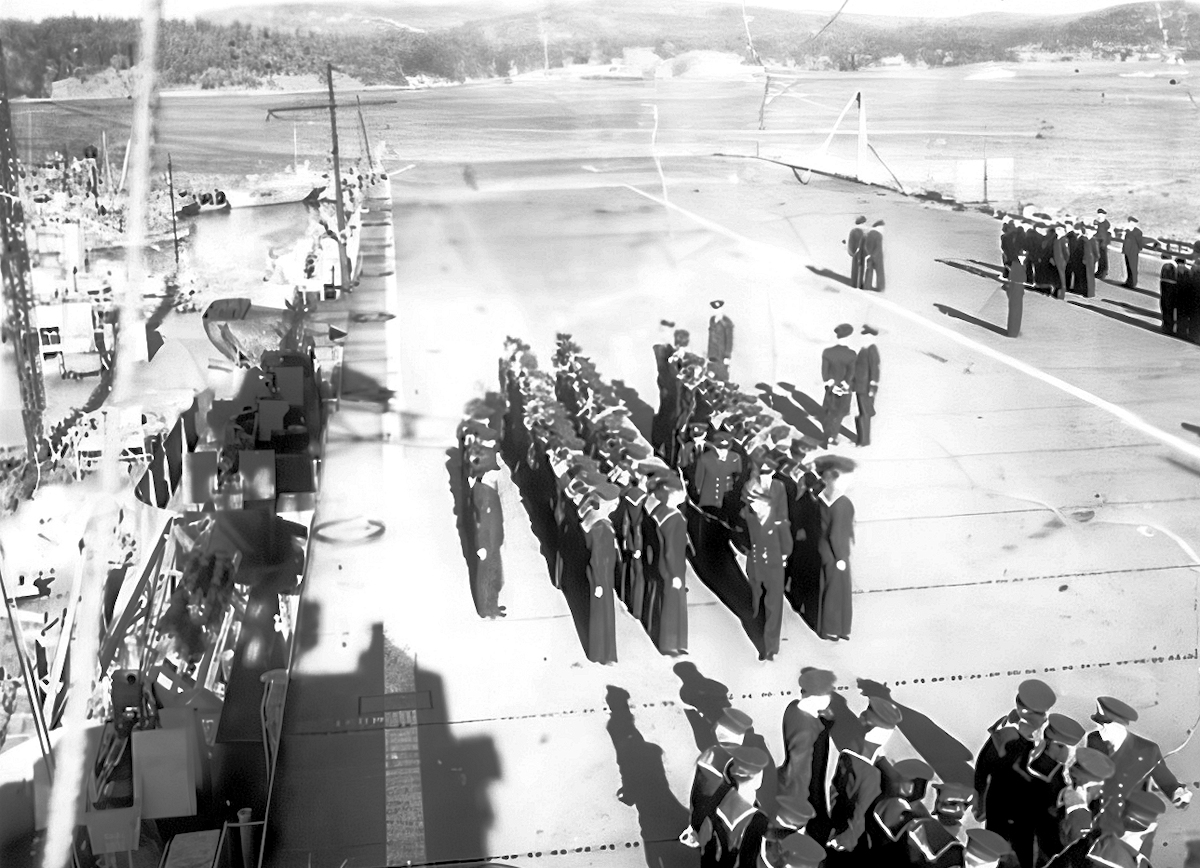
Manned by her steaming party, RULER departed Trachoma for Vancouver, British Columbia, on the evening of 22 December, under her own steam. She anchored in English Bay off the Port of Vancouver the next day, 23 December 1943.
She was one of 19 escort carriers modified to meet Admiralty requirements in Vancouver, British Columbia. She would also receive her full crew complement and complete a work-up, ready to begin her active service. A crew draft for several escort carriers due to enter service had left the UK on November 13th 1943, on the armed troop ship the QUEEN ELIZABETH, which sailed from Greenock as convoy TA.71. She arrived at New York on November 19th. The personnel were taken by train to Asbury Park, New Jersey, and the R.N Barracks, HMS ASBURY. In early January 1944, the crew draft began travelling from New York to Vancouver by train in several groups. On arrival at Vancouver, they were accommodated onboard the CVE STHANE which was acting as a naval barracks for crew waiting to join carriers as they became ready for active service.
The Burrard Dry Dock Co. Ltd., North Vancouver, British Columbia, undertook this work. RULER was the tenth ship to be modified by Burrard's. She was not due to arrive at Burrard’s dockyard until New Year’s Eve but arrived at Lapointe Pier on the 29th, where she was moored at No eight berth. At the time of her arrival in Vancouver, sister EMPRESS, SHAH , NABOB, PREMIER, SPEAKER and QUEEN were in the hands of Burrard's yard and at various stages of modification. During this period, the ship's company vacated the ship; Officers lived ashore, and the crew were accommodated aboard THANE
Work commenced to de-store the ship and her alteration work began on January 3rd 1944: this work totalled 150 separate modifications and included lengthening of the flight deck, fitting redesigned flying controls and fighter direction layout, modifications to hangar, accommodation and store rooms, installing extra safety measures including major changes to the aviation fuel stowage and oiling at sea arrangements, modifying gunnery and other internal communications, adding extra W/T and R/T sets, and improved darken ship arrangements.
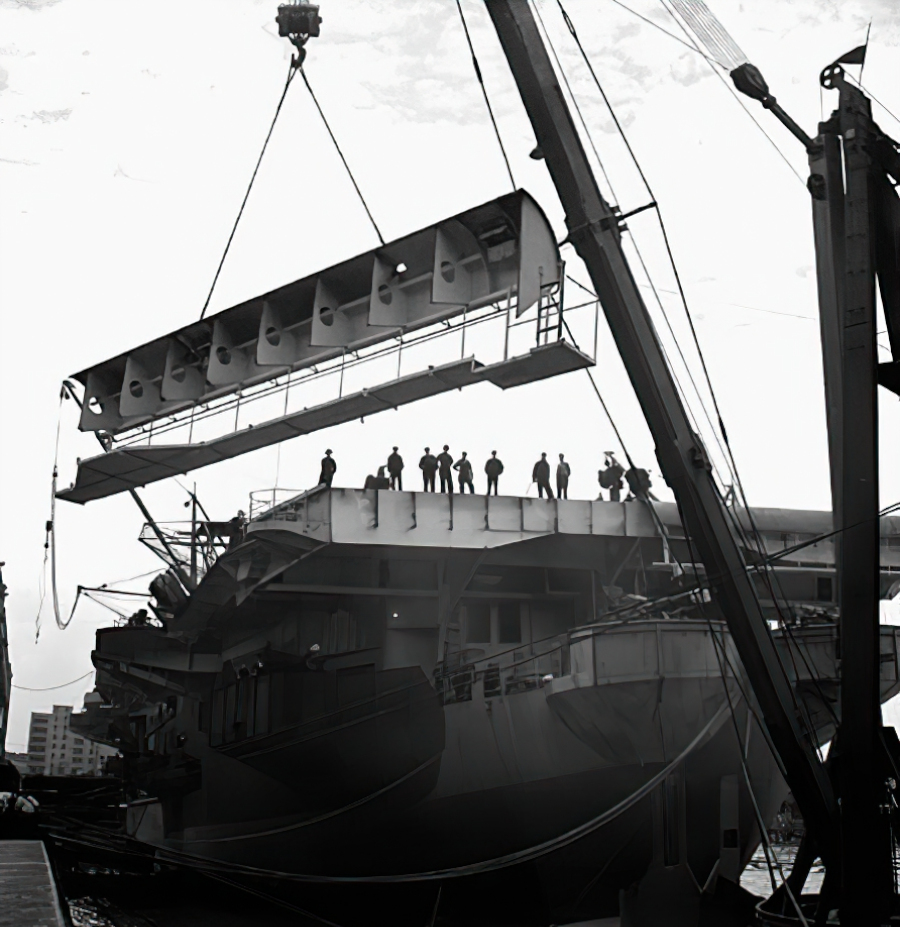
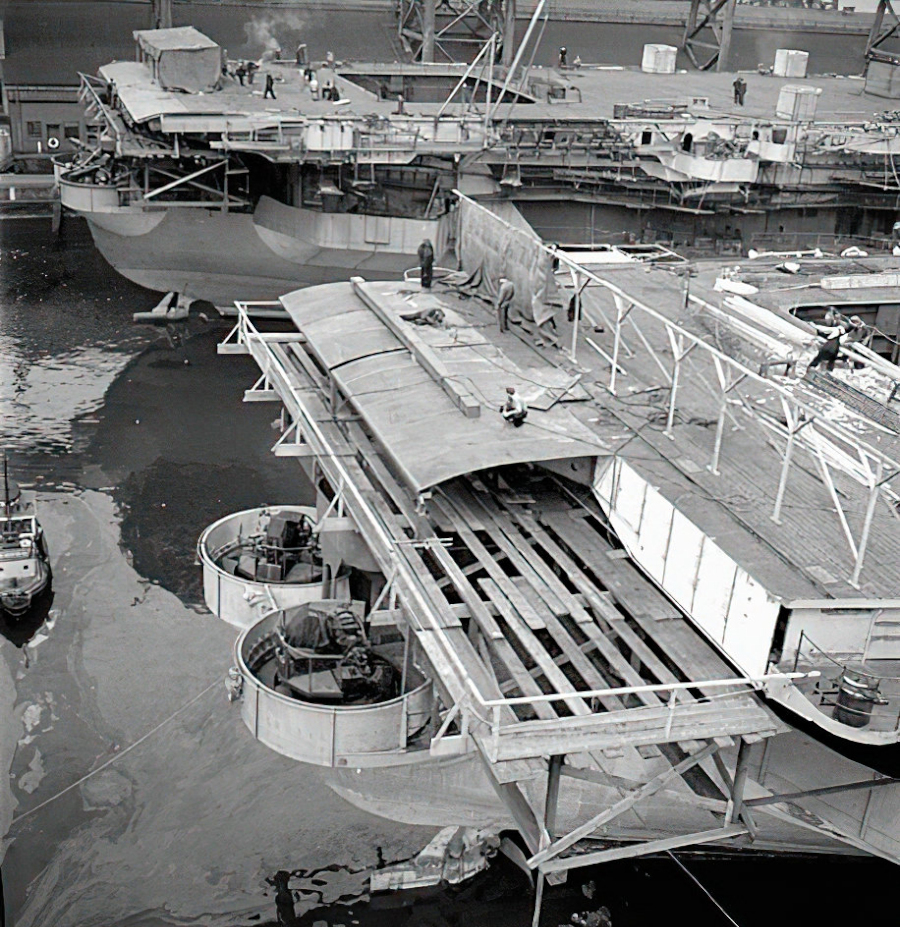
As work progressed RULER moved through the yards various berths; the yard could be working on six different ships at any time with separate aspects of the work carried out at different berths, the ships passing through like a production line, moving from one berth to another until complete. She moved into No. 3 berth on January 17th, from there she moved to Berth No.4 on January 29th, and No. 5 berth on February 3rd. Her alteration work was completed on February 19th but she still had to be docked; she entered Burrard' s floating dry dock on February 20th for the fitting of additional sea valves and other remedial work and on undocking on the 22nd she moved to Berth No. 7. RULER had spent 48 days in dockyard hands.
Although the alteration phase of her work was now complete RULER was still undermanned, during January her crew began to arrive, including the commanding officer Captain H P Currey OBE, RN, the non-commissioned personnel transferred from
THANE on February 25th – “Commissioning Day”, and the ship was fully crewed.
RULER began her work-up on the morning of February 28th 1944, operating out of Vancouver, BC, and cast off at 08:00. She arrived at the de-gaussing range at 09:55 to commence the first of several runs, completing at 11:00 when manoeuvring trials began at English Bay. The next day, she began exercising action stations and conducted communications testing at 10:15, followed by radar tests in the afternoon. At 15:00, she exercised close-range guns during dummy runs by low-flying aircraft. On completion at 16:35, she moved to an anchorage in Vancouver Harbour and commenced embarking ammunition at 22:00. This task was not completed until early on March 2nd, when she moved to an anchorage in English Bay at 08:45, where ammunitioning resumed. The loading was finally completed at 23:40.
She sailed again at 12:20 on the 3rd on passage to the Puget Sound Navy Yard, Bremerton, Washington. She conducted more manoeuvring trials in Juan de Fuca Strait and carried out night action stations drills before arriving at Bremerton at 12:15 the next day where she commenced embarking stores. She remained at Bremerton until the 6th, sailing at 08:10 for the Manchester oiling depot, Puget Sound to take on fuel, arriving at 09:30. She departed Manchester at 05:10 on march 7th and resumed trials at 05:24. The day was spent exercising her gun crews; live firing commenced at 07:15, anti-aircraft gunners were exercised starting at 13:15 and in close weapons were fired at drifting targets starting at 15:00. The same gun crews performed a close-range night shoot from 20:45 using the ship’s searchlight.
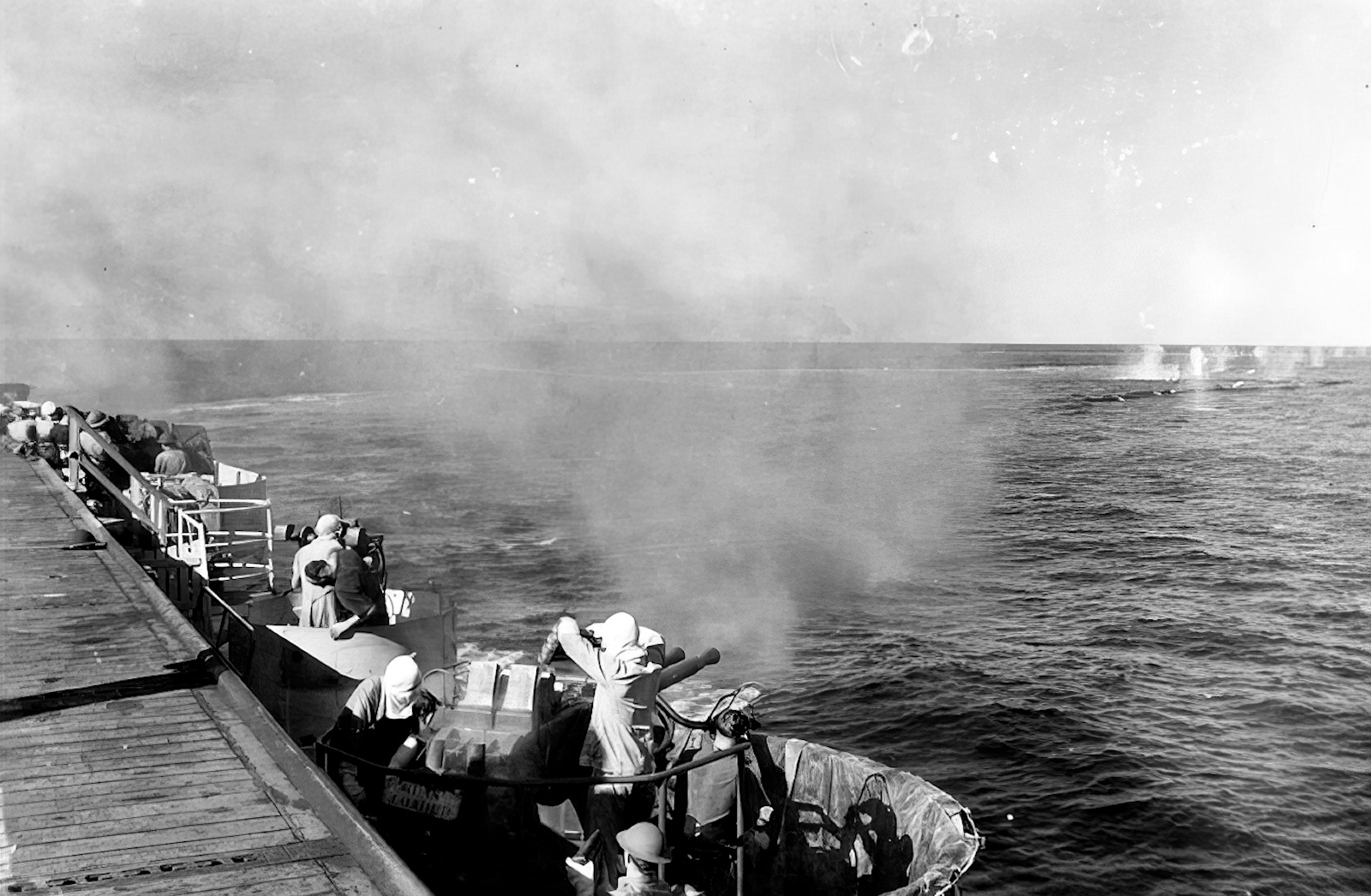
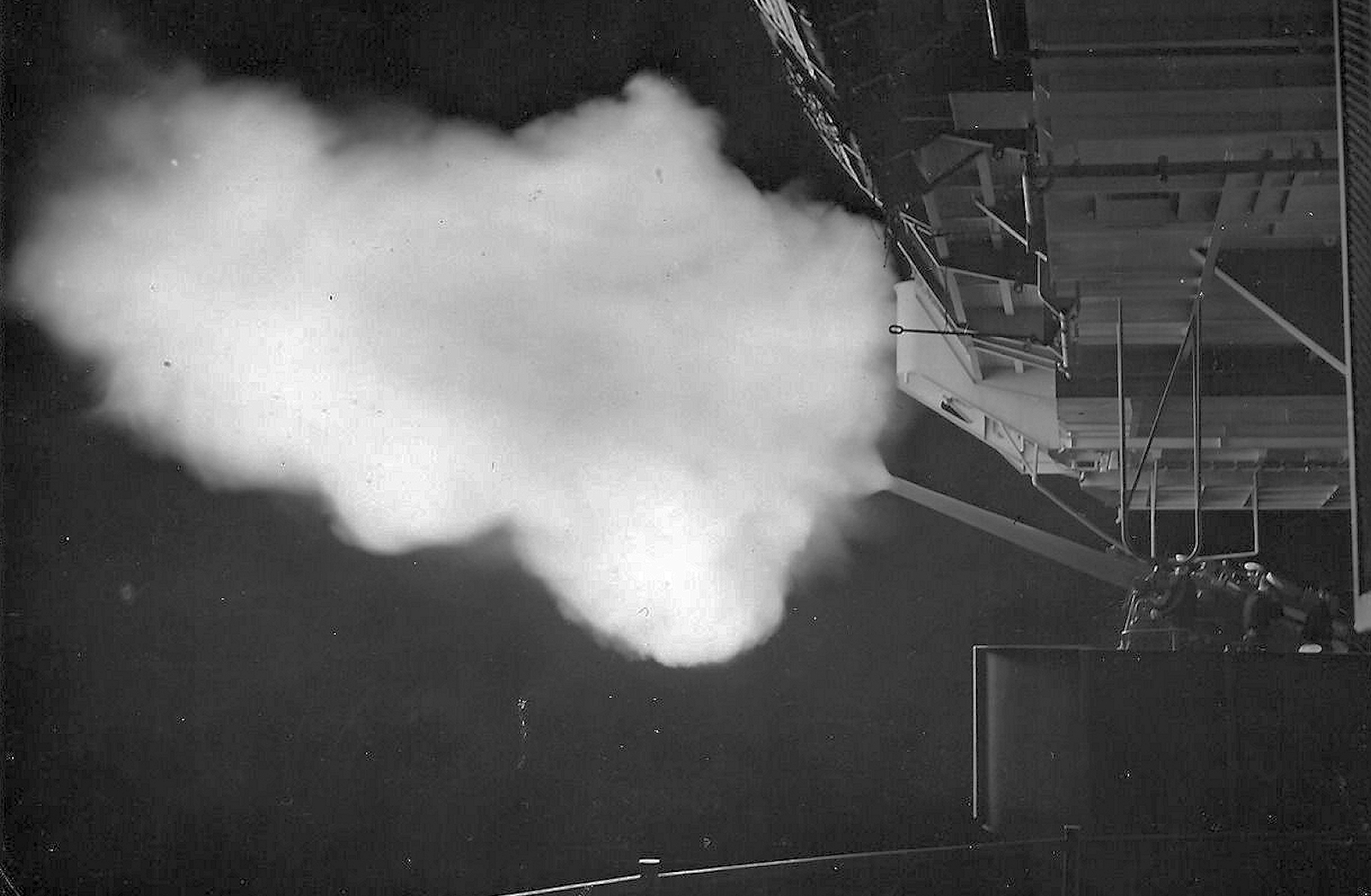
On the morning of the 8th she carried out radar calibration off Tatoosh Island; at 14:00 her steering gear failed and control was passed to the emergency steering position and course was set to return to harbour. She anchored in Vancouver harbour at 23:05. She was taken in hand by engineers from Burrards the next morning to effect repairs while the ship’s company embarked additional stores.
On putting back to sea on the 10th she resumed gunnery exercises; dummy runs with low flying aircraft commenced at 10:00 followed by close range firing at aircraft towed sleeve targets at 10:30. In the afternoon the 5-inch gun crews began live firing practice using drifting targets starting at13:50. In view of recent events the ship exercised changing to the emergency steering position at 18:50 before commencing night exercise with pyrotechnics at 20:00 and a live shoot at towed target at 21:00. The weather prevented any training on the 11th, the ship returned to Vancouver harbour and remained at anchor until the 13th, Divisions and Prayers on flightdeck on Sunday 12th. The ship exercised action stations in the afternoon of the 13th followed by 40 mm shoot exercise starting at 15:20. On completion of the live firing the engine room exercised making smoke at 17:10. More night exercises were carried out begging at 20:20. Beginning at mid-day on the 14th she calibrated her radar with aircraft in a position 60 miles west of Cape Flattery, returning to her berth in Vancouver Harbour on completion.
RULER remained at anchor in Vancouver Harbour on the 15th but was back at sea on the 16th, exercising with smoke floats before noon, followed by a final night encounter exercise with an MTB commencing at 21:00. On completion, she anchored off Esquimalt at 22:50. She had now completed her work-up period and began preparing to sail on active service.
On the morning of the 17th, she adjusted her magnetic compasses before being secured alongside a jetty at Esquimalt at 16:00. The following day, she began embarking more stores and confidential books. Storing was completed in the forenoon of the 19th, and she moved back out to anchor off Esquimalt at 14:25, where she carried out HF/DF calibration before making final preparations to sail.
RULER sailed from Esquimalt at 07:04 on March 20th for the Panama Canal. She initially carried out further radar calibrations, and simulated attacks with shore-based aircraft, these exercises were completed by the end of the day. The passage down the West coast of America was uneventful and RULER reached Balboa on the morning of April 1st.
The captain had been warned that the size of the ship (and sell of her sister ships) may cause problems, mainly in entering the locks at each end of the canal; the locks were 110 feet wide and RULER measured 1085 feet 6 inches at the Flight Deck. She would have tugs in attendance for the whole passage and as many as six pilots - one on the bridge in charge. one on the centre line and one at each comer of the Flight Deck, all had to be provided with a telephonic for communication with the bridge; the centre line pilot required a wooden platform some 15 feet high at the forward end of the flight deck to give good sight lines. The flight deck was never below the level of the sides of the locks, so all they had to worry about was the width over the sponsons, which was 88 feet. Also embarked at Balboa, was a party of armed USN sailors – they were attached to every ship passing through the Canal because of fears of enemy agents boarding a ship and sinking it, thus blocking the canal. RULER entered the Panama Canal at 08:00 and secured alongside at Colon at 17:10 after an uneventful transit.
After fuelling and embarking provisions, the ship sailed from Colon at 10:12 for passage to Norfolk, Virginia, arriving there on April 8th. The ship was now taken in hand by the dockyard for repairs; the two biggest of which involved dry-docking to enable the 20-ton propeller to be adjusted to stop it 'singing' and replacing the defective aircraft catapult which had failed on acceptance trials but was beyond the means of the dockyard facilities to replace before sailing. This replacement work was carried out in drydock, a large section was cut out of the port side and the faulty 42-ton aircraft catapult was craned off and the new one put in, the section was then welded back in position. Repairs were completed on the April 19th and, after trials on the 20th the moved to the Naval Operating Base where work began to load 31 aircraft for ferrying to the UK, these were stowed in the hangar.
On the 21st, RULER sailed from Norfolk for New York to embark further ferry aircraft. She secured alongside at Pier 14, Staten Island, at 10:10 on the 22nd. While alongside, she embarked an additional 42 aircraft and passengers for passage: 12 Naval officers, including Engineer Rear Admiral E. J. O'B Croker CBF, and 54 civilians – 11 women, five girls, 34 boys and five infants. She sailed at 10:30 on the 24th to join convoy CU.22, ferrying 73 airframes.
The crossing was made in good weather until May 4th, when the convoy encountered a severe gale. The only enemy contact was on the 3rd when a torpedo from U-473 hit the Destroyer USS DONNELL. She had sighted a periscope a few minutes after picking up a sound on her ASDIC and turned to make a depth charge attack. Simultaneously, she was struck by a torpedo which blew off her stern, killing 29 and wounding another 25. She was taken in tow by the USS REEVES, USS HOPPING and HMS SAMSONIA. RULER arrived at Liverpool mid-day on May 6th and berthed in Gladstone Dock, Liverpool, at 12:08 to disembark her passengers and aircraft.
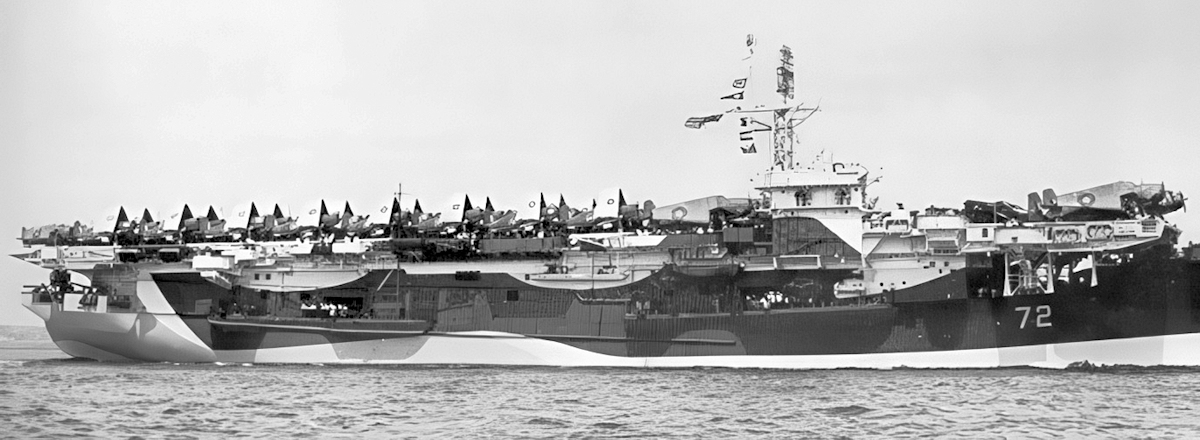
RULER operating as a ferry carrier loaded with American Lend-Lease aircraft, mostly Corsairs with Avengers in the forward third of the flight deck.
RULER sailed at 23:50 on May 9th to join the westbound convey UC.22 from Liverpool bound for New York to collect a second ferry load of American sir frames from Norfolk. This was another fair-weather crossing without incident. RULER detached from the convoy at 19:20 on the 19th to proceed independently to Norfolk, securing alongside pier 7 oat the Naval Operating Base at 07:00 on the 21st. The ship took on fuel and stores throughout the day on the 21st before embarking aircraft from 09:00 0n the 22nd. Eighteen Avenger Torpedo Bombers were to be embarked but the operation had to be suspended and the ship moved to another berth after the shoreside crane broke down. Loading was completed at 21:00 and RULER sailed at 21:15, bound for New York.
At 19:35 on the 23rd, she berthed at the 35th Street Pier, Brooklyn, New York, to undergo voyage repairs by Bethlehem Steel Company’s 56th Street yard. The work was completed on the 30th; she sailed later that day to join convoy CU.26 for the Atlantic crossing; she was carrying 80 aircraft and 135 passengers, a draft of 80 RN ratings, 22 RN officers, 1 Army officer, 1 WRNS officer, 1 WRNS rating, 1 QARNNS nurse, and 29 civilians – 10 women, three girls, two men, 14 boys and one infant.
After an uneventful crossing with fair weather, RULER berthed at Gladstone Dock. Liverpool at 16:20 on June 11th to unload the aircraft and disembark her passengers. She next sailed for the Clyde on the 15th and anchored at the Tail of the Bank, later than planned due to gale-force winds in the Irish Sea
On June 21st, she put to sea and tested the catapult and arrester gear using an Avenger from 778 Service Trials Unit. Having successfully passed these tests, she sailed for Newport, South Wales, on the 23rd, where she was to enter a commercial shipyard for further modification work; she was one of several CVEs selected for conversion into an 'Assault Carrier ', one of a new type of ship to be used to provide air support for major military landings. The assault CVE would provide air cover until shore-based airstrips became operational
The modifications involved many new pieces of equipment being installed; a new type 277 radar, a new telephone system consisting of over 100 telephones, a new Briefing Room and `Army Plot' Room and cabins added around the 'Aircraft Direction Room' and numerous other additions such as extra W/T and R/T sets and still further improvements to the bridge. Another important modification was an anti-aircraft armament upgrade; all existing single Oerlikon mounts on the Gallery Deck and foc'sle deck, were to be changed for fourteen powered twin mountings.
The work was completed in mid-September, post conversion trials were carried out on the 16th and she sailed for Greenock the next day. Work now began preparing the ship for a work-up in the Clyde training areas. On the 21st Commander Sir Michael Culme-Seymour, Bart RN joined the ship relieving Commander Cowell as the executive officer. On September 24th Vice Admiral Lyster, Flag Officer Carrier Training (FOFT), inspected the ship before flying operations to test the flight deck equipment commenced on the 26th.
After these trials were completed, RULER returned to aircraft ferry duties for one final voyage. She sailed from Greenock at 14:25 to join the Belfast section of convoy UC.39B at 20:45, or an Atlantic crossing to Norfolk, Virginia.
On the 9th, the ship suffered engine failure when the low-pressure turbine was partly stripped, which damaged its bearings. The Engineer Officer on watch managed to limit the damage, and once things were sorted out, the engine was successfully restarted, and speed slowly increased until 12½ knots could be achieved, but she could not go astern. She now detached from the convoy and made her way to Norfolk, arriving at 18:35 on the 11th. The ship was immediately taken in hand to dismantle her engines, and the damaged rotor was brought up through the hangar deck; repairs took 12 days to complete.
Main engine trials were carried out in Chesapeake Bay on October 24th, and the ship was berthed at the Naval Operations Base upon completion to embark on aircraft, loading 14 Hellcats and 12 Corsairs. The Ship sailed from Norfolk unescorted at 08:30 on October 31st, berthing at Pier 10 Staten Island, New York, at 16:00 on November 1st. At 18:00, she was taken in hand by dockyard staff from the Bethlehem Steel Company to commence voyage repair work. This work was completed on the morning of November 7th, and the ship sailed at 11:00 to join Convoy CU—46 for passage to the Clyde.
She had embarked a total of 11 Service and 26 civilian passengers while in New York and embarked more American aircraft as deck cargo, bringing her load to 66 aircraft. Her crossing was uneventful until 18:00 on November 17th, when the convoy split into several sections. The convoy Commodore and Vice-Commodore were detached from the main convoy in company with the English Channel section. Captain Currey took over the duties of Commodore for the Bristol Channel, Jersey and Clyde sections. RULER anchored in 02 Berth off Greenock at 16:45 on November 18th. The ship began a boiler clean and took on stores; extended leave was given.
RULER sailed from Greenock at 08:00 on December 9th and, during the forenoon, carried out a practice shoot at an aircraft towed target; in the afternoon, she practised oiling a corvette at sea by the astern method. The following day, she developed engine trouble, which reduced her to steaming at slow speed until eventually anchoring in Bangor Bay at 17:15. She had come to Northern Ireland to embark her allocated squadron, 885 NAS, which had been training ashore at RAF Ballyhalbert since August.
She remained at anchor for three days, carrying out repairs and putting to sea for three test runs. Repairs were completed by the 14th, but bad weather prevented the ship from reaching her berth at RNAS Belfast (aka Sydenham airport); this was achieved at 08:00 on the 15th when she secured alongside Airport Wharf. During the forenoon, the 24 Pilots and the maintenance personnel of 885 squadron embarked. The Pilots had flown to Sydenham airport on the outskirts of Belfast, taxied their Hellcats to the aircraft wharf and walked on board; the remaining squadron members arrived by bus. Their 24 Hellcat fighters were loaded on board by crane in the morning of the 16th.
After loading squadron sores and equipment, RULER sailed for the Clyde at noon on the 18th and began a short workup for the ship and her new squadron beginning on the 19th. Flying went very smoothly to start with, but later that day, after about 30 normal deck landings by several Pilots, Sub-Lt (A) R. E. Goadsby RNVR in JW875 caught his hook on the round-down and ended up at high speed in the barrier. The aircraft was written off and pushed over the side. Sub-Lt (A) M. N.D. Furnivall RNVR in JW717 came in fast, caught the No.8 wire and entered the barrier. Completing the day’s flying programme, the squadron flew ashore to RNAS AAyr.
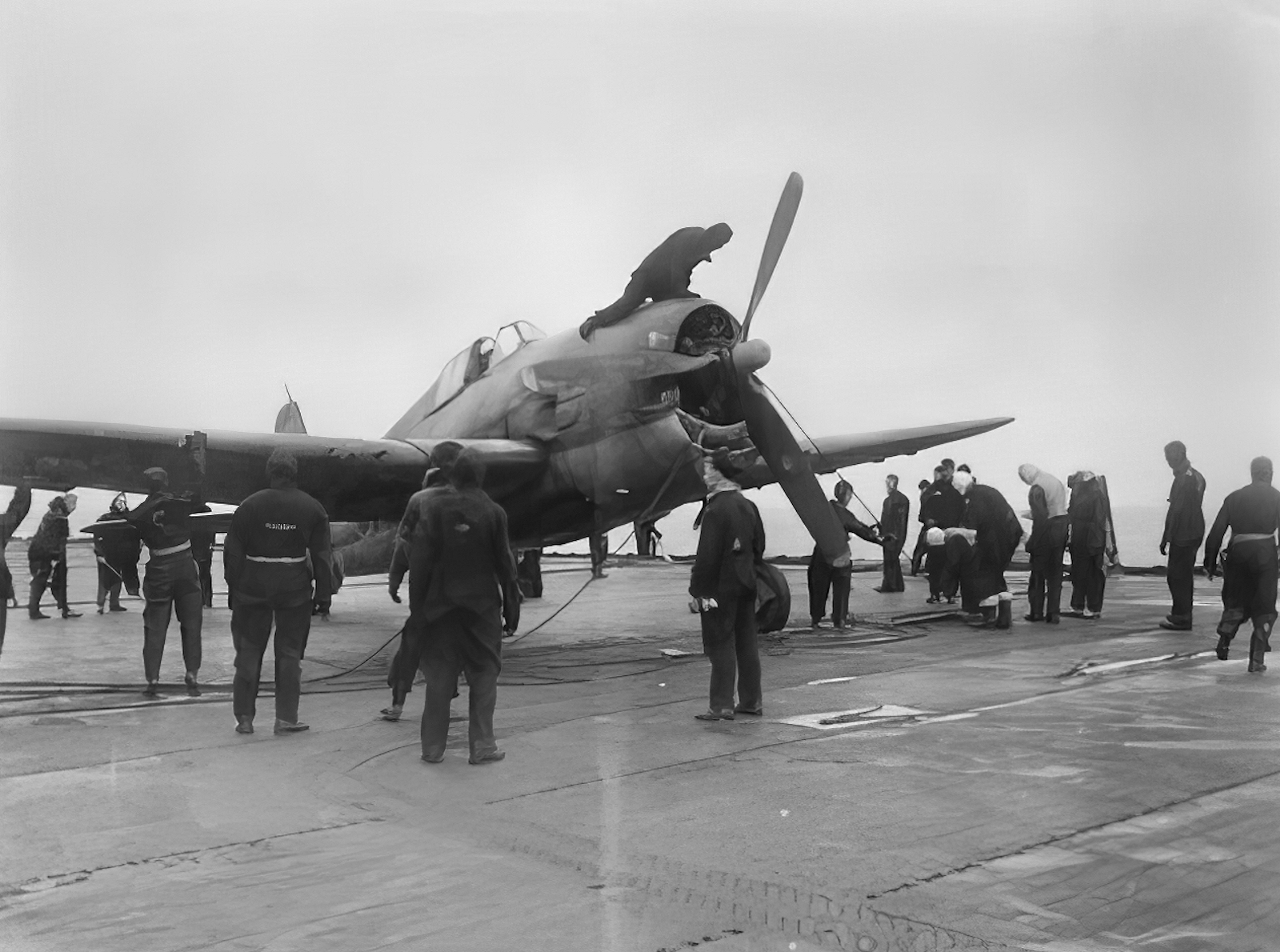
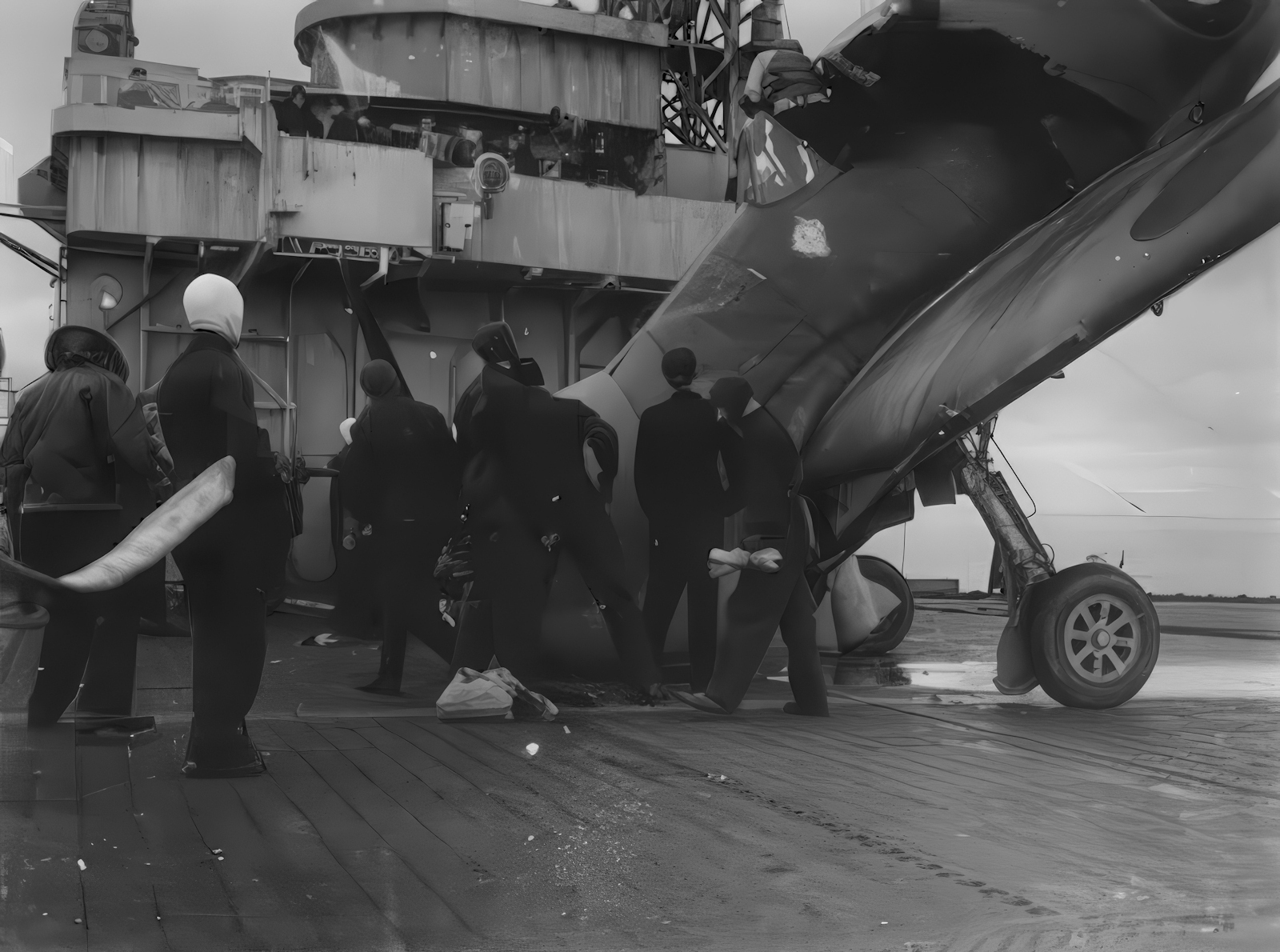
C. December 1944, Hellcats from 885 squadron operate from the ship during the working-up period in the Irish Sea. It was not unusual for a Hellcat to end up on its nose after being stopped by the crash barrier, which catches the aircraft across its undercarriage legs and tips it forward with great force.
The Hellcats returned to the ship on December 22nd to continue their work-up. On Christmas Eve, there were three landing incidents, two involving Sub-Lt (A) GH. Home; he made a heavy landing in JV235, bounced, missed all the arrester wires, nosed up in the barrier, broke off his hook landing in JX732, and again ended up on his nose with a bent engine. Another Hellcat, FN441, had to be sent ashore and replaced after Sub-Lt (A) Goadsby caught No. 9 wire and smashed into the barrier. Despite festivities on Christmas Eve, deck landing training on Christmas Day saw no incidents.
On December 27th, two Hellcats were lost when Sub-Lt Fumival approached the deck through a rain squall in JV252, bounced over the barriers, and crashed into a Hellcat parked forward – from which Lt (A) H. Lang RNZNVR had just leapt out and into the port catwalk. Both Hellcats careered overboard in great balls of flame and plunged into the sea in a cloud of steam, from which Sub-Lt Furnival swam out of his cockpit and was recovered by the attendant escort. The fiery scene was watched from the air by Sub-Lt (A) R. E. Thomas RNVR, who was about to land on himself, and from the bridge by FOGT during his final inspection. The incident demonstrated to all, without casualties, the need for speed in getting clear of the flight deck when other aircraft were landing.
On the last day of flying from RUILER, Sub-Lt (A) J. Fisher RNVR was severely injured when his aircraft, JW780, was seen to stall directly into the sea astern of the ship from about 200 feet. He was picked up by the plane guard but was found to have severely damaged his spine and was hospitalised and later invalided out of the Service. On completing the day’s flying operations, 885 disembarked to RNAS AAyr, and RULER returned to the Clyde.

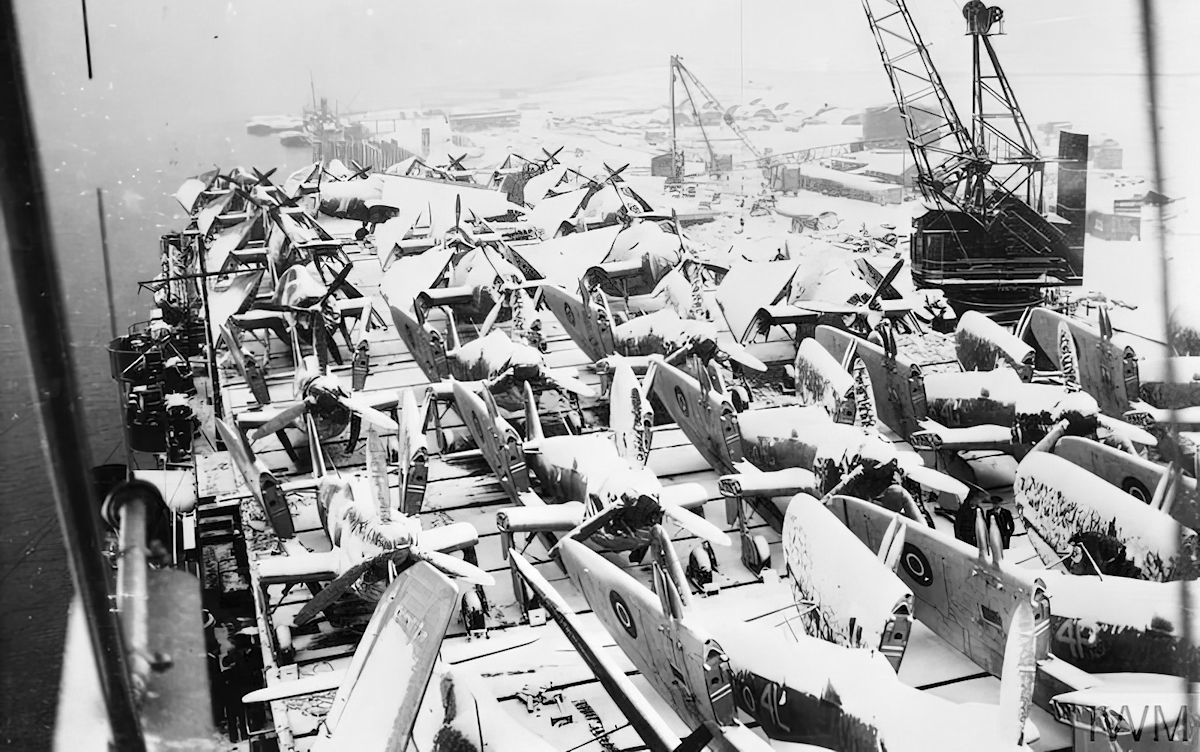
The ship was docked by a floating dock off Helensburgh on January 4th 1945 for maintenance, and undocked on the 10th. January 19th was the last day of flying before the ship secured alongside Airport Wharf at RNAS Belfast to commence loading stores and spare aircraft for passage to the Far East. The Hellcats were stowed in the hangar before the 18 Fireflies, equipment, and stores of 1772 squadron were hoisted aboard on the 20th. These were followed by a number of Corsairs and Avengers lashed to the flight deck as deck cargo. Loading was completed on the 22nd when RULER sailed to return to the Clyde. Six days later, she sailed from Greenock into an Atlantic storm in company with the British-built escort carrier ACTIVITY as part of a convoy KMF 39. RULER on the first leg of her voyage to Australia,ACTIVITY for Ceylon. On February 2nd, the carriers detached from the convoy and proceeded to Alexandria, arriving there on the 9th. RULER had suffered damage to the front of her wooden flight deck during a severe storm in the Mediterranean on the 8th and required dockyard assistance on arrival to repair the damage; ACTIVITYproceeded alone.
RULER entered the Suez Canal on February 17th and arrived at Colombo on the 27th. Here, she took on fuel and stores before sailing for Sydney on March 2nd. For this leg of her journey, she sailed in company with the escort carrier FENCER, which was returning to Sydney with her second ferry load of reserve airframes from Cochin, India, and escorted by the Australian destroyers NORMAN and NEPAL.The ship crossed the equator on March 3rd; the traditional Crossing the Line ceremony was performed.
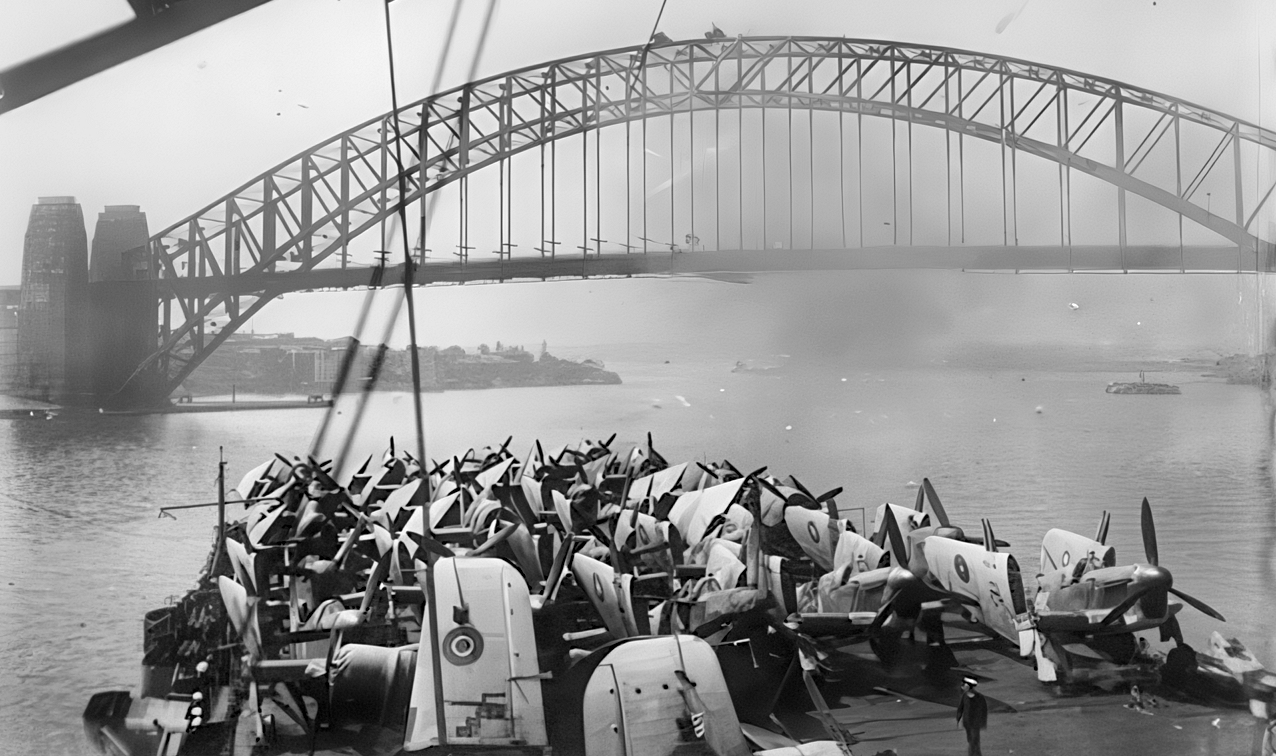
March 16th 1945, RULER has passed under the Sydney Harbour Bridge on her arrival in Australia.
At 10:24 on March 16th, RULER passed under Sydney Harbour Bridge and secured at Pyrmont No 12, where work began to unload her ferry load and 1772 Squadron Fireflies for transport to RNAS Bankstown, Sydney. 1772 moved to RNAS Schofields on the western outskirts of Sydney on the 18th. 885 stayed on board and were ordered to fly off to Schofields. After six weeks on passage, the Hellcat engines had to be de-inhibited and tested on deck before all 24 aircraft were catapulted off to Schofields due to the lack of wind; it was flat calm when the ship put to sea early on March 18th. Sub-Lt (A) F. J. B. Boyd RNVR was accidentally catapulted off while his engine was still in 'tick-over' revolutions; with his reaction time and excellent flying ability, he achieved flying speed and narrowly missed ditching. However, Hellcat JW702, flown by Sub-Lt E. H. Hardwick RNVR, suffered engine failure shortly after launch and force landed in the sea. He was rescued safely, but his injuries required hospitalisation. On completion of dispatching the Hellcats, RULER returned to Harbour and disembarked the squadron maintenance personnel and their equipment for transport by road to RNAS Schofields.
RULER, now secured alongside at Woolloomooloo, began embarking stores and equipment in preparation for joining the British Pacific Fleet (BPF). On April 5th, she was ordered to sea to provide a deck for the pilots of 1772 squadron, the only spare Firefly crews in Australia, to conduct refresher flying training. The Fireflies were craned onboard in Sydney, and on the morning of the 6th, three of them took off and, on landing, all three crashed. MB380 ('4A'), flown by Mid R. P. Hubble RNVR, hit the rounddown on landing, MB378 ('4L'), flown by Sub-Lt. H. Jobbings RNVR dropped its Stbd wing on landing and crashed over the starboard side; the pilot was rescued OK. The last was the squadron CO. Lt. Cdr L. C. Wort DSC RNVR in MB381 ('4B'), which entered the barrier and removed the undercarriage. RULER’s Captain then halted flight operations anchored in Jervis Bay for the rest of the day, going out to sea for an hour the following morning to ditch the written-off Fireflies. During the afternoon, the Hellcats of 885 Squadron flew back on, and the aircrews of 1772 Squadron were put ashore by boat. The weather now deteriorated, so there was no further flying that day or the following one.
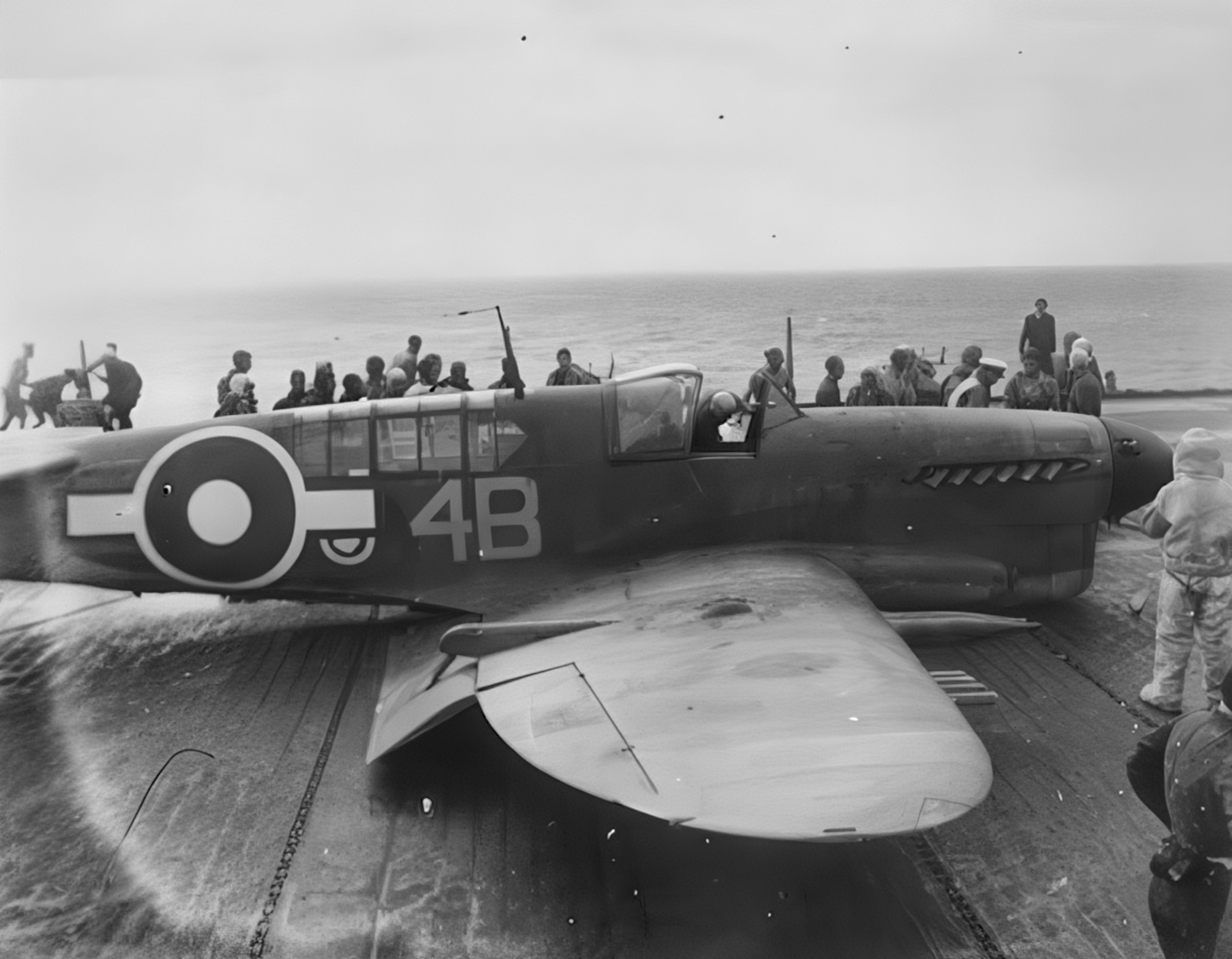
Firefly MB381 ('4B'), of 1772 Squadron, piloted by their commanding officer. Lt. Cdr L. C. Wort DSC RNVR, having had its undercarriage removed in a barrier crash during a disastrous deck landing training session on April 5th.
On the 9th, the wind had died down, but there was still a heavy swell out at sea, so limited DLT was carried out within the Bay. Conditions were better on the 10th, and a complete DLT program was possible; on the 12th, after flying was completed, the ship returned to Sydney and anchored in the harbour overnight. The next morning, the ship was berthed at Pyrmont and spent two days
storing, including loading aircraft all night. Finally, at 17:22 on April 15th, RULER left Sydney for the Pacific operational area to join the British Pacific Fleet (Task Force 57).
The ships of the British Pacific Fleet (Task Force 57) had been engaged in operations against Japanese forces since March 26th, conducting Operation ICEBERG, joint attacks with the US Fifth Fleet on islands of the Sakishima-Gunto group in support of preparations for US landings on Okinawa. After Thirty-two days at sea, the fleet withdrew to Leyte for repairs and replenishment; they anchored in San Pedro Bay, the Philippines, at 12:45 on April 23rd. RULER arrived at Leyte Gulf in the Philippines at 07:00 on the morning of April 25th after an uneventful passage. She had steamed at the best speed, an average of 17 knots, from Sydney to arrive on station during the BPF repairs and replenishment period. She carried spare aircraft, pilots and stores badly needed by the Fleet Carriers. One Carrier in particular, INDOMITABLE, was in dire need of replacement pilots.
RULER was to relieve SPEAKER as the Logistic Support Group (LSG) air defence Carrier, providing Combat Air Patrol (CAP) fighters and Torpedo, Bomber and reconnaissance aircraft for anti-submarine patrols (ASP) for the ships of the Fleet Train in the replenishment area. The LSG regularly met with the BPF to replenish them between strikes. SinceSPEAKER was now to act as a replenishment Carrier, her Hellcat squadron, 1840 squadron, was disbanded on April 27th; the most experienced pilots and 70 maintenance personnel were transferred to the 5 Naval Fighter Wing in INDOMITABLE, where they were absorbed into 1839 squadron. The remaining squadron aircraft and the least experienced pilots were assigned to RULER's 885 squadron, which also saw several experienced pilots transferred to bring INDOMITABLE up to full strength. Once aircraft lighters had offloaded her ferry load, four Avengers were retained to provide the ASP function, giving 885 Squadron as strength of 18 Hellcats (two flights of nine) with 18 pilots, a flight of 4 Avengers with five crews, four on loan from 854 Squadron, ILLUSTRIOUS. A fifth crew had flown out from Sydney to join RULER just before sailing for Fleet Train duties.
Once this readjustment was completed, Task Force 57 sailed from Leyte at 06:30 on May 1st to return to their operational area off the Sakishima-Gunto group for a second series of 12 strike days. The Fleet refuelled from the LSG Tanker Group in Area Mosquito One during the day on the 3rd to top off their tanks before departing for the flying-off position.
RULER weighed anchor at 06:55 on May 3rd and proceeded to sea escorted by the Sloop CRANE; she joined the Replenishment Carrier STRIKER (Commodore 30 ACS) and her escorts, which formed the Fleet Train Task Unit TU 112.2.3. The two carriers were on passage to rendezvous with the Logistic Support Group in the replenishment area, codename ‘COOTIE’. This was a 5000 square mile area of ocean east of Luzon, which was 50 miles to the south and 100 miles west of 21° 52’ N 129° 24 E. RULER began DLT sessions on passage for her aircrew; six of her Hellcat pilots had not previously deck-landed with this type of aircraft and had had no DLT apart from that provided in the DLT carrier during their initial training.
Operational flight operations commenced at dawn - around 05:30 on 4th May- and maintained patrols throughout the day until dusk, approximately 18:30. A Tanker group, comprising of Task Units 112.2.1 and 112.2.5, was in place for the first complete replenishment of this phase of operations on the afternoon of May 5th, having sailed from Leyte on April 30th to provide a final top off of fuel for the ships of TF 57 in area ‘MOSQUITO’ on May 3rd before relocating to ‘COOTIE’.
On arrival at ‘COOTIE’ at 15:00 on May 5th, RULER joined TU 112.2.5 as the CAP Carrier. She was to remain on station with this Task Unit for the next 21 days, providing CAP and ASP during the five visits of TF 57 to the Service Area. The aircraft engaged in these duties were also utilised for Fleet Exercises (SKTX, AWEX, DAX, FDX, and AATOF), under the direction of CTU.57.1.5.
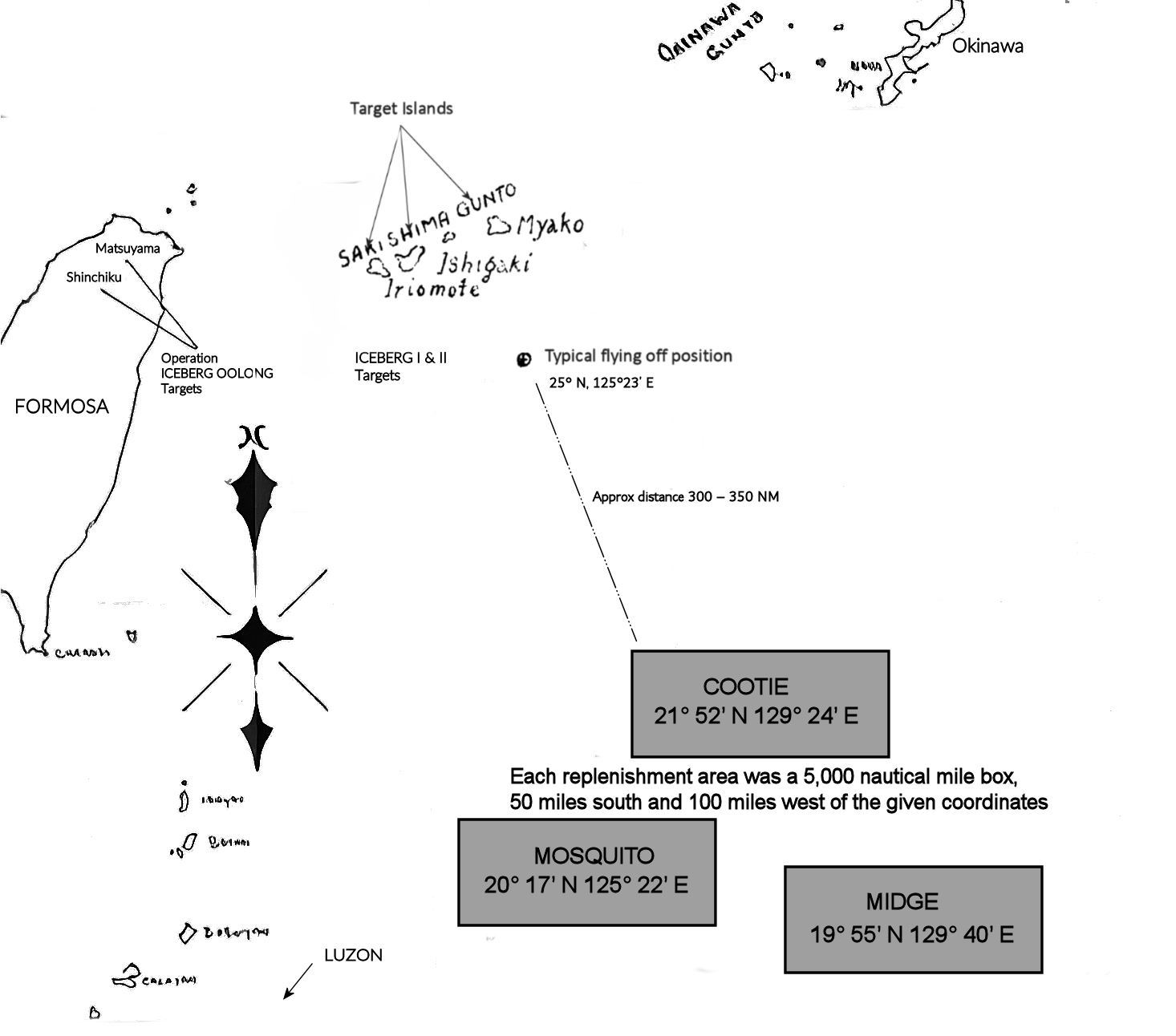
Map showing the three replenishment areas ‘COOTIE’, ‘MIDGE’, & ‘MOSQUITO’ where the logistic support group (LSG) could rendezvous with the ships of TF 57 to refuel and take on stores and replacement aircraft. Inset shows the Sakishima Gunto group of islands, the targets for the British Pacific Fleet during Operation ICEBERG. There were 3 airfields on each island: Nobara, Hirara & Sukama on Miyako Jima and Ishigaki, Miyara & Hegina on Ishigaki Jima.
BPF Replenishment period 8, May 6 - 7: The ships of TF 57 met up with the LSG at 06:30 for their eighth RAS (replenishment at sea) in the Pacific; there were five tankers and one replenishment carrier on station. US Task Group 52.1 had taken over the suppression of airfields on the islands. The replenishment period was a busy one; Kamikaze dive bombers had attacked the carriers of TF 57 on May 4th, the first day of ICEBERG phase II operations, targeting FORMIDABLE. A Kamikaze crashed into the flight deck near her island; She was seriously damaged, casualties were eight killed and 47 wounded; 1 Corsair and 10 Avengers were damaged beyond repair, both flight deck barriers were destroyed, and the forward one was irreparable.
During the day, STRIKER transferred 15 replacement aircraft to the Fleet. The replenishment loads for the second round of ICEBERG operations had been adjusted due to an acute shortage of Seafires being assembled and sent forward from Australia; the average load now consisted of 3 Seafires, 1 Avenger, 10 Corsairs, 7 Hellcats, and 1 Firefly. As a result of this adjustment, FORMIDABLE received only a single replacement Avenger, leaving her with twelve operational. One Avenger crew from RULER was transferred to INDOMITABLE as a replacement crew.
Late that afternoon, a Fleet Fighter Direction Exercise was conducted utilising aircraft from RULER’s 885 squadron. On completion of issuing replacement aircraft, she embarked 34 casualties from FORMIDABLE and sailed for Leyte at 19:15 in company with KEMPENFELT, which was detached from TF 57 with defects. STRIKER and the other replenishment carriers were tasked with casualty evacuation in the replenishment areas. At this time, STRIKER was the only Replenishment Carrier on station, so her departure ended any further exchanges of airframes for this round of resupply. At 18:45, the Fleet detached from the Tanker Group for the night.
At 06:15 on May 7th, fuelling recommenced. The transfer of fuel and exchange of stores, mail, and correspondence were completed by 14:00, when the Fleet disengaged from the tankers and took departure for the operations area. 885 Squadron CAP & ASP aircraft encountered no enemy activity during the two days of replenishment.
With the fleet's departure, CLSG began preparations for the next replenishment. The two tanker groups departed for Leyte to reload, and TU 112.2.1 was escorted by AVON and WHIMBREL, TU 112.2.2 escorted by NORMAN. RULER and CRANE set course to rendezvous with the incoming tanker and replenishment group TU 112.2.4 on the 9th.
Replenishment period 9, May 10 - 11: At 06:10, May 10th, TF 57 met the LSG, which now included the replenishment carrier SPEAKER and four Tankers. Replenishment commenced at 06:40.
The Fleet Carriers had been attacked by Kamikaze planes again on the 9th, causing damage to VICTORIOUS and FORMIDABLE. The latter suffered a significant loss of aircraft; six Corsairs and one Avenger were destroyed by fire on deck. A further three Avengers and eight Corsairs were damaged in the hangar when burning fuel entered through a popped deckhead rivet, triggering the salt water sprinkler system. In total, eighteen aircraft were put out of action: four Avengers and 14 Corsairs, of which three Avengers and seven Corsairs were flyable duds. SPEAKER issued seven replacement Corsairs to FORMIDABLE and, in return, received six unserviceable but flyable duds. She also issued one replacement Seafire to INDEFATIGABLE. Twenty casualties were embarked from FORMIDABLE and VICTORIOUS for passage to the Hospital Ship OXFORDSHIRE at Leyte. At 19:15, the Fleet disengaged from the Tanker Group for the night.
Fuelling and storing continued on the 11th; in the afternoon, INDEFATIGABLE transferred 6 Avengers from 820 Sqn and their crews to FORMIDABLE to bolster her aircraft complement for the remaining strike days. In the afternoon, Dive bombing exercises were conducted by aircraft from RULER’s 885 squadron, carrying out simulated attacks on the carriers and cruisers. On completion, the Fleet disengaged at 16:40 and departed for the operational area.
SPEAKER detached from the LSG in the afternoon to return to Leyte. She was escorted by QUEENBOROUGH, which had developed shaft vibration and was to return to Leyte for repairs. Also returning to Leyte were the tankers AASE MAERSK and SAN AMADO, escorted by HMAS BALLARAT and HMAS WHYALLA.
Replenishment period 10, May 14 - 15: At 06:30 on May 14th TF 57 met the LSG n area Cootie One. A second group comprising STRIKER (Replenishment), NIZAM and Tankers WAVE KING and WAVE MONARCH were delayed; a search by RULER’s CAP fighters located the small force and guided them to the rendezvous. They were on station by 11:00. STRIKER transferred 14 replacement aircraft and recovered one flyable dud. During the forenoon, search aircraft were sent to direct the Hospital ship TJITJALENGKA to the Fleet. She arrived at the replenishment area later that afternoon, prepared to accept any future casualties when the Fleet withdrew from operations. Casualties, now fit to be moved, were transferred to TJITJALENGKAby destroyer in the afternoon. This Hospital ship was to operate independently of the LSG and was ordered to remain at call within 30 miles of a position 85 miles forward or the normal dawn position of the fleet in the fuelling area.
885 Squadron provided aircraft for Dive Bombing exercises, which were conducted by all ships except a few destroyers, and a Fighter Direction exercise conducted by the cruiser UGANDA. A second Avenger crew from 885 Squadron was transferred to INDOMITABLE as a replacement crew. The Fleet disengaged from the Tanker Group for the night at 19:10.
There was a serious deck crash on RULER which resulted in two fatalities; Hellcat II.PR FN432 piloted by Sub-Lt P. J. Orr RNVR overshot attempting to land after am operational sortie and crashed into the deck park. The Hellcat continued on over the bows and was not seen again, as it passed it pushed Avenger JZ266 off the end of the flight deck onto the forecastle. Unfortunately, the Pilot of the Avenger, Sub-Lt N. E. Grant RNVR was still in his cockpit and was severely injured. Another Hellcat was put out of action when JV237, flown by Lt H. Lang RNZNVR bounced on landing, caught No. 8 wire and entered the barrier, the pilot was OK.
The Fleet reformed on the Tanker Group at 06:30 on the 15th, and fuelling and the exchange of stores, aircraft, and correspondence continued. STRIKERissued a further six aircraft and received one flyable dud. A change to TU 112.2.5 destroyer escorts was made before the Fleet departed. Captain D 25 in GRENVILLE (Captain D,25) joined the LSG while NEPAL joined TF 57. At 17:05, the Fleet disengaged from the Tanker Group and departed for the operations area.
On the 15th, RULER lost a further 3 Hellcats and one was damaged; one deck crash resulted in the death of a member of the flight deck party. JW707 flown by Sub-Lt H, P. Smith landed with port side drift causing the port wing to the hit Deck Landing Control Officer’s (DCLO) screen. JV285 stalled on take-off and dove into the sea; the pilot, Sub-Lt W. G. Bowles RNZNVR, was rescued OK. JV258 made a heavy landing causing the arrester hook to break off, the aircraft broke through No.3 barrier and hit another Hellcat parked forward; both aircraft went overboard, the pilot Sub-Lt G. Chadwick RNVR was rescued OK but Able Seaman T. C. C. Morgan D/JX 41627, a member of the Flight Deck Party was killed when the propellor broke free from JV258 and struck him. Sadly, Sub-Lt Grant died from his injuries early that morning, he and Able Seaman Morgan were buried at sea at 17:00.
On completion of the replenishment task, TU 112.2.3, comprising STRIKER, NIZAM, PIEASANT and WOODCOCK, with the four Tankers detached for Leyte to reload. The LSG relocated overnight to rendezvous with the incoming tanker group TU 112.2.1, which now included the replenishment carrier CHASER escorted by NORMAN.
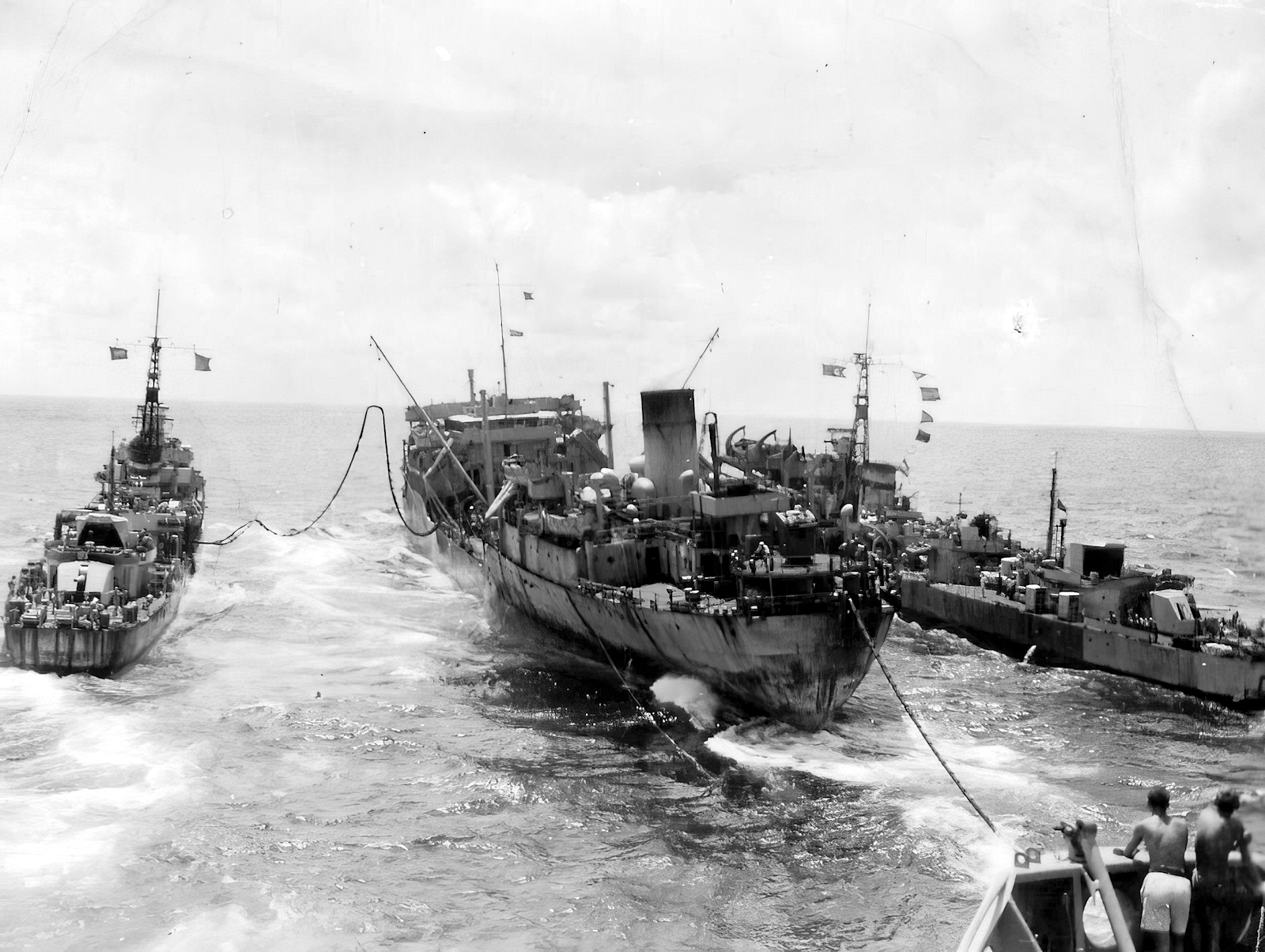
RULER remained on station with the Commander of the Logistic Support Group and the nucleus of the replenishment force for 28 days. These vessels relied on the Tankers of the Fleet Train to keep them supplied with fuel, and to a lesser degree, stores and provisions. In this image taken from the flight deck on RULER, a Tanker is simultaneously fuelling two destroyers using the abeam method and RULER herself through a hose streamed astern.
Replenishment period 11, May 18 - 19: At 05:45 on May 18th, the Fleet met with the LSG in area COOTIE. The Fleet formed up with the Tanker Group, and fuelling and the exchange of aircraft and stores commenced.
At 10:30, a serious fire broke out in FORMIDABLE; the guns of a Corsair in the hangar accidentally fired into the Avenger parked in front of it, which then exploded, igniting the fire. It immediately became clear that the fire curtains, which were supposed to partition the hangar automatically, were out of service due to earlier Kamikaze attacks. The fire was eventually extinguished by drenching the hangar with seawater; 7 Avengers and 21 Corsairs were damaged, ranging from complete write-offs to flyable duds. By the evening, she reported being able to resume limited flying operations.
The replenishment carrier CHASER transferred nine aircraft during the first day of the replenishment period: 3 Seafires and 1 Firefly to INDEFATIGABLE, 2 Hellcats to INDOMITABLE, 2 Avengers to FORMIDABLE and 1 Corsair to VICTORIOUS. One Firefly ‘flyable dud’ was received. There were very light winds that morning, which prevented RULER from launching additional aircraft for Fleet exercises. However, a Fighter Direction Exercise was conducted with UGANDA and EURYALUS. The Fleet was now seriously short of bombs, and throughout the day, Cruisers not involved in exercises were employed to deliver bombs from Formidable for issue by jackstay transfers to INDOMITABLE; this continued until dusk, when TF 57 withdrew for the night. At 18:00, the LSG changed course to proceed to the replenishment area COOTIE (1) for the next day's rendezvous.
At 06:00 on the morning of May 19th, they rendezvoused with the Armament Store Issuing Ship ROBERT MAERSK, which had been escorted from Leyte by the Australian Corvette CHASER. TF 57 located the LSG at 06:45; fuelling, aircraft exchange, and the issuing of stores resumed. VICTORIOUS went alongside the ROBERT MAERSK at 09:45 and commenced loading bombs. INDOMITABLE went alongside later. Work was held up at 13:30 when an accident occurred on the ammunition ship but was soon resumed. The Hospital ship TJITJALENGKA was contacted by aircraft and directed to the Fleet to receive a few sick and casualties.
CHASER received three flyable, but unserviceable, Avengers from FORMIDABLE in the morning and issued 1 Firefly to INDEFATIGABLE However, bad weather and poor visibility closed in by the afternoon, preventing FORMIDABLE from dispatching any further ‘flyable duds’; she still had 28 on board when TF 57 withdrew to return to the operational area. At this time, her air group consisted of 13 Corsairs and 2 Avengers that were operational. The deteriorating weather also hampered the transfer of bombs to the Carriers, so it was decided that both CHASER and ROBERT MAERSK should remain with the LSG to resume transfers on the next replenishment. At 18:00, the Tankers of TU 112.2.1 and the ROBERT MAERSK were detached to return to Manus escorted by the Frigate AVON and FINDHORN and Australian Corvettes BENDIGO and CAIRNS. TF 57 detached from the LSG at 19:30 and set course for the operational area.
Late in the morning of May 20th, the Commander Logistic Support Group was ordered by signal to dispatch the Rescue Tug WEASEL with RULER to provide air cover to proceed north towards the Fleet in the operational area to rendezvous with a damaged Destroyer under tow headed for the refuelling area.
At 05:15, on the morning of May 20th, the vessels of TF 57ran into dense fog in the operational area; at 05:24, the Destroyer QUILLLAM, endeavouring to form astern of INDOMITABLE as her counter-Kamikaze vessel, collided with her. The impact caused severe damage to the Destroyer's bow, while the Carrier sustained only superficial damage; there were, however, no casualties. The Destroyer NORMAN was ordered to take QUILLIAM in tow once clear and the Cruiser BLACK PRINCE was sent to stand by both ships at 06:15 and was to escort them to area COOTIE. It was soon evident that NORMAN was having considerable difficulty in towing QUILLIAM stern first; the wrecked bow hanging in the water acted as a hard over rudder. By 13:00, BLACK PRINCE had taken over the tow, but the same difficulty restricted the towing speed to 3 and increased later to 51/2 knots. RULER spent the two days covering the withdrawal and was back on station with the LSG late on the 21st. On handing over the tow to WEASEL the BLACK PRINCE continued as escort to area COOTIE.
TU 112.2. 3, SPEAkER and two Tankers, made rendezvous with the LSG in area COOTIE (1) on the 21st to bring the replenishment group strength for the final resupply Period of ICEBERG operations to two replenishment carriers, an Armament Store ship and four Tankers.
Replenishment period 12, May 22-23: TF 57 met with the LSG on the morning of May 22nd, for the last full replenishment period of the ICEBERG operations.SPEAKER had joined the replenishment carrier CHASER, and both were to return to Manus upon completion. RULER with 885 squadron would remain with the Tanker Group, providing CAP and ASP aircraft. During the day, CHASER, and both were to return to Manus upon completion. RULER with 885 squadron would remain with th transferred 10 aircraft to the Fleet, SPEAKER issued 1 Avenger to 849 squadron on VICTORIOUS. At 18:00, FORMIDABLE was detached to proceed to Manus and then on to Sydney to expedite the repair of battle damage. She was escorted by the destroyers KEMPENFELT and WHIRLWIND, both of which were due for refit. BLACK PRINCE rejoined TF 57 while GRENVILLE was detached from TU 112.2.5 to rejoin TF 57. WESSEX took her place as an escort to RULER. H.M. Tug WEASEL departed for Leyte, towing QUILLIAM with NORMAN acting as escort. The American tug TURKEY was sent from Leyte to meet them and assist in the tow.
RULER had one Hellcat put out of action during the day’s CAP sorties; JW700, flown by Sub-Lt D. B. Bardand RNVR, had a barrier crash. At 1:915, the Fleet disengaged from the Tanker Group for the night.
At 07:45 on the 23rd, the Fleet reformed on the Tanker Group, and fuelling and exchange of stores continued. SPEAKER launched 2 Seafires and 3 Fireflies as replacements to INDEFATIGABLE. Just after they were airborne, INDEFATIGABLE’s arrester gear accumulator gave out. At the same time, RULER suffered a crash on deck with five CAP Hellcats in the landing circuit, and SPEAKER was asked to accept these and the replacement aircraft back. Flying for replenishment CVEs was usually restricted to launching replacements and receiving flyable duds, but occasionally the ship was pressed into service to receive other aircraft in an emergency. At this time, SPEAKER's flight deck was busy with newly landed, flyable ‘duds’, so the prospect of ten incoming aircraft had the flight deck party hastily moving aircraft forward to clear the deck. Luckily, all ten did not arrive; RULER's Hellcats were safely recovered, as well as the 2 Seafires, one of which required an emergency landing. VICTORIOUS accepted the Fireflies. The Hellcats returned to RULER once her deck was operational again.
It was 14:00 before INDEFATIGABLE was able to receive aircraft, and the replacement aircraft took off once more. On departure from VICTORIOUS, two of the Fireflies developed serious coolant leaks upon takeoff and required immediate emergency landings. The pilot of one landed on against the instructions of the DCLO. The ship was not steaming into the wind, and the rudder was hard over as she made her turn to change course. Fearing he could not go round again, he came in regardless, forgot to lower his hook, and entered the side of the No. 2 barrier, striking the port station and wrecking the aircraft without any injuries. CHASER issued four replacement Hellcats to 885 Squadron. Tragically, another pilot from RULER’s squadron was killed during the day. Sub-Lt R. D. Napier RNVR took off in JW778 with his prop in course pitch and crashed into the sea; he was not recovered.
At 18:00, CHASER, SPEAKER, and NAPIER were detached for Manus, leaving RULER with the two Tankers of TU 112.2. 3. At 18:15, the Fleet, now operating only three carriers, detached from the Tanker Group, taking departure for the operations area for one final strike period.
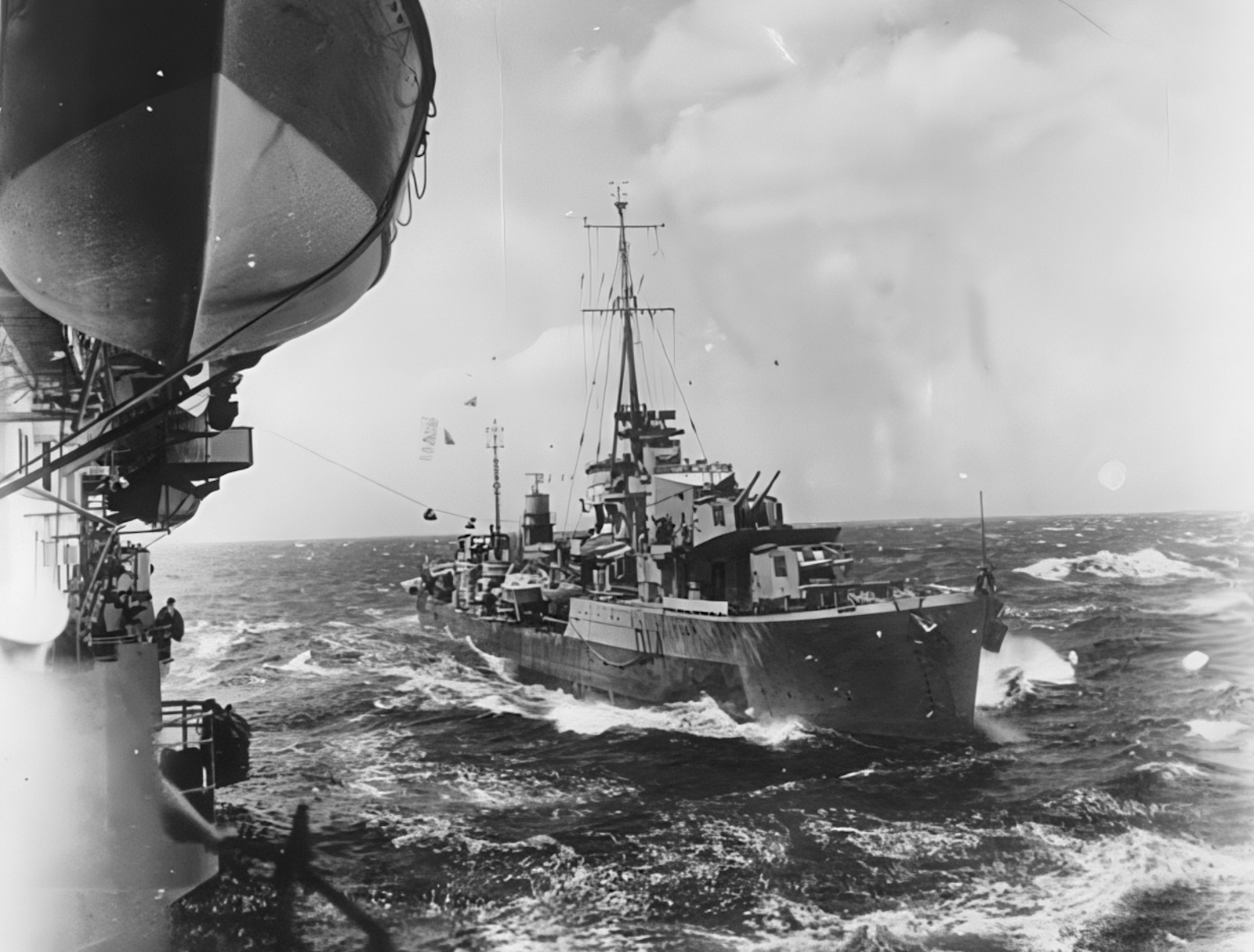

Replenishment period 13: On May 26th, TF 57 met with the LSG Tanker Group to refuel. On completion of fuelling, TF 57 set course for Manus on passage to Australia to undergo a significant replenishment and receive battle damage repairs. On May 27th, the British Pacific Fleet came under the control of Admiral William Halsey's United States Third Fleet and was redesignated Task Force 37 (TF 37) in readiness for its next round of operations against the Japanese mainland, planned for July.
RULER and the other vessels of the LSG also set course for Manus, arriving on May 31st and mooring in Seadler harbour. During ICEBERG II, the 23 pilots of 885 squadron flew 654 hours in 24 days.
At Manus, work began to embark stores and prepare for the next operation, this time with the Fleet Carrier IMPLACABLE, which had arrived from Australia on May 29th. Like her sister ship INDEFATIGABLE, she carried two Seafire, one Firefly, and one Avenger squadrons but had no operational experience in theatre. Operation INMATE was designed to give her and her aircrews local operational expertise to prepare for the BPF’s return at the start of July..
The target was the Japanese base on Truk in the Caroline Islands; the Americans had virtually destroyed this during Operation HAILSTONE in February 1944, removing it as a threat to Allied operations in the central Pacific. With no operational reason to capture it, it was bypassed. Operation INMATE was designed to neutralise the remaining air installations on Truk. Although there were few suitable targets left, it would provide IMPLACABLE’s air group and the other recently arrived BPF reinforcements with some realistic practice.
The force, TU 111.2 comprised the Carrier IMPLACABLE ((CTU 1 11.2 Rear Admiral E. J. P. Brind, CBE, CB, RN), 801 and 880 Squadrons – 48 Seafire, 828 Squadron - 21 Avengers, and 1771 squadron – 11 Firefly), Cruisers ACHILLES (RNZN), NEWFOUNDLAND, SWIFTSURE and UGANDA (RCN), CVE RULER, Destroyers TEAZER, TENACIOUS, TENNAGANT, TERPSICHORE, and TROUBRIDGE
RULER's role in the operation was to provide a spare deck and operate a reserve CAP of 11 Seafires, which would be transferred to RULER as convenient on T-2 or T-1 day. In addition, she was to operate an ASR Walrus aircraft. She weighed anchor on the morning of June 9th and proceeded to anchor off Ponam Island to disembark the aircraft and squadron personnel of 885 Squadron to RNAS Ponam HMSNABARON (MONAB IV). Aircraft lighters accomplished this task, and on completion, she returned to her mooring in Seadler Harbour the following day.
Before sailing, one Walrus was embarked from IMPLACABLE. The Seafires allocated for reserve CAP were not transferred; this part of the plan had been cancelled. RULER sailed from MANUS at 11:00 on June 12th, in company with TERMAGENT, making rendezvous with Task Group 11L.2 at 17:00. SWIFTSURE, RULER, and TERMAGENT now formed Task Unit 111.2.3 under the command of CTU 111.2.3 in SWIFTSURE.
June 14th: T Day
The Strike Area was reached early on 14 June (T Day), with TUb111.2.3 having been previously detached from the main force. IMPLACABLE commenced flying operations about 05:30 in favourable weather, and a CAP of eight Seafires was launched. This was to be maintained throughout the day. Twelve Seafires and two Fireflies followed these; The Seafires strafed a radar station and airfield on Moen Island, while the Fireflies flew a reconnaissance of the atoll. One Seafire was equipped with a reconnaissance camera and photographed Japanese installations, and the resulting photographs were used to plan further air attacks and bombardments.
At 06:35, RULER accepted the first of six Seafires; the first of these reported that his aircraft had developed an oil leak and that he was about to abandon it when he saw RULER through a gap in the clouds. The remaining five Seafires had been unable to land on IMPLACABLE due to a crash on deck, so they too made use of the spare deck. The last of these aircraft to land, Seafire NN613 of 880 Squadron, struck the rounddown and crashed on deck. The pilot, Lt I. M. L. Banyard, RNVR, was unhurt, but the aircraft was later written off. Shortly after this crash, torrential rain was encountered, and arrangements were made to clear the crashed aircraft in preparation for any other aircraft that required a deck. The speed and ferocity of the changing weather caught the flight deck Party unawares; the ASR Walrus, which was parked forward of the barrier, was inadequately secured while priority was given to the recovery operation, and at 06:43, a heavy squall struck the ship on the starboard side and swept the Walrus overboar.
On rejoining the main task group, four of the six Seafires were flown off to IMPLACABLE at 09:53, and TERPSICHORE returned the pilots of the remaining two unserviceable aircraft. At 16:55, another Seafire, low on fuel, approached and landed on. This aircraft was refuelled and flown off at 17:19.
During T Day, IMPLACABLE launched strikes at one-and-a-half-hour intervals; the strike groups generally comprised five Avengers armed with bombs and four Firefly aircraft armed with cannon and rockets, escorted by Seafires. The day’s last attack was made by 12 Seafire aircraft, which dive-bombed fuel tanks on Moen Island. Several of the tanks were cracked open, but the absence of fires indicated that they were empty. The strike groups reported finding few worthwhile targets, but the Japanese anti-aircraft defences engaged them throughout the day; one Seafire failed to return from a strafing attack. Sub-Lt M. H. Payne RNVR of 801 Squadron was killed when his Seafire PP975 was hit by AA fire. No Japanese aircraft were encountered in the air.
During the night of 14/15 June, two Avengers were launched to patrol over the atoll in an attempt to prevent the Japanese from repairing the airfield on Moen: the aircraft were taken under fire and tracked by searchlights, but suffered no casualties.
June 15th: T+l Day
The second day of Operation INMATE involved the cruisers bombarding shore targets during the late morning. RULER and IMPLACABLE, escorted by TERPSICHORE and TERMAGANT, were detached from the main force; throughout the bombardments, they steamed some 10 miles to the east of Truk, remaining within VH/F range and providing CAP cover. Rear-Admiral Brind temporarily transferred to HMCS UGANDA for this phase of the operation.
The bombardment force was organised into three task units comprising both cruisers and destroyers: UGANDA and ACHILLES, escorted by TENACIOUS, bombarded a Japanese seaplane base at Dublon Island, but they hardly did any damage, and there were communication problems with the spotting Seafires. NEWFOUNDLAND, escorted by TROUBRIDGE, attacked coast defence batteries and the airfield on Eten Island. Her fall of shot was considered good. SWIFTSURE, escorted by TEAZER, bombarded Moen Island. The fall of shot was, however, terrible, and it was later found out that there had been a defect in the fire control table. Each task unit was also assigned two Seafire fighters to spot their gunfire. The destroyers assigned to the bombardment task units were responsible for counter-battery fire on any Japanese guns which fired on the cruisers and for generating smokescreens if necessary.
At 11:07, a Seafire, which had been spotting for NEWFOUNDLAND, landed on RULER, having had to leave the target area with engine trouble. This aircraft was made serviceable, refuelled and flown off to IMPLACABLE at 16:38. There was nearly a friendly fire incident as ACHILLES steamed away from Truk, having completed her shoot, her anti-aircraft gunners fired on two aircraft approaching from the direction of the atoll, until they were identified as Avengers from IMPLACABLE, which had launched further air attacks in the afternoon. Two groups of Avengers attacked a floating dry dock and several oil tanks.
During the night of 15/16 June, six Avengers armed with bombs, supported by two Avengers equipped for flare-dropping, launched the final attack of 'INMATE'. However, it is believed that most of their bombs fell into the sea. In addition to the loss of one Seafire, IMPACANLE’s 828 Squadron lost four Avengers, all on takeoff; two were lost on the 14th and two on the 15th the crews were picked up by destroyers. Sadly, the pilot of one, JZ439, was killed when his aircraft lost power shortly after launch for a shipping strike and ditched. Sub-Lt R. S. Scholefreld RNVR was killed, but the observer Sub-Lt L. Kalinauekas RNVR and Leading Airman R. E. Dollimore were rescued.
June16th: T+2 DAY
At 07:15, an Avenger landed on RULER ferrying a Seafire pilot to collect the remaining, repaired Seafire originally unserviceable due to an oil leak on T-Day. This aircraft, together with the Avenger, was flown off to IMPLACABLE at 07:34.
RULER, in company with SWIFTSURE and TERMAGENT, took departure from the strike force at 16:45 when course was set for MANUS. The use of the escort carrier as a 'spare deck' was considered successful, but was not to be repeated b
The following nine days were spent embarking stores and preparing the ship for the next replenishment cycle, during which the BPF would be engaged in strikes against targets on mainland Japan.
On the morning of June 27th, RULER weighed anchor and proceeded to Ponam Island to begin re-embarking the squadron personnel and equipment of 885 squadron. While ashore, the squadron had been reorganised in light of their previous tasking during ICEBERG operations, where aircraft were employed on Fleet training sorties. The squadron strength was now 8 Hellcats, 8 Corsairs, and 6 Avengers. Their primary function with the Logistic Supply Group should now be to provide an FRU (Fleet Requirements Unit) for the fleet and to keep pilots in flying training. CAP duties were relegated to a secondary role. The eight Corsairs and one Avenger were issued from the Forward Aircraft Pool on Pityilu Island.
The eight Corsairs and Pilots arrived on June 21st, and Flying exercises on Ponam Island began. Eight Hellcats, three Avengers and six Corsairs flew out to land on RULER, and flying trading commenced on the 28th. Three new Hellcat pilots, eight Corsair pilots, and three Avenger pilots were to carry out DLT off Ponam; they had been conducting AADDLs (Aerodrome Dummy Deck Landings) on Ponam airfield over the previous week, but now they needed to requalify for shipborne landings. One Corsair pilot crashed on landing; Sub-Lt C. W. Jones RNVR in KD228 drifted to starboard on crossing the rounddown, caught the no.6 wire and crashed into the aft bridge ladder behind the island. On completion of the DLT sessions and flying training on the 29th, RULER returned to her mooring in Seadler Harbour, dropping her anchor at 17:37.
RULER sailed from Manus for the replenishment area at 11:47 on the 5th July with HMAS Nepal in company and proceeded north at 1712 knots. On the 7th, two Hellcats were scrambled to intercept an unidentified aircraft, which was later identified as a friendly. Operational flying commenced on the 8th with regular air patrols. After six days, RULER rendezvoused with the Fleet Train at 18:12 on the 11th, and the LSG proceeded to the first replenishment area, ‘British SWIM’ (34°10'N, 155°30'E), approximately 780 miles east of Tokyo. There were two other refuelling areas off Japan to be used during these operations: 'British TIZZY' (28°00'N, 138°55'E), approximately 460 miles south of Tokyo and ‘British DRINK’ (32° 25’ N 143° 30’ E), approximately 290 miles south of Tokyo.
This phase of operations posed serious problems for the British Fleet Train; during ICEBERG, the BPF operated as an independent force, planning its own operations and replenishment cycles. For operations off Japan, it became an integrated unit of the US Third Fleet (renamed TF 37) and had its operations planned by the Americans. To keep the Japanese guessing, the targets were changed frequently, and the Fleet Train had to move with each change. The British Fleet Train consisted of vessels available at the time, mainly older Merchant Navy vessels, the slowest of which could manage 8 knots. Few modern tankers and store-issuing Ships were on the strength. The majority were Merchant Navy-manned and required RN personnel to be drafted for assistance, which caused delays until both groups became accustomed to working together and operating the equipment. By contrast, the American Fleet Train was purpose-built and USN-manned; many of the ships were constructed on merchant hull designs similar to the British replenishment Carriers, enabling them to reach 18 knots. Their organisation was based on the US Navy anchorage at Ulithi Atoll.
The British supply chain initially stretched from the main base at Sydney, with forward bases at Manus in the Admiralty Islands and Leyte in the Philippines; its vessels operated over a distance of some 2,500 miles each way. For the strikes against the Japanese mainland, this supply line was even longer, but with some essential differences; when the BPF withdrew to Australia to replenish, the Fleet Train withdrew from Leyte to Manus. Because the operational area was now so far north, Leyte was no longer being used as the forward staging area; the replenishment carriers now had to operate out of Manus (2,300 miles south), returning there for reloads, and the tankers were based out of Eniwetok Atoll in the Marshal Islands, 1,700 miles to the southeast of the replenishment area. In addition to the replenishment carriers and ammunition issuing ships, meeting with the LSG, Victualling Store Issue Ships were now also on station.
The ships of the BPF (now Task Force 37) had arrived back at Manus on July 4th and, after refuelling, sailed from Manus for the forward area on July 6th. They rendezvoused with the LSG on the morning of July 13th in replenishment area 'British SWIM' (34°10'N, 155°30'E) to top off their fuel reserves. The advanced elements of the LSG consisted of the Sloops PHEASANT (Commander LSG), REDPOLE, and WHIMBREL, CVE RULER, and Destroyer NEPAL (RAN). Also on station were the Tankers DINGLEDALE, SAN AMADO, and WAVE EMPEROR, escorted by the Destroyers USK and BARLE. Flying commenced at 08:25 with the launch of the first CAP and ASP aircraft. The last aircraft landed at 17:10. Fuelling continued on the 14th and was completed on the morning of the 15th; RULER secured from flying stations at 10:00. The vessels of TF 37 now departed for a rendezvous with the American TF 38 early on the 16th.
With their departure, the LSG prepared to move towards the next rendezvous point. On the 16th, Avengers were launched to search for the Hospital Ship TJITJALENGKA and her escort, the sloop CRANE to guide her into position relative to the LSG. On the 18th, they were joined by TU 112.2. 6, with the Tankers SAN AMBROSIA, SAN ADOLPHO, WAVE MONARCH, and the VSIS GLENARTNEY, escorted by Frigate FINDHORN and Corvette GAWLER (RAN). Also present were two Replenishment CVEs, ARBITER escorted by NIZAM (RAN), and STRIKER escorted by NAPIER (RAN), which had sailed from Manus on July 9th. During the day, 885 Squadron conducted DLT sessions for several Corsair and one Avenger pilot in readiness for their transfer to the fleet as replacements during the upcoming replenishment period.
Replenishment period 15: July 20 - 23 On the morning of July 20th, TF 37 rendezvoused with the LSG and a Tanker Group in area ‘British DRINK’. Also present was the Fleet Carrier INDEFATIGABLE (7th CAG, 820 Avenger, 1772 Firefly, 887 & 894 Seafire Squadrons). Refuelling commenced at 05:45; however, it was discovered that the tankers were 2,400 tons short of fuel oil to fuel all the vessels of TF 37. As a result, a request was made to US TF 38 for assistance in fuelling some of the larger ships. It was agreed that three Cruisers, ACHILLES. GAMBIA and UGANDA would detach and rendezvous with US Task Group 30.8, the US Logistic Support Group. NEPAL was tasked with locating TJITJALENGKA, with orders for her to rendezvous with TF 37 on the 21st. During the day, ARBITER issued replacement aircraft; the replenishment load was typically a mix of 24 aircraft, comprising 9 Seafires, 7 Avengers, 6 Corsairs, 1 Hellcat, and 1 Firefly. Corsair losses were higher than projected, so extra Corsairs would need to be carried. Of her six Corsairs, ARBITER issued four to FORMIDABLE, 3 for the 1841 squadron, and 1 for the 1842 squadron; a fifth crashed on take-off. RULER made up the shortfall and transferred three Corsairs from 885 Squadron to 1842 Squadron, along with five Corsair Pilots, as well as one Avenger and its crew, which were also transferred to FORMIDABLE as replacements.
The Rescue Tug WEAZEL, which was also on station in ‘British DRINK’, reported her steering gear had broken down and she was taken in tow by KING GEORGE V while repairs were carried out. At 18:20, the tow later parted, and QUIBERON was ordered to resume the tow for the night. Fuelling ceased at last light, and the Fleet withdrew, but remained in contact with the LSG.
On July 21st, fuelling commenced again at 04:30 and continued throughout the day. Having completed the issue of replacement airframes, ARBITER transferred as many as possible of her remaining inventory to STRIKER before she was detached to Manus in company with NIZAM to embark more aircraft and undergo conversion into an auxiliary Oiler. At 19:00, the three tankers were detached with FINDHORN and GAWLER to return to Eniwetok Atoll to reload.
During the replenishment period, six hospital cases were transferred from TF 37 to RULER. These do not appear to be casualties, but rather hospital cases being handed over to clear the main Sick Bays of the Fleet vessels, in readiness to receive any casualties. Late on the 21st, she was detached and escorted by NAPIER was ordered to locate the Hospital Ship TJITJALENGKA . Having located her through her Avengers air searches, she transferred her charges at 14:15 on the 22nd. She rejoined the Fleet Train at 04:25 on the 24th. RULER fuelled NAPIER that morning.
During the 22nd and 23rd, smaller vessels were topped up by the Battleship KING GEORGE V, FORMIDABLE, and IMPLACABLE, while the US Task Groups also continued fuelling. GLENARTNEY issued fresh provisions to QUALITY, WAKEFUL and KING GEORGE V. On the 22nd, her repairs completed, WEAZEL was ordered to Eniwetok, escorted by WHIMBREL.
The LSG was to remain in the vicinity of the refuelling area. 'British TIZZY’ to await the return of the BPF on July 26th for their third replenishment during the mainland Japan operations, the 16th replenishment at sea since operations began in the Pacific. RULER launched Avengers at 04:45 on the 24th to search for the incoming tankers and guide them to rendezvous. The same routine was done on the 25th when the replenishment group was assembled. Avenger JZ258, piloted by Sub-Lt P. Litherland RNVR, was damaged on the 25th when returning from a search sortie.
A new Tanker group now arrived on station, comprising four oilers: CEDARDALE, CARELLA, WAVE EMPEROR, and EAGLESDALE, a hastily assembled task group aimed at addressing the fuel load shortages. The group, however, was less than ideal. Two had been in action in the previous replenishments. WAVE EMPEROR had been on station for her first fuelling on July 13th during the passage North and was ordered to proceed at best speed to refuel at Eniwetok after that and was now back on station. CEDARDALE was the one experienced tanker of the party, having operated during ICEBERG operations. CARELLA had been hurriedly converted at Sydney for abeam oiling only and was now making her first appearance as a Fleet attendant oiler. EAGLESDALE had arrived at Manus after a passage through the Torres Strait, making only seven knots due to a foul bottom and engine defects; she sailed north after 48 hours under repair. She proved able to fuel from one side only, and with a single horse astern. The Admiralty Tanker HMS OLNA also arrived on station on the 25th, having sailed from the UK via the Panama Canal. She arrived at Eniwetok in time to sail for the BPF replenishment period 16. [*]
Replenishment period 16, July 26 – 27: at 05:55 on the morning of the 26th, Search aircraft from TF 37 located the LSG 52 miles out, and the course was set to intercept. The two forces rendezvoused in approximate position 28°35’N, 139°03'E, and fuelling commenced at 09:00. Replacement aircraft and pilots were transferred to the carriers. RULER transferred a further five aircraft from the strength of 885 Squadron to FORMIDABLE as replacements: two Hellcats, two Corsairs and their pilots, plus one Avenger and its crew. SPEAKER had now joined STRIKERon station.
KING GEORGE V fuelled from OLNA by the abeam method and on completion of fuelling, called the ammunition ship ROBERT MAERSK to come alongside to attempt the transfer of 14" shells at sea for the first time. It was decided to test the gear by transferring over the empty cordite cases held on board; this proved satisfactory, and one 14" shell was sent over to complete the resting. Fuelling continued until 18:30 when the fleet disengaged from the oiling force, remaining just ahead of the oilers throughout the night.
Fuelling resumed at 05:15 on the 27th. It had become evident that the oilers could not hope to complete fuelling the British ships in the available time, so the cruisers ACHILLES and NEWFOUNDLAND were detached to fuel from US TU30.10.1. At 05:45, KING GEORGE V resumed ammunitioning from the ROBERT MAERSK, a total of 94 14" shells and 155 cases of cordite being transferred. On completion of final aircraft replenishments, STRIKER transferred her remaining three replacement airframes to SPEAKER and detached for Guam en route to Manus to reload. At midday, TF 37, except FORMIDABLE and three destroyers that had not completed fuelling, and TF 38 disengaged from the tankers to set course for the next morning’s flying off positrons. FORMIDABLE and the Destroyers rejoined TF 37 at 14:00.
With the departure of TF 37, WAVE EMPEROR detached for Eniwetok to reload with PLYM and PARRET as escort. At the same time, the tankers CEDARDALE and EAGLESDALE consolidated their reserves into CARELIA before detaching for Manus, escorted by LAUNCESTON and WHYALLA. The remaining vessels of the LSG, PHEASANT (CLSG), CARELIA, CORINDA, GLENARTNEY, OLNA, ROBERT MAERSK, CRANE, DERG, REDPOLE, RULER, SPEAKER, NEPAL, NAPIER, ODZANI, PIRIE and WHIMBREL set course for the next refuelling rendezvous.
On the 28th, RULER sent search aircraft to locate the incoming Tankers WAVE GOVERNOR and WAVE KING and the Rader Repair Ship ARBUTUS.
Replenishment period 17, July 31 – August 2: The LSG was located by search aircraft from TF 37 at 07:10 at 61 miles to the southeast. RULER commenced CAP & ASP sorties at 09:45, and the two forces met in approximate position 28°4’ N 139° 00’ E, and oiling began at 10:00. The Tanker group now comprised of CARELIA, which had remained on station, joined by OLNA, WAVE GOVERNOR and WAVE KING. The weather in the area was less than ideal, with a heavy swell running caused by a succession of typhoons to the east of the fuelling area. However, because the British were now proficient in replenishment at sea (RAS), the weather did not significantly impact the operation as it would have a few weeks earlier.
The vessels on station for this replenishment period included the Radar Repair Ship ARBUTUS, two Armament Store Issuing Ships ROBERT MAERSK and CORINDA, and the Victualling Store Issue Ship GLENARTNEY, and two replenishment carriers, SPEAKER, which had remained on station, and CHASER, which had sailed from Manus on the 24th. KING GEORGE V called the ammunition ship ROBERT MAERSK to come alongside for a second round of ammunitioning, embarking 80 14" shells and 64 cordite cases.
Fuelling continued through the day, and SPEAKER issued replacement aircraft and pilots to the carriers. Upon completion of replenishment operations, SPEAKER transferred her remaining airframes to CHASER. She then embarked Rear-Admiral J. H. Edelsten, C.B., C.B.E. (R.A. (D)) and Rear-Admiral R. M. Servaes, C.B.E. (C.S.2) and their staffs via jackstay transfer for passage. She sailed in company with QUEENBOROUGH for Manus to reload replacement airframes. TF 37 disengaged at 18:50 for the night and changed course to the south to avoid the tail of a typhoon due to pass to their north. The heavy swell resulted in one landing incident on RULER; Sub-Lt C. W. Jones RNVR made a heavy landing in Corsair JT382 on a pitching deck. RULER secured from flying stations at 18:24.
On August 1st fuelling resumed at 05:20 in approximate position 27° 15’ N 138° 00’ E. Oiling was hampered by a heavy swell and the typhoon still threatened the ships of TF 37 and TF 38; the US commander ordered a further move south at the end of the day’s replenishment, to rendezvous in area ‘HURRICANE’ at position 25° N, 137° E.
On the morning of August 2nd, storing and ammunitioning continued. To keep the tanker cycle going, it was necessary to discard two of the four tankers as soon as possible to reload and return in time for the next planned replenishment. Instructions were given to Commander LSG to consolidate cargoes at first light, with VAVE GOVERNOR being transferred into OLMA and CARELIA being transferred into WAVE KING.
At 08:30, VICTORIOUS and IMPLACABLE went alongside the oilers for fuel and avgas whilst the destroyers were topped up. FORMIDABLE embarked bombs from CORINDA, and after detaching from the Tankers, VICTORIOUS commenced embarking bombs from ROBERT MAERSK. ACHILLES, KING GANGE V and LACK PRINCE drew provisions from GLENARTNEY.
Fuelling was completed at 16:50, and at 17:00, CARELIA, escorted by PIRIE and ULYSSES, the latter for collision damage repair, sailed for MANUS. WAVE GOVERNOR, escorted by ODZANI, sailed for ENIWETOK for reloading and return. The Commander SLG in PHEASANT with OLMA, WAVE KING, GLENARTNEY, RULER, CHASER, NORMAN, and CRANE were detached to proceed at 15 knots to the next fuelling area, which was in position 34° 20' N 147° E, approximately 420 miles SE of Tokyo, slightly further northeast of area ‘British DRINK’. The slower ROBERT MAERSK, CORINDA, and ARBUTUS, escorted by REDPOLE, DERG and WOODCOCK, followed at their best speed.
However, at 20:00, CTF 37 received orders from the Commander 3rd Fleet that the next strike day would now be on the 5th, weather permitting. All Task Forces were to remain in area ‘HURRICANE’, which was to be shifted to 25⁰ N, 136⁰ 45’ E., topping up Destroyers on the 3rd. This forced a change of plans for the replenishment group, which now had to delay its departure.
At first light on August 3rd, VICTORIOUS began embarking bombs from ROBERT MAERSK. That morning, KING GEORGE V fuelled the Destroyer QUALITY. The next planned refuelling was on August 8th, and any delay in the Tanker Groups' arrival on station would jeopardise the Fleet's ability to participate in future strikes.
On August 4th, RULER, on passage to the next refuelling area, launched Avenger to provide ASP and search for incoming assets, including Tankers DINGLEDALE and SAN AMADO, the VSIS FORT WRANGELL and the Replenishment CVE ARBITER. Meanwhile, TF 37 were preparing to leave area ‘HURRICANE’ for the upcoming Strike, all Destroyers having been refuelled from King GEORGE V and the cruisers. At 13:30, however, Commander 3rd Fleet notified CTF 37 that the Strike was again postponed until the 8th, requiring a further replenishment on the 6th. A new set of co-ordinates for a refuelling in position 33° 36’ N, 147° E was passed to Commander LSG, and the course was altered.
Replenishment period 18, August 6 - 7: TF 37 met with the LSG at 09:00, RULER commenced CAP and ASP sorties at 09:45. Unbeknownst to the men of TF 37, the first atomic bomb had been dropped on the Japanese city of Hiroshima at 08:15; at this time, the ships of the BPF were 770 miles east of the explosion.
The LSG now comprises the Tankers OLNA, WAVE KING, DINGLE DALE, SAN AMADO, with CVEs RULER (CAP & ASP), ARBITER and CHASER (Replenishment), VSIS FORT WRANGELL and GLENARTNEY, and Radar repair ship ARBUTUS. They were escorted by destroyers NORMAN and NIZAM, sloops CRANE, PHEASANT, WOODCOCK and REDPOLE, frigates BARLE and DERG, and RAN Corvettes BALLARAT and BURNIE. Replenishment commenced at 10:00. ARBITER issued 10 Seafire, 6 Corsairs, 1 Avenger and 1 Firefly. However, only three 'flyable duds' were received: one Avenger and two Seafires. CHASER issued 1 Seafire.
The main oiling was completed by 18:30, and ARBITER, CHASER, GLENARTNEY, WAVE KING, DINGLEDALE, escorted by NEPAL and NORMAN, were detached with orders to proceed to Manus to reload. Before she sailed, GLENARTNEY reported that she had spent 23 days on station supporting both the LSG and TF 37. During this time, she had provisioned 77 ships and discharged 422 tons of Victualling stores at an average rate of 7½ tons per hour. ROBERT MAERSK, CORINDA, and ARBUTUS, escorted by REDPOLE, also detached for Manus. During the mine days, she was on station with the LSG, ARBUTUS approached no fewer than forty ships to tranship stores and spare parts, and serviced their radar equipment.
A first light on the 7th, the Fleet resumed oiling, the Tankers OLNA and SAN AMADO topped off the Destroyers while FORT WRANGELL issued provisions to NEWFOUNDLAND. All oiling was completed by 11:30, and the Fleet set course for the flying off position.
The LSG set course to rendezvous with incoming Tankers for the next planned replenishment on the 11th. This was intended as a one-day replenishment employing five Tankers to top off the ships of TF 37 as it withdrew to Australia for a further significant replenishment. RULER launched Avengers to search for the incoming Tankers on the 8th and 9th, and TJITJALENGKA on the 10th.
This plan was about to change. On August 9th, the exact date that the US dropped a second atomic bomb on Nagasaki, Russia declared war on Japan. The focus of the US Third Fleet Commander altered to support Russian attacks: revised orders were to attack targets in northern Honshu and Hokkaido, the northern Island of Japan, on August 10th, replenish on the 11th and conduct two more strike days on the 12th & 13th. This extension to the programme was problematic for the BPF, which was scheduled to withdraw to Australia after the strike on August 10th.
The LSG and Tanker Groups had already begun executing the plans set out to prepare for the upcoming Operation OLYMPIC, the seaborne Invasion of Southern Japan planned for November, meaning no Tanker support would be available after the 11th. The US Logistic Group would not be able to provide fuel oil for the entire TF 37, so the British would not be able to continue offensive operations. Vice-Admiral Sir Bernard Rawlings, 2 IC, BPF proposed a solution, a token force of 1 Battleship, 1 Fleet Carrier, 2 Cruisers, and attendant Destroyers was to remain in the operational area for strikes against Japan with the US Third Fleet; this comprised of KING GEORGE V, INDEFATIGABLE (7th CAG; 820 Avenger, 1772 Firefly, 887 & 894 Seafire) GAMBIA, NEWFOUNDLAND, TROUBRIDGE, TERMAGANT, TENACIOUS, TEAZER, TERPSICHORE, BARFLEUR, NAPIER, NIZAM, WAKEFUL, and WRANGLER.
Replenishment period 19, August 11: TF 37 met with the Tanker Group in approximate position 37° 55’ N 144° 44’ E, and oiling began at 04:40. The LSG, now comprised of five Tankers: OLNA, SAN ADOLPHO, SAN AMADO, SAN AMBROSIO, and WAVE EMPEROR, and the VSIS FORT WRANGELL. They were escorted by RULER (CAP & ASP), sloops CRANE, PHEASANT (CLSG), FINDHORN, frigates BARLE and USK, RAN Corvettes BALLARATT, BURNIE, GERALDTON, and IPSWICH. Also present was the Hospital Ship TJITJALENGKA; no replenishment carriers were present. It fell to RULER to provide a replacement aircraft and aircrew to help bring the Corsair squadrons up to strength. Her last five Corsairs and six pilots were transferred from 885 Squadron to the carriers FORMIDABLE and VICTORIOUS. Also, in light of news of Japan's announced willingness to accept the Allies' surrender terms, laid out in the Potsdam Declaration issued on July 26, 1945, TJITJALENGKA was ordered to transfer all convalescing patients to the vessels returning to Manus and to prepare to receive liberated Allied PoWs as part of US Task Group 35.8. The Tankers OLNA, SAN AMADO and WAVE EMPEROR detached for Leyte with the Sloop FINDHORN and RAN Corvette GERALDTON to reload.
Task Force 37 is dissolved: A reduced BPF force redesignated Task Group 38.5
At 12:00 on August 12th, Task Force 37 was dissolved, and at 13:00, the bulk of the BPF set course for Manus, en route to Sydney. The remaining force was now attached to US Task Force 38 and designated as Task Group 38.5. Meanwhile, revised plans were made for the Fleet Train to provide additional tankers and a replenishment CVE; however, these would not be in place in time for the next refuelling period.
After completing their revised Strike programme, Task Group 38.5 was refuelled by the US Oinking Group in position 33°36' N 144°33' E on August 14th. Aircraft from INDEFATIGABLE carried out strikes on the 13th without loss.
The BPF launched a fourth strike against mainland Japan on August 15. Flying commenced at 04:15, from an approximate position of 34° N 142° E for air strikes at targets in the Tokyo area. This was the last British air combat of the war; at 07:00, orders were received to "SUSPEND ATTACK AIR OPERATIONS X ACKNOWLEDGE"- no reason was given, but all offensive operations were cancelled. US Task Force 38 now remained in a holding pattern while next steps were planned; meanwhile, the British Logistics Support Group was back on station to meet TG 38.5 on the 18th.
At 09:15 on the morning of August 17th, RULER launched Avengers to search for the incoming Tanker WAVE GOVERNOR escorted by ODZANI. She was successfully located, and the aircraft landed at 12:11; this was the only flight conducted by RULER since providing CAP and ASP on August 11th.
BPF Replenishment period 21, August 18 - 20: FG 38.5 located the LSG bon radar at 02:00, and refuelling commenced at first light in Position 31° N, 144° E. There were three Tankers on station: SAN ADOLPHO, SAN AMBROSIO, and WAVE GOVERNOR, plus the VSIS FORT WRANGELL and the Hospital Ship TJITJALENGKA on station with Sloops PHEASANT (CLSG) and CRANE, RULER (CAP & ASP) frigates BARLE, ODZANI and USK, RAN Corvettes BALLARATT, BURNIE, and IPSWICH. Fuelling continued throughout the day until 17:00 when SAN ADOLPHO and SAN AMBROSIO were detached for Leyte to reload, escorted by USK and BURNIE. Fuelling continued on the 19th from WAVE GOVERNOR; the reassignment of Tankers in light of the change in plans meant that a second Tanker would not join until the 20th.
On the 20th, logistic reinforcements arrived: the Tanker CARELIA, escorted by RAN Corvettes PIRIE and CESSNOCK (TU 112.2.28), arrived in the morning. Also arriving at the station was the replenishment CVE SPEAKER, escorted by QUEENBOROUGH. She had Orders to transfer as many aircraft as possible to INDEFATIGABLE and RULER. By this stage in operations, the replenishment CVEs had also been employed in carrying essential stores and provisions for issue to the fleet. For this run, SPEAKER carried 350 packages of stores, 237 oil hoses and 15 tons of potatoes, all of which were issued by jackstay transfers at sea. Although offensive operations had ceased, replenishment work was still necessary. A large part of the stores carried were destined for the hospital ship TJITJALENGKA ; 246 items of stores were transferred during a two-and-a-half-hour replenishment session. On completion of the day’s refuelling, WAVE GOVERNOR was detached for Ulithi escorted by ODZANI for a rapid reload.
The token BPF force, Task Group 38.5, was dissolved on the 20th: INDEFATIGABLE with escort destroyers BARFLEUR, WAKEFUL, WRANGLER, TROUBRIDGE, TERPSICHORE, TERMAGANT, TENACIOUS, and TEAZER joined the American Carrier Force TU 38.3.1 (USS RANDOLPH, USS WASP, USS TICONDEROGA, USS MONTERRAY, and USSS BATTAAN)—the Battleships KING GEORGE V and DUKE OF YORK, Cruisers GAMBIA and NEWFOUNDLAND, with Destroyers NAPIER. NIZAM, WHELP and WAGER joined TG 38.4 as TU 38.4.6.
On the 21st, SPEAKER transferred ten Seafires and one Firefly to INDEFATIGABLE and six Avengers to RULER for storage. The first of these Avengers landed at 10:13; the last arrived on board at 11:27, and all were struck down into the hangar. At this time, 885 Squadron had three serviceable and four unserviceable Hellcats and two serviceable Avengers. Later that morning, a typhoon warning forced the ships of the 3rd Fleet to relocate southwards to approximate position 30⁰30’ N, 142⁰00’ E to continue refuelling; the LSG did not follow but remained in the vicinity of ‘British DRINK’ to await further orders. RULER launched aircraft for precautionary CAPs at 09:30 on August 22nd and 23rd, securing from flying stations at 12:00. These sorties were probably for the arrival of the incoming Tankers DINGLEDALE and WAVE KING.
The first elements of the Allied fleets entered Sagami Wan and later advanced into Tokyo Bay on August 27th. The Logistic Support Group received their orders to proceed to Tokyo Bay late in the afternoon of the 28th. Beginning at first light on the 29th, the ships of the LSG were ordered to take on board all available provisions and took turns to go alongside the Victualling Store Issuing Ship FORT WRANGELL. Opportunity was also taken to top off fuel and oil from the Tanker Group. At 09:04, the coordinates of the swept channel into Tokyo Bay were received by signal. RULER launched Hellcats for precautionary CAP at 09:45. The aircraft landed at 12:00. This was the last flight undertaken by 885 Squadron: three Hellcats, four Avengers remaining serviceable.
By 15:30 on August 30th, the LSG was off the southern end of Honshu Island, about 540 miles southwest of Tokyo, when orders were received for entering Salami Bay, where allied vessels were to anchor in preparation for entering Tokyo Bay. SPEAKER, however, escorted by DERG, was ordered to proceed to Tokyo Bay with despatch, independent of the other vessels of the support group. All non-essential personnel had been transferred to RULER in the previous few days as SPEAKER was prepared to receive the first allied POWs released from camps in Japan. The LSG were instructed to proceed at 18:45.
SPEAKER entered Tokyo Bay early in the morning of August 30th, and was to report to the commander of 'Rescue Group' (CTG 30.6), a unit of the 3rd Fleet formed to liberate, evacuate, and care for Allied POWs in Japan, which arrived in Tokyo Bay on August 29th. SPEAKER was the first Allied carrier to anchor in Japanese waters, mooring at berth 293 off Yokohama. On board every available bunk, hammock and camp bed was made available for Allied POWs who were being liberated from the camps on the Japanese mainland. Within five minutes of dropping her anchor, landing craft from USS GOSSELIN began arriving alongside SPEAKER carrying POWs who were deemed fit enough for travel. This process was to be repeated throughout the night. These men were British, primarily servicemen from all three fighting services and the Merchant Navy; they also included Commonwealth servicemen, including Africans and Indians. By noon the next day (September 1st), 54 officers and 423 other ranks had been accommodated.
Tokyo Bay and the rescue of POWs: August 31st - September 15th Meanwhile, at 07:00 on Friday, August 31st, the LSG, now the tankers CARELIA, DINGLEDALE, and WAVE KING, Store Issuing Ship FORT WRANGELL, CVE RULER, Sloops CRANE, PHEASANT, WOODCOCK, Frigate DERG and the RAN Corvettes CESSNOCK, IPSWICH and PIRIE. PIRIE entered Tokyo Bay and came to anchor off Yokohama from 09:00. RULER had ranged several unserviceable aircraft on the aft end of the flight deck when she dropped anchor at 10:04. This marked the completion of 57 days at sea, being replenished by the vessels she was tasked with protecting. This record was surpassed only by PEASANT, which had been at sea for 59 days.
On September 1st, four pilots who had been POWs joined the ship, two of them from 1772 squadron that had been onboard RULER on passage from the UK. Like SPEAKER, she was to be utilised for the evacuation of former POWs. At 09:30 on September 2nd 1945, the formal ceremony of surrender took place on board USS MISSOURI; The war had ended. Captain H. P. Currey, along with other senior British officers from the BPF and Fleet Train, witnessed the signing of the surrender articles.
At 13:00 on September 3rd, SPEAKER left her mooring. She was the first allied ship to depart the area. All her passengers fell in on the fore end of the flight deck and the ship's company abaft them, and prepared to set course for Manila. The passage through Tokyo Bay was 12 miles, but every vessel in the Bay had cleared lower deck and was standing by to cheer as she steamed by, her 477 passengers cheering and waving back. The ship wove in and out of the mass of vessels at anchor, passing as close as the ship's navigator dared to each. RULER was waiting to receive passengers for evacuation but was carrying a large number of naval personnel until INDEFATIGABLE anchored in Salami Bay at 16:30 on September 5th; all squadron and air department personnel from SPEAKER and RULER then went aboard for passage to Australia. After transferring personnel, preparations for receiving POWS began with clearing the hangar, and all aircraft were ranged on the flight deck. The hangar was now filled with camp beds. Still, there was a delay in embarking passengers because fewer liberated POWs were reaching the clearing centre in the Tokyo area, and there was sufficient air transport available to evacuate those fit to travel.
It would be September 13th before RULER received orders to embark her passengers. At 19:30, the first of 375 passengers came on board; they included internees, 25 women, 15 children and several civilians. The women and children were accommodated in squadron officer cabins. That evening, the captain of the cruiser NEWFOUNDLAND sent over the ship’s dance band to entertain them. A further 70 liberated POWs, mainly Australian army officers, arrived the following morning.
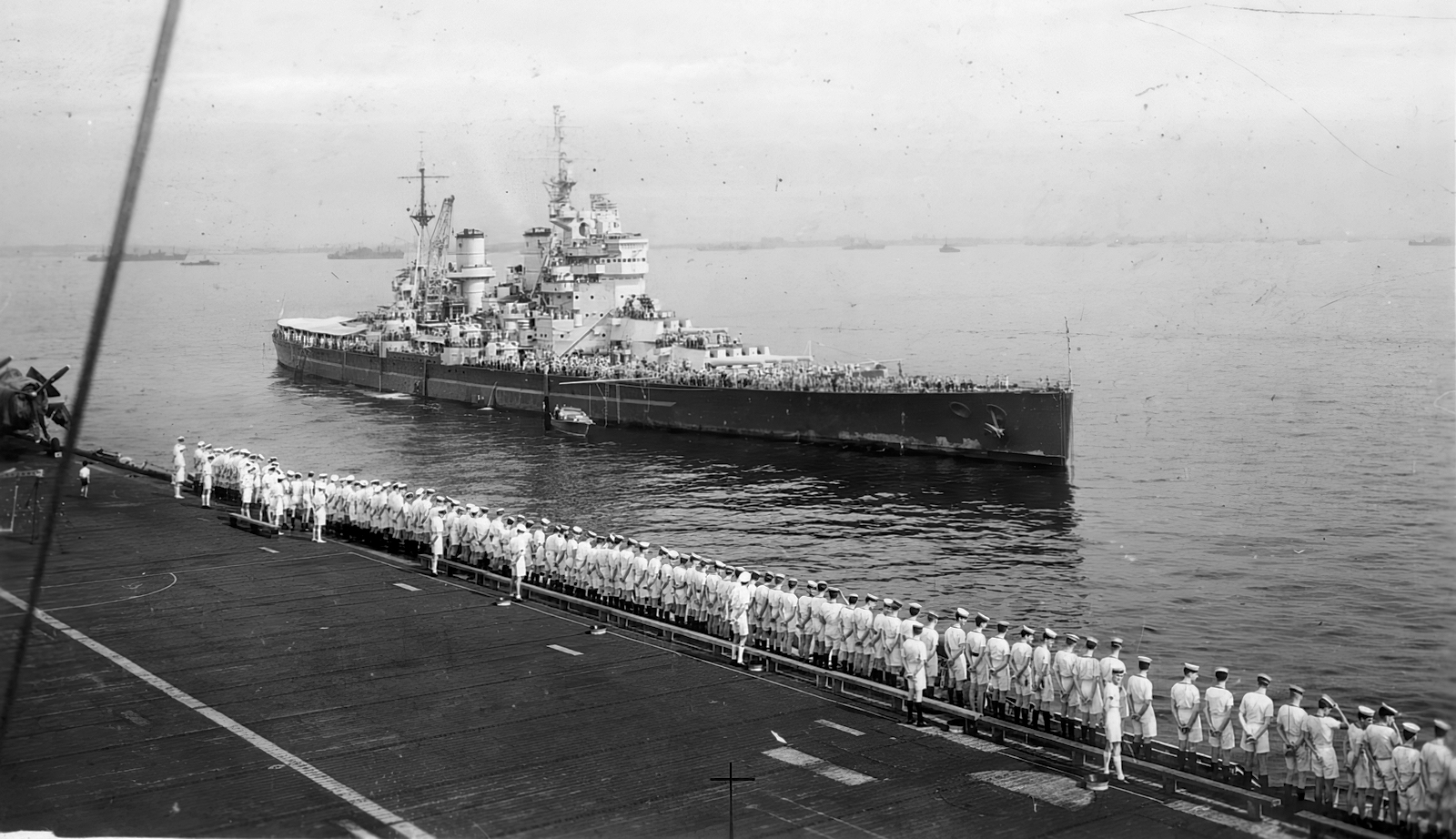
September 15th, 1945: RULER passes the Battleship KING GEORGE V as she leaves Tokyo Bay to return to Australia, carrying 445 released POWs and Internees on board. The crew dressed ship in their tropical whites while her passengers gathered on the front of the flight deck as the ship passed other allied vessels still in the Bay.
Now at capacity with 445 released POWs and Internees on board, RULER sailed from Tokyo, with the destroyer WIZARD in company, at 08:50 on September 15th, bound for Sydney. Like SPEAKER before her, she zig-zagged her way through the allied ships with the ship's company lining the sides of the flight deck and the passengers standing on the forward end. However, by this time, much of the British fleet had departed, but enough remained to mark their passage with crews lining the decks and cheering them on as they passed. The voyage to Manus was delayed slightly due to a course change to avoid the path of yet another typhoon at 20:00. She resumed her original course at 13:00 on the 16th.
RULER arrived at Manus on September 21st to take on fuel, water, and food. Also waiting there was their new commanding officer, Captain J. M. Armstrong RAN. His appointment had been arranged before the Japanese surrender. It was intended to give him experience of commanding an aircraft carrier in readiness for Australia receiving its own Light Fleet Carrier. Instead, circumstances meant he would assume command of a non-operational carrier. Storing complete RULER sailed at 22:00 for Sydney. The day after leaving Manus, the ship’s company staged a ‘sod’s opera’ titled ‘This Ain’t The Navy’, primarily for the passengers' morale. The crew wholeheartedly performed 20 acts to a packed house.
The first liberated POWs and internees to arrive in Australia had been evacuated from Hong Kong by the Hospital Ship OXFORDSHIRE. She had embarked more than 300 of the most serious hospital cases from Stanley Camp, and 60 internees, 16 of whom were women, and arrived in Sydney on September 21st, after calling first at Manila and then Brisbane, landing some patients in both ports. Those patients still on board when the ship reached Sydney were transported to RN Auxiliary Hospital Sydney at Herne Bay. RULER, however, had sailed directly from Japan. She secured a No. 14 berth, Pyrmont at 11:54 on the morning of September 27th, after being greeted by almost every house with a view of the water, waving towels and sheets from their windows, and every vessel, large and small, tooting their horns and sirens madly. Her passengers had been in high spirits and improved health until the ship had passed Brisbane on the run down the coast to Sydney; the change in air temperature, falling by 30⁰ F (15⁰ °C approx.) had an unexpected impact on some of the passengers, their health deteriorating quite badly in response to the sudden change, some needing to be disembarked on stretchers and were transported to the RN Auxiliary Hospital Sydney upon docking. The other passengers were transported to HMS GOLDEN HIND, RN Barracks, Sydney, at Warwick Farm.
At 09:00 on September 28th, Captain Armstrong RAN assumed command, and at 12:15, Captain Currey left to fly home to the UK. This appointment, however, was short-lived, and Captain Armstrong was relieved by the ship’s executive officer, Commander Sir M. Culme-Seymour RN, on October 19th.
Leave was now granted to the ship’s company, this being staggered to maintain sufficient personnel aboard to handle the ship. The first group had been granted leave almost straightaway, including those with relatives in Australia, who were given up to 14 days' leave and made quite long journeys to see them. On October 5th, the crew was temporarily accommodated ashore in the evening while the ship was fumigated and returned on the morning of the 8th. Just over a week later, on the 15th, RULER entered drydock for three days to have her hull cleaned and painted and to fit a new piece of equipment, the Loran long-range navigational aid. More men were sent on leave. The work complete, RULER was undocked on October 18th. The following day, Commander Sir M. Culme-Seymour RN assumed command for the voyage home. The ship’s company were now returning from leave to begin storing the ship in preparation for sailing.
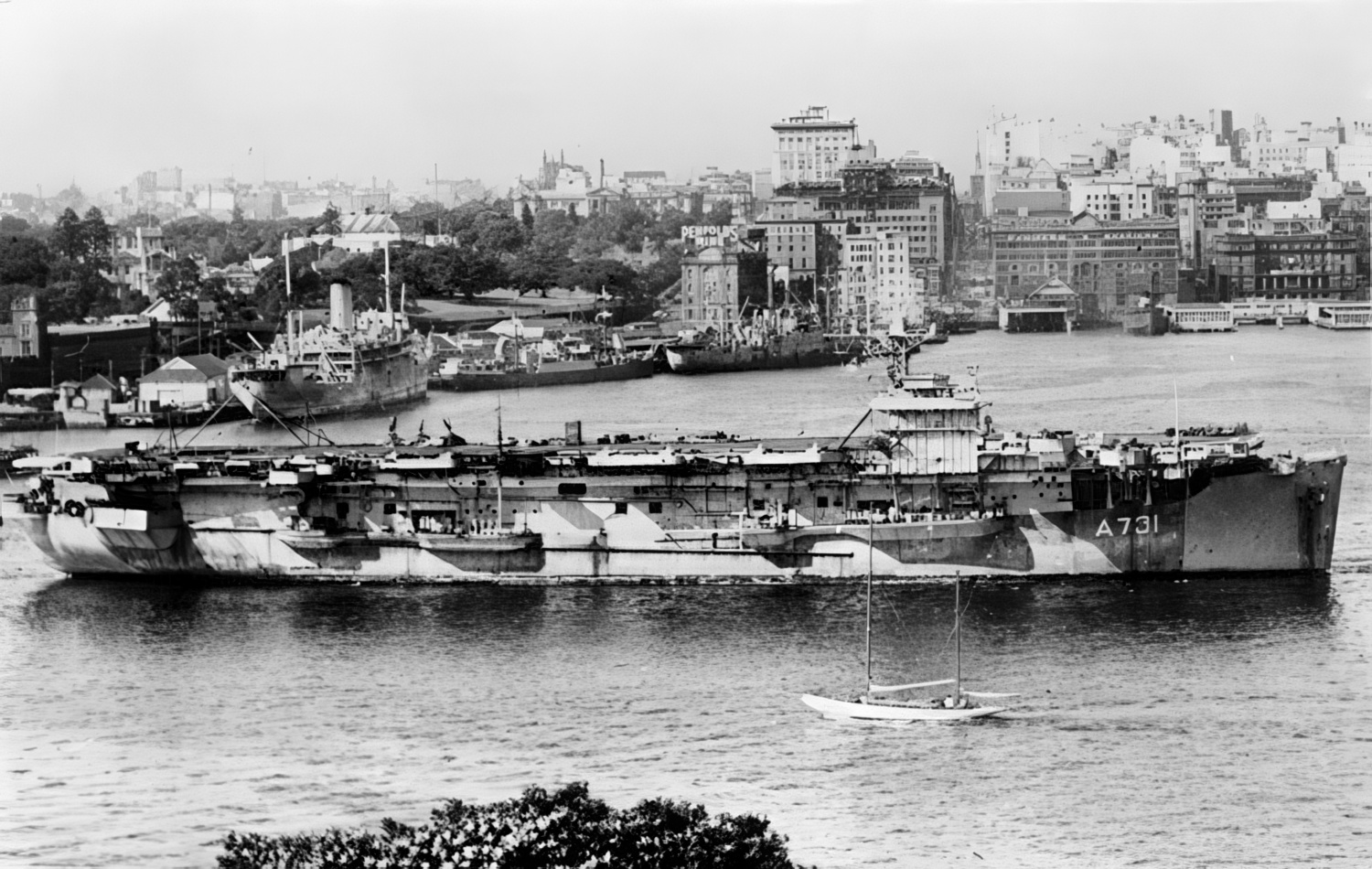
HMS RULER wearing her BPF pennent number A731 making her way out of Sydney harbour bound for the UK.
RULER e left Sydney for the last time at 18:02 on October 24th and proceeded north to Brisbane, where we secured alongside Brett's Wharf at 16:25 on the 26th. She was here to deliver her remaining aircraft to RNAMY Archerfield ( TAMY 1) and embark a ferry load for delivery to the UK. Overnight, the Seven Hellcats and eight Avengers, along with all spare engines and major components, were disembarked; the following day, stores and aircraft, mainly Seafires, were loaded as freight for the UK. She sailed for Fremantle, Western Australia, on the 27th, proceeding north, inside the Great Barrier Reef, to reach Fremantle at midday on November 4th. She secured alongside Shed F at 07:15 to take on provisions and more stores, sailing at 06:21 the next day. Instructions had been revised to exercise fuel economy on passage; a maximum of 15 knots was dictated. However, with her hull newly cleaned and painted, the ship experienced considerable vibrations at this speed, so the captain increased the speed, and the vibrations went away.
Four days out from Fremantle in the Indian Ocean, some crew members were playing deck hockey on the Flight Deck when one of our stokers, Stoker Massey, stumbled and went down the aircraft's ditching ramp into the sea. There was quite a strong wind blowing so there were plenty of white horses, and he was not easy to spot in the water; however, the plot started at once, and by the time RULER had turned round, most of the ship's company were on the flight deck looking for him, and he was soon spotted. By the time the ship coasted alongside his position, 25 minutes had elapsed, but Stoker Massey amazed everyone by climbing up a scrambling net unaided. The ship made a non-stop crossing from Fremantle to Aden, where she arrived at 10:0 on the 18th, and after taking on fuel and provisions, sailed for Suez at 15:12. RULER passed through the Suez Canal on the 22nd November, entering at 07:15 and secured in Port Said at 19:20, sailing the following day at 15:00.
RULER was to make two more brief calls on the voyage, arriving at Grand Harbour, Malta at 08:55 on November 26th to take on stores and fuel, sailing at 15:36. She arrived at Gibraltar on the 29th to collect a naval draft, anchoring outside the breakwater and staying only eight hours. RULER passed Lands’ End at 0:708 on December 2nd, and she berthed at King George V Dock, Glasgow, at 12:05 on the 3rd.
Over the next month, work progressed to destroy the ship and remove Admiralty equipment. Non-essential crew also left the ship and were drafted to their respective barracks. Anyone not needed for the passage to America left, and those remaining all received some leave. The ship shifted to a buoy at the Tail of the Bank on December 8th but moved back to the King George V Dock on the 28th for two days, returning to anchor at the Tail of the Bank on the 30th. After spending the New Year 1946 on the Clyde, RULER sailed for Southampton on January 4th, arriving on the 6th. Here she embarked a large number of US servicemen as passengers for the crossing to Norfolk. Commander Sir M. Culme-Seymour RN left the ship on January 6th, and Captain J. H. Huntley RN assumed command for her final voyage.
RULER departed from Southampton on January 8th, bound for Norfolk, Virginia. During the crossing, RULER suffered storm damage; the forward 6 feet of her flight deck was lifted, and the starboard walkway was damaged. In addition, both port and starboard navigation lights had vanished. Water also entered the hangar deck, making some very wet, seasick G.I.s. The ship was reduced to slow ahead until the weather improved and actually arrived at the entrance to the James River 6 hours ahead of schedule. She berthed in Norfolk Navy Yard on January 19th.The following nine days were spent making final preparations for leaving the ship. HMS RULER was decommissioned on January 29th 1946, and returned to US Navy custody.
CVE 50, no longer required for service by the US Navy, was taken in hand and prepared for disposal, the work being completed on February 19th. She was placed on the disposal list on March 20th 1946. The vessel was sold on May 31st 1946, and subsequently scrapped.
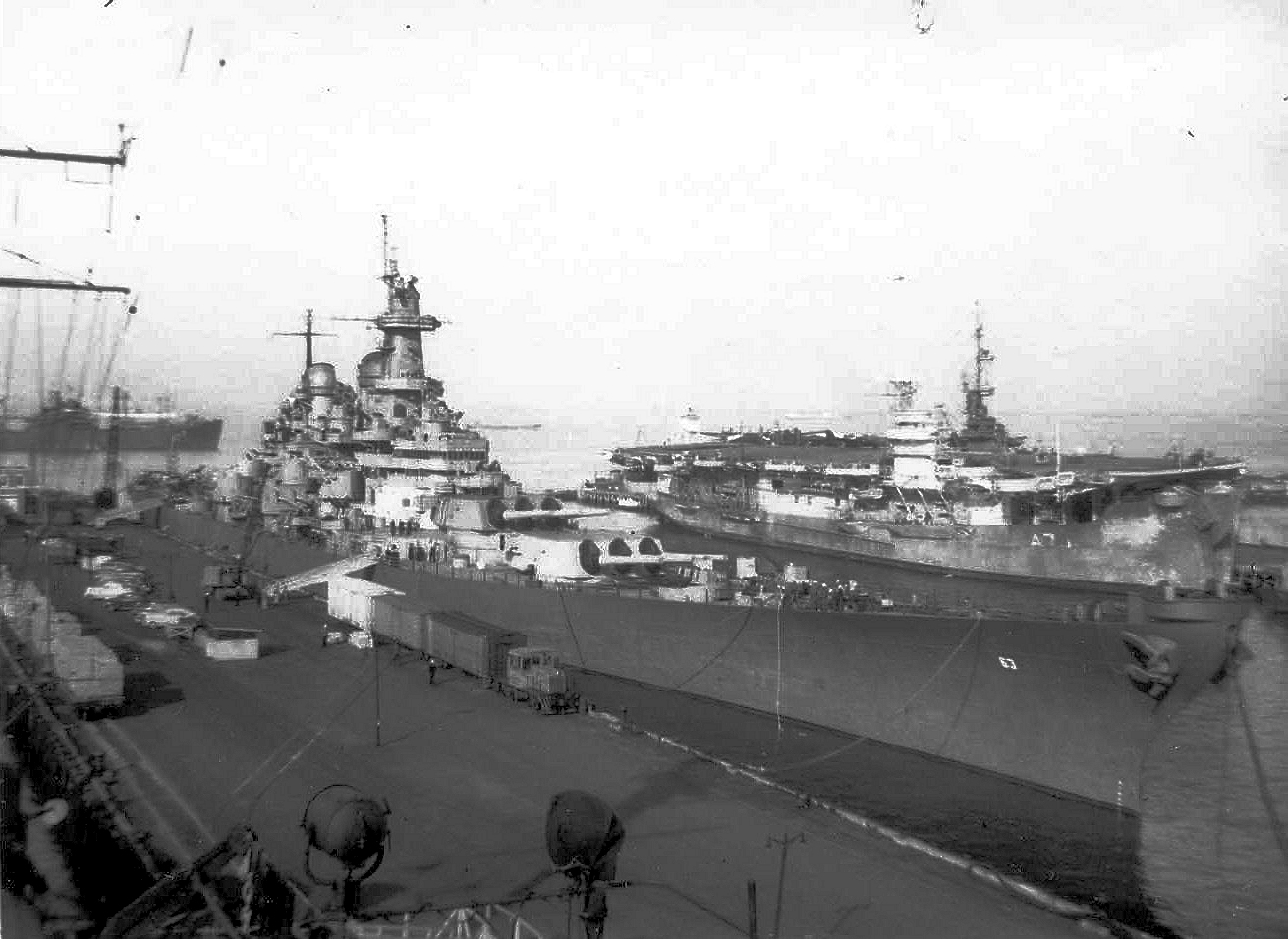
May 12th 1946, U.S. Naval Base Norfolk, Virginia: the last known image of CVE 50 (ex- RULER) at pier 10, nineteen days before she was sold. The Battleship USS Missouri BB 63 is at pier 9.
Last modified: 06 February 2025
© 1999-2026 The Royal Navy Research Archive All Rights Reserved Powered by W3,CSS
Press F5 to refresh the page after posting your comment or to hide the form
Shape: Standard, circular.
Blazon (Heraldic description) On a blue field: A dexter gauntlet, proper, grasping a baton ensigned to the dexter with a crown, and held fesswise, gold.
A RULER: One who rules or governs. In heraldry the baton is a symbol of authority and a badge of office, title or rank; the crown indicates a royal ruler. The gauntlet is a glove of mail and this signifies one who is armed and prepared to do battle.
For explanations of heraldic terms see the
Royal
Navy Ship's Badges page.
The Logistic Support Tanker Group
Tanker Group TU 112.2. 1, Tankers CEDARDALE SAN ADOLPHO, and SAN AMBROSIO escorted by the Frigate AVON and Sloop WHIIMBREL.
CloseThe Logistic Support Group comprised of two or more Task Units of Task Group 112; one Task Unit provided air cover for the LSG and remained in the replenishment area.
LSG air cover TU 112.2.5, the CVE RULER (885 Sqn - 12 Hellcats, 4 Avengers and 8 Corsairs - for Combat Air Patrol and Anti-Submarine duties covering the LSG), escorted by the Sloop CRANE.
Replenishment group TU 112.2. 1, the CVE STRIKER (Replenishment), Tankers WAVE KING and WAVE MONARCH escorted by the Sloop PHEASANT, Australian Destroyers NAPIER, - NORMAN, and NEPAL.
CloseThe Logistic Support Group comprised of two or more Task Units of Task Group 112; one Task Unit provided air cover for the LSG and remained in the replenishment area.
LSG air cover TU 112.2.5, the CVE RULER (885 Sqn - 12 Hellcats, 4 Avengers and 8 Corsairs - for Combat Air Patrol and Anti-Submarine duties covering the LSG), escorted by the Sloop CRANE.
Replenishment group TU 112.2.2, the CVE SPEAKER (replenishment), Tankers ARNDALE, AASE MAERSK, DINGLEDALE, and SAN AMADO escorted by the Sloops PHEASANT and WOODCOCK, Australian Destroyer NEPAL, and Australian minesweepers BALLARAT and WHYALLA.
Note: The rescue Tug WEASEL also arrived on station with the Tanker group.
CloseThe Logistic Support Group comprised of two or more Task Units of Task Group 112; one Task Unit provided air cover for the LSG and remained in the replenishment area.
LSG air cover TU 112.2.5, the CVE RULER (885 Sqn - 12 Hellcats, 4 Avengers and 8 Corsairs - for Combat Air Patrol and Anti-Submarine duties covering the LSG), escorted by the Sloop CRANE. The Destroyer GRENVILLE joined on the 15th.
Replenishment group TU 112.2.1, the CVE STRIKER (Replenishment), WAVE KING and WAVE MONARCH escorted by the Australian Destroyer NIZAM. And TU 112.2. 3, Tankers ARNDALE, DINGLEDALE, escorted by the Sloops PHEASANT and WOODCOCK.
CloseThe Logistic Support Group comprised of two or more Task Units of Task Group 112; one Task Unit provided air cover for the LSG and remained in the replenishment area.
LSG air cover TU 112.2.5, the CVE RULER (885 Sqn - 12 Hellcats, 4 Avengers and 8 Corsairs - for Combat Air Patrol and Anti-Submarine duties covering the LSG), escorted by the Sloop CRANE and Destroyer GRENVILLE.
Replenishment group TU 112.2.1, the CVE CHASER (Replenishment), Tankers SAN AMBROSIO, SAN ADOLPHO, and CEDARDALE escorted by the Sloop WHIMBREL, Frigate PARRETT, Destroyer NORMAN and Australian minesweeper BENDIGO.
Joining on the 19th - ROBERT MAERSK (Armament SIS) escorted by Australian minesweeper CAIRNS
CloseThe Logistic Support Group comprised of two or more Task Units of Task Group 112; one Task Unit provided air cover for the LSG and remained in the replenishment area.
LSG air cover TU 112.2.5, the CVE RULER (885 Sqn - 12 Hellcats, 4 Avengers and 8 Corsairs - for Combat Air Patrol and Anti-Submarine duties covering the LSG), escorted by the Sloop CRANE and Destroyer GRENVILLE.
Replenishment group TU 112.2. 3, the CVE SPEAKER (replenishment), Tankers WAVE KING and WAVE MONARCH with TU 112.2.1, the CVE CHASER (replenishment) and Tankers AASE MAERSK, and SAN AMADO, Armament Store ship ROBERT MAERSK with combined escorts Frigate AVON and FINDHORN, Destroyer NAPIER.
The Cruiser BLACK PRINCE, and Destroyer NORMAN were still in the service area escorting the damaged Destroyer QUILLAM while under tow from the Tug WEASEL.
CloseThe Logistic Support Group comprised of two or more Task Units of Task Group 112; one Task Unit provided air cover for the LSG and remained in the replenishment area.
LSG air cover TU 112.2.5, the CVE RULER (885 Sqn - 12 Hellcats, 4 Avengers and 8 Corsairs - for Combat Air Patrol and Anti-Submarine duties covering the LSG), escorted by the Sloop CRANE.
Replenishment group TU 112.2. 3, Tankers WAVE KING and WAVE MONARCH with TU 112.2.1, Tankers AASE MAERSK, and SAN AMADO, with combined escorts Frigate AVON and FINDHORN.
CloseTanker Group only.
TU 112.2.1, Tankers DINGLEDALE, SAN AMADO, and WAVE EMPEROR escorted by Frigates USK and BARLE.
CloseThe Logistic Support Group comprised of two or more Task Units of Task Group 112; one Task Unit provided air cover for the LSG and remained in the replenishment area.
LSG air cover TU 112.2.5, Sloops PHEASANT (Commander LSG), REDPOLE, WHIMBREL escorting TU 112.2.12 the CVE RULER (885 Sqn - 12 Hellcats, 4 Avengers and 8 Corsairs - for Combat Air Patrol and Anti-Submarine duties covering the LSG), escorted by NEPAL (RAN). .
Replenishment group TU 112.2. 6, Tankers SAN AMBROSIA, SAN ADOLPHO, WAVE MONARCH, VSIS GLENARTNEY, escorted by Frigate FINDHORN and Minesweeper GAWLER (RAN) with the CVEs ARBITER (Replenishment) escorted by NIZAM (RAN), and STRIKER (Replenishment) escorted by NAPIER (RAN).
CloseThe Logistic Support Group comprised of two or more Task Units of Task Group 112; one Task Unit provided air cover for the LSG and remained in the replenishment area.
LSG air cover TU 112.2.5, Sloops PHEASANT (Commander LSG), REDPOLE, WHIMBREL escorting TU 112.2.12 the CVE RULER (885 Sqn - 12 Hellcats, 4 Avengers and 8 Corsairs - for Combat Air Patrol and Anti-Submarine duties covering the LSG), escorted by NEPAL (RAN).
Replenishment group TU 112.2.1 STRIKER (Replenishment) escorted by NAPIER (RAN), Tankers CEDARDALE and WAVE EMPEROR and TU 112.2. 3, the CVE SPEAKER (replenishment), escorted NORMAN (RAN), Tankers CARELIA, EASEDALE, and OLNA, VSIS GLENARTNEY, Armament Store Issuing Ships ROBERT MAERSK and CORINDA, escorted by light cruiser ARGONAUT, sloops CRANE, frigates ODZANI and DERG and minesweepers LAUNCESTON, PIRIE, WHYALLA (RAN).
CloseThe Logistic Support Group comprised of two or more Task Units of Task Group 112; one Task Unit provided air cover for the LSG and remained in the replenishment area.
LSG air cover TU 112.2.5, Sloops PHEASANT (Commander LSG), REDPOLE, WHIMBREL escorting TU 112.2.12 the CVE RULER (885 Sqn - 12 Hellcats, 4 Avengers and 8 Corsairs - for Combat Air Patrol and Anti-Submarine duties covering the LSG), escorted by NEPAL (RAN).
Replenishment group TU 112.2. 3, the CVE SPEAKER (replenishment), escorted NORMAN (RAN), Tankers CARELIA, and OLNA, Victualling Store Issue Ship GLENARTNEY, minesweepers LAUNCESTON and WHYALLA (RAN). TU 112.2.1 CHASER (replenishment), escorted by QUEENSBOROUGH, Tankers WAVE GOVERNOR and WAVE KING. TU 112.2.6 Radio and Radar Repair Ship ARBUTUS, Armament Store Issuing Ships ROBERT MAERSK and CORINDA, escorted by sloops CRANE, frigates ODZANI and DERG and minesweeper PIRIE (RAN).
CloseThe Logistic Support Group comprised of two or more Task Units of Task Group 112; one Task Unit provided air cover for the LSG and remained in the replenishment area.
LSG air cover TU 112.2.5, Sloops PHEASANT (Commander LSG), REDPOLE, WHIMBREL escorting TU 112.2.12 the CVE RULER (885 Sqn - 12 Hellcats, 4 Avengers and 8 Corsairs - for Combat Air Patrol and Anti-Submarine duties covering the LSG), escorted by NEPAL (RAN).
Replenishment group TU 112.2. 6, the CVE ARBITER (replenishment), escorted NIZAM (RAN), Tankers DINGLEDALE and SAN AMADO, minesweepers BARRARAT and BURNIE (RAN). TU 112.2.1 CHASER (replenishment), escorted by QUEENSBOROUGH, Tankers OLNA and WAVE KING. TU 112.2.6 Radio and Radar Repair Ship ARBUTUS, Armament Store Issuing Ships ROBERT MAERSK and CORINDA, Victualling Store Issue Ships FORT WRANGELL and GLENARTNEY escorted by sloop CRANE, frigates BARLE and DERG.
CloseThe Logistic Support Group comprised of two or more Task Units of Task Group 112; one Task Unit provided air cover for the LSG and remained in the replenishment area.
LSG air cover TU 112.2.5, Sloops PHEASANT (Commander LSG), REDPOLE, WHIMBREL escorting TU 112.2.12 the CVE RULER (885 Sqn - 12 Hellcats, 4 Avengers and 8 Corsairs - for Combat Air Patrol and Anti-Submarine duties covering the LSG), escorted by NEPAL (RAN).
Replenishment group - Tankers OLNA, SAN ADOLPHO, SAN AMADO, SAN AMBROSIO, and WAVE EMPEROR, Victualling Store Issue Ships FORT WRANGELL, HMHS TJITJALENGKA, escorted by sloops CRANE, FINDHORN, frigates BARLE and USK, minesweepers BALLARAT, BURNIE, GERALDTON, (RAN).
CloseThe Brutish Pacific Fleet Task Force 113 comprised:
1st Aircraft Carrier Squadron INDOMITABLE (Flag 1st Aircraft Carrier Squadron (1ACS), 857 Avenger, 839 and 1844 Hellcat), ILLUSTRIOUS (854 Avenger, 1830 & 1833 Corsair), INDEFATIGABLE (820 Avenger, 1770 Firefly, 887 & 894 Seafire), VICTORIOUS (849 Avenger, 1834 and 1836 Corsair,);
1st Battle Squadron
HMS KING GEORGE V (Flagship V.A.B.P.F. Vice Admiral Sir H. Bernard Rawlings, KCB, OBE), and HMS HOWE;
4th Cruiser Squadron
SWIFTSURE, (Flagship CS 4 Rear Admiral E. J. P. Brind, CB, CBE), ARGONAUT, BLACK PRINCE, EURYALUS, (Flag of Rear Admiral (D) Rear Admiral J. H. Edelsten, CB, CBE), GAMBIA;
4th Destroyer Flotilla
QUICKMATCH (Capt. D:4), QUIBERON, QUEENBOROUGH, QUALITY;
25th Destroyer Flotilla
GRENVILLE (Captain D 25) ULSTER, UNDINE, URSA, URANIA;
27th Destroyer Flotilla
KEMPENFELT (Captain D 27), WAKEFUL, WHIRLWIND, WHELP, and WESSEX.
(Note: KEMPENFELT (Capt. D.27) was attached to TU 112.2.5, the group remaining in the replenishing area. WHIRLWIND and. WESSEX were attached to TU 112.2.1 and TU 112.2.2 respectively, the Tanker Groups proceeding between Leyte and the replenishing area.
Note:
Why STRIKER sailed for BRITISH TIZZY on August 4th is a mystery, TF 37 planned for the last strike day being August 10th after which they were to return to Australia for a further major replenishment. The CVEs required for the remaining two replenishment periods were already on station or in transit: SPEAKER and CHASER provided replacement airframes on July 31 – August 2, while ARBITER and CHASER covered replenishment on August 6 – 7th, withdrawing for Australia on completion so STRIKER was not needed.
CloseThe Brutish Pacific Fleet Task Force 37 comprised:
CTF 37; Battleships KING GEORGE V (Flagship V.A.B.P.F. Vice Admiral Sir H.
Bernard Rawlings, KCB, OBE);
CTU 37.1.1; Aircraft carriers FORMIDABLE (Flag 1st Aircraft Carrier Squadron, Vice-Admiral P.L. Vian, KCB, KBE, DSO and 2 Bars, RN) 2ND Carrier Air Group -848 Avenger, 1841 and 18342 Corsair), VICTORIOUS (1st Carrier Air Group - 849 Avenger, 1834 and 1836 Corsair,) IMPLACABLE (8th Carrier Air Group - 848 Avenger, 1771 Firefly, 801 & 880 Seafire), joined on July 20th by INDEFATIGABLE (7th Carrier Air Group - 820 Avenger, 1772 Firefly, 887 & 894 Seafire);
CTU 37.1.4; light cruisers HMS NEWFOUNDLAND (flag of Rear-Admiral E.J.P. Brind, CBE, CB, RN), HMCS UGANDA, HMNZS GAMBIA, HMNZS ACHILLES, HMS EURYALUS and HMS BLACK PRINCE.;
CTU 37.1.5; Destroyers HMS BARFLEUR (flying the flag of Rear-Admiral J.H. Edelsten, CB, CBE, RN), HMS GRENVILLE (Capt. D 25), HMS ULYSSES, HMS UNDAUNTED, HMS URCHIN, HMS QUADRANT, HMS QUALITY, HMAS QUIBERON and HMAS QUICKMATCH. HMS TROUBRIDGE (Capt. D 24), HMS TEAZER, HMS TENACIOUS, HMS TERMAGANT AND HMS TERPSICHORE.

Comments (8)
Don't know if its of any interest but my late Uncle Leonard Jackson was a radio operator aboard HMS Ruler.
Leslie R Freakley
My father served on HMS Ruler from late 1943 to end of 1945 when it sailed back to th uk from Australia. He was on board while anchored in Tokyo bay for the Japanese surrender. I don’t know much of anything else as he really didn’t talk about it, just greatful he survived.