
D64 (Atlantic)
R308 (Pacific)
ATLANTIC 1943
- 44
NORWAY 1944
NORTH SEA 1944
ARCTIC 1944
Builder: Western Pipe & Steel,
San Francisco, California.
Completed by: Mare Island Naval Shipyard, Vallejo California.
Displacement: 14,170 tons
Length (Overall): 486ft
Beam: 69ft 6in
Draught: 16 ft
Flight deck: 442ft x 80ft wood covered mild steel plate
Propulsion: 2 Foster Wheeler boilers; 1 x Allis-Chalmers geared turbine driving 1 shaft
Speed: 18.5 knots
A/C Capacity: 20
Hangar: 262ft x 62ft x 18ft
A/C lifts: 2; aft 34ft long x 42ft wide; forward 42ft long x 34ft wide
Arrestor wires: 9 with 3 barriers
Catapult: 1 H4C hydraulic
Armament: 2 single 4in USN Mk 9, 4 twin 40mm Bofors, 8 twin 20mm Oerlikon, 10 single 20mm Oerlikon
Crew Complement: 646
Capt. E. W. Anstice RN Aug 42 - Dec 43
Capt. W. W. R. Bentinck RN Jan - Jun 44
Lt. Cdr. J. A. Eardley Wilmot DSC RN Jun 44 - Jul 45
Cdr. A. M. Harris Jul - Nov 45
Capt. K. Mackintosh RN Nov 45 - Apr 46
None
None

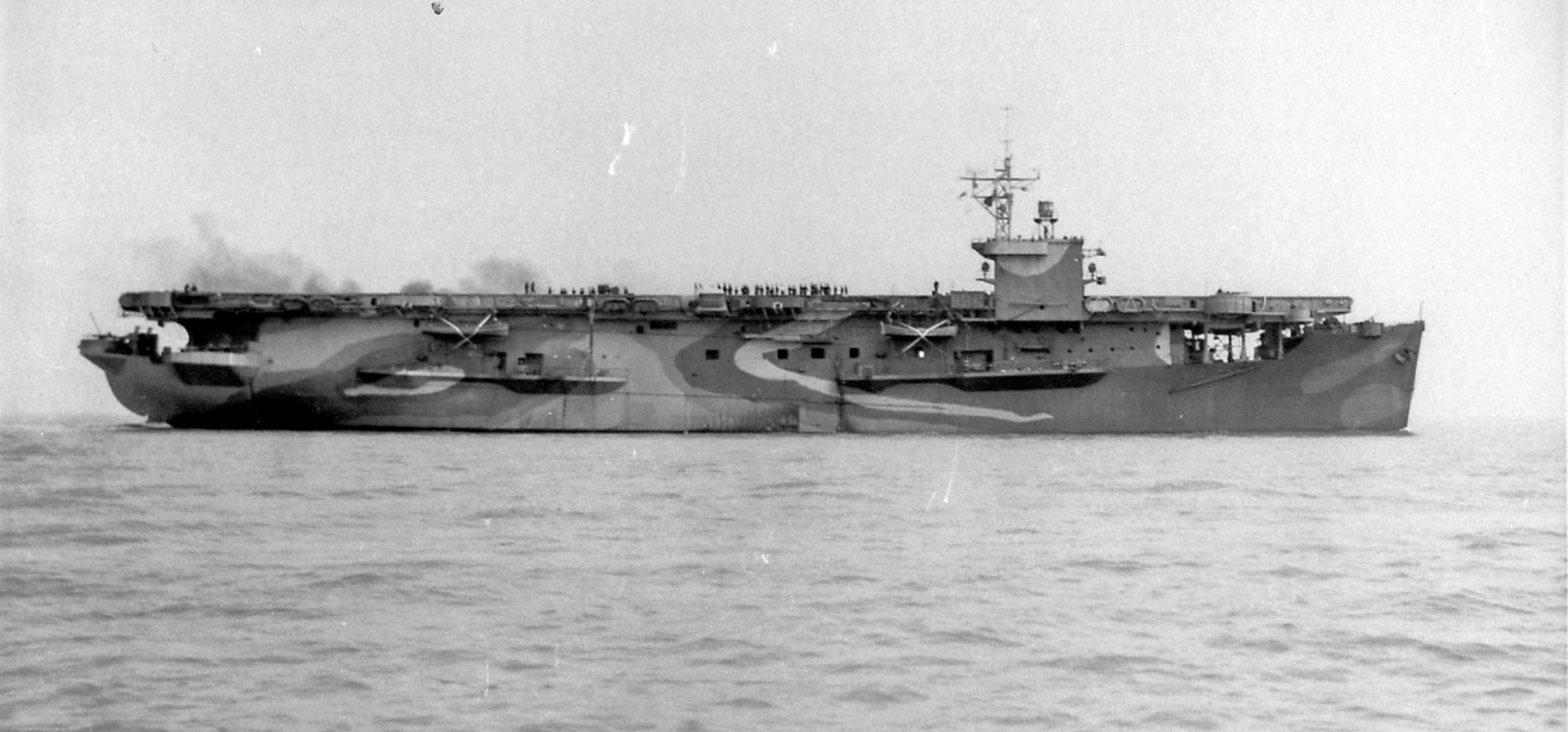
HMS FENCER ACV 14 taken on March 26th 1943 during her builder's sea trials off San Francisco
Her keel was laid down on September 5th 1941, by the Western Pipe and Steel Co., San Francisco, California, as a Maritime Commission C3-S-A2 type freighter, hull number 197, Western Pipe and Steel hull number 77. While under construction, the hull was purchased by the US Navy to be the USS CROATAN, AVG-14. She was launched on April 4th 1942, and the hull was towed to the Mare Island Naval Shipyard, Vallejo, California, to be completed and fitted out as an Auxiliary Aircraft Carrier. Whilst still under construction, it was decided that ACV-14 was to be transferred to the Admiralty, on loan under the Lend-Lease scheme, upon completion. She was the third of four vessels built for completion as an auxiliary aircraft carrier by Western Pipe and Steel for transfer to the Royal Navy; the other three were ATTACKER (ex USS BARNES), STALKER (ex USS HAMLIN), and STRIKER (ex USS PRINCE WILLIAM). Her build was completed on February 20th 1943, having taken a total of 534 days, 212 days on the ways and 323 days afloat.
On completion of defect rectification and final fitting out, ACV-14 was officially delivered to the US Navy at Mare Island on February 20th 1943 and commissioned into USN service as the USS CROATAN. She was decommissioned and transferred to Admiralty custody on February 27th 1943 alongside at Pier 26 in San Francisco, under the San Francisco–Oakland Bay Bridge.
A Royal Navy commissioning crew had begun to arrive in San Francisco from New York during May 1942, and was under the command of Cdr C. N. Lentaigne RN. While waiting for the ship to be completed, they attended courses to prepare them to operate the American equipment on board; for example, specialist training in the use of ASDIC equipment was given at the U.S. Navy Patrol Force Anti-Submarine Training Unit. ACV-14 commissioned into RN service on March 1st 1943 as HMS FENCER (D64), Captain E. W. Anstice RN in command. Her US Navy designation now became BACV-14, the ‘B’ signifying British.
She sailed from San Francisco on March 30th to begin her Admiralty Sea trials and calibration runs, followed by Gunnery exercises and RDF trials off the California coast. These were completed on April 1st, and she returned to her berth for defect rectification and to complete storing ship in preparation for departure.
FENCER sailed from San Francisco on April 5th bound for Balboa on passage to Norfolk, Virginia; she arrived at Balboa on the 15th. After passage through the Panama Canal, she sailed from Cristobal on April 18th, securing alongside at Norfolk Navy Yard at 14:45 on the 24th. Here she was taken in hand by the dockyard for the installation of radio direction finder equipment, work to straighten the ammunition hoist cage and install additional stiffening, boom and deck drains. Made repairs to leaking port boilers, pitometer log and siren. This work was completed by the 27th, and she left her mooring at 16:00 to come alongside at the Naval Operating Base. Here she embarked a ferry load of American airframes and stores for delivery to the UK. She sailed for New York on May 1st.
On arrival at New York on May 4th, she was moored alongside at Pier #86. North River for voyage repairs, which were carried out by Todd Erie Basin Drydocks, Inc.; the work was completed the following day. FENCER was now prepared to join the UK-bound convoy HX.238, which departed from New York on May 7th for Liverpool. After an uneventful Atlantic crossing, FENCER and the convoy arrived at Liverpool on the 22nd.
After unloading her ferry load, FENCER was taken in hand by a commercial shipyard on the Mersey for a two-month period of modification to bring her to RN standards before entering full service. This work included lengthening the flight-deck to allow Swordfish aircraft to take off with a full weapons and fuel load, installing British Type 79B aircraft warning and Type 272 surface search radars, replacing the US 5in gun mountings with British models, and modification of her petrol distribution system. On completion of her post-modification shake-down, she sailed for the Clyde on July 31st to begin work-up for operational service.
On August 5th she embarked the 9 Swordfish and 6 Seafires of 842 Squadron from
RNAS Belfast to begin her flying work-up in the Clyde training areas. There are two recorded deck crashes during this period; on August 12th Sub-Lt J. A. Metcalf, RNVR flying in Swordfish HS329 ('F') buckled the fuselage on landing, and on the 19th Sub-Lt I. D. Kelsell, RNVR in Seafire MB373 touched the barrier on landing, this resulting in the fuselage skin being wrinkled.
In late September FENCER was allocated for service with the 8th Escort Group (destroyers INCONSTANT, VISCOUNT, WHITEHALL, WRESTLER, and Free Polish GARLAND and BURZA) for trade protection duties in the Atlantic. Her first outing was to be as part of the covering force for Operation ALACRITY, the ferrying of RAF assists to the Azores. On September 25th she embarked additional aircraft, 6 Walrus and 4 Swordfish that formed 700 ‘W’ flight to increase her anti-submarine (A/S) capabilities and sailed with the 8th Escort Group. They joined Escort Group B5 (destroyers HAVELOCK, VOLUNTEER and WARWICK, corvettes BUTTERCUP, LAVENDER and GODETIA, and sloop LOWESTOFT) to escort a special convoy from the UK to the port of Angra do Heroism, Terceira Island, in the Azores carrying the men and equipment of Coastal Command No. 247 Group Royal Air Force which were to setup flying operations on the Azores Islands of Fayal and Terceira.
The ALACRITY convoy arrived at Angra do Heroism on October 8th, FENCER had already disembarked some of her aircraft to Lagens airfield on Terceira on the 6th, the first RAF aircraft, Flying Fortresses, were expected soon but bad weather delayed their departure from Gibraltar so RN Swordfish commenced anti-submarine patrols. The First Fortresses arrived on the 18th, but 842 sqn remained ashore until October 24th.
There were two Seafire accidents during this period; on the 8th, Sub-Lt A. Sachnovsky, RNVR, made a fast approach to land on FENCER in NX911, resulting in the aircraft being damaged. The first Seafire to land at Lagens was PAl20 Sqn ('P') flown by Sub-Lt Kelsall on the 10th; he managed to hit a haystack, but the aircraft suffered no damage. Two Swordfish were lost during Operation ALACRITY. On October 7th, HS623 ('H') ran out of fuel and ditched; the crew, Sub-Lt T. D. Merrick, RNVR, Sub-Lt J. B. Simpson, RNVR and Petty Officer Airman R. Morgan, were all killed. On the 11th, HS661 ('D') ditched after failing to achieve sufficient flying speed on take-off, armed with 8 Rocket projectiles (RP), and stalled into the sea; the crew, Lt. L. R. Chadwick, RNVR, Sub-Lt D. W. Glassborrow, RNVR and Naval Airman M. A. Thackeray, were safely rescued.
On release from Operation ALACRITY, FENCER and 8th Escort Group sailed to rendezvous with the east-bound convoy SC.145 from Halifax; air cover was provided from October 29th until November 2nd. On the 1st, Swordfish LS191 ('A'), flown by Sub-Lt H. G. Boniface, RNZNVR, was damaged on returning from patrol; the aircraft stalled over a pitching deck and struck the island.
She then proceeded to the Clyde, arriving on the 5th. On November 6th, the four Wildcats of 1832A flight from RNAS Maydown, Northern Ireland, embarked to supplement her fighter complement. One of these new additions was lost on November 20th while attempting to land on FENCER off Ailsa Craig, JV385, flown by Sub-Lt J. M. Kay, RNVR, stalled and hit the rounddown before falling into the sea and sank; he was not recovered. 700 ‘W’ disembarked to RNAS Machrihanish on November 19th.
Her next convoy cover was the combined OS.60/ KMS.34 which departed Liverpool on November 25th bound for Gibraltar. FENCER began A/S sweeps from the 26th, remaining with it until December 5th, when she switched to cover the UK-bound combined convoy SL.141/MKS.32 from the 6th to the 11th. She then switched to cover the south-bound combined convoy OS.61/KMS.35, which departed Liverpool on December 8th. She covered this convoy from the 11th to the 16th.
On December 1st her new Wildcat fighters had their first successful interception; JV344 ('FY') flown by Lt L. C. Wort, RNVR and JV427 ('FW') flown by Lt R. A. Fleischmann-Allen, RNVR shot down a Fw200 German reconnaissance plane after setting its starboard engine on fire, it was seen to break up in flames, and two survivors were observed in the sea at position 48°30' N 18°30' W.
On December 19th, while on passage to the Clyde, Seafire PA100 ('D') flown by Sub-Lt Sachnovsky RNVR, drove off a Fw200 at 08:45 in position 45°08' N 18°53' W; although fired upon, no damage was seen.
On arrival on the Clyde, she entered a dockyard for repairs on the 24th. The work was to take five weeks; after completion of post refit trials, she was deployed with 16th Escort Group and resumed Atlantic convoy defence duties. There were two Seafire accidents on February 5th; both aircraft were flown by Sub-Lt E. R. Bennett, RNVR; he entered the barrier in PAl20 and crashed on landing and ditched overboard in NX985, and was rescued by the plane guard Destroyer.
FENCER was to cover the passage of 5 convoys during February 1944; the first was ON.223 bound for New York, she briefly covered its passage on the 10th & 11th. On joining the convoy, one of the carriers, Swordfish, attacked and sank U-666; Swordfish LS368 ('A') made an attack using aerial depth charges in position 53°56' N 17°16' W; the pilot, Sub-Lt W. H. Thomson, RNVR, was awarded the DSC for this action.
FENCER next switched to cover the inbound HX.278, joining them on the 15th, remaining with them until the 19th. She next joined Convoy KMF.29, which had departed from the Clyde bound for Alexandria on February 21st, covering this from late on the 21st until the 26th, when she switched to the combined north-bound Convoy SL.149/MKS.40, escorting this until the 1st, when she detached and proceeded to the Clyde.
FENCER remained on the Clyde until she sailed for Scapa Flow on March 17th 1944, arriving there the following day. 842 squadron now carried 12 Swordfish and 8 Wildcats; the remaining 3 Seafires departed and ‘E’ flight of 1832 squadron joined as FENCER sailed from the Clyde. She was now allocated to participate in Operation TUNGSTEN, specifically to provide an A/S element to the force.
Operation TUNGSTEN forces left Scapa on March 30th in two groups; Force 1 comprised DUKE OF YORK, ANSON, VICTORIOUS (1834 & 1836 Sqns – 28 Corsair II, 827 Sqn – 9 Barracuda, 829 Sqn – 12 Barracuda II), BELFAST, and 5 destroyers left Scapa early morning and after conducting brief exercises proceeded to a position off Bear Island to cover the passage of the outbound Russian convoy JW58. Force 2 comprised ROYALIST (Rear Admiral Escort Carriers), FURIOUS (801 Sqn – 6 Seafire IIb, 880 Sqn – 8 Seafire L.II.c, 830 & 831 Sqns – 18 Barracuda II), SHEFFIELD, JAMAICA, EMPEROR (800 & 804 Sqns – 20 Hellcat), SEARCHER (882 & 898 Sqns – 20 Wildcat V), PURSUER (881 & 896 Sqns20 Wildcat V), FENCER (842 Sqn – 12 Swordfish II & 8 Wildcat V), 2 oilers, and 5 destroyers left Scapa p.m. and preceded west of the Orkneys.
On April 1st, the date for the operation, which had been April 4th, was advanced 24 hours to take advantage of favourable weather and lack of air reconnaissance of Force 1. Force 1's first screen from Skaalefiord joined Force 2 the following day, and on April 1st the two oilers with two destroyers were detached to the oiling position. On April 2nd, ANSON, VICTORIOUS, BELFAST, and 4 destroyers were detached from Force 1 and joined Force 2. The TUNGSTEN force then steered for the flying-off position. Flying conditions were perfect when the flying-off position was reached at 04:00 on the 3rd, and the aircraft were flown off according to plan except for the loss of one Barracuda, which ditched. 40 Barracudas and 81 fighters took part in the two strikes, and a further 25 fighters and 9 Swordfish were kept for the defence of the Fleet.
The good weather allowed for the two strike forces to obtain their desired heights and to take the best route over the mountains. No enemy aircraft were seen by the strike aircraft or the Fleet, and the flak around the TIRPITZ was much less than anticipated. The attack was carried out by both fighters and bombers; fighters strafing the defences from a low height and bombers pressing home an accurate attack. The losses during the attack were remarkably small. One Barracuda was shot down over the target and another by shore batteries, both after dropping their bombs. A third Barracuda was lost taking off from VICTORIOUS, and a Hellcat ditched when unable to land on EMPEROR. Both strikes returned and landed safely with the exception of the one Hellcat. The question of repeating the attack the next day was considered but owing to fatigue of the air crews and serious damage reported to TIRPITZ this was abandoned, and the force withdrew westward. FENCER’s Swordfish patrols failed to find any U-Boats, and she arrived back at Scapa on the 6th, 842 being put ashore to RNAS Grimsetter.
On the 11th, FENCER embarked the 20 Wildcat fighters of 882 and 898 squadrons in preparation for Operation PITCHBOWL; their parent carrier SEARCHER had been sent to Rosyth to undergo repairs after operation TUNGSTEN and the loss of her 20 fighters would have been a big shortfall for the next operation which did not require an A/S carrier.
Operation PITCHBOWL called for the provision of fighter protection to RAF Beaufighters operating in two strikes against shipping in the Norwegian Leads provided by three CVES of the Home Fleet. The force, comprising of ROYALIST (Rear Admiral Escort Carriers) CVEs EMPEROR (800 & 804 Sqns – 20 Hellcat), PURSUER (881 & 896 Sqns20 Wildcat V), FENCER (882 & 898 Sqns – 20 Wildcat V), Cruisers BERWICK, and SHEFFIELD, escorted by Destroyers MUSKETEER, METEOR, MARNE, MATCHLESS, ONSLAUGHT, PIORUN, and SIOUX, sailed on the 13th, for the flying off position 62°00’ N, 2°30’ E.
Visibility was poor throughout the day, and no flying took place. On the following day, the first RAF strike was postponed owing to weather and the force reversed its course. There was no improvement in the weather by the afternoon of the 14th, and the first RAF strike was cancelled. The following morning was the same, and the operation was abandoned. The force returned to Scapa, arriving p.m. on the 15th. SEARCHER arrived back at Scapa in the afternoon and her squadrons flew back on board. FENCER was next allocated to participate in Operation FZ.
Operation F Z was the codename given to escorting a convoy from northern Russia to the UK. 842 sqn re-joined FENCER on April 18th, flying out from RNAS Hatston , Wildcat JV527 ('S') flown by Sub-Lt R. P. Gibson. RNVR missed all the wires and entered the barrier joining the ship. The Force comprised of the Cruiser DIADEM (Rear Admiral Commanding, First Cruiser Squadron), Escort Carriers ACTIVITY (833 Sqn - 3 Swordfish & 7 Wildcats) and FENCER (12 Swordfish & 8 Wildcats), transport NEA HELLAS, Destroyers MILNE, MUSKETEER, MATCHLESS, METEOR, ULYSSES, VERULAM, VIRAGO, INCONSTANT, WHITEHALL, WALKER, KEPPEL, WRESTLER, WESTCOTT, GROU, OUTREMONT, WASKESIU, and CAPE BRETON left Scapa on the 19th for Kola Inlet.
The warships all arrived at Kola Inlet on the 24th after an uneventful passage, ACTIVITY lost two Swordfish, the first lost its hook while attempting to land on after a patrol and went over the side on the 22nd, the other ditched in the sea when it discovered that its hook was defective on the 24th, the Canadian Destroyer WKSKESIA rescued the crews of both aircraft.
The ships of the escort Force were to bring Russian and US naval personnel from Murmansk to the UK. 346 officers and men of the USS MILWAUKEE delivered to Murmansk under lend-lease s in convoy JW.59 and 4 Senior Russian Officers were embarked in the escorts of the convoy, 2,348 Soviet officers and men who were to man ships being transferred from Britain to Russia under the lend-lease scheme at UK ports were embarked in the 45 Merchant ships comprising the convoy. The merchant transport NEA HELLAS was intended as the accommodation for the Russian contingent but had to return to the UK soon after departure due to mechanical problems.


RA.59 sailed from Kola Inlet on the 28th; the return passage was more eventful, on April 30th Swordfish HS619 ('F') from 842 Sqn made a rocket RP attack on an unidentified U-boat which escaped, and a pair of Wildcats from ACTIVITY ’s 833 squadron, FN122 flown by Lt. J. G. Large, RNVR and FN135 flown by Sub-Lt R. K. L. Yeo, RNVR shot down a Ju88 in flames in position 67°0' N 3°9' W. At 19:56 U-307 fired a spread of three torpedoes at the convoy about 50 miles south of Bear Island. The SS WILLIAM S. THAYER in station #33 was hit by two torpedoes on the starboard side, the explosions causing her to split into three sections before sinking.
On May 1st, the same two 833 Sqn pilots, now in Wildcats FN135 and JV332, shot down a Bv138 German reconnaissance plane in flames in position 72°20' N 9°13' E. On the same day, Swordfish LS369 ('C') of 842 Sqn Sank U-277 by recharges at position 73°24’ N 15°'32' E; the crew, pilot Sub-Lt L. G. Cooper, RNVR, and Observer Lt R. V. Barnes, RNVR, were later awarded DSC, and Petty Officer Airman K. Sutherland was awarded the DSM. Swordfish LS280 (833 Sqn) also made a rocket RP attack on an unidentified U-boat which escaped.
Swordfish LS369 ('C') was in action again on May 2nd; this time, U-959 was sunk by Rocket Projectiles south-east of Jan Mayen Island, in position 69°20’ N, 00°20’ W, crewed by Pilot Sub-Lt B. F. Vibert, RNVR, who was later awarded the DSC, Observer Lt E. L. Hutchinson, RNVR and Petty Officer Airman M. A. Thackeray.
On May 3rd FENCER, WALKER, WHITEHALL, and BOADICEA detached from the convoy and proceeded to the Clyde with U.S. and Russian Naval personnel, DIADEM, VERULAM, ULYSSES, and VIRAGO detached to Scapa, also with U.S. Naval personnel. On the 4th, ACTIVITY , MILNE, MUSKETEER, MATCHLESS, MARNE, and METEOR detached to Scapa with U.S. Naval personnel. FENCER arrived on the Clyde on May 5th. She disembarked 842 Squadron to RNAS Machrihanish on the 7th before entering a commercial dockyard on the Clyde for repairs to storm damage; this took a month to complete. She re-embarked her squadron on June 10th and arrived back at Scapa on June 13th.
Operation WANDERERS. This operation was designed to create a diversion in Norwegian waters in the hope of influencing the German navy to retain the large U-boat force already in that area, instead of relocating them south to harass convoys in the English Channel supplying the ongoing operation OVERLORD The Force, Cruisers ROYALIST (Rear Admiral Escort Carriers) and SHEFFIELD, CVES FENCER (842 Sqn - 12 Swordfish & 8 Wildcats), and
STRIKER (824 Sqn - 9 Swordfish II and 6 Sea Hurricane IIc), Destroyers MILNE (D3) METEOR, MUSKETEER, WESSEX, WAKEFUL, and MARNE sailed from Scapa at 06:00 on June 20th.
For this operation FENCER embarked 8 Wildcats of
881 squadron from
RNAS Skeabrae to provide fighter cover. The operation was unsuccessful; no U-boats were sighted.
The Force returned to Scapa on the 25th. The following day the
881 squadron
detachment departed for
RNAS Eglinton, while half her squadron Swordfish flew ashore to
RNAS Grimsetter, the remainder of the squadron joined them on the 30th. [1]
A reduced squadron strength of 6 Swordfish and 5 Wildcats re-embarked on July 5th, and FENCER sailed for the Clyde on the 6th. On arrival on the 7th, she was transferred to Western Approaches Command for convoy protection duties with the 19th and 40th Escort Groups.
In company with the 19th Escort Group, she rendezvoused with the southbound combined convoy OS.83/KMS.57, which sailed from Liverpool earlier that day. Air cover was maintained until the 22nd, when she switched to cover the northbound combined convoy SL.164/MKS.55, escorting them until the 29th. There were two landing accidents during this period of convoy protection, both involving Wildcats; On July 15th, Sub-Lt R. J. Smyth, RNVR, in JV434 landed on a pitching deck and burst his starboard tyre, causing the starboard upper drag link to be bent; on the 17th, Sub-Lt E. E. Ames, RNVR, crashed onto a pitching deck in JV596. FENCER then returned to the Clyde on detaching from convoy SL.164/MKS.55 in preparations for Operation CX.
Operation CX was a series of anti-submarine sweeps in the North-Western Approaches. On August 7th, FENCER received orders to sail to Stornoway, Outer Hebrides and to disembark 3 of the Swordfish plus squadron personnel and stores to RAF Station
Stornoway. arriving there on the 8th. After unloading the personnel and stores, she returned to Scapa, arriving the following day. New orders were received on reaching Scapa; FENCER was to proceed for further detached duty with Western Approaches Command. She sailed for passage to Loch Ewe on the 10th. En route, she called in at Stornoway and put her remaining 3 Swordfish ashore. It is unclear what duties she performed on reaching Loch Ewe; however, she returned to
Stornoway to re-embark her Swordfish on August 16th, only to disembark them again to RAF Station Stornoway on the 22nd; the Swordfish left the ship for the final time and were to operate under the control of RAF Coastal Command.
FENCER was now temporarily allocated to Home Fleet Command for Operation TENABLE. No longer carrying a complete squadron, FENCER embarked several detachments to give her a complement of 12 Wildcats and 4 Avengers: 4 Wildcats of 850 Sqn fighter flight arrived from RNAS Eglinton on September 23rd, while on the 27th she embarked an additional 4 Wildcats and 4 Avengers of 852 squadron from RNAS Hatston. The following day, the force comprising the Cruiser EURYALUS, CVEs FENCER (842 Sqn 4 Wildcat, 850 Sqn 4 Wildcat, 852 Sqn 4 Avenger & 4 Wildcat), TRUMPETER (846 Sqn 12 Avengers + 4 from 852 Sqn), and Destroyers CAMBRIAN, CAPRICE, CASSANDRA, MYNGS, SAVAGE, and ZAMBESI, set out to lay aerial mines off the Norwegian coast at Ramisoysund, Lepsoyrev, and Harhamsfjord to hamper German coastal shipping. The Force arrived at the flying off point as planned, but the operation was abandoned after the weather closed in, preventing any flying, and they returned to Scapa on October 5th. The 852 detachments disembarked on the 7th.
She next sailed on October 13th for Operation LYCIDAS, a repeat off the abandoned TENABLE employing the same Force. The 852 Sqn detachments re-embarking in FENCER on the 10th and TRUMPETER on the 13th. On October 15th the Avengers laid mines off Åramsund and Sado as a result of a navigational error. Mines were also sown in the designated area during the following day. The Force arrived back at Scapa on the 17th, and the 852 Sqn detachment left the ship before she sailed again for the Clyde were she arrived on the 18th. The following day the Wildcats of 842 Sqn and 850 Sqn transferred to HMS CAMPANIA.

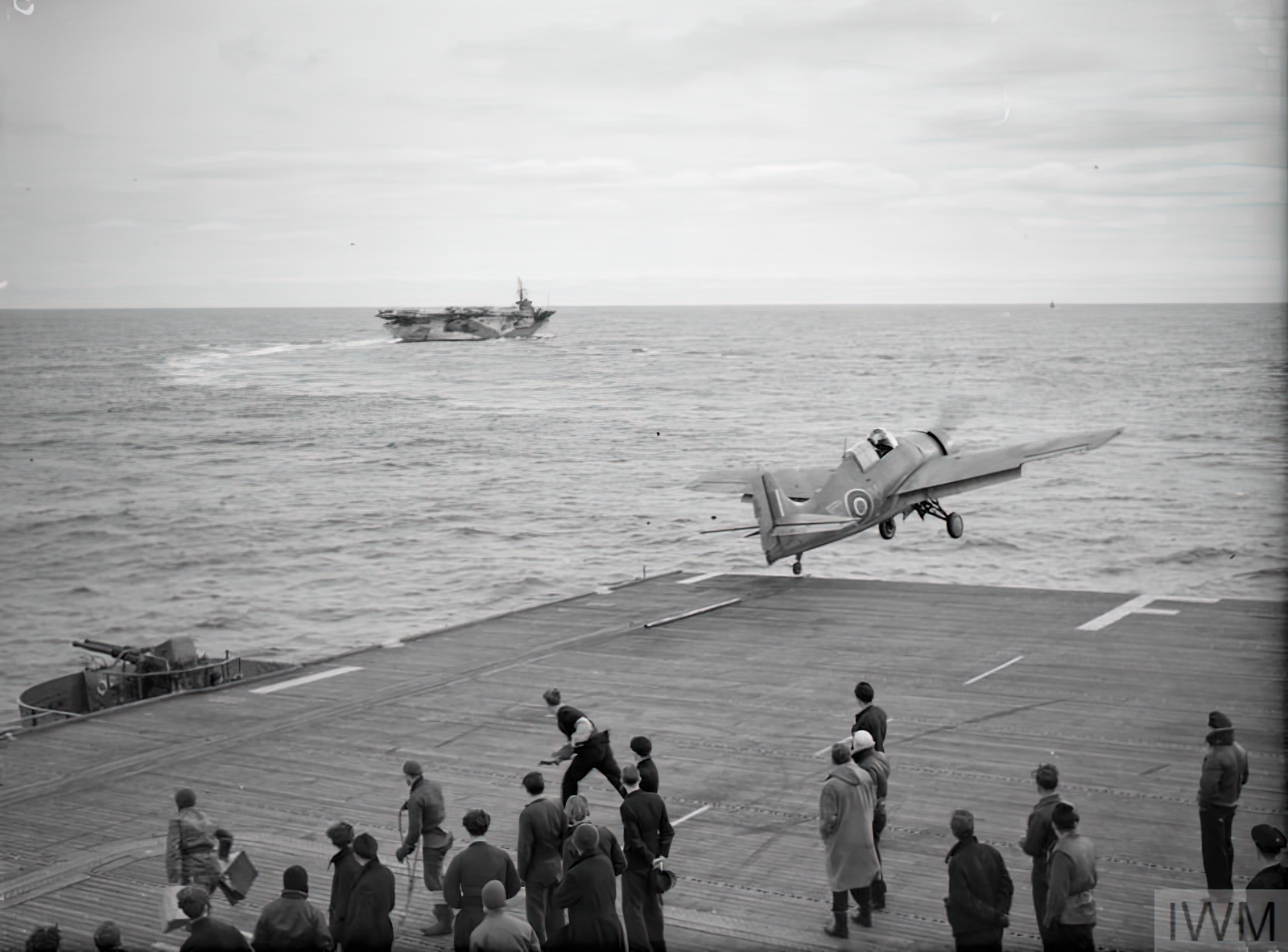
On completion of unloading the personnel and equipment of 842 Squadron, FENCER sailed for Liverpool and was berthed at King George V Dock, where she was joined by her sister CVE STRIKER on October 25th. The two carriers were to embark 27 Mosquitoes, 24 B.IVs, and 3 PR.XVIXVI, belonging to 618 Squadron RAF; these aircraft, together with their equipment and stores, were to be ferried to Australia. The aircraft were hoisted onto the flight deck by a floating crane, and the personnel of 618 Squadron embarked on October 30th, half in each carrier. On completion of loading, the two carriers proceeded to the Clyde.
618 Squadron was a specialist unit for the delivery of the 'Highball' anti-shipping bouncing bomb. By the time this unit was ready, German targets were scarce, so in July 1944 it was allocated for the Pacific theatre for operations against Japanese targets. The aircraft were carrier-capable and had arrestor hooks and strengthened undercarriage legs, but no record of any of their Mosquitoes performing shipboard deck landings is known. The squadron's pilots were trained in the art of deck landing flying Barracudas on RAJAH. (See also The mystery of the navalised De Havilland Mosquito during the Second World War for more background.)
The two carriers departed the Clyde at 14:30 on October 31st bound for Gibraltar, escorted by KELVIN, MARNE, and MUSKETEER. The ships arrived at Gibraltar at 01:00 on November 5th. After refuelling, they continued on to Alexandria, UNDAUNTED joining the escort. They arrived at Alexandria on November 11th, where the three destroyers that had escorted her from the UK detached to join the Mediterranean Fleet. After transit of the Suez Canal, l FENCER, STRIKER and UNDAUNTED took passage down the Red Sea to call at Aden to refuel before crossing the Indian Ocean; they arrived at Trincomalee, Ceylon on November 22nd.
After a short time spent in Ceylon, the two carriers sailed from Colombo on December 10th 1944, this time in company with the cruiser SWIFTSURE (flagship of Rear-Admiral E. J. P. Brind, CB, CBE, commanding Fourth Cruiser Squadron) and their escort, the destroyers KEMPENFELT (Captain D, 4th Destroyer Flotilla), WESSEX, and WAKEFUL. Once at sea, they were joined by the CVEs ATHELING and BATTLER, the cruiser HMNZS ACHILLES and destroyers WAGER and WHELP, to proceed in convoy to Australia. Most of the destroyers returned to Trincomalee on the 11th, and on the 16th the cruisers SWIFTSURE and ACHILLES parted company with the carriers and went on ahead to Fremantle.
From Fremantle,
ATHELING and
BATTLER continued on to Sydney before crossing the Pacific for a period of duty on loan to the US Navy. FENCER and
STRIKER sailed for Melbourne after refuelling, arriving there on December 23rd to unload 618 Squadron and their aircraft at Nelson Pier, Williamstown, Victoria. Both ships then proceeded to Sydney to join the British Pacific Fleet (BPF), arriving there on January 7th 1945.
After unloading at Sydney, FENCER was to be employed as a dedicated ferry carrier; she sailed almost straightaway for India to collect her first load, embarking aircraft at RNAS Cochin on January 28th. On arrival back in Australia her ferry load was disembarked RNAS Bankstown, Sydney, and she made a second run to Cochin, embarking another ferry load on February 28th.
TThis time, after unloading at Sydney, she embarked a ferry load of aircraft for delivery to the Maintenance Carrier
UNICORN at San Pedro Bay, Leyte, in the Philippines, the location of the Fleet Trains forward base. FENCER sailed from Sydney on March 31st and arrived at San Pedro Bay at 098:00 on April 10th. She remained at Leyte for the next two weeks, sailing for Manus on April 26th. She called at Hollandia, New Guinea, on April 29th before arriving at Manus on the 30th. This was a short stopover; she sailed for Sydney on May 1st.
On completion of her duty as a Fleet Train ferry carrier, FENCER was assessed for her refit needs on her arrival back at Sydney, with particular attention being given to her close-in defensive armament. She was to be reallocated for service with the 21st Aircraft Carrier Squadron, part of the East Indies Fleet, and a new squadron would be allocated on her arrival on station.
Her refit was to be carried out by the RN Dockyard at Simon's Town, South Africa, and she sailed from Sydney on June 13th. The carrier was docked at the Selborne dry dock at Simon's Town July 9-11th. By the time she had completed her post-refit shakedown and arrived at Trincomalee, the war was over, and she was nominated for return to the UK for conversion to a Troop Ship.
FENCER sailed from Ceylon on September 4th 1945, carrying passengers and equipment for return to the UK. She arrived on the Clyde on September 25th and was allocated to a commercial Dockyard in London for her conversion work to be carried out and sailed for the Thames on September 30th.
FENCER was one of 6 CVEs to be converted for Trooping, along with ATHELING, PATROLLER, QUEEN, RAJAH, and RANEE. For Trooping, these vessels were outfitted to carry approximately 60 officers and 1,000 ratings in addition to a reduced crew of about 250. FENCER’s conversion was estimated to cost £17,766.
The main work consisted of converting the hangar deck into accommodation spaces; 684 bunks and kit lockers were installed along with providing a dining hall in the hangar with tables and seating for 240 men. Additional Heads and washing facilities were installed by converting several spaces, including the torpedo workshops, pyrotechnics locker, aircraft and Boat engine workshop, and aft lift well spaces. Corticene (a form of Limonium) was laid in all gangways, the dining hall and the berthing spaces in the hangar for improved footing. Additional equipment was also installed in the main galley and Wardroom galley to cater for the increased numbers to be fed (three and a half times her wartime complement). Several petrol tanks were converted to provide additional fresh water.
The ship was also to be tropicalised as far as possible in the time available, mainly by providing improved ventilation in the hangar deck and engine room; much of the work had already been completed on previous refits. Additional lifesaving equipment, sufficient for evacuation of all on board, was provided by installing banks of extra Carley Floats on the Flight Deck. For good order and discipline, part of compartment A.104E – forward of Frame 47 was converted into a Guard Room with four cells.
First trooping run : FENCER sailed from the UK on December 11th 1945 for Colombo carrying Naval Drafts and civilian passengers, including a number of White Fathers missionaries going to Mombasa, Kenya, to re-establish their ministry there after the war. She called at Malta on the 19th, but sailing was delayed by an engine defect; she sailed at 15:00 on Dec 29th, eta Port Said at 16 knots at 07:00 on New Year’s Day 1946. At Port Said, she disembarked a small draft and 8 cwt. Of stores before entering the Suez Canal at 12:00 that day. She departed from Port Suez at 05:00 on the 2nd and arrived at Colombo on January 11th. After exchanging passengers and stores and embarking fuel and fresh water, FENCER sailed on the return leg of her voyage on the morning of January 15th. She had to return to Colombo shortly after sailing, with her main feed pump armature burnt out and an auxiliary feed defect. The repair work delayed her departure until February 2nd. After calling at Aden on the 7th, she reached Port Suez on the 11th and transited the Canal the same day. She sailed at 06:00 on the 12th for Malta, arriving there on the 15th. After embarking more passengers, she sailed on the 16th for Chatham, where she docked on February 21st 1946.

HMS FENCER entering Grand Harbour, Malta during one of her trooping voyages during 1946.
Second trooping run: She sailed again on March 14th for another run to Colombo. Sailed on March 22nd for Port Said, sailed for passage through the Canal at 05:35 on the 26th for onward passage to Aden and Colombo. She arrived in Colombo on April 5th. After storing, fuelling and embarking passengers, she sailed from Colombo on April 10th. Called at Aden on the 15th and reached Port Suez on the 19th. Entered the Canal the same day but moored at Ismailia the next day. Resumed her transit to arrive at Port Said on the 20th. Departed for Malta at 19:00 on the 20th, calling there on the 23rd to embark passengers before sailing for Gibraltar on the 24th, sailing for the UK at 08:00 on the 26th. She called at Plymouth on April 30th, and Portsmouth on May 1st to discharge passengers before arriving back at Chatham on May 2nd 1946.
Third trooping run: After a quick turnaround, FENCER sailed again to collect passengers from the East Indies Fleet sailing for Kilindini and Colombo on May 20th. She departed Gibraltar at 23:30 on May 25th and arrived at Port Said at 23:30 on May 30th. Passed through the Suez Canal on June 1st, departing Port Suez for Aden at 18:30, arriving there on the 5th. From Aden she proceeded to Mombasa, arriving there at 07:45 on June 11th. After embarking passengers and cargo, she sailed for Colombo at 07:30 on the 14th, arriving on the 32nd. Here she embarked stores, passengers, cargo and fuel, sailing at 05:30 on June 25th for Aden at 16 knots. She called at Aden for fuel on July 2nd before arriving at Port Suez on July 6th and made an immediate transit of the Canal, arriving at Port Said late on the 6th. She sailed for Gibraltar on the 7th, arriving there on the 13th to take on fuel and passengers, sailing for Plymouth on the 14th. FENCER called at Plymouth on July 17th to disembark passengers, and proceeded to Portsmouth later that day. She arrived at Chatham on the 18th.
Fourth trooping run: Her final dedicated trooping voyage was planned as a final run to Ceylon to collect passengers from the East Indies Station departing from Chatham on August 17th. However, this was amended on August 4th, the voyage being shortened to Port Said and return with a departure date from Chatham of August 10th. After calling at Malta, she departed for Port Said at 23:00 on the 16th, arriving there at 06:30 on August 30th. After exchanging passengers, she sailed to return to Malta at 17:00 on the 31st. After embarking 67 tons of cargo, she sailed from Malta at 17:00 on September 4th for Gibraltar, calling there on the 7th. FENCER arrived back in the UK on September 12th 1946.
Once all her passengers and cargo had been disembarked, FENCER began the process of de-storing and removing Admiralty equipment in preparation for her return to the US Navy. She sailed from the UK on October 22nd for Norfolk, Virginia, carrying passengers, stores, and equipment for delivery to the Royal Naval Dockyard in Bermuda, arriving at Norfolk on November 8th 1946.
On November 21st, a US Navy Care & Maintenance party embarked to inspect the ship and take possession of CVE-14, which was returned to US Navy custody on that date and HMS FENCER officially paid off. CVE-14 was later stricken from the US Navy register and put up for disposal. She was sold for conversion into mercantile service in December 1947.
Purchased by Flotta Lauro Lines (along with sister ship ATHELING) she was converted in Naples, Italy, into a passenger/cargo liner for use as an Emigrant ship. FENCER was renamed SS SYDNEY; ATHELING became SS ROMA. They emerged from conversion with first-class passenger accommodation on two of the superstructure decks, while tourist class had three decks below. Two cargo holds forward and one aft. Initially, each ship could carry 92 first-class and 680 Tourist-Class passengers.
Based in Genoa, ROMA made her maiden voyage in August 1951, followed by SYDNEY in September. Both ships served the Italy-to-Australia route, Genoa to Fremantle, continuing to Melbourne and Sydney, then travelling north to Brisbane before returning to Genoa. SS SYDNEY was sold late in 1969 to ‘Aretusa SpA di Nav’, but she was laid up well into 1970 before she was sold again, that same year to ‘Sovereign Cruises’. She was sold again in 1971 to ‘Mediterranean Cruises’ and was renamed GALAXY QUEEN. In 1972, she was sold to ‘G Koszovillis ’, who renamed her LADY DINA; finally, in 1973, she was sold to ‘Marimina Shipping Co. Sa.’, who renamed her CARIBIA 2. In 1974, she was sold to Italian ship breakers ‘Terrestre Marittima’, La Spezia and CARIBIA 2 was scrapped beginning in September 1975.
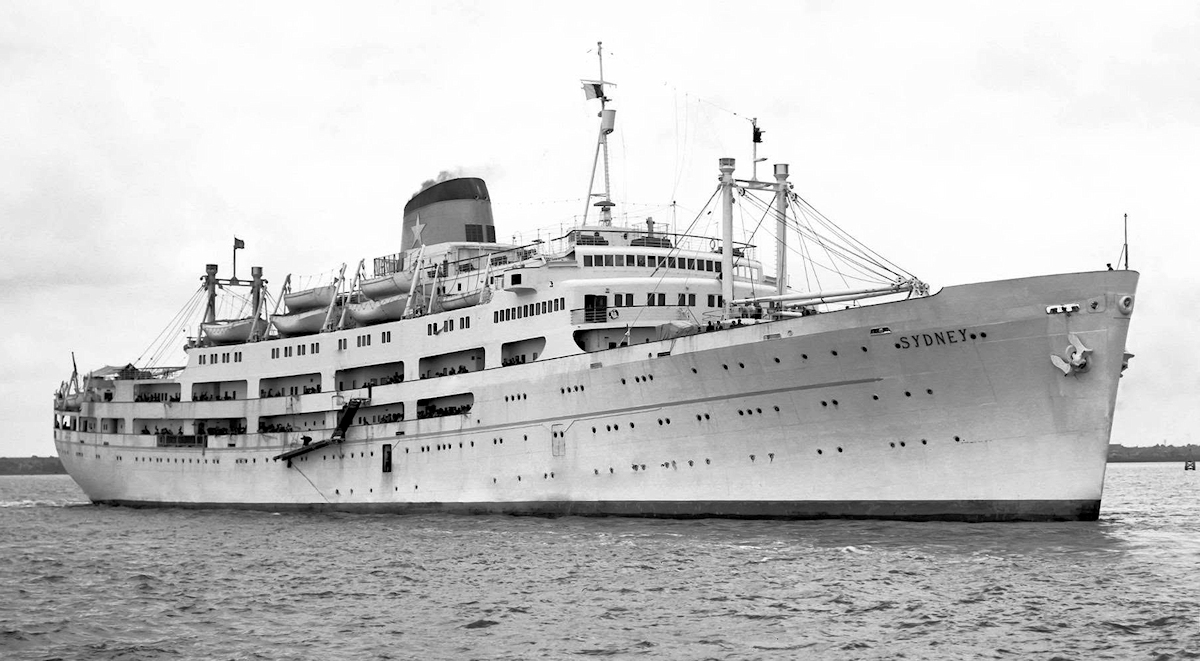
The S.S. SYDNEY
Last modified: 26 July 2026
© 1999-2026 The Royal Navy Research Archive All Rights Reserved Powered by W3,CSS
Press F5 to refresh the page after posting your comment or to hide the form
Shape: Standard, circular.
Blazon (Heraldic description)
On a blue field: Two fencing foils in saltire, a fencing mask charged, inclined to profile, gold.
FENCER: One who participates in the sport of fencing. Based on the traditional skills of swordsmanship where speed, skill and determination lead to victory.
For explanations of heraldic terms see the
Royal
Navy Ship's Badges page.
Note: S842 Squadron was now to operate a number of detachments, beginning on July 5th; 3 aircraft embarked in FURIOS, returning to Grimsetter on the 19th. 6 aircraft embarked in INDEFATIGABLE on the 6th, disembarking to Hatston on the 21st. And 6 aircraft embarked in FENCER on the 5th, leaving the ship at Stornoway on August 10th. It is unclear which aircraft types were involved in the detachments operating from the Fleet Carriers, but it is assumed they were Swordfish.
CloseNote:Uncorroborated reports of ATTACKER having sustained no damage when CHASER dragged her anchor in Clyde during a gale and collided with ship on January 22nd 1944. Other reports now place this incident as March 13th in Liverpool Bay. Also - on January 24th sustained damage when FENCER dragged anchor in Clyde during gale conditions and collided with ship.
CloseNote:In his account of the incident in his book 'Upside of trouble' Anthony Shaw gives the date as the 21st - the entry in ‘Fleet Air Arm Aircraft 1939 to 1945' by Sturtivant & Burrows the date is given as August 28th.
CloseNote:Sub Lt Gowan RNZNVR was later awarded the DSC for skill and leadership in dive-bombing and strafing missions during 'Operation Dragoon'
CloseNote: Several commentators have ATTACKER arriving at Taranto for refit on Dec 6th with squadron personnel taking passage to Egypt in the Italian cruiser DUCA D'AOSTA. However, squadron records show that the aircraft of both 809 and 879 squadrons were disembarked from ATTACKER on Dec 11th in Egypt.
Close
Comments (4)
A couple of photos from on board HMS Fencer, June 1944 from my late aunt's photo album, she served in the WRNS.
My Grandparents sailed to Europe on the "Roma", i still have the passenger list