A History of HMS THANE
|
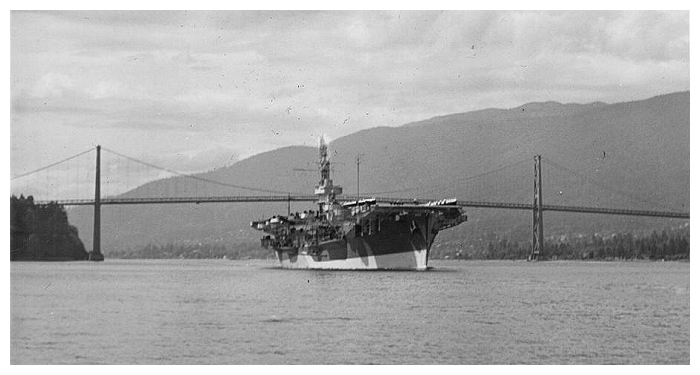 |
June 28th 1944 - HMS Thane has just passed under Lions
Gate Bridge returning to Lapointe pier, Vancouver after
collecting ammunition from Bremerton Navy Yard,
Washington State. Photo: Maureen Ross |
HMS
Thane was a 'Ruler' class escort carrier (US Bogue class) built in
the USA at Seattle-Tacoma Shipbuilding Co. Tacoma, Washington. Her
keel was laid down on February 23rd 1943 as a C3-S-A1 type
freighter, Maritime Commission hull number 259, Seattle-Tacoma hull
number 43. The hull was purchased by the US navy to be completed as
the USS Sunset, ACV-48 (designation later changed to CVE-48). She
was launched on July 15th 1943, 142 days after her keel was laid, by
her sponsor Mrs. C. E. Taylor. Whilst still under construction it
had been decided that CVE-48 was to be transferred to the Admiralty
on loan upon her completion; after spending a further 127 days
outfitting she was ready for delivery on November 18th 1943; CVE-48
took a total of 269 days to complete.
CVE 48
was transferred to Royal Navy custody at Tacoma. Washington on
November 19th 1943 and was accepted on behalf of the Admiralty by
Captain Penrose O. Davis, RNR. The White Ensign was hoisted and the
ship was renamed HMS THANE. Pennant number D-83.
Modification and preparation to enter service:
After
completing builders and Admiralty acceptance trials CVE 48 manned by
a small steaming party under the command of Captain Davis, preceded
to Vancouver, Canada, arriving there on December 5th. CVE 48 was one
of 19 escort carriers to be modified to meet Admiralty requirements
by the Burrard Dry Dock Co. Ltd., North Vancouver, British Columbia.
While in Vancouver she was to receive her full crew compliment and
work up ready for beginning her active service.
|
![Saturday July 1st. commissioning ceremony and dedication service on the flight deck: Captain Baker reading the Ships’ Commissioning Warrant. [Photo: Maureen Ross]](../ESCORT/images/Ships/Thane_D.jpg) ![Rear Admiral V. G. Brodeur RCN & Senior Royal Navy Officers inspect the ships company after the Dedication Service aboard HMS Thane, Vancouver, June 44.[Photo: Ray Keena]](../ESCORT/images/Ships/Thane_E.jpg) |
Saturday July 1st 1944: Dedication ceremony on the
flight deck - the church service was led by The Right
Reverend Sir Francis Heathcote, Bishop of New
Westminster B.C., followed by Admirals divisions, Rear
Admiral V. G. Brodeur RCN, Commanding Officer, Pacific
Coast inspecting. Photos: Maureen Ross. |
Upon
her arrival in Vancouver Thane was moored alongside at Burrard
terminal to act as an accommodation ship for the crews of other RN
escort carriers which either had modifications in hand or were
awaiting modification, including Arbiter, Queen and Speaker. During
the first four months at Vancouver her hangar deck was outfitted
with rows of two and three-tier bunks to provide one large communal
ratings mess deck.
HMS
Thane was to have three commanding officers before she entered
active service; Commander Eric McCausland, RN (formerly Executive
Officer, of the escort carrier HMS Premier which had arrived at
Vancouver in mid November) relieved Captain Davis, assuming command
on December 11th. He remained with the ship until relived by Captain
Edmond Baker, RN on May 7th 1944.
Thane
moved to No. 7 berth LaPointe Pier on April 10th in preparation for
modification and outfitting as a Strike/CAP (Combat Air Patrol)
carrier, work began on April 15th. This phase of the work was
completed on June 8th. Part of this work included the addition of
264 tons of pig iron as additional ballast.
One
notable event which took place while Thane was in for modification
was a wedding ceremony performed in the Captain's cabin to marry one
of the ship's officers, Paymaster Lieutenant. Eric H. Grieve-Brown
RNR to Flight Officer Muriel Anne Pennoyer RCAF (WD) on March 3rd
1944. The event is notable because it is believed to be the first
instance of a marriage being performed on a RN aircraft carrier.
With
phase one of her modification program complete Thane's commanding
officer and crew came aboard and began commissioning the ship in
preparation her for moving to Esquimalt, Victoria, North Vancouver,
for remedial work in dry dock. With the majority of her officers and
men victualled and accommodated on board Captain Baker announced
that HMS Thane was officially commissioned on June 9th.
Thane
entered the Esquimalt berthing dock on the 10th and work was
completed on the 14th. The ship returned to No. 7 berth LaPointe
Pier on the 15th; after final works where completed she was moved to
a mooring in the harbour on the 22nd. Thane's modification
programme had taken 55 days to complete.
[Note: the last five CVEs to pass through Burrard's dockyard,
PATROLLER, PUNCGER, REAPER, RANEE and THANE had a longer
modification timetable than the other 14 vessels modified by
Burrard's; this was due to the Admiralty decision that the single
Oerlikon mounts on the Gallery Deck and foc'sle deck, were to be
changed for fourteen twin mountings. An extra ten days being
allocated for this work to be completed.]
On
26th June HMS Thane made her first voyage as a commissioned ship, a
short two day round trip to Bremerton Navy Yard, Washington State to
load US ammunition; during this period sea trials and departmental
work up routines was undertaken. Arriving back at her mooring in the
harbour on the 28th, the ship began taking on stores and ammunition.
While
at this mooring a former RCAF Blackburn Shark III (RCAF Serial
number 548) was delivered to Thane by lighter for use in training
the aircraft handling parties, prior to their receiving squadron or
ferry aircraft. This was one of five airframes to be handed over to
RN escort carriers for this purpose, and they were issued to
Patroller, Puncher, Ranee, Reaper and Thane. [These five ships also
had a longer modification timetable than the other 14 vessels to
pass through Burrard's dockyard; the Admiralty decided that all of
the single Oerlikon mounts on the Gallery deck and foc'sle deck,
were to be changed to twin mountings, an extra ten days being
allocated for this work to be completed.]
A
Dedication Service was held on board HMS Thane on Saturday July 1st.
The service, which took place on the flight deck was conducted by
The Right Reverend Sir Francis Heathcote, Bishop of New Westminster
B.C., and Captain Baker read the Ships' Commissioning Warrant. The
service was followed by Admirals divisions, Rear Admiral V. G.
Brodeur RCN, Commanding Officer, Pacific Coast, and guest of honour,
inspecting.
Thane
was to make one final short visit alongside at Burrards, mooring at
No. 8 berth on Friday July 7th in preparation for a farewell dance
which was held on the flight deck late afternoon on Saturday.
Admiral Brodeur, the guest of honour, and several hundred guests
enjoyed food, refreshments and dancing on the flight deck to the
singing of Lester Coles' Debutantes accompanied by the Sandy de
Santis band. Thane returned to her mooring in the harbour early on
the morning of Sunday the 9th to prepare for her maiden voyage as an
operational carrier.
|
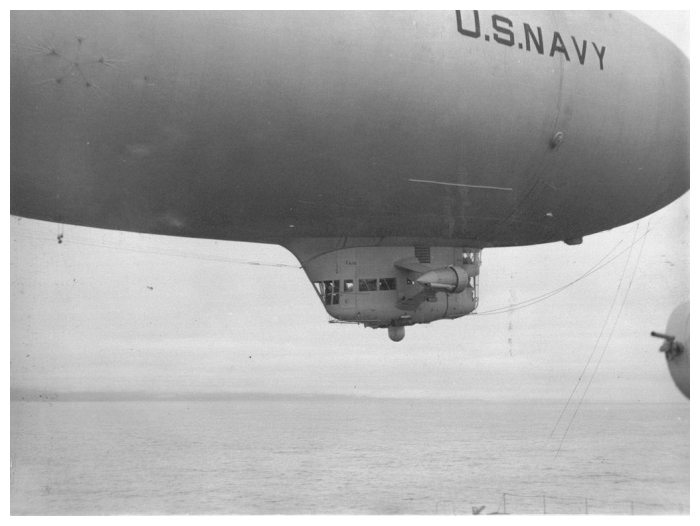 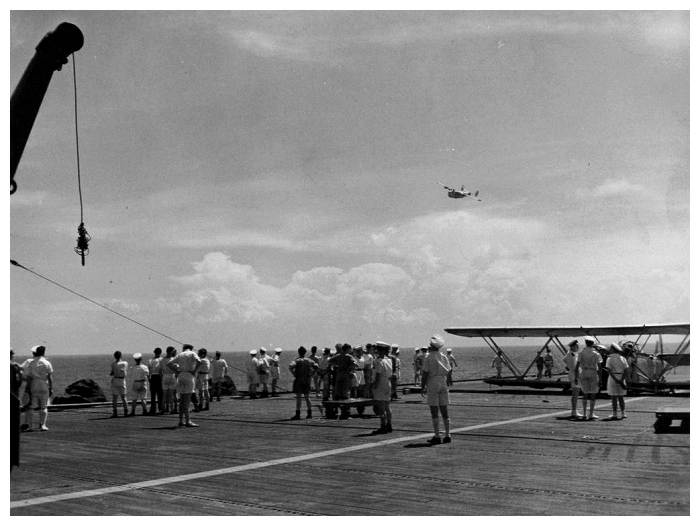 |
Left: July 21st 1944, a US navy Air Ship exercises with
HMS thane in the vicinity of San Francisco en route to
the Panama Canal. Right: A B-24 Liberator of the Panama
Canal defence forces, "attacking" Thane on July 22nd.
The ship's Shark has its undercarriage removed to
simulate a crash on deck - the ship's mobile crane is
ready to move in to 'recover' it.. Photos: Left -
Jack Browne, Right - Maureen Ross. |
Active service, first ferry run to Cape Town:
HMS
Thane sailed from Vancouver on Sunday July 9th, slipping her mooring
at 14:30hrs heading for San Francisco, where she arrived on
Wednesday 12th July; poor visibility meant that the ship had to
navigate by radar to enter the harbour, where her arrival seemed to
be unexpected as no tugs met her or mooring party appeared at the
allocated jetty. A party of seamen were put ashore to handle mooring
lines. The ship manoeuvred under her own power, since the crew were
not yet familiar with her handling characteristics a small collision
occurred when a gun sponson clipped a warehouse. At San Francisco,
additional communications equipment was fitted to the bridge and
combat communications room and further stores were taken aboard.
Major Patch RM, Commander Flying, took the opportunity to arrange
with the CO of Alameda Naval Air Station to supply some aircraft
with towed drogues for gun crew training.
The
ship sailed from San Francisco at 08:00hrs on Friday 14th July
headed for the Panama Canal, and as arranged two drogue towing
aircraft were provided, however poor visibility prevented gun crew
training. During the voyage to Balboa exercises and daily drills
were performed, including flight deck emergency drills using the
Blackburn Shark; radar tests were carried out on Saturday 15th July,
but were curtailed when the participating Liberator developed an
engine fault. On July 21st A US Navy Blimp (air ship) patrolling the
Pacific approaches to the Panama Canal "intercepted" the carrier,
and on the 22nd Thane engaged in exercises with aircraft of the US
VI Bomber Command, part of the Panama Canal defence forces; B-24
Liberators from the 3rd and 29th Squadrons took off from Howard
Field at 11:00, assembled over Rio Hato at 5,000 feet, and were
joined by aircraft of the 74th Bombardment Squadron. Radar contact
was made with the carrier at 13:30, and the B-24's let down to an
altitude of 3,700 feet, "attacking" the carrier at 1348.
The
ship docked at Colon on the evening of Sunday 23rd July; the passage
from San Francisco took longer than expected as the ship was forced
to reduce her speed due to a bearing on the HP turbine gearing
running hot. At Colon the US authorities sent a repair party aboard
to assist in the repairs. [This was a common fault with the US built
CVEs, Lt. (E) C.J. Kenna, senior engineer on Thane, had already
encountered a similar but more severe problem on HMS Tracker's
maiden Voyage between Seattle and Panama, but in that case emergency
repairs had to be carried out at sea whilst the ship drifted
aimlessly in the Pacific.]
At
Colon Captain Baker agreed to give passage to Norfolk to 3 officers
and 200 men of the US Marine Corps; shore leave was given to both
watches. Thane entered the Panama Canal at 10:00hrs the following
morning and the ship was secured alongside at Cristobel, on the
Atlantic coast, at 19:30hrs. Thane left Cristobal for Norfolk,
Virginia the next day.
On
Wednesday 26th July, Assistant Steward J.W. Newman died of a
perforated malignant ulcer; he was buried at sea during the
forenoon. On the morning of Friday 28th Acting Leading Seaman T.H.
Johns who was working on the side of the ship was lost overboard;
although the ship put about and at least one lifebuoy was deployed
while he was still visible, but no trace of him was found when the
ship reached the lifebuoy.
Thane
put into Norfolk Navy Yard, Virginia, on July 30th, and after
unloading her passengers underwent a short period of defect
rectification. While at Norfolk Thane was allocated to Western
Approaches Command for duty as a ferry carrier. On completion of her
repairs Thane moved to the Norfolk Naval Operating Base to load 85
Grumman F6F Hellcat aircraft for ferrying to South Africa. On
completion of loading Thane sailed for Cape Town on August 14th.
HMS Thane arrived in Cape Town on September 2nd and unloaded her
aircraft to
RNAS Wingfield. Whilst in Cape Town, the ship's flight
deck was re-caulked before she sailed for Norfolk, to collect her
next load on September 15th, arriving there on October 3rd.
|
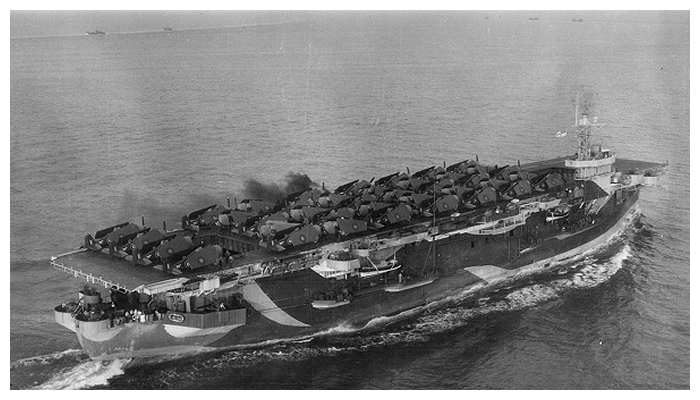 |
HMS THANE as seem from USN Blimp (airship) K72 as she
left Chesapeake Bay heading for New York, October 5th
1944 with a ferry load of Hellcats on board. Photo:
Maureen Ross |
Second ferry run, Norfolk to Greenock:
On arrival at Norfolk THANE secured alongside at the Naval Operating Base and began loading a ferry load of American lend-lease aircraft for delivery to Glasgow. She sailed on
October 5th to join convoy CU-42 which was formed off New York on the 6th and sailed later that day for the UK. She was in company with sister CVE
PUNCHER which had loaded a ferry load at Staten Island, New York. On approaching the coast off Ireland on the 16th the two carriers detached and proceeded to the Clyde. Thane moored on the Clyde on the 17th.
After unloading her ferry load 7 days leave was granted to each watch intern while the ship prepared for a short delivery run to Belfast embarking a cargo of Jeeps, Lorries and other military vehicles. Thane sailed from the Clyde to Belfast on November 3rd, her cargo was unloaded on the same day. She then began loading Hellcats and Avengers in preparation for a ferry run, this time to the Middle East.
.
Third Ferry run, UK to Adabiya, Egypt & back
Thane
sailed on November 6th as part of the 20 ship Alexandria bound
convoy KMF 36; the convoy arrived in Gibraltar on the 15th, and
reached Alexandria on the 19th. Thane continued on to Port Said,
arriving there on the 20th. She transited the Suez Canal the next
day to the military harbour at Adabiya on the Gulf of Suez, and
unloaded her cargo of aircraft onto the quayside. The following day
the personnel of 831 NAS and personnel and aircraft of 834 NAS were
embarked for passage to the UK where both squadrons were to disband.
These units had been disembarked from
BATTLER, in preparation
for the ships' new role as a ferry carrier, Battler embarking the
ferry load delivered by Thane for onward passage to India.
|
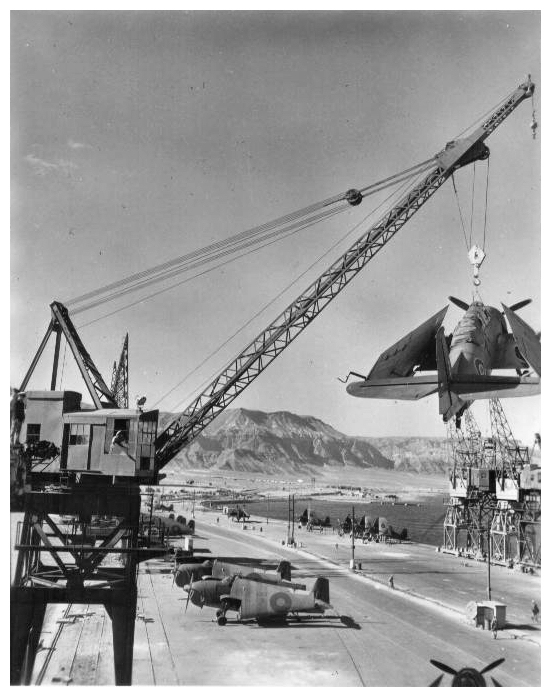 |
HMS THANE unloading her ferry load at the military
harbour at Adabiya on the Gulf of Suez,. Photo:
Maureen Ross |
Thane sailed from Adabiya on the 23rd,
arriving back at Gibraltar on the 30th. She departed from
Gibraltar on December 1st in company with the destroyer HMS
CROOME as escort. Thane arrived on the Clyde on December 6th
after a very rough passage through the Bay of Biscay.
After unloading her aircraft and disembarking the personnel
of 831 & 834 squadrons HMS Thane restored ship and made good
the storm damage in preparation for her next voyage.
|
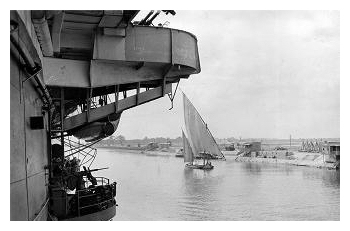  |
Left: HMS THANE transiting the Suez Canal on her way to
the military port of Adabiya in the Gulf of Suez..
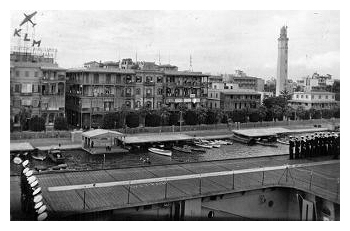
Right: HMS THANE passes the KLM airline offices, Port
Said on her return voyage to the UK from Adabiya.
Photos: Left - Ray Keena , Riught - Maureen Ross. |
Fourth ferry run, Greenock to Norfolk, Va and back:
Thane
sailed for Norfolk, Va., on December 16th, on a round trip voyage,
Greenock to Norfolk for a mixed ferry load of aircraft. On December
28th 1851 squadron embarked at Norfolk Operating Base for passage to
the UK; this unit had formed and worked up at USNAS Brunswick. The
squadron embarked with 18 Corsair IV aircraft, aircrews and
maintenance personnel. The squadron was briefly at USNAS Floyd
Bennett Field for a period of deck landing practice on USS Charger
in Chesapeake Bay before delivering its aircraft to the quayside for
loading.
Also
loaded and stowed in the hangar was the Royal Navy's first batch of
helicopters - at least 9 Sikorsky R-4B Hoverfly I. The machines had
been delivered to RN Ferry Squadron at Floyd Bennett Field, USA
during June 1944 and were embarked on Thane at Norfolk & 30th. These
machines were flown on board, four landing on Thane's fight deck on
December 29th; these were struck below for storage in the hangar
before snowfall made further landings impossible. The remaining five
machines flew on board at 08:00hrs the next morning. A number of
spare airframes, including Corsairs and Wildcats, some of which had
been operated by RN training squadrons based at US Naval Air
Stations where also loaded as deck cargo; this completing a load of
86 aircraft, 24 in he hangar and 62 as deck cargo. Thane sailed for
New York at 10:00hrs on New Year's Eve 1944. After a difficult
passage through fog and later gale force winds the ship arrived in
New York on New Year's Day 1945 and was berthed at 35th Street,
Brooklyn in the mid evening. . Passengers and stores were embarked
for the UK and Thane waited to join the next UK bound convoy.
At
11:00hrs on January 3rd Thane departed from New York and joined the
33 vessel New York to Liverpool convoy CU 53 sailing for the UK,
this was another stormy passage, so rough in fact that on the 6th
aircraft had to be re-lashed on deck as the chains securing them
were snapping under the violent pitching of the ship. On the evening
of the 8th the convoy hove to because the very severe seas; Thane
suffered more storm damage, some of which required the attention of
her damage control parties to prevent the ship taking on water. Upon
reaching the Western Approaches Thane broke off and proceeded to
Belfast, arriving there on the 14th. At 14:00hrs she was alongside
Sydenham Air Station jetty where the 18 aircraft, stores and
aircrews of 1851 squadron and part of the maintenance personnel
disembarked to the RN Aircraft Repair Yard. [Squadron members not
required at Sydenham were allowed to remain aboard so that they
could get home on leave earlier than if they had to travel by
passenger ferry from Belfast]
Thane
sailed for the Greenock the following morning where she was to off
-load her remaining cargo of aircraft which was intended for
delivery to the navy's Receipt & Despatch Unit at RNAS Abbotsinch,
and make repairs to storm damage.
Torpedoed:
At
13:28hrs, approaching the Clyde Light Ship, and entering the swept
channel, Thane was rocked by an underwater explosion on her
starboard aft quarter. The force of the explosion blew the starboard
aft 5 inch gun and its sponson clean off the side of the ship, and
displaced the aft aircraft lift causing it to become wedged within
its well. Eye witnesses reported that the flight deck planking
seemed to ripple and take on a corrugated appearance. The explosion
created a large hole between the destroyed after starboard gun
sponson and the keel.
|
 |
HMS Thane photographed by an aircraft from HMS Puncher
while at No. 1 Casualty Buoy on the Clyde, January 17th.
Note: this is a rare picture in which she is wearing her
pennant number '83'. Photo: Maureen Ross |
Also
in the vicinity were the trawlers Cypress and Cirisinio and a
Norwegian Oiler Spinanger; the fast troopship HMT Ile de France (a
21 knot, three stacker) and her screen, destroyers HM Ships Caprice
and Oribi were 4 miles astern. Caprice and Oribi closed on Thane to
investigate, at 13:35hrs they signalled Ile de France that Thane had
been mined or torpedoed; the troopship increased speed to avoid
becoming a target. [It became known later that Thane had been
torpedoed by U-1172 {for many years this attack was accredited to
U-482. This submarine also attacked and damaged the Norwegian tanker
Spinanger at 14:05 about 1 nautical mile off Clyde Light Vessel, and
½ a mile from Thane's position; both vessels were sailing
unescorted from Northern Ireland to Greenock.]
|
![Thane after being torpedoed (1): the Port After gun sponson has been sheared off by the explosion and an enormous hole extends almost to the keel [Photo: Maureen Ross]](../ESCORT/images/Ships/Thane_F.jpg) |
Thane after being torpedoed: the Port After gun sponson
has been sheared off by the explosion and an enormous
hole can be seen on the water line, Photo: Maureen Ross |
Although Thane's main engines were undamaged attempts to get under
way failed, underwater damage was such that no connections existed
between turbine and propeller. The main steering gear was also out
of action, emergency steering by hand was instigated in the tiller
flat, it was found that 12 degrees of rudder to port and starboard
was possible. Damage control parties completed shoring up the most
badly damaged bulkheads by 16:00hrs and a continuous damage watch
was instigated to monitor repairs and potential areas of weakness in
the hull. Several compartments were successfully pumped out, and the
ship maintained a fairly even keel. Casualties were dealt with by
the ship's medical staff and by a group of QARNNS nurses (Queen
Alexander's Royal Naval Nursing Service) who had come aboard at
Belfast for passage to Greenock. The ship suffered approximately 25
casualties and 10 fatalities. The casualties were mainly the men
closed up at the starboard aft gun sponson and in No. 11 mess where
there were one or two mess sweepers at work and off watch
watch-keepers present in the mess went the explosion occurred.
|
![Thane after being torpedoed (2): the Port After gun sponson has been sheared off by the explosion and an enormous hole extends almost to the keel [Photo: Maureen Ross]](../ESCORT/images/Ships/Thane_G.jpg) 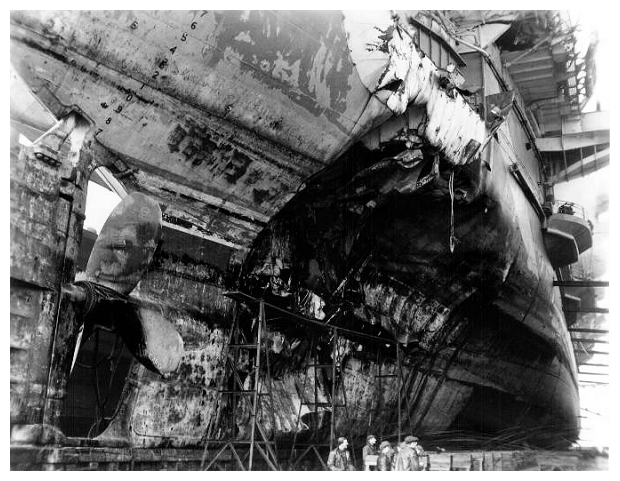 |
THANE in dry dock after being torpedoed: the Port After
gun sponson has been sheared off by the explosion and an
enormous hole extends almost to the keel, Photos:
Maureen Ross |
Several attempts were made in the afternoon to take Thane in tow but
a line was not successfully passed aboard until the Frigate HMS
Loring was ordered to take the ship in tow. The tow got underway at
18:50hrs and speed was gradually worked up to approximately 7 knots.
Not long after the ship was inside the boom defences (04:30hrs
approx) the tugs Paladen & Duchess of Abercorn relieved Loring of
the tow; the ship was moored to No. 1 Casualty buoy off Greenock at
07:42hrs.
The
next two days were spent making the ship safe and recovering bodies
trapped behind watertight hatches. Shore leave was granted to the
majority of the crew who had been warned not to mention the incident
and to behave as normal [this was a common practice designed to deny
the enemy of confirmation of damage]. Divers inspected the
underwater damage in order to assess the cause and extent of the
damage.
The
ship cast off No. 1 Casualty buoy at 09:00hrs on the 18th and was
towed by tugs to E.1 Buoy where she was secured at 10:00hrs in
preparation for de-storing ship. A floating crane and 4 lighters
came alongside at lunchtime to begin off loading the 68 aircraft
which were still on board (24 in the hangar and 44 parked on the
flight deck); this operation was completed by 15:20hrs. Seven of the
nine helicopters were flown off the ship later, after arrival in
port. The floating crane had left by 17:00hrs; the remaining ships'
company continued disembarking stores.
Thane
was next moved to a mooring in the Gareloch where Lt Cdr James
Woodrow RNVR and Lt W.D. Hatton RNVR (HMS President), naval mine
disposal officers, came aboard with a de-ammunitioning party of
ratings from HMS Spartiate and Orlando. The job was to take 10 days
to complete in extremely dangerous conditions owing to the condition
of the ammunition - shell noses and fuses were badly crushed with
detonators completely exposed, and much of it was covered with oil
fuel; by this time the ship was almost deserted, most of Thane's
crew being on leave (the majority of whom were not to return,
receiving new postings whilst on leave).
|
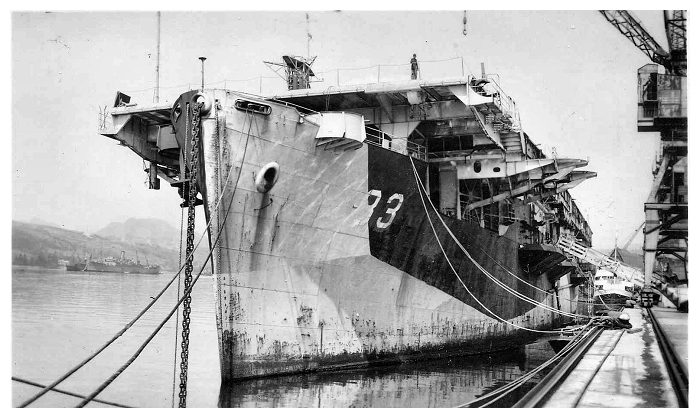 |
HMS THANE alongside in Faslane.. This photo shows her
with her radar and armament removed prior to her
disposal. |
Thane
was fully ammunitioned at the time of the attack, all of her Ready
Use Magazines and lockers were stowed to 100% capacity. The party
removed over 600 5 inch Shells and a similar number of charges from
the 5 inch magazine and Powder Room, over 2000 cases of 40mm and 131
Cases 20mm ammunition from other Magazines. Fuses from the bomb and
depth charge rooms had been safely removed by the ship's crew
earlier. Lt. Cdr Woodrow handled the first batch of damaged
ammunition by himself in order to give confidence to his party.
The
damaged ammunition and shells were loaded into a Clyde puffer (a
small auxiliary vessel) which made a number of trips to drop the
unstable cargo in 95 fathoms of water in an area between Ardrossan
and Brodick. Lt. Cdr Woodrow was awarded a bar to his George Medal
for the de-ammunitioning of Thane, others in the de-ammunitioning
party and five of Thane's officers and crew received awards
Investigations into the explosions in both Thane & Spinanger
concluded that in both cases the damage was caused by a single
German T.5 torpedo, with a non-contact pistol, the head containing a
600 lb. charge of alumanized hexanite. Such a torpedo would have
been running at a depth of between 30 and 40 feet.
Disposal:
Upon
inspection in dry dock HMS Thane was declared a constructive total
loss and was towed to Faslane and de-stored. On February 22nd Cdr
James C. Allan RNR became O.I.C. HMS Thane, Captain Baker being
reassigned to became CO of HMS Garuda (RN Aircraft Repair Yard,
Coimbatore, S. India) Thane was decommissioned to reserve and laid
up at Faslane with a small care and maintenance party on board under
Lt. Ernest Evans, RN who was appointed when Cdr Allan left at the
beginning of May to become CO of HMS Dungeness. Tame was reduced to
nominal reserve status on July 21st 1945.
Thane
had been earmarked for service with the British Pacific Fleet, for
which she was assigned the pennant number R316 which she would have
carried for service in the Pacific. Although Thane was completed as
a Strike/CAP carrier she never operated any aircraft (other than the
Hoverflies), and her arrester wires appear not to have been rigged.
CVE -
48 was returned to United States custody as lying' on December 5th
1945 while still n the United Kingdom at Faslane. She was stricken
for disposal by the US Navy in 1946, and was subsequently sold to
Metal Industries (Salvage) Ltd. She was broken for scrap at Faslane
later that year.
|
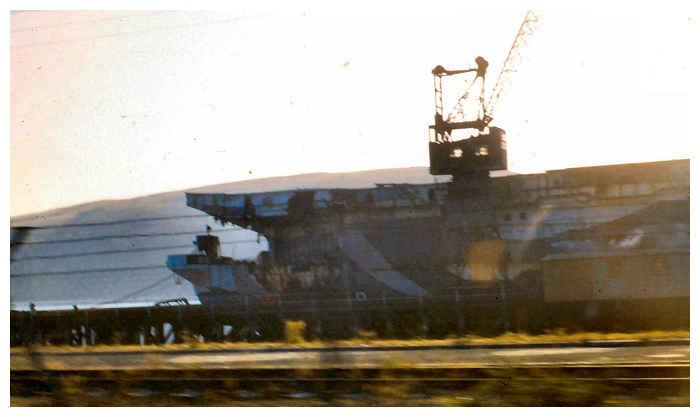 |
A rare colour shot of HMS THANE alongside at Faslane
after being decommissioned. Photo by "Foxx" - inage from
the Paul Moore collection. |
Content revised:
21 July 2024
Sources used in compiling this account:
Click here for a list of
Primary sources
Additional sources:
Kenna, R. & Dodgson, A. (2005) 'H.M.S. Thane, Getting on with the job'
private publication.
Fold3.com various documents including;
Admiralty War Diaries
Norfolk Navy Yard War Diaries
Mew York Navy Yard War Diaries
Miscellaneous documents
|
Home
page |
go to the top
|



Comments (7)
He is still alive and will be 93 in October this year