
D80
GABBARD 1653
SCHEVENINGEN 1653
BARFLEUR 1692
VIGO 1702
VELEZ MALAGA 1704
LOUISBURG 1758
QUEBEC 1759
ATLANTIC 1939-40
NARVIK 1940
SALERNO 1943
ATLANTIC 1943-44
SOUTH FRANCE 1944
AEGEAN 1944
BURMA 1945
Builder: Ingalls
Shipbuilding
Corp, Pascagoula, Mississippi.
Displacement: 14,170 tons
Length (Overall): 486ft
Beam: 69ft 6in
Draught: 16 ft
Flight deck: 442ft x 80ft wood covered mild steel plate
Propulsion: 2 Foster Wheeler boilers; 1 x Allis-Chalmers geared turbine driving 1 shaft
Speed: 18.5 knots
A/C Capacity: 20
Hangar: 262ft x 62ft x 18ft
A/C lifts: 2; aft 34ft long x 42ft wide; forward 42ft long x 34ft wide
Arrestor wires: 9 with 3 barriers
Catapult: 1 x H2 hydraulic
Armament: 2 single 4in USN Mk 9, 4 twin 40mm Bofors, 8 twin 20mm Oerlikon, 10 single 20mm Oerlikon
Crew Complement: 646
Capt. H. H. McWilliam RN May 42 - Sep 44
Capt. A. D. Torless RN Sep 44 - Dec 45
813 det
Mar -Apr 43
Swordfish II
834
Jul -Aug 43
Swordfish II
899
Aug -Oct 43
Seafire IIc
808
Oct 43-Feb 44
Seafire L.IIc
807
Jan 44-Dec 44
Seafire L.IIc
807
Mar -Oct 45
Seafire L.III
1700 det
Apr -Sep 45
Walrus I
None
None

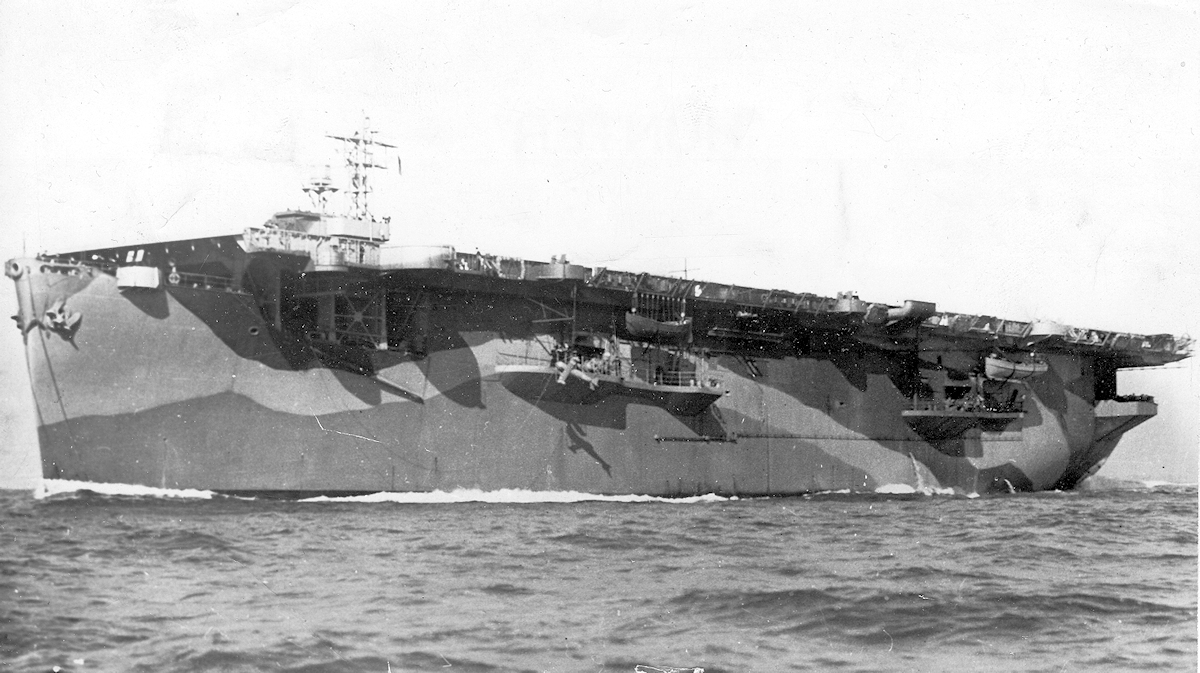
Port side view of HMS HUNTER during her builders trials off the Mississippi coast. At this stage she carries no armament or Radar.
HMS HUNTER began life as an 11,900-ton Maritime Commission C3-S-A2 type freighter, MORMACPENN ordered for the US operator Moore-McCormack Lines. Her keel was laid down on May 15th 1941, at the Ingalls Shipbuilding Corporation shipyard in Pascagoula, Mississippi; she was Maritime Commission hull number 161, and Ingalls hull number 294. The MORMACPENN was purchased by the US Navy for conversion into an auxiliary aircraft carrier, the USS BLOCK ISLAND. AVG-8 was promulgated but cancelled on March 17th 1942, when it was decided that AVG-8 would be transferred to the Admiralty on loan under Lend-Lease arrangements. After 373 on the ways, AVG-8 was launched on May 22nd 1942; details of her sponsor are not available. In line with US Navy policy, she was redesignated ACV-8 on August 20th 1942.
The ship spent the next 224 days alongside the fitting out wharf. Her build was completed on December 31st 1942, and she was delivered to the US Navy in Pascagoula on January 9th 1943. ACV-8 was transferred to the Royal Navy on the same day. She was commissioned into the Royal Navy at Pascagoula on January 11th 943 as HMS HUNTER (pennant number D80), under the command of Captain H. H. McWilliam RN. She was the sixteenth RN ship to bear the name. (AVG - 8 was originally to become HMS 'TRAILER ', but this was changed in order to continue the name of the 'H' class destroyer HMS 'HUNTER').
On Arrival at Norfolk Navy Yard at 11:45 on February 1st, she was taken in hand to complete fitting out. This work also included the installation of radio equipment, such as TBS-3 and TCS-1 systems, catapult testing, and the fitting of towing irons. She was docked for the Installation of ASDIC and NMB Echo Sounding equipment. On February 18th, she departed Norfolk Navy Yard for post-modification shake-down in Chesapeake Bay [1], mooring at pier #5 at Norfolk Naval Operating Base on February 26th.
On completion of her dockyard work she moved to the Naval Operating Base, Norfolk to embark a ferry load of non-operational US Army Force fighter aircraft, stores and personnel. She sailed for New York at 08:20 on March 3rd to rendezvous with her sister escort carrier
STALKER, also transporting the same ferry load, and to sail on March 5th as part of convoy UGF-6 for Casablanca.
The convoy, comprising of 21 merchantmen and 12 escorts, was to take the southern trans-Atlantic route, splitting into a Mediterranean section and a Casablanca section at 07:00 on the morning of March 18th while off the Moroccan coast, HUNTER and STALKER in company with the United States Army troopships JOHN ERICSON, MONTEREY, and SANTA ROSA, merchant ships EVANGALINE, J. W. MC ANDREWS, and MEXICO, and the oiler USS MATTAPONI, escorted by Force 64 consisting of US ships BRISTOL, BROOKLYN, BUCK, EDISON, LUDLOW, NEVA YORK, NICHOLSON, ROE, SWANSON, WILKES, and WOOLSEY, entered harbour. Having unloading their cargo and aircraft by dockside crane, HUNTER and STALKER sailed from Casablanca at 19:15 on the 19th, escorted by US ships LUDLOW, ROE, and WOOLSEY for passage to Gibraltar, arriving there the next day.
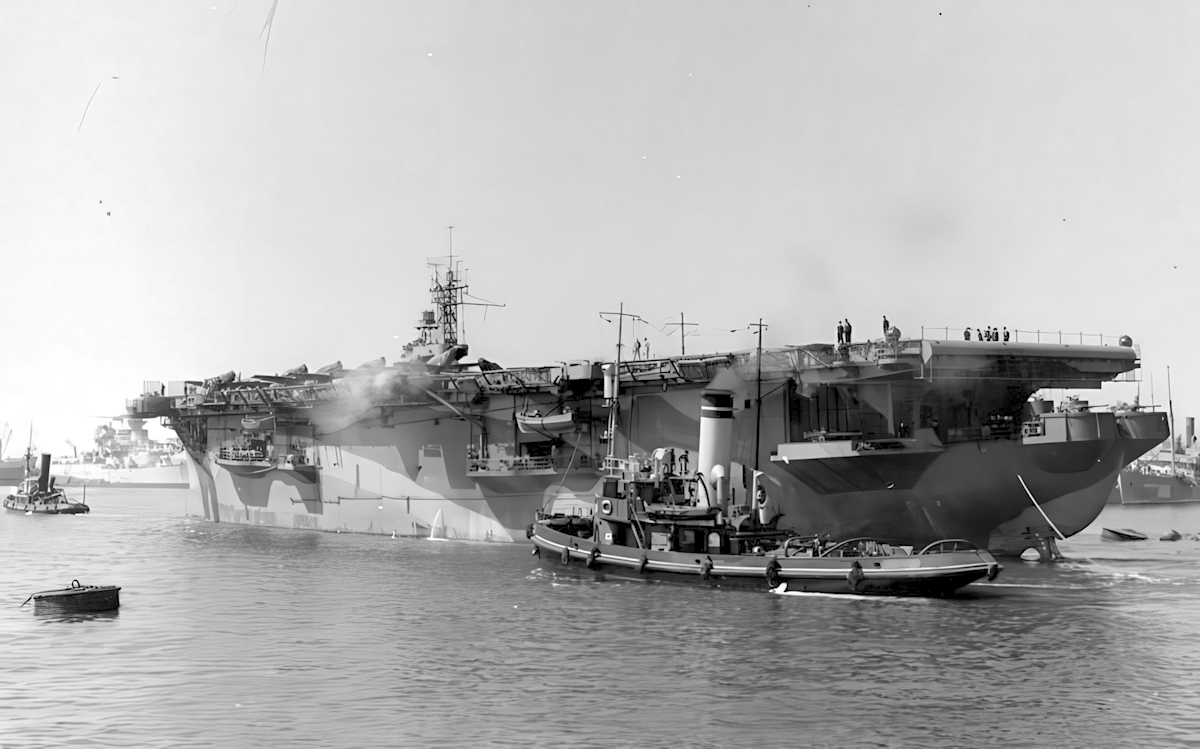
Match 18th 1943: HMS HUNTER at Casablanca unloading her cargo of US Army Air Force planes.
The two carriers were to continue on to the UK as part of convoy MKF.11 sailing from Gibraltar on March 28th; a temporary squadron comprising four Swordfish (detached from 813 squadron) and two Seafires, together with maintenance personnel, was assembled from reserves held at RNAS North Front to provide anti-submarine patrols and limited fighter protection during the passage. The convoy arrived on the Clyde on April 5th 1943. There were two deck crashes during the passage, both involving Swordfish: on April 1st, V4622 flown by Lt. G. A. Willis, RCNVR, stalled on landing, causing the undercarriage to collapse; on the 3rd, Sub-Lt G. A. Donaghue, RNVR, entered the barrier in HS289 making a fast landing.
After unloading stores and equipment from the U.S., both carriers were allocated to British shipyards for further modification work. HUNTER was to go to Dundee, STALKER to Chatham. HUNTER arrived in Dundee on April 12th 1943, and her aircraft left the ship, probably disembarking to RNAS Arbroath. She now entered a dockyard to commence alterations to bring her to RN standards; this work included lengthening the flight-deck to allow Swordfish aircraft to take off with a full weapons and fuel load, installing British Type 79B aircraft warning and Type 272 surface search radars, replacing the US 5in gun mountings with British models, and modification of her petrol distribution system.s
On completion of her modification work, she began a work-up period in the Clyde area. She embarked the 9 Swordfish and 6 Seafires of 834 squadron from RNAS Machrihanish on July 6th. On July 15th she carried out anti-submarine (A/S) exercises with HMS URSULA.
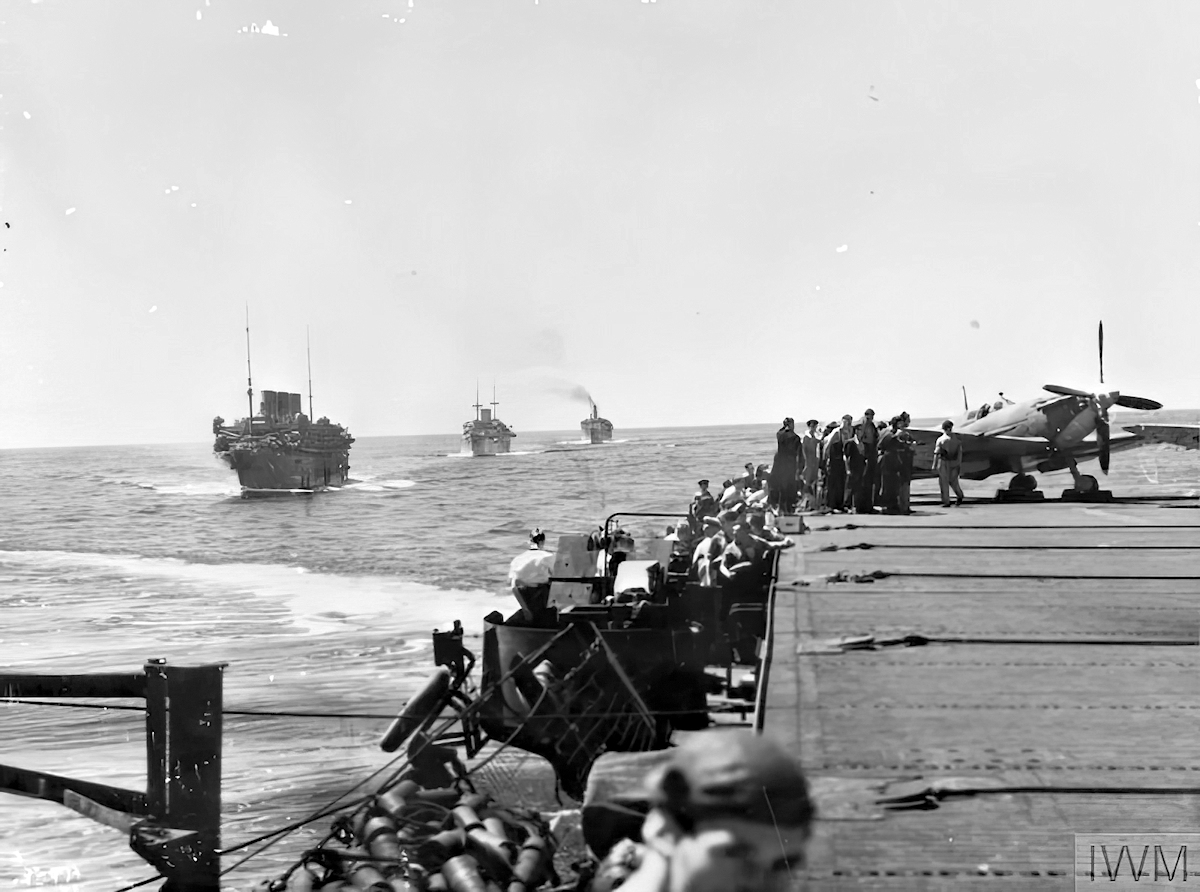
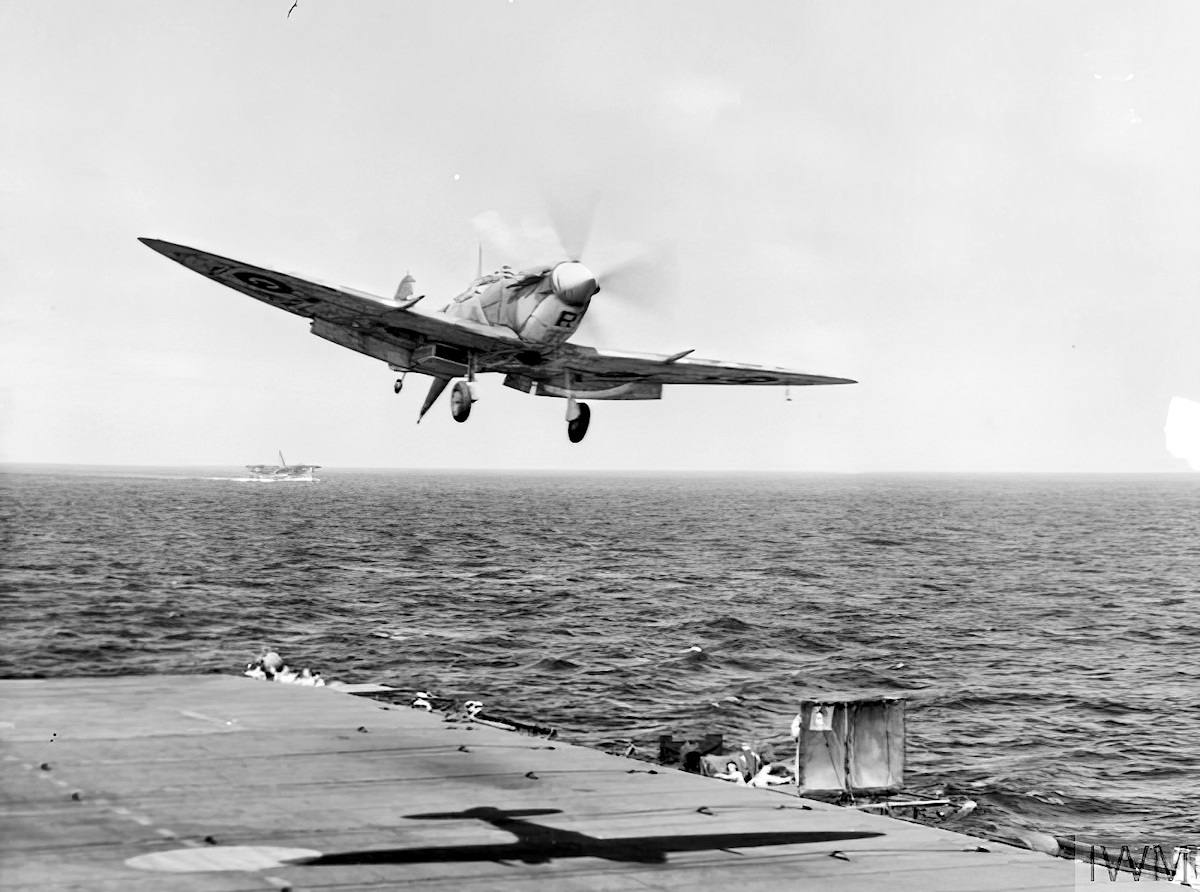
On completion of her work-up, HUNTER was allocated to join the carrier force for the upcoming Allied invasion of Italy. HUNTER sailed from the Clyde at 14:00 hours on August 2nd in company with her sister CVEs ATTACKER, BATTLER, and STALKER bound for Gibraltar. One of her Swordfish was lost only one day out from the UK when LS190 was forced to ditch with engine failure during an A/S patrol; the crew, Sub-Lt A. B. Cookson RNZNVR, Sub-Lt J. R. Leighton, RNVR and Leading Airman R. H. Holmes, were safely rescued.
The four carriers and their escorts ran into a terrible storm in the Bay of Biscay, which lasted through the 4th and into the 5th; the seas were so rough that the ships had to heave to, riding it out. All four carriers suffered storm damage, and many aircraft were badly damaged. HUNTER suffered the worst of the damage: 13 aircraft, 8 Seafires and 5 Swordfish, were badly damaged in the hangar when lashing broke, and several Seafires crashed around, hitting other, still lashed aircraft. She was forced leave the convoy to return to the UK. The remaining three carriers arrived at Gibraltar at 18:00 hours on the 9th.
HUNTER’s repair work was carried out by Harland and Wolfe on the Mersey and on completion of repairs she received replacement airframes and sailed from Liverpool for Gibraltar as part of Convoy WS.33 on August 17th, arriving at Gibraltar on the 24th.
834 squadron was now disembarked to RNAS North Front, Gibraltar; 6 of her Swordfish were to operate ashore from here until October 1st conducting anti-submarine patrols as 834 'Z' squadron. The main body of 834 re-embarked on August 28th along with the Seafires of 899 squadron; this brought HUNTER's embarked strength to 3 Swordfish* and 20 Seafire L.IIc (6 from 834 fighter flight and 14 from 899 squadron).
On the 29th, the ship conducted exercises with vessels allocated to the operation east of Gibraltar. After storing ship at Gibraltar, HUNTER continued on to Malta, arriving there on September 5th.
HUNTER was to form part of Force 'V', the covering force for the allied invasion of Salerno, Italy in operation AVALANCHE planned for September 9 - 12th. Force 'V' comprised UNICORN (809 – 10 Seafire IIC, 887 – 10 Seafire IIC, and 897 - – 10 Seafire IIC), ATTACKER (879 – 10 Seafire LII, 899 – 12 Seafire LIIC), BATTLER (897– 9 Seafire IIC , 808 – 9 Seafire LIIC), HUNTER (834 – 6 Seafire IIC, 886 – 10 Seafire LIIC), STALKER (833 – 6 Seafire LIIC , 880 – 14 Seafire LIIC), the light cruiser EURYALUS [flag of Rear-Admiral P.L. Vian, KBE, DSO and 2 Bars, RN], AA cruiser SCYLLA, Destroyers CLEVELAND, HOLCOMBE, ATHERSTONE, LIDDESDALE, FARNDALE, CALPE, and Polish destroyers ORP SLAZAK and ORP KRAKOWIAK.
A second force, Force ' H ', comprised the Battleships NELSON, RODNEY, WARSPITE and VALIANT, Fleet Carriers ILLUSTRIOUS and FORMIDABLE, and a screen of 21 destroyers, including French, Polish and Greek warships, which was a covering force for the landings, intended to prevent any interference by Italian surface warships. On the eve of Operation AVALANCHE, Italy surrendered, so the threat had passed; however, a strong German force remained in the area.
Force 'V' sailed from Malta on September 8th and proceeded via the Straits of Messina to arrive on station 45 miles south-west of the beachhead early in the morning of September 9th. The carriers of Force 'V' operated only Seafire squadrons; ATTACKER (879 & 886, 19 aircraft), BATTLER (807 & 808, 18 aircraft), HUNTER (834 Fighter flight & 899, 20 aircraft), and STALKER (833 Fighter flight & 880, 19 aircraft) UNICORN (809, 887, and 897, 30 aircraft) making a total of 109 Seafires in 11 squadrons. The five carriers were to provide fighter cover for the landings. It was intended that a constant presence of naval air cover would be maintained over the landing sites, up to 20 aircraft would provide top cover over the force. The first flights were launched at dawn on the 9th. At this time, none of the four CVEs was equipped as fighter or assault carriers, so fighter direction was provided by the Fighter Direction Ship HMS ULSTER QUEEN.
Flying operations began at 06:15 on September 9th and continued throughout the day, with the last sorties landing at 19:15. HUNTER lost one aircraft to enemy action; an unidentified Seafire from 899 Sqn made a forced landing after being badly damaged by enemy gunfire; the pilot, Sub-Lt E. G. Elwell, RNVR, was OK.
During the night of the 9th/10th September, the Force withdrew clear of the operational area, returning on the morning of the 10th, when flying resumed at 06:15. 899 Sqn lost another aircraft during operations; Seafire NM935, launched without a new overload tank, subsequently ditched in Salerno Bay at 07:45. The pilot, Sub-Lt T. H. Johnson, baled out and was picked up by US minesweeper USS YMS 227. Sub-Lt W. J. Long made an emergency landing in Seafire NM967 after developing an oil leak from the prop.
There were two deck crashes on HUNTER on the 11th. Sub-Lt G. Steven, RNZNVR (899 Sqn), entered the barrier in LR661 after his arrester hook bounced off the deck. Sub-Lt J. Kirk, RNVR (899 Sqn), had a spectacular barrier crash in MB298. He made a fast approach with suspected flack damage and entered the barrier. The force of the impact tore his engine free, which fell overboard into the sea. Both pilots were OK.
By the third day of flying operations, attrition was high, and the CVEs required additional aircraft to be transferred from the Fleet Carriers of Force H to sustain operations at this level (Force H withdrew to Malta on the 11th, having nearly exhausted its aircraft by then). It had been envisaged that one or more enemy airfields would be in Allied hands by the end of the first day, so shore-based air cover would take over; this did not happen. Only on the third day, when the airfield at Paestum came under Allied control, did this become possible.
At 06:15 on the 12th, the first sorties were flown off. At 13:45, as many serviceable fighters as could be mustered were put ashore to operate at Paestum; ATTACKER managed 4, BATTLER 5, HUNTER 5, and STALKER only 2, UNICORN supplied 10. At approximately 18:30, the Force left the operational area and proceeded to Palermo, Sicily, to replenish, arriving at 20:00. At 06:00 the following morning, the Force sailed for Bizerta, arriving there at 19:00.
During the four days on station, the carriers launched a combined total of 713 sorties, providing more than half the Allied air coverage over the beachhead. No RN aircraft were lost to enemy action, but 4 were lost through engine failure, and 32 were written off in deck landing accidents. The carriers were back on station by the 16th and the detached aircraft were recovered. On the 17th, a reorganisation of resources was undertaken, resulting in the transfer of what remained of the 807 and 808 squadrons from BATTLER to HUNTER, 834 now transferred to BATTLER.
Force 'V' disbanded on the 20th of September; the four CVEs proceeded to Gibraltar, arriving there on the 24th.
ATTACKER HUNTER and
STALKER to await a convoy to the UK to
refit and allow their squadrons the opportunity to receive replacement
aircraft and aircrews.
BATTLER however, had been assigned to the Eastern Fleet for duties as a trade protection carrier and arrived at Gibraltar to resupply and for 834 Squadron to regroup; she joined the Fast Convoy K.M.F. 24 off Gibraltar on September 22nd for passage to Port Said and on to Bombay.
ATTACKER HUNTER and
STALKER joined the Clyde bound convoy MKF.24 as additional escorts on September 30th. On arrival in the UK, HUNTER was ordered to Dundee to undergo repairs at the end of September, disembarking the men and aircraft of 807 and 808 naval air squadrons to
RNAS Burscough, Lancashire on October 6th, and 899 to
RNAS Ballyhalbert, Northern Ireland on the 13th.
HUNTER in company with ATTACKER sailed from the Clyde on October 7th, ATTACKER for Rosyth naval dockyard, HUNTER for Dundee, both to undergo conversion to an assault carrier. HUNTER arrived at Dundee on October 10th. She was one of several CVEs selected for conversion into a new type of ship to provide air support for major military landings.
The assault CVE would provide air cover until shore-based airstrips became operational; Operation AVALANCHE was the first time such a strategy was tried, and as a result ATTACKER, HUNTER and STALKER were nominated for conversion to the role. The modifications involved many new pieces of equipment being installed; a new Type 277 radar, a new telephone system consisting of over 100 telephones, a new Briefing Room and 'Army Plot' Room, cabins added around the 'Aircraft Direction Room,' and numerous other additions such as extra W/T and R/T sets and still further improvements to the bridge. Another important modification was an anti-aircraft armament upgrade; all existing single Oerlikon mounts on the Gallery Deck and foc'sle deck were to be replaced with fourteen powered twin mounts.
The ship was due to complete her conversion in Dundee in early December 1943 but suffered damage to the Hangar deck plating while she was being undocked on the 3rd. This damage was taken in hand at a dockyard on the Clyde, HUNTER arriving there four days later. It was to be mid-January before she was ready to resume active service.
HUNTER re-embarked 807 and 808 squadrons from RNAS Burscough on January 20th and 21st to carry out Bombardment spotting and target reconnaissance exercises.
On completion of exercising, HUNTER disembarked 808 squadron to RNAS Lee-on-Solent, Hampshire, on February 25th to re-equip and join the 3rd Naval Fighter Wing; some of this unit's aircraft were retained aboard HUNTER, and were absorbed into 807 to bring its strength up to 20 Seafires for operations as part of the 4th Naval Fighter Wing (807 HUNTER, 809 STALKER and 879 ATTACKER). The ship then proceeded to the Orkneys, arriving at the anchorage at Scapa Flow on March 1st to begin working up. 807 squadron was put ashore at RNAS Grimsetter on March 5th, re-joining the ship on the 10th, only to be put ashore again on the 14th. The squadron would not re-join HUNTER again until the end of April.
After three weeks of exercising and flying training HUNTER sailed from Scapa for Belfast on the March 21st escorted by the Norwegian Destroyer STORD, arriving the next day. She was to spend the next five weeks at Belfast, her crew being granted leave
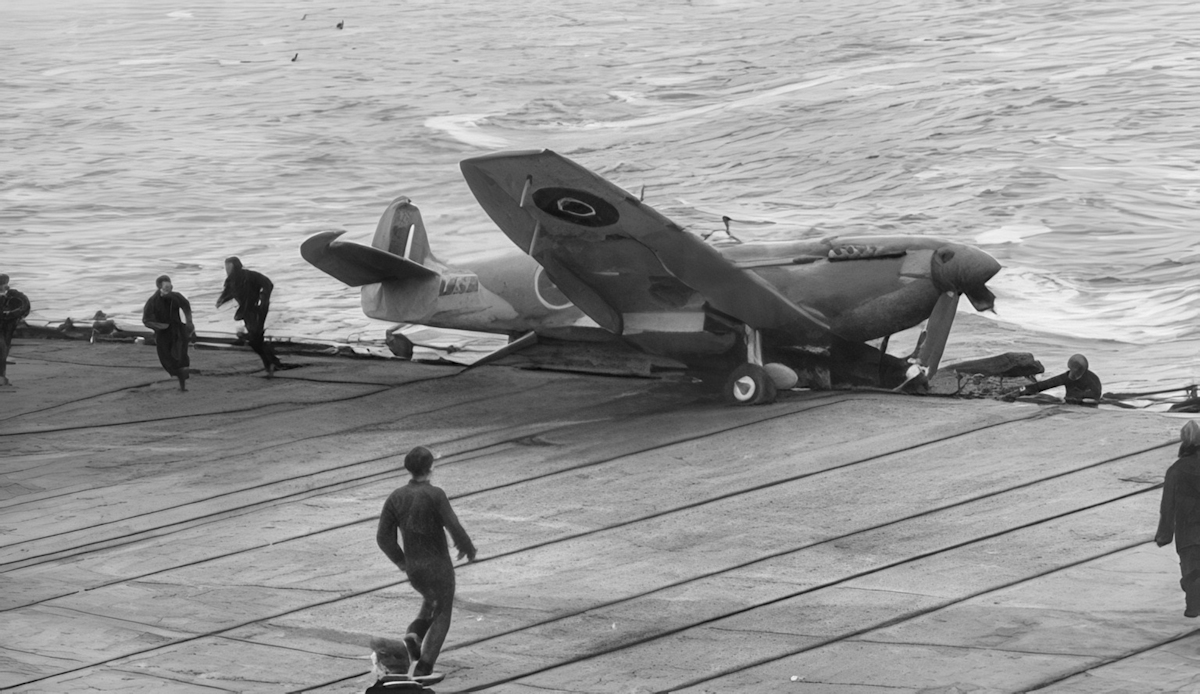
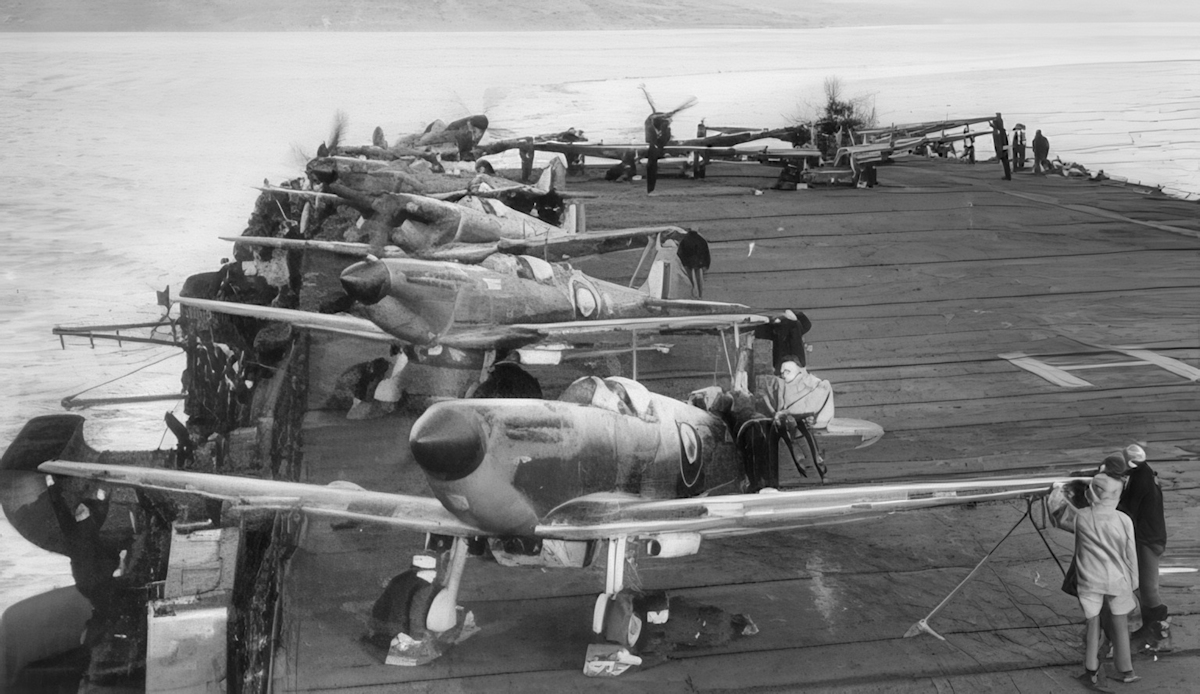
HUNTER put to sea again on April 30th, sailing from Belfast, embarking 807 squadron from RAF Long Kesh on passage for the Clyde. She sailed for Scapa on May 4th and joined ATTACKER and STALKER three on the 5th – this short visit was presumably for radar and RDF calibration; the three carriers left Scapa for Belfast on May 7th.
Arriving at Belfast on May 8th, each carrier embarked spare aircraft and stores in preparation for sailing to return to the Mediterranean. HUNTER, in company with ATTACKER & STALKERsailed on May 14th as additional escort for convoy KMS.51, which departed from Liverpool the day before, for passage to re-join the forces in the Mediterranean. The carriers detached from the convoy at latitude 43° N on the 19th to the 19th, to proceed to other assigned support duties. On reaching Gibraltar on May 24th a detachment of 7 Seafires put ashore to RNAS North Front.
HUNTER put to sea again with ATTACKER on June 6th, re-embarking the detached aircraft; they sailed for Mers-el-Kebir, Algeria, arriving the next day. The ship was to spend the next few months escorting convoys while in the western Mediterranean.
Her squadron was now split between the ship and various airfields, engaged in Army co-operation flying with units in North Africa and Italy; the first detachment flew off on June 20th, with 8 aircraft to operate from Blida, Algiers. This was followed by detachments to Orvieto, Fabria, Capodichino, and Pomigliano in Italy, and North Front at Gibraltar. She put to sea on June 25th to join the escort for convoy KNF.32 on passage, detaching on the 28th.
HUNTER and her sister CVE STALKER were now allocated to operate as part of ask Group 88.2 f (TG 88.2) or the upcoming invasion of Southern France, Operation DRAGOON.
HUNTER sailed from Mers-el-Kebir on the evening of July 21st with the American CVE USS TULAGI escorted by US Destroyers HAINES, HUGHES, and TATUM, for passage to Malta. At 11:17 the following morning, they were joined by STALKER escorted by the USS GLEAVES. The group anchored at Marsa Sorrocco anchorage, Malta, on the 25th. Here they were joined by a second US CVE, the USS KAZAN BAY and US Destroyers BUTLER, GHERARDI, HERNDON, and SHURBRICK to complete TG 88.2. The whole force sailed for Alexandria on the 26th, exercising on passage, arriving there at dawn on the 28th.
TG 88.2 sailed again on August 1st, to return to Malta. On the morning of the 3rd, the ships of TG 88.1 were sighted. The Cruiser HMS COLOMBO joined the group at 08:00 and the CVE E
SEARCHER at noon. The force entered Valletta harbour at 15:35.
The Carrier Force, TF 88, comprised of the seven carriers of Rear Admiral Troubridge’s Escort Carrier Squadron and two U.S. CVEs, divided into two Task Groups; TG 88.1 - Cruisers ROYALIST (Rear Admiral Troubridge, CTF 88 and CTG 88.1) and AA Cruiser DELHI, CVEs ATTACKER (879 squadron with 28 Seafire), EMPEROR (800 squadron with 23 Hellcat), KHEDIVE (899 squadron with - 26 Seafire), PURSUER (881 squadron with 24 Wildcat), SEARCHER (882 squadron with 28 Wildcat), with 7 destroyers. TG 88.2 comprised of the CVEs USS TULAGI (Rear Admiral Durgin USN, CTG 88.2, VOF-1 - 24 Hellcat), USS KAZAN BAY (VF-74 - 24 Hellcat), HUNTER (807 squadron with 24 Seafire, plus 1 Swordfish) and STALKER (809 squadron with 23 Seafire), AA Cruisers CALEDON and COLOMBO, 6 US destroyers.
The ships of TG 88.1 sailed from Malta at 18:00 on August 12th to proceed to the flying off position; they were followed by TG 88.2 at 18:30. Operation DRAGOON commenced in the early hours of August 15th, TF 88 flying operations commenced at 06:00, the last aircraft landed on at 21:05. Only daylight flying operations were carried out.
The assault area, centred on St Tropez, extended some 30 miles along the Cote d'Azur. It was divided into four sectors, code named (from east to west) Camel, Delta, Alpha and Sitka. The assault troops were formed of three American divisions of the VI Corps, reinforced by the French 1st Armoured Division. The 3rd Infantry Division landed on the left at Alpha Beach (Cavalaire-sur-Mer), the 45th Infantry Division landed in the centre at Delta Beach (Saint-Tropez), and the 36th Infantry Division landed on the right at Camel Beach (Saint-Raphaël). A fourth Force, the First Special Service Force, a joint U.S.-Canadian special forces unit was landed on the offshore islands for ‘Operation Sitka’ to neutralise the Hyères Islands, (Porquerolles, Port-Cros, Bagaud, and Levant). By the end of the first day, 60,150 troops and 6,737 vehicles had been put ashore, including the first French armoured contingent.
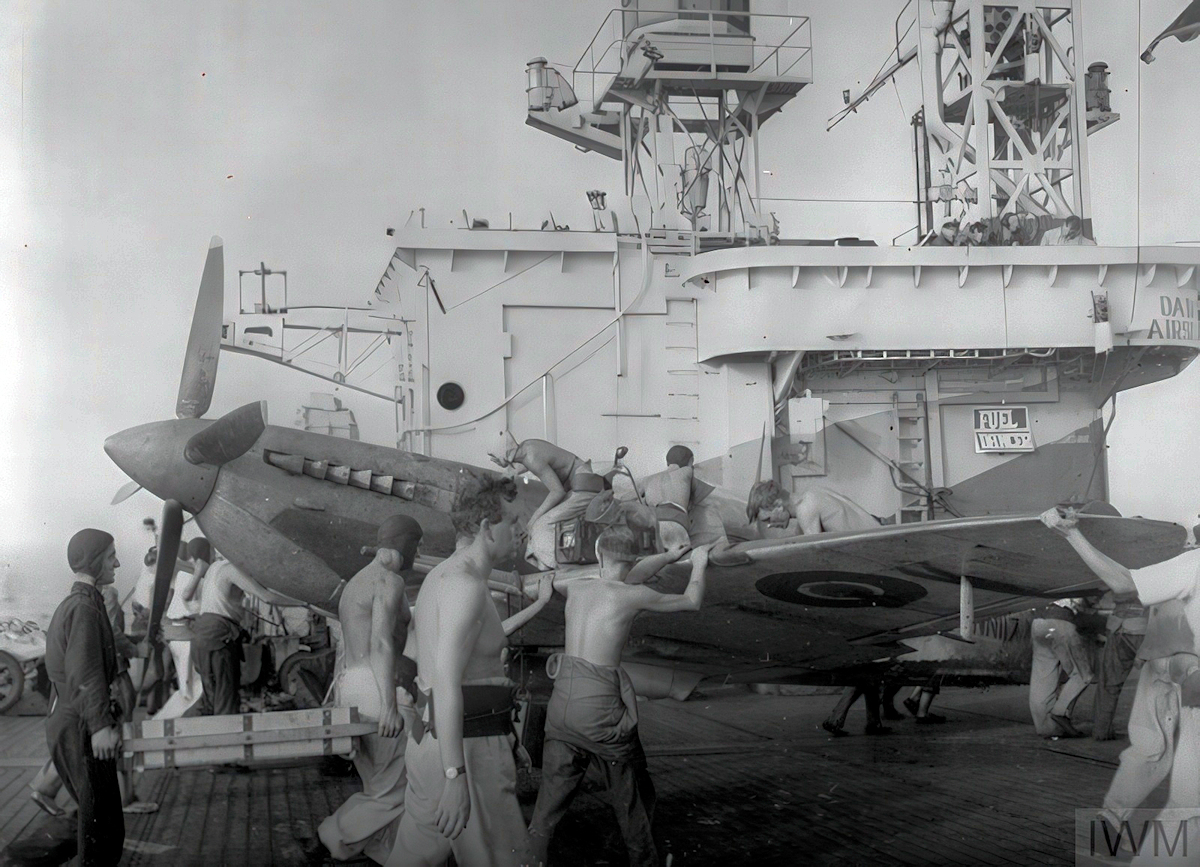
Seafire NN117 of 807 squadron being being manhandled on the flight deck by the aircraft handling party.
On ‘D’ Day, HUNTER and TG88.2 were at the flying off position at 05:30 and 807 squadron had 24 serviceable aircraft that could be tasked with any of six mission types: Fighter Bomber (F/B), Strafing, Tactical Reconnaissance (TacR), Force Cover, Beach Cover, and Bombardment Spotting. There were 26 pilots and 24 Seafires on board and limited reserves aircraft held ashore at Casabianda airfield in Corsica.
The first two Serials launched at 06:00: 4 aircraft for Force cover and 2 for Bombardment spotting. The squadron maintained a cycle of 4 aircraft on Force Cover and pairs on Spotting sorties throughout the day. The last Force Cover aircraft landed at 21:05. Owing to the very light wind of 18 knots, aircraft had to utilise the full length of deck for the take-off run. On one occasion, owing to an unforeseen zephyr coming up astern, two aircraft actually took off with long-range tanks with only 15 knots (downwind). Another consequence of the low wind was mist and haze; the coast was not visible, and only the smoke of explosions was seen from the ship.
The squadron flew a total of 41 sorties; 31 Force Cover and 10 Spotting in DELTA sector. There was no call for any TacR missions although it had been expected that this would form one of the principal functions of the Seafires in the early stages of the operation. One aircraft was lost and 3 others damaged in landing accidents: Lt T. B. Leaning, RNR, on take-off in Seafire NF443 observed that his wing folding safety indicator had come unlocked and he force-landed ahead of the ship, he was picked up by the Destroyer BUTLER, but he sustained back injuries which put him out of the operation, he was subsequently discharged to the Naval Sick Quarters at Maddalena. Sub-Lt M. La Page, RNVR floated into the barrier in NF645, Sub-Lt P. W. J. Webb, and RNVR made a heavy landing in NF624 and the port undercarriage collapsed, Lt K. M. Evans, RNVR landed in LR880 but the arrestor wire did not fully pull out, the aircraft tipped on its nose then dropped back.
On D+1 807 squadron had 17 serviceable aircraft available; a pair of TacR Seafires were ranged at 06:00, on call but not launched. At 07:40 8 aircraft launched for a joint F/B Beach Cover mission. This was the first occasion on which bombs were carried by HUNTER's aircraft, their orders were to fly first to the assigned target, with orders to proceed to the Beach Patrol after its attack. This was a poorly conceived mission for the Seafires; reaching the objective occupied about forty minutes including target identification, avoidance of flak areas and a preliminary climb to attack, then return to the DELTA Beach area with little time left on the Beach Cover Patrol (approx. 30-35 minutes) when landing on the carrier at 08:55. The next launch was not until 14:40 when 2 aircraft took off for a spotting mission, a second spotting pair were reneged on call.
The squadron flew a total of 28 sorties; 4 F/B, 4 strafing, 4 Force Cover, 16 Beach Cover. The results were 3 x 500 lb Bomb hits on a road NW of Toulon. 3 x 500 lb bombs on German Fort and Coastal Defences. A Wireless Pylon was felled. One Seafire suffered minor damage; Sub-Lt L. G. C. Reece, RNZNVR, in NF626 landed with drift, and the prop was damaged.
On D+2 807 squadron had 18 serviceable aircraft available; a pair of TacR Seafires were ranged at 06:00, on call but not launched. The first launch of the day was at 07:15 when 8 aircraft departed for a Beach Patrol; they were diverted to investigate and strafe enemy vessels interfering with minesweeping operations a few miles to the Southwest of Toulon Harbour. During this mission, Lieutenant (A) L. G. Lloyd, RNVR, approached a German armed vessel and was hit by fire from a flak ship; his aircraft NF606 caught fire and dived into the sea from 800 feet South of Toulon; he was not recovered.
At 11:10 HUNTER received the first request for Army support outside of the prearranged flying programme utilising the specialised training and capabilities of her Seafires; eight Fighter-bombers were ranged at readiness on call, at 11:29 the target information was received and the aircraft were ready to take off at 11:45. The target was 70 miles from HUNTER ,and the attack was completed by 12:30.
The squadron flew a total of 32 sorties: 8 F/B, 4 Force Cover, 24 Beach Cover. The results were 3 enemy M.T. damaged. One Seafire and its pilot were lost; a second aircraft suffered prop damage when a cowling came adrift.
On D+3, 807 Squadron had 13 serviceable aircraft available; the flying programme again called for a pair of TacR Seafires ranged at 06:00, on call but not launched. The first launch was 8 aircraft for Beach Patrol at 07:40; they returned at 08:55. The squadron struggled to fulfil the aircraft requirements for the remainder of the day’s scheduled sorties; a problem with the wing folding mechanism on a number of Seafires carried on strength meant that some sorties were not launched. The programme called for 20 sorties; 4 F/B, 8 Force Cover, 8 Beach Cover. The results were 8 enemy M.T. destroyed, 5 damaged, 1 x 500 lb. Bomb hit on a River Bridge. One aircraft was damaged when it bounced on landing, bursting both tyres.
On D+4, 807 Squadron had only 8 serviceable aircraft available; the planned programme was similar to D+3, with an additional Force Cover serial at 19:20; this landed at 21:00 when the day’s flying ended. A second request for an Army co-operation mission was received at 12:20, which called for 6 fighters to strafe a railway target approximately 65 miles from the ship. Briefing was completed by 12:45, and take-off commenced at 12:56. Arriving over their target at 13:35, they destroyed a locomotive before returning to the ship. 807 squadron flew a total of 30 sorties; 8 F/B, 10 Strafing, 12 Force Cover. The results were: 1 Train attacked; Engine destroyed; 8 enemy M.T. destroyed; 8 damaged. Photographs taken of shipping in Marseilles.
The ship’s communications Swordfish was launched in the afternoon to deliver photographs and maps to the force Flagship USS TULAGI; this resulted in a barrier crash, and the aircraft caught fire and was destroyed. The pilot and passenger escaped uninjured.
The two Task Groups of Force 88 had operated together for the first five days of the operation, but separated late on the 19th; ATTACKER, EMPEROR, PURSUER, and SEARCHER withdrew to Maddalena, Sardinia for a 24 hours replenishment and rest period while KHEDIVE transferred to TG 88.2 to bolster the force.
On D+5, 807 Squadron had 16 serviceable aircraft available; the weather and wind conditions improved, and the emphasis shifted to armed reconnaissance missions, and the squadron carried out its first successful Bombardment spotting mission with the American Battleship the USS NEVADA and heavy cruiser USS QUINCEY. A photo recon mission was flown by Lt E. C.B. Ford, RNVR, a vertical line overlap series at 12,000 feet over Marseilles harbour to gather information on enemy shipping; the results showed that, up to this moment, no visible demolition by the Germans had taken place in the port.
On returning from the dawn bombing mission, Lt E. V. Speakman, RNVR, was killed; having suffered flak damage while attacking targets ashore, his aircraft Seafire FB.L.IIc MB314 was unable to lower its flaps for landing. He attempted a normal approach to land but was seen to fall unconscious just before touching down; instead of cutting the throttle to land, his forward slump pushed the throttle fully open. The aircraft partially rose from the deck and flew through the barriers, narrowly missing the island and went over the starboard bow. The crash brought down the HF/DF nest and caused the deaths of six ratings, AF(E) S. T. C. Barter, AF(E) W. G. P. Peirce, and AM2 E. F. Pym, who were working on deck, and Ordinary Seaman J. Pyke and Able Seaman W. R. Street, with serious injury to AM2 X. Brown and the loss of Ordinary Seaman C. O. J. Knight, who was knocked over the side into the sea. The burial of the ratings who died on board was carried out the same evening at 19:30.
807 squadron flew a total of 22 sorties; 8 F/B, 4 Force Cover, 4 TacR, and 6 spotting. The results were 6 enemy M.T. destroyed, 1 damaged. HMS KHEDIVE detached from TG88.2 at 22:00 and sailed for Maddalena for replenishment.
On D+6, 807 squadron had 12 serviceable aircraft available. TG88.1 had arrived back on station, and TG88 flying operations began at 06:30. By this time, the seventh day of operations for TG88.2, the serviceability of aircraft began to suffer; the Seafire, being a folding wing aircraft made the servicing of their guns almost impossible due to the pace of operations, maintenance required the aircraft to be on deck and wings in flight position for his procedure. The result was a marked increase in the number of guns jamming on target. All spotting missions for TG88.2 were cancelled. During the day, 807 Squadron flew a total of 42 sorties: 4 F/B, 22 Strafing, and 16 Force cover. The results were 23 enemy M.T. destroyed, 13 damaged.
On completion of the day’s flying TG88.2 withdrew and proceeded overnight to Maddalena, Sardinia for a 24 hours replenishment and rest period.
D+7, rest day: TG88.2 arrived at Maddalena at 08:00 on the 22nd and the carriers anchored in Arcachon Bay. The pilots had a day’s rest but most of the ship's company were busy on maintenance work, embarking ammunition, petrol, stores, etc. Bombs were not available at Maddalena and the American Carriers were desperately seeking additional stocks. It was decided that HUNTER and STALKER would transfer their remaining 250 & 500 lb bombs to the USS TULAGI and USS KAZAN BAY; their Hellcats were employed against more substantial military targets and often beyond the range of the Seafires, so their need was greatest. With some simple modification, the Hellcats could successfully use these bombs.
During the visit to Maddalena, five of 807 squadron’s Seafires were put ashore by lighter, four being category Y and would be too labour intensive to repair on board and one unfit for further operation due to engine problems. Six pilots were sent from HUNTER to Ajaccio by destroyer to collect and ferry six replacement aircraft to the landing strip at St. Tropez, which was by that time serviceable; they would embark on the 24th when operations resumed. The visit was not long enough to allow the embarkation of fuel oil or aviation spirit, of which only sufficient then remained on board for about six days' operations.
D+8, rest day: rest day: TG88.2 sailed from Maddalena at 11:00 for Propriano, Corsica in the hope of finding US ships that could help with the shortage of bombs. They arrived in Propriano Bay at 14:45 but found no additional ordnance. HUNTER and STALKER managed to continue replenishing their air stores, which had been hastily embarked in several Destroyers for later transfer. The Force weighed anchor at 18:00 and set course for the operational area.
On D+9 TG88.2 arrived back on station at 06:30 on August 24th, having relieved TG88.1, which had withdrawn to Maddalena overnight. 807 squadron had 11 serviceable aircraft available out of 15 aircraft on board, 8 Seafire L III s and 7 L IICs, four of which were photo recon aircraft.
The tasking changed for the second period of operations: no Fighter Bomber or Beach cover sorties were to be flown. The largest number of sorties was assigned to spotting, although on many occasions no bombardment took place. The bombarding ships and spotting aircraft, however, were maintained at continuous readiness throughout the day. A few strafing sorties and reconnaissance were flown, but many targets were at the limits of the Seafire’s range. There were two incidents that occurred during one of the strafing missions; while ranged for take–off at 17:00, a chock-man, AB Moss, manning chocks backed into prop of NF638 ('D5X') manned by Sub-Lt N. A. Neal RNVR causing serious injuries, he was stabilised by blood transfusions in the ship’s Sick Bay before being transferred to an American hospital ship the following morning. One pilot from the mission failed to return to the ship; Sub-Lt G. E. Thomas, RNVR, in Seafire NM994 lost contact with his flight over Saint-Laurent-la-Vernède; there was no flak or enemy aircraft in the area, and the remainder of the flight saw no evidence of a crash. One other Seafre L.IIc, NM917, was damaged on landing; Lt. Cdr A. F. Slaney bounced on touchdown and burst a tyre; the resulting stress wrinkled the fuselage. Also, in the afternoon, a replacement Wildcat for PURSUER’s 881 squadron arrived over the fleet from St. Tropez and landed on the USS KAZAN BAY; it later transferred to HUNTER to await instructions but remained on board.
During the day 807 squadron flew a total of 26 sorties; 12 Strafing, and 4 Force cove and 10 spotting. The results were 5 enemy M.T. destroyed, 7 damaged, 2 Successful Spotting Mission with USS NEVADA.
On D+10 807 squadron had only 9 serviceable aircraft available; 8 of these machines would complete 23 out of the 24 sorties flown this day. A call for army support had been declined; at the time of the request, 4 replacement Seafires from St. Tropez had landed, and a major reshuffle of aircraft in the hangar was necessary to accommodate them; there were several crashed machines and a Wildcat still on board taking up valuable space. These replacement aircraft had to be taken over at Casabianda, Corsica, and were found to be in very poor condition. On arrival at St. Tropez none had its radio or beacon equipment serviceable; one of them showed mainplane buckling, and one had a slightly wrinkled fuselage. A serviceable aircraft had to be flown ashore to lead them out to the ship, reducing the number for offensive operations down to 8. On take-off from St. Tropez, one replacement suffered a brake failure, causing it to ground loop before take-off, and it was so seriously damaged as to be a probable write-off. None of these replacement aircraft was operationally serviceable before the ship was withdrawn from the operation.
At about 12:20, two replacement Seafires for STALKER’s 809 squadron arrived over the force; they were not expected, and STALKER’s forward lift was out of action from 12:15. An electrical fault kept it in the down position, preventing any flying operations until 17:15; they were ordered to land on HUNTER and transferred to STALKER at 17:30.
At the end of this day's flying, the ship’s Y.E. Beacon aerial had to be unmounted and lowered to the flight deck; a very large number of 180-degree turns at 18 knots throughout the day resulted in severe vibration felt throughout the island structure, which had shaken the aerial loose, which fortunately did not fall from the mast. During the day, 807 Squadron flew a total of 24 sorties: 6 Force cover, 4-armed reconnaissance, and 14 spotting. The results were 3 Successful Spotting Missions with FS LORRAINE.
There were two aircraft put out of commission on returning to the ship, both piloted by Sib-Lt P. M. Lamb, RNVR; he landed heavily in NM934, bursting both tyres and damaging the oleos, and again landed heavily in NM999, and bounced into the barrier and struck the island.
On D+11, 807 squadron had only 8 serviceable aircraft available. Four Seafire undertook a long range strafing mission which was carried out at a depth of 120 miles from the ship; the practical limit for Seafires equipped with 30 gallon drop tanks which have to return to a ship not less than 30 miles from the coast. Considerable flak was experienced on this mission and one aircraft had its drop tank shot off but returned safely.
A further photo reconnaissance of Marseilles Harbour was carried out; again, a Vertical Lino Overlap was taken at the same scale as the shot taken on D+5. This showed a very different picture. Demolition had been carried out on every wharf, crane, warehouse and other port facility of importance, and most of the ships previously seen intact were now sunk.
During the day, 807 Squadron flew a total of 17 sorties: 4 Straffing, 5 Force cover, 4 armed reconnaissance, and 4 spotting. The results were 1 Good Spotting Mission with USS AUGUSTA, a successful photo recon Mission over Marseilles. One Seafire was damaged landing on the ship; Sib-Lt Lamb in LR686 caught No. 7 wire, and his prop hit the barrier.
On D+12, 807 squadron had 10 serviceable aircraft available; they were airborne at 08:20. The wind, which had been a steady 30 knots across the deck the day before, now dropped; the resulting dramatic change caused havoc for the fatigued pilots and the Deck Landing Control Officers. By 15:00 there were only three serviceable aircraft, 5 were put out of action due to deck landing accidents. One, the last sortie of the day to come in to land, suffered an undercarriage hang-up and was ordered to land at St. Tropez and fly to Casabianda airfield in Corsica once the aircraft was serviceable.
During the day, 807 Squadron flew a total of 21 sorties: 4 Strafing, 2 Force cover, 4 armed reconnaissance, and 11 spotting. The results were 1 Staff Car destroyed - 2 M.T. damaged, 1 Successful Spotting Mission with HMS RAMILIES. There were 5 deck crashes; Sub-Lt Page in LR749 bounced over all the wires and entered the Barrier; Lt. J. E.M. Thornhill, RNVR in NF626 tried to go around again, but his hook snagged on No. 3 barrier, and the aircraft dropped onto the forward lift. Sub-Lt L. D. Graham, RNZNVR in NF638 hit the barrier, damaging the prop and engine fairings; Sub-Lt N. A. Neal, RNVR in NN117 entered the barrier and nosed over; and Lt. Cdr A. W. Bloomer, RNVR in NN112 suffered a starboard oleo collapse, damaging the prop.
This completed flying operations for Operation DRAGOON. That evening HUNTER received an urgent request from the Commanding Officer of TULAGI for a component part for her catapult (which was the same typo as in HUNTER). The TULAGI had three more days of operations ahead of her, and HUNTER, having no need to use her catapult, the Captain had the component part removed from HUNTER and transferred to TULAGI, with the promise to arrange the replacement of this component from the repair ship USS VULCAN as soon as possible. At 20:48, HUNTER, STALKER and the Cruiser CALEDON escorted by the American destroyers MURPHY and SHUBRICK detached from TG88.2 and proceeded to Maddalena.
HUNTER and
STALKER arrived at Maddalena at 10:45 on Monday ,August 28th and anchored in Arsachona Bay at about 11:30. At this time 807 squadron had only 4 serviceable aircraft available. Over the 13 days of operation DRAGOON 807 squadron completed a total of 485.10 flying hours in 307 sorties; 36 dive-bombing, 56 armed reconnaissance, 96 Force cover, 48 Beach Cover, 16 TacR and 55 Spotting missions for the loss of 4 aircraft and 11 deck landing accidents. Two pilots were killed, 1 reported missing, and one seriously injured. After storing ship HUNTER sailed for Alexandria, arriving there on September 2nd, 807 disembarked a detachment of 6 aircraft to
RNAS Dekheila the same day.
While at Alexandria the seven carriers of Rear Admiral Troubridge’s Escort Carrier Squadron were reallocated for operations in the Aegean, and a new force, Force 120, was constituted on September 2nd. This initially comprised HM Ships ROYALIST (FOEC) ATTACKER, HUNTER, EMPEROR, KHEDIVE, PURSUER, SEARCHER, STALKER, TROUBRIDGE (Capt. (D) 24), TYRIAN, TEAZER, TERMAGANT, TERPSICHORE, TUMULT, TUSCAN, TENACIOUS, Greek destroyer HHelMS NAVARINON, and Polish destroyer ORP GARLAND. They were joined on the 24th by the cruisers ORION, AJAX, BLACK PRINCE, ARGONAUT, AURORA, and COLOMBO from Naples.
Elements of Force 120 were to operate in the Aegean conducting Operation OUTING; this was to be carried out in five phases; phase 1 began only a week after the carriers arrived back at Alexandria, and the final phase concluded at the end of November. HUNTER took part in phases 1 & 2.
Operation OUTING I
Force 120 and the Cruisers were to split into two groups, the carriers s HUNTER,
KHEDIVE,
PURSUER, and
SEARCHER sailed on September 9th with Force ‘A’; their task was to hamper and delay German troop movements in the Dodecanese Islands (Leros, Kos, Samos, Rhodes, and Levitha). Force A sailed from Alexandria on the 9th of September to operate off the south coast of Crete, the carriers to carry out reconnaissance and strikes by day, also to provide CAP for the force while the Cruisers and Destroyers of the force struck at targets by night. The first night targets were presented on the 12th/13th, when ROYALIST and three destroyers attacked a small convoy on the Candia-Santorin route; the next night drew a blank, but on the night of the 14th/15th, two German KT ships were destroyed by ROYALIST and the Destroyer TEASER.
EMPEROR and
ATTACKER arrived on station on the 15th and HUNTER was released to return to Alexandria.
Operation OUTING II
HUNTER next sailed on September 27th as part of the force for Operation OUTING II, a second series of strikes commencing on September 30th. The Force comprised ROYALIST (FOEC),
ATTACKER, HUNTER,
EMPEROR, and the Anti-Aircraft Cruiser COLOMBO plus screening Destroyers. A priority was the bombardment of two airfields on Crete which were being used by the Germans to evacuate their troops in night-time airlifts. As many as 100 flights a night were departing from Crete, but Force ‘A’ carried no night fighters, so there was little they could do to intercept this traffic except to damage the airfields at Maleme and Heraklion themselves. Strikes were made against shipping near Leros on October 3rd. Few targets were presented during Phase 2, and the three carriers flew only 82 sorties between them; the Force returned to Alexandria on October 5th. HUNTER remained on station to join the covering force for minesweeping operations. During Outing I & II, 807 Squadron had flown 135 sorties, including Force Cove, Fighter Bomber, and TacR.
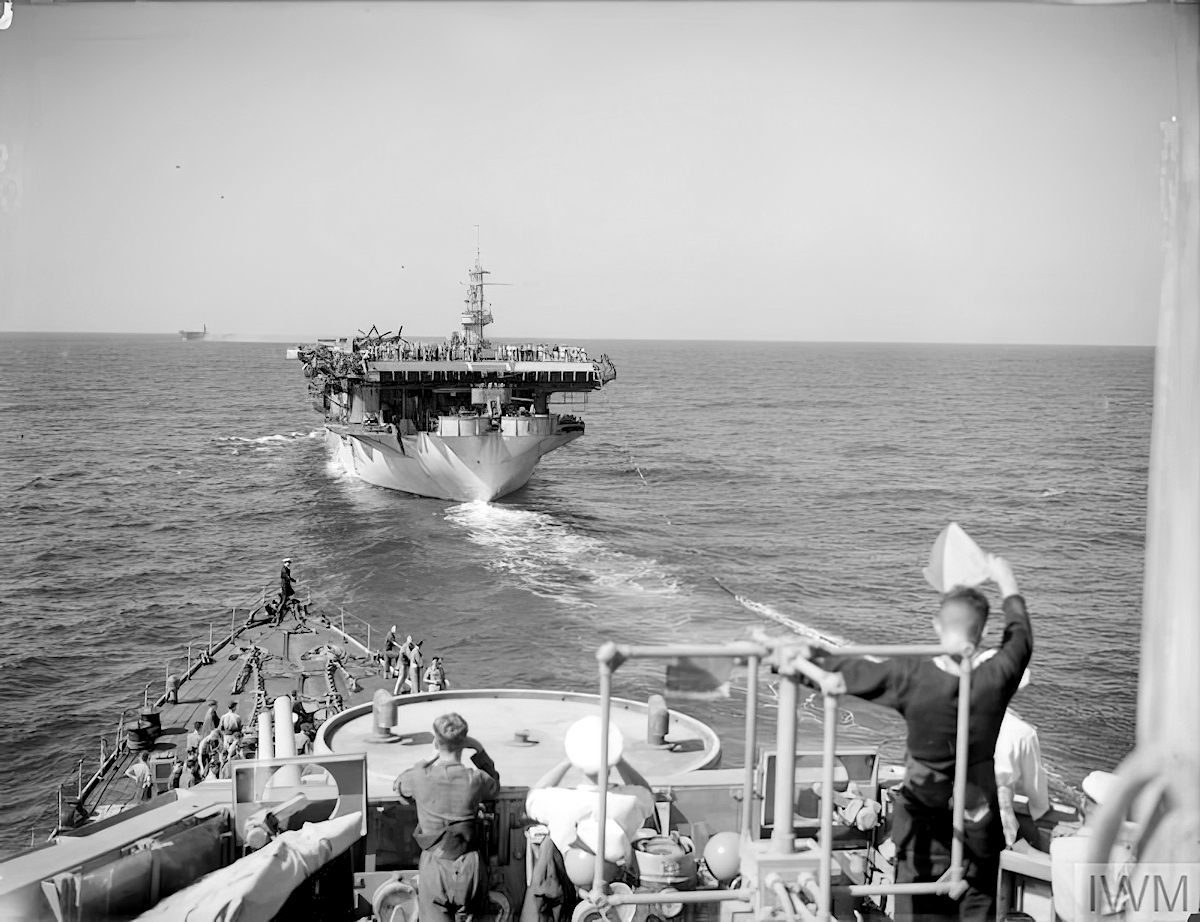
HUNTER acting as an auxiliary Oiler during operations in the Aegean, in early October 1944. She is fuelling the Cruiser AURORA off the island of Santorin. © IWM A 2600
Air cover for the 5th Minesweeper Flotilla and strikes in the central Aegean
On October 6th HUNTER joined the covering force that had been protecting the 5th Minesweeper Flotilla operating in the Kinaros Channel comprised the Cruisers BLACK PRINCE (S.O), AURORA, CVEs HUNTER and STALKER. On the 7th they passed through the Kinaros Channel to enter the central Aegean. That afternoon 12 F/B Seafires carried out a strikes against a small enemy convoy of three ships, the largest, approximately 1,000 tons was sunk, another, a Caïque was damaged and one of the convoy escorts was run aground Later that afternoon 8 F/B Seafires, 4 each from 807 and 809 carried out a strike against a 2,000 ton vessel located SW of Lemnos, 2 direct hits with 500-lb bombs were achieved, one each by Lt. Cdr Eaden and Sub-Lt A. C. S. Morrison, RNVR, (809 Sqn) it sank almost immediately. Flak from the ship hit Seafire NF439 forcing the pilot Sub-Lt D. Stewart (807 Sqn) to bale out but he was killed. On completion of the day’s operations the two Carriers and attendant Destroyers detached from the Cruisers and moved overnight to begin a day of armed reconnaissance in the central Aegean.
The Carriers arrived at the start point of their operational area, west of the island of Strati, at 07:30 on September 8th. Most of the day was reconnaissance sorties but some strikes were called for once targets were identified, this were mostly attacks against coastal shipping and harbours.
During operations on the 9th HUNTERS 807 Sqn lost another pilot while attacking a group of 3 Siebel Ferries, Sub-Lt J. A. Littler, and RNVR was hit by flak but failed to bale out. On the 10th the two carriers were ordered to withdraw, STALKER was to proceed directly to Alexandria but HUNTER conducted reconnaissance flights over Syros and Leros and launched attacks on harbours on passage as a diversion for OUTING phase 3 operations in the northern Aegean. ATTACKER arrived on station 11th.
During this period HUNTER’s 807 squadron flew 102 sorties; she carried 17 Seafires and 24 pilots; 2 aircraft and their pilots were lost in action. 1 aircraft was seriously damaged; on withdrawing, she had 10 serviceable aircraft. She also carried out 7 RAS sessions (Replenishment At Sea) fuelling other vessels of the force. On arrival at Alexandria, she disembarked 807 Squadron to
RN Air Station Dekheila, Egypt in preparation for her return to the UK for a short refit.
On October 31st, the three Assault Carriers, ATTACKER, HUNTER, and STALKER sailed in company for the UK. Calling at Malta on November 3rd to embark passengers for passage to the UK. The three carriers were earmarked for service with the 21st Aircraft Carrier Squadron (21 ACS), with the East Indies Fleet and were to undergo a short period of defect rectification while their crews went on home leave. They reached Plymouth on November 10th and ATTACKER and STALKER were handed over to the Devonport Naval Dockyard; HUNTER continued on to Portsmouth.
The three Carriers were moored alongside in their respective dockyards, and two weeks' leave was granted to the whole ship's company; only a care and maintenance party remained aboard. The immediate repairs and crew leave completed, the three Carriers sailed from the UK on November 29th for Gibraltar; all three were on passage to undergo refits and tropicalisation in Mediterranean dockyards; STALKER was to refit in Gibraltar on their arrival on December 3rd so her squadron, 809 Seafires transferred to ATTACKER on leaving Plymouth and were disembarked along with 879 squadron to RNAS Dekheila, Egypt on December 11th. HUNTER proceeded to Malta for refit beginning December 6th. ATTACKER was to refit in the Italian port of Taranto.
Her modifications and refit completed HUNTER sailed for Trincomalee, Ceylon on February 21st 1945; the ship was reunited with 807 naval air squadron on March 6th when they re-embarked from RNAS Dekheila before the ship entered the Suez Canal.
HUNTER arrived off the west coast of Ceylon on March 20th and disembarked 807 to RNAS Katukurunda. She spent the next month working up with 21 ACS and 807 in preparation for Operation DRACULA the sea borne assault on Rangoon.
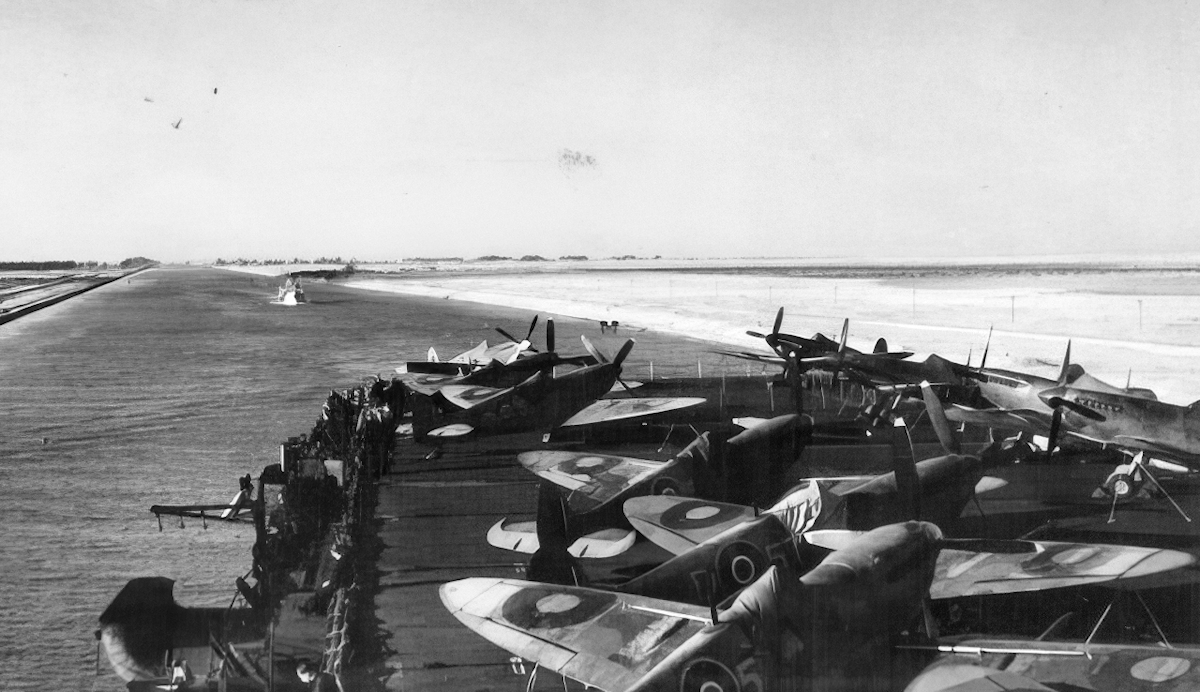
c. March 7th 1945: HUNTER on passage through the Suez Canal on to join the East Indies Fleet.
HUNTER sailed from Trincomalee for passage to Akyab, Burma at 15:00 on the 23rd. She sailed as part of 21 ACS - ROYALIST (Flag 21 ACS, Commodore G. N. Oliver, CB, DSO), PHOEBE (Fighter Direction Ship), CVEs EMPEROR, HUNTER, KHEDIVE, and STALKER screened by Destroyers SAUMAREZ (sailing delayed by defects) , VENUS, VIGILANT, VIRAGO. The carriers conducted flying exercises on passage, the Force arrived at Akyab at mid-day on April 26th, ROYALIST and PHOEBE going to Kyaukpyu. After refuelling the Force awaited further orders.
Assault convoys and passage to Rangoon: The force sailed from Akyab at 11:00 on Sunday the 29th for Kyaukpyu; four Auster Air Observation Post aircraft from No. 656 AOP Squadron RAF flew out to join the force once clear of Akyab, one landing on each carrier. On passage, communications for the operation were tested, and radar calibration was carried out. The force anchored off Kyaukpyu at 16:53, joining the vessels of Force ‘W’ for the assault operation. These ships had already been moved from their bases in India and Ceylon to gather off Akyab and Kyaukpyu. D-Day was set for the second of May, and the assault force was sailed in four convoys from Kyaukpyu, the slowest, 'Dog' of 4½ knots, on April 27th, followed by 'Easy' on the 28th and 'Charlie' and 'Baker' at roughly twenty-four-hour intervals thereafter.
The 21st Aircraft Carrier Squadron sailed at 06:40 on April 30th to provide daylight air cover for convoy 'Baker' as it left Kyaukpyu. This convoy included LARGS (Flag Officer, Force W), PHOEBE as Fighter Direction Ship, 4 Landing Ships Infantry, 2 transports, and H.M. Indian sloops CAUVERY and SUTLE. Flying commenced at 10:00 when EMPEROR launched a section of 2 Hellcats for high convoy cover, this being maintained until 16:00. STALKER launched 4 Seafires for low convoy cover at 16:00, followed by 4 more at 16:45; another 4 were kept on deck at ten minutes' notice. KHEDIVE flew 4 sorties for Force Cover.
On the morning of May 1st HUNTER began launching pairs of Seafires for low convoy cover, her squadron completing 16 sorties during the day; EMPEROR again maintaining a continuous pair of Hellcats on high convoy cover, providing 10 sorties during the day. KHEDIVE flew 10 sorties for Force Cover. STALKER began flying operations at 12:00, launching 4 aircraft for low-level convoy cover; by this time, Convoy Charlie was also receiving air cover. STALKER began flying operations at 12:00 when ashes launched 4 aircraft for low convoy cover, by this time convoy Charlie' was also receiving air cover, STALKER launched a further 12 sorties during the afternoon. Throughout the day, the force took on fuel: ROYALIST took on 248 tons from STALKER, SAUMAREZ 70 tons from KHEDIVE; VENUS 120 tons from EMPEROR, VIRAGO took on 116 tons; and VIGILANT took on 111 tons from HUNTER. Flying ceased at 17:55, and the Squadron retired to the Southeast.
D-Day May 2nd: The assault convoys arrived at the lowering positions 30 miles off the Yangon River during the night 1st/2nd May and formed into two assault groups; W1 and W2. Group W1 consisted of the Landing Ships (Infantry) PERSIMMON and BARPETA, Landing Craft (Headquarters) 317, 4 Landing Craft (Infantry), 9 Landing Craft (Tank), 3 Landing Craft (Gun), 2 Motor Launches and 4 Harbour Defence Motor Launches. Captain Tyndale Cooper, Senior Officer Assault Group W1, with Brigadier L. V. Hutcheson commanding the 71st Indian Infantry Brigade, were embarked in Landing Craft (Headquarters) 317,. Group W2 consisted of the Landing Ships (Infantry) SILVIO, GLENROY and PRINCE ALBERT, Landing Craft (Headquarters) 101, 10 Landing Craft (Infantry), 8 Landing Craft (Tank), 2 Landing Craft (Gun), and an unstated number of Motor Launches and Harbour Defence Motor Launches. Captain Bell, Senior Officer Assault Group W2, with Brigadier I. Lauder, commanding the 36th Indian Infantry Brigade, were embarked in Landing Craft (Headquarters) 101.
At 02: 30 on May 2nd the assault group were formed up on their respective Landing Craft Headquarters ships; once the manoeuvre was completed, the two groups set off for the beaches. The Landing craft touched down shortly after 7 o'clock, Assault Group W1 at Kyauktan Creek on the Eastern bank of the Yangon River, Assault Group W2 at Sadinghmut on the Western bank. There was no opposition; the Japanese had left Rangoon.
The Carrier force had arrived in the flying off position, south of the mouth of the Yangon River at 05:30 and flying operations began. EMPEROR flew off four F/B Hellcats at 05:30; these aircraft joined four F/B Seafires from HUNTER, all armed with two 500 lb. M.C. bombs to bomb and strafe light Flak positions at Thakutpin on the west bank of the Rangoon River. All bombs were dropped within the target area, but no enemy was seen. Flying ceased at 17:15. The weather deteriorated during the day.
The four carriers flew a total of 100 sorties on D-Day, 12 for Force cover, 72 for Beach Cover, and 16 Fighter-bomber sorties. HUNTER flew 24 sorties: 4 F/B and 20 Low Beach Cover. KHEDIVE flew 20 sorties: 4 F/B, 16 Low Beach Cover. STALKER flew 20 sorties: 4 F/B, 16 Low Beach Cover. EMPEROR flew 42 sorties. 4 F/B, 20 High Beach Cover, and 16 Force Cover.
At dawn on D-Day 807 Sqn had 24 serviceable Seafires, at dusk this number was down to 19; one aircraft was lost on an operational flight, NN381 flown by Sub-Lt C de Grey Vyner, RNVR was on route to begin a Beach cover patrol was caught in the flight leader's slipstream descending through heavy rain at 500ft at 09:31, the aircraft flew into sea killing the pilot. Three other aircraft were put out of action due to deck crashes; NF419 flown by Sub-Lt F. P. Curry, RNVR caught No.8 wire and continued into the barrier, PR211flown by Sub-Lt P. J. Stephens, RNZNVR floated into the barrier landing in poor visibility; this was a write-off and was jettisoned. The port undercarriage leg of NN366 flown by Lt. Barker collapsed after a heavy landing.
D +1: returning to the operating area at 05:30 on the 3rd, EMPEROR had four Hellcats ready at 05:20 to attack a coastal battery on Nenkey Point, Rangoon City, with four Hellcats from KHEDIVE, . The weather was extremely bad, and as it appeared certain that the enemy had evacuated the city, the mission was cancelled. No operational flights were flown during the day. At 17:40, troops entered Rangoon City unopposed. The carriers anchored in the carrier operating area off Rangoon at 18:27. Total sorties flown - nil.
D +2: The force weighed at 05:20 and flying commenced at 06:20. The first launch was 4 Seafires for Low Beach Cover from STALKER and 4 Hellcats for inshore high cover from KHEDIVE at 06:30. STALKER launched another 4 Seafires at 07:11. At 07:10 EMPEROR flew off four Hellcats for inshore high cover. At 07:57, all flying was cancelled; patrols aloft were recalled, and no further operational flying took place on this day due to the weather. Throughout the day, the force took on fuel; at 06:45, SAUMAREZ began fuelling 162 tons from HUNTER and VENUS, 123 tons from KHEDIVE. At 10:45 on completion of fuelling VENUS collided with KHEDIVE causing minor damage above the waterline. At 13:25 VENUS began fuelling a further 208 tons from EMPEROR. At 14:15 the Auster AOP aircraft were launched from the carriers to fly to a prepared strip inland; HUNTER’s Walrus launched with them to act as a guide, returning to the ship once they reached the coast. On completion of flying operations, the carrier force withdrew at 17:15 and sailed overnight to the next flying off position.
The four carriers flew a total of 16 sorties on D +2; 4 for High Beach Cover, 12 for Low Beach Cover. HUNTER flew 0 sorties. KHEDIVE flew 4 sorties for Low Beach Cover. STALKER flew 8 sorties for Low Beach Cover. EMPEROR flew 4 sorties for High Beach Cover. . Each carrier launched 1 Auster to operate ashore.
Strikes in the Mergui amd Victoria Point areas on the Tenasserim coast: On May 5th the Carrier Squadron arrived in position 12° 38’ N, 97° 22’ E, approximately 300 miles south of their previous operational area, and flying commenced at 06:45. STALKER launched 2 Seafires for Force Cover at 06:54.
The flying programme called for 9 anti-shipping armed recon missions, 5 employing Hellcats, and four by Seafires. Six Hellcats were launched for each mission. 4 configured as Bombers with 2 fighters providing cover. EMPEROR’ 800 Sqn launched aircraft for 2 missions, KHEDIVE’s 808 Sqn launched aircraft for 3. The Seafire missions were conducted by 4 aircraft configured as Fighter Bombers, HUNTER’s 807 Sqn launched aircraft for 3 missions, and STALKER’s 809 Sqn launched aircraft for 4 missions. In addition to seeking out enemy shipping the Hellcats also ranged inland to strike at Japanese airfields.
Shipping targets were few; most of the vessels encountered were small fishing craft or barges; EMPEROR’s second sweep did find a target, a large camouflaged Junk which was strafed and left burning, they also checked out the Japanese emergency airfield at Turrets which was deserted and had been made unusable by ditches dug across the runway. Hellcats from KHEDIVE attacked a Jetty south of the town at Mergui with bombs, and it collapsed. Barges alongside were damaged. A Jetty on the west side of Patit Island was bombed and cut in half, and 4 lighters sunk. Warehouses to the west of the jetty were hit by two bombs. A further 4 lighters between Mergui and Patit Island were strafed. At Turretts Island, an 80-foot camouflaged junk was left burning and probably sunk.
Flying ceased at 17:30, and the force withdrew to the Southwest at 1800. The four carriers flew a total of 52 sorties on May 5th: 12 Force Cover, 20 anti-shipping armed recon, 10 Fighter Escort & 4 Fighter intercept. HUNTER flew 14 sorties, 12 anti-shipping armed recon & 2 Force Cover. STALKER flew 8 sorties, 10 Force Cover, 6 anti-shipping armed recon & 4 intercepts. KHEDIVE flew 18 sorties, 12 anti-shipping armed recon& 6 Fighter Escort. EMPEROR flew 12 sorties, 8 anti-shipping armed recon& 4 Fighter Escort.
On May 6th the squadron arrived at position 10°38’ N, 97°10’ E at 06:00. Flying commenced at 06:30 when 12 aircraft were launched for armed reconnaissance over airfields and anti-shipping strikes in the area of Victoria Point, approximately 17 miles further south from Mergui. This strike comprised of 8 Hellcats, 4 from EMPEROR and 4 from KHEDIVE, each carrying two 500 lb bombs and 4 Seafires as fighter escort from STALKER. A Radar installation on Victoria Point was bombed and strafed, 1 barge was sunk and a 150-foot junk was strafed and left blazing. At the airfield North of Victoria Point, 3 aircraft were observed on the ground: two burnt out and the other probably a dummy. Airfield buildings and a Barracks to the east were strafed by the Seafires.
The last sorties of the operation were flown by 4 Seafires from STALKER taking off at 10:15 for an armed shipping reconnaissance of Go Frah Tang Island area. A thunderstorm forced them to turn back before reaching the Thailand coast, and they eventually landed in difficult conditions.
Flying ceased at 11:20 due to poor weather conditions, and the force withdrew to the Southwest at 12:00, setting course for Trincomalee. During the day, the four carriers flew a total of 24 sorties on May 6th: 6 Force Cover, 4 anti-shipping armed recon, 8 TacR, 4 Fighter Escort; 2 Recon sorties launched while withdrawing. HUNTER flew 8 sorties, 6 Force Cover and 2 Recon. STALKER flew 8 sorties, 4 anti-shipping armed recon & 4 Fighter Escort. KHEDIVE flew 4 TacR sorties. EMPEROR flew 4 TacR sorties.
On May 7th, flying exercises commenced at 08:35; later in the afternoon, ROYALIST fuelled 114 tons from STALKER, and VIGILANT 114 tons from EMPEROR. On Tuesday, May 8th, all exercises were cancelled on account of the surrender of German armed forces. Late that afternoon KHEDIVE developed engine defects; at 17:15, she was detached to proceed independently and was escorted by VIGILANT. The ships of 21 ACS arrived at Trincomalee at 08:50 on Wednesday, May 9th.
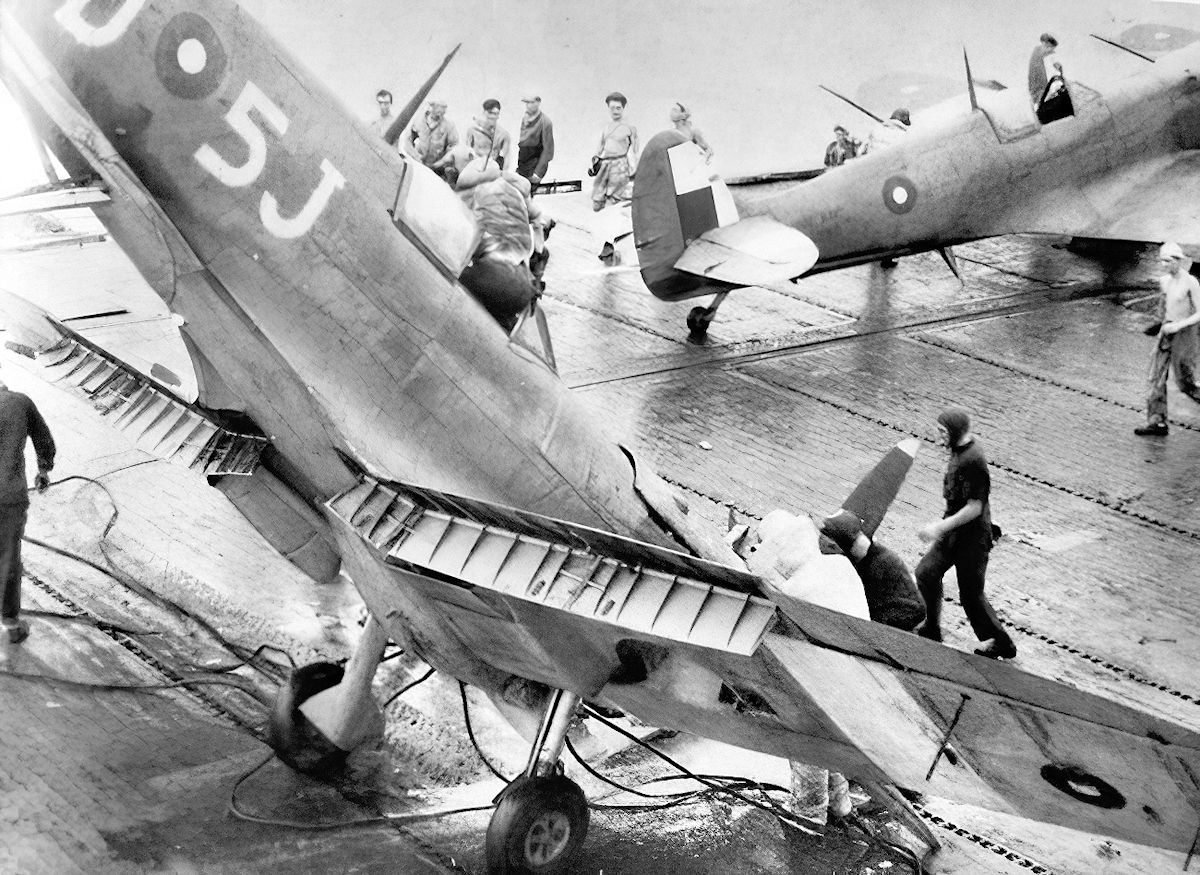
PR171 ('D5J'), a Seafire FR..III flown by CPO Wright has entered the barrier. This aircraft carried one vertical and one oblique F.24 camera allowing for photo recon while still retaining its armament. c. May 1944
The victory celebrations were curtailed by the news that the Japanese cruiser HAGURO, one of the last surviving major Japanese warships, escorted by the destroyer KAMIKAZE, was attempting to evacuate troops from the Nicobar and Andaman Islands to Singapore. At 22:30 on the 9th, the submarines STATESMAN and SUBTLE, two of three submarines on patrol in the Malacca Straits, both reported sighting one Japanese cruiser of the MYOKO class, with a single destroyer escort proceeding north westward. Based on this intelligence, the ships of the Third Battle Squadron and all available ships of the 21st Aircraft Carrier Squadron were ordered to prepare to put to sea to intercept them
Both these forces had only arrived back in Trincomalee on May 9th, Force 63 (the battleships QUEEN ELIZABETH and Free French RICHELIEU, escort carriers EMPRESS and SHAH, heavy cruisers CUMBERLAND and SUFFOLK, light cruisers CEYLON and Free Dutch TROMP, and destroyers NUBIAN, PENN, ROTHERHAM, TARTAR and VERULAM) having been at sea for Operation BISHOP, the decoy raids intended to cover the DRACULA landings.
The first of three groups of ships which comprised the hastily constituted Force 61, sailed at 06:00 on the morning of May 10th; group two departed first and comprised of the ships of the 21st Aircraft Carrier Squadron ROYALIST (Flag AC21), EMPEROR (800 Sqn Hellcat), HUNTER (807 Seafire + 1 ASR Walrus), KHEDIVE 808 Sqn Hellcat), SHAH (851 Sqn Avenger) escorted by destroyers ROTHERHAM (D 11, NUBIAN and PENN. Group one, comprising of the battleships QUEEN ELIZABETH (Flag Vice Admiral H. T. C. Walker, BS3), HMNLS TROMP and the destroyer TARTAR (D10), sailed next. The third and final group comprised of CUMBERLAND (Flag CS5), Free French RICHELIEU, and elements of the 25th Destroyer Flotilla SAUMAREZ (D26), VENUS, VIGILANT, VIRAGO, and VERULAM [sailed late, delayed by defects and joined the force at sea]. Force 70, an oiling force consisting of PALADIN and RFA EASEDALE, sailed from Trincomalee on the same day.
Force 61 was tasked with intercepting the Japanese evacuation ships, later given the codename Operation MITRE, and to hunt for the HAGURO under the codename Operation DUKEDOM. The force set course for the 10 Degree Channel at 16 knots where it was hoped to intercept the cruiser as she headed north on the 12th. The destroyer PENN suffered mechanical problems shortly after sailing and returned to Trincomalee, TARTAR switched groups to replace her. HUNTER, carrying only Seafires, operated the force's Combat Air Patrols.
At 05:00 on the 11th, SHAH had to slow down due to suspected fuel contamination, NUBIAN was detailed to stand by her. Later in the morning, further difficulties arose due to the lack of wind, which required the carriers to constantly change course to operate their aircraft. SHAH had sailed with a defective accelerator, and this was still unserviceable when she re-joined the main force. This meant that she could still not launch a fully loaded Avenger, and a reshuffle of resources was ordered by Vice Admiral Walker at 14:30. SHAH should attempt to fly off 851 squadron’s Avengers, carrying minimum fuel and no armaments, to operate from EMPEROR while eight Hellcats from 800 squadron were transferred to SHAH while eight Hellcats from 800 squadron were transferred to SHAH to join the detachment of four 804 squadron Hellcats already embarked. During this transfer process, one of the Hellcats, JX797 of 800 Squadron, had a deck landing accident that was to cause damage to 6 aircraft; the arrestor hook had caught on the metal frame of the after lift, and the hook pulled out; the aircraft careered through both barriers into Hellcats parked forward.
By 16:00 hours the transfers were complete, and Force 61 resumed their south-easterly course. By this time, the force had been detected by a Japanese plane, and its position had been reported. The delays encountered during the day meant the force would not reach the 10 Degree Channel in time, and the Admiral ordered the force to split at 18:00; Group 3, consisting of RICHELIEU, CUMBERLAND and the destroyers SAUMAREZ (D26), VENUS, VIGILANT, VIRAGO and VERULAM were detached to proceed ahead to the 6 Degree Channel in the hope of intercepting the Japanese Cruiser.
On the morning of May 12th it was reported that the enemy cruiser and destroyer were retiring south eastward – probably due to the sighting by Japanese aircraft of units of Force 61 to the westward of the Nicobars on the previous day. As a result of this information, Force 61 proceeded to a position about 200 miles southwest of Achin Head, North Sumatra, and Force 70 was ordered to rendezvous for refuelling. It was hoped that if Japanese aircraft made no further sightings of the Force, the HAGURO might make a second attempt to reach Port Blair. At 15:00 Group 3 was ordered to return to the main Force and rendezvoused that evening.
Beginning at 06:00 on the 13th, Force 61 commenced refuelling, the destroyers being oiled from the escort carriers. This operation was hampered by monsoon weather conditions and took most of the day. Intelligence was received in the morning that the Japanese were planning to launch Kamikaze attacks on the force, so Admiral Walker decided to make a pre-emptive strike against Car Nicobar airfield. At 11:30, EMPEROR launched a strike force of four Hellcats to carry out a low-level strafing attack on Car Nicobar. One of the Hellcats had to abort the mission and was escorted back to EMPEROR by another one of the strike forces. The remaining two Hellcats carried out a successful strike, destroying at least one aircraft on the ground. At 12:15 QUEEN ELIZABETH and other units of the Force picked up a radar contact; four Hellcats were flown off EMPEROR at 12:25 to investigate. Another four were ranged on deck at readiness. The interception was aborted almost straightaway, and the flight was diverted to land on SHAH. During this incident, the force had moved nearly 100 miles south from the position where the two returning Hellcats from the Car Nicobar strike expected them to be; on reaching the position, they climbed to 12.000 feet and miraculously picked up EMPEROR’s Homing beacon at 85 miles. They landed on at 16:00.
After steaming northeast through the night, the Force passed through the 6 Degree Channel at 04:00 on the morning of the 14th. Having received no news of the HAGURO by 05:15 Admiral Walker gave orders for Group 3 to remain in the area of the 6 Degree Channel while Groups 1 and 2, led by the QUEEN ELIZABETH, reversed course and steered southwest to return to the refuelling area southwest of Pulau Bunta to rendezvous with Force 70 at approximately 15:30 hours.
The search for the Japanese relief force, Force Two: Still without reports of the whereabouts of the HAGURO, but intelligence suggesting other shipping movements in a report of one small escorted transport heading South for Sabang expected to arrive on the 15th, Admiral Walker gave orders to implement Operation MITRE at 02:17 on the 15th; this was a specific operation to carry out an air and sea sweep of the Malacca Strait and south Andaman Sea for Japanese auxiliary vessels. The operation was to be jointly carried out by vessels of Walker's Force with RAF Liberators of 222 Group; however, DUKEDOM had priority, and MITRE could be cancelled at any time. The 26th Destroyer Flotilla, SAUMAREZ (D26), VENUS, VIGILANT, VIRAGO and VERULAM, was detached at 27 knots to lead the sweep, the remainder of the force following in support.
The intelligence was referring to the Japanese relief force, Force Two, the KUROSHIYO MARU No 2 escorted by submarine chaser CH- 57 which had evacuated troops from Nancowry Island in the Nicobars and had been sighted by an RAF Liberator aircraft of 222 Group late in the evening of the 14th heading for Penang. Actually, Naval intelligence was unaware that the HAGURO (Vice Admiral Hashimoto) and KAMIKAZE had been waiting off the Permatang Sedepa lighthouse, in position 2°53’ N, 100°59’ E, for news as to whether the British had sighted Force Two, which had sailed from Penang for Nancowry Island, where they arrived on May 13th. Believing the British had failed to detect Force Two, Vice Admiral Hashimoto decided to make a dash for Port Blair, so the HAGURO and KAMIKAZE were on passage to Port Blair. However, for various reasons, this time Walker didn't receive any sighting reports from the submarines stationed in the Strait of Malacca.
At 07:00 a second British force, Force 62 comprising the cruiser NIGERIA with the 11th Destroyer Flotilla (ROEBUCK, RACEHORSE, ROCKET and REDOUBT) rendezvoused with Force 61, having sailed from Trincomalee on the 13th to reinforce Walker’s force. The combined Force then set course to support the Destroyers of Group 3. At 07:30 in approximate position 4°30’ N, 93°30’ E, EMPEROR launched a reconnaissance/strike flight of four Avengers, each armed with four 500 lb bombs, to search ahead of the force; the aircraft were given the call signs “Duty” Able, Baker, Charlie and Dog. Their instructions were to fly to a point, designated BB, which was in approximate position 6°20’’ N, 94°35’ E, then to diverge and fly a search pattern. The pilots had been briefed that on sighting the enemy convoy (Force Two), they were to shadow and report.
At 09:37 in approximate position 6°44’ N, 97°3’’ E, Avenger “Duty” Charlie sighted Force Two en route to Penang and made an immediate sighting report. Shadowing the ships until 09:50, none of the others in the flight had joined, so the pilot decided to attack, reasoning that being at the extreme edge of their search radius, dropping the bombs would extend their time over the target. The first run was with two bombs; one failed to drop, and the other missed. A second attack was made, dropping a single bomb, but it was unsuccessful. “Duty” Baker now arrived and immediately attacked the Japanese force, missing with all four bombs. While diving on the KUROSHIYO MARU for their third run, “Duty” Charlie was hit in the engine just as the bombs were released. The damage was severe, but the pilot, Sub-Lt Burns, RNVR, managed to pull up and turn onto a course for the fleet. “Duty” Baker formed up on Charlie as it began to lose height and prepared to ditch, which it did soon after.
At 10:04, almost exactly the time of “Duty” Charlie’s ditching, EMPEROR launched a further strike of four Avengers, with the call signs “Duty” Fox, George, Jig, and Hotel. The squadron C.O., Lt. Cdr M. T. Fuller RNVR, was first to launch in “Duty” George; the next, “Duty” Hotel, reported his engine overheating while on the catapult but was launched to clear the deck and 10 minutes later landed on HUNTER. A fifth aircraft, “Duty” King, had been brought up from the hangar to replace Hotel. The report of “Duty” Charlie's ditching had just reached ROYALIST and the Avengers were ordered to remain over Force 61 to await orders; due to communication problems only “Duty” Fox received the order and remained circling for an hour and a half before jettisoning his bombs and returning to EMPEROR only to crash into the barrier on landing. George, Jig and King continued on their search pattern, but were now looking for the life raft of Sub-Lt Burn and his crew.
The first of the early morning flight, “Duty” Dog landed on at 11; 55, “Duty” Able at 12:15. On reaching the expected position of the carriers “Duty” Baker found there were no ships in sight; they were eventually joined by “Duty” Jig and King and “Duty” Jig escorted him towards the fleet; after 4 hours and 50 minutes in the air “Duty” Baker ran out of fuel at 121:0 and ditched 30 miles from the carriers, the crew were rescued by the 1700 squadron Walrus from HUNTER, this was a perilous rescue in itself, sea conditions were borderline for a walrus to land and successfully take-off again but the pilot, Lt, J. Weaver, RNVR skilfully handled his aircraft and returned safely to the Carrier. Despite efforts to locate them, the crew of “Duty” Charlie were not rescued; their raft eventually made landfall in Burma, but they were later taken prisoner.
At 10:44 Lt. Cdr Fuller, in “Duty” George, sighted and reported the Japanese Force Two. Shortly after sending off his sighting report, a second force was sighted, two further ships about 15 miles ahead of Force Two; these turned out to be the HAGURO and KAMIKAZE. At 10:50 a second signal reporting enemy cruiser and destroyer in position 06°55’ N, 96°50’ E, and retiring south eastward. The HAGURO had been found almost by accident and the result of errors and failures in communication; while “Duty” George was aloft, a revised search area had been calculated taking into account currents and wind over the time since the ditching, and this was transmitted but not received by the four Avengers. So Lt. Cdr Fuller and his crew were in the wrong place at the right time to stumble upon both targets. Sadly, they did not locate the life raft they were looking for; unknown to the crew, they passed within 400 yards of them after dropping their bomb load to extend their time on station. “Duty” George remained shadowing the Cruiser until 12:50 when they made a final course and speed report before heading back.
Air strike against the HAGURO: Following Lt. Cdr Fuller’s signals and updates, a further strike force of three Avengers was ranged on deck, fuelled and armed by 13:50. These aircraft were given the call signs “Duty” Peter, Queen and Roger, all three pilots making their second sortie of the day. Their mission was to attack the HAGURO with 500 lb bombs; ideally this should have been a torpedo attack, but none of the Escort Carriers operating with the East Indies Fleet carried torpedoes. They were launched from a position 110 miles due west of Sabang and were to fly a dog-leg course to avoid the nearby enemy airfields.
Lt. Cdr Fuller in “Duty” George arrived back at the estimated rendezvous point at 14:32; this was where the fleet was expected to be, calculated using the MLA (Mean Line of Advance), but no ships were sighted. Eleven minutes later, he switched his I.F.F. to “Distress” mode, and a course to steer was radioed to them; he was then joined by two Seafires from HUNTER’s CAP flight, which escorted him back to EMPEROR. He landed on at 15:15 after 5 hours and 11 minutes in the air.
The Strike of three Avengers had reached the estimated position of HAGURO at 15:16, 16 minutes later than planned, but she was not in sight; they then began a square-search with 15-mile legs. The Cruiser and her escort were sighted by “Duty” Peter at 15:41 near the end of the third leg, and they began shadowing her until the other two re-joined. They attacked from astern, starting their dive at 10,000 feet, Peter and Roger together, Queen a few seconds behind. Anti-aircraft fire was intense; one hit was scored on Peter’s wing, and Queen was peppered with shrapnel splinters. All released their payloads; Peter and Roger pulled out at 3,000 feet and turned away at full speed. Queen continued on down to 300 feet and fled out to sea on the HAGURO’s starboard bow. Reforming at 14:15, they set course for the fleet. They thought at least one of the 12 bombs hit, and one was a near miss, but in reality, they all missed. All three arrived back at EMPEROR at 18:30 and landed on. “Duty” Peter, Queen, and Roger had completed a 530-mile round-trip flight to strike the HAGURO, the longest attacking round-trip flight of any Fleet Air Arm aircraft. They had accomplished the first and only Dive-bombing attack by 851 Squadron; this was also the first such attack on a major warship since the sinking of the KONIGSBERG in April 1940.s
Sinking of the HAGURO: To the surprise of the squadron aircrew, no further strikes were ordered, possibly because the target was believed to have passed the maximum range for another strike. Instead, the chase was handed over to the 26th Destroyer Flotilla to engage the two ships.
Captain Powers had been ordered to resume his original course at 27 Knots at 12:10 (then looking for Force Two). At 12:30, CUMBERLAND and RICHELIEU were ordered to rejoin the destroyers at best speed to give them support. Captain Powers planned to make a night attack employing the single ship ‘Star-attack’ opening with a salvo of torpedoes. By the early hours of the 16th, they were in radar contact and positioned ahead of the Japanese ships, closing the gap. At 00:50 the HAGURO detected the 26th Destroyer Flotilla in front of her at 17,500 yards; Captain Power’s trap had been sprung. The HAGURO made an immediate turn to starboard and increased speed to 30 knots, heading North, away from Singapore for Penang, and the Destroyer attack began. The first torpedoes were fired by SAUMAREZ at 01:13, and the last were fired by VENUS at 02:02. The HAGURO made an immediate turn to starboard and increased speed to 30 knots, heading North, away from Singapore for Penang, and the Destroyer attack began. The first torpedoes were fired by SAUMAREZ at 01:13 and the last were fired by VENUS at 02:02 and the HAGURO hhaving been hit by six torpedoes and nearly an hour of gunfire from the 5 Destroyers, sank at 02:06 in position 4°49’ N, 99°42’ E. The KAMIKAZE escaped to the west, returning later to pick up survivors. The only British vessel to suffer damage was the SAUMAREZ; she was hit in her No 1 Boiler Room by one of the HAGURO’s 5 inch shells, The shell only partially exploded, but it killed two and put No 1 boiler out of action. Having fought the last major surface gun and torpedo action of World War II the flotilla formed up at 02:10 and steered north westerly to re-join the CUMBERLAND and RICHELIEU, still some 50 miles away.
Air strikes on the Andaman Islands: At 07;00 on May 16th EMPEROR launched 4 Hellcats, each armed with eight 60lb rockets, to search for and strike the KUROSHIYO MARU, and two Avengers to continue searching for the crew of “Duty” Charlie. A further 6 Hellcats from KHEDIVE's 808 squadron were launched to strike the airfield at Lhokseumawe in Northern Sumatra; two turned back with radio failure while the remaining four strafed the airfield, damaging one fighter on the ground and a nearby locomotive.
From 08:00 the fleet came under almost constant air attack and, HUNTER’s Seafire CAP aircraft were kept busy chasing down radar contacts; while none were shot down, at least four Ki-43 ‘Oscars’ were believed to have been damaged in aerial combat; 2 possibly damaged shared by Sub-Lt W. C. Whitlam, RNVR in NF419 and Sub-Lt L. E. Gardner, RNVR in NN300, and 1 each damaged by Sub-Lt TI. Ingle, RNVR in NN295 and Lt. J. E. M. Thornhill, RNVR in NN473.
The searches for both the KUROSHIYO MARU and the life raft came up empty, and the aircraft returned safely. At 17:25, two A6M3 ‘Haps’ were caught off guard by a flight of four Hellcats from 800 squadron led by Lt de Witt but managed to escape into cloud cover. The last attack of the day came at dusk when HUNTER was about to refuel VIRAGO; the Destroyer was approaching from astern when the operation had to be aborted when the two ships came under attack by a single ‘Oscar’. Heavy anti-aircraft fire from VIRAGO and HUNTER seemed to deter the Japanese pilot who, released his fragmentation bomb and veered away. The bomb fell into the sea 30 yards off VIRAGO’s port quarter, and the shrapnel from the blast killed 4 crewmen outright and wounded 8 more.
HUNTER had one deck crash during the day; Lt. Cdr E. J. Clark, RNVR, in Seafire NN398 struck the rounddown and the aircraft ended up on its nose.
At 08:00 on the 17th the force was split again: ROYALIST,
KHEDIVE,
SHAH and Force 62 detached and set course for Trincomalee, arriving on the 19th. The remainder of the fleet, including HUNTER and
EMPEROR ,arrived aback off Ceylon on the 20th and 807 flew a detachment of 6 aircraft ashore to
RNAS Trincomalee. The wreckage of Seafire NN398 was offloaded by lighter to the following day
The detachment re-embarked on June 1st when HUNTER sailed for Cochin, the entire squadron being disembarked to RNAS Cochin on June 4th. HUNTER was now briefly employed as a ferry carrier, embarking loads of airframes from RNAS Cochin for delivery to Ceylon.
On release from ferry duties she sailed for Cocanda on the east coast of India to join ROYALIST (AC 21), EMPEROR, LARGS, RACEHORSE, and ROEBUCK for a Brigade Landing exercise which began on the 24th; 807 re-embarked on this date, having relocated to RAF Vizagapatam on the 23rd. There were 3 deck crashes during this exercise; on the 25th Sub-Lt G. J. Jinks, RNVR in NN403 crashed into the starboard walkway after No.3 wire parted, on the 26th Sub-Lt F. Logic, RNZNVR had two crashes – in NN395 he caught No.8 wire and went into the barrier damaging the port wing, in PP979 he floated over all the wires and entered the barrier. The exercise was completed on the 26th, and HUNTER returned to Trincomalee. On arriving there on the 29th, the wreckage of Seafires NN403 and PP979 was lightered ashore to RNAS Trincomalee.


HUNTER put to sea again on the 29th to provide a deck for pilots from 757 Fighter Pool Squadron to undertake two days of DLT, Seafires flying out from RNAS Puttalam to the ship for each session. There were two landing accidents during their DLT session; Sub-Lt W. T. Waller, RNVR in NN200 caught No.3 wire but the port undercarriage leg collapsed, and Sub-Lt F. Armstrong, RNVR in NN204 entered the barrier.
A detachment of 6 aircraft flew ashore to operate from RNAS Colombo Racecourse on the 30th. The ship continued a programme of flying training and exercising off Trincomalee during the first half of July to prepare for her next combat operation. There were several landing accidents during this training period; on July 10th NN390 flown by Sub-Lt T. I. McCartney, RNVR caught a wire, but his arrester hook pulled out, and the aircraft entered the barrier; the following day Sub-Lt D. M. Jarman, RNVR in PR170 bent the port oleo and damaged the prop landing; both these aircraft were lighters ashore at Trincomalee. The 16th appears to have been a busy day for flying training with 3 deck crashes recorded; the most serious was the crash of NN384 flown by Sub-Lt G. J. Jinks, RNVR, and the aircraft bounced heavily and broke through the crash barrier before overturning and coming to rest on the forward lift; the aircraft was a write-off. Sub-Lt R. Brook, RNVR, also entered the barrier in PR255 after catching a late wire. Lt J. E. M. Thornhill in PP991 suffered the most common Seafire landing incident; his starboard oleo broke on landing.
The main body of 807 Sqn disembarked to
RNAS Colombo Racecourse on July 17th, but not before there was one further deck crash; Sub-Lt W. C. Whitlam flying in NN179 approached a pitching deck and landed heavily to port, damaging the undercarriage and prop. Two days later the squadron moved to
RNAS Trincomalee.
HUNTER was now allocated to participate in Operation JURIST, an amphibious assault by the 3rd Commando Brigade to capture Penang Island on the west coast of Malaya planned for August 21st 1945. She put to sea again on August 2nd for deck landing training, embarking a detachment for ATTACKER’s 879 Squadron the same day, and eight Seafires from 807 on August 4th; all embarked from RNAS Trincomalee; one of the 807 aircraft, NN413, suffered an engine fire after take-off and the pilot, Lt. Cdr Clark, successfully baled out and was rescued.
Both HUNTER and
ATTACKERwere at sea on August 15th preparing for Operation JURIST; the rest of 807 squadron flew out from RNAS Trincomalee to re-join the ship once HUNTER was clear of the harbour, when the news of the Japanese surrender was announced when Station General Message "SUSPEND OFFENSIVE OPERATIONS AGAINST JAPANESE FORCES' was made to all ships and allied forces. The detachment from 879 Squadron transferred to
ATTACKER on the 16th while the orders for JURIST were being reappraised.
Elements of the EIF put to sea at 09:30 on August 17th for Operation JURIST; the plan was still to land on Penang Island and reoccupy it, and accept the surrender of Japanese forces there. Six separate Forces were deployed. Force 11, comprising the Battleship NELSON (Flag, Vice Admiral Walker), escort carriers ATTACKER (879 Sqn 24 Seafire L.III), HUNTER (807 Sqn 24 Seafire L.III), SHAH (845 Sqn 12 Avenger (for strikes), 851 Sqn 5 Avenger for A/S cover)), and STALKER (809 Sqn 24 Seafire L.III), the light cruisers CEYLON and NIGERIA, the destroyers PETARD, TARTAR and VOLAGE, and the landing ships PRINCES BEATRIX and QUEEN EMMA. Force 12 comprised the destroyers VERULAM and VIGILANT and eight yard minesweepers; Force 13 comprised the destroyer PENN and LST 383 loaded with vehicles; Force 14 with the escort destroyer CALPE and the Royal Fleet Auxiliary’s BELA and EMPIRE SALVAGE; Force 68 with the heavy cruiser LONDON (Flag, Commodore Poland) and destroyers RAIDER and ROCKET; and Force 157 with the Indian sloop GODAVARI, Coastal Forces repair ships BARRACUDA and MULL OF GALLOWAY, tanker CROMWELL, 26 motor launches of the 34th, 38th and 56th Motor Launch Flotillas, and nine harbour defence motor launches of the 110th Harbour Defence Motor Launch Flotilla.
Shortly after the JURIST forces took passage eastward, delays in negotiations and in the arrival of the Japanese Emperor's orders to cease hostilities in South East Asia became apparent; orders were issued postponing the start of JURIST and on August 20th all forces took shelter on the north-east coast of Great Nicobar Island. ATTACKER and HUNTER were ordered to proceed to Rangoon. SHAH , STALKER and the Cruiser NIGERIA were released and sailed for Trincomalee on the 24th, arriving in harbour on the 26th. 807 Sqn lost another aircraft t on August 24th. Sub-Lt F. A. Brash SANF(V), returning to the ship in PR247 with an unserviceable radio, could not release his arrester hook and baled out near the ship. Another aircraft was badly damaged on the 26th when PRI84, flown by Sub-Lt L. L. Beckford, RNVR, entered the barrier and nosed over.
Political constraints also meant that no landing could take place until after the signing of the surrender in Tokyo. These delays meant that all plans were now to change: the occupation of Penang was still to be undertaken as Operation JURIST, but without the amphibious assault, and would include the occupation of Sabang, with both objectives to be occupied by contingents of Fleet Royal Marines.
ATTACKER and HUNTER sailed from Rangoon on August 27th to rendezvous with NELSON and CEYLON off Penang. At mid-day on August 28th a reduced Force 11, NELSON, accompanied by CEYLON,
ATTACKER and HUNTER, three destroyers and two large infantry landing ships carrying the Royal Marine landing party, arrived off George Town, Penang to negotiate the surrender of local Japanese forces and to reoccupy the area. At the same time, LONDON, accompanied by one destroyer, arrived off the northern tip of Sumatra carrying a small contingent of Royal Marines to occupy Sabang Island. The Japanese forces surrendered on September 2nd.
ATTACKER and HUNTER sailed from George Town on September 7th and provided air cover for the passage of assault convoys through the Malacca Straits during the 8th and 9th for the modified Operation ZIPPER, the re-occupation of Port Swettenham and Port Dickson which began at first light on the 90th, before setting course for Singapore.
The reoccupation of Singapore was achieved by Operation TIDERACE; Allied forces arrived on September 4th and encountered no opposition. By 18:00 the Japanese had surrendered their forces on the island to Lieutenant-General Sir Philip Christison aboard HMS SUSSEX. The formal surrender was to be finalised on September 12th at Singapore City Hall.
On the morning of Tuesday, September 11th, 1945, the ships of Admiral Walker's force (now designated Force 61) and Carriers of the 21st Aircraft Carrier Squadron anchored in Singapore Roads between 09:30 and 10:30 and waited for instructions. Later the order was given for part of the force to proceed into the harbour;
EMPEROR, HUNTER,
KHEDIVE and
STALKER anchored in Keppel Harbour. The CVEs
AMEER and
ATTACKER were among 90 ships (including 70 RN and RIN warships, 3 Royal Fleet Auxiliaries, 3 hospital ships and 14 merchant vessels) present in Singapore Roads for the ceremony in which the Japanese forces in South East Asia surrendered on September 12th. At 16:00 on the 13th, ROYALIST with
EMPEROR,
KHEDIVE, HUNTER,
STALKER, and the Indian sloop GODAVARI sailed for Trincomalee.
HUNTER arrived back at Trincomalee on September 18th, disembarking a detachment of 8 Seafires to RNAS Trincomalee. HUNTER was now released from EIF operations, and preparations began for her return to the UK. 807 Squadron, being equipped with British aircraft, was to be retained and would return to the UK with her; it is assumed the detachment ashore was to provide aircraft to keep the pilots' flying hours current. These aircraft re-joined the ship on October 4th. [12
The Carrier would not undertake any flying operations on the passage home; she carried additional aircraft and equipment as cargo and Naval personnel going home to be demobbed as passengers. She sailed on October 9th, calling at Aden and Port Suez, to transit the Suez Canal on the 18th. From Port Said, Malta, and Gibraltar. Sailed from Gibraltar on October 25th for Plymouth to discharge passengers and a Naval draft on the 28th before arriving at Belfast on October 30th.
At Belfast, she disembarked 12 Seafire III aircraft from the smaller 807 Squadron, plus the squadron personnel and equipment, to RNAMY Belfast. This ended 807 Squadron’s time with the ship; however, the squadron remained on active service and moved to RNAS Nutts Corner the next day, where it received 12 new Seafire F.XVIIs.
On completion of unloading at Belfast, HUNTER proceeded to the Clyde the next day, where she was transferred to Rosyth Command to begin initial de-storing in preparation for her return to the US authorities. On November 28th she left the Clyde bound for the RN Dockyard at Portsmouth to complete her de-storing and equipment removal. HUNTER left the UK for the last time on December 12th 1945, sailing from Portsmouth bound for the US Naval Dockyard at Norfolk, Virginia.
On arrival at Norfolk on or around December 22nd 1945, she was moved to the Norfolk Shipbuilding and Dry Dock Company wharf on the 26th to begin processing and inventorying and in preparation for disposal. HMS HUNTER was decommissioned on December 29th, 1945, and CVE-8 was returned to US Navy custody. The processing and inventorying work was completed on January 12th 1946, and CVE-8 was stricken for disposal on February 26th 946.
CVE-8 was sold on September 11th 1946, and delivered to her purchaser, William B. St. John, New York, on January 17th 1947 [3]. She was sold on to the American Tankers Corporation on July 23rd 947. She was further sold on March 18th 1948, to High Seas Tankships SA, Panama, but was sold again in April that year to Waterman Steamship Corporation, based in Mobile, Alabama, and sent to Gulf Shipbuilding Corporation in Chickasaw, Alabama, to be rebuilt into a cargo/passenger ship vessel. Once completed, she had a cargo capacity of 450 tons and could carry 12 passengers.
On November 17th, 1948, the Dutch government purchased the ship and transferred it to Holland America Line in Rotterdam, the Netherlands, as the SS ALMDIJK. She regularly visited ports on trade routes connecting Rotterdam to the Gulf of Mexico and US/Mexican ports. She was renamed ALMDYK in 1953. She was sold for breaking on October 27th 1965 and arrived in Valencia, Spain on November 2nd 1965 to be scrapped.

The SS ALMDIJK
Last modified: 02 August 2026
Fold3.com various documents including;
Admiralty War Diaries
Norfolk Navy Yard War Diaries
Miscellaneous documents
© 1999-2026 The Royal Navy Research Archive All Rights Reserved Powered by W3,CSS
Press F5 to refresh the page after posting your comment or to hide the form
Shape: Standard, circular.
Blazon (Heraldic description)
On a green field: A crossbow bendwise to sinister, gold, flanked by two bolts, silver.
HUNTER: A person or animal that hunts. The design features the crossbow, a silent weapon. Originally designed for the the ‘H’ class destroyer ‘HUNTER’ which was sunk in April 1940 and the ship’s name was honoured by allocating it to a new escort carrier replacing her promulgated name of ‘TRAILER’. The design was transferred from its original shield into a standard, circular badge.
For explanations of heraldic terms see the
Royal
Navy Ship's Badges page.
Note:It is assumed that the ship undertook flying training during the nine-day period after leaving the dockyard; Admiralty signal traffic concerning her departure from Gibraltar on March 28th supports this assumption, when a temporary squadron was assembled for anti-submarine cover on passage to the UK, stating that the ship had ‘full and trained personnel for operations and has completed flying trials’. The only RN squadrons at USNAS Norfolk when HUNTER arrived were 832 squadron having exchanged 12 Albacores for 12 Avenger TBM 1s embarking in VICTOPRIUOS on February 3rd and 882 with 12 Martlet IVs, embarking in VICTORIOUS on February 1st.
CloseNote:A signal dated October 20th 1945 instructs HUNTER to retain 807 Squadron maintenance personnel on board until Belfast, where they and 12 Seafire IIIs were to be disembarked. This suggests that the squadron strength was reduced from 20 to 12 before sailing from Trincomalee. The date of October 4th, when the detached element rejoined the ship, may refer only to the personnel, with the 8 Seafires being retained at RNAS Trincomalee.
CloseNote:William B. St. John, of New York, was a broker who purchased seven former British escort carriers – AMEER, ATTACKER, HUNTER, PUNCHER, RAVAGER, SLINGER and TROUNCER. These purchases were assets for onward sale to shipping companies for conversion back into mercantile vessels.
CloseNote:Sub Lt Gowan RNZNVR was later awarded the DSC for skill and leadership in dive-bombing and strafing missions during 'Operation Dragoon'
CloseNote: Several commentators have ATTACKER arriving at Taranto for refit on Dec 6th with squadron personnel taking passage to Egypt in the Italian cruiser DUCA D'AOSTA. However, squadron records show that the aircraft of both 809 and 879 squadrons were disembarked from ATTACKER on Dec 11th in Egypt.
Close
Comments (9)
https://www.navsource.org/archives/03/cve-8/008m.htm
Hi, My Father served on HMS Hunter and Stalker in 807 squadron. His name was 'Mac' B, Heath Mcgeoch. I am trying to find out any information on what it was like serving on the air craft carrier as a mechanical engineer. He never talked to us about his war experience, which I understand more now I am older. He sadly passed in 2010, aged 88 years:shocked.
If anybody has any info or photos, I would be very interested. I believe he served on HMS Stalker too.
Dear John Steel,
My Grandfather Lt Eric Speakman flew Seafires on HMS Hunter in 1944 and was sadly killed in active service in August 1944. We know very little of his time during the war and I would very interested to read anything you may feel you can share. (This appeal would go to all contributors.)
My grandfather started out as a Navy midshipman in HMS Duncan and moved on to be a pilot. we know he trained in Canada and flew swordfish and Seafires... but this is I am afraid about it.
very happy to pass on my details if any inf is sensative.