
D26(Atlantic)
R313
/ A452 (Pacific)
OKINAWA 1945
Builder: Seattle-Tacoma Shipbuilding Co. Tacoma, Washington.
Completed by: Willamette Iron & Steel, Portland, Oregon.
Displacement: 15,390 tons
Length (Overall): 494ft 9in
Beam: 69ft 6in
Draught: 16 ft
Flight deck: 450ft x 80ft wood covered mild steel plate
Propulsion: 2 Foster Wheeler boilers; 1 x Allis-Chalmers geared turbine driving 1 shaft
Speed: 18 knots
A/C Capacity: 20
Hangar: 260ft x 62ft x 18ft
A/C lifts: 2, Aft 34ft long x 42ft wide; forward 42ft long x 34ft wide
Arrestor wires: 9 with 3 barriers
Catapult: 1 H4C hydraulic
Armament: 2 single 5in USN Mk 12, 8 twin 40mm Bofors, 14 twin 20rnm Oerlikon, 7 single 20mm Oerlikon
Crew Complement: 646
Capt. B. L. Moore RN
Jun 44 - Jun 45
Lt. Cdr. J. G. Hopkins Jun 45 - Feb 46
None
None

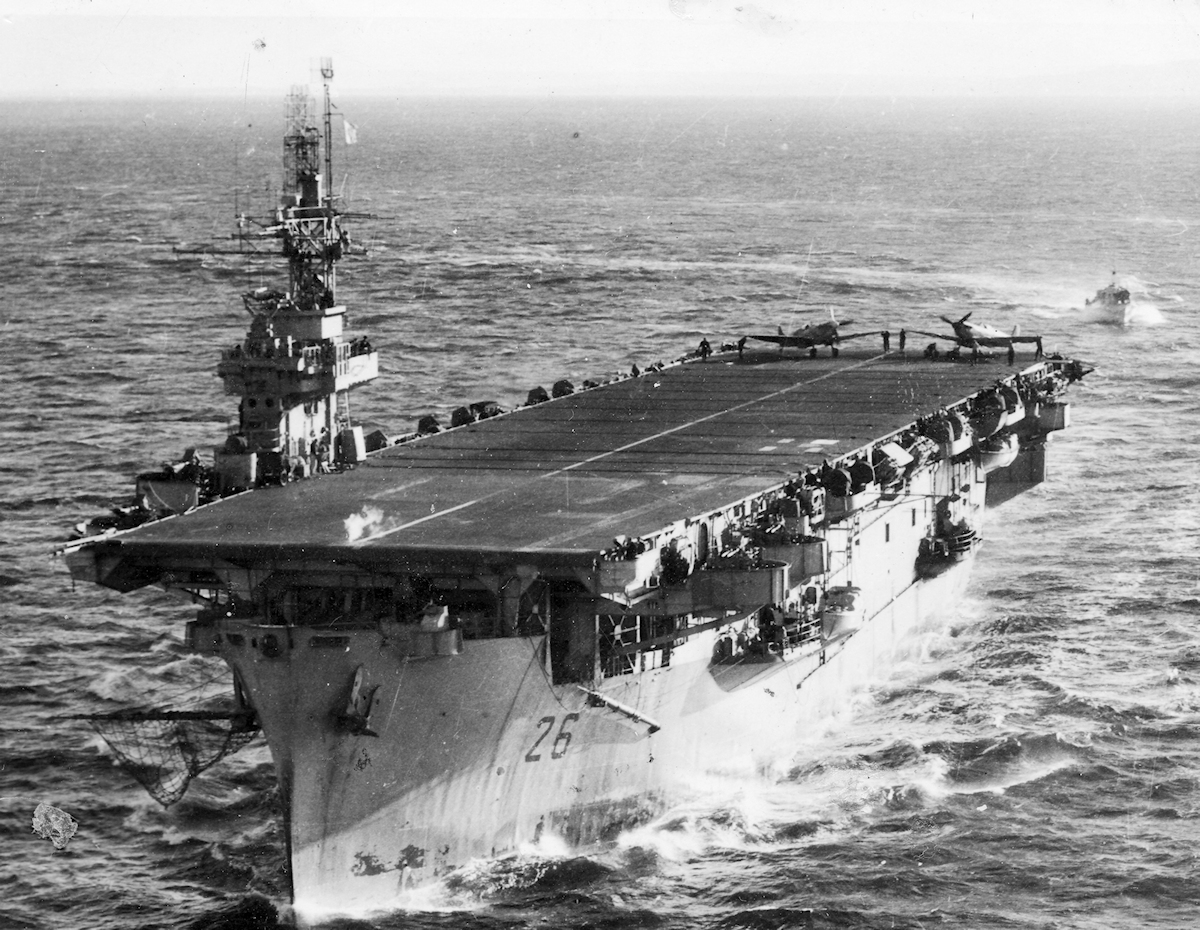
HMS SLINGER operating Seafires from 768 Deck landing Training squadron in December 1944.
HMS SLINGER was a 'Ruler' class escort carrier; her keel was laid down on May 25th 1942, at Seattle-Tacoma Shipbuilding Co., Tacoma, Washington, as a C3-S-A1 type freighter hull, Maritime Commission hull number 243; Seattle-Tacoma hull number 27. The US Navy purchased hull number 27 to become the auxiliary aircraft carrier USS CHATHAM AVG-32; however, while still under construction, it was decided to transfer her to the Admiralty on loan upon her completion under the Lend-Lease agreement between the US and Britain.
After 117 days on the Ways, the hull, complete with flight deck support beams and its engines and associated machinery installed, was launched on September 19th 1942. The hull was towed by a tug from Seattle to the port of Astoria, Oregon, on the south shore of the Columbia River, where the river flows into the Pacific Ocean. AVG-32 was the fourth of 10 escort carriers contracted for completion in Portland, Oregon, with 5 each outfitted by Commercial Iron Works and Willamette Iron & Steel shipyards. From Astoria, she was towed up the Columbia River to Portland and delivered to Willamette Iron & Steel for completion as an escort carrier.
Her crew began to arrive in Portland during the spring of 1943 and were under the charge of Lt. Cdr W. H. Roberts, OBE, the ship's Executive Officer. While still under construction, the crew stayed ashore, and many attended training courses at US Navy bases to prepare to operate the ship’s machinery and weapons systems.
While SLINGER was in the hands of the Willamette Iron & Steel yard, there was a friendly rivalry between the workers and their opposite numbers at other Portland shipyards working on ships for the Admiralty and the Commercial Iron Works yard, where HMS
TRUMPETER was being built. For many months, both ships progressed at the same pace until key parts had to be removed and sent to Bremerton Navy Yard, Washington, for adjustment. The parts had to be sent 200 miles by road, and whoever got the parts there first would gain valuable time over their rival. The Willamette workers delivered their parts first, but Commercial workers were not to be outdone and increased their productivity to make up the lost time; eventually,
TRUMPETER
was completed first by one week.
CVE-32 sailed on her builder's sea trials at 08:00 on the morning of Monday, July 19th 1943. After passing down the Willamette River, she entered the Columbia River, and trials began at 09:30. After testing her anchors, steering, engines, and general handling, she carried out a full-speed test and an emergency stop before completing a maximum-speed run over a measured mile. She returned to her berth at 16:00 after completing the test schedule.
After defect rectification and final fitting out, CVE-32 was delivered and transferred to the United Kingdom on August 11th 1943; her construction took a total of 443 days, 326 at Portland. At a ceremony held on the flight deck, the ship was accepted on behalf of the US Navy by Captain L. D. Whitgrove USN, and after the playing of the American national anthem, he delivered her to Captain A.N.C. Bingley O.B.E. RN, who accepted her on behalf of the Admiralty. Captain Bingley read out the order commissioning her as HMS SLINGER (pennant number D26), and the White Ensign and the Union Jack were hoisted.
After the British national anthem had been played, a short church service was held during which Captain Bingley read a passage from the Bible about David, the first 'SLINGER ', reading from a large print Bible that had been donated to the ship by Mr William Whitfield. The Portland-built ships, and their crews, were warmly welcomed into the Portland community, and many individuals and organisations donated recreation materials and equipment to the departing carriers built in their local shipyards.
The passage he read included Samuel 1, Ch17 verse 49 'And David put
his hand in his bag, and took thence a stone, and slang it, and smote
the Philistine in his forehead, that the stone sunk into his forehead;
and he fell upon his face to the earth.' which was the inspiration
behind the unofficial ship's badge.
HMS SLINGER left Portland on August 31st 1943, bound for Seattle, where she was to take on ammunition and stores, carry out gunnery practice, and undergo a short work-up, arriving at US Navy r Station Seattle at 17:39 on September 3rd.
She sailed on September 5th to exercise with her sister CVE TRUMPETER, which had sailed from Portland a week before and had embarked 848 Naval Air Squadron on September 4th. The squadron had formed in June at USNAS Quonset Point on the US East Coast with 12 Avengers, and had flown out to join the ship at Seattle to work up the ship and the squadron in preparation for providing anti-submarine patrols on the forthcoming Atlantic crossing to the UK. SLINGER returned to US Navy Station Seattle at 14:20 on the 7th to embark more stores. At 07:30 on the 9th, SLINGER put to sea to continue her work-up.
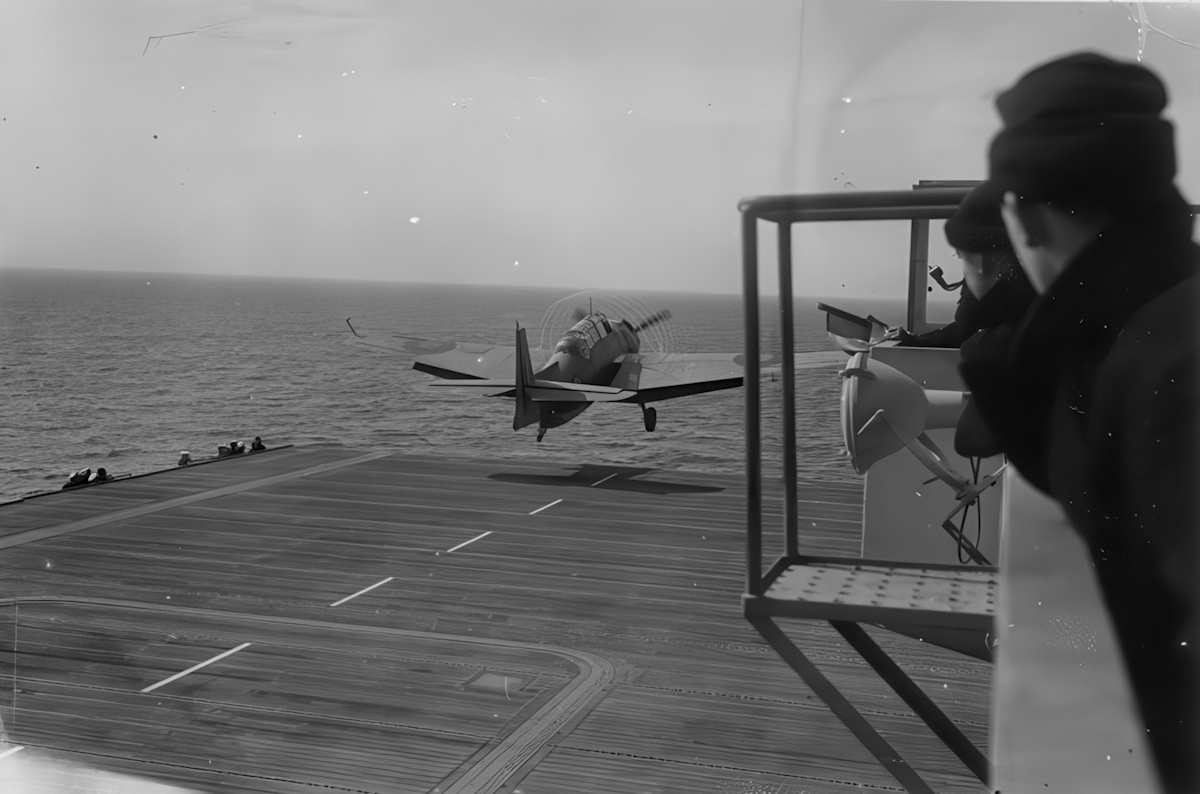
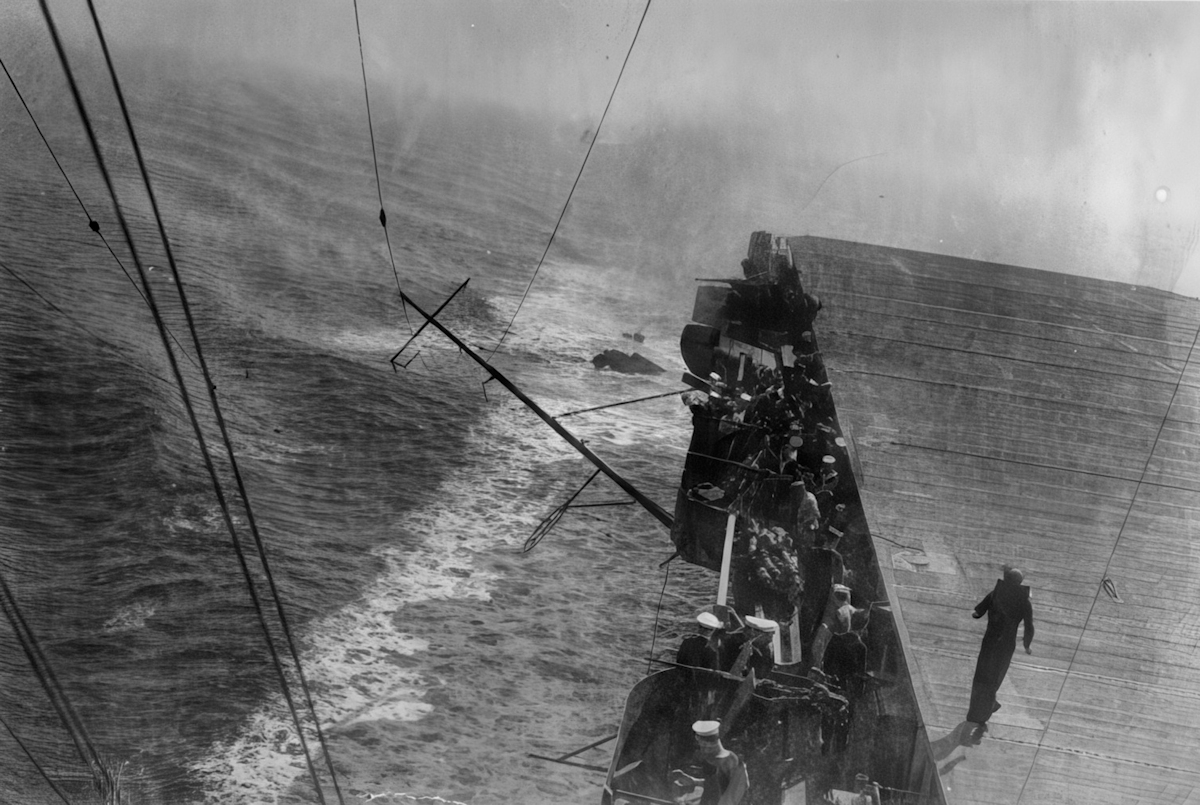
Part of SLINGER's work-up period in Puget Sound included testing her flight deck equipment, particularly the arresting gear and catapult; to do this, an Avenger from 848 Squadron was used for practice deck landings. The event proved to be an inauspicious start to SLINGER's operational service; during one of the landings on September 15th, an arrester wire parted as Avenger JZ102 attempted to land. No crash barrier was rigged, so the pilot, Lt. P. F. McClintock, RNVR, had to try to recover flying speed as his aircraft continued down the deck. Unable to recover, the Avenger ditched off the starboard bow and was overtaken by the ship. Lt McClintock was recovered safely; however, the severed arrestor cable had whipped across the deck, striking an Oerlikon Gunner, Able Seaman Jack Hill. He suffered serious head injuries and an almost severed ear. Both the port and starboard catwalks were packed with officers and men observing the trials, but AB Hill was the only casualty.
SLINGER and TRUMPETER sailed from Port Townsend on September 16th for passage to Balboa to enter the Panama Canal and onward passage to Norfolk, Virginia.
The two Carriers arrived at Balboa on September 29th, and after clearing the Panama Canal both vessels departed from Cristobal on October 1st for passage to Norfolk, Virginia, to collect consignments of aircraft for ferrying to the UK. On her arrival at Norfolk Navy Yard on October 6th, SLINGER was taken in hand for equipment installation and repairs, including a paravane shoe davit, renewed stops for paravane chains, and testing of watertight hatches and doors. On completion of the work, she moved to a berth in the Naval Operating Base, Norfolk.
SLINGER was now allocated to Western Approaches Command as a ferry carrier and began embarking 54 airframes to be ferried to the UK. This load included the 10 Corsair IIs of 1830 Naval Air Squadron which were loaded on the 9th; the squadron had formed and worked up in the US at USNAS Quonset Point on June 1st and was returning to the UK to continue training.
On completion of loading SLINGER and TRUMPETER departed Norfolk on October 13th bound for New York. On arrival, SLINGER secured alongside at the Army port of embarkation on Staten Island on the 17th, and voyage repair work was carried out by workers from Bethlehem Steel Company at Mariner’s harbour, Staten Island. After loading cargo, she proceeded to a berth at the 33rd Street Pier, Brooklyn, on the 18th, where further voyage repairs were conducted. After loading more stores, cargo, and passengers, SLINGER and TRUMPETER sailed on October 21st to join the eastbound convoy UT.4 bound for Liverpool.
As they neared Ireland on October 30th, the two carriers detached from the convoy and proceeded to Belfast, where they unloaded their squadrons at the
Royal Naval Aircraft Yard Belfast on November 1st. SLINGER then continued on to Greenock, Scotland, to unload the remainder of the aircraft and cargo.
The ship was next ordered to proceed to Chatham Dockyard on November 20th, where she was to be modified to meet RN standards. This work included installing British Type 79B aircraft warning and Type 272 surface search radars, replacing the US 5-in gun mountings with British models, and modification of her petrol distribution system. fitted. The modification work was completed in early February 1944, and SLINGER was towed by tugs from Chatham to Sheerness on February 5th to prepare to leave the River Medway and proceed to the Clyde the next day.
SLINGER weighed anchor at 08:00 on February 6th and proceeded out into the swept channel; a gunnery test was carried out mid-morning, during which time all of the ship's main armament was fired. Around midday there was a loud explosion as the ship struck a mine; the 'flying bedstead' radar array collapsed onto the bridge while the HF/DF mast toppled into the twin Bofors gun mounts, and the ship began to list and drift as the engines stopped.
The carrier was eventually taken in tow by escorting destroyer HMS GARTH as she was drifting out of the swept channel and in danger of entering our own minefields. It was nightfall before the ship was taken in tow by two tugs and began the journey back up the River Medway towards Sheerness, a journey that was to take all night. Water continued to enter the ship and the onboard pumps could barely manage to hold their own as she took on a dangerous list. At Sheerness, lighters with electric pumps were secured alongside the ship, and the long task of pumping her out began. When the water was at last under control and the list less pronounced, SLINGER was moved to Harland & Wolff's Royal Albert dry dock, North Woolwich, in the Port of London for damage easement of her hull on the 12th. Her bottom had been holed in two places, and her rudder and propeller had been severely bent.
She was to spend the next eight and a half months in the Port of London and Woolwich docks under repair; during this time, she was partly cannibalised to complete the refits of several of her sister CVEs; her forward lift, for example, was removed to repair HMS STALKER in Match. Opportunity was also taken to convert her to an assault carrier configuration.
An assault CVE would provide air cover until shore-based airstrips became operational. The modifications involved many new pieces of equipment being installed: a new Type 277 radar, a new telephone system consisting of over 100 telephones, a new Briefing Room and 'Army Plot' Room and cabins added around the 'Aircraft Direction Room ', and numerous other additions such as extra W/T and R/T sets and still further improvements to the bridge. Another important modification was an anti-aircraft armament upgrade; all existing single Oerlikon mounts on the Gallery Deck and foc'sle deck were to be changed for fourteen powered twin mountings.
During
this time in the hands of the dockyard Captain Bingley left the ship to take
up command of HMS BITER,
he was relived by Captain B. L. Moore RN on June 6th.
Repairs and modifications were completed by October 17th 1944, and SLINGER proceeded to the Clyde, where she was transferred to the control of the Flag Officer Flying Training. The ship's flight deck equipment was put through its paces by an Avenger from 778 Service Trials Unit on the 28th; this involved arrested landings and catapult-assisted take-offs. On its final landing, it experienced arrester hook trouble and ended up in the barrier.
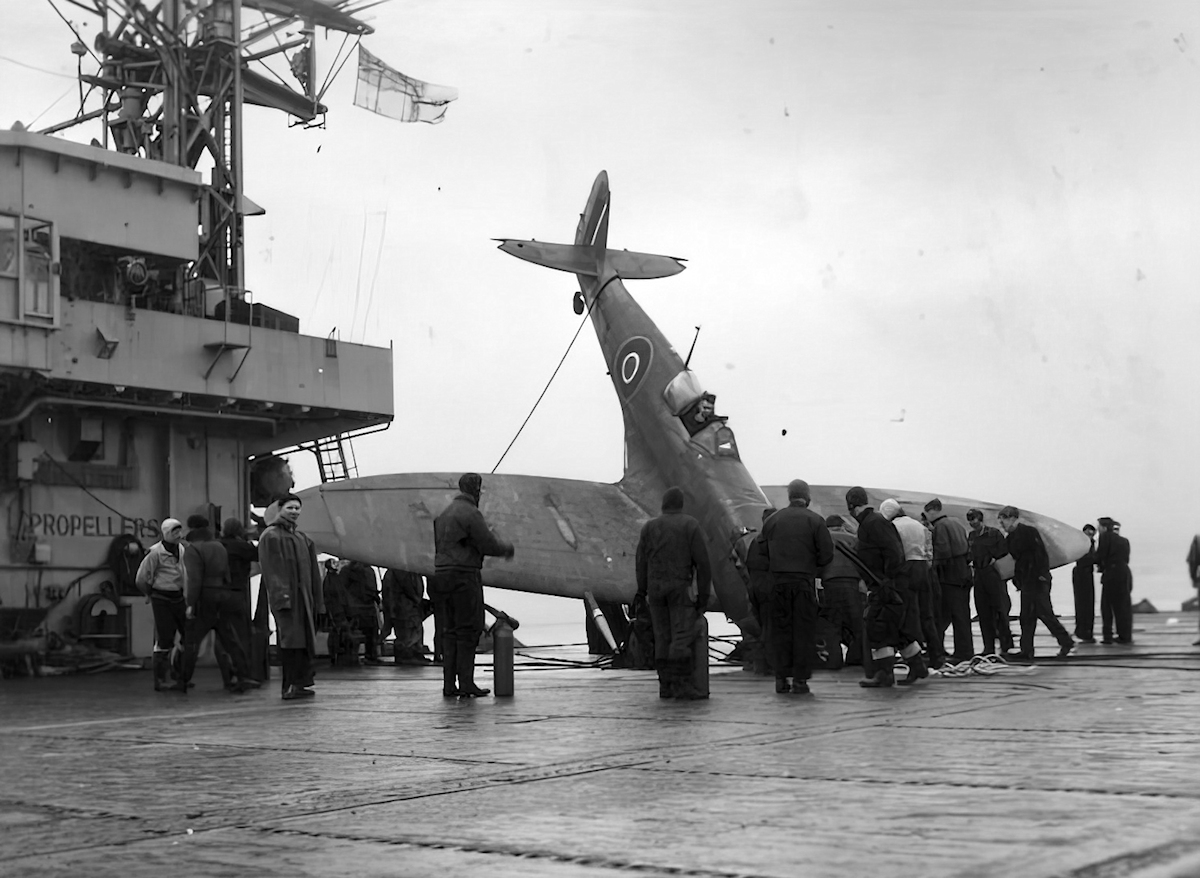
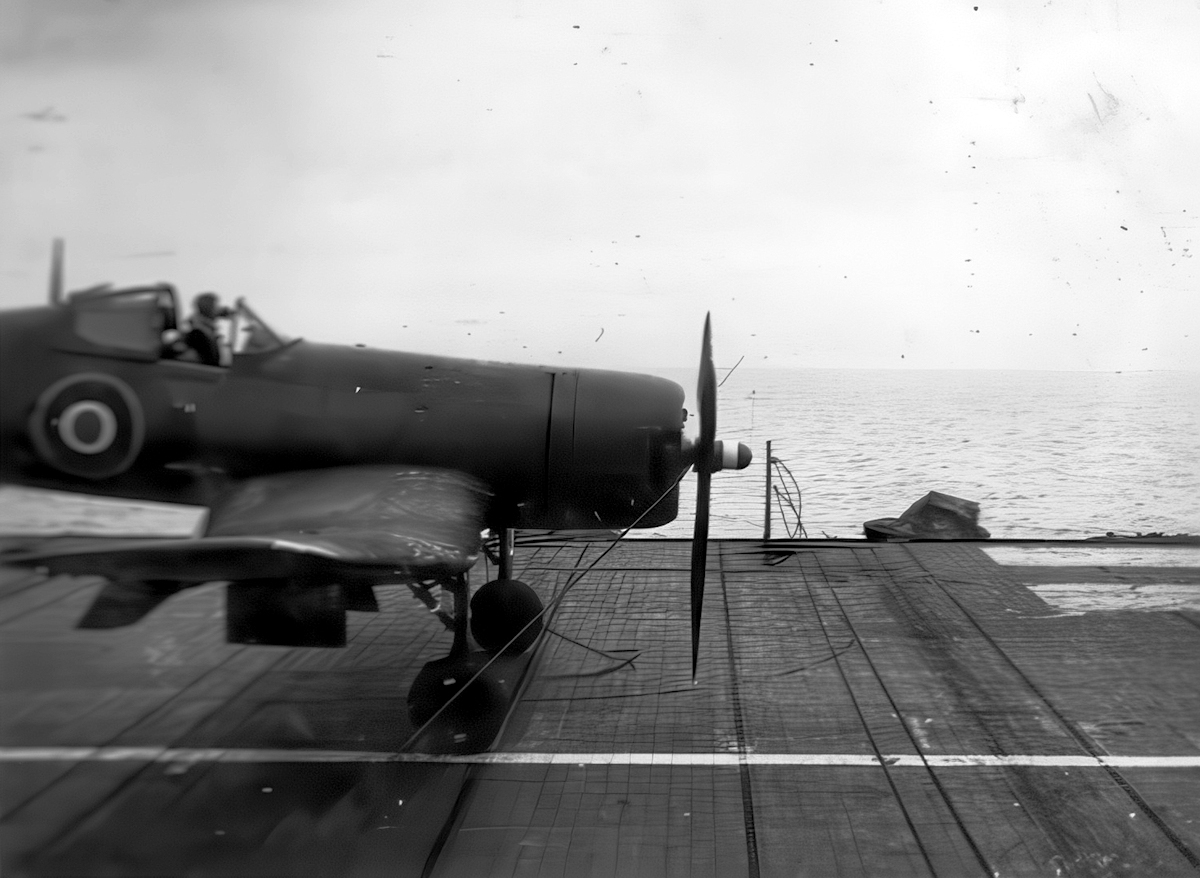
From November 3rd 1944, SLINGER was assigned to operate as a deck landing training carrier for the next six weeks,hosting a variety of aircraft from 768 Deck Landing Training Squadron from
RNAS Abbotsinch. This period put the ship's departments through their paces while training carrier pilots in the art of deck landing, and it was not without mishaps. On the 23rd, Seafire LR652 went over the port side into the sea; the pilot, Midshipman R. J. Watson, RNVR, was rescued by ML593 acting as SLINGER's safety boat; two days later, Sub-Lt E. O. Atkin, RNVR, landed short in Seafire LR687, causing the aircraft's tail oleo to hit the rounddown.
On December 19th 1944 No. 1845 Naval Air Squadron, equipped with 24 Corsair Mk. IVs, joined the ship from RNAS Eglinton, and began deck landing practice and exercising with the ship as it worked up in preparation for deployment to join the British Pacific Fleet (BPF). 1845 was part of No. 10 Naval Fighter Wing with 1843 squadron, the latter was to deploy to the BPF aboard HMS ARBITER.
December was to be a period of intensive flying training for SLINGER and her new squadron, and the strain began to show; The first accident happened three days later when Sub.-Lt Barlow failed to cut his throttle, landing in KD541 and entering the barrier. On the 27th, Sub-Lt P. D. Bennett RNVR landed KD249 heavily on the rounddown, and the undercarriage collapsed. In the New Year, Midshipman E. F. K. Webb RNVR ended in the barrier in KD465 on January 4th. Tragedy struck later that same day when Corsair KD546, flown by Sub-Lt G. A. Anderson RCN, dropped its port wing on landing and swung to port, collapsing the undercarriage leg; the aircraft came to rest on the DLCO (Deck Landing Control Officer) platform, killing the DLCO, Sub-Lt F. E. Ure RNVR. One final incident occurred before the work-up period ended: KD27 crashed on landing on the 8th; pilot unknown.
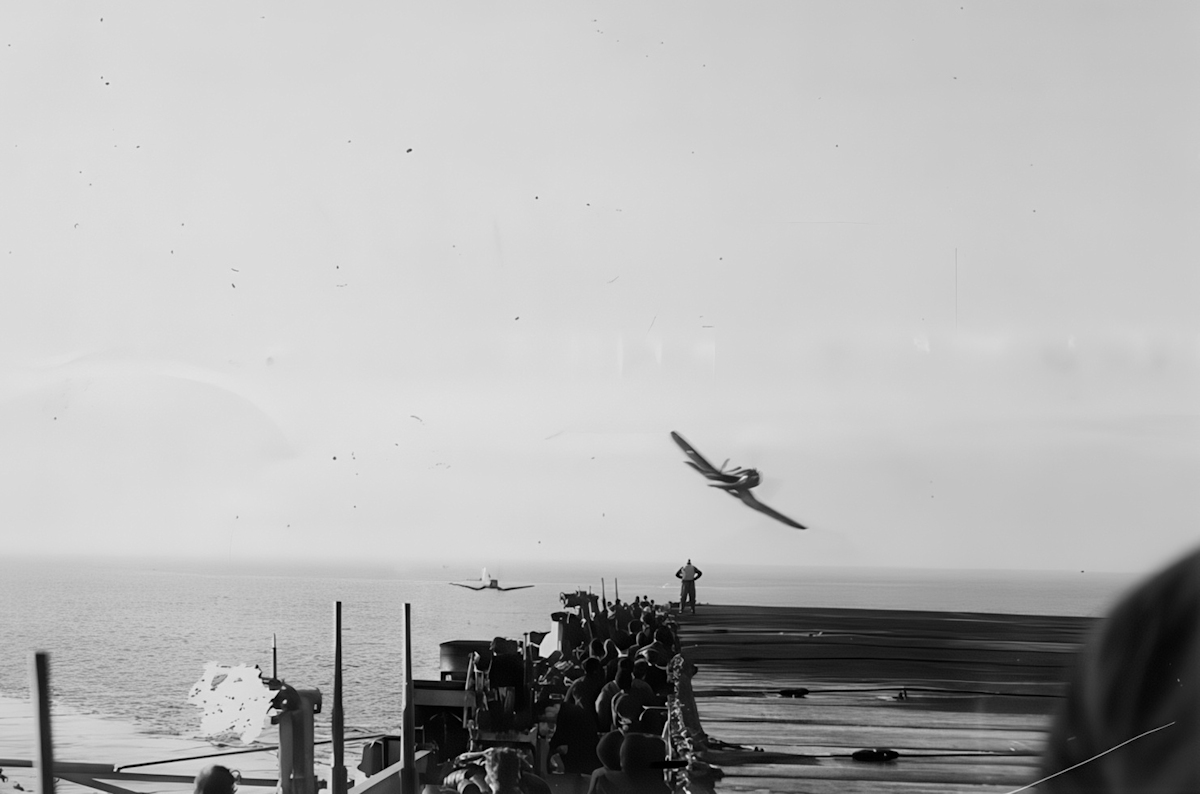
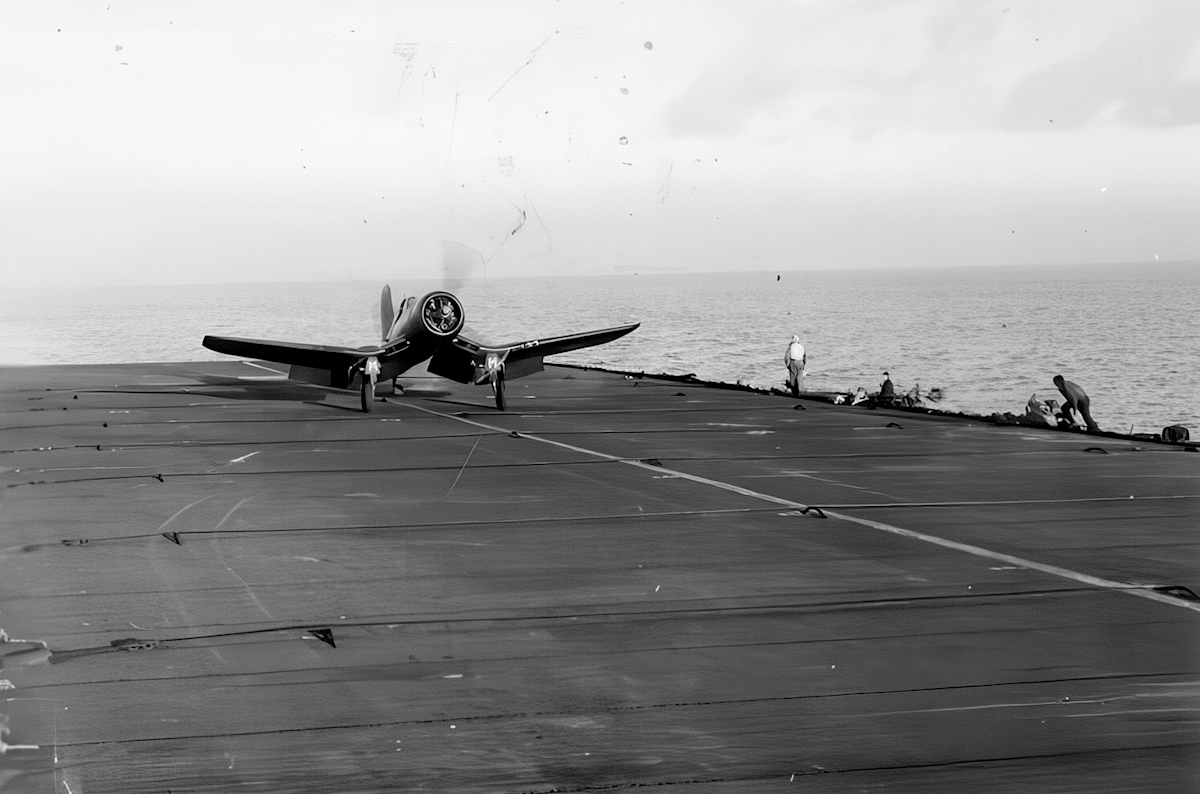
On January 11th 1945 SLINGER (1845 Corsair squadron) and CVEs KHEDIVE (Carrying 808 Hellcat Squadron, non-operational, plus reserve aircraft ferry load) and SPEAKER (1840 Hellcat squadron) together with a destroyer escort of VOLAGE, VENUS, ESKIMO, WOLVERINE and WHITEHALL sailed from the Clyde bound for Gibraltar on the first leg of the voyage to join the BPF in Australia, under command of Captain B. L. Moore, (SPEAKER) Senior Officer. The group of ships called at Gibraltar on the 16th, then set course for Malta. The next day, both SPEAKER and SLINGER flew off aircraft armed with rocket projectiles to search for a U-boat reported off the North African coast. The small convoy entered Valletta Harbour on the 19th, arrived at Alexandria on January 22nd, and entered the Suez Canal on the 24th for transit to the Red Sea. After a brief stop at Aden to refuel and store ship on January 28th, the convoy steamed straight across the Indian Ocean to Ceylon, arriving at Colombo on February 4th. Flying training and exercising with the ship continued throughout the voyage, with only one aircraft incident recorded; on January 21st, Sub.-Lt. C. Leddy RNVR made a heavy landing in KD563, causing severe fuselage structural strain; the aircraft was written off.
The three CVEs were to Part Company; on arrival at Ceylon, SPEAKER and SLINGER sailed for Sydney on the 6th, KHEDIVE remained in Ceylon to join the East Indies fleet. On February 8th the traditional 'crossing the line' ceremony was observed aboard SPEAKER and SLINGER which had crossed the equator at 21:00 hours the day before; the festivities took up most of the day. On February 11th, both ships were called to assist in a search for survivors from a torpedoed American troop ship, the S.S. Peter Silvester, 1000 miles off the coast of Western Australia.
The aircraft of
1840
and
1845 squadrons conducted aerial searches
but after five days no trace was found and
SPEAKER continued on to
Sydney, leaving the area late on the 16th; SLINGER remained to
continue searching until the 19th before she had to break off and
proceed to Sydney. On arrival off Sydney on February 25th
1845 squadron
flew off all serviceable aircraft to
RNAS Schofields (Mobile
Naval Air Base No.3), New South Wales; three unserviceable
airframes, which had suffered damage during the search on the 14th and
15th, were off loaded and taken by road to
RNAS Bankstown (Mobile
Naval Air Base No.2), the ship was secured alongside at Circular
Quay in Sydney on the 28th.
Work began to prepare the ship to join the 30th Aircraft Carrier Squadron (30 ACS; at that time comprising the CVEs CHASER, RULER, SPEAKER, STRIKER and SLINGER under the command of Commodore Carne in STRIKER); her pennant number was changed to R313 for operations in the Pacific theatre. She was to be employed as a forward area replenishment carrier and would only carry replenishment loads of spare airframes for issue to other carriers whilst at sea as a part of the Air Train, the aviation logistic support element of the British Pacific Fleet's logistics lifeline, ' the Fleet Train'. This was a collection of merchant and military vessels which supplied the fleet with fuel, food, armaments and other stores. Based in Sydney, with forward bases at Manus in the Admiralty Islands and Leyte in the Philippines, the Fleet Train operated over some 2,500 miles each way.
On March 1st the ship's company set about painting the ship, applying the Admiralty standard camouflage scheme and new pennant number; work also commenced loading stores. The following day, Admiral Sir Bruce Fraser, the C-in-C, visited the ship and gave the crew a pep talk about the importance of the Air Train's work. SLINGER was to be employed as a forward area replenishment carrier, operating as part of Task Force 112. To carry out this task, the ship was loaded with a replenishment load of 25 airframes, made up of 10 Corsairs, 7 Hellcats, 3 Seafires, 1 Avenger and 4 Fireflies for issue to the fleet during replenishment periods; this load was to be carried in addition to her squadron. 1
Once loading was completed, SLINGER sailed for Manus in the Admiralty Islands on the morning of March 11th 1845squadron re-embarked later that morning. After an uneventful passage, she arrived at Manus on the 17th; SLINGER joined the ships of TG 112, the first forward area replenishment group, assembled in the deep-water anchorage of Seadler Harbour. A number of the ship's officers went ashore to the newly opened Royal Naval Air Station squadron re-embarked later that morning. On arrival at Manus on the 17th SLINGER joined the ships of TG 112, the first forward area replenishment group which was assembled in the deep water anchorage of Seadler Harbour. A number of the ship's officers went ashore to the newly opened Royal Naval Air Station on Ponam Island, HMS Nabaron, a short distance up the coast. This proved to be a reunion with their old CO, Captain Bingley, who now commanded the Forward Area MONAB, Mobile Naval Air Base No.4, which occupied and operated the former US navy air strip on the island.
To position the replenishment force in time for the British Pacific Fleet to top up with fuel before its first strike operation, the first elements of the Fleet Train (designated Task Force 112) sailed from Manus in mid-March. The slowest group sailed first on the 17th: the Oilers CEDARDALE, SAN AMBROSIO, and SAN ADOLPHO, escorted by H.M. ships PHEASANT, CRANE, and FINDHORN. The CVEs STRIKER (S.O.) and SPEAKER and the destroyer KEMPENFELT sailed on the 19th to join them on passage to the first replenishment area, where they formed Task Units 112.2.1 (oilers and replenishment CVE) and 112.2.5. ((Commander Logistic Support Group and CAP CVE).
The second group sailed on March 19th and comprised H.M. Frigate AVON, and H.M. Sloop WOODCOCK, Landing Ships LOTHIAN (flagship, Rear Admiral, Fleet Train) and EMPIRE SPEARHEAD, Heavy Repair Ship ARTIFEX, Destroyer Depot Ship TYNE and auxiliaries ARNDALE, AASE MAERSK, BACCHUS, DINGLEDALE, WAVE KING, WAVE MONARCH, Storee Issuing Ships FORT COLVILLE, DENBIGHSHIRE, ROBERT MAERSK, THYRA S., HERMELIN. With additional escort of Australian Corvettes BALLARAT , WHYALLA, BENDIGO , KALGOORLIE, and LISMORE. SLINGER (S.O.) joined the convoy at 16:40 on the 21st. The convoy arrived at Leyte Gulf in the afternoon of the 26th and anchored in San Pedro Bay
The situation in the Pacific at the time of SLINGER's arrival on station
The British Pacific Fleet (now re-designated Task Force 57) had sailed from Ulithi Atoll at 06:30 on March 23rd 1945, for operations as part of the American Fifth Fleet under Admiral Raymond Spruance, USN. For the first phase of Operation ICEBERG. The carriers had embarked 218 aircraft: INDEFATIGABLE 40 Seafire, 20 Avenger, and 9 Firefly; INDOMITABLE 29 Hellcat and 15 Avenger; ILLUSTRIOUS 36 Corsair and 16 Avenger; and VICTORIOUS 37 Corsair, 14 Avenger, and 2 Walrus. The carriers were tasked with denying the Japanese use of airfields on two Islands in the Sakishima-Gunto group in a series of 12 strike days conducted in rotating cycles of 2-3 days of strikes and 2 – 3 days of replenishment. Because of the long distances involved between the operational area and the nearest forward base, all replenishment had to be done at sea. When TF57 stood down to replenish, USN elements TF58 and later TF52 took over the strike task.
Task Force 57 met with the Logistic Support Group (LSG), Task Units 112.2.1 and 112.2.5, at 06:00 on the 25th, at position ANT (18° 3o’N 129° 08’E), for a short replenishment at sea, which included issuing 4 replacement aircraft from STRIKER and topping off fuel tanks. SPEAKER provided Combat Air Patrols over the fleet, and fuelling was completed by 15:30.
On completion of this topping off, TF57 joined US Task Force 58 on the 26th for joint attacks on islands of the Sakishima-Gunto group in support of preparations for US landings on Okinawa. This was the first of 12 strike sorties against Japanese airfields on the Islands of the Sakishima-Gunto group in operation ICEBERG One. Because of the long distances between the operational area and the nearest forward base, all replenishment had to be done at sea; TF57 operated a 2-day on-station strike cycle followed by 2-3 days of replenishment.
After the fleet departed, the ships of the logistics support group moved to the refuelling area MIDGE on the 28th. This was one of three areas used for fuelling during ICEBERG One operations, each was a rectangular area which covered 5000 square miles of ocean east of Luzon, their code names were all called after insects; each area was 50 miles to the south and 100 miles west of' the following positions – 'COOTIE' 21° 52’ N 129° 24’ E; 'MIDGE' 19° 55’ N 129° 40’ E; and ‘MOSQUITO' 20° 17’ N 125° 22’ E. The nominated area changed from one replenishment period to the next.
The second replenishment commenced on March 28th and ended on the 30th: The LSG vessels waited at the prearranged rendezvous in area MIDGE at 07:30 on the 28th. TF57 met the Tanker Group and began refuelling. At night, the task force left the refuelling area and steamed independently at higher speed for submarine protection, rejoining the logistic support group at dawn for a second day's fuelling. With only 3 Tankers on station and leaking hoses, refuelling continued into a third day, completing at 14:30 on the 30th. During this replenishment period, STRIKER issued 13 replacement aircraft to the fleet and recovered three flyable but unserviceable aircraft; she also transferred replacement Avenger aircrew to 854 Squadron in ILLUSTRIOUS. With her spare aircraft stock exhausted, STRIKER departed for Leyte on the afternoon of the 29th, escorted by CRANE and WHIRLWIND. Replenishment was complete by mid-afternoon on March 30th, and TF57 withdrew.
SLINGER allocated to Task Unit 112.2 .2
Meanwhile, after fuelling and storing, SLINGER was allocated to Task Unit 112.2.2, along with the Tankers AASE MAERSK, ARNDALE and DINGLEDALE and escorts BENDIGO, PIRIE and WOODCOCK, which left Leyte at 18:00 on March 29th for the replenishment area Midge, replacing STRIKER as the duty replenishment carrier for the third replenishment period. TU 112.2 .2 arrived in area Midge in the early hours of April 2nd.


Bad weather hampered the the LSG rendezvous with TF57on April 3rd, which was not made until 13:20. Between April 3rd and 5th, the Fleet took on fuel and stores. During this replenishment period, two CVEs were in the LSG: SPEAKER with 1840 squadron Hellcats embarked provided CAP for the Fleet Train and SLINGER which provided replacement aircraft and aircrews; she issued 22 replacement aircraft to the fleet carriers and recovered 2 ‘flyable duds'. The fleet repositioned overnight on the 4th to replenishment area MOSQUITO One, and refuelling resumed at 06:30; a second Tanker group, TU 112.2.3, also arrived from Leyte, bringing the total to 5 Tankers on station. During the day, SLINGER embarked casualties for transport to the Hospital ship OXFORDSHIRE at Leyte; 16 men came from INDEFATIGABLE which had taken a direct hit from a Kamikaze aircraft several days earlier. It struck the flight deck adjacent to the island, destroying the flight deck sick bay, killing 14 and wounding 16. The Fleet disengaged at 19:30 for the night. Fuelling resumed at 06:30 on the 5th in better weather, and replenishment was complete by 19:30 when the Fleet disengaged and set course at 20 knots for the operational area.
TU 112.2 .2, now comprising SLINGER and Tankers ARNDALE and WAVE KING, with escorts AVON, BENDIGO, and PIRIE, withdrew from the replenishment area at dusk on the 5th and set course for Leyte. Further casualties were received from ILLUSTRIOUS, INDOMITABLE, and VICTORIOUS; all casualties had been ferried across to SLINGER by jackstay transfer from destroyers. A burial at sea took place later on the 6th for Petty Officer Mitchell, one of the casualties taken off INDEFATIGABLE , who died of his injuries. SLINGER also suffered a casualty from amongst her own crew on the 6th when 19-year-old Able Seaman David Lias RNVR was discovered to be missing; he presumably fell overboard and drowned. SLINGER and AVON detached at 18:00 on the 7th and reached Leyte the next day, where the wounded were transferred to the hospital ship. She sailed for Manus at midday on the 9th to receive another replenishment load.
During the passage to Manus, fate dealt SLINGER another blow when increasing to maximum speed she began to shake from stem to stern, these strong vibrations subsided when her speed was reduced to 12 knots. SLINGER had been struck by the bane of the 'Bogue class' CVE's: her LP rotor, part of the reduction gearing that harnessed the steam turbines to the propeller shaft, had begun shedding teeth. She was unlucky in that she (and TRUMPETER) did not have this problem rectified before leaving the US, with the modifications for RN service carried out in the UK. Most vessels in her class were either modified in Vancouver or in Seattle, where their LP rotors were checked and corrected while in the dockyard. The reduced speed meant SLINGER had to drop out of the convoy and make her way to Manus independently. It was decided after radio messages were exchanged with RAFT (Rear Admiral Fleet Train) and C-in-C BPF that SLINGER should proceed back through the Islands at best speed to Brisbane to undergo repairs in the newly opened Cairncross Dry Dock, another unfortunate ‘first '- the first carrier ever to use it, just as she had been the first carrier repaired in a London dockyard. SLINGER called at Manus on the 14th and arrived at Brisbane on April 19th, but could not enter the dry dock until the 28th.
Removing her Low Pressure (LP) turbine rotor and reduction gearing was a massive, highly disruptive operation. Because these ships were built on converted merchant hulls, the engine spaces sat directly beneath the hangar and flight deck, with no access points to remove engine components. So, dockyard workers had to create new, temporary access. Before any such work could begin, the ship had to be completely de-stored. They removed all aircraft, ammunition, and fuel to ensure safety during heavy hot work (cutting and welding). Shipyard workers had to structurally cut away sections of the upper hangar deck and intervening decks directly above the main engine room to form a temporary lift shaft.
Hundreds of feet of overhead piping, electrical cable runs, ventilation trunking, and auxiliary machinery brackets had to be unbolted or cut away to create a clear vertical path. The engine rotor casing had to be disassembled and all feed pipes and drains disconnected. Once accessed and disengaged, the LP Rotor and gearbox had to be hoisted out by crane onto the quayside and prepared for transport to an engineering works. On examination, many gear teeth were damaged and had to be reshaped on a lathe to a uniform size, about two-thirds of their original width. The repairs were to take four weeks, during which time VE Day was celebrated on May 8th.
Upon returning to sea on May 27th, one side effect of the repair became apparent: she could now achieve a maximum speed of only 12 knots and therefore could no longer conduct flying operations. As a result, she was reallocated to the role of Ferry Carrier, transporting replacement aircraft from Australia to Manus and the Philippines. This change in role effectively made SLINGER an auxiliary vessel; accordingly, her pennant number was changed again, this time to A452. Her new role also reduced the size of the ship's company; a much smaller crew was now required, so many men were drafted to the RN Barracks, HMS GOLDEN HIND , in Sydney; the unlucky personnel had to travel over 600 miles by rail back to Sydney.
By this time, Operation ICEBERG had been completed, and the ships of TF 57 had withdrawn from the forward area on May 25th and proceeded to Manus and Australia for replenishment. At the same time, SLINGER was putting to sea on the 27th; the BPF was redesignated Task Force 37 when it joined Admiral William Halsey's United States Third Fleet. Meanwhile, the Fleet Train also withdrew from Leyte to Manus, sailing in two convoys: one on the 20th and the second on the 25th. Manus would be the Fleet Train's main base for the next round of operations against mainland Japan planned for July 1945. During this period, while the fleet and support vessels regrouped, SLINGER was put to work using her remaining functionality: acting as a high-volume regional aircraft transport to move both flyable and dismantled aircraft from the Queensland depots down to the New South Wales air stations.
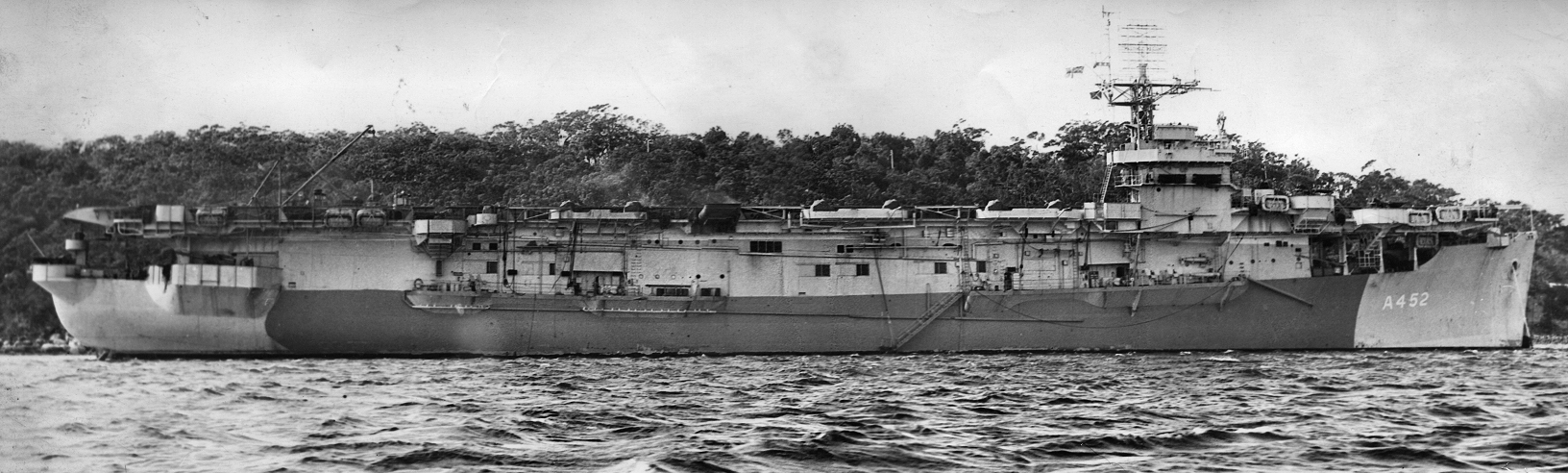
HMS SLINGER wearing her auxiliary pennant number A452. Photo: Courtesy of David Yates
SLINGER arrived in Sydney on May 29th, and work began on loading stores and embarking passengers in preparation for a round trip to Brisbane, departing on June 3rd and arriving in Brisbane on the 5th. After unloading, the ship sailed back to Sydney later that day; during this passage, very high seas and squalls were experienced, adding a day to the voyage. On June 8th, she was moored at Pyrmont, ready to embark another ferry load. It is unclear how many local ferry runs the ship undertook or how much time it spent at anchor in Sydney. 2
At the beginning of July, there was another change of commanding officer, Captain Moore leaving to take up the post of Senior British Naval Liaison Officer, Philippine. The ship's executive officer, Commander J. G. Hopkins RN, an ex-submariner who had joined SLINGER in February, replaced him as C.O.
SLINGER sailed for Manus as a ferry carrier at the beginning of August, carrying a full load of serviceable airframes for delivery to Mabus as part of the build-up of strategic reserves for the anticipated Operation OLYMPIC, the invasion of Kyūshū, planned to begin on November 1, 1945. The Air Repair Group at Manus comprised the Aircraft Maintenance Carriers UNICORN N and PIONEER , Aircraft Component Repair Ship DEER SOUND and Air Store Issuing Ships FORT COLVILLE and FORT LANGLEY ; shore-based facilities included RNAS Ponam and lodger facilities at USNAS Pityilu which housed the RN Forward Aircraft Pool and a test flight from PIONEER . In this organisation, PIONEER repaired aircraft and, after test flight, transferred them to the RN FAP, while UNICORN repaired fewer aircraft, focusing on preparing aircraft for service from Class II preservation. Ferry loads such as those delivered by SLINGER at Manus on August 13th would have been allocated to UNICORN and either RNAS Ponam or the FAP .
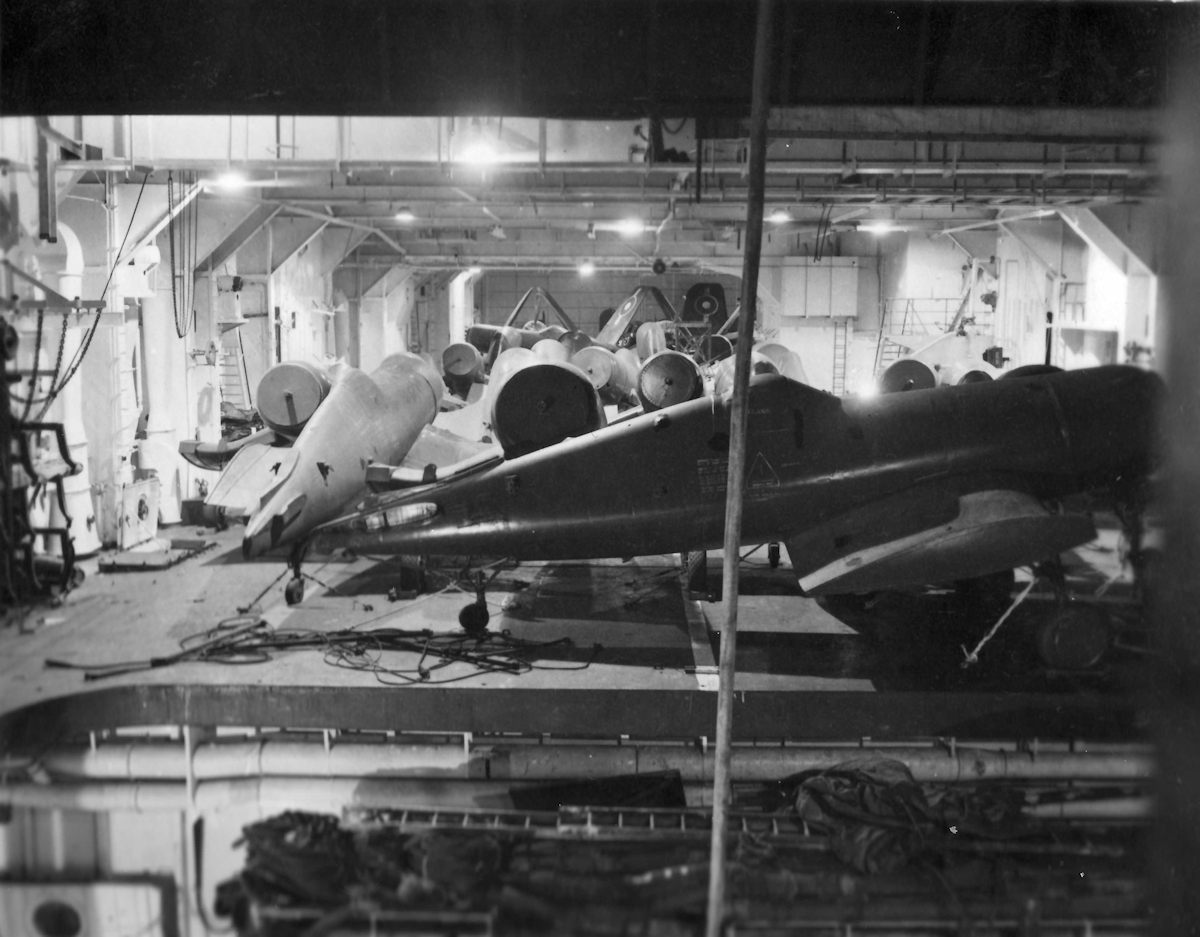
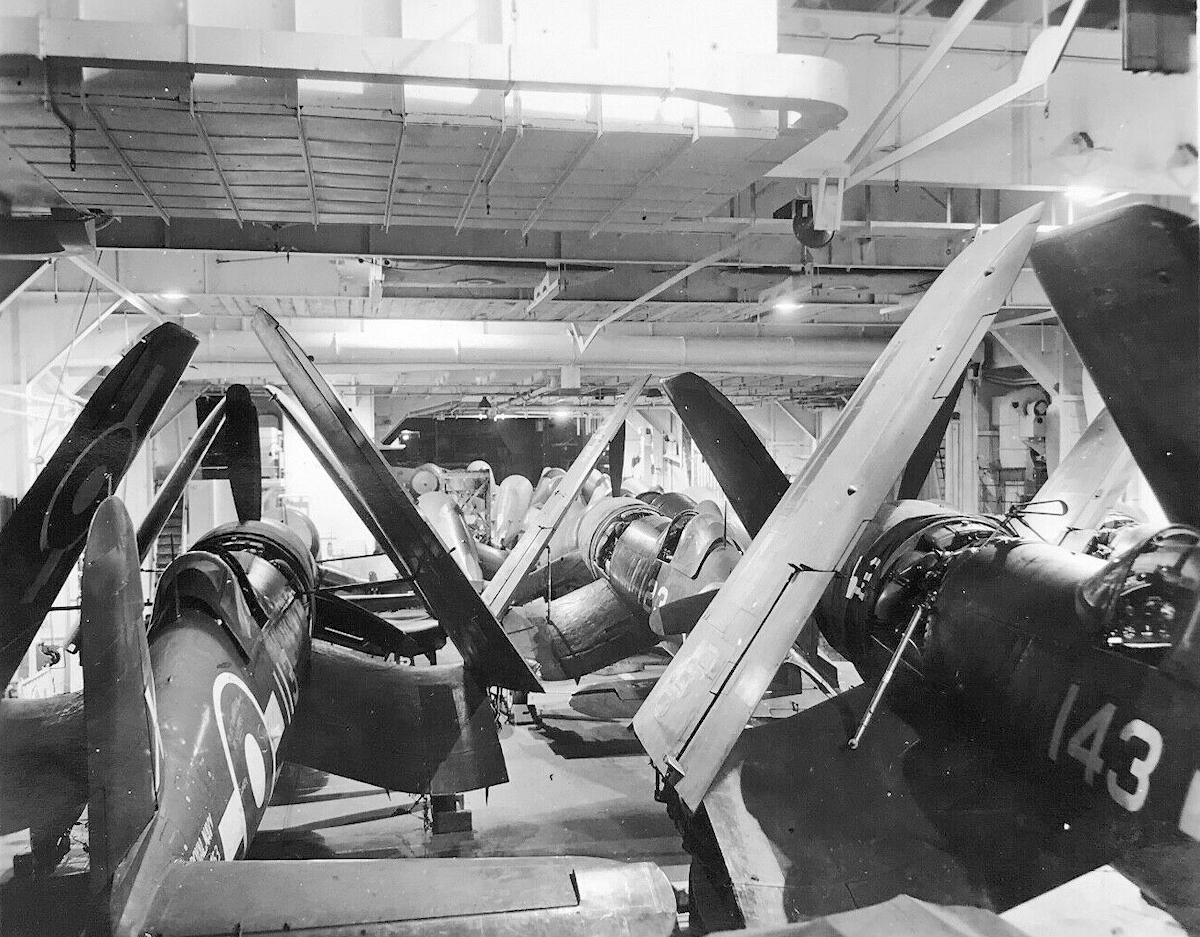
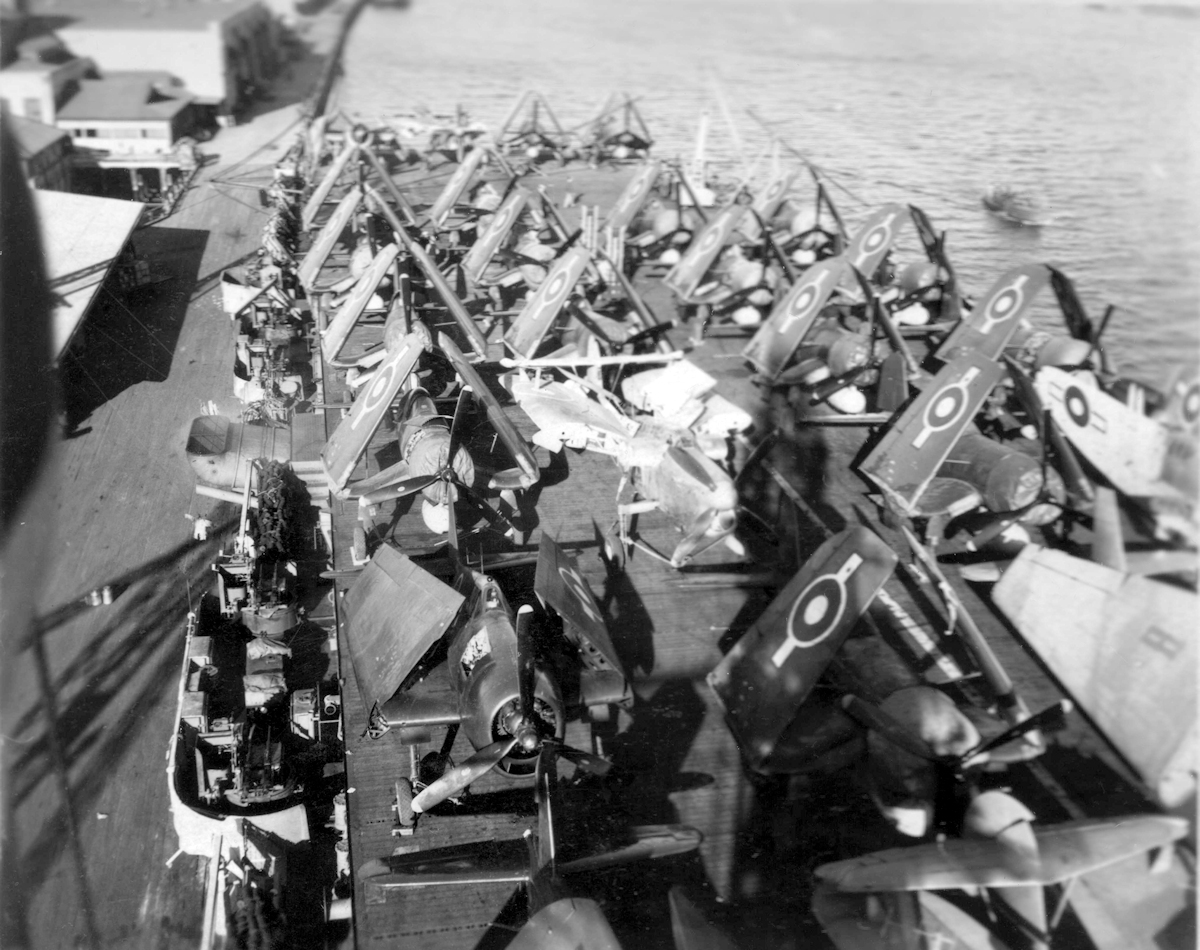
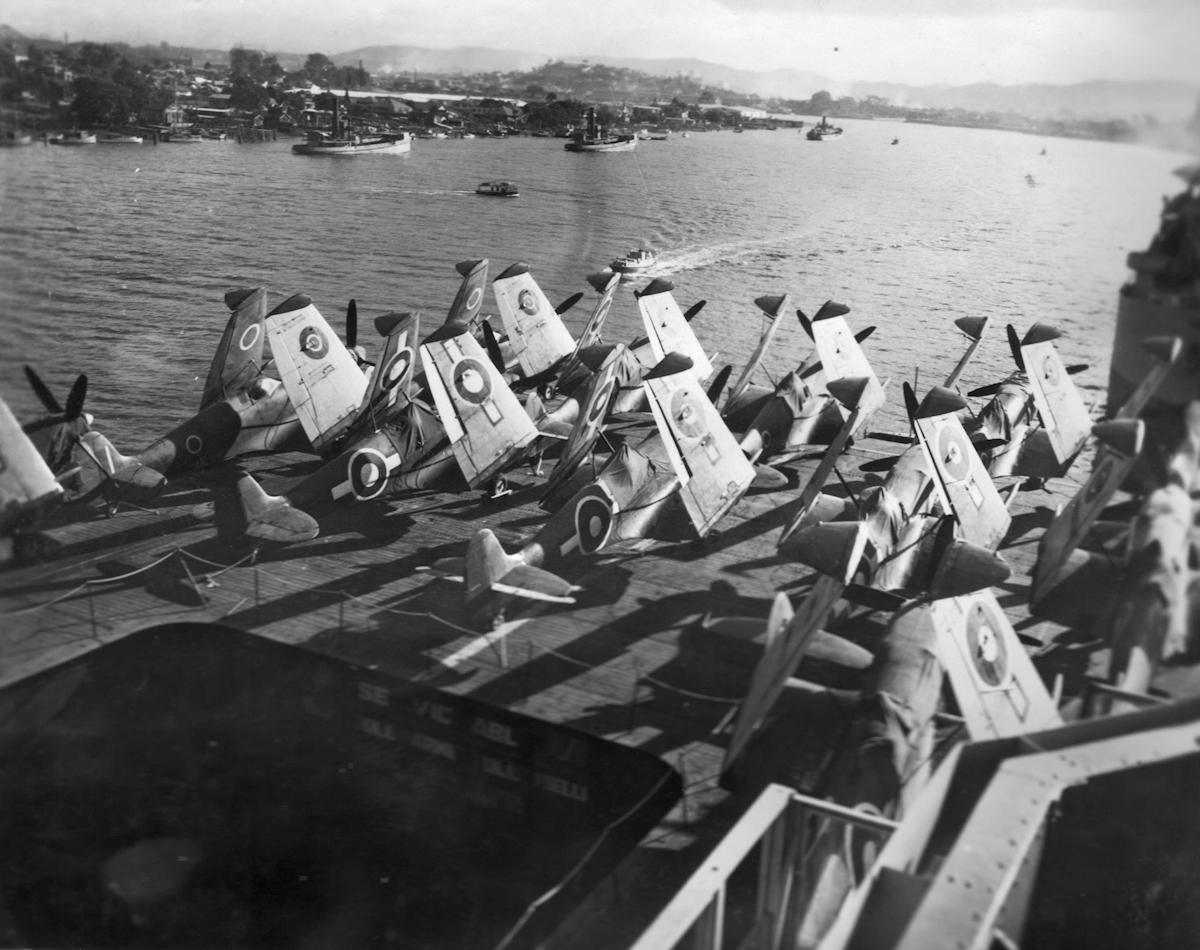
She was moored in Seeadler Harbour when the news of the Japanese surrender came over the radio. All aircraft had to be offloaded using aircraft lighters; after disembarking, preserved airframes were taken to UNICORN. She moved on the 18th to anchor off Ponam Island to complete offloading her ferry load, and embark damaged aircraft for transport to
RN Air Maintenance Yard Archerfield
, Brisbane, and sailing for Australia.
With the Japanese surrender, SLINGER and the replenishment CVEs ARBITER and STRIKER , which were also at anchor in Seeadler Harbour when the surrender was announced, were ordered back to Australia. ARBITER and STRIKER sailed from Manus on the 16th, with SLINGER following two days later. She called at Brisbane on August 24th.
Upon her arrival in Sydney, SLINGER and her sister carriers were to be employed in humanitarian relief work; after the Japanese surrender, transporting supplies and passengers to Hong Kong and returning with liberated POWs and internees became the priority. They offloaded all unnecessary equipment and loaded large quantities of food and medical supplies for delivery to the colony. The carriers were also outfitted as makeshift troop transports. Her hangar became a vast dormitory, utilising folding camp beds and, in some cases, tiers of bunks. Work and accommodation spaces previously used by the air engineering department and squadron were repurposed.
Once this conversion work was completed, she received orders to embark the advance party of HMS NABCATCHER (MONAB VIII) for passage to Hong Kong where they were to reopen Kai Tak airfield; they embarked on September 5th. HMS SLINGER sailed for Hong Kong on the 9th. En route, she called at Brisbane on the 12th to take on more stores, Manus on the 17th, and Mindanao Bay in the Philippines on the 22nd to refuel.
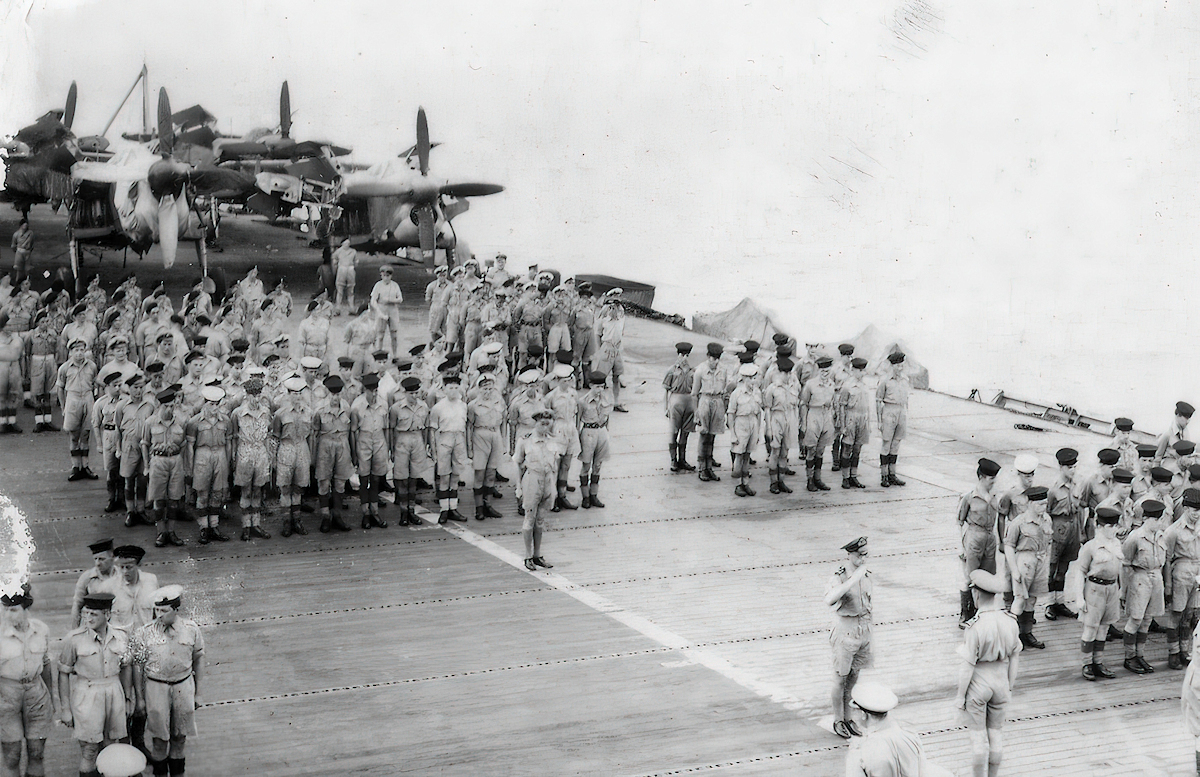
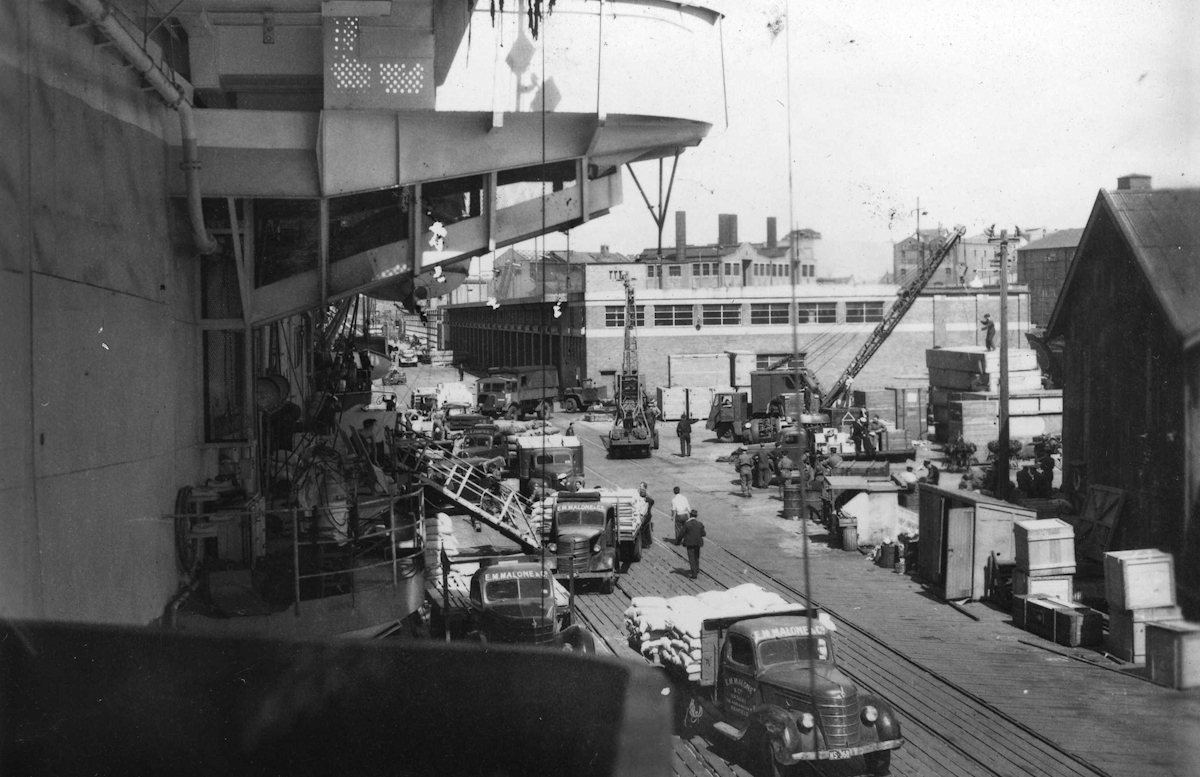
The ship arrived in Hong Kong on or around September 26th, and work began unloading stores in Kowloon; former Japanese naval personnel undertook the work and proved very efficient. Japanese prisoners were employed extensively in the colony in the early months after the surrender; working parties marching to and from assignments were a common sight. After only a few days, work had to be suspended as SLINGER and the BPF vessels in Hong Kong were ordered out to sea to ride out a typhoon fast approaching the colony. A small working party remained ashore at Kai Tak airfield which was being reopened by MONAB 8, was reopening, where much of the offloaded stores were being taken. The BPF ships spent five days at sea riding out the typhoon before it was safe to re-enter Hong Kong. Work resumed unloading the remaining stores, and the embarkation of the civilian prisoners of war from the Stanley Road Prison Camp began. Prison Camp began.
The passengers were mostly civil servants, shipping company officials, servicemen and their families. Also aboard were three prisoners under guard; these men, Major Boon, the Camp Commandant, an elderly Army Lieutenant and a Sergeant, had been accused by their fellow prisoners of collaborating with the Japanese and were to face court-martial proceedings in Britain. The prisoners were under the charge of Lt. Hughes, the ship's gunnery officer; he was also given custody of documents about the Camp and photographs of the Japanese camp personnel which were to be delivered to Naval Intelligence.
She departed Hong Kong on or around October 7th. She called at Manila on October 10th, where she picked up more passengers, including liberated Australian PoWs, and departed that same day. Upon her arrival back in Sydney on October 25th, SLINGER came alongside at 14 Wharf at Pyrmont; large crowds met the ship, many were there to meet family members and loved ones. Major Boon and his fellow prisoners were transferred to the cruiser HMS DEVONSHIRE to be taken home for trial.
After disembarking her passengers at Pyrmont, SLINGER moved to a mooring alongside at Sirius Cove. While preparing for a return voyage to the UK, her crew applied a new coat of paint and restored her old pennant number of ‘26’. This time in white characters. By the end of the first week in November, she was embarking passengers and stores for the return passage to the UK.
Most of her passengers were personnel from HMS NABARON,(MONAB 4), who embarked on November 9th; UNICORN had evacuated the Unit from Ponam Island and delivered them to Sydney on the 6th. A contingent of female nursing staff also took passage to the UK. Major Boon also arrived back on board, having been transferred back to SLINGER after a spell in hospital in Sydney; DEVONSHIRE had already sailed for the UK as planned without him.
With all loading complete, SLINGER slipped her moorings in Sirius Cove, Sydney, at 11:00 on Saturday, November 10th 1945, bound for Fremantle; HMS NABARON was officially paid off on sailing. She anchored in Gage Roads off Fremantle at 22:30 on November 17th, then berthed at E Shed Victoria Quay, Fremantle at 07:00 the next morning. After exchanging passengers and embarking more stores, she sailed for Colombo at 15:00 on the 18th. She arrived at Colombo on December 4th to embark more passengers. She departed for Aden on the 5th.

November 18th 1945 SLINGER ready for departure from Victoria Quay, Fremantle on route to the UK to pay off. Image courtesy Mike Roshier.
She arrived at Port Suez late on December 9th, began her transit of the Canal early the next morning, and sailed immediately on arrival at Port Said around 18:00 for Gibraltar, arriving there on the 17th. Local leave was granted, and the captain and navigator went ashore. While anchored in Gibraltar Roads, a storm front developed; the wind soon increased to gale force and began to act on the ship, causing her to drag her anchor, and there was a danger that she would crash into the North Mole. The weather was too severe for the captain and other officers to return to the ship by boat, so the officer of the watch took the initiative and called for the engine room to get the ship underway. Having checked the ship's drift, the anchor was secured, and SLINGER put to sea to weather the gale. The captain and liberty men were re-embarked once the storm had abated.
The foul weather continued to dog SLINGER, all the way across the Bay of Biscay and up the English Channel. She was supposed to call into Devonport first, then go to Portsmouth to disembark the 6000 naval personnel on board; however, the bad weather changed the plan, and she made for Portsmouth first, arriving on December 22nd. After unloading some of her passengers, cargo and mail from the Far East, she sailed for Plymouth. The sea was so rough on the afternoon of Christmas Eve when SLINGER arrived off Plymouth Sound that she could not pass the breakwater; instead, she anchored in Cawsand Bay until the weather eased sufficiently to allow her to secure alongside No 5 Jetty, Devonport Naval Dockyard, on December 27th. Major Boon was put ashore later that day and handed into the custody of an armed escort for transport to Exeter prison to await trial.
Once all her passengers and cargo had disembarked, SLINGER began de-storing, and Dockyard staff commenced removing Admiralty equipment in preparation for her return to the US Navy. Her crew was reduced to a steaming party to man her Atlantic crossing to Norfolk, Virginia. Those due for release under the Age and Service Act went straight to their demob depots; others, retained but unnecessary to tShe ship’s operation, were drafted to their respective RN Barracks.
No longer required for service in the RN and was to be returned under the terms of the Lend-Lease agreement. On January 16th 1946, SLINGER left Devonport for the Clyde to complete her de-storing in preparation for her decommissioning. On the 25th, she left the Clyde for the last time and proceeded to Norfolk, Virginia.
Assuming she sailed directly to Norfolk at 11 knots, she arrived there on or around February 7th. Once secured in the Naval Dockyard, the crew made final preparations to hand her back to the U.S. Navy, including removing all Admiralty material still on board. On February 27th 1946, a US Navy Care and Maintenance party came aboard to take possession of the ship and commence her inventory. CVE 32 was returned to U.S. Navy custodythe same day, and H.M.S. SLINGER officially paid off. No longer needed by the U.S. Navy, she was stricken for disposal on April 12th 1946 and put up for sale.
CVE 32 was sold into mercantile service on November 21st 1946, when the Robin Line (part of the Seas Shipping Co., Inc., of New York) purchased her to convert her into a passenger freighter. Welding Shipyards, Inc. in Norfolk, Virginia, undertook the extensive rebuilding work and engine repairs.
After extensive reconstruction, she was renamed 'ROBIN MOWBRAY' in 1948. She could carry 12 passengers in dedicated staterooms alongside her bulk cargo and operated on the company's weekly New York to South and East Africa run until Seas Shipping Co. was bought by Moore-McCormack Lines in 957. The ship continued to operate under its original commercial name until she was sold for scrap and broken up in Taiwan, starting on January 29th 1970.
Last modified: 02 October 2026>
© 1999-2026 The Royal Navy Research Archive All Rights Reserved Powered by W3,CSS
Press F5 to refresh the page after posting your comment or to hide the form
Shape: Standard, circular.
Blazon (Heraldic description) On a white field: An arm embowed, the hand grasping a sling, armed with a stone, in sinister, base, proper.
SLINGER:One who uses a sling for throwing missiles, as in ancient warfare. Both the design and the motto are references to the parable of ‘David and Goliath’ were an ordinary person, using simple weapon, overcame am enemy’s much larger proud champion who boasted he was unbeatable.
Unofficial badge:

Although an official pattern was approved in 1943 an unofficial design, believed to have been submitted for consideration by the ships officers while the ship was building was widely used in materials relating to the ship throughout her service. It comprised of a field of white with six barry wavy white and blue in base; an arm, the hand grasping a sling, armed with a stone, in sinister, proper, with a boat hook Saltirewise, gold. This design was in a Diamond shield and was possibly looking back to the Catapult trials ship - SLINGER from the First World War.
For explanations of heraldic terms see the
Royal
Navy Ship's Badges page.
Logistic Support Group
Task Unit 112.2.1, comprising replenishment CVE STRIKER (Commodore 30 ACS), escorted by CRANE, the oilers SAN ADOLPHO, SAN AMBROSIO and CEDARDALE, escorted by FINDHORN and WHIRLWIND. Task Unit 112.2.5, CVE SPEAKER (1840 squadron Hellcats for Combat Air Patrol duties over the LSG), escorted by PHEASANT and KEMPENFELT.
Close Logistic Support Group
Task Unit 112.2 .2, comprising replenishment CVE SLINGER escorted by Frigate PARRET, Oilers (RFA), ARNDALE, AASE MAERSK (RFA), DINGLEDALE (RFA), WAVE KING (RFA), WAVE MONARCH, escorts Corvettes BENDIGO and PIRIE (S.O.) and Sloop WOODCOCK Task Unit 112.2.5, comprising CVE SPEAKER (1840 squadron Hellcats for Combat Air Patrol duties over the LSG), escorted by PHEASANT and KEMPENFELT. .
Close Note
It is unclear whether 1845 retained all 24 Corsairs on arrival in Australia; adding 25 more aircraft would make flight operations challenging, since priority would be given to launching reserve aircraft and keeping a clear deck to recover flyable duds for return to UNICORN at Leyte or to Manus. .
Close Note
A sequence of photographs shows SLINGER alongside at Brett's Wharf in Hamilton, Brisbane, c. early August, during loading operations for what is presumed to be this ferry load. In these images, she loads both Class II preserved and complete Corsairs, these being hoisted onto the flight deck, along with crated components, all of which appear to have been taken down onto the hangar deck. Two views of the hangar clearly show at least 10 cocooned Corsair fuselages and 4 complete Corsairs still wearing their previous squadron markings. Later images show the flight deck covered with reserve aircraft: a ferry load of about 17 Corsairs, 11 Seafires, 2 Barracudas, 1 Firefly, and 5 Hellcats, all of which appear serviceable. .
Close Note
Anecdotal account given by Robert Hughs, SLINGER's Gunnery Officer, recalls “during July and August we tamped up and down between Sydney and the Philippines every inch of the hangar and flight deck crammed with aircraft of every sort, our largest cargo being 120, because the build-up was beginning for the last operation – the invasion of Japan itself now that Okinawa had been taken.” .
However, the Fleet Train withdrew from Leyte to Manus at the end of May. The only destination for a ferry at the start of June load would be R.N. Air Station Ponam. The reorganised Air Train was not on station at Manus until June 21st, when the Commodore Air Train (COMAT) arrived at Manus in PIONEER as the first element of the Air Repair Group. On her arrival, PIONEER established the R.N. Forward Aircraft Pool (FAP) at the US Naval Air Station on Pityilu Island. UNICORN joined her a month later, on July 21st, carrying a ferry load of reserve aircraft at Brett’s Wharf, Hamilton, embarked after a period in the Cairncross Dry Dock.

Comments (5)
My wife's father was the AB Jack Hill mentioned under Seattle: Working up the ship.
"Asbury" refers to HMS Asbury (later known as HMS Saker 11) which was a shore based transit accommodation for the Royal Navy located just outside New York City and used by crews picking up ships allocated to the Royal Navy under the provisions of Lend-Lease from the USA. He would have been on board for the handover ceremony at Portland, Oregon on 11/08/1943 and when the ship hit a mine in 1944. He was transferred to HMS STRIKER in June 1944, at the same time Capt Bingley left.
Any idea what a Greaser did on board?
On STRIKER he became a Donkeyman - what did they do?