A History of HMS NABOB
|
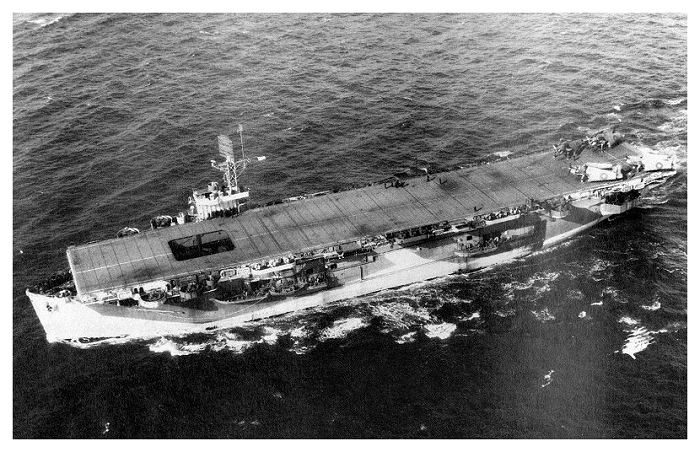 |
Aerial view of HMS NABOB in March of 1944 off the coast
of California during her post modification work up with
Avengers of 852 squadron. |
HMS NABOB was a 'Ruler' class escort carrier (US Bogue class) built in the USA at Seattle-Tacoma Shipbuilding Co. Tacoma, Washington. Her keel was laid down on October 20th 1942 as a C3-S-A1 type freighter, Maritime Commission hull number 252, Seattle-Tacoma hull number 36. The hull was purchased by the US navy to be completed as the USS EDISTO ACV-41 (designation later changed to CVE-41).
She was launched on March 9th 1943, 140 days after her keel was laid. Whilst still under construction it had been decided that CVE-41 was to be transferred to the Admiralty on loan upon her completion, and Commander L. R. Romer RN was appointed as Officer in Charge on August 15th 1943. After spending 182 days outfitting the ship was ready for delivery on September 7th 1943; CVE-41 took a total of 322 days to complete.
After completing builders and Admiralty acceptance trials on September 1st CVE - 41 was transferred to Royal Navy custody at Tacoma. Washington on September 7th 1943 and was accepted on behalf of the Admiralty by Commander Romer RN. The White Ensign was hoisted and the ship was commissioned as HMS NABOB, pennant number D77.
NABOB, manned by a small steaming party under the command of Commander Romer, departed Trachoma on September 10th or Vancouver, Canada, arriving at LaPointe Pier later that day. She was one of 19 escort carriers to be modified to meet Admiralty requirements by the Burrard Dry Dock Co. Ltd., North Vancouver, British Columbia. While in Vancouver she was to receive her full crew compliment and work up ready for beginning her active service. NABOB, manned by a small steaming party under the command of Commander Romer, departed Trachoma on September 10th or Vancouver, Canada, arriving at LaPointe Pier later that day. She was one of 19 escort carriers to be modified to meet Admiralty requirements by the Burrard Dry Dock Co. Ltd., North Vancouver, British Columbia. While in Vancouver she was to receive her full crew compliment and work up ready for beginning her active service.
Modification and preparation to enter service:
On October 15th Cdr. Romer was relieved by Capt. Horatio Nelson Lay OBE RCN who assumed command; NABOB's ship's company, excluding the Air Department and squadrons, was provided by the Royal Canadian Navy. Out of her crew of 750 men, 450 were from Canada. NABOB was still a British naval vessel however; the terms of the lend-lease agreement under which she was supplied prohibited her transfer to the Canadian government.
NABOB's alterations and modification were started by Burrard Drydock on November 1st, these would bring the ship up to RN standards and outfit her as an Anti-Submarine Warfare (ASW) carrier. NABOB was the sixth ship to be modified by Burrards, and she arrived at Vancouver on September 10th, 1943 and was berthed in the pool; at this time sister CVEs
AMEER,
ATHELING,
BEGUM,
EMPRESS and
SHAH were in the hands of the Burrard’s yard and at various stages of modification. Work commenced to de-store the ship and to remover her Low Pressure turbine for remedial work to be carried out, the rotor was removed on October 9th and despatched to Messrs. Allis Chalmers, Milwaukee, for partial re-blading. It was not until November 1st that NABOB was moved to number 3 berth at Lapointe Pier for her alteration work to begin.
The delay in starting the alterations and modifications was due to the Burrads setup being only partly geared up for the task; a total of 8 berths were eventually available but only 4 berths had power, also the first 5 ships took considerably longer to complete the work than the 45 day programme agreed upon.
BEGUM took the longest, she was in the system for 114 days.
EMPRESS took 99, while
AMEER and
ATHELING took 89 days. Things were settling in with
SHAH’s progression, she took 55 days to complete the work. All these delays meant that NABOB could not enter the yard until a berth was freed up, by this time
AMEER and
ATHELING had departed and
PREMIER was about to start her m modifications.
The work totalled 150 separate modifications and included lengthening of the flight deck, fitting redesigned flying controls and fighter direction layout, modifications to hangar, accommodation and store rooms, installing extra safety measures including major changes to the aviation fuel stowage and oiling at sea arrangements,, modifying gunnery and other internal communications, adding extra W/T and R/T sets, and improved darken ship arrangements. Electrical work was sub-contracted and completed by Hume & Rumble.
The ship was berthed in the floating dry dock on the 24th for the fitting of Asdic equipment and additional sea valves. NABOB was undocked and moved to number 4 berth on the 27th where the alteration and modification phase of the work was completed on December 21st. Her replacement LP rotor (ex EMPRESS) was received on December 27th and work was completed on January 12th 1944 having taken a total of 51 days. She undertook dock trials on the 13th and moved to a mooring in the stream on the 14th. The remainder of the planned works was concluded while the ship was moored in the stream off Lapointe Pier, in particular the addition of 130 tons of pig iron Ballast.
On January 20th she sailed for Bremerton Navy Yard, Washington to embark ammunition, arriving on the 21st and sailing for Esquimalt on the 24th to begin steaming, gunnery, radar and other trials. On January 25th NABOB ran aground at near top speed, while operating in the Georgia Strait, between Vancouver Island and the Pacific coast of British Columbia. She was taking advantage of the aircraft of
850 squadron based at RCAF Sea Island, and had arranged a day of flight operations to put the ship through its paces. While steaming at 17 knots into wind to receive aircraft NABOB had run aground on an uncharted sand bar and stuck fast.
Her sister CVE
RANEE was called upon to offer assistance and she stood by in case a tow could be rigged in an attempt to pull her off. Two attempts were made to pull NABOB free, the first at high water in the forenoon with
RANEE secured astern, HMCS ARMENTIERES on the starboard and HMCS HARO on the port side; the operation was a failure. A second attempt was made at 18:10 when the tide was again high. NABOB's crew had worked hard to lighten the ship by pumping out three hundred tons of oil and seven hundred tons of salt water from the petrol tanks. The three ships strained on their towing hawsers while NABOB's engines ran at full astern and heaved in on her bow anchor; again the attempt failed.
RANEE sipped the towing line and returned to Vancouver as two salvage tugs, the WANDO and DISCOVER, were on route to the scene; it was to take another three days to re-float NABOB at 10:01 on the 28th. No serious damage was incurred but she was placed in dry dock on her return to Vancouver.
On February 3rd she arrived at Port Townsend, Washington to load more ammunition and pyrotechnics, including bombs before conducting a live firing exercise in the Strait of Juan de Fuca on passage back to Esquimalt, arriving on the 5th to load more stores and victuals were embarked. On February 6th HMS NABOB sailed for San Francisco on the first leg of her voyage to the UK.
|
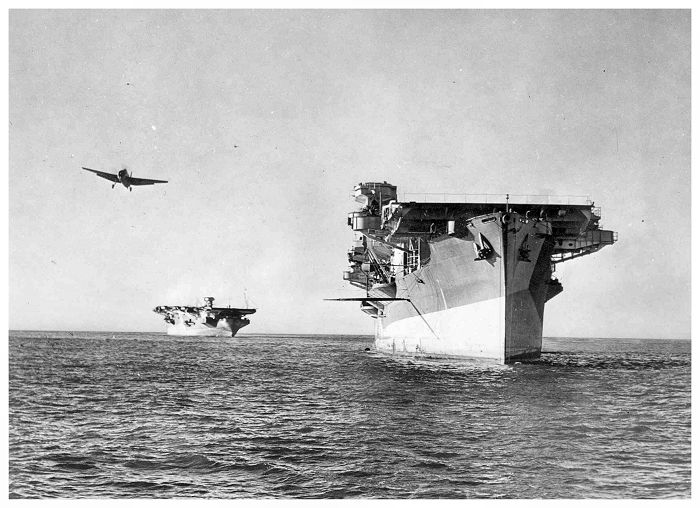 |
HMS NABOB stuck fast on a sand bar, one of 850
squadron's Avengers flying over head. MS RANEE, in the
background, has arrived to lend assistance. Note that
the censor had erased the radar arrays from both
vessels. Photo: courtesy CFB Esquimalt Naval & Military
Museum Neg: VR2002.172.066 |
Maiden voyage: Ferry trip to UK: February 6th – April 5th 1944
NABOB put into San Francisco on February 10th and moored alongside berth #7 at US Naval Air Station Alameda in San Francisco Bay. On the 11th embarked the Aircrew, maintenance personnel and 12 Avengers of
852 Squadron, which was there awaiting her arrival [1]852 Squadron had formed in the US at USNAS Squantum, Massachusetts with 12 Avenger TBR MK. I aircraft on November 1st 1943; the squadron had flown out to San Francisco in order to join NABOB at the earliest opportunity. They had nearly a month in which to operate from the ship and work up both pilots and NABOB's air departments before her deck was filled with non-flying airframes as deck cargo. the aircraft being loaded by crane. NABOB now had her full crew complement: 504 RCN, 327 RN and 9 RNZN personnel.
At Alameda she also received voyage repairs undertaken by the General Engineering & Drydock co., before she put to sea again in the afternoon of the 14th for radar calibration runs beginning at 13:00 and securing at 15:30. The next day she sailed to commence a short work up on passage to San Diego. The Destroyer USS BALLARD joined her on the 16th as planegaurd for flight operations, remaining in company until the 20th when both ships arrived at Naval Operating Base Dan Diego, securing alongside at 15:20.
There were two deck crashes during this period; on
Febraury 16th JZ159 ('2F') flown by Sub-Lt W. L. Black, RNVR entered the barrier, the following day
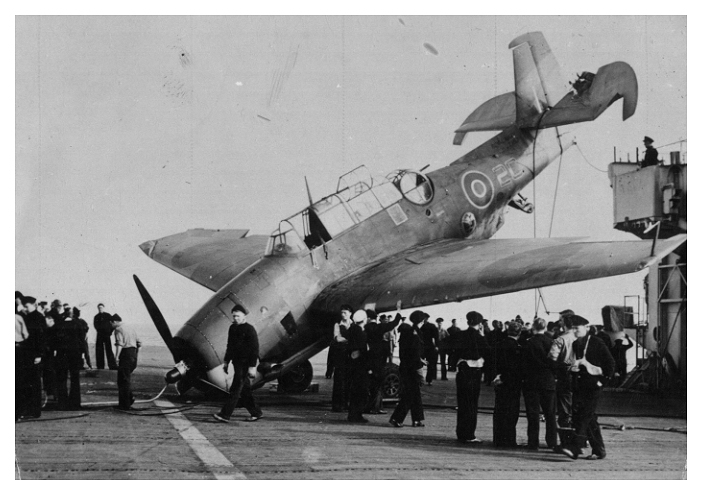
JZ157 ('2C') flown by Lt. K. R. Stevens, RNZNVR landed on with the arrestor hook up, flew into the barrier and ended on its nose. On the 18th one aircraft, JZ164 ('2M') piloted by the squadron C.O. Lt. Cdr R. E. Bradshaw DSC, RN had to return to USNAS San Diego due to a fouled flight deck.
|
  |
February1944:
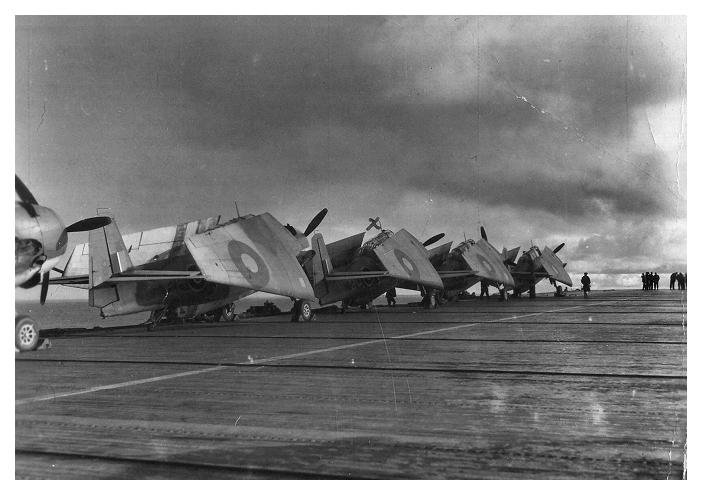
Left the Avengers of 852squadron parked on deck. Right
February 17th 1944 Avenger JZ157 ('2C') flown by Lt. K.
R. Stevens, RNZNVR has landed on with the arrestor hook
up and, been stopped by the crash barrier, ending on its nose. Photos: courtesy R Pullinger. |
She conducted live firing of her AA weapons on the 20th, a morning shoot commencing at 09:10 and completing at 12:05 followed by a shorter afternoon shoot commencing at 14:00 and ending at 14:40.
After completing her workup period off San Francisco NABOB sailed from San Diego at 15:10 on the 21st to rendezvous with her sister CVE
EMPRESS off San Francisco; the two ships were to proceed to Norfolk together, but
EMPRESS had stripped a turbine and could not continue without repairs, so NABOB was instructed to proceed to Balboa alone. She arrived at Bilbao in company with the frigate HMCS NEW WATERFORD on March 1st; they entered the Canal the same day and on completing the transit sailed from Cristobal on the 2nd for Norfolk, Virginia. Flying was conducted on passage; four aircraft were launched on the 4th for anti-submarine searches out to 150 miles following a report of a U-Boat sighting. Only three aircraft landed on by 19:00, the third had suffered radar and radio failure and had safely landed at USNAS Guantanamo, Cuba. The aircraft re-joined the ship the next morning. More flying on the 7th resulted in three aircraft put out of action due to two deck crashes on March 7th: Sub-Lt Black bounced landing in JZ159 ('2F') and broke the port wheel while Lt. Stevens returning to the ship at 18:38 caught the barrier attempting to go around again in JZ167 ('2R'), the aircraft hit JZ162 ('2K') in the aircraft park writing it off. The impact pushed JZ162 off the deck and into the port edge of trhe deck injuring a member of No.2 Bofors crew and stuck in the walkway. Darkness was fast approaching and the wind was increasing dso the wreckage could not be removed until the next morning as the ship approached Norfolk. Both aircraft were put ashore to USNAS Norfolk once docked.
A ‘near mutiny’ After Panama a mass protest or 'near mutiny' occurred in NABOB; although she was a Royal Navy ship she was one of only two ships to be jointly RN/RCN manned, additionally she carried British Merchant Navy personnel in the Engine Room and each group had different rates of pay and victualling scales. The RCN personnel received Canadian pay and marriage allowance but all other allowances, and victualling, were to RN rates of scale, it was this disparity that precipitated the dispute. They made their dissatisfaction s known first a brief 'lock-in' - refusal to work - which was followed by a large number of desertions on reaching Norfolk. The situation was relived as a result of captain Lay, (a nephew of Canadian Prime Minister Mackenzie King) bringing the dispute over living conditions on board to the attention of the Admiralty; he was able was able to use the 'incidents' as evidence of the discontent and to secure concessions from their Lordships. NABOB arrived at Norfolk Naval Base on March 8th were crewmen began to desert the ship. Captain Lay flew from Norfolk to Ottawa to speak in person with the Naval Board and outline the seriousness of the situation. He suggested that all RN personnel should be borne on the books of the Canadian Naval Headquarters for Pay and allowances and the whole ship should receive rations at RCN scale. This was approved and Captain Lay flew back to Norfolk to re-join his ship. In his absence the ship had entered drydock to have her proper replaced and replacement aircraft had been embarked.
She sailed for New York on March 18th, arriving the next day and securing alongside pier #13 Staten Island. Here she received voyage repairs and prepared to embark a ferry load of aircraft for delivery to the UK. The Avengers were all stowed in the Hangar and 45 P51 Mustangs for the RAF were loaded and lashed to the flight deck. She also embarked 27 civilian passengers, 15 of them were school boys returning home after three years in the US and Canada as evacuees.
On completion of loading NABOB sailed from New York on the 23rd, joining the fast troop convoy UT.10 bound for Greenock. NABOB detached from the convoy off Ireland and proceed to Liverpool were she secured alongside at Gladstone Dock on April 5th and unloaded the Mustangs for towing to RAF Speke, before continuing on to the Clyde.
|
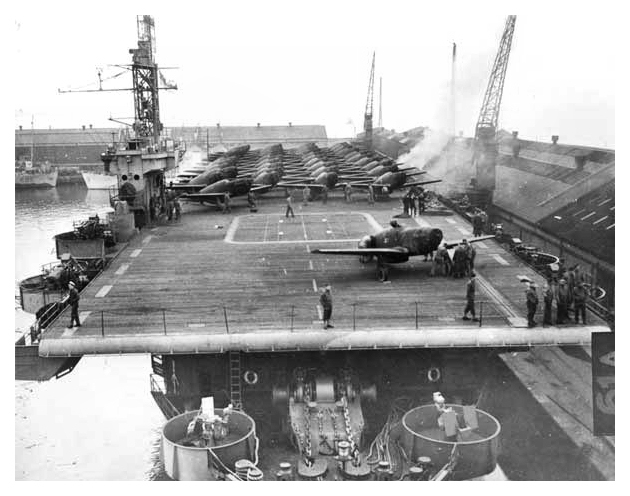 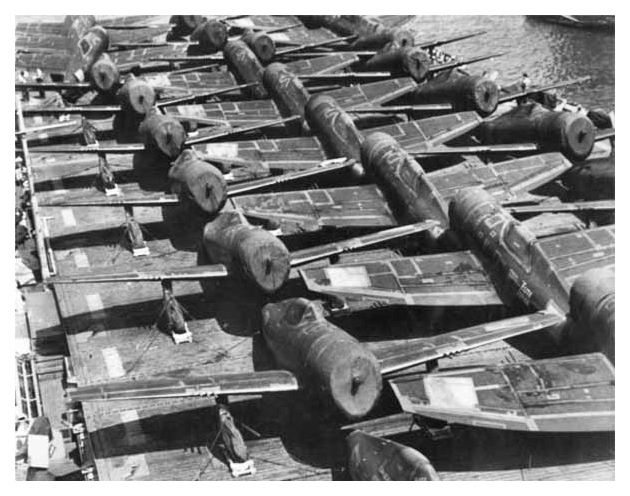 |
HMS NABOB in March of 1944 alongside in Brooklyn while
embarking a ferry laod of P51s for the RAF |
More alterations dockyard hands and working up in the UK: April - September 1944
The aircraft of
852 squadron were flown off to
RNAS Machrihanish on April 6th. The next day NABOB was allocated to Western Approaches Command and entered a Clyde shipyard for a short period of defect rectification. Further work was needed and NABOB returned to Liverpool on the 19th of April for further alterations and additions, this work was complete on June 17th when she sailed to return to Greenock.
NABOB now began to work up in preparation for active duty, she re-embarked
852 squadron from
RNAS Machrihanish on June 26th and proceeded to Belfast
Lough.
852 now included a fighter flight of 4 Wildcats bringing their strength up to 16 aircraft. With the flying element of her work up completed the ship returned to t Greenock on July 7th and
852 squadron disembarked to
RNAS Abbotsinch on the 8th. There was one landing accident during this period, on July 2nd Lt. Stevens landing in JZ294 ('2R') skidded on the wet deck, braked and toppled into the walkway.
They squadron re-joined NABOB on the 14th when she sailed to return to Belfast Lough, flying out from
RNAS Machrihanish to begin preparing for anti-shipping and mine laying operations to be conducted off the coast of Norway with the Home fleet. There were two flying incidents on the day of embarkation: Lt. Cdr Bradshaw flying in FN908 ('2O') had his arrest or hook break on landing and the aircraft entered the barrier damaging the prop and engine. Sub-Lt M. E. R. Keates, RNVR in Wildcat JV355 landed heavily on the port wheel damaging the undercarriage. During the remainder of the trading period Sub-Lt D. Cash, RNVR had three deck landing incidents: on July 20th in landing in FN806 ('2H') he pushed into the tail of JZ166 on taxying forward, on the 22nd flying in the same aircraft returning to the ship from a round trip flight to
RNAS Ayr the arrestor hook broke on the rounddown and was arrested by the barrier. Later on the same date returning to the ship form a night navex in FN898 ('2C') his hook broke off and the aircraft entered the barrier. Damaged aircraft were put ashore on the 26th.
Flying resumed on the 28th; the ship and squadron suffered their first fatalities on the 29th in an air crash. On returning from a patrol in bad weather Avenger FN841 ('2F') piloted by Sub-Lt Cash was given an early wave-off on approaching the ship, the aircraft passed up the starboard side of the ship at about 400ft and crashed into the sea ahead of the ship. The two Depth Charges on-board exploded. Sub-Lt Cash was rescued but seriously injured by the Destroyer NEWMARKET, the other two crew members, Sub-Lt C. D. Wheeler, RNVR and Petty Officer Airman B. K. Blissett were both killed. While returning to Greenock on the 30th one of the squadrons Wildcat fighters was written off landing on, JV536 ('S') made a text book landing catching Mo.2 wire, this however parted and the aircraft pulled to port causing the tail oleo leg to collapse and the fuselage to wrinkle, the pilot Sub-Lt W. P. Hughes, RNZNVR was OK.
Allocated for Home Fleet operations: August 1944
After receiving replacement aircraft NABOB sailed in company with Sister CVE
TRUMPETER on July 31st for Scapa Flow to begin operations with the Home Fleet. They arrived at Scapa on August 1st and spent the next 7 days conducting exercises to prepare for Operation OFFSPRING.
Operation OFFSPRING was designed to force the enemy out of the Leads by laying mines in Lepsorev and Harhamsfjiord, Norway. In addition to the laying of two minefields between Lepsøy and Haramsa, the Force was to attack the airfield at Gossen and shipping off the coast of German-occupied Norway.
NABOB was allocated to Force 4, which comprised of the Fleet Carrier INDEFATIGABLE (Flag RA CS1) (887 Seafire, 894 Seafire, 820 Barracudas, 1770 Firefly, 1840 Hellcat) CVEs NABOB (852 Avenger),
TRUMPETER (846 Avenger), Cruisers KENT, DEVONSHIRE, HM Destroyers MYNGS (D26), VOLAGE, VIGILANT, VERULAM, VIRAGO, SCOURGE, Canadian Destroyers ALGONQUIN, SIOUX. The Force sailed from Scapa on August 8th.
The operation commenced on the 9th and was successfully concluded. 47 aerial mines were successfully laid by the Avenger crews of 846 and
852 squadrons: 29 were laid in Harhamsfiord and 17 in Lepsorev. In addition 6 Me 110s were destroyed and one damaged on the ground. Two hangers and some storehouses were left burning at Gossen and many subsidiary targets in the Lepsoy area were attacked, including 3 radar and 2 wireless stations, a dredger and gun positions, 3 armed ships of which 2 were left burning and an oil tank which was left smoking Force 4 losses were: 1 Avenger of 846 Sqn and its crew; 1 Firefly ditched. The Force withdrew and arrived back at Scapa on the 11th. NABOB and
TRUMPETER sailed for Rosyth later that day.
Arriving at Rosyth on the 12th both carriers embarked more aerial mines for use in their next operation planned for the 18th, Operation GOODWOOD. On completion of loading they sailed to return to Scapa, arriving on the 14th.
Operation GOODWOOD was a three stage series of strikes against the German Battle Ship TIRPITZ to take place between the 21st and 28th of August 1944. This operation was to see 247 sorties of Barracudas, Hellcats and Corsairs launched from four carriers, VICTORIOUS, FURIOUS, the CVEs NABOB and
TRUMPETER were tasked with providing ASW cover for the task force and sowing aerial mines. For this operation NABOB embarked three additional Avengers from 856 squadron on the 18th.
There were three separate forces involved in GOODWOOD Force One: Battleship DUKE OF YORK (C-in-C HF), Fleet Carrier INDEFATIGABLE (Flag RA CS 1), FORMIDABLE and FURIOUS, Cruisers BERWICK and DEVONSHIRE, Destroyers MYNGS (D26), CAMBRIAN, VERULAM, VIGILANT VIRAGO, VOLAGE, SCORPION, SCOURGE, SERAPIS, STORD, WHIRLWIND, WRANGLER and Canadian Destroyers ALGONQUIN and SIOUX. Force Two: CVEs NABOB (852 11 Avenger & 4 Wildcat, 856 3 Avenger Det) and
TRUMPETER (846 9 Avenger & 4 Wildcat), Cruiser KENT, BICKERTON (SO EG 5), AYLMER, BLIGH, KEMPTHORNE, KEATS. Force Nine: Tanker force R.F.A.s BLACK RANGER and BLUE RANGER, Destroyer NUBIAN, Corvettes DIANELLA, POPPY, and STARWORT.
For this strike on the German Battleship Admiral McGrigor had devised a new plan to damage the TIRPITZ. The Avengers were to form the main strike, each armed with 2 Mk. V – 1,000lb aerial launched mines which were to be placed near TIRPITZ herself and the entrance to Kaafjord. The mines dropped near the battleship were to be fitted with time-delay fuses in the hope of causing some damage which may have prompted her Captain to leave her anchorage and be caught by the mines sown at the entrance. The aircraft from the Fillet Carriers were to launch another strike to both distract the German flak gunners and to attack the TIRPITZ. Although highly practiced in aerial minelaying the Avenger crews faced a most difficult mission, careful route planning would result in each aircraft having 15 seconds over the target to accurately place two mines. Previous raids on TIRPITZ had found the ship screen by s smoke.
Bad weather delayed the start of the operation by 24 hours; on the morning of the 22nd the Avengers of
852, 856, and 846 squadrons began to launch at approximately 09:00 and the strike force began to form up ready for departure. They were held in a holding pattern for some time while a few aircraft were launched by the Fleet Carriers, then NABOB and
TRUMPETER turned into wind again and the Avengers began to land on; this phase of the operation was cancelled on account of low cloud conditions over the target area .
At 11:00 a force comprising 32 Barracudas, 24 Corsairs, 11 Fireflies, 9 Hellcats and 8 Seafires was launched from the three fleet carriers. Thick cloud at 1,500ft also caused the Barracudas and their Corsair escorts to turn back short of the coast, they returned to the carriers without attacking. The 11 Fireflies pressed on to strafe German anti-aircraft guns on and around TIRPITZ at 12:49. Two minutes later, 9 Hellcats each released a 500lb semi-armour-piercing (SAP) bomb on TIRPITZ but did not achieve any hits, also 8 Seafires hit Luftwaffe bases at Banak and Kolvik in a co-ordinated attack.
NABOB launched four Wildcats at 12:25 for CAP, one returned and made a successful emergency landing at 14:32. The remaining three Wildcats were landed on at 15:00. At 1530 the ships of Force Two were detached to the westward. NABOB was instructed to fuel three destroyer escorts commencing at 18:00 at a position 120 miles WNW of North Cape, in the Barents Sea.
TRUMPETER was to provide CAP and A/s patrols. The flight deck was being cleared of aircraft and the hands were laying out the feeling hose.
Torpedoed
At 17:15 NABOB was struck by a single acoustic torpedo fired by U-354 which struck her on the starboard side, causing a 32-square foot hole abaft the engine room, below the waterline. She began to take on water at an alarming rate; within minutes NABOB was listing to Starboard and was 15 feet down by the stern. All electrical power had been lost and NABOB was dead in the water. A second torpedo was launched which struck HMS BICKERTON at 17:23. She was hit in the stern and her damage was extensive, 38 crewmen were dead and she had lost her propeller shafts in the explosion. The DUKE OF YORK, INDEFATIGABLE FORMIDABLE, FURIOUS, BERWICK, DEVONSHIRE
and KENT immediately took evasive action and dispersed at full speed taking most of the screening destroyers with them.
At the time of the torpedo hit NABOB had 14 Avengers and 4 Wildcats on board, of these 9 Avengers and the 4 Wildcats were stowed in the hangar while 5 Avengers were parked forward on the flight deck. None of the aircraft were damaged by the blast. All Avengers were still armed with aerial mines for deployment during GOODWOOD.
Having received damage reports and seeing the 7 degree list and significant increase in her draught at the stern Captain Lay gave the order to prepare to abandon ship, life boats and carley floats were made ready. The Frigate KEMPTHORNE came alongside and took off 210 men, 10 of which were injured, by boat. Many of those taken off were squadron personnel, it was believed that NABOB was now incapable of flight operations.
As early as 17:34 orders had been issued by the C-in-C in the DUKE OF YORK to sink BICKERTON and NABOB if they could not get underway; BICKERTON was beyond salvage and was scuttled at 21:00 by torpedoes from VIGILANT once KEMPTHORNE had taken survivors off.
|
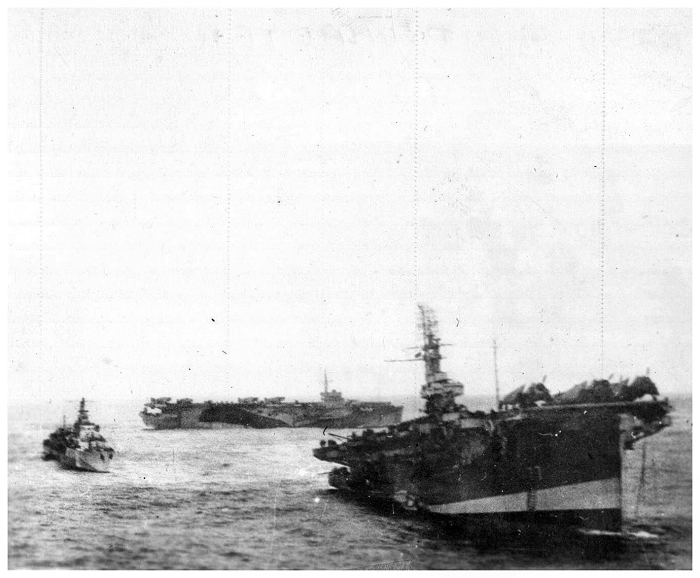 |
August 23rd, 1944, NABOB has stopped to make a second crew transfer of 203 men to the HMCS ALGONQUIN by boat. TRUMPETER stands by. Photo: courtesy R. Pullinger |
Once flooding was under control and diesel generators had been brought on-line to restore electrical power by 18:00 the Captain decided to attempt to save the ship, however he Chief engineer had released the steam pressure from her two boilers; this may have been a little premature, the engine room staff could not began to raise steam again until 20:00. The engines were restarted at 21:00 and NABOB was under power slow ahead at 10 revolutions by 21:39. She could make 60 Revs by 23:30, three knots being the maximum speed she could safely make. Although under way she was now in a very dangerous position if her flooding worsened; the 'prepared to abandon ship' order was not followed up and by the time Captain Lay had seceded to save the ship all of NABOB’s boats and carley floats, which had been lowered as per the order, had not been made fast and had drifted astern during the rather hectic few minutes after the torpedoing. This left individual life jackets as the only life-saving equipment still on board.
The U-Boat threat was still very real so it was decided to attempt to launch an Avenger to deter it form getting in too close.
[2] Where is TRUMPETER? She was in company at the time of the torpedo hit, is pictured standing off while preparations to abandon ship are underway. Home Fleet War Diary lists TRUMPETER as escorting NABOB to the Faroes and then on to Scapa, both ships arriving on the 27th. So why did Lt. Cdr Bradshaw need to launch two Avengers for A/S patrol when TRUMPETER carried 9 Avengers and 4 Wildcats herself? Some reshuffling of aircraft was done using the forward lift, the aft lift was stuck in the up position so flying operations were possible. In addition to the Avengers already on deck Wildcats ‘D’ &’N’ were readied. At 02:30 on the 23rd Lt. Cdr Bradshaw and his crew were successfully accelerated off the sloping deck in FN875 ('2H'), this was followed by a second Avenger piloted by Sub-Lt D. G. Jupp RNVR. The two aircraft, now armed with death charges, did not detect the U-Boat during their 4-hour patrol; after their launch the ship altered course to the west and the aerial theat appears to have successfully thwarted the U-Boat commander’s attempt to position himself for another attack.
On returning to the carrier the weather reduced visibility on the approach to the sloping and listing deck; Sub-Lt Jupp managed to safely land on first but Lt. Cdr Bradshaw was not so lucky, his aircraft missed the arrestor wires and snagged the barrier bringing it down into the aircraft park on top of JZ249 ('2F') causing major damage, also damaging Avenger FN887 ('2L') & Wildcats ‘D’ &’N’. The aircraft guns fired on impact and its depth charges broke free and rolled down the deck, they were stopped before they could go over the side and sink NABOB. On clearing the wreckage Avengers '2H' & '2F' were jettisoned as beyond repair and the remaining aircraft were secured.
During the early hours of the 23rd the wind and the sea swell increased, the Engine Room reported that they could increase speed; there was concern that with increased motion caused by the weather, some of the bulkheads might collapse and gradually speed increased to 5 Knots. Also on this day the Canadian escort ALGONQUIN, detached from Force One, took off a further 203 non-essential men by sea boat using her own, and those from KEATS to make the transfer
[3]It is unclear which escorts remained with NABOB; KEMPTHORNE and KEATS appear to have remained with the two Carriers and AYLMER and BLIGH may have stayed with KENT when the force dispersed.
Damage control parties continued to work throughout the night attempting to correct the list and pump out water to reduce her draught aft; as a result of careful by counter flooding the 7 degree list and been reduced to less than 2 degrees by 02:30 on the 23rd, however the ship’s draught overall had worsened as a result, setting to 15 feet forward and 41½ aft (her normal draught was 23’ forward and 25‘ aft). As much excess weight as possible was jettisoned or moved forward from the stern, the 5” guns on the aft sponsons were dismantled and aloe thrown overboard as well as ammunition. The portable pumps were run periodically to counter leakage from the secured and shored up areas and this trim was maintained for the remainder of her passage back to
Scapa. General messing facilities had been destroyed by the explosion, provision and store rooms were flooded but provisions etc., were sourced from emergency stocks located throughout the ship and hot meals were prepared in the officer’s galley.
The Destroyers CASSANDRA, KEMPENFELT, ZEST, and ZAMBESI, sailed from Scapa on the 25th to relieve ALGONQUIN, KEMPTHORNE and KEATS off the Faroes; at 05:40 on the 26th ALGONQUIN detached to rendezvous with ZEST and transfer the NABOB personnel for passage to Scapa. NABOB, TRUMPETER CASSANDRA, KEMPENFELT, ZEST, and ZAMBESI arrived
Scapa at 08:00 on the 27th. She had successfully steamed 1100 miles under her own power after being nearly mortally wounded, much of this through bad weather and rough seas.
Emergency repairs and passage to Rosyth for
damage assessment
On approaching Scapa the Avengers of 825 were put ashore to
RNAS Hatston, the remaining Wildcats followed on September 1st. Further emergency repairs were carried out on reaching the safety of the harbour at Scapa Flow and work was started to remove as many stores and unnecessary equipment to improve her trim. On September 1st a funeral service was held at Lyness Royal Naval Cemetery for FAA/FX 76721 Air Mechanic P. T. Rothwell of
852 squadron.
In a move reminiscent of the loss of the escort carrier
DASHER strict censorship was imposed, the ship’s log records the following: "Admiralty does not intend to make any announcement regarding damage to ship. No explanation can therefore be given to next-of-kiln to account for the delay in burial service. Next- of-kiln who enquire should be requested to communicate direct with Admiralty”.
Those taken off the ship and delivered to Scapa by KEMPENFELT and ZEST returned to the ship to claim their personal possessions before the crew was reorganized; many were drafted to Barracks and NABOB’ complement was reduced to 270 ratings and 30 officers.
NABOB slipped from A. 8 buoy, Scapa, at 1500 on September 8th assisted by two tugs. The tugs were slipped at 1622 and NABOB proceeded to Rosyth escorted VIGILANT with HM Tug BUCCANEER. At 13:41 on the 9th NABOB secured to No. 14 buoy, Rosyth, the tug BUCCANEER being made fast astern. All ammunition remaining in the forward magazines, together with more stores were now off loaded by lighter.
Beginning early in the morning of September 28th several compartments forward as well as all undamaged oil tanks and the forward magazines were flooded to achieve a final trim of about 29 feet forward and 31 feet aft. NABOB was moved by dockyard tugs into No. I dock, securing at 11:32. Once the dock had been pumped out the sad task of removing the bodies from the flooded compartments was begum. Fourteen of the twenty men reported a missing, 10 Canadians and 4 British ratings, were removed from the ship and prepared for burial in Douglas Bank Cemetery, Dunfermline. The Funeral services were held on November 10th.
|
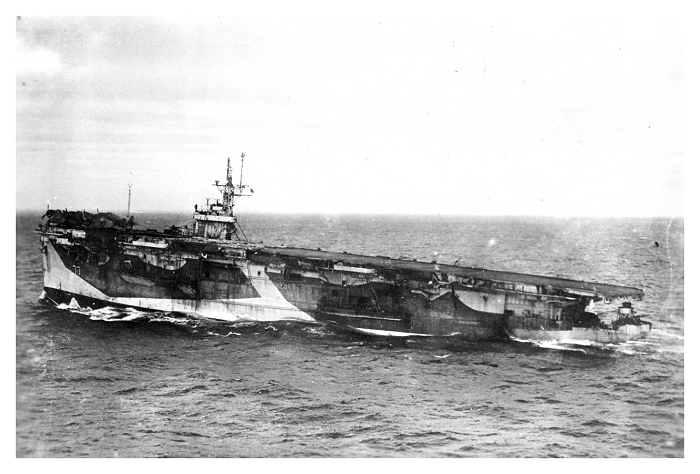 |
August 23rd 1844: HMS NABOB still down at the stern
limping home after her damage control teams managed to
control the flooding. Photo: courtesy George
Billing |
Disposal: Return to US Custody
It was decided that her damage was beyond economical repair and the decision was made to lay her up for the rest of the War. NABOB was paid off on September 30th 1944, but allocated to Rosyth Command in nominal reserve. Those personnel from NABOB who remained on the ship after October 1st were shown as discharged to HM S COCHRANE, the remainder to HMCS NIOBE, the Canadian shore establishment at Greenock. Some of her machinery was also stripped out to support her sister ships, her main gearing being installed in the other Canadian manned CVE PUNCHER.
CVE-41 was returned to US Naval custody at Rosyth on October 10th; she was stricken for disposal on March 16th 1946. Her hulk was sold for scrapping in Holland in March 1947 but she was resold and converted for merchant service. Conversion was done at AG Weser Shipyards in Bremen, Germany, October 1951–June 1952, she emerged as the German cargo liner MV NABOB, a Merchant service cadet training ship owned by the German steamship company. She was sold to a Panamanian company in 1967 and renamed GLORY in 1968. She was finally scrapped in Taiwan beginning 6th December 1977.
|
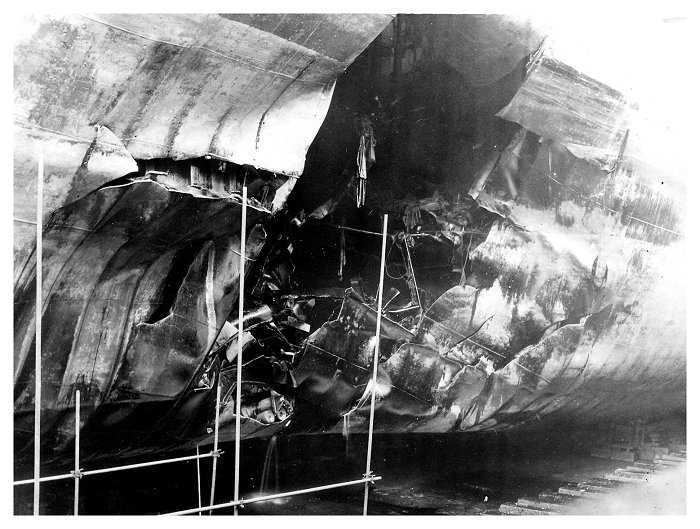 |
The damage below the water line is examined while NABOB
is in dry dock. It was later deemed that she was
beyond economical repair and she was decommissioned.
Photo: courtesy George Billing |
Captain Horatio N. Lay OBE RCN, and Commander (E), Cecil I.
Hinchcliffe, RD RCN were awarded a Mention in Despatches "For good
service when his ship HMS NABOB was damaged."
NABOB
was paid off on October 10th 1844 and CVE-41 was returned to US Naval custody at Rosyth;
she was stricken for
disposal on March 16th 1946. Her hulk was sold for scrapping in
Holland in March 1947 but she was resold and converted for merchant
service, emerging in 1952 as the German cargo liner MV NABOB,
a Merchant service cadet training ship owned by the German steamship
company. She was sold to a Panamanian company in 1967 and renamed
GLORY in 1968. She was finally scrapped in Taiwan beginning 6th
December 1977.
Content revised:
06 June 2022
Sources used in compiling this account:
Click here for a list of
Primary sources
Additional sources:
Warrilow, B. (Ed) (1989) 'NABOB The First Canadian manned
Aircraft Carrier' Ontario, Escort Carriers Ass
Fold3.com various documents including;
Admiralty War Diaries
Norfolk Navy Yard War Diaries
Mew York Navy Yard War Diaries
Miscellaneous documents
|
Home
page |
go to the top
|



Comments (10)
My late Father Donald Grant Mitton was a Chief Petty Officer in charge of victualling, onboard the Nabob when she was struck
He was later awarded with the British Empire medal (B.E.M.) by Princess Alice at the Empress Hotel in Victoria BC.
Mein Vater Georg (Schorse) Evers war als Heizer auf der Nabob. Er war von Anfang bis zum Verkauf dabei.Insgesamt 30 Jahre beim Norddeutschen Lloyd.
My father Georg (Schorse) Evers was a stoker on the Nabob. He was there from the beginning until the sale. A total of 30 years at Norddeutscher Lloyd.I was one of the 15 schoolboys returning after 3 years in Toronto in March 1944 just before my 11th Birthday.I have amazing memories of it.
My uncle, Friedrich-Karl Kuhlig was captain during the time the "Nabob" belongs to the fleet of Norddeutscher LLoyd in Bremen/Germany. I was on board as a cadet from december 27th 1960 until february 22nd 1962.