A History of HMS SMITER
|
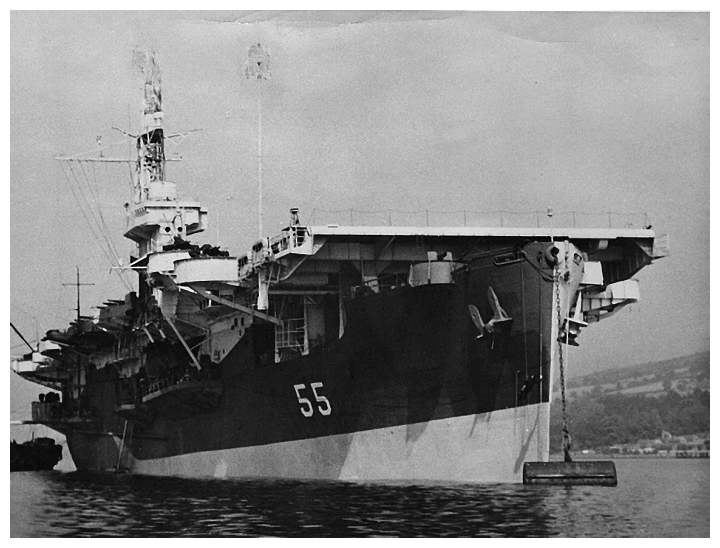 |
HMS SMITER moored at a buoy and taking on stores from a
lighter. Photo: Courtesy of Terry Oxley |
HMS SMITER was an 'Smiter' class escort carrier; her keel was laid down on May 10th 1943 at the Seattle-Tacoma Shipbuilding Co. Tacoma, Washington, as a Maritime Commission C3 type freighter hull, Seattle-Tacoma hull number 47. The hull was purchased by the US Navy for completion as the auxiliary aircraft carrier USS VERMILLION, ACV-52; her USN designation changed from ACV to CVE on 15 July 1943. She was launched on September 27th 1943. Whilst still under construction it had been decided that CVE 52 was to be transferred to the Admiralty on loan on her completion as an aircraft carrier.
She
successfully completed her builder’s sea trials at Tacoma on January
20th 1944 and was authorised for delivery; she was accepted on behalf of
the US Navy by Captain J. L. McGuigan, USN Supervisor of
Shipbuilding at Tacoma and was transferred to the Royal Navy on
the same day. She was accepted on behalf of the Admiralty by
Commander C.S. Pelly RN, as acting commanding officer and
commissioned into RN service as HMS SMITER, pennant number D55.
Modification and preparation to enter service:
After completing Admiralty acceptance tests HMS SMITER sailed from Tacoma on January 27th and proceeded to Vancouver, Canada to be modified to meet Admiralty requirements, receive her full crew compliment, and work up ready for beginning her active service. This work was undertaken by the Burrard Dry Dock Co. Ltd., North Vancouver, British Columbia. Her commanding officer Captain L.G. Richardson RN joined her at
Vancouver.
SMITER was the thirteenth of nineteen escort carriers to be modified by Burrards. On arrival at Vancouver on January 27th she was moored in the stream; at this time sister CVEs
QUEEN,
RULER,
ARBITER and
RAJAH were in the hands of the Burrard's yard and at various stages of modification. Work commenced to de-store and de-ammunition the ship before she was moved to number 7 berth at Lapointe Pier on February 14th for her alteration work to begin the following day: this work totalled 150 separate modifications and included lengthening of the flight deck, fitting redesigned flying controls and fighter direction layout, modifications to hangar, accommodation and store rooms, installing extra safety measures including major changes to the aviation fuel stowage and oiling at sea arrangements,, modifying gunnery and other internal communications, adding extra W/T and R/T sets, and improved darken ship arrangements.
As
work progressed SMITER moved through the yards various
berths; the yard could be working on six different ships at any time
with separate aspects of the work carried out at different berths,
the ships passing through like a production line, moving from one
berth to another until complete. SMITER moved to No 4 on
March 4th, then to No 5 on March 19th where her alterations were
completed on March 31st. SMITER sailed for Esquimalt,
Victoria, North Vancouver on April 1st to enter dry dock for the
fitting of additional sea valves and other remedial work. She was
un-docked on the 4th and began preparing for her work up and post
modification shakedown. Her modifications had taken a total of 45
days to complete. She also made a round trip to the Puget Sound Naval Yard at Bremerton, Washington to ammunition the ship, arriving there at 1015 on April 16th and then sailed at 0810 on the 19th to proceed to the Straits of Georgia (between Vancouver Island and the mainland), for
steaming, gunnery, radar and other trials and exercises. On her
return to Esquimalt she embarked Confidential Books and more stores.
|
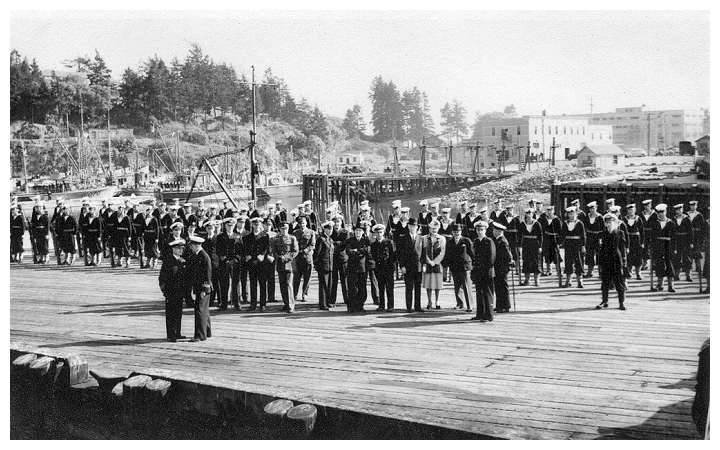 |
HMS SMITER at Esquimalt 1944 - Guard of Honour for visit
of Governor of Canada Photo: Courtesy of Terry Oxley |
Maiden voyage: Ferry trip to Liverpool
HMS SMITER departed from Vancouver on her maiden voyage to the UK on April 31st calling at San Francisco, Norfolk, and New York. She arrived at San Francisco on May 4th and was taken in hand by the Mare Island Navy Yard for additional communications equipment to be fitted to the bridge and combat communications room; this work was done by the Netson Navigation Company yard and began on May 6th and completed the following day.
Further stores were taken aboard before she sailed for Balboa on the 8th to pass through the Panama
Canal. She departed from Cristobel on May 17th for he Naval Operating Base at Norfolk Virginia, arriving there on the 23rd. The ship was to have defects rectified by the naval dockyard before putting to sea for gunnery exercises in Chesapeake Bay on June 3rd. On completion of exercises on the 4th SMITER embarked the 12 Avengers and personnel of 856 Naval Air Squadron, the aircraft being hoisted aboard from the quayside. The squadron had formed and worked up in the US and had flown to Norfolk from USNAS
Squantum on June 1st to join SMITER for ferrying to the UK.
On the morning of June 4th SMITER embarked the 18 Corsairs and personnel of 1841 Naval Air Squadron, also for ferrying to the UK; this squadron had also formed and worked up in the US and had flown to Norfolk from USNAS
Brunswick on June 2nd. Once loading was completed she sailed for New York later that day. On arrival at New York on June 6th she was berthed at 35th Street Pier Brooklyn to undergo voyage repairs carried out by the Bethlehem Steel Company's 56th street yard. The work was completed on the 8th, and after loading stores and passengers SMITER sailed in company with her sister CVE HMS
ARBITER to join the East bound convoy CU 27.
This was a 15 knot convoy of twenty five ships, which departed New York on June 8th 1944 for Liverpool. On reaching the UK on the 20th
ARBITER went to Glasgow while SMITER made for Liverpool, entering Gladstone dock that afternoon. The following day the aircraft were hoisted off the ship by crane and were towed through the streets to RAF Speke where they were prepared for departure by the RN Air Section stationed there; 856 Squadron was destined for RNAS
Machrihanish and 1841 for RNAS
Ayr.
Second Ferry run, to New York: June 23rd July 21st 1944
SMITER
was allocated to Western Approaches Command for duty as a ferry
carrier, and after storing and refuelling ship she sailed for a
ferry trip to New York on June 23rd. She was again in company with
ARBITER as part of convoy UC 27. SMITER arrived at Bethlehem Steel Company, Mariner's harbour, Staten Island for voyage repairs on July 4th, these were completed on July 10th and the ship departed the yard at 1230. While alongside at Staten Island her ferry load had been embarked along with passengers and stores.
SMITER departed New York City on July 10 part of
convoy CU 31, again in company with
ARBITER,
and arrived on the Clyde on the 21st,
ARBITER going to Liverpool this time.
|
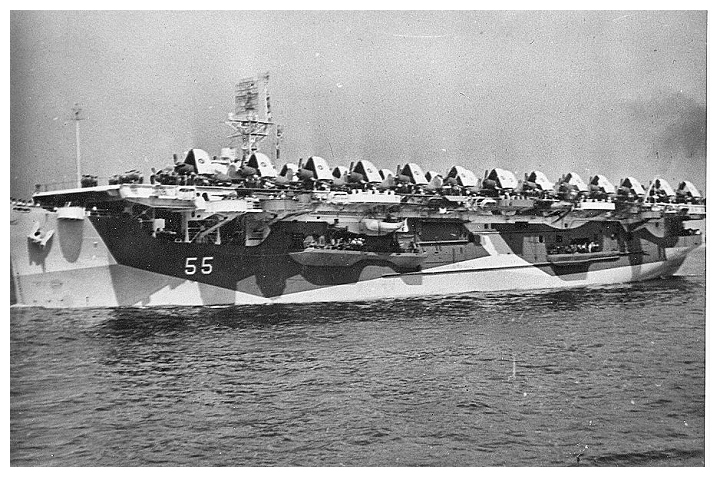 |
July 1944, HMS SMITER on her second ferry trip,; her
flight and hanger are crammed full of Corsair aircraft
for delivery to RNAMY Donibristle. Photo: Courtesy of
Terry Oxley |
Under Repair: July 22nd - December 2nd 1944
After
unloading her aircraft and other cargo SMITER was taken in
hand by a Clyde dockyard for urgent defect rectification work. On
emerging from the Clyde dockyard she sailed on October 14th for
Newport, South Wales for more dockyard work; this time to have her
electrical system repaired, This was to be a long job, she was not
ready to undertake operations until the beginning of December 1944.
Deck Landing Training Duties: December 21st 1944 -May 23rd 1945
SMITER
left Newport for the Clyde on December 2nd 1944 and was transferred
to the control of the Flag Officer Flying Training for a tour as the
west coast Deck Landing Training Carrier. From December 21st 1944
till May 25th 1945 SMITER was to operate in this role, being visited by a variety of aircraft, these mainly
belonged to 768 DLT squadron from RNAS
Abbotsinch
(Dec 21 -May 18), with periods of training for 767 DLT Squadron (Feb 1st
-Mar 21st) and 769 DLT Squadron (Jan 3rd -May 23rd) both from RNAS
East
Haven. This period put the various ships' departments through their
paces while training carrier pilots in the art of deck landing, and
was not without its mishaps.
The
training period in the Firth of Clyde got off to a tragic start with
the death of Petty Officer Pilot Donald Tucker RNZNVR who drowned
when his Wildcat (JV527) swung to port on take off then fell
overboard on December 21st. The New Year brought short training
visits from 808 Squadron's Hellcats which spent the day exercising with
the ship on January 4th before joining HMS
KHEDIVE the
following day. A detachment of 2 Firefly Night Fighters from 746
Squadron 'A' flight embarked from RNAS
Hatston and operated from
SMITER between January 5th -12th for Night DLT work; one of the
Fireflies (DK430) suffered damage on the first day when a heavy
landing collapsed its tail oleo. Earlier on the same day one of 769
Squadron Avengers (FN832) suffered an engine failure on take off and
ditched into the sea off Rothesay. Several of 769 Squadron Barracudas
ditched on take off but the crews were safely rescued. Towards the
end of the DLT period SMITER operated in the Firth of Forth; on
Wednesday, May 16th 1945 a member of SMITER's crew C/JX 731828, Able
Seaman Ronald Ness was reported as missing and presumed killed.
|
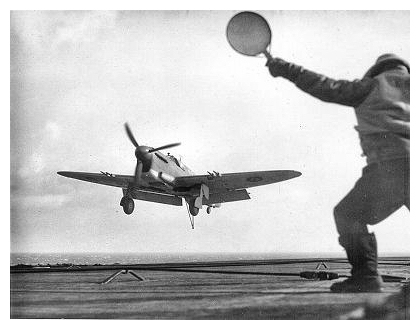 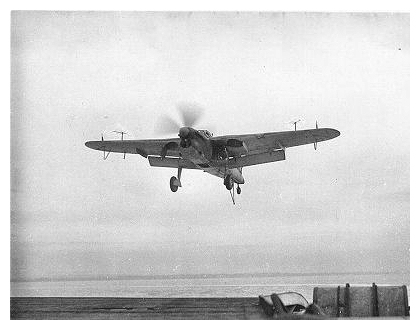 |
Left: A Firefly is guided onto the deck by the Deck
Landing Control Officer during a DLT period. Right: A
Barracuda comes in to land during a DLT period. Photos:
Courtesy of Terry Oxley |
Allocated to the East Indies Fleet for operations with 21 ACS
Her
tour of duty as the DLT carrier behind her, SMITER was next
earmarked for operations in the Indian Ocean with the 21st Aircraft
Carrier Squadron based in Ceylon. In preparation for this new role
she was docked in a Clyde yard on May 26th 1945 for conversion to a
'General Purpose' carrier -this would enhance her capabilities by
allowing her to operated and support both fighters and anti-submarine aircraft,
and become a much more flexible asset.
She
left the yard at the end of June and began storing ship and
embarking a ferry load of aircraft for the voyage to Ceylon. On this
voyage she was to carry the personnel of 815 Squadron which embarked
from RNAMY
Belfast on July 1st. A week later SMITER sailed
for the Far East departing Belfast on the 7th. She proceeded to
Cochin, Southern India via Gibraltar, Port Said, the Suez Canal and
Aden. On Friday, July 13th, while in the Red Sea Leading Seaman, C/JX 160224, Frederick G, Bartlett was lost overboard.
The ship arrived at Cochin on July 27th to unload her ferry load, and 815 squadron, to the RN Air Section at RAF
Cochin . While at Cochin the ship's
company was given leave, a watch at a time, to the RN Rest Camp at Ootacamund, while the
ship was fumigated to combat bed bugs.
SMITER next proceeded to Trincomalee, Ceylon, entering the harbour on the 1st of August. SMITER was assigned the pennant number R321 for service with
the East Indies Fleet but this was probably not worn. In July
Captain L.L.B. Myers RN arrived to relive Captain Richardson as
commanding officer. After a short work up period SMITER
re-embarked the 12 Barracuda TR.III aircraft of 815 Squadron on
August 11th; Some flying was undertaken on the 16th and 17th of
August but with the end of hostilities with Japan the Squadron was
no longer required for active service. 815 Squadron were flown
to
the RN Air Yard at Sulur
on August 18th where their aircraft were withdrawn; the personnel
were to return home to the UK on HMS
FENCER
in September.
|
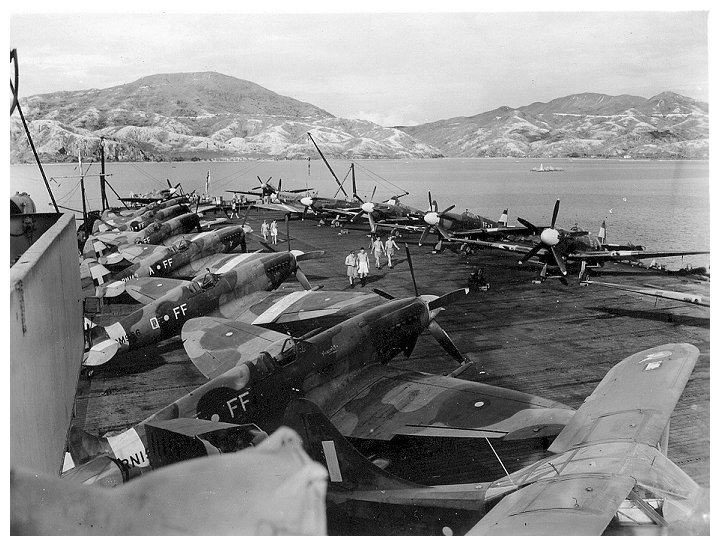 |
Spitfire Mk.XIVs of No 132 (City of Bombay) Squadron RAF
aboard SMITER in Hong Kong Harbour, September 1945.
There is also a single Stinson Reliant communications
aircraft (nearest camera). Photo: Courtesy of Terry
Oxley |
Ferry and Humanitarian duties: September 2nd -December 28th 1945
On her return to Trincomalee SMITER was ordered to ferry aircraft,
equipment and relief supplies to Singapore and Hong Kong; part of
her cargo was the Spitfire Mk.XIVs of No 132 (City of Bombay)
Squadron RAF which were being transferred from their base on the
Cocos Islands to provide air defence cover for the newly liberated
colony of Hong Kong. She sailed for Singapore, via the Cocos Islands
on September 2nd; SMITER crossed the equator on route to the Cocos
Islands and the traditional 'crossing the line' ceremony was
observed by the crew. After Loading the RAF aircraft a short stop
was made at Singapore before she continued her voyage, leaving
Singapore on September 11th. SMITER arrived in Hong Kong on the 15th
and unloaded 132 Squadron to the RAF detachment at Kai Tak airfield
(this was a joint RAF/RN airfield). For the return trip SMITER
embarked former PoWs and other passengers, including women and
children for passage to Ceylon, and she sailed for Singapore on
September 26th.
SMITER was to make a number of runs between Singapore and Colombo
ferrying former PoWs, and one run to Java to transport troops before
she returned to Trincomalee on November 21st. In December she was
again tasked with ferrying aircraft, this time to the newly reopened
Naval Air Station at Sembawang, Singapore. On the 16th the photo
reconnaissance Hellcats of 888 Squadron were embarked and they were
joined on the 20th by the 6 Corsairs, 6 Vengeance and 1 Harvard of
791 Fleet Requirements Unit which had recently formed at RNAS
Trincomalee. SMITER unloaded the two squadrons to RNAS
Sembawang on December 27th. This was to be her last duty as part of
21 ACS and the East Indies Fleet; the following day she sailed for
Trincomalee to load passengers for the voyage home to the UK.
|
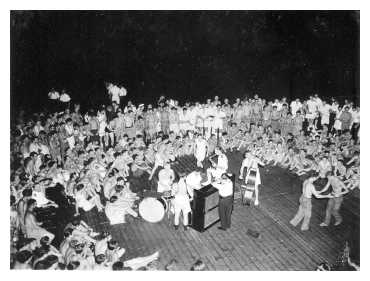 |
Left: August 1945: members of SMITER's crew celebrate
Victory over Japan with a dance on the flight deck.
Right: Former internees and POWs are entertained with a
dance on the flight deck aboard SMITER shortly after
leaving Hong Kong Harbour in late September 1945, on
passage to Ceylon. Photos: Courtesy of Terry Oxley |
Disposal: Return to US custody April 1946
HMS
SMITER arrived on the Clyde on February 11th 1946 and was
stood down from active service. Once her passengers were unloaded
work began de-storing her and removing Admiralty equipment in
preparation for her return to US custody.
HMS
SMITER arrived at Norfolk, Virginia on 20 March 1946 and her
commission was paid off. CVE-52 was returned to US Navy custody at
Norfolk Navy Yard on April 6th 1946; her name was struck from the US
Navy Registry on May 6th 1946.and was stricken for disposal on May
21st. On January 28th 1947 she was sold to the Newport News
Shipbuilding and Drydock Company, Norfolk, Virginia for conversion
into a passenger/cargo liner for the Argentinean shipping company
Dodero Lines (Compania Argentina de Navigacion Dodero, S.A.). She
was renamed SS ARTILLERO on December 16th 1947, and entered service in
1948 travelling between Buenos Aires and Liverpool. She was renamed
PRESIDENT GARCIA in 1965 and under that name she was wrecked
off Guernsey in July 1967; she was deemed to be a total loss and her
hulk was salvaged for scrap and it arrived in Hamburg on November
24th 1967 for breaking.
Content revised:
31 October 2021
Sources used in compiling this account:
Click here for a list of
Primary sources
Additional sources:
Fold3.com various documents including;
Admiralty War Diaries
US Naval Station, Seattle, Washington
US Naval Station, Manchester, Washington
Puget Sound Navy Yard War Diaries
US Thirteenth Naval District War Diaries
Norfolk Navy Yard War Diaries
Mew York Navy Yard War Diaries
Miscellaneous documents
|
Home
page | go to the top
|





Comments (5)
Hi there... interesting to read about this ship. I believe my grandfather served on this ship... my Nan talked about this shop alot but she had now passed away. Just wondered if you have any information on my grandfather. His name was Arthur Noble and he was a telegraphist... many thanks Colin Noble
My Father also served on Smitter as a Corsair pilot, based in Australia, though the info above doesn't seem to support this ?