A History of HMS ATTACKER
|
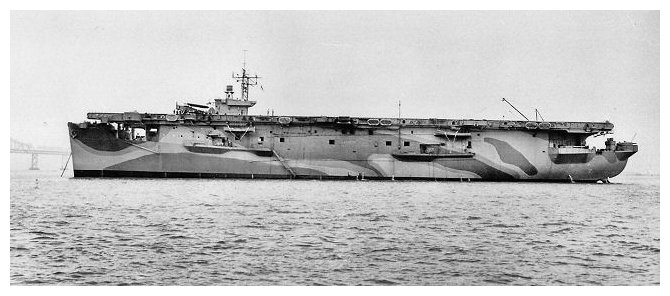 |
Port broadside view of HMS ATTACKER during her trials
with swordfish of 838 squadron aboard off San Francisco.
Photo: Author's collection |
Her keel
was laid down on April 7th 1941, by the Western Pipe and Steel Co.
in San Francisco as the 'STEEL ARTISAN' a Maritime Commission
C3 type freighter; Maritime Commission hull number 171, Western Pipe
and Steel hull number 62. She was purchased by the US navy to be the
USS BARNES ACV- 7). She was launched on September 27th 1941 by her
sponsor Mrs. William A. Ross. The hull was towed to the Mare Island
Naval Shipyard, Vallejo California on October 10th 1941 for
conversion and fitting out as an aircraft carrier. Whilst still
under construction it had been decided that ACV- 7 was to be
transferred to the Admiralty, on loan on her completion.
ACV- 7
was delivered to the US Navy and commissioned as USS BARNES on
September 30th 1942; she was decommissioned and transferred to the
Royal Navy on the same day. She was the first Bogue class escort
carrier to be supplied under the Lend-Lease scheme. She commissioned
as HMS ATTACKER (D02) while alongside Pier 26 in San Francisco on
October 7th 1942, Captain W. W. P. Shirley-Rollison RN in command.
Sea trials and work-up: November 1942 to March 1943
HMS ATTACKER began sea and flying trials off San Francisco on
November 12th, embarking the 4 Swordfish Is of 838 naval air
squadron from USNAS Alemeda Island. These aircraft had been at
Alemeda Island since early August waiting for the ship to arrive,
They had formed and worked-up at
RN Air Section Dartmouth, Nova Scotia, on May 15th 1942 and had
flown across country to San Francisco, thirty-five and a half
hours' flying time in a journey spread over seven and a half days.
On being passed fit for duty on completion of her trials and shake
down she sailed from San Francisco for Balboa on December 12th and
passed through the Panama Canal to arrive at Cristobal on December
22nd 1942. From Cristobal she headed for the Naval operating
Base at Norfolk, Virginia. 838 squadron disembarked to USNAS
Quonset Point on January 1st 1943. During January ATTACKER
underwent defect rectification after her maiden voyage and then
began a period of flying training in Chesapeake Bay. She was visited
by Martlet fighters from 882, 896 and 898 squadrons for Deck Landing
Training (DLT) sessions prior to their embarking in the Fleet
Carrier HMS VICTORIOUS at the start of February, and Swordfish from
838 and 840 squadrons which were working up at USNAS Quonset Point.
On the last day of the fighter DLT period, February 1st 1943,a
Martlet, FN132 of 898 Squadron flying from USNAS
Quonset Point, crashed into the sea on take-off from ATTACKER
and sank; killing the pilot Sub Lt R.U. Davis RNZN.
On securing from flying stations the ship returned to Norfolk for
modification work and the installation of additional equipment.
ATTACKER lost her first crew member two days later, D/JX
288228 Able Seaman Sidney Morgan who is recorded as having died of
wounds.
|
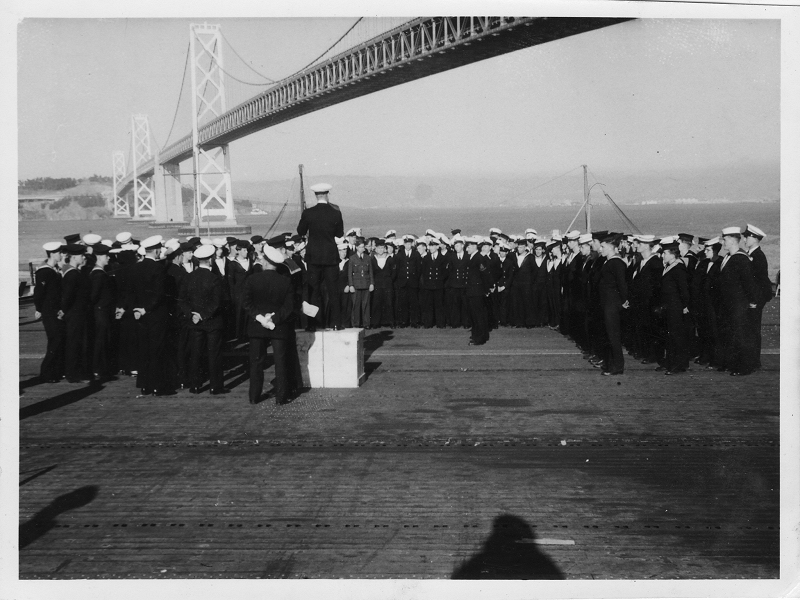 |
October 7tth 1942, Captain W. W. P. Shirley-Rollison RN
reads the commissioning warrant for HMS ATTACKER
alongside Pier 26 in San Francisco before the White
Ensign is raised.. Photo: Author's collection |
Passage to the UK: March 1943
On March 2nd 838 squadron re-embarked together with a further 6
Swordfish of 840 squadron, both flying out from USNAS
Quonset Point. From Norfolk ATTACKER proceeded to Curacao, via
Kingston Jamaica, to join a UK bound convoy. ATTACKER sailed from
Willemstad, Curacao with convoy CU.01 on March 20th as part of the
escort force and provided anti submarine cover for the Atlantic
crossing. She detached from the convoy on reaching the safety of UK
waters and anchored on the Clyde on April 1st. She sailed for
Liverpool the following day, both 838 and 840 squadrons disembarked,
flying ashore to
RNAS Machrihanish.
Modification and working-up: April - July 143
On April 4th 1943 she arrived at Liverpool for a two month period of
modification to bring her to RN standards before entering full
service. This work included installing British Type 79B aircraft
warning and Type 272 surface search radars, replacing the US 5in gun
mountings with British model, and modification of her petrol
distribution system. Towards the end of her modification period a
Swordfish (V4570 of 837 squadron was embarked on June 7th for trials
using with torpedoes with a fine-pitch prop.
HMS ATTACKER left Liverpool on June 15th and sailed for the Clyde to
begin a five week post modification work up and flying training
program in preparation for operational service in the Mediterranean.
Between the 19th and 21st June she carried out flying training with
Swordfish aircraft from
886 squadron, operating out of
RNAS Machrihanish. This training session got off to an
inauspicious start when Swordfish HS547 ('L'), piloted by Sub Lt
J.A. Luke was forced to make an emergency landing after his engine
began spluttering and he had to return to the ship during the first
day.
The squadron's full strength of 9 Seafire L.IIc & 6 Swordfish Is
flew out from
RNAS Machrihanish to join the ship on July 12th. The squadron's
arrival was not without incident again, two Seafires were damaged on
the 12th; Lt. I.O. Robertson broke the fuselage of LR633 when
he failed to lower the tail after catching a wire, and he floated
into the barrier in his replacement airframe NM927 later that day.
Flying training continued through the month, with two more Seafires
suffering damage; on the 21st Lt H. Lang RNZN stalled MB157 into the
sea when it was caught by air eddies from ship, he was recovered OK.
Two days later Lt H.G. Thom RAN in NM919 made a heavy tail landing
and the aircraft suffered skin wrinkling. ATTACKER embarked a second
squadron from
RNAS Machrihanish on July 29th; this was
879, operating 10
Seafire L.IIc.
At some point during this period No.1 Carrier Borne Air Liaison
Section, (1 CBAL) a part of the Army's No.12 Air liaison Section,
arrived on board; this small 5 man unit comprised of Captain,
a Sergeant and 2 clerks from the Royal Army Signals Corps, under the
command of Major Richard Pegler RA. This was the first unit of its
kind to operate with a carrier.
Departure for the Mediterranean:
After storing ship and loading stores and passengers ATTACKER, in
company with her sister CVEs
BATTLER,
HUNTER, and
STALKER, sailed
from the Clyde at 14:00 hours on August 2nd bound for Gibraltar. The
four carriers and their escorts ran into a terrible storm in the Bay
of Biscay which lasted thought the 3rd and into the 4th; the seas
were so rough the ships had to heave to to ride it out. All four
carriers suffered storm damage and many aircraft were badly damaged,
HUNTER suffered the worst of the damage and was forced leave the
convoy to return to the UK. Upon arrival at Gibraltar, at
18:00 hours on the 9th,
886 squadron disembarked to RN air section
North Front. The squadron's Swordfish were to remain ashore until
October 1st conducting anti-submarine patrols, the Seafires
re-embarking when the ship sailed for Malta on August 31st;
879
remained embarked. No.1 CBAL was to have disembarked at Gibraltar
but permission was granted for them to remain aboard after Captain
Shirley-Rollison put forward a compelling argument for them to be
integrated into the ship's routine and so gain valuable experience.
Operation AVALANCHE: September 1943
ATTACKER sailed from Gibraltar at 1800 on the 31st August and
proceeded to Eers-el-Kebir, arriving at 0900 on the 1st September.
She left there to rendezvous with SCYLLA and forces in company at
0800 on September 5th. This Force arrived at Malta at 0700 on
September 7th.
ATTACKER was to form part of Force 'V' the
covering force for the allied invasion of Salerno Italy in operation
AVALANCHE planned for operations between September 9 - 12th. Force
'V' comprised HM Escort Aircraft Carriers ATTACKER, BATTLER,
HUNTER,
STALKER and the maintenance carrier
UNICORN (making a rare
operational contribution), Cruisers EURYALUS [flagship], SCYLLA and
CHARYBDIS, Destroyers CLEVELAND, HOLCOMBE, ATHERSTONE, LIDDESDALE,
FARNDALE, CALPE, and Polish destroyers ORP SLAZAK and ORP KRAKOWIAK.
A second force, Force 'H' comprised the Battleships NELSON, RODNEY,
WARSPITE and VALIANT, Fleet Carriers ILLUSTRIOUS and FORMIDABLE and
a screen of 21 destroyers including French, Polish and Greek
warships was a covering force for the landings, intended to prevent
any interference by Italian surface warships. On the eve of
operation AVALANCHE Italy surrendered so the threat had passed,
however there was a strong German force in the area.
Force
'V' left Malta on the 8th September and proceeded via the Straits of
Messina arriving on station 45 miles south-west of the beachhead
early in the morning of the 9th September. Each CVE in Force 'V'
carried 2 Seafire squadrons,
UNICORN 3, making a total of 109
aircraft in 11 squadrons. The five carriers were to provide fighter
cover for the landings. It was intended that a constant presence of
naval air cover would be maintained over the landing sites, up to 20
aircraft aloft at a time. The first flights were launched at dawn on
the 9th. At this time none of the four CVEs were equipped as fighter
or assault carriers so fighter direction was provided by the Fighter
Direction Ship HMS ULSTER QUEEN.
Flying
operations began at 06:15 and continued throughout the day, with
ATTACKER's last range landing on at 19:15. During the last serial of
the day, Sub-Lt G Calder RNVR (879) in Seafire NM965, landing on
under somewhat poor light conditions, floated at speed over the
arrester gear and crashed through the barriers into aircraft parked
forward, NM965 was write off, NM941 was pushed it overboard by the
impact and rendering another unserviceable for 18 hours. By the end
of the first day's flying program all 52 planned sorties had been
completed; 12 aircraft were serviceable, or made serviceable for the
following day.
During
the night of the 9th/lOth September the Force preceded clear of the
operational area, returning on the morning of the 10th, when flying
resumed at 06:15. The day began with a tragedy when Ord. Seaman
Edwin Kershaw, of the Aircraft Handling Party, ran into a propeller
and was instantaneously killed. He was buried at sea at 11:00 on the
same day. Later that second day one of
BATTLER's aircraft landed on
as her deck was foul but approached at an excessive speed, crashed
through the barriers into aircraft parked forward, the pilot writing
off his own aircraft and severely damaging two others. At the end of
the second day's operations 8 aircraft were available or made
available for the following day.
At
0615 on the 11th, flying resumed at 06:15 again, and operations
continued throughout the day to the last range at 18:31. Lieut.
Morrison (879) landed at the emergency field ashore with hook
trouble. His hook was repaired by the R.A.F. and he returned to the
ship at 1805. Subv-Lt Sturges (879) in NM944 was unable to lower his
undercarriage on returning to land on, and was told to return to
shore for an emergency landing Salerno beach; the aircraft was
abandoned, he later rejoined the ship at Bizerta. At the end of the
third day's operations 5 aircraft were serviceable or made
serviceable for the following day. The attrition rate was very high,
all the CVEs required additional aircraft to be transferred from the
Fleet Carriers of Force H in order to continue operations at this
intensity (Force H withdrew to Malta on the 11th, being nearly out
of aircraft itself by this time).
At
06:15 on the 12th, the first aircraft were flown off. 10 sorties
were flown. It had been envisaged that one or more enemy airfields
would be in allied hands by the end of the first day and so shore
based air cover would take over, this was not the case; it was not
until the third day that the airfield at Paestum was under Allied
control that this became possible. At 1345 on the 12th as many
serviceable fighters as could be mustered were put ashore to operate
at Paestum; ATTACKER managed 4,
BATTLER 5,
HUNTER 5, and
STALKER
only 2,
UNICORN supplied 10. At approximately 1830 the Force left
the operational area and proceeded to Palermo [1]
Note:
Some commentators state Palermo, others Bizerta
,
arriving at 2000. At 0600 on the following morning the Force sailed
for Bizerta, arriving there at 1900. ATTACKER's detached aircraft
re-joined the ship on the 17th.
During
the four days on station the carriers, launched a combined total of
713 sorties, aircraft from ATTACKER flew 132 sorties;
879 squadron
carried out 75 patrol sorties,
886 flew 57. No aircraft were lost to
enemy action.
Force
'V' was to disband on September 20th; ATTACKER,
HUNTER and
STALKER
proceeded to Gibraltar, arriving there on the 24th to await a convoy
to the UK to refit and allow their squadrons the opportunity to
receive replacement aircraft and aircrews. The three carriers joined
the Clyde bound convoy MKF.24 as additional escorts on September
30th. The Swordfish element of
886 squadron re-joined
ATTACKER on
October 1st and conducted anti-submarine patrols on passage. The
convoy arrived on the Clyde on October 6th, disembarking her
squadrons to
RNAS Machrihanish.
|
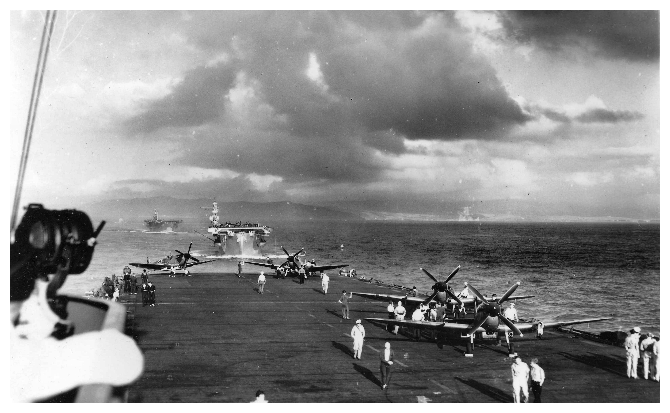 |
HMS ATTACKER leading HMS STALKER (seen from BATTLER, in
a formation lead by HMS HUNTER) leaving Naples.
Photo: Author's collection |
Conversion to an Assault Carrier: October - December 1943
ATTACKER in company with
HUNTER sailed from the Clyde on the 7th,, ATTACKER for Rosyth naval dockyard,
HUNTER for DUNDEE, both to
undergo conversion to an assault carrier. ATTACKER arrived at Rosyth
on October 10th. She was one of a number of CVEs selected for
conversion into a new type of ship to be used to provide air support
for major military landings.
The assault CVE would provide air cover until shore based air strips
became operational; Operation AVALANCHE was the first time such a
strategy was tried and as a result ATTACKER,
HUNTER and
STALKER were
nominated for conversion to the roles. The modifications involved
many new pieces of equipment being installed; a new type 277 radar,
a new telephone system consisting of over 100 telephones, a new
Briefing Room and `Army Plot' Room, cabins added around the
'Aircraft Direction Room,' and numerous other additions such as
extra W/T and R/T sets and still further improvements to the bridge.
Another important modification was an anti-aircraft armament
upgrade; all existing single Oerlikon mounts on the Gallery Deck and foc'sle deck, were to be changed for fourteen powered twin
mountings. After emerging from the dockyard in December the ship
underwent her post refit trials and then took passage from Rosyth to
the Clyde. She re-embarked the Seafires of
879
and
886 squadrons on
December 29th to begin work up and training in her new role.
Working up on the Clyde January to March 1944
Four flying incidents occurred during this training period; on
January 3rd Sub Lt W.T.S. Buchan,
886 Squadron pilotingNM973 floated
into the barrier, on the 4th Sub Lt C.M. Carter,
879 squadron
piloting NM914, struck rounddown on landing, caught a wire but the
aircraft fell over the port side, he was rescued by the attendant
destroyer. On January 7th Lt J.M. Howden RNZN,
886 Squadron, made a
forced landing after his aircraft LR645 suffered an engine fire.
886
squadron lost another pilot on February 1st when Sub Lt J.W. Leake
in Seafire MA984 missed all the wires and bounced over the barrier
and dived over the starboard bow into the sea. In early February
ATTACKER was ordered to Liverpool for further repair work to be
carried out, her squadrons flew ashore to
RNAS Burscough on the 6th.
|
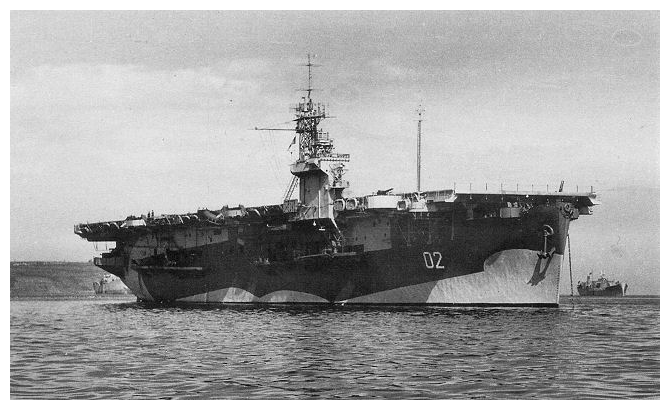 |
HMS ATTACKER
March 1944, in Bangor Bay, Northern Ireland. Photo:
Author's collection |
|
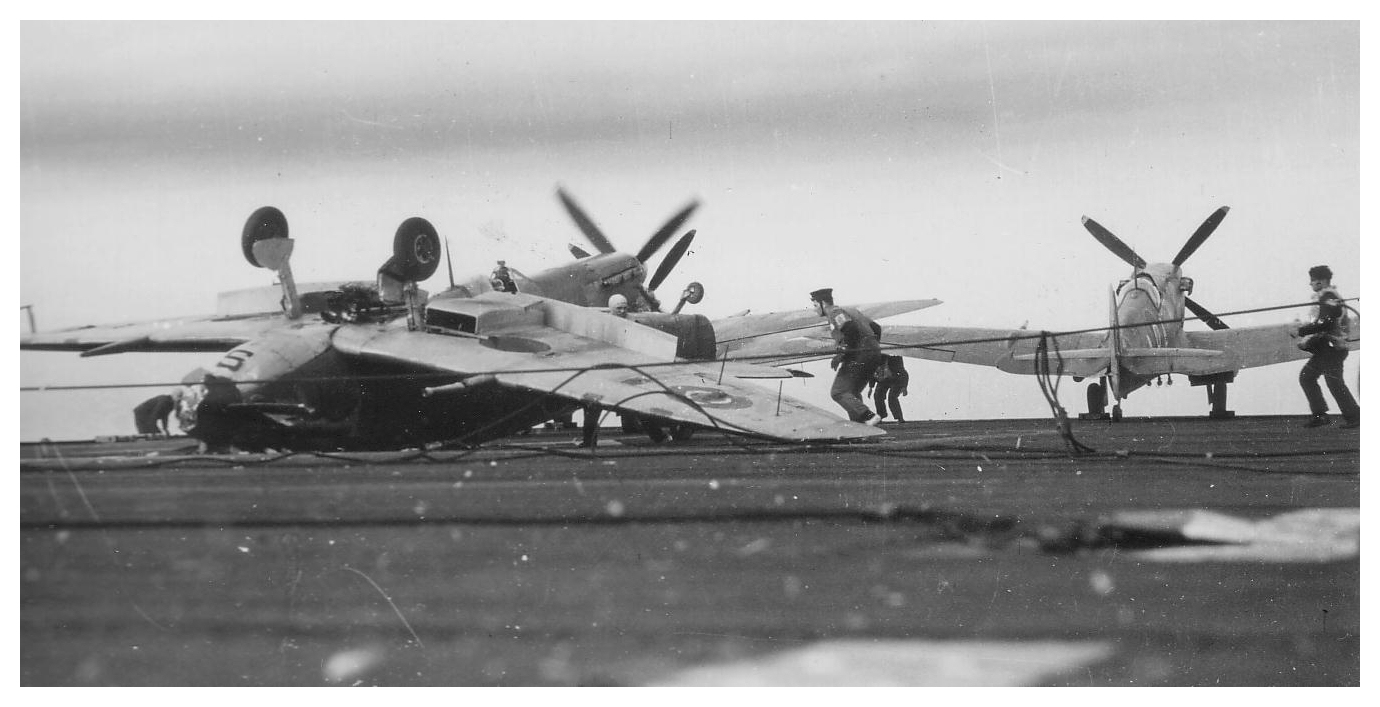 |
Match 21st 1944; Seafire MB215 floated over all the
arrestor the wires, hit the barrier and overturned, the
pilot, Sub Lt R.G. Hallas, was unharmed.. Photo:
Author's collection |
At this
time
886's association with ATTACKER ended, the squadron was to be
re-equipped and reallocated to other duties;
879 absorbed the
aircraft and some of the aircrew of
886 squadron to bring the unit
strength up to 20 aircraft. The ship entered the Alexandra Dock on
the 9th; she would remain in dockyard hands for the next month
before returning to the Clyde.
On the 16th 879 squadron rejoined the ship, for nine
days of flying, during this period the squadron suffered three more
flying accidents; MB215 floated over the wires, hit the barrier and
overturned on the 21st, Sub Lt R.G. Hallas was unharmed, the
following day Sub Lt J.G. Hornshaw in NM937 caught a late wire and
was stopped by the barrier and Sub Lt G. Calder in LR730 hit the
rounddown landing on. The squadron flew ashore to RAF Long Kesh,
Northern Ireland on the 24th for a short spell of Army Co-operation
training. ATTACKER anchored off Belfast and the ship's company was
granted leave from March 31st. ATTACKER provided a day's Deck
landing practice for
STALKER's 809 squadron on April 7th.
On
April 30th
879 rejoined the ship and ATTACKER was allocated to join
the Home Fleet at Scapa Flow for Operation HOOPS, an attack on
Norwegian coast shipping with
HUNTER and
STALKER scheduled for May
8th. She left the Clyde for Scapa on the 4th arriving there on the
5th. Tasking allocations were changed before the operation was
launched;
EMPEROR,
SEARCHER and
STRIKER
were to participate instead
of the three assault carriers which departed from Scapa on the 7th
and proceeded to Belfast. The three ships arrived at Belfast on the
8th.
|
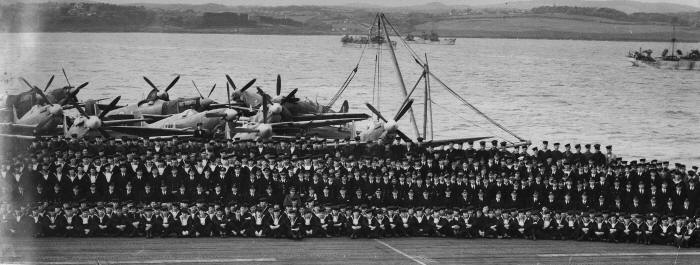 |
The ship's company and personnel of 879 squadron aboard
HMS ATTACKER in Bangor Bay, N.I. Photo: courtesy of
George Clarke. click to see larger image |
Return to the Mediterranean: May 1944
On May 10th replacement Seafires were hoisted aboard
from tenders. One was hoisted to the deck head storage in the
afternoon but fell in the evening; it was written off but another
that it had damaged was repairable. A further five Seafires were
securely slung up on May 12th; there were now 30 Seafires
aboard, 20 were on squadron strength with 10 reserves.. Also on the
12th the ship's new commanding officer, Capt. H.B. Farncomb RAN
came aboard
ATTACKER, in company with
HUNTER &
STALKER sailed on May 14th as
additional escort for convoy KMS.51, which departed from Liverpool
the day before, for passage to rejoin the forces in the
Mediterranean. The carriers detached from the convoy at latitude
43N, on the 19th, to proceed to other assigned support duties.
ATTACKER put into Gibraltar on May 24th, and two groups of 5
Seafires were disembarked to operate from
RNAS North Front until
June 5th.
On June 2nd, the ship moved from its berth on the North mole to one
on the detached mole; while there on the night of Sunday, June 4th
at 02.15 an explosion rocked the ship and momentarily put out all
the lights. An enemy submarine had apparently seen the silhouette of
ATTACKER showing above the mole and loosed off a torpedo which
detonated on hitting the mole. No serious damage occurred, the ship
had been 'cushioned' by floating rafts between the ship and the
mole. ATTACKER put to sea again with
HUNTER, on June 6th,
re-embarking the detached aircraft they sailed for Mers-el-Kebir,
arriving the next day. The ship was to spend the next few months
escorting convoys while in the western Mediterranean. She provided
air cover for Convoy KMS.52 from Gibraltar June 6th to June 9th.
The ship moved on to Algiers on the 16th, and flew off 6 aircraft to
operate from Blida, they were joined by four others on the 18th.
879
squadron was now split 50/50 between the ship and various airfields
engaged on Army co-operation flying with units in North Africa and
Italy including Blida (Algeria) June 16th - July 22nd, Pomigliano
(Italy) June 22nd - 25th, Capodichino (Italy) June 22nd - 26th,
Orvieto (Italy) June 25th - July 19th and Castiglione (Italy) July
5th - 18th.
From Algiers ATTACKER provided partial cover for Convoy NSF.25 which
departed from Oran June 19th while on passage for Naples arriving
there on June 22nd when more detachments of
879 flew ashore to Pomigliano, She covered the return Convoy SNF.25 from Naples on June
24th, arriving ORAN June 27th. On leaving SNF.25 ATTACKER switched
to briefly cover the Port Said to Liverpool convoy MKF.3 2 as it
passed her area of patrol. During early July ATTACKER was nominated
to support the allied landings in south France and she undertook a
Self Maintenance Period, including a boiler clean, at Algiers before
re-embarking her squadron on July 22nd in the Bay of Naples. She
sailed for Malta the following day in company with
KHEDIVE,
PURSUER,
SEARCHER and
EMPEROR, anchoring in Dockyard Creek on July. 25th.
Operation DRAGOON, the invasion of Southern France: August 19444
At Malta
ATTACKER joined Carrier Force TF88.1 for Operation DRAGOON. TF88
also included CVEs
EMPEROR,
KHEDIVE,
PURSUER and
SEARCHER, Cruisers
ROYALIST and DELHI screened by five RN destroyers and one Greek
destroyer. The force exercised off Malta between August 2nd and
12th, the actual invasion commenced in the early hours of August
15th.
The
following day the first 8 aircraft launched at 09.30 on a bombing
and strafing mission between Brignoles and Aix. Red section was
targeting a railway bridge, and though the bridge was not destroyed
the road was cratered and an armoured car, a bowser, a lorry and two
trailers and a searchlight were all set on fire. 26 sorties were
flown during the day - 8 bombing, 10 TacR, 2 spotting and 6 CAP
(Combat Air Patrol), and at the end of the day
879 had 24 aircraft
serviceable. Comment was made on the keenness shown by the troops.
One aircraft was damaged by flak but returned to the ship OK.
Similar sorties were flown on the 19th, Sub Lt W.A. Clarke flying in
Seafire LR704 successfully dive bombed some suspected tanks, through
severe AA fire, hitting two lorries before bouncing over all the
arrestor wires and flying into the barrier on his return to
ATTACKER..
TF88.1
withdrew late on the 19th and took passage overnight to Maddalena,
Sardinia, to refuel and rearm. Arriving at dawn men were allowed
ashore to have a short rest & recuperation period before she sailed
that evening to return to the beachhead. Arriving at the flying off
point, a position south of Marseilles, on the 21st, ATTACKER
launched 4 Seafires at dawn which split into pairs to search for
targets of opportunity; only one returned to the ship. Each pair was
to have an aircraft shot down, Sub Lt G. Calder was hit first,
suffering damage from AA fire; he managed to make a forced landing
in the countryside and avoided capture until allied forces found
him. His wing man loitered in the area before his fuel levels made
him head back to the coast, he landed on another carrier when it
looked like his fuel was too low to make it to ATTACKER. Later that
sortie Sub Lt A.I.R. Shaw's Seafire was hit by enemy AA fire after he successfully attacked German
mobile artillery on a country road; his engine was on fire so he had
to bail out over enemy territory [2]
Note:
In his account of the incident in his book 'Upside of trouble' Anthony Shaw gives the date as the 21st - the entry in ‘Fleet Air Arm Aircraft 1939 to 1945' by Sturtivant & Burrows the date is given as August 28th.
. He was soon captured but
subsequently escaped and was helped by locals until the advancing
allied forces reached his location. His wingman was flying in a
camera equipped Seafire and he took photos of the parachute as it
floated to earth, he arrived back on board safely. Both downed
pilots eventually rejoined the squadron. A further 5 aircraft were
put out of commission that day; Sub Lt W.A. Clarke in LR710,
returning from a TacR sortie, caught his hook on a plate on the
after lift, was thrown up over all the arrestor wires and cleared
the barriers to continue on into the forward deck park, damaging
LR643, NN128 & LR740; Sub Lt A.A. Gowan RNZNVR [3]
Note:
Sub Lt Gowan RNZNVR was later awarded the DSC for skill and leadership in dive-bombing and strafing missions during 'Operation Dragoon'.
was critically injured in the crash, he was still in the cockpit of
his aircraft (NN128) having taxied forward into the aircraft park,
his thigh was broken by LR740's airscrew which ripped through the
cockpit door. The fifth aircraft put out of commission was LR760, Lt
G. Ogilvy caught No.5 wire but continued into the barrier.
ATTACKER
and the ships of TF88.1 withdrew from the area for a second time to
refuel and rearm on the evening of August 23rd and headed for
Maddalena. A further barrier crash occurred on the 24th when the
arrestor hook of NN357, flown by Sub Lt R.I. Sturges bounced off the
deck and locked up. A further barrier crash occurred on the 28th
when Sub Lt D.A. Gibson flying in MB260 landed off centre, caught
number 8 wire and hit the island.
ATTACKER
and the other CVEs of Task Group 88.1 were released from their
duties on August 28th; by this time Sub Lt. Gowan was off the danger
list.
879 squadron's aircraft had completed 226 sorties including
strikes on ground targets, bombardment spotting for HMS AURORA and
tactical reconnaissance missions;120 were bombing missions. HMS
ATTACKER left Maddalena to proceeded to Alexandria on the 29th,
having suffered a generator failure which held her departure up by
24 hours. She arrived there on September 2nd to replenish stores,879
squadron received replacement aircraft and aircrew from
RNAS Dekhelia.
|
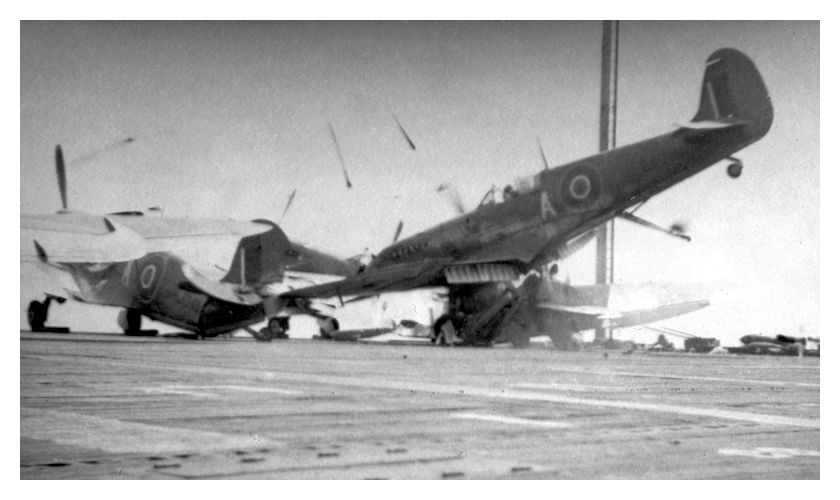 |
August 21st 1944; Seafire LR710 floated over all the
arrestor the wires, and the barrier to severely
damage three other parked aircraft. The pilot, Sub Lt
W.A. Clarke, was unharmed.. Photo: George Clarke |
Operation OUTING I & OUTING II: September - October 1944
ATTACKER
put to sea again on September 14th bound for the Aegean to relieve
HMS
HUNTER deployed for operation OUTING I. She arrived on station
on the 15th joining Force A with CVEs
EMPEROR,
KHEDIVE,
PURSUER, and
SEARCHER, Cruisers ORION, AJAX, ROYALIST, BLACK PRINCE, ARGONAUT,
AURORA, and COLOMBO; their task was to hamper and delay German troop
movements in the Dodecanese Islands, (Leros, Kos, Samos, Rhodes and
Levitha).
ATTACKER's aircraft (15 Seafire L.III and 5 Seafire LR.IIcs) flew
armed reconnaissance sorties from the 16th, and ground attack
missions on enemy transport, including dive-bombed shipping in
Rhodes harbour on he 19th. Returning from a Force Cover sortie on
the 19th Sub Lt W.A. Clarke suffered a barrier crash on Landing in
Seafire LR704, after a hard three point landing the aircraft bounced
and the tail wheel fell off, unable to regain airspeed the aircraft
continued into the barrier.
ATTACKER
withdrew to Alexandria on the 20th to re-supply. She sailed for the
Dodecanese Islands on September 27th for the second phase of
operations, OUTING II. Seafires from
879 squadron strafed the W/T
station on Levitha on the 3rd before conducting Tactical
Reconnaissance flights on the 4th together with bombardment spotting
for the cruiser ROYALIST. The force returned to Alexandria for a
further replenishment of aircraft and stores on October 5th;
ATTACKER's aircraft having completed 102 sorties.
Operation MANNA October 1944
On her
return to the Eastern Aegean ATTACKER again relieved
HUNTER on
October 11th, for the next offensive, Operation MANNA. ATTACKER
operated as part of Force 120 from the 15th, with CVEs
EMPEROR and
STALKER, Cruisers AURORA, BLACK PRINCE, AJAX, ORION, Destroyers TROUBRIDGE, TERMAGANT, TUSCAN, TYRIAN and Polish ORP GARLAND to
cover the reoccupation of Piraeus.
STALKER left the force on the
20th, returning to Alexandria. On the 23rd and 24th railway rolling
stock and motor transport was strafed and set on fire, and together
with extensive dive-bombing of the railway system stopped all rail
traffic on Kos. Towards the end of the month ATTACKER and
EMPEROR
provided air cover for amphibious landing at Mitylene on the island
of Lesbos. On the 26th, aircraft from
879 squadron operated ashore
at Mitylene until re-embarking to cover the landing on Piskopi on
the 29th. ATTACKER withdrew to Alexandria on October 30th leaving
EMPEROR as the only CVE operating in the area.
879 had flown 240
sorties between September 16th and October 29th.
Return to UK, repairs, leave and refit: November 1944 - March
1945
On
October 31st the three Assault Carriers, ATTACKER,
HUNTER &
STALKER
sailed in company for the UK. Calling at Malta on November 3rd
ATTACKER embarked 150 ratings for passage to the UK The three
carriers were earmarked for service with the 21st Aircraft Carrier
Squadron (21 ACS), with the East Indies Fleet and were to undergo a
short period of defect rectification while their crews went on home
leave. They reached Plymouth on November 10th and were put in the
hands of Devonport Naval Dockyard.
The
carriers sailed from Plymouth on November 29th for Gibraltar; all
three were on passage to undergo refits in Mediterranean dockyards;
STALKER was to refit in Gibraltar on their arrival on December 3rd
so her squadron, 809 Seafires transferred to ATTACKER on leaving
Plymouth and were disembarked along with
879 squadron to
RNAS Dekhelia, Egypt on December 11th.
HUNTER proceeded to Malta
for refit beginning December 6th. ATTACKER was to refit in the
Italian port of Taranto 4]
Note:
Several commentators have ATTACKER arriving at Taranto for refit on Dec 6th with squadron personnel taking passage to Egypt in the Italian cruiser DUCA D'AOSTA. However, squadron records show that the aircraft of both 809 and 879 squadrons were disembarked from ATTACKER on Dec 11th in Egypt.
.
On
completion of post refit trials HMS ATTACKER sailed for Alexandria
on April 1st 1945. She re-embarked the 24 Seafires of
879 squadron
from
RNAS Dekhelia
on the 14th and proceeded through the Suez Canal to Aden and on to
Ceylon. There were two barrier crashes while on passage; Sub Lt
W.T.S. Buchan in NN490 in April 19th and Sub Lt H.C. Vane in NN495
on the 21st, ATTACKER arrived off Ceylon on April 29th and
disembarked her squadron to
RNAS Katukurunda.
Although now a part of 21 ACS ATTACKER was not fit for operational
duty due to defects that had presented themselves on passage. She
was initially deployed with
HUNTER on aircraft transport duties from
ports in India and South Africa to Ceylon. The squadron re-embarked
on June 10th, remaining aboard until July 17th, presumably on flying
training, they then returned to RNAS Katukurunda. They re-embarked
three days later as ATTACKER continued flying operations before
taking passage to Trincomalee where they disembarked to
RNAS
Trincomalee on the 19th. This short ten day outing was a costly one
for
879 squadron, 11 aircraft suffered damage through flying
incidents, and one pilot was killed. The run of bad luck began the
day the squadron re-embarked with Sub Lt B. Lees RNZN putting NF445
into the barrier. On the 11th two aircraft 'pecked' the deck on
landing, NF600 flown by Sub Lt G. H. Wilson RNZN and NN401 flown by
Sub Lt M.D. S. McClelland; Sub Lt I.H. Gladders made a heavy landing
in NN437 resulting in the starboard tyre bursting and buckling the
oleo leg. A fourth incident on the 11th resulted in Sub Lt A.W.K.
Foxon being killed; his Seafire NN347 flew through the barrier
damaging parked aircraft as it dived over starboard side into the
sea. There were five more aircraft put out of action on the 12th,
Sub Lt W.J. Cody in NF643 hit the rounddown with his tail wheel
causing damage to the fuselage; later that day he put NN408 into the
barrier. Sub Lt L. Livemore in t NN365 also put his aircraft into
the barrier, while Sub Lt G.H. Wilson RNZN flying NN451 caught a
wire but his prop clipped the deck. while attempting to go round
again, Sub Lt. HC Vane in NN397 hit the edge of the flight deck and
the aircraft fell into the sea. The pilot was safely rescued. On the
final day of flying before flying ashore to Trincomalee Seafire
NN437 flown by Sub Lt G.H. Wilson RNZN suffered fuselage damage when
a bomb carrier dislodged landing on.
Operation CARSON: August 1945
ATTACKER was not employed on offensive operations until early
August; she re-embarked
879 on August 9th on being allocated to
Force 61 for operation CARSON, a series of attacks on shipping and
airfields in Penang and Medan area of Sumatra. Force 61, consisting
of the AA Cruiser ROYALIST (Flag of Rear Admiral G.N. Oliver, CB,
DSO, Rear Admiral Commanding 21ACS), CVEs
AMEER, ATTACKER,
EMPEROR,
EMPRESS,
KHEDIVE, and
SHAH, Destroyers TARTAR (Captain (D), Tenth
Destroyer Flotilla), PENN, VIGILANT, and VERULAM. The force sailed
from Trincomalee on August 10th, to carry out strikes on August 14th
and 15th. On August 11th the force was ordered to hold west of 90
degrees east and await further orders; the operation was eventually
cancelled in light of the news of Japan's announced willingness to
accept the Allies' surrender terms. The force subsequently returned
to Trincomalee.
ATTACKER was now allocated to participate in Operation JURIST an amphibious assault by the 3rd Commando Brigade to capture Penang Island on the west coast of Malaya planned for August 21st 1945. Elements of the EIF including ATTACKER and
HUNTER had put to sea on August 15th for operation JURIST, when the news of the Japanese surrender was made when Station General Message "SUSPEND OFFENSIVE OPERATIONS AGAINST JAPANESE FORCES' was made to all ships and allied forces.
Operation JURIST the surrender of Penang, August 1945
Forces originally allocated to operation JURIST were Force 11, comparing the Battleship NELSON ( Flag, Vice Admiral Walker), escort carriers ATTACKER,
HUNTER,
SHAH and
STALKER, the light cruisers CEYLON and NIGERIA, the destroyers PETARD, TARTAR and VOLAGE, and the landing ships PRINCES BEATRIX and QUEEN EMMA. Force 12 comprised the destroyers VERULAM and VIGILANT and eight yard minesweepers; Force 13 comprised the destroyer PENN and LST 383 loaded with vehicles; Force 14 with the escort destroyer CALPE and the Royal Fleet Auxiliary’s BELA and EMPIRE SALVAGE; Force 68 with the heavy cruiser LONDON (Flag, Commodore Poland) and destroyers RAIDER and ROCKET; and Force 157 with the Indian sloop GODAVARI, Coastal Forces repair ships BARRACUDA and MULL OF GALLOWAY, tanker CROMWELL, 26 motor launches of the 34th, 38th and 56th Motor Launch Flotillas, and nine harbour defence motor launches of the 110th Harbour Defence Motor Launch Flotilla.
With hostilities over attention turned to the reoccupation of former British territories held by Japanese forces, but it was to be late August before orders were received to send out naval forces to reoccupy key ports in Burma, Malaya and Singapore. Shortly after the JURIST forces took passage eastward delays in negotiations, and in the arrival of the Japanese Emperor's orders to cease hostilities in South East Asia became apparent; orders were issued postponing the start of JURIST and on August 20th all forces took shelter on the north east coast of Great Nicobar Island. ATTACKER and
HUNTER were ordered to proceed to Rangoon.
JURIST revised
Political constraints also meant that no landing could take place until after signing of surrender in Tokyo. These delays meant that all plans were now to change; the occupation of Penang was still to be undertaken as Operation JURIST but without the amphibious assault, and would include the occupation of Sabang, both objectives being occupied by contingents of Fleet Royal Marines.
ATTACKER and
HUNTER sailed from Rangoon on August 27th to rendezvous with NELSON and CEYLON off Penang. At mid-day on August 28th a reduced Force 11, NELSON, accompanied by CEYLON, ATTACKER and HUNTER, three destroyers and two large infantry landing ships carrying the Royal Marine landing party, arrived off George Town, Penang to negotiate the surrender of local Japanese forces and to reoccupy the area. At the same time LONDON, accompanied by one destroyer, arrived off the northern tip of Sumatra carrying a small contingent of Royal Marines to occupy Sabang Island. The Japanese forces surrender taking place on September 2nd.
Operation ZIPPER support and the surrender of Singapore
ATTACKER and
HUNTER sailed from George Town on September 7th and provided air cover for the passage of assault convoys through the Malacca Straits during the 8th and 9th for the modified Operation ZIPPER, the re-occupation of Port Swettenham and Port Dickson which began at first light on the 90th, before setting course for Singapore.
The reoccupation of Singapore was achieved by Operation TIDERACE, allied forces had arrived in Singapore on September 4th, meeting no opposition. By 18:00 the Japanese had surrendered their forces on the island to Lieutenant-General Sir Philip Christison aboard HMS SUSSEX. The formal surrender was to be finalised on September 12th at Singapore City Hall.
On the morning of Tuesday, September 11th, 1945 the ships of Admiral Walkers force (now designated Force 61) and Carriers of the 21st Aircraft Carrier Squadron anchored in Singapore Roads between 0930 and 1030 and waited for instructions. Later the order was given for part of the force to proceed into the harbour;
EMPEROR,
HUNTER,
KHEDIVE and
STALKER anchored in Keppel Harbour. The CVEs
AMEER and ATTACKER were among 90 ships (including 70 RN and RIN warships, 3 Royal Fleet Auxiliaries, 3 hospital ships and 14 merchant vessels) present in Singapore Roads for the ceremony in which the Japanese forces in South East Asia surrendered on September 12th.
Return to the UK: October - November 1945
On
September 14th HMS ATTACKER sailed from Singapore bound for
Trincomalee, arriving there on the 19th, her squadron disembarked to
RNAS Trincomalee. She was released from duties with the EIF and
prepared to take passage to UK; she re-embarked her squadron on
October 10th and sailed for Bombay the following day. She carried
many passengers and servicemen going home to be de-mobbed; after
Bombay she called at Malta on route, arriving in UK waters on
November 10th 1945.
879 squadron departed from the ship for the
final time she steamed up the Irish Sea, flying off to RNAS Nutts
Corner, Northern Ireland. HMS ATTACKER arrived at her mooring on the
Clyde on November 11th 1945.
Disposal: return to US custody December 1945
She was
to be removed from active service upon her arrival and once her
passengers had been disembarked work began to de-store her. The next
stage was the removal of Admiralty equipment in preparation for her
return to US Navy custody under the terms of the Lend/Lease
agreement.
HMS
ATTACKER departed from the Clyde on her final voyage on December 9th
1945, calling at Southampton to embark US troops for passage to
Norfolk, Virginia, arriving on 24th December. She was decommissioned
by the Royal Navy on December 29th 1945 and returned to USN custody
at Norfolk. CVE 7 was struck from the US Navy list on February 26th
1946 and put up for disposal.
She was
sold on September 11th 1946 to William B. St. John, for conversion
into a merchant vessel for National Bulk Carriers of New York City,
N.Y. Work on her conversion was stopped when she was purchased in
1950 by Navcot Corp, a company set up by Alexander Vlasov, founder
of Sitmar Lines. She was renamed CASTEL FORTE but remained laid up;
in 1952 she was transferred to the books of the Sitmar Line but work
did not resume until February 1957 when she was moved to the
Bethlehem Shipyards in New York to begin a conversion to a passenger
liner. She sailed to Genoa in December 1957, where she received her
interior fittings including accommodations for 1,461 passengers. On
completion in 1958 she was registered in Panamanian under her new
name FAIRSKY. She commenced service from Southampton on June 26th
1958. She operated on the England to Australia route carrying
immigrants until February 1972 when she was laid up at Southampton.
She re-entered service in December 1973 and completed just 2 round
voyages UK to Australasia, before becoming a full-time cruise ship
from Australian ports, from mid-1974.
FAIRSKY
hit a submerged wreck on June 23rd 1977 near Jakarta, Indonesia, and
beached to prevent sinking. Re-floated June 29th 1977 after being
temporarily patched up, the ship continued to Singapore under her
own power, but when the extent of the damage became apparent it was
decided she was beyond economical repair and was to be scrapped. She
was purchased by a Philippines consortium which planned to convert
her into a floating hotel and casino ship the PHILIPPINE TOURIST.
She was towed to Mariveles, Luzon, Philippines, arriving there on
March 28th 1978 to begin the conversion work but was destroyed by
fire on November 3rd 1979 and subsequently scrapped at Hong Kong
starting 24 May 1980.
Content revised:
18 April 2022
Sources used in compiling this account:
Click here for a list of
Primary sources
Additional sources:
Fold3.com various documents including;
Admiralty War Diaries
Norfolk Navy Yard War Diaries
Mew York Navy Yard War Diaries
Miscellaneous documents
Special thanks to Mr. George Clarke for making
available the reminiscences of his late father, Sub
Lieutenant (A) William Anthony 'Nobby' Clarke, RNVR (P) who
served with 879 squadron 8 March 1944 - 14 November
1944. Many dates and events have been drawn from his diary,
flying log book, and the squadron history.
|
Home
page |
go to the top
|







Comments (5)
I had just been sorted through a folder of scanned photos and came across a folder of my Uncle's photos. He served on HMS Attacker and is mentioned several times above. SubLt Geoffrey H Wilson (RNZN). I have uploaded them to the Flickr page. One of the photos is the Seafire MB215photo plus one that looks like it was immediately preceding. This is a great site and a good account thank you.
https://www.flickr.com/photos/43399867@N06/albums/72177720332516006
I was looking for information about my uncle, Walter T Buchan who flew off HMS Attacker with 879 in the Mediterranean during WW2.
Wonderful to see all the photographs.
Good day to you. I have just read about the H.M.S. Attacker. My brother Jack was on her during WW2, as galley crew. A great write-up on the carrier. I was on H.M.S. Reaper and H.M.S. Patroller as T124X crew.