A History of HMS PUNCHER
|
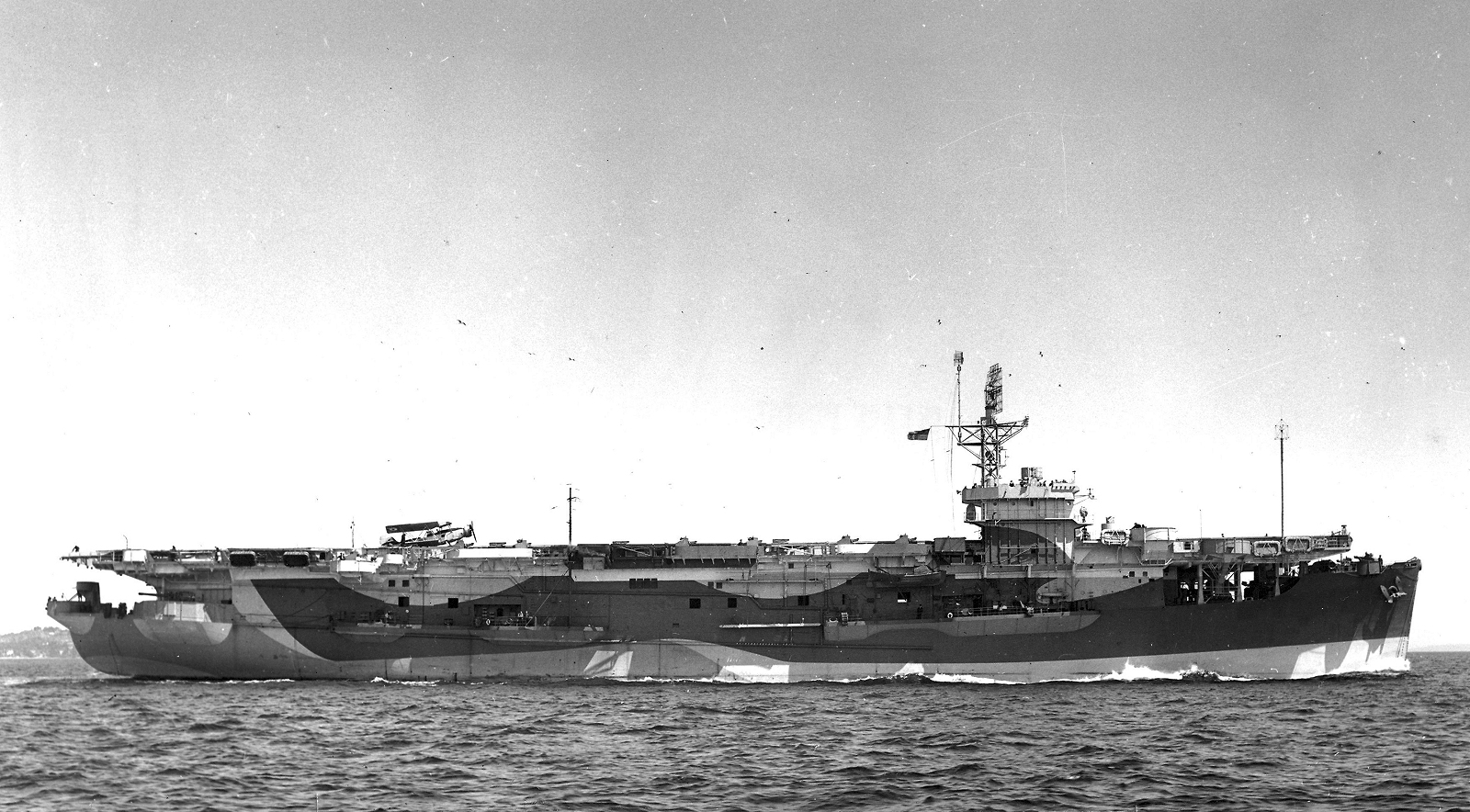 |
PUNCHER off Vancouver in early June 1944, an
obsolete RCAF Blackburn Shark, is parked on the
flight deck, aircraft handling parties used this to
learn the art of aircraft handling.
|
HMS PUNCHER was a 'Smiter' class escort carrier (US Bogue class) built in the USA at Seattle-Tacoma Shipbuilding Co. Tacoma, Washington. Her keel was laid down on May 21st 1943 as a C3-S-A1 type freighter, Maritime Commission hull number [unknown], and Seattle-Tacoma hull number 48. The hull was purchased by the US navy to be completed as the USS WILLAPA ACV-53 (designation later changed to CVE - 53). She was launched on November 8th 1943, 171 days after her keel was laid, by her sponsor Mrs. C. E. Taylor. Whilst still under construction it had been decided that CVE 53 would be transferred to the United Kingdom under Lend Lease in October 1943. Commander F A. Price, RCNVR was appointed as executive officer and Officer in Charge on January 17th in preparation for her transfer to the RN.
After spending a further 89 days outfitting she completed her builder's sea trials on February 3rd was ready for delivery on February 5th 1944; CVE 53 took a total of 260 days to complete. She was transferred to Royal Navy custody at Tacoma, Washington on February 5th 1944 and was accepted on behalf of the Admiralty by Commander Price who assumed temporary command of the ship. The White Ensign was hoisted and the ship was commissioned HMS PUNCHER, pennant number D79.
Modification and preparation to enter service:
Manned by a small steaming party under the command of Commander Price, PUNCHER departed Trachoma for Vancouver, British Colombia, on February 12th arriving at Lapointe Pier later that day where she was moored in stream. PUNCHER was ahead of schedule, arriving at Vancouver one month early. She was one of 19 escort carriers to be modified to meet Admiralty requirements by the Burrard Dry Dock Co. Ltd., North Vancouver, British Columbia. While in Vancouver she was to receive her full crew compliment and work up ready for beginning her active service. At this time sister CVEs
RULER,
ARBITER,
RAJAH,
SMITER, and
TROUNCER were in the hands of the Burrard's yard and at various stages of modification.
RULER’s work was completed on February 28th and she left No.7 Berth for a mooring in the stream. PUNCHER was moved to No. 8 berth on the same day where work commenced to de-store the ship but her modification work did not commence until she moved to No.7 Berth on March 15th.
This work totalled 150 separate modifications and included lengthening of the flight deck, fitting redesigned flying controls and fighter direction layout, modifications to hangar, accommodation and store rooms, installing extra safety measures including major changes to the aviation fuel stowage and oiling at sea arrangements,, modifying gunnery and other internal communications, adding extra W/T and R/T sets, and improved darken ship arrangements.
As work progressed PUNCHER progressed through the yards various berths; the yard could be working on six different ships at any time with separate aspects of the work carried out at different berths, the ships passing through like a production line, moving from one berth to another until complete. She moved to No 3 on March 20th, then to No 4 on April 1st. She moved to No.5 on the 16th where her alterations were to be completed on May 8th having taken 55 days [1
The last five CVEs to pass through Burrard's dockyard, PATROLLER, PUNCHER, REAPER, RANEE and THANE had a longer modification timetable than the other 14 vessels modified by Burrard's; this was due to the Admiralty decision that the single Oerlikon mounts on the Gallery Deck and foc'sle deck, were to be changed for fourteen twin mountings. An extra ten days being allocated for this work to be completed.]. Part of this work included the addition of 314 tons of pig iron as additional ballast which was to compensate for adding weight to the upper structures.
On April 19th Captain R. E. S. Bidwell RCN arrived to assume command. PUNCHER was one of only two ships to be jointly RN/RCN manned, NABOB was the other; her ship’s company, excluding the Air Department and squadrons, was provided by the Royal Canadian Navy. A number of British Merchant Navy personnel under T124X contracts manned the Engine Room. Out of her crew of 646 men, 450 were from Canada.
On May 9th she sailed to Esquimalt to enter dry-dock for the fitting of additional sea valves and other remedial work; after undocking on the 12th she returned to Burrard’s and secured at No 7 berth on the 15th to begin storing ship. She was moved to a mooring in the streams on May 19th from where she proceeded to sea to work up and carry out gunnery practice, including tests of the new twin Oerlikon mountings, the ship being one of the first to have this type fitted. Part of this work up involved a short round trip voyage to the US Naval Yard at Bremerton, Washington, to pick up ammunition; she anchored in Sinclair Inlet in the forenoon on May 24th and on completion of loading she sailed at 08:00 on the 27th. PUNCHER secured at the RCN base at Esquimalt on her return.
On May 31st, just prior to her sailing from Esquimalt, PUNCHER received her first aircraft - a non-airworthy Blackburn Shark given to the RN on free issue for training flight deck handing parties on the voyage to Norfolk, Virginia. The Shark was ferried out to the ship by lighter from No. 3 Repair Depot RCAF were her floats had been substituted for wheels. Four other CVEs at Vancouver, PATROLLER, REAPER, THANE, and RANEE also received written-off Sharks for this purpose. This vintage aircraft caused some interest when PUNCHER put into US ports; she was finally pushed overboard when her usefulness had come to an end and deck cargo was due to be loaded.
Maiden voyage: Ferry trip to New York June 9th – July 8th 1944
HMS PUNCHER sailed from Esquimalt on June 9th 1944 with the frigate HMCS BEACON HILL in company, bound for New York. The carrier was to make several stops on her way to New York, calling first at San Francisco to load more stores and special equipment before arriving at San Diego at 17:00 on the 14th for the installation of additional equipment and several tractors and trailers were embarked.
On leaving San Diego at 06:00 on the 15th PUNCHER and BEACON HILL were joined by HMS FOAM, a fleet minesweeper, and the three ships headed for Balboa at sixteen-knots. While on route to Balboa exercises and daily drills were performed, including flight deck emergency drills using the Blackburn Shark; this aircraft was ditched over the side before the ship reached the Canal Zone, having served its purpose as a training aid.
Several lively deck hockey competitions were held to provide some respite from drills. Arriving at Balboa on June 23rd, they passed through the Panama Canal the same day and secured overnight at Christobal. Here PUNCHER embarked a number of British officers and seamen, survivors from merchant ships for passage to the United States. PUNCHER and her escorts sailed for the entrance to the Mississippi river on the afternoon of June 24th. The three ships preceded ninety miles up the Mississippi river to the port of New Orleans where PUNCHER was to pick-up four 72' harbour defence motor launches that had been built up further up river and carried down river on barges.
PUNCHER and her escorts sailed for New York on
July 3rd, arriving at Brooklyn Navy Yard on July 8th to unload the launches
and other equipment and stores she was carrying for trans-shipment on to
Europe. After a speedy turnaround the ship was sent to Norfolk, Virginia
where she was taken in hand at Portsmouth Navy Yard on July 11th for a short
period of minor defect rectification, and to receive her final additions to
equipment and for installation of Bofors anti-aircraft mountings. This work
was completed in nine days and the ship sailed at 05:45 on the 21st to
return to New York.
|

 |
Loading harbour defence motor launches ay New Orleans
|
Ferry trip to Casablanca July 21st - August 27th 1944
PUNCHER was now allocated to the strength of Western Approaches Command for duties as a ferry carrier, receiving scaled orders to report to the Brooklyn Naval yard. Upon her arrival in New York on July 22nd PUNCHER was berthed alongside another CVE, the USS SHAMROCK BAY (CVE 84) at Staten Island, here dockyard workers from the Bethlehem Steel CO., came on board to effect voyage repairs. Both ships were loaded under strict secrecy; their ferry loads included the USAAF's latest night fighter the Northrop P-61 Black Widow. PUNCHER embarked a mixed load of 40 aircraft, along with 29 officers and 45 enlisted men of the 427th Night Fighter Squadron. The two ships also embarked stores and equipment, their cargo was bound for Casablanca in North Africa in preparation for the invasion of Southern France.
On completion of loading PUNCHER and SHAMROCK BAY headed for Hampton Roads off the Virginia coast to join the Mediterranean bound convoy UGF13. The convoy sailed on July 28th bound for Naples; this-was a fast convoy of sixteen ships, tankers and troop transports carrying about 18,000 men escorted by the cruiser, USS CINCINNATI, with six Destroyers and three Minesweepers as escorts. Off the African coast PUNCHER, SHAMROCK BAY and four merchantmen were detached and, escorted by four French Chasseurs, preceded into Casablanca on August 8th to off-load their cargo. While at Casablanca an excursion was organised fro off duty members of the ship's company; 15 officers and 142 liberty men, were given a 140 mile trip around Morocco by truck, the transport was provided by the U.S. Army Air Transport base, in Casablanca. On the 12th PUNCHER sailed from Casablanca as commodore of a small four vessel merchant convoy which rendezvoused with the Port Said to Norfolk convoy GUS-48 at 18:00, PUNCHER stepping down as commodore and taking her place in the line. PUNCHER arrived back in Norfolk on August 27th.
|
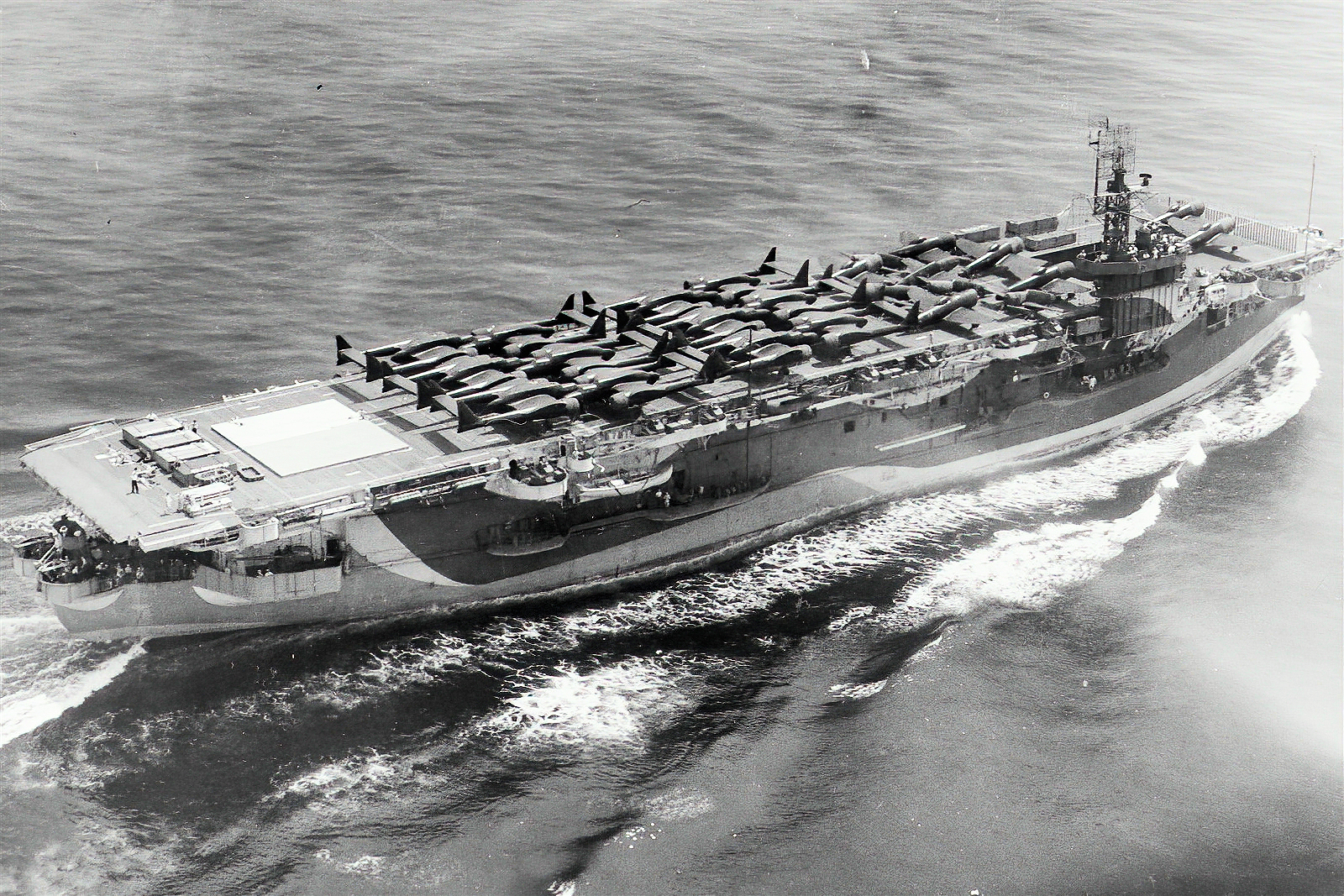 |
PUNCHER on passage to Casablanca, her deck cargo included a number of the twin tail
boomed P-61 'Black Widows' of the 427th Night Fighter
Squadron USAAF; a couple of P-47 Thunderbolts, can be
seen towards the front of the flight deck . |
Second ferry run, Norfolk to Liverpool: August 30th – September 115th 1944
PUNCHER secured alongside at Norfolk Naval Operating Base on August 30th to
begin loading; eighteen corsairs and the support equipment of
1845 squadron were hoisted on-board and
stowed in the hanger. This squadron had formed and worked up at USNAS
Brunswick in June 1944 and was being ferried to the UK to begin operation
service. She then began loading a deck cargo of Hellcats, Avengers, Corsairs
and one Helldiver for delivery to the UK. Twenty-one officers and 128
ratings of
1845 also came on board before the ship
sailed on to New York.
She arrived at the 35th Street Pier, Brooklyn, at 18:00 on September 1st to undergo voyage repairs and to embark more passengers, including twenty-eight women and children. Repairs were completed on the 3rd and PUNCHER prepared to sail with the 40 ship UK bound convoy CU-38 sue to depart from New York the nest day. PUNCHER was delayed in sailing from New York to wait delivery of a consignment of special ammunition; she was due to sail with the 40 ship UK bound convoy CU-38 on September 4th but sailed a day later with the Destroyer USS ENRIGHT as escort, sighting the convoy late morning on the 9th.
|
 |
August 30th 1944: Corsair MK.IIIs belonging to 1845
naval air squadron are loaded aboard PUNCHER for
ferrying to the UK. The squadron had formed and worked
up in the USA at USNAS Brunswick, Maine. Corsair JS834 ('4V7') is seen being hoisted
aboard and struck down.
Squadron aircraft were stowed in the hangar while new
airframes were loaded as deck cargo. |
Approaching Bishop Rock on the 14th, the convoy split into two groups; PUNCHER became commodore of a thirty-ship group headed for the Liverpool, others were bound for Southampton and Bristol. PUNCHER berthed at King George V dock, Glasgow, on the 15th having parted company with the convoy in Liverpool Bay. Unloading began immediately.
1845 squadron was disembarked to
RNAS Eglinton, Northern Ireland on the 18th just prior to the ship making her next voyage to New York.
Third ferry run, Belfast to New York and return to Liverpool: September 20th – October 17th
PUNCHER rendezvoused with the New York-bound convoy, UC-38A, at dawn on September 20th. Upon her arrival at Staten Island, New York on September 30th PUNCHER began loading a cargo of American aircraft for delivery to the UK; the load comprising of Sixty-three P-51 Mustangs, eight P-47 Thunderbolts, and seven F-6F Hellcats and associated stores. On October 6th PUNCHER sailed to join convoy CU-42, forty-seven other ships including her sister CVE THANE bound for the UK. On approaching the coast of Ireland on the 16th the two carriers detached and proceeded independently,
THANE to the Clyde and puncher to Liverpool. PUNCHER arrived at Liverpool Docks on October 17th to unload her cargo; she was to spend three days alongside before proceeding to the Clyde for a short period of defect rectification and boiler cleaning. PUNCHER was secured to a buoy at the Tail of the Bank on October 21st, before entering a local dockyard.
821 Squadron work up : November 1944 - January 1945
On leaving the dockyard PUNCHER began preparations for receiving her first squadron. Part of this preparation involved PUNCHER being modified to operate the Barracuda TBR (Torpedo, Bomber & Reconnaissance) aircraft; the ship was already outfitted for fighter operations so this made her an all-rounder, capable of operating in both strike and A/S roles.
On November 5th and 6th the ship's catapult and arrestor systems were tested in a programme which saw two aircraft from 778 squadron Service Trials unit at
RNAS Arbroath carry out a series of launches and deck landings, 7 by an Avenger and 12 by a Barracuda. On the 8th a single Barracuda from 821 Sqn flew out to the ship; MD843 piloted by Sub-Lt P. S. Sharp grazed the barrier after the arrester hook bounced back up on landing.
PUNCHER was ready to begin training operations by November 26th, when she
received twelve Barracudas of 821 Squadron which embarked from
RNAS Maydown, Northern Ireland while she
was steaming in the Clyde, these were her first operational aircraft. During
this squadron embarkation there were two crashes, both by Lt. A. D. L.
Payne, RNVR; in both DR297 and MX602 he caught no.9 wire and entered the
barrier. Deck landing practice began in the Irish Sea the next day but
operations were curtailed when the wind strengthened in the afternoon. While
returning to the Clyde that evening the ship suffered engine problems, at
20:20 the main engines had to be stopped as the ship had suffered a main
gearing failure; many of her sister CVEs suffered similar mechanical
problems . The ship was now in danger of running aground as the
freshening wind had increased to a force eight gale and was pushing the ship
towards the Shore of Great Cumbrae Island. Before the dropping the anchor
became a necessity the engines were brought back on line at greatly resumed
power, giving hardly enough revolutions to maintain steerage way. After
limping back to the Clyde anchorage it was discovered that there was no
berth available and so PUNCHER dropped anchor for the night before
attempting to enter Greenock the following morning.
|
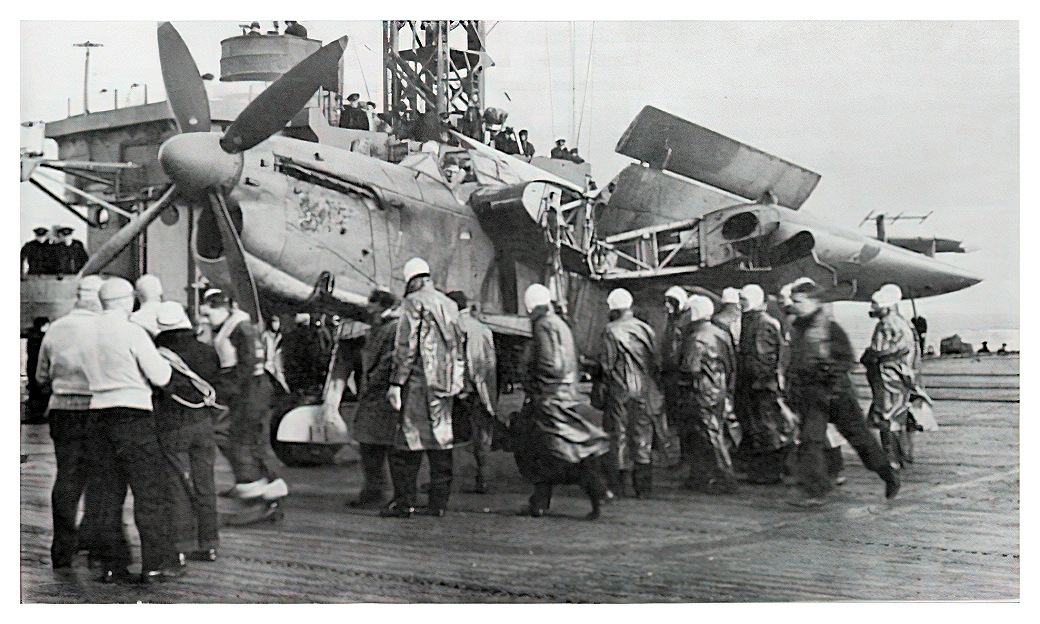 |
A Barracuda of No.821 squadron about to be
struck down into the hanger. A number of the squadron's
aircraft came aboard HMS PUNCHER f for a
period of deck landing practice and exercises at the end
of November 1944. |
At first light PUNCHER launched her Barracudas to fly ashore to RNAS Machrihanish before she accepted lines from two tugs which were to assist her to a suitable buoy. While attempting to secure to the Buoy the tow line parted from one of the tugs, the remaining tug could not check PUNCHER's momentum and the ship was out of control in the harbour until the mooring party finally snagged the mooring buoy. PUNCHER was to remain at his mooring for the next month as repairs got under way. On December 18th she was moved by tugs to Gareloch where she received the reduction gear assembly salvaged from her sister ship NABOB [2
Low Pressure Turbines
The first ten vessels to be modified by Burrards had defective Low Pressure Turbine Rotors which needed to be corrected. Repairs entailed the Turbine Rotor being removed and sent to the makers, Messrs. Allis Chalmers in Milwaukee, for partial re-blading, returned to Vancouver and refitted. On average this operation required at least four weeks. In later ships, including PUNCHER the alterations to the turbines were done by the U.S. Shipbuilders. NABOB received the corrected LP Turbine removed from EMPRESS meaning it was installed in three different CVEs.
]; she had been laid up at Rosyth since September after she was torpedoed off Norway, the ship being written off as beyond economical repair and cannibalised for spares. PUNCHER returned to her buoy on the 22nd and was pronounced ready for sea trials on Boxing Day 1944.
PUNCHER returned to active duty on December 30th 1944, re-embarking 821 squadron to resume their DLT and squadron work-up period; exercising the aircrews in
performing Attack Light Torpedo (ALTs), Attack Dummy Torpedo (ADTs) and Rocket Assisted Take-off (RAT0) procedures.
There were 5 deck crashes during the first nine days of 1945; the first was on January 2nd when MD835 piloted by the squadron’s senior pilot Lt. G. F. Cornish, the aircraft bounced into the barrier, the starboard wingtip hit the after searchlight platform and swung into the island. On the 5th Sub-Lt J. A. Wright, RNVR failed to lower the hook of MD839 and flew into the barrier. While making a night landing on the 8th Sub-Lt N. B. Cox, RNVR in MD846 drifted to port and rana wheel into the walkway. On the 9th Sub-Lt A. R. Jarvis, RNVR also put his aircraft, MD845, into a walkway during a night landing, this time the starboard walkway; on the same day Sub-Lt D. H. Slaney in MD836 landed with his hook up and crashed into the island.
On January 15th while steaming in the Cycled PUNCHER was called into action when a signal brought the news that a sister CVE,
THANE, had been torpedoed near the Clyde Light Vessel. Two Barracudas armed with depth charges were launched to investigate and were the first aircraft on the scene; they flew a defensive patrol over the stricken carrier for two hours, the crews also took photographs of her.
PUNCHER completed her exercise period on January 29th, the final day being curtailed by snow showers. The following day, while moored at the Tail of the Bank the ship received two important visitors, the Honourable Angus L. Macdonald, Canadian Minister of National Defence for Naval Services, and Vice-Admiral G. C. Jones, CB, RCN, Chief of the Naval Staff (Canada) who toured the ship before she left to commence her first offensive operation with the Home Fleet.
Operations with the Home Fleet: February 1st – April 13th 1945
PUNCHER left the Clyde for Scapa Flow on January 31st accompanied by her escorts, HMS TOWEY and HMCS IROQUOIS, arriving on February 1st. A detachment of 4 aircraft was put ashore to
RNAS Hatston on the 5th re-joining on the 10th; on the 9th a new squadron, the Wildcats of 881 squadron flew on board from
RNAS Skeabrae to provide fighter cover for the upcoming operation.
Operation SELENIUM I & II February 12th - 13th 1945: PUNCHER put to sea on the 11th for her first operation with elements of the Home Fleet, strikes against shipping off Norway, operation "SELENIUM" I & II. The ships sailed in two forces to conduct two strikes, the first involving both Forces, the second being conducted by Force 2 alone. Force 1 comprised the Cruisers NORFOLK and DIDO with a destroyer screen of MYNGS, ZAMBESI and SAVAGE. Force 2 comprised the Cruiser DEVONSHIRE, escort carriers
PREMIER (856 Sqn, 8 Avenger & 8 Wildcat) and PUNCHER (821 Sqn, 9 Barracuda & 881 Sqn, 12 Wildcat), destroyers CAVENDISH, CAVALIER, SCOURGE, and ZEBRA.
On the night of the 11th Force 1 was prepared for phase one, a night shipping strike off Bud, aircraft from Force 2 conducted searches but no targets were found and the force withdrew. The following day phase two was carried out by Force 2, 7 Avengers from
PREMIER and 9 Barracudas from PUNCHER, escorted by Wildcats from both carriers carried a successful aerial mine laying sortie in Skatestraumen. This mission was particularly difficult as the channel to be mined was extremely narrow between 3,000ft cliffs; one Avenger was forced to return to
PREMIER with an oil leak and one failed to release its mine.
There were two deck landing crashes on PUNCHER on return from the mission, both involved Wildcats of 881 Sqn; JV693 ('UR') flown by Sub-Lt A. P. Berry, RNVR drifted into the starboard catwalk and JV715 ('UG') flown by Sub-Lt R. P. Gibson, RNVR landed into the sun and the trail hit the rounddown, broking off the tail wheel and arrester hook, the impact caused the aircraft’s guns to fire as it continued on into the barrier. The rounds wounded 3 members of the deck party and badly damaged Barracuda MD839 in the aircraft park. Force 2 withdrew to Scapa Flow once all aircraft were recovered.
All serviceable Barracudas were flown ashore to
RNAS Hatston on February 13th and the Wildcats to
RNAS Skeabrae on the 14th while the ship remained moored in the flow preparing for her next operation. The respite was short lived however as both squadrons were re-embarked on the 17th.
Operations SHRED and GROUNDSHEET February 21st - 23rd 1945: On February 21st
PREMIER (856 Sqn, 8 Avenger & 8 Wildcat) and PUNCHER (821 Sqn, 9 Barracuda & 881 Sqn, 12 Wildcat) put to sea again as part of Force 4 operating with the Cruiser DIDO and Destroyers CAVALIER, MYNGS and SCORPION as escorts to conduct two concurrent operations "SHRED" was a minesweeping run through a suspected German minefield off Stavanger by vessels of the 10th Minesweeping Flotilla, HM Ships COURIER, JEWEL, SERENE, WAVE, HARE, and GOLDEN FLEECE. The Minesweepers supported by Force 4 sailed in the early hours of February 21st. The operation was successfully carried out although no mines bobbed to the surface.
Operation "GROUNDSHEET" commenced in the forenoon of February 22nd, this operation was another aerial
mine laying sortie. This time the Barracudas of 821 squadron were carrying the mines while Wildcats from both carriers provided the escorts and top cover; nine Barracuda MK IIIs fitted with Rocket Assisted Rake-off Gear (RATOG) and eight Wildcats were launched from PUNCHER, and a further eight Wildcats from
PREMIER.
The planes made landfall over the heavily defended town of Stavanger instead of their intended waypoint of Utsire as a result of this navigation error the minelayers and the fighters lost each other. Two Barracudas were shot down by German flak killing both crews; MD846 Pilot Lt. Payne, Observer Sub-Lt D. M. King, RNVR & Leading Airman H.J. Brooks, and MD838, Pilot Lt. L. W. E. Maffey, RNZNVR, Observer Sub-Lt J. B. Watson, RNVR & Leading Airman N. F. W. Smee. The remaining seven successfully laid their mines in Karmoy Channel. The fighters destroyed a Dornier 24 flying boat at its moorings and strafed two silo type buildings on the waterfront at Stavanger. After recovering aircraft the force withdrew and headed for Scapa.
All serviceable aircraft were flown ashore on the 24th, 821 Sqn to
RNAS Hatston and 881 Sqn to
RNAS Skeabrae. Later that day PUNCHER was riding at anchor in Scapa when she started to drag into her anchor. Attempts to arrest her drift were made, including letting go a second anchor, owing to the proximity of the ship to anti-submarine defences (baffles) she was unable to work engines. The wind strengthened throughout the day and had reached gale force by midnight, and the ship had passed over the underwater 'baffles', when the weather had moderated enough for divers to enter the water on the 26th her rudder and propeller were examined and were found to be undamaged.
On March 4th PUNCHER was visited by two of the
Royal Navy's first helicopters in squadron service, Hoverfly FT836 ('A') and
KK971 ('G') from 771 Squadron at
RNAS Twatt, these two machines had been fitted with floats for trials with HMS Furious. KK971 ('G') suffered an engine fire shortly after two machines departed from PUNCHER, the pilot, Sub-Lt J. A. Gray, RNVR made a heavy water landing but the aircraft sank in Scapa Flow despite being fitted with floatation pontoons. This machine had earlier given a short flight to PUNCHER's Commander (Flying) Lt. Cdr Godfrey.
|
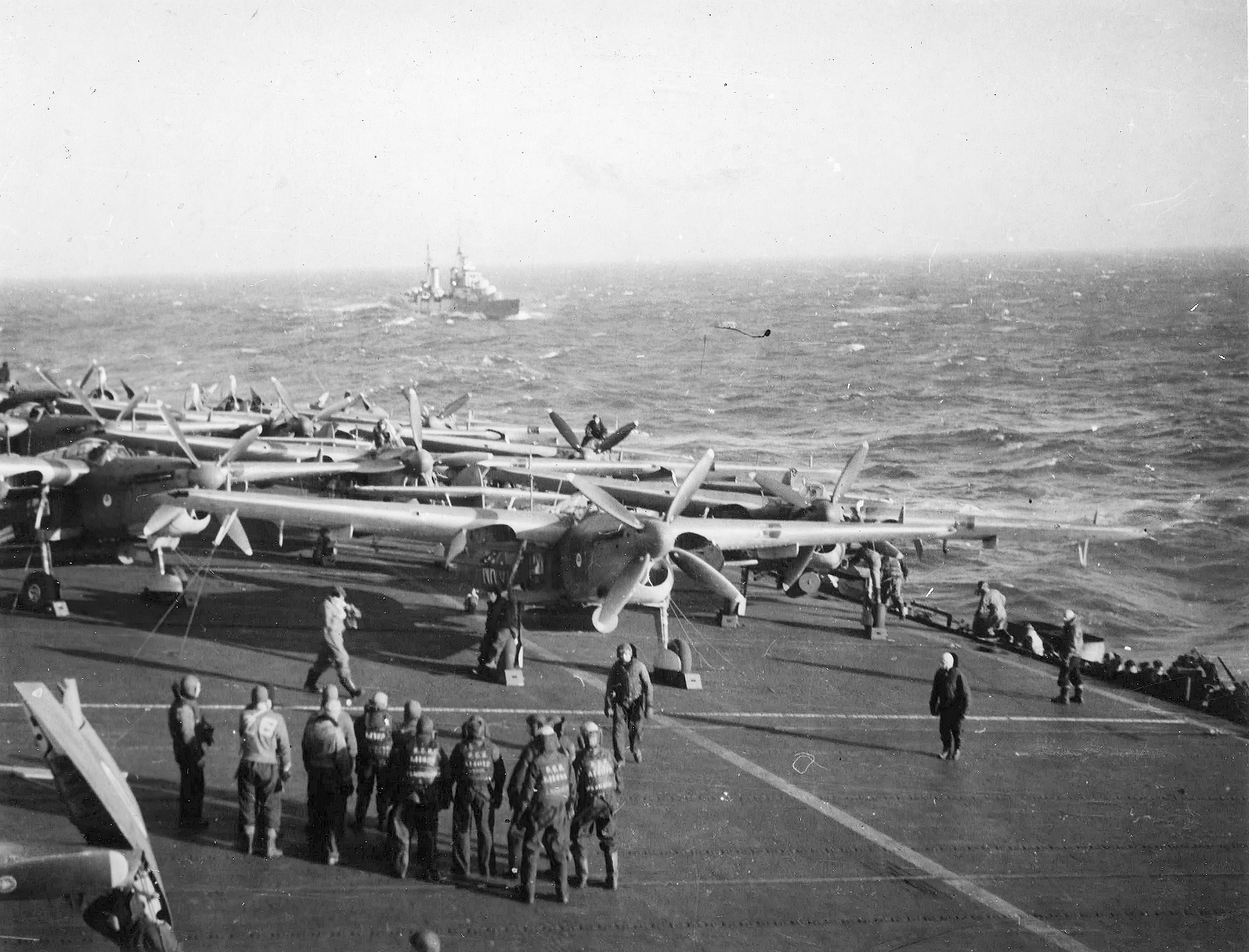 |
Barracudas of 821 squadron lashed to the deck as the
ship prepares to begin launching her aircraft in rough
seas. |
A detachment of 4 Barracudas re-joined the ship on March 15th for a period of day and night deck landing practice. On the 15th Lt. G. F. Cornish caught No.8 wire landing in MD837 ('F') and the prop struck the barrier, that evening Lt. R. C. Munday in MDI10 damaged the arrestor hook frame during a nught landing, the hook had bounced off the deck on touchdown. Sub-Lt R. A. K. Stewart, RNVR landed ME114 wheels up after suffering hydraulic failure during a night DLT session. The whole of 821 Sqn re-embarked on the 23rd in readiness for her next deployment, Operations MUSCULAR and PREFIX.
Operations MUSCULAR and PREFIX March 24th – 28th: This set of concurrent operations called for day and night strikes against enemy shipping on the Norwegian coast: MUSCULAR was a night strike in the Leads between Stadlandet and Bredsund while PREFIX I called for a day strike in the Leads between Trondheim Fjord and Kristiansund North and PREFIX II a second day strike if targets were located.
Force 2, comprising of the Escort Carriers
SEARCHER ((Flag CS 1) 882 Sqn, 20 Wildcat), PUNCHER (821 Sqn, 9 Barracuda & 12 Wildcat),
NAIRANA (835 Sqn, 14 Swordfish & 6 Wildcat) ,
QUEEN (853 Sqn, 8 Avenger & 8 Wildcat), Cruisers BELLONA and DIDO, Destroyers ONSLOW (D 17), SERAPIS, CARYSFORT, ZEST, ZEALOUS, HAIDA (RCN), and IROQUOIS (RCN) sailed from Scapa on March 24th.
On reaching the operational area on the morning-of the 26th the weather was marginal, however PREFIX I commenced with a strike by aircraft from
QUEEN and
SEARCHER; 9 Avengers, each armed four 500lb bombs, and 4 Wildcats (top cover) from 853 Sqn escorted by 19 Wildcats from 882 Sqn to attack shipping in Trondheim Leads and North Kristiansand. As they approached the coastline at 300 feet, conditions were better and two ships, as a tanker escorted by a minesweeper, were staffed by two flights of Wildcats. The force was intercepted by a group of eight or ten Messerschmitt Bf 109Gs which were engaged by two flights of Wildcats which shot down three and damaged two others. The Avengers in the strike package found no suitable targets so they had to jettison their bombs and return to the fleet. One of
PUNCHER's Barracudas, MD837 ('F') failed to return from an A/S patrol ahead of the force, Lt. G. F. Cornish, Sub-Lt E. J. Tracey, RNVR & Petty Officer
Airman A. G. Sumner were all killed.
MUSCULAR was to have commenced on the night of the 26th, a night strike by
NAIRANA; s Swordfish against targets in the Leads between Stadlandet and Bredsund but bad weather forced this part of the operation to be cancelled. The bad weather continued throughout the 27th and the task force remained off the coast waiting for it to clear.
PREFIX II was carried out in slightly better weather on the 28th when 15 Wildcats from 882 Sqn launched to strike targets at Aalsund, 7 of these aircraft were fighter bombers each carrying 2 2501b SAP bombs. The strike was led through rain, sleet and poor visibility by a single Firefly Night Fighter from 764 Sqn specially embarked in
NAIRANA for this operation. A low level attack was made on 2 merchant ships seen alongside a quay but no hits were observed. As they withdrew the fighters strafed a W/T station on Vikero Island leaving it burning. Once all aircraft had landed on the force withdrew to return to Scapa. ON arriving back at Scapa ion the 29th 821 squadron was disembarked to RNAS Hatston.
Operation NEWMARKET April 6th – 12th: HMS PINCHER was next at sea on April 6th for Operation NEWMARKET part powerful force which included four CVEs, PUNCHER,
QUEEN,
SEARCHER, and
TRUMPETER, Cruisers BELLONA, BIRMINGHAM, and eight destroyers. For this operation PUNCHER had a detachment of Barracudas and the 8 Wildcats of 825X fighter flight. This was an abortive mission to attack on U-boat depot ships at Kilbotn on April 7th; bad weather at flying off position prevented the strike taking place but the force steamed back and forth for five days in squalls and mountainous seas before the operation was finally cancelled.
This was to be PUNCHER's last offensive operation; after arriving back at Scapa Admiral McGrigor visited the ship and inspected the carrier before taking the salute at a march past on flight deck. 821 squadron flew off the ship for the last time on April 13th, disembarking to
RNAS Hatston, the Wildcat’s of 825X going to
RNAS Grimsetter. . A short period of catapult trials was undertaken on the 18th using Wildcat JV653 of 853 Squadron before PUNCHER sailed for the Clyde escorted by HM Destroyers SAVAGE and SCOURGE for boiler cleaning, arriving there on April 21st.
A period of Deck Landing Training Duty: May – June 1945
PUNCHER was in dry dock near Glasgow on May 8th, Victory in Europe (VE) Day. The Victory celebrations caused some delay and the ship was not undocked until May 11th when she proceeded down river for trials. On her return to active duty PUNCHER was allocated to Rosyth Command on May 13th, coming under the administrative control of the Flag Officer Carrier Training (FOCT) from the 15th. She was to spend the next five weeks giving deck landing practice and on training exercises off the Isle of Man and in the Irish Sea for two Firefly night fighter squadrons which were working up in the UK for operations in the Far East. PUNCHER anchored between exercises off Douglas, Isle of Man, and later off Bangor, Ireland.
The first session was with 1790 squadron from
RNAS Burscough commencing on May 24th and ending on the 30th. Tragically on the first day DK443 struck the rounddown with its tail wheel and hook, the hook parted and the barrier failed to halt its momentum and the aircraft went over the bow into the sea. The ship's crash boat sped to the scene and picked up the two-man crew, the pilot Sub-Lt E. B. A. Everett, RNVR was OK but unfortunately his observer Sub-Lt. P. Cariss, RNVR who was seen exiting aircraft wearing his life vest, was found to be drowned when the boat reached him. The squadron had only one other incident during this training period, Mb499 flown by the squadron C.O. Lt-Cdr J. H. Kneale touched down between two wires making a night landing on the 30th and entered the barrier; this aircraft was jettisoned overboard in Morecambe Bay.
|
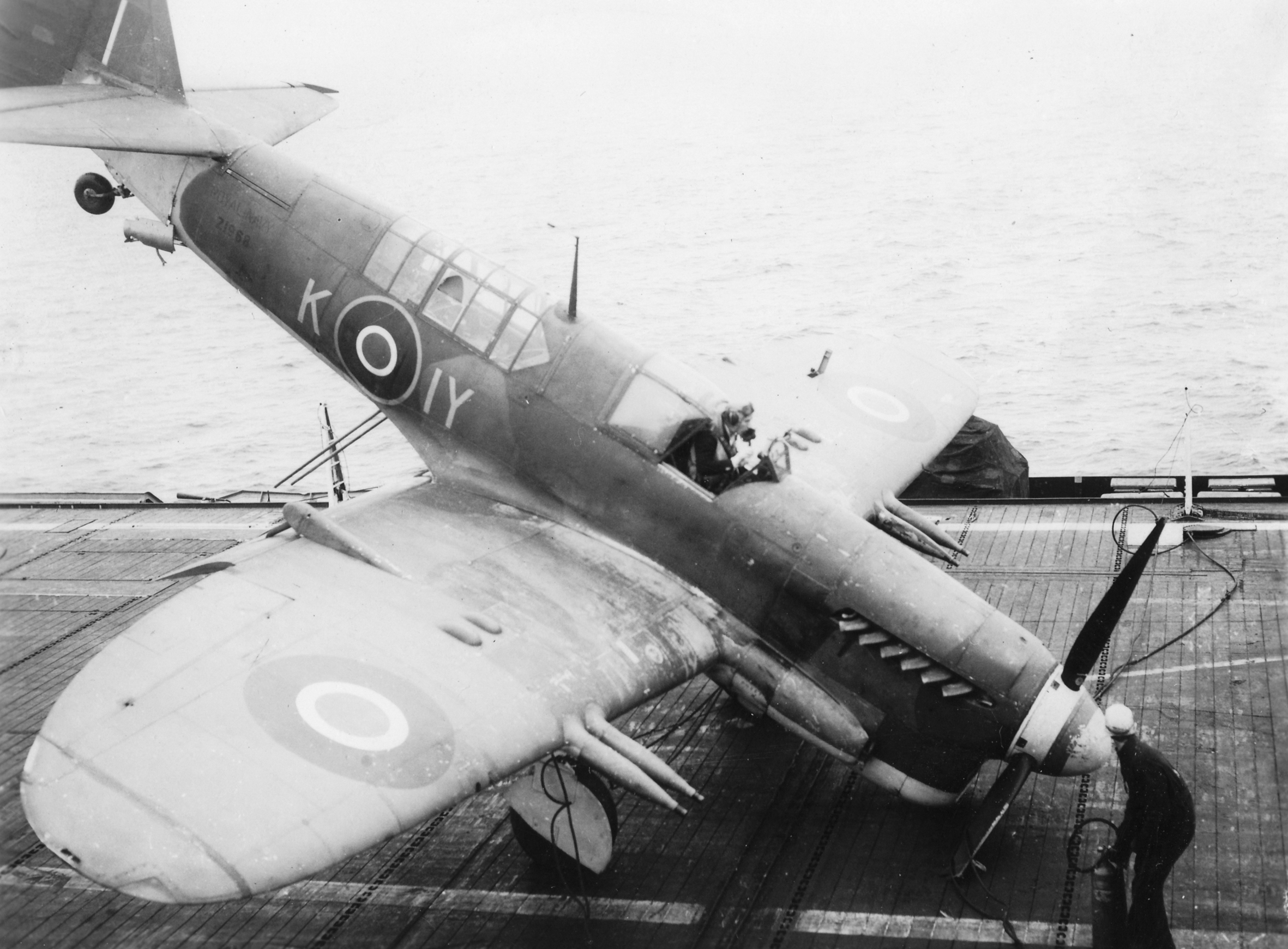 |
June 11th 1945: Firefly Z1968 (K-1Y) of 766 Deck
Landing Training squadron seconds after entering the
crash barrier - the aircraft struck the rounddown on
landing and the arrestor hook was torn off ; Unable to
go around again the aircraft entered the barrier.
|
No. 1791 squadron embarked on June 11th to begin their, shorter, DLT period which concluded on the 13th,
flying out from
RNAS Inskip. There were three landing accidents during this session; on the 11th Sub-Lt A. B. Bellenger, RNVR in Z1968 made a low approach and his tail oleo hit the rounddown, the arrester hook pulled out and the aircraft hit the barrier. On the 12th Sub-Lt G. Hardaker, RNVR in Z1878, landed with drift, to port causing port oleo damage, and Sub-Lt W. D. Hodgson, RNVR MB410 suffered starboard wing, stall over the deck and the starboard oleo collapsed.
By the middle of June PUNCHER had completed her second period of deck landing practices and was ready for her next role. The training period was very rewarding and both squadrons had reached a high standard of efficiency.
Reallocated to trooping Duties: July – August 1945
With the war in Europe over and the fleet requirement for CVEs in the Far East being met there was no offensive role for PUNCHER, when her tour as a training carrier ended in mid-June 1945 it was decided that she was to be converted for trooping duties. Work began almost as soon as the ship moored at the Tail of the Bank; the hanger deck and workshops were cleared and workmen converted the workshop spaces into bathrooms. Temporary accommodation was provided in the hanger and squadron cabins for 491 naval personnel, including fifty members of the Women's Royal Canadian Naval Service, for passage to Halifax, Nova Scotia. These were men who volunteers for the British Pacific Fleet and were entitled to leave in Canada before going out to the Far East.
PUNCHER was the first CVE to be converted for trooping duties, but she received only minimal alterations to outfit her for trooping in the North Atlantic; several months later the Admiralty began a programme to convert 6 other CVEs ATHELING, FENCER, QUEEN, PATROLLER, RAJAH, and RANEE, for long haul trooping in tropical climates.
The ship arrived in Halifax on July 3rd and was to spend eleven days alongside while the ship's company was reduced to a ferrying complement. An engine fault was discovered while alongside and it was decided that it would require a US naval dockyard to correct this; PUNCHER was ordered to proceed to Portsmouth Naval dockyard, Virginia for repairs on July 14th, arriving there on the 16th. After completing the repairs the ship moved to the US Navy Operating Base at Norfolk to embark passengers and a ferry load of aircraft as deck cargo, these were mostly fleet air arm machines from training squadrons which had been operating at US naval air stations on the US east coast. On completion of loading she sailed from Norfolk on July 30th for New York to embark more passengers.
PUNCHER left New York on her return trooping voyage to the Clyde on August 3rd, making one brief detour off the coast of Ireland on the 10th when a signal was monitored ordering a frigate to the scene of a ditched Halifax bomber. The ditched plane was 130 miles to the north of the ship's position and the captain decided he could render assistance, after informing the C-in-C Western Approaches PUNCHER immediately increased to full-speed and changed course. Upon arriving in the area at 15:00 it was found that the 5,300 ton merchantman SS JAMAICA PRODUCER had already rescued the six-man crew an hour before PUNCHER arrived. The survivors were transferred to PUNCHER and the ship resumed course for the Clyde where she docked at King George V. docks in Glasgow on the 11th.
Further modification for extended trooping duties
The Japanese surrender, and the end of World War Two, came while PUNCHER was alongside at King George V docks in Glasgow having unloaded her cargo of planes and disembarked her passengers. With the war now over the Canadian government approached the Admiralty asking for PUNCHER to be employed as a troop ship for ferrying Canadian forces home for demobilisation. The scheme was approved and PUNCHER passed down the Clyde to Greenock where further work commenced on the ship to equip her to accommodate more passengers. Additional two-tier metal bunks were brought from the RCN barracks at HMCS NIOBE at Greenock, and were welded on the metal hangar deck. These modifications enabled the ship to accommodate five hundred troops in addition to her ferry crew.
Second trooping voyage: PUNCHER Sailed for her second trooping run to Halifax carrying personnel from all three branches of Canada's armed forces on August 28th, arriving in Halifax on September 4th. After unloading and local leave PUNCHER sailed for the Clyde via New York departing Halifax on September 18th, arriving at Greenock on the 25th.
Third trooping voyage: She sailed from the Clyde on October 8th arriving at Halifax on the 14th. At Halifax Stores and personnel for the new Canadian light fleet carrier, HMCS WARRIOR, came aboard for passage to Belfast where she was being built. PUNCHER sailed for Belfast via New York on the 26th. After stopping off in Belfast on November 2nd to off load the men and stores for HMCS WARRIOR the ship moored on the on the Clyde to await her forth trooping complement.
Forth trooping voyage: Once loaded PINCHER departed the Clyde on November 11th bound for New York. This was to be a stormy passage; the ship was forced to heave to on the 14th when the wind speeds reach Force 10, increasing to a full blown gale two days later. The ship suffered some structural damage as a result of plunging into high seas, the forward end of the flight deck and the structure beneath it were buckled from a few, exceptionally high waves breaking over the bows. After a brief stop in New York the ship reached Halifax on November 18th.
Departing from Halifax on November 24th PUNCHER arrived at New York on the 25th to embark more passengers before sailing for the Clyde on the 28th On December 9th 1945 PUNCHER arrived on the Clyde for the last time, after disembarking her passengers she began preparing for her fifth and final west bound trooping voyage to Halifax.
Fifth trooping voyage: PUNCHER sailed from the Clyde on December 14th for Halifax; on this trip she passed through more severe gales which battered the ship, and delayed her arrival at Halifax by forty-eight hours. She secured alongside at Halifax on December 23rd just in time to give her Canadian crew Christmas leave. During her four months as a trooping carrier PUNCHER transported 3,665 men and women West-bound and 1,595 made the return trip to the United Kingdom.
|
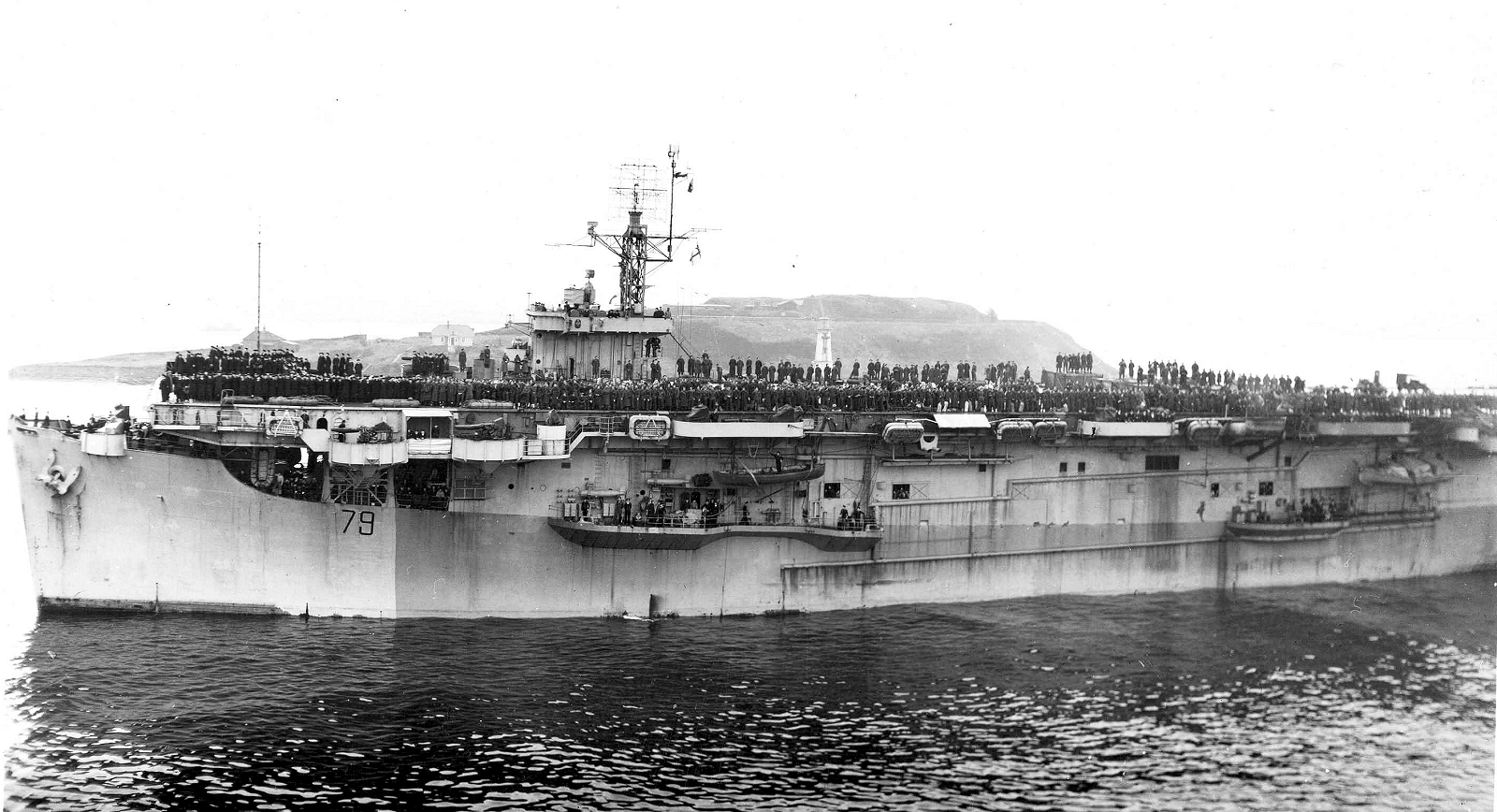 |
HMS PUNCHER arrives at Halifax November 18th 1945. |
Departing from Halifax on
November 24th PUNCHER arrived at New York on the 25th to embark more
passengers before sailing for the Clyde on the 28th On December 9th 1945
PUNCHER arrived on the Clyde for the last time, after disembarking her
passengers she began preparing for her fifth and final west bound
trooping voyage to Halifax. PUNCHER sailed from the Clyde on December
14th for Halifax; on this trip she passed through more severe gales
which battered the ship, and delayed her arrival at Halifax by
forty-eight hours. She secured alongside at Halifax on December 23rd
just in time to give her Canadian crew Christmas leave. During her four
months as a trooping carrier PUNCHER transported 3,665 men and women
West-bound and 1,595 made the return trip to the United Kingdom.
Disposal: Return to US Custody
After destoring ship at Halifax HMS PINCHER began her final voyage as a Royal Navy vessel on January 6th 1946 when she set sail for Norfolk, Virginia. On January 16th 1946 the White Ensign was lowered for the last time, and CVE 53 was transferred back to the custody of the United States Navy.
CVE 53 was stricken for disposal on March 12th 1946 and was subsequently sold to the Lancashire Shipping Co Ltd for conversion to a merchantman. She entered service in 1948 as 'MUNCASTER CASTLE'. The vessel was chartered by the Shaw Savill & Albion line in 1954, and was renamed 'BARDIC'. In 1957 the 'BARDIC' was sold to the Ben Line, her charter with the Shaw Savill & Albion line continued until 1959, when she was re-named 'BEN NEVIS' by her owners. She was scrapped at kaohsiung, Taiwan in June 1973.
|
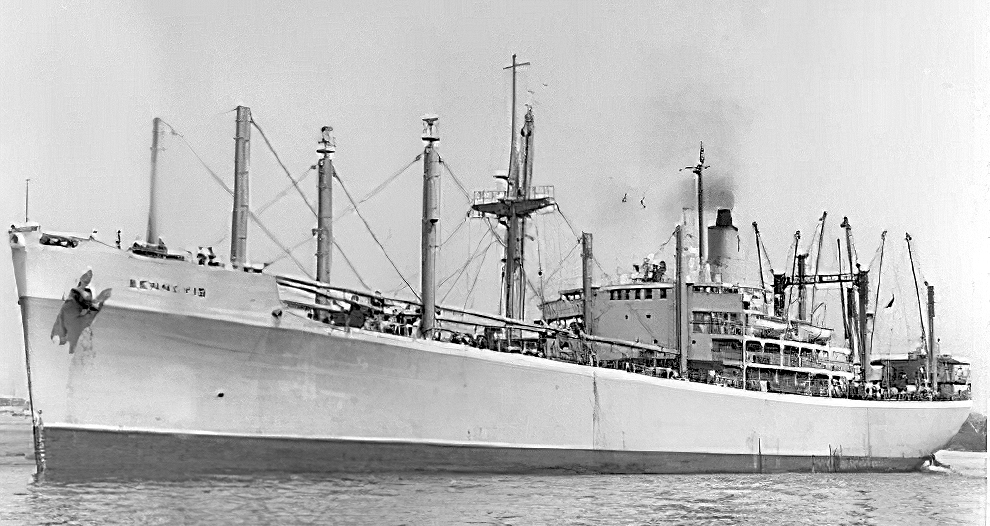 |
The S.S. BEN NEVIS |
Content revised:
21 July 2024
Sources used in compiling this account:
Click here for a list of
Primary sources
Additional sources:
Outerbridge, :.M., (uinknown) 'H.M.S. Puncher'
Regins, Outerbridge
Fold3.com various documents including;
Admiralty War Diaries
US Naval Station, Seattle, Washington
US Naval Station, Manchester, Washington
Puget Sound Navy Yard War Diaries
US Thirteenth Naval District War Diaries
Norfolk Navy Yard War Diaries
Mew York Navy Yard War Diaries
Miscellaneous documents
|
Home
page |
go to the top
|



Comments (3)
With my Mother and Brother we sailed from New York to the Clyde on the 28th November 1945 arriving in Scotland on the 9th December. I had my 2nd birthday on board 2nd December 1945.
My step grandfather Flt Sgt Reg Jackson seated front and far left had this picture that he left to my dad (stepson) who then left that picture to me.
I took the old picture frame apart and on the back of the 'HMS Puncher' picture is the stamped date JUNE 5 1944 - PHOTOGRAPHIC SECTION HMS PUNCHER which helps me with timelines of vessel in San Francisco and thought the info may be of use to you as well.
Pictures attached for reference.