A History of HMS REAPER
|
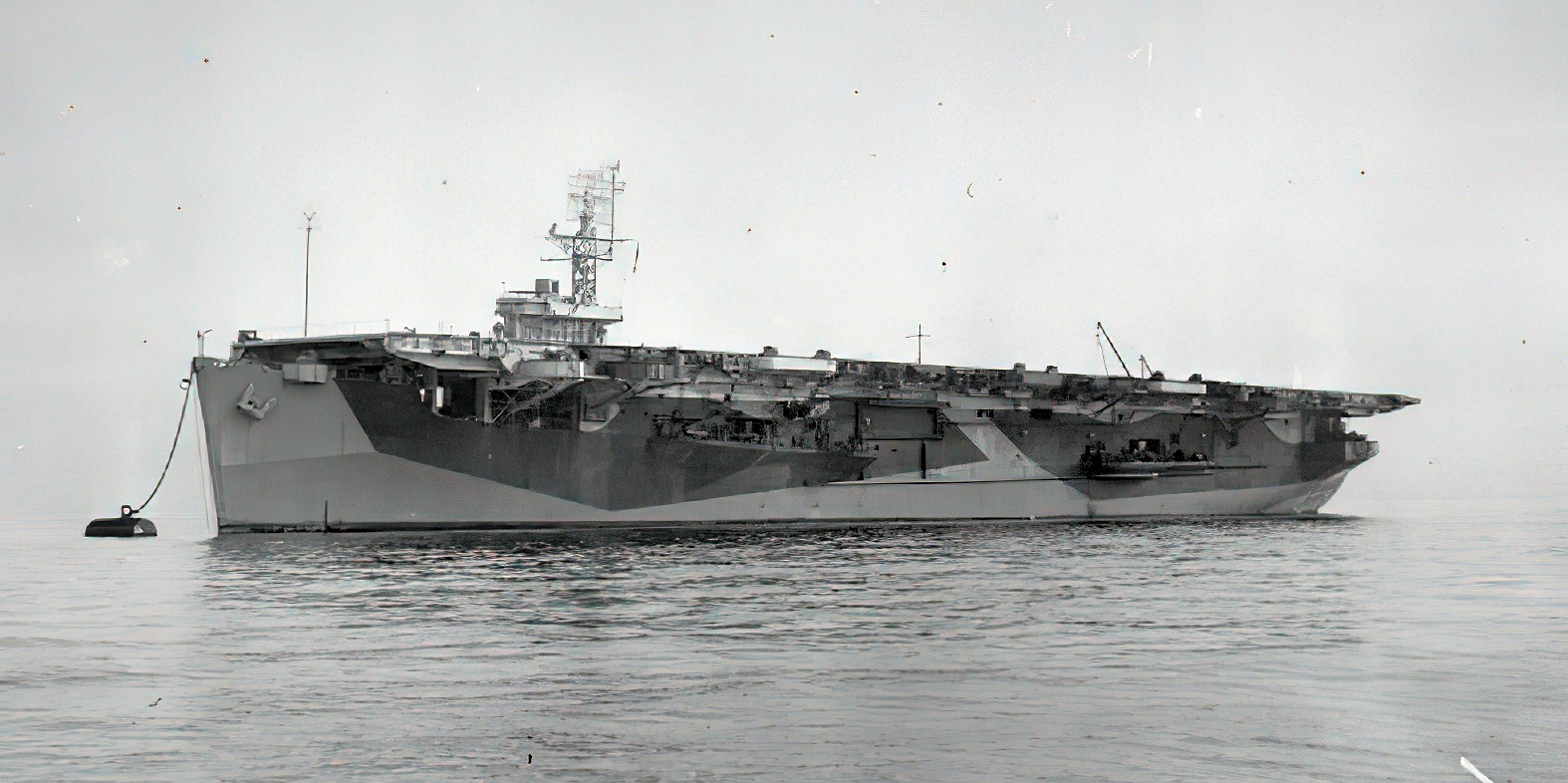 |
HMS REAPER moored at Greenock.© IWM (A 25715) |
HMS REAPER was an 'Ameer' class escort carrier, her keel was laid down June 5th 1943, at Seattle-Tacoma Shipbuilding Co. Tacoma, Washington, a Maritime Commission C3 type freighter hull number 49; the hull was purchased by the US navy to become the auxiliary aircraft carrier USS WINJAH, AVG-54.
On June 23rd 1943 whilst still under construction it was been decided that CVE 54 was to be transferred to the Admiralty on her completion as an aircraft carrier under the Lend Lease agreement. Her USN designation was changed to CVE-54 from July 13th 1943. She was launched on November 22nd 1943.
Upon her delivery on February 18th 1944 she was accepted on behalf
of the US Navy by Captain J. L. McGuigan, USN Supervisor of
Shipbuilding at Tacoma and was transferred to the Royal Navy on the
same day. She was accepted on behalf of the Admiralty by Captain
J.F.H. Sawyer RN, as her commanding officer and commissioned into RN
service as HMS REAPER (Pennant number D82) three days later.
Modification and preparation to enter service:
After completing her builder's sea trials and Admiralty acceptance tests HMS REAPER proceeded to Vancouver, Canada to be modified to meet Admiralty requirements, receive her full crew compliment, and work up ready for beginning her active service. This work was undertaken by the Burrard Dry Dock Co. Ltd., North Vancouver, British Columbia. Electrical work was sub-contracted and completed by Hume & Rumble.
REAPER was the sixteenth of nineteen escort carriers to be modified by Burrards, and she arrived at Vancouver at on February 26th and was moored in the stream. At this time sister CVEs
RAJAH,
SMITER,
ARBITER,
TROUNCER and
PUNCHER were in the hands of the Burrard's yard and at various stages of modification. Work commenced to de-store and de-ammunition the ship before she was moved to number 8 berth at Lapointe Pier on March 21st in preparation for her alteration work to begin on the 31st. this work totalled 150 separate modifications and included lengthening of the flight deck, fitting redesigned flying controls and fighter direction layout, modifications to hangar, accommodation and store rooms, installing extra safety measures including major changes to the aviation fuel stowage and oiling at sea arrangements,, modifying gunnery and other internal communications, adding extra W/T and R/T sets, and improved darken ship arrangements. She also received 338 tons of pig iron as additional ballast.
As work progressed REAPER progressed through the yards various berths; the yard could be working on six different ships at any time with separate aspects of the work carried out at different berths, the ships passing through like a production line, moving from one berth to another until complete. REAPER moved to No 3 on March 1st, then to No 4 on March 16th and to No. 5 on May 9th where her alterations were completed on May 23rd. She was moved to a mooring in the stream the following day.
|
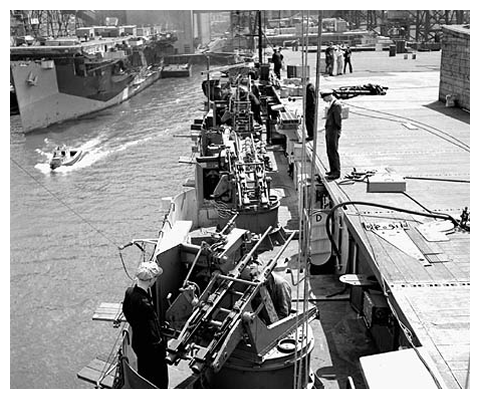  |
HMS PATROLLER in no.3 berth at Burrards dockyard,
Vancouver, (third week of May 1944). HMS THANE is in the
left foreground occupying no. 4 berth with HMS REAPER
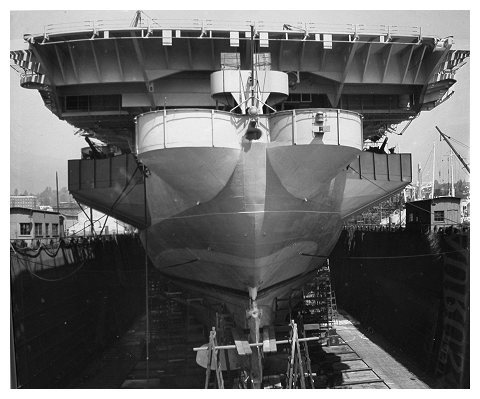
just visible behind her in no. 5 berth. Right: A CVE
(possibly REAPER) in the Burrards floating dry dock at
the end of the modification process. This image shows
just how 'top heavy' these merchant conversions were.
Photos: Ronny Jaques / National Film Board of Canada.
Photothèque / Library and Archives Canada. Thanks to
David Weaver for photo interpretation |
On Thursday May 25th the ship was placed in Burrard's floating dry
dock for the fitting of Asdic equipment and sea cocks. A member of
REAPER's crew was died on this date, Able Seaman Thomas J HOLLAND,
D/JX 208349, is recorded as having died of wounds.
She was un-docked on the 27th and returned to berth No.7 to store ship and began preparing for her work up and post modification shakedown. Her modifications had taken a total of 55 days to complete. She returned to her mooring in the stream on May 31st. While at this mooring REAPER received her first aircraft - a non-airworthy Blackburn Shark given to the RN on free issue for use in training the aircraft handling parties, prior to their receiving squadron or ferry aircraft. The Shark was ferried out to the ship by lighter from No. 3 Repair Depot RCAF were her floats had been substituted for wheels. This was one of five airframes to be handed over to RN escort carriers for this purpose, and they were issued to PATROLLER, PUNCHER, RANEEE, REAPER and THANE. [These five ships also had a longer modification timetable than the other 14 vessels to pass through Burrard's dockyard; the Admiralty decided that all of the single Oerlikon mounts on the Gallery deck and foc'sle deck, were to be changed to twin mountings, an extra ten days being allocated for this work to be completed.]
At the beginning of June REAPER moved to the Royal Canadian Naval Base at Esquimalt to prepare for her post modification shakedown and work up. She made a round trip to the Puget Sound Naval Shipyard, Bremerton Washington, to ammunition the ship, anchoring in Sinclair Inlet at 10:07 on June 5th. On completion of loading ammunition, she sailed for Manchester, Washington, arriving at Orchard Point to refuel at 08:00 on June 8th. She departed at 06:00 the following day for the Straits of Georgia (between Vancouver Island and the mainland), for steaming, gunnery, radar and other trials and exercises. On her return to Esquimalt where she embarked Confidential Books and more stores.
|
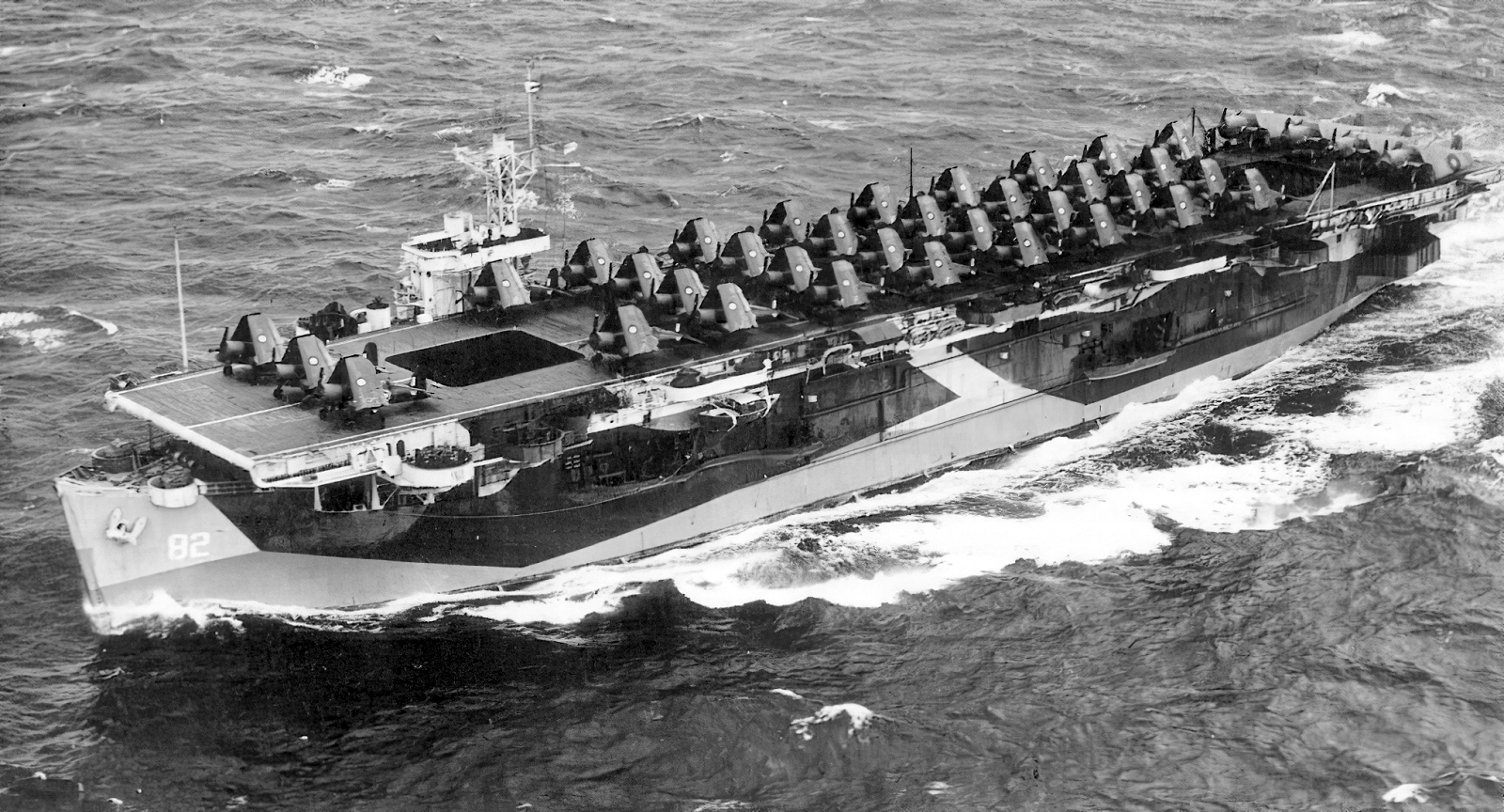 |
HMS REAPER on
her maiden Atlantic crossing. She is carrying a ferry
load of Lend-lease aircraft, there are 26 Corsairs and 4
Avengers on her flight deck. |
Maiden voyage: Ferry trip to Liverpool
HMS REAPER departed from Vancouver on her maiden voyage to the UK in mid June calling at San Francisco, Norfolk, and New York. On arrival at San Francisco additional communications equipment was fitted to the bridge and combat communications room and further stores were taken aboard. She sailed for Balboa on the June 22nd to pass through the Panama Canal and on to the Naval Operating Base at Norfolk Virginia, arriving there at 17:50 on July 10th. The Blackburn Shark airframe was jettisoned at sea at some point before she reached Norfolk to clear the ship in preparation for taking on board a full ferry load of Lend Lease planes for delivery to the UK.
Loading completed REAPER sailed at 06:10 on the 21st bund for New York where she was to form part of convoy CU.33. This convoy sailed from New York for Liverpool July 26th. On reaching the western approaches on August 4th REAPER and the U.S. Army transport the USS GENERAL J. R. BROOKE detached from the convoy at 18:25 escorted by the Destroyer USS IRA JEFFERY and headed for the Clyde to unload her ferry load. On August 5th, after unloading she was taken in hand for repair in a Clyde commercial shipyard and further modifications, including changes to petrol distribution system, were carried out.
Ferry voyage UK to Gibraltar
On leaving the dockyard REAPER embarked aircraft for transport to Gibraltar Joined outward Convoy KMF.34 in NW Approaches on August 25th for passage to Gibraltar. On arriving at Gibraltar REAPER left the convoy. Which continued to Port Said, on the 31st and began unloading. Once unloaded REAPER waited at Gibraltar for the return Convoy MKF.34, which she joined on September 10th and arrived back on the Clyde on the 14th. REAPER's immediate tasking was to be an aircraft transport and she was allocated for service as Ferry Carrier on her arrival back in the UK.
Ferry voyage Norfolk to Gibraltar
REAPER next sailed in Convoy UC.39A which depart from Liverpool on September 27th 1944, she detached off New York on October 7th to proceed to Norfolk to embarked more aircraft for delivery to Gibraltar. He5r ferry load included at least 27 Corsairs and 4 Hellcats as deck cargo with other airframes and equipment stowed in her hangar; on completion of loading, she sailed from Norfolk t on October 14th to join with the Naples bound Convoy, UGF.16. REAPER detached from the convoy at 07:55 on October 25th escorted by the Destroyer USS MERVINE and proceed into Gibraltar harbour. The return leg was with the returning US bound convoy GUF.15B from Naples which REAPER joined on November 1st; she detached from GUF.15B at 14:00 on the 13th and made independent passage to Norfolk, arriving on November 16th.
Ferry voyage Norfolk to UK
On the 17th REAPER embarked the aircraft and the personnel of two Corsair squadrons, 1849 NAS (18 Corsair IVs) and 1850 NAS (18 Corsair IVs) for transport to UK; These squadrons had formed and worked-up in the U.S. and were to voyage to the UK for further training and to be allocated to a carrier for combat operations. In addition, REAPER embarked a mixed load of airframes Including 2 Grumman Tigercats, twin engine single seat fighters, for evaluation by the Fleet Air Arm. These two aircraft were parked on the flight deck forward of the Island since they were too large to fit in the hanger even though the outboard wing sections folded for carrier operations.
She sailed from Norfolk and proceeded to New York arriving on November 19th and secured alongside at the 35th Street Pier, Brooklyn at 15:25 to embarked more aircraft and passengers. While there she received voyage repairs carried out by workers from Bethlehem Stell Co. based at 56th Street Brooklyn. Her repairs and loading were completed by mid-day on the 23rd and she sailed to join Convoy CU 48 for the Atlantic crossing to the UK. On reaching the Western Approaches REAPER detached and proceeded to Belfast arriving there on December 6th to disembark 1849 & 1850 squadrons. REAPER proceeded to the Clyde the next day to await orders.
|
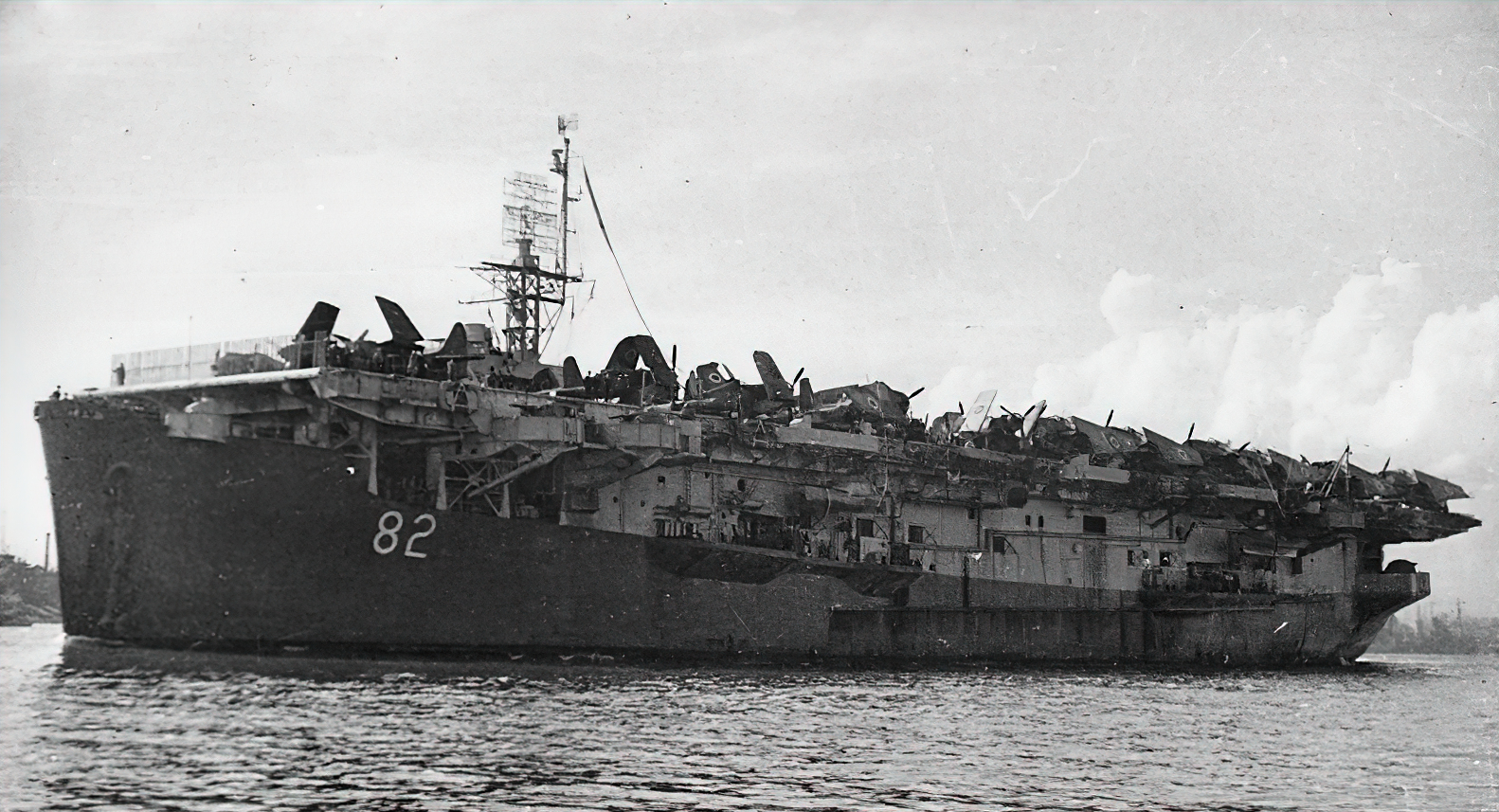 |
HMS REAPER on
the Clyde December 7th 1944 waiting to disembark her
ferry load, a Grumman Tigercat can be seen forward on
the flight deck. |
Loaned to the US Navy as a ferry carrier
On December 9th the ship was involved in a collision with the 1,4140 ton Dutch Troopship TEGELBURG on the Clyde; the damage was serious enough to warrant a short spell in the hands of a Clyde dockyard. While under repair orders were received that REAPER would be loaned to the US Navy for use as a ferry carrier in the Pacific.
On returning to active-duty REAPER sailed for San Diego, California via the Panama Canal. Departing on January 5th 1945, she joined Convoy UC.51B for the crossing to New York and then detached from the convoy at 15:15 on the 12th escorted by the USS BRNUGH (DE-148) to proceed independently to the Canal. At 10:25 on January 14th REAPER narrowly avoided another collision; a request was made enquiring if the USS BROUGH, could drop off their mail when they made port, this was agreed and a light line followed with a heavier one was received on REAPER and then a nail sack was attached. During the course of this manoeuvre the two vessels got so close that when REAPER rolled the BROUGH was in danger of getting smashed by her sponsons - in order to avoid a collision, the BROUGH, being the smaller vessel, went to flank speed to get clear. The sack of mail had not yet been secured and was promptly drenched with salt water. The crew of the BROUGH dried off what they could down in the engine room. Later that afternoon the two ships rendezvoused with the USS NAIFEH (DE-352) which relieved the USS BROUGH which broke off to rendezvous with convoy UC-51B. The USS NAIFEH escorted REAPER to Cristobal, arriving there on the 20th, before continuing on her way to Manus, the Admiralty Islands.
REAPER arrived at Balboa on the Pacific end of the Canal on January 21st and sailed for San Diego later that day. On arrival at San Diego on January 29th REAPER underwent voyage repairs carried out by workers from the Matson Navigation Company, San Francisco before moving to the Naval operating Base at San Diego on February 16th to begin loading US airframes for ferrying to USN bases in the Pacific.
She began ferry operations with the US Pacific Fleet on February 23rd, sailing from San Diego at 12:50 on the first leg to Manus in the Admiralty Islands. She arrived at Seeadler Harbour, Manus Island on March 18th to deliver stores and airframes and embark others for return to San Diego. She sailed the following day for Ulithi Atoll, arriving there on the 22nd to embark passengers before sailing for Guam the next day. REAPER moored alongside at Naval Operating Base Guam on March 24th and sailed again on the 26th for Enewetak Atoll in the Marshall Islands. She completed her round trip on April 11th when she arrived back at San Diego. After unloading she moved to the U. S. Naval Repair Base, San Diego, for voyage repairs and alterations which commenced April 12th, the work was completed on April 20th and REAPER moved to the Naval Operating Base the same day.
Return to RN control
Once back in the Caribbean on her return journey she rendezvoused with the USS BENNER (DD-807) in the Windward Passage, a strait in the Caribbean between the islands of Cuba and Hispaniola on May 3rd, for passage to Norfolk. The USS BENNER's crew dropped 11 depth charges on a possible submarine contact later that day, they later determined it to be a false contact The USS BENNER parted company with HMS REAPER on the 7th when Reaper arrived off Norfolk. She put into Norfolk the same day; it is assumed to embark a ferry load for passage to the UK. REAPER lost a second crew member on May 9th when Steward Lewis CLARKSON R1083829, died from illness.
REAPER Sailed from Norfolk on May 12th and arrived at New York on the 13th and proceeded to pier 88 in Manhattan for voyage repairs carried out by the Blair Shipyard, Yonkers, the work was completed the following day. On Tuesday May 15th she departed New York in convoy CU.70 and arrived on the Clyde on May 25th
Allocated for service with the British Pacific Fleet: Refit and Operation SEAHORSE June – July 1945
After unloading her ferry load REAPER took passage to the Firth of Forth and entered Rosyth Naval Dockyard on May 31st for refit. In March, it had been promulgated that the three RN escort carriers on loan to the US Navy, REAPER, PATROLLER and RANEE, were to be withdrawn from service in April for modification for operation as replenishment carriers for the British Pacific Fleet. It was expected that REAPER (in ferry) mode) would arrive in Sydney by the end of August, PATROLLER would sail with a spare Light Fleet Carrier Group to arrive in Sydney in early September. RANEE with 881 Hellcat Squadron projected to arrive about mid-October.
On July 7th 1945, Commander I. T. Clark relieved Captain Sawyer as officer commanding HMS REAPER. Upon completion of her post-refit trials, she was assigned to participate in Operation 'SEAHORSE', the retrieval phase of Operation 'LUSTY', the allied operation to recover top-secret German aircraft and weapons from Europe. REAPER was due to make an Atlantic crossing on route to the Panama Canal on her voyage to Australia to join the BPF, and so she was the ideal vessel to ferry the captured airframes. Sailing on July 12th, she proceeded to Cherbourg to begin loading.
Operation 'LUSTY' had commenced on April 22nd 1945, and involved USAAF Intelligence Service personnel scouring Europe searching for top secret German aircraft and weapons, along with other technical and scientific intelligence, to be taken back to the US for study. The Searchers, nicknamed "Watrson's Whizzers" (after their CO) located many airworthy aircraft, including nine Me 262 jet aircraft at Lechfeld, and other secret weapons and materials; in total Operation 'LUSTY' had acquired 16,280 items (6,200 tons) of equipment and other materials which were transported to Cherbourg for the voyage to the US under the code name operation 'SEAHORSE'. For this operation two vessels were loaded at Cherbourg, HMS REAPER and the liberty ship USS RICHARD J. GATLING. REAPER was to ferry the recovered German airframes, the last of which had arrived at Cherbourg on July 8th 1945 these were cocooned before being secured as deck cargo on the flight deck.
|
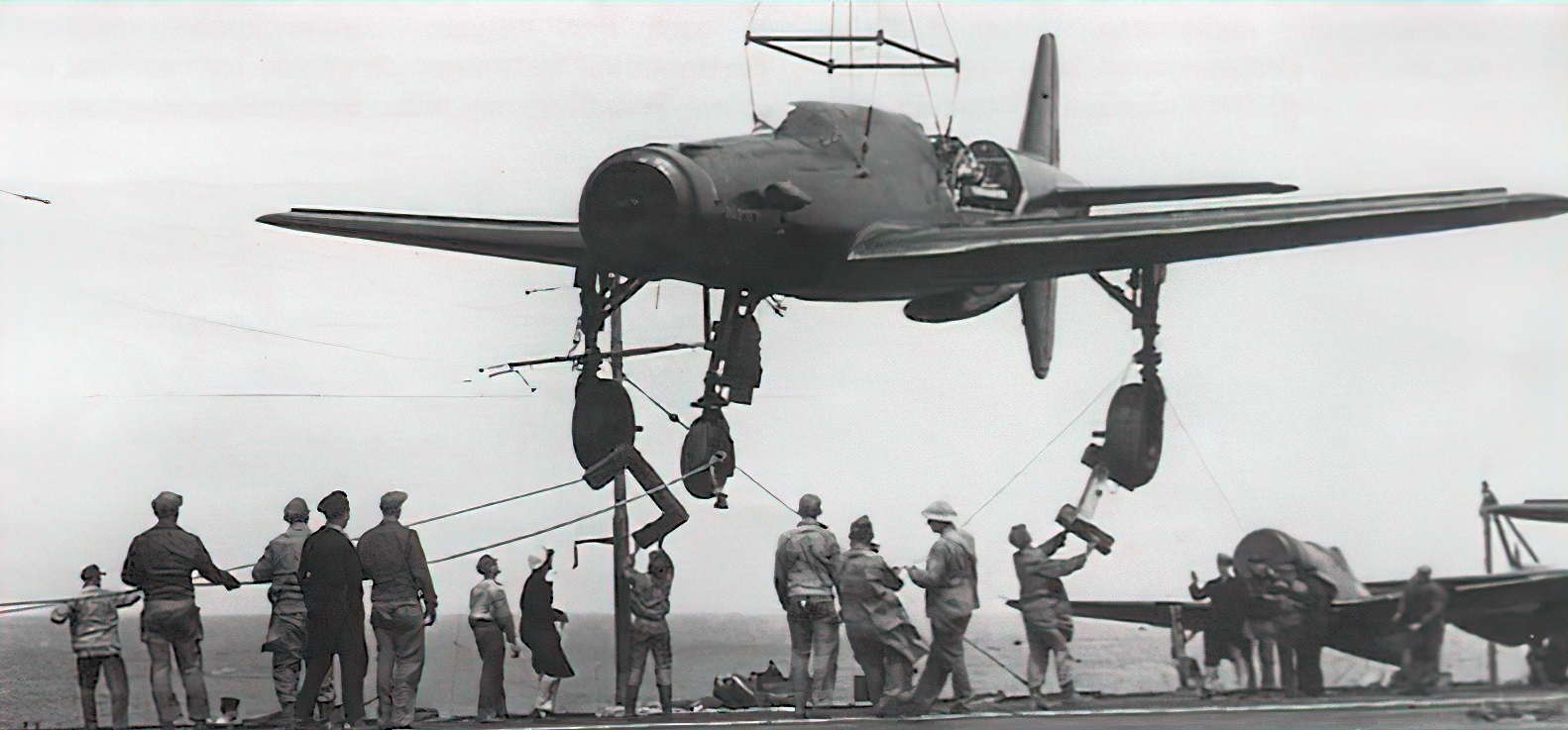 |
One of the pair of (Dornier Do 335As being loaded aboard
REAPER at Cherbourg during Operation 'Seahorse'. |
HMS REAPER embarked 40 airframes comprising of:
Ten Me 262;
Five Fw 190F;
Four Fw 190D;
One Ta 152H;
Four Ar 234B;
Three He219;
Three Bf 109;
Two Do 335;
Two Bu 181;
One Helicopter WNF 342;
Two Fl 282 helicopters;
One Ju 88G; One Ju 388;
One Bf 108;
and One US P-51.
|
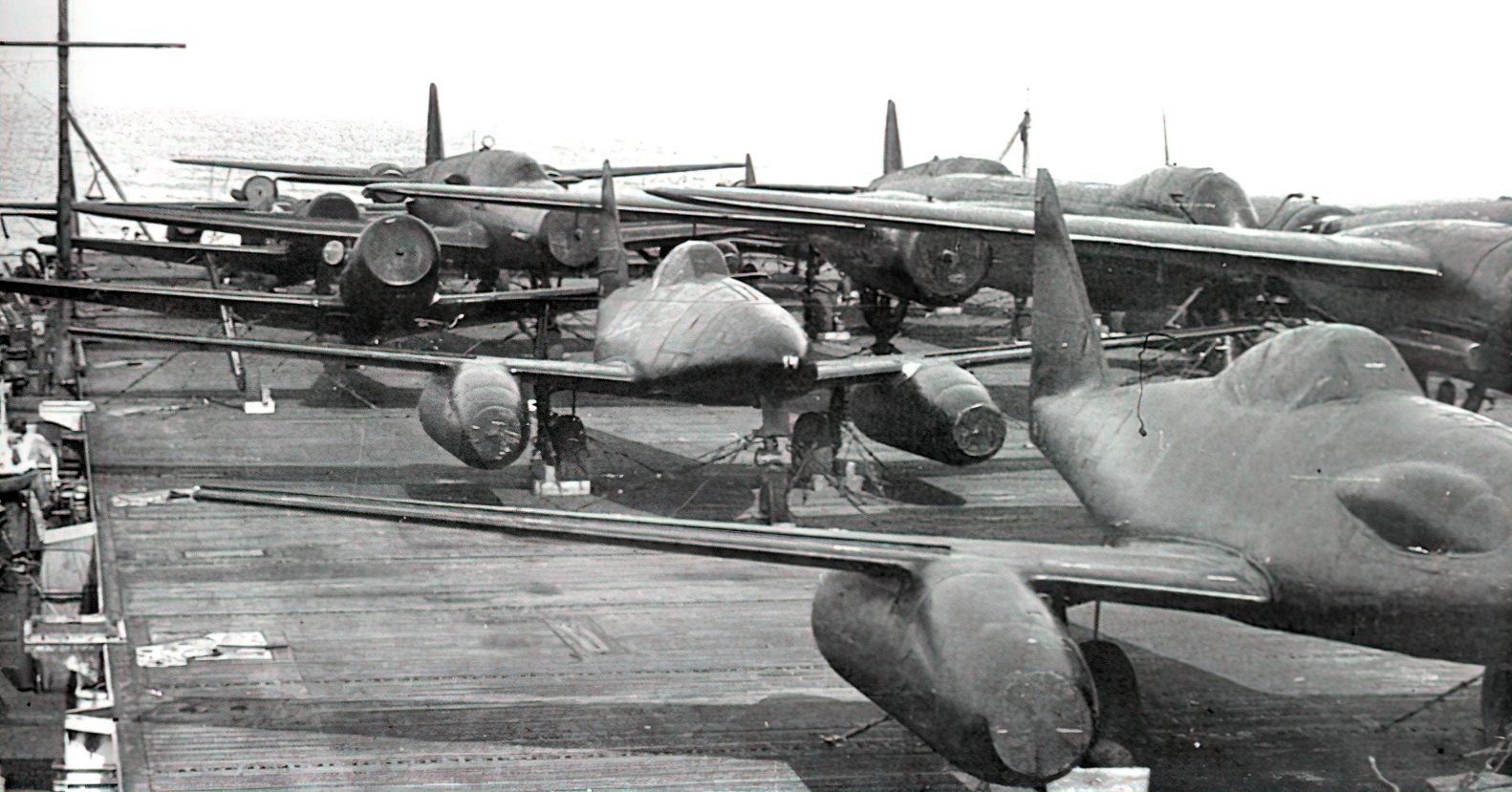 |
The flight deck of HMS REAPER on leaving Cherbourg
during Operation 'Seahorse'. The two jet aircraft
nearest the camera are MesserschmittMe-262 , and there
are several Arado Ar 234 jet bombers lashed on the
opposite side of the deck. There are several piston
engine aircraft parked further down the deck and all
appear to have their props and/or engines removed for
transport. |
HMS REAPER also accommodated the intelligence staff and searchers as passengers.. She sailed form Cherbourg bound for New York on July 19th, 1945 and docked at pier 14, New York Harbour on July 31st. REAPER's cargo was then off- loaded by crane onto barges which were towed to a canal that bordered loaded Ford Field, an Air Material Command facility in Newark, NJ where another large crane lifted each aircraft to the hard standing.
After unloading REAPER embarked a number of passengers before sailing for Norfolk to load a ferry load of 61airframes, for delivery to Sydney, Australia. She arrived at Norfolk on August 7th and sailed for Cristobal on the 13th. She was in the Mexican Gulf on the 15th, on route to the Panama Canal when the news was announced that the Japanese had surrendered and the war was over; almost everyone on board attended a thanksgiving service held on the flight deck. The ship reached Cristobal on August 18th and entered the Panama Canal the same day, she departed from Balboa and entered the Pacific on the 19th.
Operations with the British Pacific Fleet
HMS REAPER arrived in Sydney on Monday September 10th 1945. Amongst the passengers on board were 18 women who had embarked at New York - 16 Canadian and American brides of Australian Servicemen, one Servicewoman and a Mrs Wilson Ewart whose husband was attached to the Australian Legation in Washington. There were also two babies in the party; all the brides were wives of members of the RAAF and most of the husband's verse at the wharf to meet them.
Voyage to Hong Kong
Her ferry load of Avengers and Corsairs were transported by road to the RN Receipt & Despatch Unit at
RNAS Bankstown on the outskirts of the city, by the unit’s Salvage unit which was responsible for the movement of all aircraft and stores by road between the dockside and Bankstown. REAPER now undertook a short period of defect rectification before she was moved to a wharf at Pyrmont to prepare for a humanitarian mission to Honk Kong. The ship embarked food and medical supplies for delivery to the newly liberated colony. The work was hampered by industrial action by an Australian waterside workers' dispute, part of a larger pattern of strike action by transport and other workers in the months immediately following the Japanese surrender. On Tuesday, September 18th Leading Seaman Hilary COPE, P/JX 521981 was killed, the circumstances of his death are not clear.
Also embarked for passage to Hong Kong were a large part of the staff of Admiral Sir Bruce Fraser, former Commander of the British Pacific Fleet, which was to relocate to Hong Kong; the Admiral would sail aboard the Battleship Duke of York on December 1st. The personnel, equipment and vehicles of M.S.R.9 (Maintenance, Storage & Reserve component of a Mobile Naval Air base (MONAB)) were also loaded; this unit was assigned to operate as part of
MONAB VIII
at the newly reopened
Kai Tak
airfield. Much of the loading was carried out by naval ratings to ensure the ship would sail on time, which she did, on Friday September 28th.
|
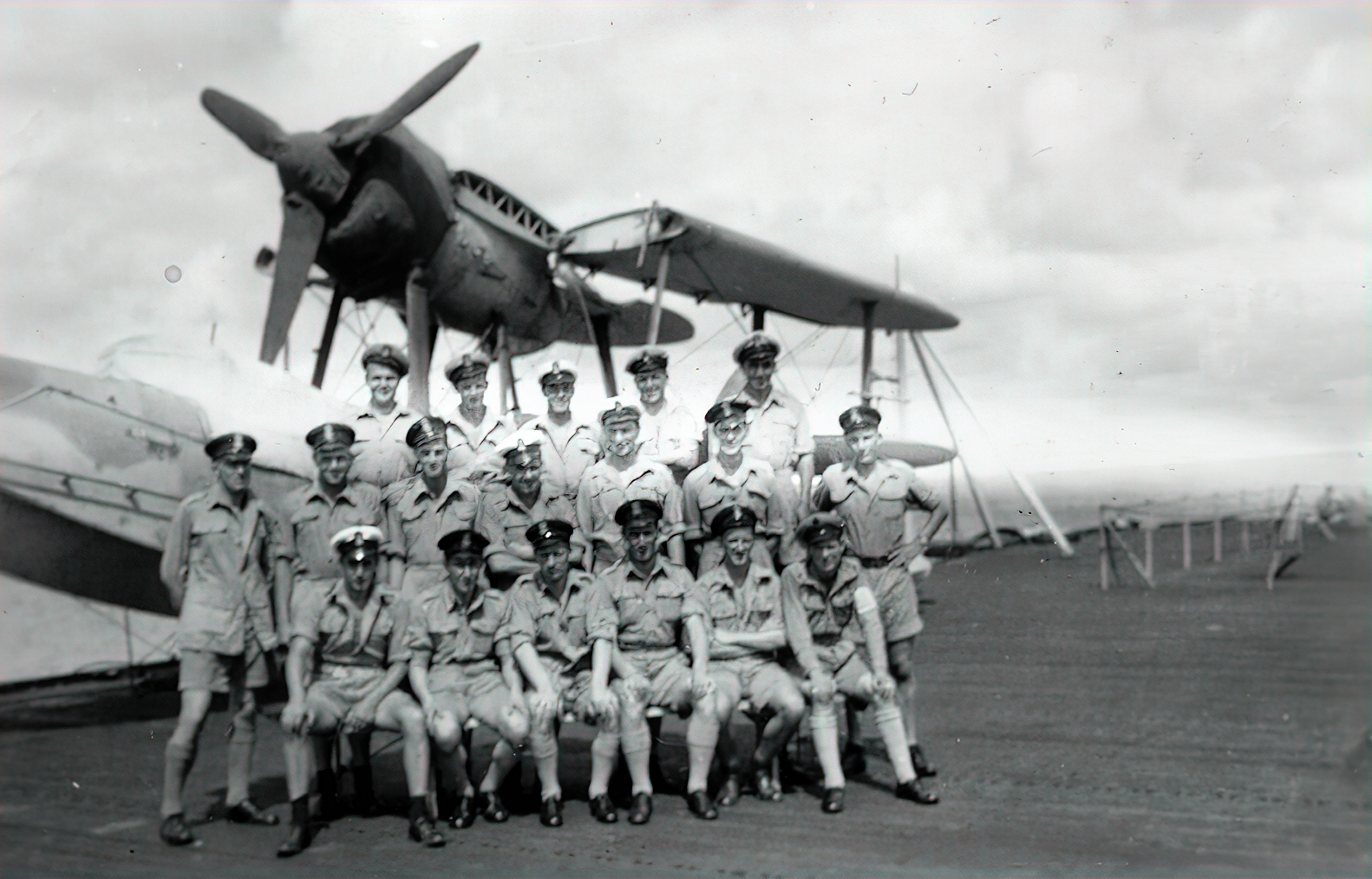 |
Some of the senior ratings of M.S.R.9 pose with one of
1701 squadron's Sea Otter aircraft on REAPER's flight
deck.
Photo courtesy Mr. Terry Rushton |
REAPER arrived at Manus in the Admiralty Islands at teatime on October 3rd and preceded to
RNAS Ponam
(MONAB
IV) to embark 'B' Flt of
1701
Squadron and their four Sea Otter aircraft the following day, this unit was also destined to operate from
MONAB VIII at
Kai Tak airfield, Hong Kong. REAPER sailed at teatime on the 4th for passage to Manila where she was to refuel. The ship arrived in Hong Kong on October 11th and disembarked her cargo and aircraft. Once unloading was completed work began embarking former POWs and civilian internees, including some children, for passage to Australia. She sailed for Sydney via Manus on the 18th.
Repatriation voyage to New Zealand
After embarking more passengers at Manus REAPER arrived In Sydney on November 4th. After unloading she was moved to a pier at Woolloomooloo to embark her next passengers, this time her destination was to New Zealand. REAPER embarked 188 officers and ratings of the Royal New Zealand Navy; 114 officers and other ranks of the New Zealand Army; 179 officers and other ranks of the Royal New Zealand Air Force and the members of the Royal New Zealand Air Force Band which had been touring Australia. She sailed from Sydney for Auckland on the 14th.
On her arrival in Auckland on November 17th; she approached Prince's Wharf at 18:00 hours but it was found that her sponsons which project from the sides of the ship at the level of the hangar deck would foul the wharf at low water, so she was taken back into the stream and anchored for the night. Local authorities were eager to get the returning servicemen home to their families as soon as possible so a method for bringing them ashore from the ship while she lay in the stream was sought. The solution was provided by the Devonport Steam Ferry Company which immediately made one of its vehicular ferries available, this went alongside REAPER about 20:0 and took on board all the soldiers and airmen and some merchant sailors. They were then taken to the ferry landing at Mechanics Bay and put ashore. Later that night about 22:00 the RNZN examination vessel HAUITI came alongside and took the naval personnel to the RN depot ship HMS PHILOMEL at Devonport, Auckland.
After spending the night in the stream HMS REAPER berthed at Prince's Wharf at 11:20 on the 18th after wooden punts were moored alongside the wharf to give her a clearance of about 12ft from the wharf. Once alongside REAPER began embarking passengers, about 203 British internees and prisoners of war who had been recovering in New Zealand, most of them from the Army's convalescent depot at Ravensthorpe, and a few from Papakura Camp. REAPER sailed from Auckland at 11:00 on November 19th for Sydney where she was to embark more passengers for return to the UK via Singapore.
|
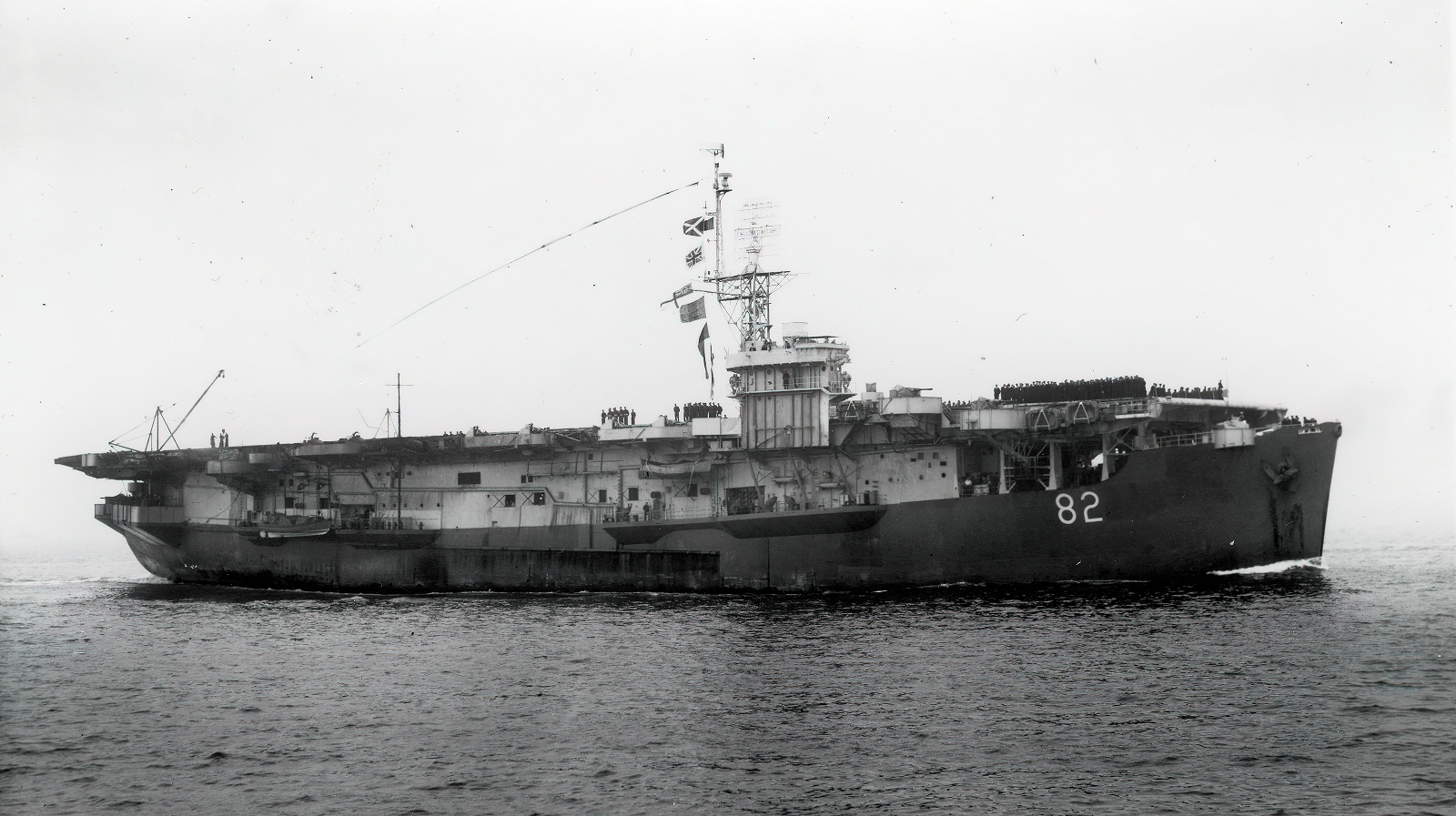 |
HMS REAPER
arriving at Portsmouth harbour in March 1946 flying her
paying off pennant from the masthead. |
Disposal: Return to US Custody
Details of the voyage home to the UK are not clear but it is likely that it was a trooping voyage delivering and collecting passengers on route. From Singapore she is beloved to have crossed the Pacific and passed through the Panama Canal arriving at Bermuda on February 7th. From Bermuda it appears she sailed for Valletta, Malta before the last leg to Portsmouth where she unloaded her passengers in late March. HMS REAPER arrived on the Clyde on March 27th where she was allocated to Rosyth Command and taken out of operational service.
Once all passengers had been disembarked REAPER began de-storing in preparation for her return to US custody. During April all admiralty equipment was removed and the majority of her ship's company were drafted to other billets, leaving a steaming party aboard for her final Atlantic crossing. She embarked passengers at Glasgow including Admiral Sir Ralph Leatham, Mrs Isabella Brewer, with her children Veronica and Martin, on April 24th for passage to Bermuda.
REAPER arrived at Bermuda on Thursday May 9th, Admiral Sir Ralph Leatham left the ship and went to the capital Hamilton where he was to take up his new post as Governor of Bermuda the next day. On arrival at Norfolk, Va., on May 13th 1946 HMS REAPER was decommissioned. CVE 54 was returned to US Navy custody on May 20th.
No longer required for military service her disposal was authorized on June 14th, CVE 54 was struck from the US Navy list on July 8th 1946. She was sold to the Blue Star Line Ltd. on February 12th 1947 and moved to Gulf Shipbuilding Corp., Mobile, Alabama, USA for conversion into a cargo liner. On completion she entered service as the SS SOUTH AFRICA STAR in 1948; she was scrapped at Milhara in 1967.
|
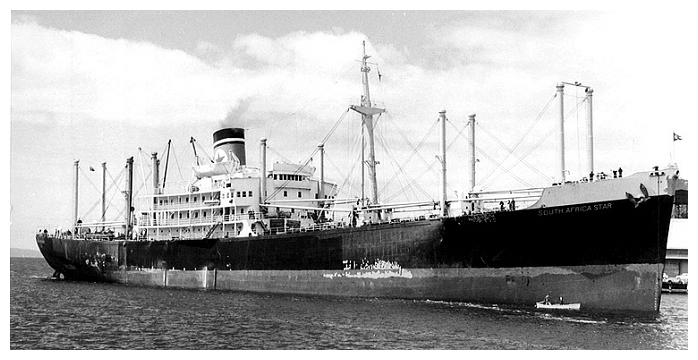 |
SS SOUTH
AFRICA STAR |
Content revised:
30 November 2023
Sources used in compiling this account:
Click here for a list of
Primary sources
Additional sources:
Fold3.com various documents including;
Admiralty War Diaries
Norfolk Navy Yard War Diaries
Mew York Navy Yard War Diaries
Miscellaneous documents
|
Home
page |
go to the top
|





Comments (11)
This is to correct and enrich the history of HMS Reaper. HMS Reaper did not arrive at Bermuda in early February 1946 it was on Thursday, 9 May 1946:please see attached "cutting" from The Royal Gazette of Friday,10 May 1946 recording the arrival of passengers on the Reaper the day before, including Sir Ralph Leatham. Isabella Brewer, with her children Veronica and Martin, embarked on HMS Reaper at Glasgow on 24 April 1946: please see attached copy of the embarkation form. Sir Ralph Leatham having arrived on HMS Reaper was sworn in as Governor on 10 May 1946: please see cutting from the front page of The Royal Gazette of that date.
My father served on HMS Reaper
On the voyage across the Atlantic I saw aeroplanes, which at the time I thought were bi-planes, being pushed off the back of the aircraft carrier.